
International Research Journal of Engineering and Technology (IRJET) e-ISSN: 2395-0056
Volume: 11 Issue: 07 | July 2024 www.irjet.net p-ISSN: 2395-0072

International Research Journal of Engineering and Technology (IRJET) e-ISSN: 2395-0056
Volume: 11 Issue: 07 | July 2024 www.irjet.net p-ISSN: 2395-0072
Santosh Kumar Mahananda1, Akhand Pratap Singh2 , Parmeshwar Sahu3
M.Tech. Scholar1, Assistant Professor2 , Assistant Professor3 Department of Civil Engineering
Shri Rawatpura Sarkar University, Raipur Chhattisgarh ***
Abstract
The depletion of natural resources has become a significant concern in the construction sector, including the road constructionsegment.Extensiveroadconstructionactivitiesdemandvastquantitiesofaggregates,leadingtoconsiderable energy consumption through blasting, quarrying, crushing, and transportation. Moreover, the rapid depletion and shortageofaggregatematerialshaveintensifiedtheneedforsustainablealternatives.Concurrently,industrialwastes,byproducts,andlocallyavailableunusedmaterials,oftenconsiderednon-conventional,presentenvironmentalanddisposal challengesbutholdpotentialforroadconstructionapplications.
Thisstudyexplorestheutilizationoftworegionallyavailablematerials:slag,awasteproductfromthesteelindustry,and locally abundant gravel (moorum), in pavement sub-base layers. The research examines the chemical and phase composition, as well as the presence of toxic and heavy metals in both slag and its leachate water. Gradation and other physical properties are analyzed using appropriate tests and techniques. Conventional crushed aggregates are combined withslagormoorumtomeettherequiredgradingspecificationsoftheMinistryofRoadTransportandHighways.
The study identifies the optimal proportions of slag and moorum in the sub-base layer as 80% and 50%, respectively. Additionally, cement is used with moorum to achieve the desired strength. The physical properties of these materials indicatethatbothslagandhardmoorumexhibitexcellentcharacteristicsforuseasroadaggregate,makingthemsuitable forroadbaseandsub-baseapplications.
Key words: Slag,Moorum,XRDanalysis,Toxicity,Unconfinedcompressivestrength,Sustainableconstruction,Aggregate alternatives
1. Introduction
Road transportation is a critical driver of economic, industrial, social, and cultural development in a country. India, possessing the second-largest road network globally, has seen significant advancements due to extensive road construction programs led by the Government of India. These initiatives, including the National Highways Development Programme (NHDP) and Pradhan Mantri Gramin Sadak Yojna (PMGSY), facilitate the construction of thousands of kilometersofroadsannually,enhancingbothurbanandruralconnectivity(IndianHighways,May2011).
Pavement structures used in road construction are generally classified into two types: flexible and rigid. Flexible pavements consist of four main components: soil sub-grade, sub-base course, base course, and surface course. These components work together to transmit vertical loads from the top surface to the sub-grade. A well-compacted granular arrangement with well-graded aggregates forms a robustflexible pavement, efficientlydistributingcompressivestresses overawiderarea.Thebaselayer,positionedimmediatelybelowthesurfacelayer,supportsthepavementbytransmitting loads to the underlying layers. The sub-base layer, situated below the base layer, provides additional support, transmits traffic loads to the sub-grade, and offers frost action and drainage capabilities. The sub-base generally consists of two layers: a lower filter layer, which prevents sub-grade soil intrusion, and an upper drainage layer composed of granular sub-base (GSB) materials to facilitate water drainage from surface cracks(Yoder & Witczak, Principles of Pavement Design)
Rigidpavements,incontrast,typicallyconsistofacementconcreteslab,withagranularbaseorsub-basecoursebeneath it.Thisbaseorsub-basecourseservestomanagedrainage,controlpumping,frostaction,andmitigateshrinkandswellof the sub-grade. Unlike flexible pavements, rigid pavements distribute loads differently; the critical condition arises from
International Research Journal of Engineering and Technology (IRJET) e-ISSN: 2395-0056
Volume: 11 Issue: 07 | July 2024 www.irjet.net p-ISSN: 2395-0072
maximum flexural stressin theslabdue to wheel loads andtemperature changes, whereasflexible pavements distribute compressive stresses throughout the structure. Despite the notable flexural strength and rigidity of rigid pavements, flexiblepavementsaremorecommonlyusedduetotheirsmootherridingsurfaceandlowerconstructioncosts (Yoder& Witczak).
Inlightof the extensive demandforaggregatesand therapiddepletion of natural resources,sustainablealternativesare imperative. Industrial wastes, by-products, and locally available unused materials, though often considered nonconventional, can address environmental and disposal challenges while holding potential for road construction applications. This study investigates the use of regionally available materials, specifically slag (a steel industry waste product) and gravel (moorum), in enhancing pavement sub-base performance. The research evaluates the chemical and physicalpropertiesofthesematerialsandtheirpotentialforsustainableroadconstruction.
1.2 Problem Statement
Traditionally,materialsusedinhighwayconstruction,suchassand,crushedaggregates,andgravels,arealsoemployedin other construction activities, including buildings, industrial setups, dams, and powerhouses. These natural aggregate resources,essentialforprovidingthenecessarystrengthanddurabilityinbaseandsub-baselayers,areheavilyconsumed tomeettheenormousdemandsofroadconstruction,particularlyinurbanmarkets.Theextractionofaggregatesfromhills throughquarryingoperations,crushing,andtransportationnotonlycontributestoenvironmentaldegradation including theloss offorestlands,vibrations,dust, noise,andpollutionhazards butalsoconsumessubstantial amounts ofenergy, depletingourenergyresources(IndianHighways,May2011)
1.3 Objective
The present work focuses on the utilization of a combination of slag, locally available hard moorum, and conventional crushed aggregates of different nominal sizes for use in the base or sub-base layers of pavement. The objectives of this workare:
a) To determine the chemical composition, phase composition, and presence of hazardous materials in slag and its leachatewater.
b) Toevaluatethephysicalpropertiesofslagandassessitssuitabilityforuseinthesub-baselayerofpavement.
c) Toexaminethephysicalcharacteristicsoflocallyavailablehardmoorumanddetermineitssuitabilityforuseinthe baseorsub-baselayerofpavement.
d) To investigate the effects of cement stabilization in base or sub-base layers incorporating natural aggregates and locallyavailablegravel(hardmoorum).
e) Toexploretheoverallpotentialofutilizingregionallyavailablematerialstoenhancetheperformanceofpavement sub-baselayers,therebypromotingsustainableroadconstructionpractices
2. Literature Review
Basic oxygen furnace(BOF) slagas well as electric arc furnace (EAF) slag is alsoused forroad base as well as road base asphalt concrete. In a trial, the mix design and performance characterization of the bituminous mixes was done in Italy. Gyratorycompactiontests,indirecttensilestrengthtests,fatiguetests,permanentdeformationtestsandstiffnessmodulus tests (at various temperatures) of the mixtures of EAF slag and asphalt showed better mechanical characteristics than those of the conventional natural aggregate and asphalt mixture, satisfying the acceptable criteria for Italian road construction. [Pasetto and Baldo (2010)].
Inamoisturedamageinvestigationoftheroad,theBOFpreparedasphaltmixtureswerecharacterisedbyresilientmodulus tests, indirect tensile strength tests. The freeze-thaw tests showed better moisture sensitivity of BOF slag mixture than thatofthebasaltmixture [Jun Xie., et al. (2012)]
ThemoorumcollectedfromSukrut(UttarPradesh)wasmixedwithGangasandand cementstabilisedforuseinWetMix Macadam(WMM) [Ransinchung., et al. (2014)]. Thephysicalpropertiesofmoorum,Gangasand,crushedaggregateand stonedustwerefoundout.Theproportionsofindividualaggregatesweredeterminedsothatthemixturewouldsatisfythe desired gradation of MoRTH specifications. Ordinary Portland cement was used as a stabiliser and varying the cement content the CBR tests and the unconfined compressive strength tests were conducted. The results showed highest CBR value(423%)andunconfinedcompressivestrength(18.55kg/cm2)at9percentcementcontent.
International Research Journal of Engineering and Technology (IRJET) e-ISSN: 2395-0056
Volume: 11 Issue: 07 | July 2024 www.irjet.net p-ISSN: 2395-0072
Variousstudieshavedemonstratedthatsteelslagcanbeeffectivelyusedasamaterialforroadconstruction.Itsphysical and engineering properties have been found to be superior to those of natural aggregates. Characterizationand leaching studieshaveconfirmedthatsteelslagposesminimalhazardouseffectsontheenvironment,makingita viable optionfor unboundroadpavements,provideditmeetsthenecessaryspecificationsandleachatewatertoxicitystandards.
The application of hard moorum in road construction has been less extensively studied. However, available research suggests that moorum has potential for use in road base and sub-base layers. Given that the properties of moorum can varysignificantlybasedonitsgeographicalsource,furtherstudiesareneededtogeneralizeitspropertiesanddetermine howeffectivelyitcanbeutilizedinroadpavementapplications.
This study aims to address these gaps by evaluating the use of steel slag and locally available hard moorum in road construction, focusing on their physical properties, environmental impact, and potential for enhancing pavement performance.
Whether using natural aggregates, industrial wastes/by-products, or locally available materials, it is essential that these materialssatisfythedesiredphysicalpropertiesandstrengthparametersforapplicationinthebaseorsub-baselayerof road pavement. Additionally, materials with the potential to affect the environment are subjected to chemical tests and characterizationtoensuretheyareenvironmentallyacceptable.
In this work, the chemical composition and characterization of slag were undertaken. The physical properties of slag, naturalcrushedaggregates,andmoorumweredeterminedaccordingtorelevantcodes,specifications,andliterature.The followingtestmethodswerecarriedoutinthisstudy:
Chemicalcompositionanalysistodeterminetheelementspresentinslagandtheirconcentrations.
Phasecompositionanalysistoidentifythemineralphasesintheslag.
Hazardousmaterialsassessmentinslaganditsleachatewatertoensureenvironmentalsafety.
Physicalpropertytestsforslag,naturalcrushedaggregates,andmoorum,including:
Gradationandparticlesizedistribution
Specificgravityandbulkdensity
Moisturecontentandabsorption
Compactioncharacteristics(Proctortest)
CaliforniaBearingRatio(CBR)testforstrengthevaluation
Cementstabilizationeffectsonthemixtureofnaturalaggregatesandmoorumtoassessimprovementsinstrength anddurability.
These comprehensive tests ensure that the materials meet the necessary standards for use in road construction while promotingsustainablepracticesbyutilizinglocallyavailableandindustrialby-productmaterials.
Thefollowingmaterialswereutilizedforthestudy:
Slag:ObtainedasawastematerialfromtheRourkelaSteelPlantpremises.
Locally Available Hard Moorum:Sourcedfromlocalregionsforpotentialuseinroadconstruction.
Crushed Aggregates: To be blended with slag or moorum to achieve the desired gradation, as per the
International Research Journal of Engineering and Technology (IRJET) e-ISSN: 2395-0056
Volume: 11 Issue: 07 | July 2024 www.irjet.net p-ISSN: 2395-0072
MinistryofRoadTransportandHighways(MoRTH)specifications.
Cement:Usedasabinderforcementstabilizationtoenhancethestrengthanddurabilityofthemixtures.
Chemicals: Required for performing various chemical analyses to assess the properties and environmental impactofthematerials.
These materials were selected to evaluate their effectiveness in road base and sub-base applications, with a focus on achievingdesiredperformancestandardsandenvironmentalsafety.
4. Results and Discussion
4.1 Characterization of Slag
4.1.1 Chemical Composition
ThechemicalcompositionoftheslagsampleswasdeterminedbytheXRFtechniqueandispresentedintable4.1.
Table 4.1. Chemical Composition of the Slag Samples Determined By XRF Technique
.
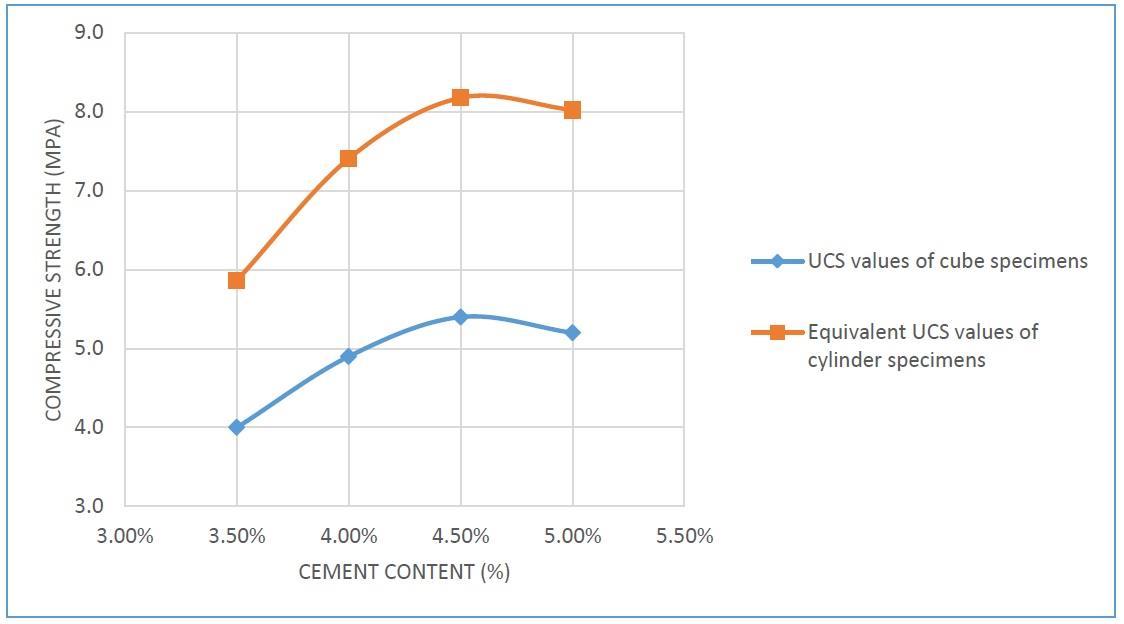
Figure 4.8 (b) Comparison of the UCS values of cube specimens with the equivalent UCSvalues of cylinder specimens for use in the cement treated base [Moorum=50%+ A10=15%+A6=35%]
© 2024, IRJET | Impact Factor value: 8.226 | ISO 9001:2008 Certified Journal | Page1099
International Research Journal of Engineering and Technology (IRJET) e-ISSN: 2395-0056
Volume: 11 Issue: 07 | July 2024 www.irjet.net p-ISSN: 2395-0072
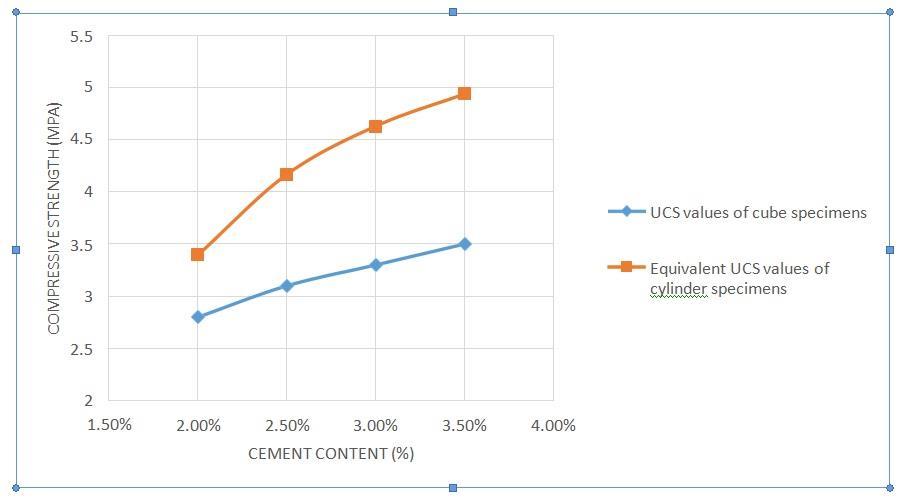
Figure 4.8 (C) Comparison Of UCS Values Of Cube Specimens With Equivalent UCS Values OfCylinder Specimens For Use In The Filter Layer Of Cement Treated Sub-Base [Moorum=50%+ A10=15% +A6=35%]
The UCS value of the combination of moorum and crushed aggregates was found to be more as compared to that of the combinationofcrushedaggregatesonlyforparticularcementcontent.TheequivalentUCSvaluesofthecylinderspecimens were found to be more as comparedto those of the cube specimens. The 7 days UCS values for cement bound materials shouldbebetween4.5to7MPaforuseinthebaseandbetween1.5to3MPaforuseinsub-base(drainageorfilterlayer) asperIRCSP:89(2010).SodependingontherequiredUCSvalueforconstructionofaparticularlayerthecorresponding cementcontentcanbetakentosatisfytherequirements.
5. Conclusion and Future Scope
5.1 General
Fromtheexperimentsconductedontheslagsamplesandlocallyavailablehardmoorum,andfromtheanalysisofresults,the conclusionsdrawnaresummarizedbelow.
5.1.1
Theslagsampleusedinthisworkcontainsabout30%byweightofCaO,SiO2and20%byweightofFeOandsomeamountof Al2O3andMgO,confirmstheslagassteelslag.
The phases present in the slag are in carbonate, hydroxide or silicate form rather than oxide form making it suitable for constructionpurposes.
Theheavyandtoxic metals presentinthe slagandits leachate waterare eitherzero or negligible.Hence,the potential for environmentalhazardsisverylow.
5.1.2 Physical Properties
Theslagsamplesarewellgradedwhichrequirelessamountofcrushed(conventional)aggregatesforblendingtomeetthe desired grading for usein different layers ofsub-base.For filterlayer a maximum upto76%slag andfordrainagelayera maximumupto80%slagcanbeusedtosatisfy thedesiredgrading(GSBgradingII andgradingIVrespectivelyasperthe MoRTHspecifications).
Thefinermaterialcontentinthemoorumusedforthisworkisveryhigh.Hence,theamountofmoorumthatcanbe usedforbaseandsub-baseislimitedto50%inthetotalaggregateblend.
International Research Journal of Engineering and Technology (IRJET) e-ISSN: 2395-0056
Volume: 11 Issue: 07 | July 2024 www.irjet.net p-ISSN: 2395-0072
Theimpactvaluesoftheslag,crushedaggregatesandwetimpactvalueofmoorumarewithinthemaximumlimits forroadbaseorsub-baseapplications.
Thespecificgravityoftheslagaggregatesismuchhigherthanthatofthecrushedaggregates.Hence,theMDDand CBRvaluesoftheslagandaggregateblendsareveryhigh.
Thespecificgravityofmoorumiscomparativelymorethanthatofthecrushedaggregates.Hence,theMDDvalues arealsohigherinthemoorumaggregateblend.
Cementisusedasabinderforstabilizationofmoorumbecauseofitshighplasticity(PI=20).TheUCSvaluesofthe combinationofmoorumandcrushedaggregatesspecimenssatisfythedesiredlowerlimitsforuseinthecement treatedbaseorsub-baselayers.
The UCS value of cement treated moorum-crushed aggregates blend is more as compared to that of crushed aggregatesblendforparticularcementcontent.
5.2 Conclusion
This study explored the use of slag and locally available hard moorum in various layers of road base and sub-base construction.Thefindingsindicatethefollowingkeyconclusions:
Slag Utilization: Theslag,sourcedfromtheRourkelaSteelPlant,wasfoundtobewell-gradedandsuitableforuse asamajoraggregatecomponentinroadsub-baseapplications.Itcanconstituteupto80%ofthetotalaggregate mixforbothfilteranddrainagelayers.Theslagdemonstratedexcellentphysicalproperties,meetingtherequired strength standards for road sub-base applications. Additionally, it was confirmed to be environmentally safe, showingnosignificanthazardouseffects.
Hard Moorum Utilization: The locally available hard moorum, characterized by a higher proportion of fine materials,issuitablefordensegradingapplicationssuchasbaseorfilterlayersofthesub-base.Ithasthepotential to replace conventional aggregates by up to 50% by weight. The physical properties of moorum metthe desired requirements, and its strengthcan be enhanced by using a small amount of binder (cement). For specific binder content,moorumexhibitedbetterstrengththanconventionalcrushedaggregates.
Overall, the study confirms that both slag and moorum can effectively replace traditional materials in road construction, offeringsustainablealternativesthatmeetperformanceandenvironmentalstandards.Theintegrationofthesematerialscan contributetomorecost-effectiveandenvironmentallyfriendlyroadconstructionpractices.
Thepresentstudyhasprovidedvaluableinsightsintotheuseofslagandlocallyavailablehardmooruminroadconstruction. To further enhance the understanding and applicability of these materials, the following areas warrant additional investigation:
Dynamic Loading and Resilient Modulus: While the study focused on strength parameters such as California Bearing Ratio (CBR) and Unconfined Compressive Strength (UCS), future research should include repeated load triaxial tests. These tests will help evaluate the effects of dynamic loading on different layers and determine the realisticresilientmodulusvalues,whicharecrucialforassessinglong-termperformanceundertrafficloads.
Permeability Assessment: The permeability of the slag and crushed aggregate mixture, particularly in the drainagelayerofthesub-base,shouldbeevaluated.Suitabletestscanbeconductedtomeasurethepermeabilityof these materials, providing insights into their effectiveness in drainageapplications and their potential impact on theoverallpavementperformance.
Theseadditionalstudieswillcontributetoa morecomprehensiveunderstandingoftheperformancecharacteristicsofslag andmooruminroadconstructionandhelpoptimizetheiruseinvariouspavementlayers.
References
1. Aiban,S.A."Utilizationofsteelslagaggregateforroadbases."JournalofTestingandEvaluation34,no.1(2006):65.
2. Behiry, A. E. A. E. M. "Evaluation of steel slag and crushed limestone mixtures as subbasematerial in the flexible pavement."AinshamsEngineeringJournal4.1(2013):43-53.
3. Chaurand,P.,Rose,J.,Briois,V.,Olivi,L.,Hazemann,J.L.,Proux,O.,Domas,J.,&Bottero,J.Y."Environmentalimpacts of steel slag reused in road construction: A crystallographic and molecular (XANES) approach." Journal of HazardousMaterials139.3(2007):537-542.
International Research Journal of Engineering and Technology (IRJET) e-ISSN: 2395-0056
Volume: 11 Issue: 07 | July 2024 www.irjet.net p-ISSN: 2395-0072
4. Emery,J.J.,"SlagUtilizationinPavementConstruction",ExtendingAggregateResources,ASTMSTP774,1982,pp.95118.
5. http://encyclopedia2.thefreedictionary.com/Basicity
6. http://xrf-spectroscopy.com/
7. Indoria,R.P.“AlternativematerialsforRoadConstruction”,IndianHighways,May2011
8. IS:2386(Part-I),“MethodsofTestforAggregatesforConcrete: ParticleSizeandShape”,BureauofIndianStandards, NewDelhi,1963
9. IS: 2386 (Part-III), “Methods of Test for Aggregates for Concrete: Specific Gravity, Density, Voids,Absorption,Bulking”,BureauofIndianStandards,NewDelhi,1963
10. IS:2386(Part-IV),“MethodsofTestforAggregatesforConcrete:MechanicalProperties”,BureauofIndianStandards, NewDelhi,1963
11. IS:2720(Part2),“MethodofTestforSoils:DeterminationofWaterContent”,BureauofIndianStandards,NewDelhi, 1973.
12. IS:2720(Part5),“MethodofTestforSoils: DeterminationofLiquid andPlastic Limit”,BureauofIndianStandards, NewDelhi,1985
13. IS: 2720 (Part 8), “Methods of Test for Soils: Determination of Water Content-Dry DensityRelation Using Heavy Compaction”,BureauofIndianStandards,NewDelhi,1983
14. IS: 2720, “Methods of Test for Soil (Part 16): Laboratory Determination of CBR”, Bureauof Indian Standards, New Delhi,1987
15. IS: 4332, “Methods of Test for Stabilized Soils (Part V): Determination of UnconfinedCompressive Strength of StabilizedSoils”,BureauofIndianStandards,NewDelhi,1970
16. IS: 5640, “Method of Test for Determining Aggregates Impact Value of Soft Coarse Aggregates”, Bureau of IndianStandards,NewDelhi,1970
17. IRC: SP: 89. “Guidelines for Soil and Granular Material Stabilization using Cement, Limeand Fly ash”, Indian Road Congress,NewDelhi,2010
18. MinistryofRoadTransportandHighways,“SpecificationsforRoadandBridgeWorks”,IndianRoadsCongress,New Delhi,2013
19. Potgieter,J.H.,Potgieter,S.S.,andLegodi,B."Proposedmodificationstothemethodforthedeterminationofavailable lime."Mineralsengineering14.5(2001):515-523.
20. Pasetto, M., & Baldo, N. "Experimental evaluation of high-performance base course and road base asphalt concrete withelectricarcfurnacesteelslags."Journalofhazardousmaterials181.1(2010):938-948.
21. Ranshinchung, G. D., Kumar, P., Kumar, B., Anupam, A. K., & Chauhan, A. P. "Laboratory evaluation for the use of moorum and Ganga sand in wet mix macadamunboundbasecourse."IndianHighways42.4(2014).
22. Shen, W., Zhou, M., Ma, W., Hu, J., & Cai, Z. "Investigation on the application of steel slag–fly ash–phosphogypsum solidifiedmaterialasroadbasematerial."JournalofHazardousMaterials164.1(2009):99-104.
23. “Slag–IronandSteel(AdvanceRelease)”,IndianMineralsYearbook(2011):Part-II,50thEdition.
24. “Standard Test Methods for Compressive Strength of Molded Soil-Cement Cylinders”, ASTM Standards, D1633, 2007.
25. USEPA, Method 1311: TCLP – Toxicity Characteristic Leaching Procedure. In: TestMethods for Evaluating Solid Waste.3rded.Washington,DC,1992
26. Viswanathan,P.V.andGangadharan,T.K.“Environmentalandwastemanagementinironandsteelindustry”,NML, Jamshedpur,pp.199-207,1996
27. Waligora, J., Bulteel, D., Degrugilliers, P., Damidot, D., Potdevin, J. L., and Measson, M."Chemical and mineralogical characterizations of LD converter steel slags: A multi- analytical techniques approach." Materials characterization 61.1(2010):39-48.
28. Wang, Q., and Yan, P. "Hydration properties of basic oxygen furnace steel slag."ConstructionandBuilding Materials24.7(2010):1134-1140.
29. Yi, H., Xu, G., Cheng, H., Wang, J., Wan, Y., & Chen, H. "An overview of the utilization of steel slag." Procedia EnvironmentalSciences16(2012):791-801.
30. Yoder,E.J.&Witczak,M.W.“PrinciplesofPavementDesign”,WileyIndiaPvt.Ltd.,NewDelhi,1975.