
International Research Journal of Engineering and Technology (IRJET) e-ISSN:2395-0056
Volume: 11 Issue: 07 | July 2024 www.irjet.net p-ISSN:2395-0072

International Research Journal of Engineering and Technology (IRJET) e-ISSN:2395-0056
Volume: 11 Issue: 07 | July 2024 www.irjet.net p-ISSN:2395-0072
Nagendra Lakidi1 , Praveen B. M.1 , * and Bharath K. Devendra2 ,
1Department of Chemistry, Srinivas University, Institute of Engineering and Technology, Srinivas Nagar, Mukka, Mangaluru-574146, Karnataka
2Department of Chemistry, M.S. Ramaiah College of Arts, Science and Commerce, MSR Nagar, MSRIT Post, Bengalru-560054, Karnataka
Abstract:
Impurities,particularlythoselinkedtotheactivepharmaceuticalingredient(API),cancompromiseadrug'squality,safety, and efficacy by inducing deterioration or interactions. The effective mitigation and control of impurities in pharmaceuticalshingeonestablishingsafety-basedlimitsfortheseimpurities.Conductingaforceddegradationstudyisa crucial component in the evaluation of degradation impurities that complies with regulatory standards for both drug substancesandproducts.ThisprocessisformalizedasaregulatoryrequirementintheICHGuideline.Itisverysignificant to characterize the sources of impurities prior to the delving into subsequent processes like analytical techniques and acceptancecriteria,Thischaracterizationensurestheformulationofregulatoryrequirementsandmanagementplansthat can be defined and adhered to. Additionally, it scrutinizes strategies for the identification, control, and determination of impurities indrugsubstances.Analytical techniquessuchasHPLCandLC-MS/MSenablethequantificationof impurities at trace levels. Ultimately, the study underscores the significance of impurity analysis using HPLC along with LCMS applicationforelucidatingthestructureofunknownstressdegradationcompounds.
Key words: Impurityprofiling,HPLC,LCMS,degradationimpurities,Characterization,Analyticalmethoddevelopment
The primary objective of the pharmaceutical industry is to safeguard public health by ensuring patients have access to appropriatemedicines[1]withthecorrectdosageandefficacyatanaffordablecost.Consequently,thesafetyandefficacy ofpharmaceuticalsarepivotalconsiderationsindrugtherapy [2].Thesafetyofadrugproductreliesonthetoxicological propertiesnotonlyoftheactivedrugsubstancebutalsoontheimpuritiesitcontains[3,4]
Pharmaceutical impurities are undesired substances that can be present in drug formulations and can originate from various sources during the drug development and manufacturing process [5]. Effective control and monitoring of impuritiesareessentialtoensurethesafety,efficacy,andqualityofpharmaceuticalproducts[6].
1.1
1.1.1.
Organicimpuritiesrepresentaclassofunintendedsubstancesthatcanbepresentinpharmaceuticals,arisingfromvarious stagesofdrugdevelopment andmanufacturingprocesses.Understandingandcontrollingtheseimpuritiesarecrucial for ensuringthesafety,efficacy,andoverallqualityofpharmaceuticalproducts.
Organic impurities encompass diverse categories, including starting materials, intermediates, degradation products, and residual reagents or catalysts. Starting materials and intermediates can persist through synthesis, while degradation products mayform during manufacturingorstorage, potentiallycompromising the stability ofthe active pharmaceutical ingredient (API) [7]. Residual reagents and catalysts from the synthesis process pose additional challenges, as they may haveadversetoxicologicaleffects.
International Research Journal of Engineering and Technology (IRJET) e-ISSN:2395-0056
Volume: 11 Issue: 07 | July 2024 www.irjet.net p-ISSN:2395-0072
Inorganicimpuritiesconstituteacategoryofunintentionalsubstancesthatmaybepresentinpharmaceuticalproducts [8]. Theseimpuritiescanoriginatefromvarioussourcesduringthedrugdevelopmentandmanufacturingprocesses,andtheir controlisvitaltoensuringthesafety,efficacy,andqualityofpharmaceuticals[9].
Types of Inorganic Impurities:
Inorganic impurities encompass a range of substances, with notable examples including heavy metals such as lead, mercury,arsenic,andcadmium.Theseimpuritiescanfindtheirwayintopharmaceuticalsthroughrawmaterials,catalysts, orotherprocessesduringmanufacturing[10].
1.1.3. Residual Solvents:
Residual solvents refer to unintended substances that may persist in pharmaceutical products as remnants from the manufacturingprocess[11].Managingandcontrollingresidualsolventsarecriticalaspectsofensuringthesafety,efficacy, andoverallqualityofpharmaceuticals.
Classes of Residual Solvents:
Residualsolventsaretypicallycategorizedintothreeclassesbasedonpotentialhealthrisks.Theyare
Class1:Includessolventswithknowncarcinogenicortoxicproperties.
Class2:Consistsofsolventswithlowtomoderatetoxicitylevels.
Class3:Encompassessolventswithlowtoxicpotential.
1.1.4. Isomeric and Chiral Impurities:
Isomeric and chiral impurities represent specialized categories of unintended substances in pharmaceuticals, often requiring precise control due to their potential impact on drug efficacy and safety. Understanding and managing these impuritiesarecriticalforensuringthequalityofpharmaceuticalproducts[12]
1.2 Degradation impurities:
Degradationimpurities,alsoknownasdegradationproducts,aresubstancesthatareformedduringthedegradationofa drug substance or drug product. These impurities can arise due to various factors, including exposure to environmental conditions such as light, heat, humidity, or chemical reactions over time [13]. The presence of degradation impurities in pharmaceuticals can impact the safety, efficacy, and overall quality of the product. The common types of degradation impuritiesinclude
Oxidation Products:
Oxidation products are a class of degradation impurities that can emerge during the exposure of pharmaceuticals to oxygen. This chemical reaction, known as oxidation, can significantly impact the safety, efficacy, and stability of drug substances and products. Understanding the formation, impact, and control of oxidation products is crucial in pharmaceuticaldevelopment[14].
Hydrolysis Products:
These are formed through the reaction of the drug with water, resulting in the cleavage of chemical bonds. Hydrolysisproductscanincludeacidsorbasesdependingonthereactionconditions[15].
Photo-degradation Products:
These are arising from the exposure of the drug substance to light. Light-induced reactions can lead to the formationofnewcompoundswithalteredchemicalstructures[16]
Thermal Degradation Products:
Theseareoccurringdueto theexposureofthedrugsubstanceto elevatedtemperatures.Hightemperaturescan inducechemicalreactionsthatresultintheformationofnewcompounds[17]
International Research Journal of Engineering and Technology (IRJET) e-ISSN:2395-0056
Volume: 11 Issue: 07 | July 2024 www.irjet.net p-ISSN:2395-0072
Therepresentativeimagevisualizingtheformationofdegradationimpuritiesinanypharmaceuticalproductwas presentedinfigure1.
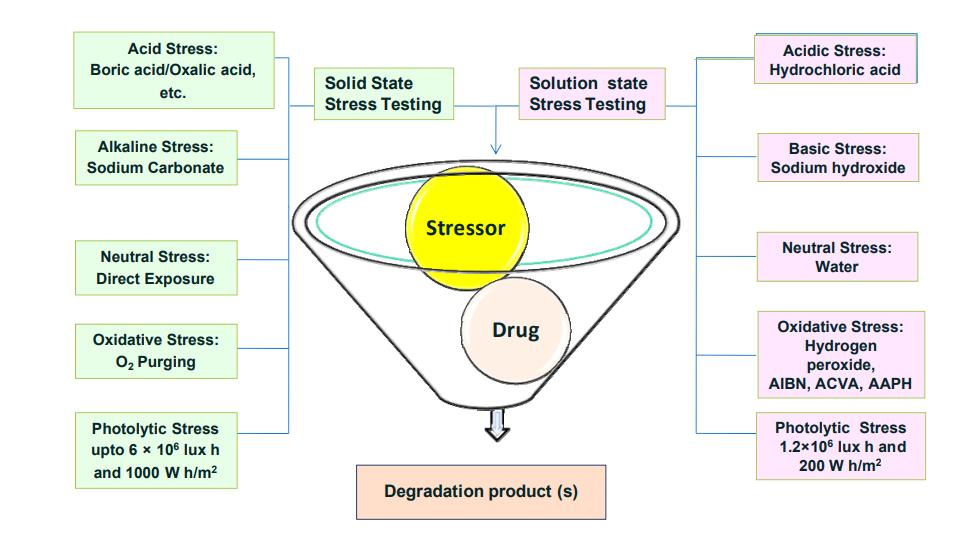
Figure 1: Representative image showing the formation of degradation impurities in a pharmaceutical product
2. Qualification of impurities:
Qualificationinvolvesobtainingandassessingdatatoestablishthebiologicalsafetyofaspecificimpurityora designatedimpurityprofileattherelevantlevel(s).Itisadvisableforapplicantstoofferajustificationforsettingimpurity acceptancecriteria,encompassingsafetyconsiderationswhenapplicable[18].
Animpurityisdeemedqualifiedunderthefollowingcircumstances:
IftheobservedlevelandproposedacceptancecriterionfortheimpurityarewithintherangeobservedinanFDAapprovedhumandrugproduct.
Whentheimpurityfunctionsasasignificantmetaboliteofthedrugsubstance.
Iftheobservedlevelandtheproposedacceptancecriterionfortheimpurityarescientificallyjustifiedbyexisting literature.
Whentheobservedlevelandproposedacceptancecriterionfortheimpurityarebelowtheleveladequately assessedincomparativeinvitrogenotoxicitystudies.
Recommendedqualificationthresholds,basedonthemaximumdailydose(outlinedinTableNo.1for drugsubstance and Table No. 2 for drug product), can be found in ICH Q3A [19] and ICH Q3B [20]. Table 1: Drug substance impurities thresholds
or1.0mg/day intake(whicheveris less)
International Research Journal of Engineering and Technology (IRJET) e-ISSN:2395-0056
aHigherreportingthresholdshouldbescientificallyjustified.
bLowerthresholdcanbeappropriateiftheimpuritiesareunusuallytoxic.
Table 2: Thresholds for degradation products in drug products
Daily dosea Threshold Reporteda,b
≤1g
>1g
0.1%
0.05%
Daily dosea Threshold Identifieda,b
<1mg 1mg–10mg
>10mg–2g >2g
1.0%or5µgTDI,whicheverislower
0.5%or20µgTDI,whicheverislower
0.2%or2mgTDI,whicheverislower
0.10%
Daily dosea Qualification thresholda,b
<10mg 10mg–100mg
>100mg–2g
>2g
1.0%or50µgTDI,whicheverislower
0.5%or200µgTDI,whicheverislower
0.2%or3mgTDI,whicheverislower
0.15%
aThresholdsfordegradationproductsareexpressedeitherasapercentageofthedrugsubstanceorastotaldailyintake (TDI)ofthedegradationproduct.Lowerthresholdscanbeappropriateifthedegradationproductisunusuallytoxic.
bHigherthresholdsshouldbescientificallyjustified
Table 2: Thresholds for degradation products in drug products
3. Significance of Impurity Analysis in Pharmaceuticals:
The pharmaceutical industry is undergoing rapid expansion in the quest to discover and develop new drugs, whether derived from natural sources or synthesized through chemical processes. Amidst this evolution, a consistent principleendures:theimperativeforpharmaceuticalproductstoattainthehighestpossiblepurity.Purityhasmaintained its paramount status as a critical criterion ensuring the quality of medications. It is essential to acknowledge that no medication can be deemed entirely risk-free, and even a minute dosage may yield fatal consequences. The historical trajectory,fromtheeraofParacelsusinthefirsthalfofthe16thcenturytothegroundbreakingworkofEhrlich,reflects a shiftfromtheuseofnaturalsubstancesintheirentiretytotheutilizationofpureextractsorsyntheticcompounds.Ehrlich, notablyawardedtheNobelPrizein1909,pioneeredsignificantadvancementsinpharmaceuticalresearchduringtheearly 20th century. In the preceding century, heightened attention has been directed towards scrutinizing and evaluating the purityofnaturalsubstances.Researchershavechallengedthenotionthatapparentquantities,measuredbyweight,truly represent virtual quantities once impurity alloys are considered. This heightened scrutiny underscores the evident progressinpharmaceuticalresearchoverthepastcentury,contributingsignificantlytotheenhancementofhumanhealth andoverallqualityoflife[21].
Drug regulatory bodies are increasingly focusing on pharmaceutical contaminants falling within the 0.01% to 0.1%range.Theterm"impurities"referstoundesired substancesthatcanbefoundinactivepharmaceuticalingredients (APIs), emerge during the formulation process, or result as byproducts of API degradation or the API's use in drug manufacturing. The presence of these unwanted substances, even in trace amounts, poses a potential risk to the effectivenessandsafetyofpharmaceuticalproducts[22].
Theimpurityprofileofadrugsubstanceisinfluencedbyamultitudeofvariables,encompassingthequalityofraw materials,reagents,andsolventsutilizedinsynthesis,theconditionsofthereactions,thepurificationstepsemployed,and thedurationofstorageforthedrugsubstance.Evenminoralterationsinthesefactorscanexertasignificantimpactonthe
Volume: 11 Issue: 07 | July 2024 www.irjet.net p-ISSN:2395-0072 © 2024, IRJET | Impact Factor value: 8.226 |
International Research Journal of Engineering and Technology (IRJET) e-ISSN:2395-0056
Volume: 11 Issue: 07 | July 2024 www.irjet.net p-ISSN:2395-0072
distribution of impurities. Detection of impurities is imperative in drug material produced in developmental and commercial batches, as well as under stress conditions. When contaminants are identified at concentrations of 0.1% or higher,orinspecificinstances0.2%orhigherrelativetotheprescribeddailydose,theirstructuresneedtobeelucidated. Onceidentified,theseimpuritystructuresaresynthesized.Tofacilitateselectiveanalyticalquantificationindrugmaterial and/orproducts,areferenceimpuritystandardisestablished,enablingthedevelopmentofapreciseanalyticalprocedure [23].
For regulatory purposes, API impurities can be categorized into three groups: "organic impurities, inorganic impurities,andresidualsolvents."Organicimpuritiesmayoriginatefromvarious sources,includingrawmaterials(often isomeric impurities), synthetic intermediates (resulting from incomplete reactions or the use of excess reagents), byproducts, degradation products, reagents, ligands, and catalysts. While these compounds, ligands, and catalysts are typically not present, their occasional occurrence can pose challenges as contaminants in APIs. Pharmaceutical products maycontaininorganicimpuritiessuchas "equipmentresidues,reagents,catalysts,heavymetals,dryingagents,andfilter aids." Despite the infrequency of impurities from reagents, ligands, and catalysts, their presence can still present challenges if manufacturers are not vigilant. The primary sources of heavy metal contamination are the water used in operationsandthereactors,especiallywhenstainlesssteelreactorsareemployedforprocessesinvolvingacidificationor acidhydrolysis[24].
The advent of recommendations from ICH, US-FDA, WHO, and the European Committee for Directorates has markedlyheightenedthenecessityfortheestablishmentofastability-indicatingassay.Theserecommendationsexplicitly mandate the separation of the drug ingredient from degradation products. The guidelines prescribe the execution of forced decomposition experiments encompassing various conditions such as pH variations, exposure to light, oxidation, dry heat, among others. A stability-indicating test is precisely defined as "a validated quantitative analytical procedure capableofdiscerningchangesovertimeinthepertinentpropertiesofthedrugsubstanceanddrugproduct."Typically,the validationprocessforastability-indicatingassaycomprisestwodistinctphases[25].
The examination of drug material involves a thorough investigation of forced breakdown, and a stabilityindicatingtestiscraftedbasedoninsightsintothedrug'sdegradationbehavior.Duringthisphase,theprimaryobjectiveof validation is to establish specificity and selectivity, followed by the incorporation of additional criteria such as accuracy, precision, linearity, range, and robustness. This established technique is then employed to analyze stability samples, determining the retest or expiration date of bulk medicine. When the stability-indicating test is applied to diverse matrices,suchasformulations,thefocusshiftstodemonstratingtheassay'sapplicabilityinthepresenceof excipientsor other components. In this scenario, key metrics including specificity, selectivity, accuracy, and precision undergo revalidation. ICH has standardized necessary conditions through two recommendations. The first offers a concise overview and definition of validation criteria for various testing methodologies, while the second delves deeper, incorporating essential experimental data and statistical interpretation. These recommendations serve as a cornerstone for regulatory agencies and industries globally, emphasizing the imperative of accurate validation for all stakeholders involvedinthesubmissionprocess[26].
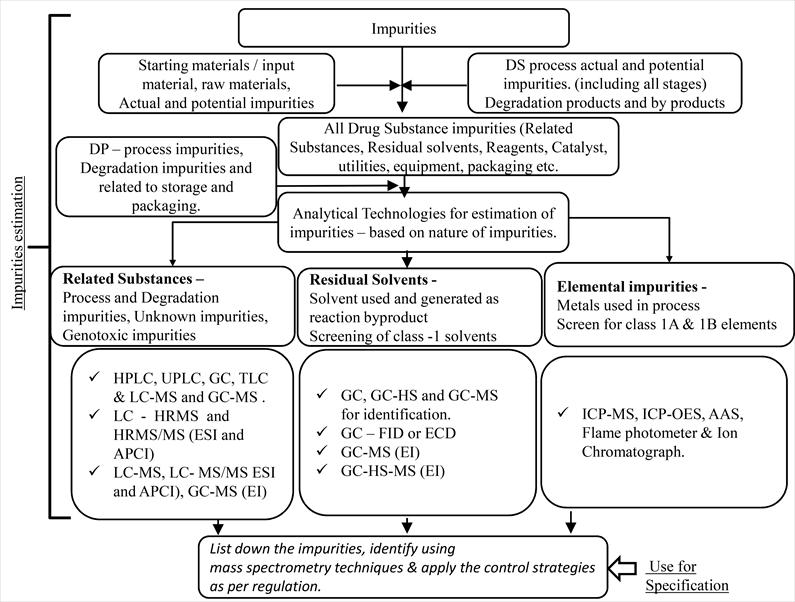
Incontemporarytimes,thepharmaceuticalindustrystandsasavitalcomponentoftheglobaleconomy,wieldinga profound impact on the daily lives of people worldwide. A substantial portion of the industry's investments is directed towardsResearchandDevelopment(R&D)forinnovativemedicationcompounds,aprocessthatdemandsover$1billion and 10-15 years for the creation of a new medicinal compound. The past decade has witnessed the authorization of approximately280therapeuticnovelmolecularentitiesbytheFDA(2010-2020),underscoringtheparamountimportance ofregulatorsinoverseeingthequality,safety,andefficacyofthesemedications.Toaddresstheevolvingchallenges,there has been a surge in the utilization of analytics in the drug development process. This has prompted continuous technologicaladvancementstomeetthedemandsofensuringmedicationquality.Presently,pharmaceuticalanalysisplays a pivotal role in providing dependable data for diverse purposes, including research on medication safety, facilitating development and monitoring processes, and ensuring post-market regulatory compliance [27]. Figure 2 illustrates the frameworkforestimatingimpuritiesinAPIs.
International Research Journal of Engineering and Technology (IRJET) e-ISSN:2395-0056
Volume: 11 Issue: 07 | July 2024 www.irjet.net p-ISSN:2395-0072
Thepressingneedtoestablishananalyticaltechniqueforanewlyintroducedmedicinalingredientorformulation stands out as a critical concern. Various analytical methods, including titrimetric, spectrophotometric, qualitative, and activityprocedures,areemployedtoensuretheadherencetoqualitystandardsindrugs.Therealmsofartificial,medical specialty, pharmaceutical, and clinical analysis heavily rely on the analytical insights derived from pharmaceutical research. This reliance fosters the development of highly cost-effective medication treatments. The absence of suitable analytical methods would render the measurement of crucial elements such as impurity levels, degradation products, or medicationdosagesimpossible.Thesecontaminantssignificantlycontributetothe subparqualityofdrugs inthecurrent market. Therefore, in the creation of new medicines, the identification and characterization of potential contaminants become imperative. Spectroscopic tests, including NMR, IR, and MS, play a crucial role in characterizing the structure of contaminantsordegradationproductspresentwithinthemedicationconstituents[28].
Impurities should be rigorously assessed, even when present at levels of 0.1% or higher. Recognizing the pharmaceutical industry's growing demand for advanced analytical techniques, the focus of this review was selected to address these requirements. Numerous contemporary analytical methods, including UPLC, LC-MS, LC-Q-TOF, GCMS, HPTLC,andLC-NMR,werecitedamongothers.Thediscussionencompassedarangeoftopics,includingimpuritysources, types, management strategies, identification, regulatory considerations, degradation products, and stability-indicating assaymethods[29].
HPLC is a powerful analytical technique widely employed in the pharmaceutical industry for the analysis of impuritiesindrugsubstancesandformulations.Itssignificanceliesinitsabilitytoseparate,identify,andquantifyvarious components in complex mixtures with high precision and sensitivity. In the context of pharmaceutical impurity analysis, HPLCplaysapivotalroleinensuringthequality,safety,andefficacyofdrugs[30,31].ThekeyfuturesofHPLCincludes
© 2024, IRJET | Impact Factor value: 8.226 | ISO 9001:2008 Certified Journal | Page1024
International Research Journal of Engineering and Technology (IRJET) e-ISSN:2395-0056
Volume: 11 Issue: 07 | July 2024 www.irjet.net p-ISSN:2395-0072
High Resolution and Sensitivity:
HPLC offers exceptional resolution, enabling the separation of closely related impurities. This high resolution is crucial for identifying and quantifying impurities, even at low concentrations. The sensitivity of HPLC allows for the detectionofimpuritiesintraceamounts,ensuringacomprehensiveanalysis.
Versatility:
HPLCisversatileandcanbeappliedtoadiverserangeofcompounds,includingpolarandnon-polarsubstances. Thisversatilityisessentialinpharmaceuticalimpurityanalysis,whereimpuritiescanvarywidelyintheirchemicalnature.
Quantitative Analysis:
HPLCfacilitatesaccurateandreproduciblequantificationofimpurities.Precisemeasurementofimpuritylevelsis crucialforassessingthequalityofdrugsubstancesandformulations,aligningwithregulatoryrequirements.
Speed and Efficiency:
HPLC provides rapid analysis, allowing for the quick assessment of impurity profiles. This efficiency is vital for pharmaceuticalcompaniestostreamlinequalitycontrolprocessesandexpeditedecision-makingindrugdevelopment.
Stability-Indicating Method:
HPLC methods can be designed to be stability-indicating, meaning they can effectively separate and quantify impuritiesgeneratedduringthedrug'sshelflife.Thisisessentialforensuringthestabilityandpotencyofpharmaceutical productsovertime.
Regulatory Compliance:
Regulatory authorities, such as the FDA, recommend HPLC as a standard method for impurity analysis in pharmaceuticals. Adherence to these standards ensures regulatory compliance and facilitates the approval process for newdrugapplications.
Keep this in consideration; various authors utilized HPLC for developing stability indicating method for quantification of impurities in formulations. The summary of the methods reported during 2019-2023 were tabulated in table3
Table 3:
LCMSisapowerfulanalyticaltechniquewidelyemployedinthepharmaceuticalindustryforthecharacterization ofstressdegradationproducts.Stresstesting,involvingtheintentionalexposureofadrugsubstanceorproducttovarious stress conditions, is a critical step in the drug development process. LC-MS, with its ability to separate, identify, and quantify compounds, plays a crucial role in elucidating the degradation pathways and characterizing the resulting degradationproducts[51-54].ThekeyapplicationsofLCMSinclude
:
LC-MS allows for the accurate identification of degradation products formed under stress conditions. The technique provides high-resolution chromatographic separation coupled with mass spectrometric detection, enabling precisedeterminationofthemolecularweightandstructureofdegradationproducts.
Structural Elucidation:
LC-MS facilitates the structural elucidation of degradation products by providing information about their elemental composition, fragmentation pattern, and possible chemical structures. This is essential for understanding the chemicaltransformationsundergonebythedrugsubstanceunderstress.
International Research Journal of
Volume: 11 Issue: 07 | July 2024 www.irjet.net
Selective and Sensitive Detection:
LC-MSoffersselectiveandsensitivedetectionofdegradationproductsevenatlowconcentrations.Thisiscrucial fordetectingtracelevelsofimpurities,ensuringacomprehensiveassessmentofthedrug'sstability.
Quantification of Degradation Products:
The quantitative capabilities of LC-MS enable the determination of the levels of degradation products. This quantitativeinformationisvitalforassessingtheextentofdegradationandestablishingdegradationkinetics.
Comparative Analysis:
LC-MSallowsforthecomparisonofstressedandunstressedsamples,facilitatingacomprehensiveunderstanding ofchangesinducedbystressconditions.Comparativeanalysisaidsindifferentiatingdegradationproductsfrominherent impurities.
Regulatory Compliance:
Regulatory authorities often require a thorough characterization of stress degradation products as part of the drug approval process. LC-MS, as a well-established and widely accepted technique, helps meet regulatory requirements [55]
The summary of stress degradation studies along with characterization of stress degradation products reported during2019-2023weretabulatedintable4.
Volume: 11 Issue: 07 | July 2024 www.irjet.net
Table 4: Studies reported during 2019-2023 for LCMS/MS characterization of stress degradation compounds
The characterization of compounds using mass fragmentation patterns is a fundamental aspect of mass spectrometry. Mass spectrometry provides information about the molecular weight and structural composition of compounds. When a sample is ionized and introduced into a mass spectrometer, the resulting mass spectra can reveal valuableinsightsintothechemicalnatureofthemoleculespresent.
Mass fragmentation patterns occur when ions generated from the sample undergo fragmentation in the mass spectrometer.Thisprocessinvolvesthebreakingofchemicalbondswithintheions,resultingintheformationofsmaller fragments. The mass-to-charge ratios (m/z) of these fragments are then measured, and the pattern of fragment peaks in the mass spectrum is indicative of the compound's structure. By analyzing the mass fragmentation pattern, researchers can deduce the possible structural elements of a compound. This aids in elucidating the connectivity of atoms and the arrangementoffunctionalgroups.
In the process of identification of stress degradation compounds, researcher initially optimizes a method for resolutionofdegradationproductsalongwithanalyteinthestudy.Further,theLCMSanalysisofthedegradationproducts was evaluated. The mass fragmentation spectra of the peaks representing degradation products were simulated and the interpretation of the mass fragmentation spectrum confirms the structure of that particular degradation product. The representativeLCMSchromatogramsoflasmiditanreportedinliterature[72]thatshowstheformationoffivedegradation productswerepresentedinfigure3.Figure4showsthemassfragmentationspectraoffiveDPsreportedinliterature[72]. The authors [72] finalized the structure of DPs based on the mass fragmentation spectrum of DP and the reported structureofDPswasshowninfigure5.
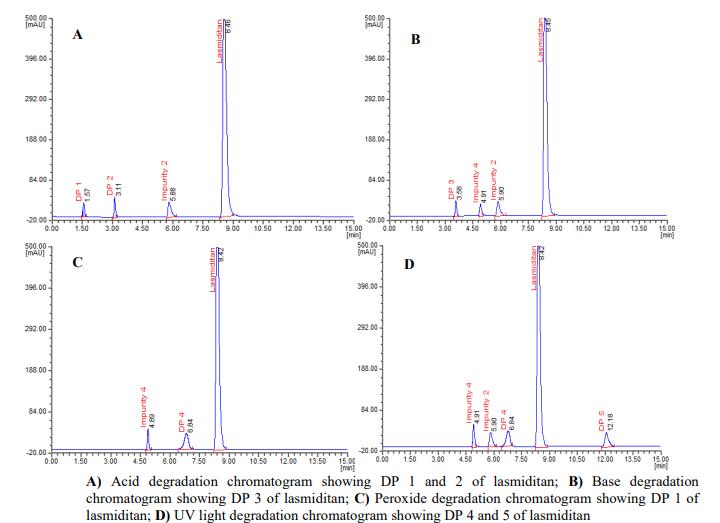
(Reusewiththepermissionofthecorrespondingauthor)
Figure 3: Stress degradation chromatograms of lasmiditan reported in literature [72]
International Research Journal of Engineering and Technology (IRJET) e-ISSN:2395-0056
Volume: 11 Issue: 07 | July 2024 www.irjet.net p-ISSN:2395-0072
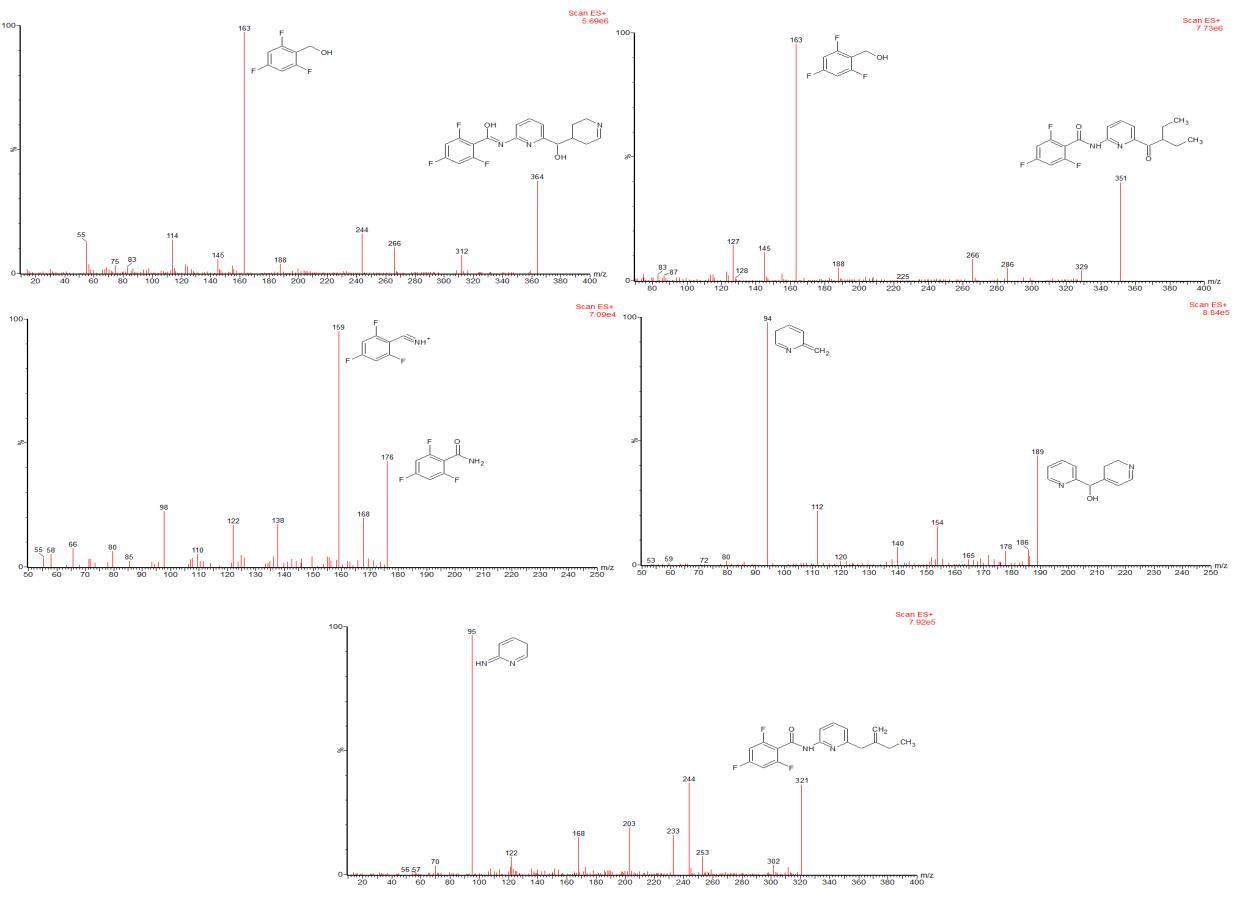
(Reusewiththepermissionofthecorrespondingauthor)
Figure 4: Mass fragmentation spectra of degradation product 1 to 5 of lasmiditan reported in literature [72]
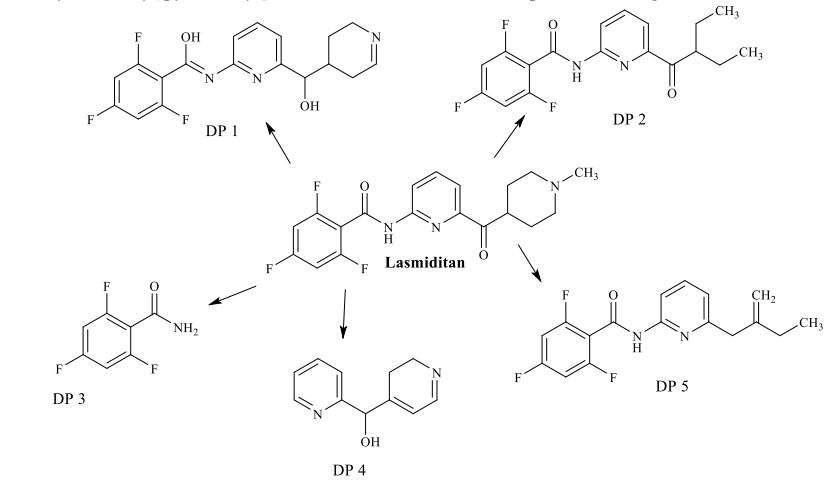
(Reusewiththepermissionofthecorrespondingauthor)
Figure 5: Structures elucidated for degradation product 1 to 5 of lasmiditan reported in literature [72]
ThestructuralcharacterizationofDPswasreportedbasedonindividualfragmentsidentifiedinmassspectra.The probable molecular mass and accurate mass measurements were correlated with structure of main compound and the
© 2024, IRJET | Impact Factor value: 8.226 | ISO 9001:2008 Certified Journal | Page1029
International Research Journal of Engineering and Technology (IRJET) e-ISSN:2395-0056
Volume: 11 Issue: 07 | July 2024 www.irjet.net p-ISSN:2395-0072
possiblestructureofeachfragmentalongwithstructureofDPwasproposed.Figure5presentsthepossiblemechanismof formation of each mass fragment and on correlation with all these fragments, structure of DP proposed by reported by Rajesh et al.,2023[73]forletermovirpuredrug.
(Reusewiththepermissionofthecorrespondingauthor)
6: Schematic representation of structural characterization of degradation products of letermovir reported by Rajesh et al., 2023 [73]
Limitations of the study:
LC-MS is a powerful analytical technique widely used for the characterization of degradation products in pharmaceuticals,environmentalsamples,andothercomplexmixtures.However,likeanyanalyticaltechnique,LC-MShas itslimitations.Thelimitationsspecifictothecharacterizationofdegradationproductsincludes
Sensitivity Issues:
Detection of low-abundance degradation products can be challenging, especially in the presence of a complex matrix.Somedegradationproductsmaybepresentatverylowconcentrations,requiringhighlysensitiveinstrumentation.
Matrix Effects:
Complex sample matrices, such as biological fluids or environmental samples, can affect the ionization and detection of degradation products. Co-eluting matrix components may interfere with the accurate identification and quantificationofdegradationproducts.
Ionization Variability:
The efficiency of ionization can vary among different compounds. Some degradation products may ionize less efficientlythanothers,leadingtounderrepresentationorcompleteabsenceinthemassspectrum.
International Research Journal of Engineering and Technology (IRJET) e-ISSN:2395-0056
Volume: 11 Issue: 07 | July 2024 www.irjet.net p-ISSN:2395-0072
Chemical Diversity:
LC-MS may not be equally effective for all types of degradation products. Compounds with diverse chemical properties (polarity, volatility, etc.) may exhibit different behaviors during chromatographic separation and mass spectrometricanalysis.
Resolution Limitations:
The chromatographic resolution of closely related degradation products can be challenging. Co-elution of peaks mayoccur,makingitdifficulttodistinguishbetweenstructurallysimilarcompounds.
Structural Elucidation:
While mass spectrometry provides valuable information about the mass and fragmentation patterns of compounds, it may not always provide sufficient structural information for complex degradation products. Additional techniquessuchasNMRspectroscopymayberequiredforcomprehensivestructuralelucidation.
Stability of Degradation Products:
Some degradation products may be unstable and prone to further degradation during the analysis process, leadingtoinaccuratecharacterizationorunderestimationoftheirpresence.
Sample Preparation Challenges:
The complexity of sample preparation, especially for complex matrices, can impact the efficiency and reproducibility of the analysis. Proper sample preparation is crucial for the accurate detection and characterization of degradationproducts.
Quantification Challenges:
Quantifyingdegradation productsaccuratelycanbechallenging, especiallywithoutsuitablereferencestandards. Calibration curves may not be linear across a wide concentration range, and matrix effects can impact quantification accuracy.
Economic aspects:
The economic aspects of Liquid Chromatography-Mass Spectrometry (LC-MS) characterization of degradation productsareessentialconsiderations,especiallyinpharmaceuticalresearchanddevelopment.Theeconomicaspectstobe mindfulofincludes
Instrumentation Costs:
Acquiring and maintaining LC-MS instrumentation involves significant upfront and ongoing costs. High-quality instruments with advanced capabilities for accurate degradation product characterization may require substantial financialinvestment.
Consumables and Reagents:
The cost of consumables, such as columns, solvents, and reagents, can contribute significantly to the overall expense.Properhandlinganddisposaloftheseconsumablesalsoincuradditionalcosts.
Training and Expertise:
Personnel’s training is crucial for the effective use of LC-MS equipment and data interpretation. Investing in trainingprogramsforanalyststoensureproperhandlingoftheinstrumentationcanimpacttheeconomicefficiencyofthe characterizationprocess.
Sample Preparation Costs:
Samplepreparationisa critical stepinLC-MSanalysis.Thecostofsamplepreparationmethods,includinglabor, materials,andequipment,shouldbeconsidered.Efficientandcost-effectivesamplepreparationmethodscancontributeto overalleconomicefficiency.
International Research Journal of Engineering and Technology (IRJET) e-ISSN:2395-0056
Volume: 11 Issue: 07 | July 2024 www.irjet.net p-ISSN:2395-0072
Analysis Time and Throughput:
The time required for LC-MS analysis influences the overall efficiency and cost-effectiveness. Improving throughput,eitherthroughtheuseoffasteranalysismethodsorautomation,canhaveeconomicimplications,especiallyin high-throughputenvironments.
Data Analysis Software:
The use of specialized software for data analysis and interpretation may incur additional costs. Proper software licensesandupdatesareessentialforaccuratedataprocessingandreporting.
Reference Standards and Quality Control:
Theavailabilityandcostofreferencestandardsfordegradationproductsareimportanteconomicconsiderations. Ensuringthequalitycontrolofstandardsandestablishingvalidationprotocolscontributetothereliabilityoftheresults.
Regulatory Compliance:
Adhering to regulatory requirements may involve additional costs for documentation, validation studies, and compliancewithGoodLaboratoryPractices(GLP)orGoodManufacturing Practices(GMP)standards.Meetingregulatory standardsiscrucial,especiallyinthepharmaceuticalindustry.
Sample Storage and Stability:
Proper storageconditionsforsamplesto maintainstabilitycanimpactcosts.Some samplesmayrequirespecific storageconditions,andensuringtheirstabilityovertimemayinvolveadditionalresources.
Outsourcing vs. In-House Analysis:
Organizations may choose to outsource LC-MS analysis to external service providers rather than investing in in-house capabilities.Theeconomicfeasibilityofoutsourcingdependsonfactorssuchassamplevolume,frequencyofanalysis,and theavailabilityofsuitableserviceproviders.
Return on Investment (ROI):
Assessing the overall economic impact of LC-MS characterization involves evaluating the return on investment. This includes considering the value of the information obtained, the impact on decision-making in research and development,andpotentialcostsavingsindownstreamprocesses.
Balancing the economic aspects of LC-MS characterization involves optimizing the workflow, utilizing resources efficiently,andmakinginformeddecisionsbasedonthespecific needsandgoalsoftheanalyticalprocess.Itiscrucialfor organizations to carefully evaluate the cost-effectiveness of their analytical strategies in the context of their overall researchanddevelopmentobjectives
Conclusion and Recommendations:
The rapid expansion of the pharmaceutical industry is fuelled by the quest for new therapeutic agents, whether derived from natural originsorchemicallysynthesized pharmacological compounds.Asa result, ensuring the purity and absence of impurities has been a longstanding fundamental criterion for guaranteeing the quality of medications. It is crucialtorecognizethatnomedicationcanbedeemedentirelysafe,andevenaminimaldosemayleadtofataleffects.The assertion by researchers that apparent amounts, as measured by weight, do not represent virtual quantities when factoringinimpuritieshascatalyzedaheightenedinterestinstudyingandevaluatingthepurityofnaturalsubstancesover the past century. Undoubtedly, the remarkable progress in medical science during the last century, driven by pharmaceuticalresearch,hassignificantlyelevatedpublichealthandoverallwell-being.
Drug regulatory agencies are increasingly focusing on the detection of trace contaminants in pharmaceuticals, particularly those present in the range of 0.01% to 0.1%. Impurities in pharmaceuticals refer to unintended compounds thatmayoriginatefromactiveAPIs,emergeasby-productsoftheformulationprocess,orresultfromthedegradationof APIs or their precursors used in drug manufacturing. The presence of even minute quantities of these undesired substances could compromise the effectiveness and safety of pharmaceutical products. To address this concern, drug
International Research Journal of Engineering and Technology (IRJET) e-ISSN:2395-0056
Volume: 11 Issue: 07 | July 2024 www.irjet.net p-ISSN:2395-0072
registration authorities have proposed specific methods for the detection and quantification of impurities. The impurity profileofadrugsubstanceisinfluencedbyvariousfactors,includingthepurityofstartingmaterials,reactionconditions, purificationmethods,andthedurationofstorageforthedrugsubstance.
Developing an analytical method for a novel pharmaceutical ingredient or formulation is a formidable task. Various analytical techniques, such as titration, spectroscopy, qualitative testing, and activity assays, are employed to ensure that the drug adheres to the necessary quality standards. The analytical insights derived from pharmaceutical research find extensive applications in artificial, medical specialty, pharmaceutical, and clinical analyses, fostering the creation of highly cost-effective pharmaceutical solutions. Importantly, without these established analytical methods, therewouldbenoofficialmeansofquantifyingimpuritylevels,degradationproducts,ormedicationdosagesintheevent of their accumulation. The subpar quality of drugs in the current market is largely attributed to the presence of contaminants. Identifying and characterizing potential contaminants during drug development is a critical step. The structure of the actual contaminant or degradation product within the medication constituent should be elucidated throughspectroscopictests,includingNMR,IR,andMS.
References:
1. ICH. Impurities in new drug substances Q3A (R2). International Conference on Harmonization, IFPMA, Geneva (Switzerland),2006.
2. Baertschi SW. Analytical methodologies for discovering and profiling degradation-related impurities. Trends Anal. Chem.2006.
3. Bharate SS, Bharate SB, Bajaj AN. Interactions and incompatibilities of pharmaceutical excipients with active pharmaceuticalingredients:Acomprehensivereview.JExcipientsFoodChem.2010;1(3):3-26.
4.Rajesh Varma Bhupatirajua,Sreenivasa RaoBattulaa,Maruthi Venkata Narayana RaoKapavarapub, VaraprasadReddy Mandapati. Assessment of gas chromatography methodology approach for the trace evaluation of carcinogenic impurity, methylchloride,intrimetazidinedihydrochloride. AnnalesPharmaceutiquesFrancaises.2023,81,64-73.
5.B.K.Devendra,B.M.Praveen,V.S.Tripathi,H.P.PrashanthKumar,K.R.Chethana.Thedevelopmentofplatinum-rhodium alloy coatings on SS304 using a pulse/direct electrodeposition technique and their application to antibacterial activity. JournaloftheIndianchemicalsociety.99(6)2022,100466.
6. Quaglia MG, Farina A, Donati E, Cotechini V, Bossu E. Determination of MPTP, a toxic impurity of pethidine. J Pharm BiomedAnal.2003;33(1):1–6.
7. Gavin PF, Olsen BA. A quality evaluation strategy for multi-sourced active pharmaceutical ingredient (API) starting materials.JPharmBiomedAnal.2006;41:1251–1259.
8.RoyJ.Pharmaceuticalimpurities–aminireview.AAPSPharmaSciTech.2002;3:1–8.
9. Basak AK, Raw AS, Al Hakim AH, Furness S, Samaan NI, Gill DS, Patel HB, Powers RF, Yu L. Pharmaceutical impurities: regulatoryperspectiveforabbreviatednewdrugapplications.AdvDrugDelivRev.2007;59:64–72.
10. Bauer J, Spanton S, Henry R. Ritonavir: An Extraordinary Example of Conformational Polymorphism. Pharm Res. 2001;18:859–866.
11.ICHQ-3C(R4).Impurities:guidelineforresidualsolvents.February2009.
12. Jiang Y, Zhang ZF, Wang H. Isomeric impurity research and quality control of β-lactam antibiotics. Chin J Antibiot. 2010;35:561–566.
13. Varma RB, Rao BS. Gas Chromatography-Head Space-Flame Ionization Sensor based assessment of four residuary solventsinrivaroxabanbulkmedication.ResearchJournalofPharmacyandTechnology.2022;15(11):5158-63.
14.B.H. Varma Rajeshand RaoB.Sreenivasa,GasChromatography-HeadSpace-MassSpectrometrySensor based Quality Control of Dobutamine Hydrochloride Bulk Material for a mutagenic impurity, 2-bromopropane. Research Journal of ChemistryandEnvironment.2023;27(2),54-61.
International Research Journal of Engineering and Technology (IRJET) e-ISSN:2395-0056
Volume: 11 Issue: 07 | July 2024 www.irjet.net p-ISSN:2395-0072
15. Rajesh Varma Bhupatiraju, Battula Sreenivasa Rao, Kapavarapu Maruthi Venkata Narayana Rao and Mandapati Varaprasad reddy, A novel Rivaroxaban degradation impurity detection by RP-HPLC extraction by preparative chromatography,andcharecterizationbyLC-MS,NMRandFT-IR:Analysisofnovelimpurityinbatchsamplesandtablets ofRivaroxaban.RasayanJournalofChemistry.2022;15(4),2373-2381.
16.FDA(May16,1997).Guidelineforthe photostabilitytestingof new drug substancesand newdrugproducts.Federal Register62(95),27115–27122.
17.AbendrothRP.Selectinglight-resistantcontainers.ChromConnection.July:4–6,1994.
18.BasakAK,RawAS,AlHakimAH,FurnessS,SamaanNI,GillDSetal.,Pharmaceuticalimpurities:Regulatoryperspective forAbbreviatedNewDrugApplications,AdvancedDrugDeliveryReviews,2007,59,64-72
19.U.S.FoodandDrugAdministration.GuidanceforIndustry,Q3AImpuritiesinNewDrugSubstances.February2003.2.
20.U.S.FoodandDrugAdministration.GuidanceforIndustry,Q3BImpuritiesinNewDrugProducts.July2006
21. Rahman, N., Azmi, S.N.H. and Wu, H.F. (2006) The Importance of Impurity Analysis in Pharmaceutical Products: An IntegratedApproach.AccreditationandQualityAssurance,11,69-74.
22. Ahuja, S. and Alsante, K.M. (2003) Handbook of Isolation and Characterization of Impurities in Pharmaceuticals. AcademicPress,Cambridge.
23.Tegeli,V.S.,Gajeli,G.B.,Chougule,G.K.,Thorat,Y.S.,Shivsharan,U.S.andKumbhar,S.T.(2011)SignificanceofImpurity Profiling:AReview.InternationalJournalofDrugFormulationandResearch,2,174-195.
24. Maggio, R.M., Calvo, N.L., Vignaduzzo, S.E. and Kaufman, T.S. (2014) Pharmaceutical Impurities and Degradation Products:UsesandApplicationsofNMRTechniques.JournalofPharmaceuticalandBiomedicalAnalysis,101,102-122.
25. Ramachandra, B. (2017) Development of Impurity Profiling Methods Using Modern Analytical Techniques. Critical ReviewsinAnalyticalChemistry,47,24-36.
26. Prabu, S.L. and Suriyaprakash, T.N.K. (2010) Impurities and Its Importance in Pharmacy. International Journal of PharmaceuticalSciencesReviewandResearch,3,66-71.
27. Ramachandra, B. (2017) Development of Impurity Profiling Methods Using Modern Analytical Techniques. Critical ReviewsinAnalyticalChemistry,47,24-36
28. Venkatesan, P. and Valliappan, K. (2014) Impurity Profiling: Theory and Practice. Journal of Pharmaceutical Sciences andResearch,6,254-259.
29. Holm, R. and Elder, D.P. (2016) Analytical Advances in Pharmaceutical Impurity Profiling. European Journal of PharmaceuticalSciences,87,118-135
30. Singh, D. and Isharani, R. (2023) A Detailed Review on Analytical Methods to Manage the Impurities in Drug Substances.OpenAccessLibraryJournal,10,1-18
31.KristinaWicht,MathijsBaert,ArdianaKajtazi,SonjaSchipperges,NorwinvonDoehren,GertDesmet,AndrédeVilliers, FredericLynen,Pharmaceuticalimpurityanalysisbycomprehensivetwo-dimensionaltemperatureresponsive×reversed phaseliquidchromatography,JournalofChromatographyA,2020,1630:461561
32. Bikshal Babu Kasimala, Venkateswara Rao Anna and Useni Reddy Mallua, Stability-indicating reversed-phase HPLC method for the separation and estimation of related impurities of Cilnidipine in pharmaceutical formulations, Indian drugs,2018,55(12),41-49.
33.UseniReddymallu,VenkateswaraRaoannaandBikshalBabukasimala,RapidStabilityIndicatingHPLCMethodforthe Analysis of Leflunomide and Its Related Impurities in Bulk Drug and Formulations, Turk J Pharm Sci. 2019 Dec; 16(4): 457–465.
2024, IRJET | Impact Factor value: 8.226 | ISO 9001:2008 Certified
International Research Journal of Engineering and Technology (IRJET) e-ISSN:2395-0056
Volume: 11 Issue: 07 | July 2024 www.irjet.net p-ISSN:2395-0072
34.AdisonFernandes,SanjayPaiP.N.ValidatedStabilityIndicatingRP-HPLCMethodForEstimationofTolfenamicAcidIn PresenceofItsPharmacopoeialImpurities,IntJAppPharm,Vol11,Issue5,2019,264-270.
35. Iryna Drapak, Borys Zimenkovsky, Liudas Ivanauskas, Ivan Bezruk, Lina Perekhoda, Volodymir Muzychenko, Liliya Logoyda, Inna Demchuk, HPLC method for simultaneous determination of impurities and degradation products in Cardiazol,pharmacopeia,2020,67(1),29-37.
36. Mohammad Al Bratty, Neelaveni Thangavel, Ramalingam Peraman, Vinod Kumar, Padmanabha Reddy, Krishna Veni Nagappan, and Hassan Al Hazmi HPLC–DAD method for investigating pantoprazole for its stress-dependent degradation byphotolysisandoxidation,ActaChromatographica,2020,32(4),247-255.
37. Adriane Lettnin Roll Feijó, Fernanda Macke Hellwig, Clésio Soldateli Paim, Marcelo Donadel Malesuik, Forced degradation studies and stability-indicating liquid chromatography method for determination of tirofiban hydrochloride andsyntheticimpurities,Rev.colomb.cienc.quim.farm.2020,49(2),509-522.
38.V.G.Kamani,M.Sujatha,G.B.Daddala,DevelopmentandvalidationofanovelstabilityindicatingHPLCmethod forthe separationanddeterminationofdarolutamideanditsimpuritiesinpharmaceuticalformulations,BulletinoftheUniversity ofKaraganda–Chemistry,2021,104(4),57-68.
39. K. Sri Girija, Bikshal Babu Kasimala, Venkateswara Rao Anna, A New High-Performance Liquid Chromatography MethodforTheSeparationAndSimultaneousQuantificationOfEptifibatideAndItsImpuritiesInPharmaceuticalInjection Formulation,IntJAppPharm,Vol13,Issue2,2021,165-172.
40.Somana SivaPrasad,BikshalBabuKasimalaandVenkateswara RaoAnna,QBDbasedanalyticalmethoddevelopment and validation for the separation and quantification of agomelatine and its impurities in solid oral dosage forms using HPLC,RasayanJ.Chem.,2021,14(4),2183-2190.
41. Venu Kamani, M. Sujatha, G. S. N. Koteswara Rao and N. Vinod Kuma, Stability Indicating RP-HPLC Method for the AnalysisofDacomitinibanditsRelatedImpuritiesin BulkandOralSolidDosageFormulations,JournalofPharmaceuticalResearchInternational,2021,33(40B):187-199.
42. Manali Parab, Vaishali A. Shirsat, Yogita M. Kodgule, and Mandar Kodgule, A RP-HPLC Method for the Analysis of Neostigmine Methylsulfate and Process-Related Impurities, Forced Degradation Studies, in the Injection Formulation, InternationalJournalofAnalyticalChemistry,2021.
43.NitinMahajan,SuparnaDeshmukhandMazaharFarooqui,Anovelstability-indicatingmethodforknownandunknown impurities profiling for diltiazem hydrochloride pharmaceutical dosage form (tablets), Future Journal of Pharmaceutical Sciences,2021,7,204.
44. Venu Gopal Kamani and M. Sujatha, an innovative stability indicating HPLC method with impurity profiling of niraparib-ananticancerdruginpharmaceuticalformulations,RasayanJ.Chem.,2022,15(4),2976-2983.
45.V.N.V.Kishore,G. V.Ramana,Simultaneous Determination ofTigecyclineAndItsPotential ImpuritiesByAStabilityIndicatingRP-HPLC-UVDetectionTechnique,IntJAppPharm,2022,14(1),75-82.
46.Zaman,B.;Hassan,W.Khan,A.Mushtaq,A.Ali,N.Bilal,M.Ahmed, D.A.ForcedDegradationStudiesandDevelopment andValidationofHPLC-UVMethodfortheAnalysisofVelpatasvirCopovidoneSolidDispersion.Antibiotics2022,11,897.
47. Venu Gopal Kamani, Sujatha M, and Guna Bhushana Daddala, Novel stability indicating high-performance liquid chromatography method for the separation and simultaneous quantification of acalabrutinib and its impurities in pharmaceuticalformulation,AnalyticalScience&Technology,2023,36(1),32-43.
48. Priyanka Gondhale-Karpe, Sonali Manwatkar, Quantitative determination of related substances for Lamotrigine extended-releasetabletbyRP-HPLC,Heliyon9(2023)e15732.
49.Harish,J.,Kumar,B.S.,Babu,U.N.,Rao,G.S.,&Anna,V.R.(2023).Development andApplicationofa Validated HPLC Method for the Determination of Alpelisib and its Process-Related Impurities in Pure Drug and Pharmaceutical Formulations.ToxicologyInternational,30(3),371–382.
International Research Journal of Engineering and Technology (IRJET) e-ISSN:2395-0056
Volume: 11 Issue: 07 | July 2024 www.irjet.net p-ISSN:2395-0072
50. Attada Tharun, Potnuru Jagadeesh, B Srinivasa Kumar, Kota Thirumala Prasad and Venkateswara Rao Anna, Qualitative and quantitative assessment of process related impurities in Brigatinib raw material and formulations using HPLC,AnalSciTechnol,2023,36(4):180-190
51.Bhattacharya,K.,Mathew,J.Developmentandvalidationofstability-indicatingUPLCmethodforthedeterminationof gliclazideanditsimpuritiesinpharmaceuticaldosageforms.FuturJPharmSci,2021,7:95
52. Blessy M, Patel RD, Prajapati PN, Agrawal YK. Development of forced degradation and stability indicating studies of drugs-Areview.JPharmAnal.2014Jun;4(3):159-165.
53. Shinde NG, Bangar BN, Deshmukh SM, Sulake SP, Sherekar DP. Pharmaceutical Forced Degradation Studies with RegulatoryConsideration.AsianJResPharmSci.2013;3(4):178-188.
54. B.K. Devendra, B.M. Praveen, V.S. Tripathi, D.H. Nagaraju. Advanced Strategies for Hydrogen Generation by Rhodium MetalCatalystsCoatedbytheElectrodepositionMethod.AppliedSurfaceScienceAdvances.12,2022,100320.
55. Doneski L, Dong MW. Pharmaceutical Regulations: An Overview for the Analytical Chemist. LCGC North America. 2023;41(06):211–215
57.RúbiaAdrieliSversut,JamesCabralVieira,NájlaMohamadKassab,DeniseBrentanSilva,HéridaReginaNunesSalgado, Forceddegradation behavioroftwo-drugcombinations: Isolationandcharacterizationofmajordegradationproductsby LC-MS,MicrochemicalJournal,2019,150,104074.
58 Varadaraj S, Shreeprakash B, B.M. Praveen, B.K. Devendra, The Effect of graphene content on the corrosion and mechanicalpropertiesofanelectrodepositedNi-Graphenecoating.AppliedSurfaceScienceAdvances.11,2022,100310.
59. Dhruvisha Pokar, Amit Kumar Sahu & Pinaki Sengupta, LC-Q-TOF-MS driven identification of potential degradation impurities of venetoclax, mechanistic explanation on degradation pathway and establishment of a quantitative analytical assaymethod,JournalofAnalyticalScienceandTechnologyvolume11,Articlenumber:54(2020).
60. Raghuvirsinh Parmar, Sadhana Rajput, Arivozhi Mohan, Identification, isolation, and structure elucidation of novel forceddegradationproductsofalectinibhydrochloride,SepSciplus2021;4:174–184.
61. Amrej Singh Yadav, Aishwarya Prabha, Divya Dornala, Debasish Swain, Dilep Kumar Sigalapalli & Gananadhamu Samanthula,CharacterizationofForced Degradation Products & Related Substances of Bilastine by Online LC-Q-TOF-MS and Insilico Study of Characterized Compounds,AnalyticalChemistryLetters,(2021)11:4,563-579,
62.LovekeshMehtaa,TanveerNaveda,ParulGrover,MonikaBhardwaj,DebarajMukherjeeLCandLC–MS/MSstudiesfor identificationandcharacterizationofnewdegradationproductsofibrutinibandelucidationoftheirdegradationpathway, JournalofPharmaceuticalandBiomedicalAnalysis,2021,194,113768.
63.PrasannaBM,PraveenBM,HebbarNarayana,VenkateshaTV,TandonHC(2014)Ketosulfonedrugasagreencorrosion inhibitorformildsteelinacidicmedium.IndEngChemRes53,2014,8436–8444.
64. Pragati J Vanavi, Sadhana J Rajput, Separation and Characterization of Novel Degradation and Process Related ImpuritiesofBedaquilineBulkDrug,JournalofChromatographicScience,2022,60(7),678–691.
65.VikrantLiladharSalode, MadhuriDeoraoGame,GouriVikrantSalode,SonaliSureshGadge,DevelopmentofValidated Stability Indicating Method for Estimation of Vandetanib and Characterization of its Degradants by LC-ESI-MS, Indian JournalofPharmaceuticalEducationandResearch,2022,56(1),232-239.
66. Daya Raju Adye, Amit Kumar Sahu, Niraj Rajput, Niraj Kumar Panday and Pinaki Sengupta, Stability Indicating AnalyticalMethod,CharacterizationofDegradation
Impurity by UPLC-Q-TOF-MS/MS, and Establishment of Degradation Mechanism of Evodiamine, Current Analytical Chemistry,2023,19,497-507.
International Research Journal of Engineering and Technology (IRJET) e-ISSN:2395-0056
Volume: 11 Issue: 07 | July 2024 www.irjet.net p-ISSN:2395-0072
67.BodasingiSaiKumar,JammuHarish,BhagyaKumarTatavarti,T.Eswarlal,VenkateswaraRaoAnna,Characterizationof forced degradation products of Netarsudil: Optimization and validation of stability-indicating RP-HPLC method for simultaneousquantificationofprocessrelatedimpuritiesofNetarsudil,Turkishjournalofpharmacy.
68.B.K.Devendra,B.M.Praveen,V.S.Tripathi,G.Nagaraju,PrasannaB.M,ShashankM.DevelopmentofRhodiumcoatings byElectrodepositionforPhotocatalyticDyedegradation.Vacuum.205,2022,111460.
69. Suresh Salakolusu, Naresh Kumar Katari, Ganapavarapu Veera Raghava Sharma, Muralidharan Kaliyaperumal, Umamaheshwar Puppala, Mahesh Ranga, and Sreekantha Babu Jonnalagadda, Identification, isolation, and structural characterizationofnovelforceddegradationproductsofErtugliflozinusingadvancedanalyticaltechniques,SciRep.2023; 13:9472.
70.Xiao-WenZhang,Gang-LongJiang,Guo-JingLi1,Xiao-YanChen,Ai-NanZhou,Yu Liu,QuantitativeStudyofImpurities in Bedaquiline Fumarate: Identification and Characterization of Its Three Degradation Products Using HPLC, LC/ESI-MS, andNMRAnalyses,PharmaceuticalFronts,2023,5(1),2023.
71. Maxime Annereau, Marina Vignes,Tahar Sif Eddine Bouchema,Lucas Denis,Audrey Solgadi,Victoire Vieillard, Muriel Paul,AndréRieutord,JacquesGrill,Philippe-HenriSecretan,andBernardDo,IdentificationofDegradationProductsofthe New Anticancer Drug Substance ONC201 by Liquid Chromatography–High-Resolution Multistage Mass Spectrometry, Chemosensors2023,11(5),294.
72. Cherukula Srinivasa Reddy, Chilakabattina Naga Narasimha Babu,Bhagya Kumar Tatavarti, Nalleboyina Vijaya,VenkateswaraRaoAnna,Developmentofastability-indicatingHPLCmethodforLasmiditananditsprocessrelated impuritieswithcharacterizationofdegradationproductsbyLC-MS/MS,J.Chem.Metrol.17:1(2023)79-92.
73. Praveen, B. M., Prasanna, B. M., Mallikarjuna, N. M., Jagadeesh, M. R., Hebbar, N., & Rashmi, D. Investigation of anticorrosive behaviour of novel tert-butyl 4-[(4-methyl phenyl) carbonyl] piperazine-1-carboxylate for carbon steel in 1MHCl.Heliyon,7(2),2021,e06090.