
International Research Journal of Engineering and Technology (IRJET) e-ISSN: 2395-0056
Volume: 11 Issue: 07 | July 2024 www.irjet.net

International Research Journal of Engineering and Technology (IRJET) e-ISSN: 2395-0056
Volume: 11 Issue: 07 | July 2024 www.irjet.net
p-ISSN: 2395-0072
1Akshata Hate, 2Devendra Ghawat, 3Mohit Bhoir, 4Sakshi Nirbhavane
1,2,3,4 Dept. of CSE (AI&ML), Smt. Indira Gandhi College of Engineering, Navi Mumbai, Maharashtra, India ***
Abstract - This article uses robotics technology to present the automated firing control system. The fact that this technology requires less labour from humans makes it more safe. The Arduino technology is used to create the suggested firefighter robot. Robots employ sensors to detect fires and transmit that information to a microcontroller, which then sends the signal to control circuitry to move the robot into the designated fire zone and use an extinguisher or water pump to put out the fire.
Key Words: ArduinoBoard,DCMotor,FlameSensor.
Robots are now more frequently employed to lessen human labour. The necessity of a fire extinguisher robot that is capable of autonomous fire detection and extinguishment.Oneoftheengineeringspecialtieswiththe fastest current growth is robotics. Robots are made to function in hazardous or labour-intensive environments and to replace humans in certain situations. The development of such a device can reduce the amount of damagecausedbythefirewhilesavinglivesandproperty. It is our responsibility as engineers to create a prototype thatcanrecognizeafireandputitoutonitsown.
ThepurposeoftheFireFighterRobotistofindandputout firesinhomesand businesses.The robot's primarytask is to be placed in a fire-prone region; if it senses a fire breakout, it will begin to operate autonomously. When entering a fire-prone region is extremely challenging for service personnel, this prototype aids in rescue efforts during fire incidents. There are many kinds of vehicles availabletoputoutforestfiresandcombatflamesathome. Our suggested robot can operate independently or under remote control. These robots provide for increased security in fire detection and rescue operations without puttingfirefightersindanger.
Stated differently, firefighters may not need to enter as manyhazardous situations whenthere are robotsaround. Alack ofscientificinnovationhasresultedininnumerable and tragic losses. Furthermore, despite intensive training, themethodsusedinfirefightingtodayare insufficientand ineffective because they mostly rely on people, who are prone to making mistakes. The use of robots rather than people to tackle fire dangers is a recent and increasingly prevalent trend. This is mostly due to the fact that they might be employed in circumstancesthat aretoo risky for anyoneperson.
Our project involves creating a robot thatcanfind fire and put it out in a specific setting. Throughout its journey, the robotnavigatestheterrainandstaysclearofanyobstacles. The Arduino board servesas thecontrol circuitry's central nervoussystem.Thetwosensorsthatareinterfacedinthe control circuitrymakeuptherobot.Therobotismovedto thefirespotbysensorsthatidentifyareasthatareproneto fireinalldirections.Apumpextinguisherthatisattachedto the robot activates to put out the fire as it approaches the firezone.
Thispaperdescribestheconstructionofafirefightingrobot that can put out a fire without putting firefighters in needless danger. The robot is called robot. In order to facilitate small site access and a deeper reach for extinguishingfiresintightspaces,robotsareintendedtobe smaller than other traditional fire-fighting robots. In addition, the robot has an ultrasonic sensor to prevent collisions with nearby items and obstacles, and a flame sensor is fixed to detect fires. As a result, the robot displayed the ability to remotely put out fires at a specific distance and to autonomously recognize fire places. Robot is designed to locate the fire and halt when it is 40 cm or less from the flames. A human operator can monitor the robot by using camera which connects to a smartphoneor remotedevices.
The perilous work of detecting and putting out fires endangers the lives of fire fighters. Every year, there are several fire incidents worldwide in which firefighters are forcedto die while performing theirduties.Robotics is the result of study and development in the field of artificial intelligence. Robots are used in many different fields, including manufacturing, industries, and medicine. Therefore,roboticscanhelpfirefighterscarryoutthiswork ofcombatingfiresandtherebylowertherisktotheirlives. One robot made for usage in these kinds of harsh environmentsiscalledFireFighter.
A firefighting robot model was proposed by Tawfiqur Rakib and M. A. Rashid Sarkar. It comprises a base platform composed of "Kerosene wood," an LM35 sensor fortemperaturedetection,flamesensorsforfiredetection, and a one-liter water container made of sturdy cardboard that is water resistant. The robot can move on its two wheels.
The Atmega2560 microcontroller concept put forth by Saravanan P. Soni Ishawarya divides the robot into three
International Research Journal of Engineering and Technology (IRJET) e-ISSN: 2395-0056
Volume: 11 Issue: 07 | July 2024 www.irjet.net p-ISSN: 2395-0072
primary sections based on its intended use: a locomotive unit, a fire detection unit, and an extinguisher unit. Every unitcarriesoutitsassigneddutieswiththegoalofputting out fires. With the aid of four infrared and four ultrasonic sensors, the locomotive unit moves the robot and helps it avoid obstacles. The temperature sensor and LDR are employed by the fire detection device to identify fire. The extinguishing equipment uses a BLDC motor and a water containertoputoutthefire.Inordertonavigate,therobot alsohasaBluetoothmodulethatislinkedtosmartphones.
An Arduino UNO R3-powered android-controlled firefighting robot was proposed by S. Jakthi Priyanka and R.Sangeetha.Therobot'scomponentsincludeagassensor for detecting fires, a gear motor and motor drive for movement, and a bluetooth module for controlling the robot from a smartphone and connecting it to an Android device. Sprinklers and a water pump are also utilized in this.ProgrammingandimplementingcodeontheArduino UNO requires the use of the Arduino IDE, an open source program.
A fire extinguishing robot was proposed by Nagesh MS, Deepika T V, Stafford Michahial, and Dr M Shivakumar. It usesDTMF(DualToneMultiFrequencyTones)technology fornavigationandaflamesensorforfiredetectionthatcan detect flames with wavelengths rangingfrom 760to 1100 nmandsensitivityvaryingfrom10cmto1.5feet.
Sushrut Khajuria, Rakesh Johar, Varenyam Sharma, Abhideep Bhatti proposed an arduino based fire fighter robot which consists of RF based remote operation to operatetherobotandwaterpump.Therobotiscontrolled bytheuserwithinarangeof7metres.Italsoconsistsofa wirelesscamerawhichhelpsusertomove therobotinthe requireddirection.
Khaled Sailan, Prof. Dr.-Ing. Klaus-Dieter Kuhnert, Simon Hardt proposed an obstacle avoidance robot named as Amphibious Autonomous Vehicle. In this robot, a fuzzy controller is used to avoid static obstacle in real time. It aims to guide the robot or vehicle along its path avoiding alltheobstaclethatcomesalongthepath.
JJalani1,DMisman1,ASSadun1andLCHong1proposed aautomaticfirefightingrobotwithnotification.Thisrobot consists of three flame sensors for fire detection in left, right and center direction. It also consists of three ultrasonic sensors for obstacle detection and avoidance. When the robot detects fire it also sends a warning notificationtotheuserusingBluetooth.
Every input/output system is processed using an Arduino UNO. Fire, smoke, UV, water level, voltage, and Bluetooth modules are used as data inputs in this system. Servo motors, DC motors, buzzers, and LEDs are used as output modes.TherearetwomodesofcontrolforthisFirerobot:
Auto and Manual. In manual mode Robots are controlled using Bluetooth modules, which provide commands for both pump motor and robot control. Android apps using Bluetooth provide current sensor data. When a fire or smoke is detected in the auto mode, a servo motor scans theareausingasmokeandfiresensor.Therobotthenputs out the fire. When the ultrasonic sensor detects an obstacle,itattemptstoavoiditbymakingtheappropriate judgment. Motor Driver IC L298 controls every aspect of movement control, including turning on the spray motor and controlling its direction via a servo motor. Additionally, a voltage sensor is used to alert the user when the battery is about to discharge. To access live video,utilizetheDataaccessappontheV380IPCamera.
Pins A0 and A1 on the Arduino are connected to the Bluetooth module HC05, which is used to communicate with the Arduino over a serial communication protocol. The fire sensor is linked to pin A2, which provides a lowor high-logic input to the microcontroller indicating whetherornotafireisdetected.Thepurposeofthewater level sensor, which connects to pin A3, is to determine whether water is present in the tank. It is a digital sensor thatoutputsalogichighorlow.ADCvaluefrom0to1023, with10bitADCforsetting12volt batterylevel to5volt DC as input, is provided to the microcontroller via pin A4, whichisusedforthebatterylevelmonitor.
Pin00turnsthemotoroff,andPins4and5turnthemotor clockwise,whilePin10turnsthemotoranticlockwise.The motor driver is connected to pins 4,5, 6, and 7, which are used to regulate the left and right motor directions. The motor control command that is supplied to my microcontroller in either manual or automatic mode also applies to the other motor. The DC water pump motor is attached to pin 3, and it only turns on when a fire is detectedorwhentheusermanuallycontrolsitthroughan Android app. Buzzer attached to pin 8 that activates in response to fire, low battery, and water level. It is controlledbyArduinopinlow,whichactivatesthebuzzer, andpinhigh,whichactivatesitforonehour.Thesamered andgreenLED’sthatconnecttopins12and13fornormal andwarningprocessesalsofunction.
International Research Journal of Engineering and Technology (IRJET) e-ISSN: 2395-0056
Volume: 11 Issue: 07 | July 2024 www.irjet.net p-ISSN: 2395-0072
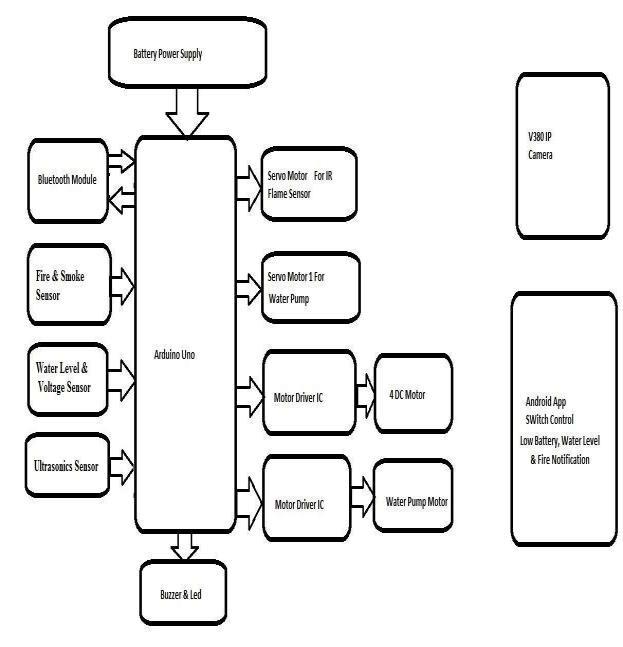
Following are the components that will be used for the mainoperationofthesystem:
Arduino UNO:
The Arduino UNO, which is based on the ATmega328P, is the primary processor of the system that is in use. It receivesinputsaccordingtothemodeinwhichthecarhas been operating manual or automatic. The inputs are processed to provide the right output to fulfill a specific goal.
IR Flame sensor:
A tiny electronics device known as a flame or fire sensor module is capable of detecting powerful light sources, includingfires.Inessence,thissensorpicksupinfrared(IR) light,whichisreleasedbyafireflameorotherlightsource andhasawavelengthbetween760and1100nm.
Smoke sensor:
The MQ6, sometimes referred to as the Gas sensor, is a sensorthatdetectssmokeintheairandnotifiestheuserof its presence. The gas modifies the resistance across the circuitandprovidesa readingafterthesensingmaterial in thesensorionizesanygasesthatcomeintocontactwithit.
Servo motor:
A feedback signal corresponding to the load's current position is provided by the position sensor. Usually, this
sensorisapotentiometer,whichusesagearmechanismto generate the voltage equal to the motor shaft's absolute angle.Afterthen,theerroramplifier'sinputissubjecttothe feedbackvoltagevalue.
Motor Driver module and DC motor:
The car's wheels will be adjusted using a DC motor and a motor drier IC as needed. It will function in accordance with the instructions that it receives. A motor driver functions as a mediator between the microcontroller and themotor.
Water pump motor:
Small submersible water pumps are typically used in residential settings, and because of their weight and size, smaller DC motors are typically used in conjunction with them. They are made to force water upward through the top of the roof and are typically located at the bottom of watertanks.
Water float sensor:
It serves as a warning to the user regarding the tank's water level. It functions by sending an electrical signal to activate a water level alarm through the opening and closingofdrycontacts.
Bluetooth Module:
We have chosen Bluetooth technology to facilitate communication between the software program and the systemsinceitissimpletouse,inexpensive,andreliable.It facilitates communication between the Arduino UNO and softwareapplications.
Camera:
The environment within the system must be continuously monitored, regardless of whether the system is in manual or automatic mode. The system uses a camera V380 to monitor its surroundings. The ability to see both day and night is this camera's specialty. It may also be shifted left, right, up, and down to observe the surroundings from all angles.
Buzzer and LED:
The user is notified when a fire, smoke, or obstruction is detected through the activation of both the 5V LED and buzzer.
The TimerOne library is included at the beginning of the code.IntheArduino environment, timerconfigurationand manipulation functions are provided by the TimerOne library. The interrupt function Sec_1() is created using the TimerOne package. The Sec_1() function reads sensor
International Research Journal of Engineering and Technology (IRJET) e-ISSN: 2395-0056
Volume: 11 Issue: 07 | July 2024 www.irjet.net p-ISSN: 2395-0072
readings, prints them to the serial monitor, and sends sensorvaluesviaserialconnectiontoaremotedevice.Itis called once per second. The servo motor's position is managedbytheServolibrary.
Subsequently, the code lists several pin numbers for diverse functions, including buzzer, LEDs, fire, smoke, ultrasonic,batteryinput,waterlevelsensing,motorcontrol, andpumpcontrol.Inordertosavethedatathatisreceived fromtheserialconnection,thecodeadditionallyestablishes a string variable named inputString. When the string is complete, it is indicated by a boolean variable named stringComplete.
The code initializes several variables, including pins for sensors and motors. These variables are used throughout theprogramtointeractwiththerobot'shardware.
The serial port and the sensor and motor pins are initializedbythesetupfunction.Additionally,itestablishes the servo motors' starting positions. The servo motors are connected to the appropriate pins and all pin modes are initialized by the setup() method. To show that the robot hasstarted,thecodeprintsamessageontheserialmonitor.
Thedata isreadfromtheserial portbytheloop()method, which then puts it in the inputString variable. After the string is finished, the code verifies the data's correctness and,ifitis,setstheValid_Datavariableto1.Afterverifying theinputdata,thealgorithmactsaccordinglybasedonthe input. For instance, the robot mode is set to auto mode if theinputdatais*A#>,andtomanualmodeiftheinputdata is*M#>.
Thedata isreadfromtheserial portbytheloop()method, which then puts it in the inputString variable. After the string is finished, the code verifies the data's correctness and,ifitis,setstheValid_Datavariableto1.Afterverifying theinputdata,thealgorithmactsaccordinglybasedonthe input. For instance, the robot mode is set to auto mode if theinputdatais*A#>,andtomanualmodeiftheinputdata is*M#>.
The code verifies the input data for pump and motor control if the robot mode is manual. The input data indicates whether the robot is stopped, moves forward, turnsleftorright,stopsallactionsiftheinputdatais*o#>, turns left or right, turns left if the input data is *l#>, turns right, or turns on the pump if the input data is *P#>. The pumpisturnedoffiftheinputdatais*p#>.
Our system is designed to put out a fire in the event of an emergency and to assist firefighters in performing their duties whenthey becomehazardousorchallenging. While themajorityofsystemsweredesignedtooperateineither automatic or manual mode. Both manual and auto mode optionsareavailableinourdesignedsystem.Theusermay
choosewhicheveroptionbestsuitstheirneedsatthetime. The switch provided in the system-developed mobile applicationcanbeusedtoselectthisoperation.
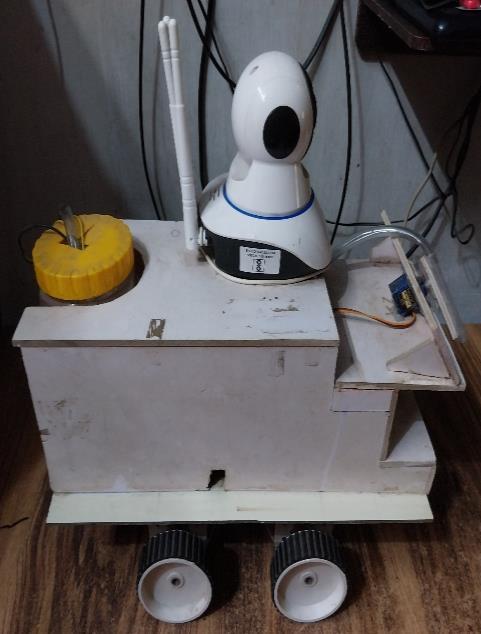
WheninAutomode,thecaroperateswithouttheneedfor humaninput.Withtheassistanceoffiresensorspositioned in the front and rear of the car, it advances autonomously and stops when a fire is detected. The buzzer and LED on the car alert people to the fire. Typically, the pipe rotates 180degreestosprinklewateruntilthefireisextinguished when a fire is detected at the front. It is possible for the vehicle to detect a fire from the back, in which case it will turn180degreesandputoutthefiredirectly.
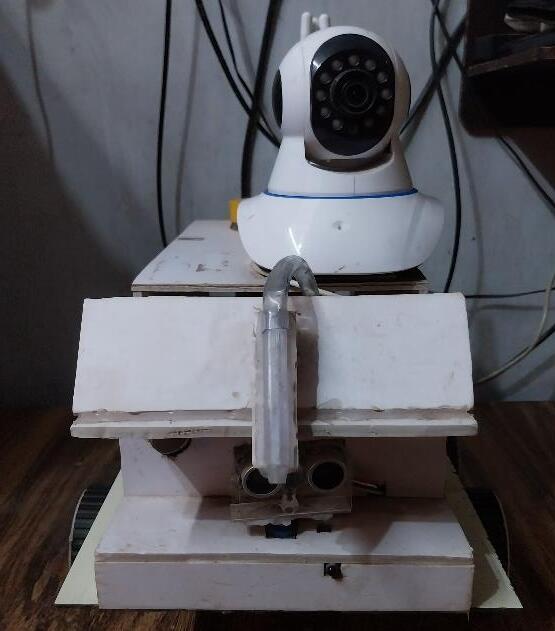
Whenanobstructionisdetected,theLEDandbuzzeralert theusertothepresenceoftheobstacle.Whenthisoccurs, thecarstopsmoving.Theultrasonicsensorturnstodetect the distance to the right and left, respectively, and compares the two readings to determine which way to go to travel the farthest. When the two measured distances are similar, the car moves a little backward before measuring the two distances once more and making the appropriatemoves.
The operation is carried out by the vehicle without the need for human assistance. With the assistance of fire sensors positioned in the front and rear of the car, it advancesautonomously and stops when a fire isdetected. The buzzer and LED on the car alert people to the fire. Typically, the pipe rotates 180 degrees to sprinkle water untilthefireisextinguishedwhenafire
is detected at the front. It is possible for the vehicle to detect a fire from the back, in which case it will turn 180 degreesandputoutthefiredirectly.
International Research Journal of Engineering and Technology (IRJET) e-ISSN: 2395-0056
Volume: 11 Issue: 07 | July 2024 www.irjet.net p-ISSN: 2395-0072
Theprojectfocusedonautomaticfireextinguishersystems that represents a significant advancement in supporting fire safety procedures by combining cutting edge technology, interdisciplinarycooperation,andunwavering research efforts. The thorough analysis of state-of-the-art developments in suppression agents, sensor technology, data analytics, and system integration reveals the revolutionary potential that these systems hold to reduce firerisksandstrengthenthesafetyofpeopleandproperty. Automatic fire extinguisher systems have the potential to provide previously unheard-of levels of accuracy, effectiveness, and flexibility in the fire detection, suppression,andmanagementdomainsthroughtheclever application of cutting-edge technologies like as artificial intelligence,theInternetofThings,andedgecomputing.
Furthermore, continued research initiatives that target system resilience, environmental issues, and regulatory compliancehighlightastrongdedicationtothecontinuous improvement and sustainability of fire safety engineering techniques. The project on automatic fire extinguisher systems is a symbol of progress as we look to the future, one in which communities will flourish with unwavering confidence and built environments will thrive with heightened resilience, and fire-related risks will be minimized.
In the upcoming years, artificial intelligence and machine learning will be used to further advance the field of robotics.Theycanbedesignedtobeabletorecognizefire, navigate dangerous settings, and take the proper action when necessary. These area few of the developments that can be applied to the construction of an intelligent firefighting robot. The majority of Arduino firefighting robots are now controlled remotely. Future advancements in roboticsandartificial intelligence, however, mightmake it possible for these robots to function independently,
increasingtheirefficiencyandloweringtheneedforhuman interaction.
More sophisticated fire detection and suppression technology, including laser-based fire detection or sophisticated fire suppression chemicals, may be incorporated into future fire-fighting robots. In the future, greaterfiresandawiderareamaybetackledbyateamof firefighting robots. In dangerous locations where it might notbesafeforpeopletoenter,likechemicalindustries,oil refineries, or nuclear sites, fire-fighting robots can be deployed. The current systems simply use cameras to monitor their environment and make decisions based on humanjudgment.Technologicaladvancementssuchasthe use of machine learning in human detection can save the livesofindividualsstrandedataccidentscenes.
[1] Anam Sheikh, Gopal Purohit, Vaishnavi.C.Raut, Rehan Rashid Abdul, Prof. C. H. Kidile, 2022, “Arduino Based FirefightingRobot”,Volume10,ISSN:2321-9653,Issue VMay2022-www.ijraset.com
[2] S. Kavitha, Krishnarajendra sagar, Mohamed Tousif, Nishanth C.R., Likith V., “Fire Fighting Robot”, 2021, "Fire FightingRobot", Volume 6, ISSN No:- 2456-2165, Issue
[3] N.Tejaswi,Dr.A.Ranganayakulu,G.LakshmiKumari,E. Alekhya,K.Tejasri,A.Pradeep,FIREFIGHTINGROBOT USINGANDROIDAPPLICATION,ISSN:0950-0707
[4] Prince, Ahmed Tamim Zabir, Kabir, Kazi Shahadat, Nabil, Md. Abdullah, Ratul, S.M. Zobaeir Akando, Rafat, Sadman Sakib, Raisa, Tabassum Tasin, Tahrim H M, Jahan Nushrat, Raza Kala, "Fire Fighting Robot", ISSN: 0950-0707,VolumeIX,IssueIII,MARCH2020
[5] J Jalani, D Misman, A S Sadun1 and L C Hong, “Automatic fire fighting robot with notification”, IOP Conference Series: Materials Science and Engineering, Volume 637, The 3rd International Conference on Robotics and Mechantronics (ICRoM-2019)August2020
[6] Aftab Nagarji, Aniket Vani, Pratik Kumathe, Prof. N.S.Nadaf, 2022, “FIRE FIGHTING ROBOTIC VEHICLE USING ARDUINO”, ISSN: 2582-5208, Volume:04, Issue:07,July-2022
[7] Diwanji, M., Hisvankar, S., & Khandelwal, C. (2019). Autonomous Fire Detecting and Extinguishing Robot. 2019 2nd International Conference on Intelligent CommunicationandComputationalTechniques(ICCT)
[8] Sumitra Motade, Aditi Suresh Bidwai, Komal Jaysing Kale, Ankita Mahadev Mahajan, "FIRE FIGHTING ROBOTUSINGANDROIDAPPLICATION",ISSN(Online) 2456-0774, Volume 4, Issue 11, ICCEME(2019-2020)