
International Research Journal of Engineering and Technology (IRJET) e-ISSN: 2395-0056
Volume: 11 Issue: 07 | July 2024 www.irjet.net p-ISSN: 2395-0072

International Research Journal of Engineering and Technology (IRJET) e-ISSN: 2395-0056
Volume: 11 Issue: 07 | July 2024 www.irjet.net p-ISSN: 2395-0072
Sanif Kandel1 , Bijay Gautam2 , Shrawan Thakur3, Manoj Shrestha4
1,2Research Scholar, Department of Computing, Softwarica College of IT and E-Commerce, Kathmandu, Nepal. 3,4Professor, Department of Computing, Softwarica College of IT and E-Commerce, Kathmandu, Nepal.
Abstract - In the current landscape of technological advancement, Online platforms now dominate the moviewatching experience in the current technological world. This evolution has presented viewers with unique issues, such as the overwhelming number of movie selections and the difficulty of finding individualized content recommendations.Themovieindustryhasyettofullyutilize recommendation algorithms, unlike food delivery and fashion e-commerce. This study examines movie recommendation algorithms, their efficacy, and user involvement to close this gap. Google Scholar, GitHub, and APIs were used to acquire data for this research. The study examined collaborative filtering, content-based recommendations, and hybrid machine learning methods. RMSE and MAE were used to evaluate each algorithm's accuracy and performance. Algorithm development ethics were extensively assessed to ensure industry best practices, user privacy, and data security. Agile and SEMMA methods ensured flexibility and reactivity during development. This research produced a powerful movie recommendation systemthatuseshybridalgorithmstoprovideindividualized content suggestions. This method solves the problem of too many movies and improves the movie-watching experience, increasing user pleasure and engagement. The study shows howalgorithmicadvancesinmoviestreamingmightchange user experiences and improves streaming user pleasure and engagement by carefully exploring and implementing algorithms. Algorithmic advances have broader consequences, highlighting the potential for data-driven solutionstopromoteinnovationacrosssectors.
Key Words: Movie Recommendation, Prediction, Hybrid Recommendation, Retention, Ratings, Reviews
Movies have entertained and told stories for almost 100 years. From silent films to today's blockbusters, movies are a worldwide craze. People rushed to theaters in the early days of film to experience its wonder. Movies in a dark theater were a worldwide favorite. However, as technology has improved and the internet has grown, movie watching has altered drastically. Streaming platforms and online movie databases have started a new movie watching era. Movies can now be watched on demand. Movie-watching is becoming more flexible as theaterqueuesandshowtimesdisappear[1].Today,more
photographs are available to more individuals. Netflix, Amazon Prime, and Disney+ offer a massive library of movies to watch at home or on the move, changing the way people watch movies. Smartphones and high-speed internetmakestreamingmoviesonseveraldeviceseasier. Withthisrevolutioninmovieviewing,audiencesmaypick what to watch, when, and how. They can discover new releases, genres, and old favorites at their own speed. Since more individuals can view movies, they may select how.
But as the huge number of movies gets easier to find, movie sites and streaming services face a new problem. Users can feel overwhelmed by the number of options, whichcanmakeithardtochoosetherightmoviefortheir mood or tastes. Users may become irritated if they aren't given clear instructions on how to find movies that relate to their interests. Movie recommendation services have turned to intricate algorithms to combat this issue. In ordertolearnaboutplatformusage,userpreferences,and user connections, these algorithms employ cutting-edge technologylikemachinelearninganddataanalytics[2] By figuring out what each user likes, the recommendation algorithms can put together lists of movies that match each person's hobbies. The main idea behind algorithms thatsuggestmoviesisthattheycanguesswhatuserswant and give them what they want. Content-based algorithms consider the quality of movies while making recommendations,whilecollaborativefilteringtechniques analyze the behavior of similarly situated people to make predictions. Hybrid models use all of these methods together to make a complete and accurate system for recommending movies. Companies like Netflix, Amazon Prime, and Hulu have spent a lot of time and money creating and enhancing the quality of their recommendationalgorithmsforthebenefitofitsusers.
International Research Journal of Engineering and Technology (IRJET) e-ISSN: 2395-0056
Volume: 11 Issue: 07 | July 2024 www.irjet.net p-ISSN: 2395-0072
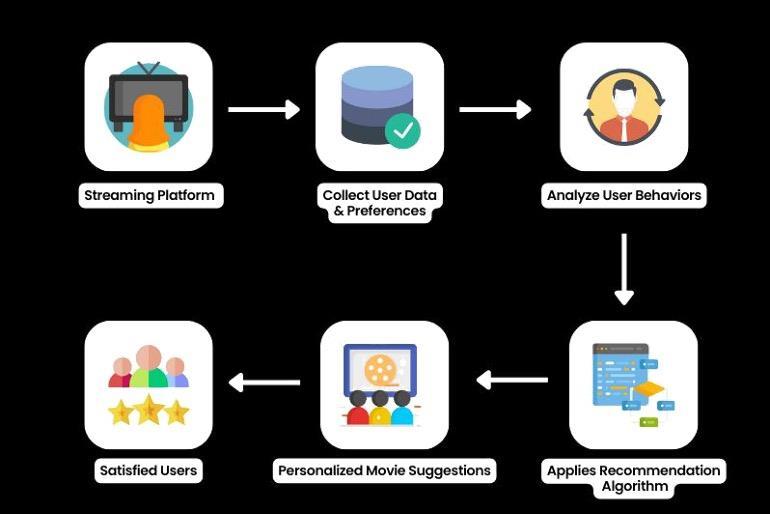
A methodical research strategy will be done to achieve this.Bygoingintotheinner workingsofthemostpopular streaming industry recommendation systems and investigate the inner workings of hybrid algorithms, collaborative filtering and content-based suggestions to better understand how they shape the user experience. Also, put them into practice and put them through their paces to see how they perform in terms of user pleasure and engagement. The results of our study will help individuals rethink their approaches to movie discovery and consumption. The goal of the study is to provide a moreuniqueandsatisfyingmovie-watchingexperienceby deciphering the secrets of good movie recommendations [3] This research aims to make it easier for users to find the movies they want to watch on streaming services. By carefully studying and comparing different approaches, this research hope to pave the way for a better movie discovery process, driven by insights from data and technology.
1.1 Aim
Conducta comprehensivestudyand comparisonofmovie recommendationalgorithmstoidentifythemosteffective, and optimal approach for providing personalized movie suggestionstousers.
1.2 Objectives
1. Evaluate and compare movie recommendation algorithms.
2. Studyuserpreferencesandbehaviorpatterns.
3. Investigate ethical considerationsrelatedtouserdata privacyandtransparency.
4. Identify the most effective method for personalized moviesuggestions.
5. Assess the impact of recommendation algorithms on userengagement.
6. Implement the most effective movie recommendation system.
In the digital age we live in now, the movie business has seen a huge change in how movies are made, spread, and watched. With the growth of the internet and improvements in technology, people who like to watch moviesnowhaveaccesstoa hugenumberofmovies.The ease of use of streaming platforms and online movie databases has changed the way people interact with material, giving them more options and more freedom than ever before. But having so many choices has made it harder for viewers to find relevant and personalized movie recommendations in the ocean of material that is out there. The fact that one can't get personalized movie suggestions is a big problem for both movie fans and streaming services. Users often get tired of making decisions because there are so many movies to choose from.Thismakesithardforthemtofindamoviethatfits their tastes. This makes people angry and, in some cases, stops them from trying out new material, which makes watching movies less fun overall. As a result, user happiness and engagement go down, which could lead to less user loyalty and retention. On the other hand, streaming services have to work hard to keep their users and set themselves apart in a very competitive market. Without personalized recommendations, platforms might findithardtokeepusersinterestedandmissoutonuseful informationabouthowusersliketousethem[4].Thislack of knowledge about what users want could mean missed chances to improve content offers and marketing strategies. To deal with these problems, it's important to useastrongsystemforrecommendingmovies.Thegoalof this research is to do a thorough study of different algorithmsforrecommendingmoviesandhowtheyaffect userengagementandhappiness.Tofindthemosteffective and efficient algorithm for making personalized movie ideas by looking at a variety of methods, such as collaborativefiltering,content-based,andhybridmethods, the strengths and weaknesses of each algorithm will be analyzed in a systematic way, taking into account things like accuracy, scalability, and the ability to change to changing user preferences [5] Users' movie-watching experiences could be changed by a well-designed suggestionalgorithm.Bylookingathowusersbehaveand what they watch, the algorithm can make movie lists that fiteachperson'slikesandinterests.
This personalized method not only makes users happier, butalsogetsthemmoreinvolvedandkeepsthemcoming back. Satisfied users are more likely to try out a wider range of material, which leads to more use and makes it easier for streaming platforms to make money [6]. To make a good system for recommending movies, it's necessary to do a few key things. First, a huge amount of informationaboutwhatmoviespeoplelikeandhowoften they watch them is gathered. The algorithm then looks at this information to find trends and links between users andmovies.Itthenmakesprofilesfor eachuser based on
what they like, which lets it make custom movie suggestions. The algorithm goes through a lot of testing and validation to make sure that the suggestions are correct and useful. To keep up with changing user tastes and industry trends, the algorithm needs to be constantly evaluatedandtweaked. Thisiterative process makessure that the algorithm is always up-to-date and keeps giving people good suggestions. The movie business could change in many ways if a complex algorithm for recommendingmovieswereputintoplace.First,itmakes users feel more connected to the content, which makes watching movies more interesting and rewarding. Users are more likely to find new material and genres that fit with what they like, which encourages them to try new thingsandbroadenstheirmovietastes.Second,streaming platforms can use what the algorithm tells them to improve their material and marketing. By learning what users like, platforms can change their content libraries to suit a wide range of tastes, bringing in more users and making them more loyal [7]. By looking at how users act, platforms can learn a lot about what their audiences like, whatmaterial ispopular,andwhatnewtrendsareonthe rise. This data-driven method makes it possible to make decisions based on data, which leads to better strategies forgettingandmakingcontent.
So,notbeingabletogetpersonalizedmoviesuggestionsis a big problem for both moviefansandstreamingservices [8]. But by making and using an effective movie recommendationalgorithm,theseproblemscanbeturned into possibilities. The algorithm's ability to suggest personalized and relevant movies increases user engagement, happiness, and loyalty. It also gives streaming platforms valuable information for improving their content offerings. This research will help to analyze the movie recommendation technology available, how they work, and which one works best for users. This will improve how users watch movies and shape the future of themovieindustry.
1. What is the most effective machine learning algorithms and methodologies for the movie recommendation system to deliver accurate and tailoredmoviesuggestions?
2. What are the challenges in implementing a movie recommendation system and how can they be overcomeforbetteruserexperience?
3. What are the ethical considerations involved in the developmentandimplementationofmachinelearning algorithmsformovierecommendation?
This research is constructed upon a solid ethical framework, which ensures the study's integrity and legitimacy at every level of the process. The commitment tohonestyandopennessthathavebeenmadeisessential to the success of this endeavor. The findings and conclusions will be given in an honest and forthright manner, and any limitations or difficulties that were experienced throughout the research will be openly discussedinordertoofferaholisticpointofview.Inorder to preserve its impartiality, the research will make every effort to be objective and free of bias in every respect. To ensure that the findings are unbiased and accurate, concerted attempts will be made to identify and counteract any possible biases that may emerge throughout the course of the research [9]. These efforts willbemadeconsciously.Itisoftheutmostsignificanceto protect the personal space and secrecy of each and every participant. Any information that is disclosed during the course of an interview, survey, or other data gathering activity will be held in the strictest confidence. The identity of the participants involved and any personal information they provide will be kept confidential, and their data will be handled with the utmost care and respect.
The research will protect intellectual property rights and steer clear of any potential violations of copyright or breaches of data privacy concerns. The appropriate citations and acknowledgments will be provided for any and all references and sources that were utilized in the research. This will demonstrate respect for the creative work ofothersandensurecompliancewithanycopyright laws[10].Inordertoensurethatthefindingspresentedin the study report remain credible and accurate, it will be subjected to routine evaluations and edits. For the purposeofvalidatingthestudymethodsandensuringthe robustness of the conclusions, feedback from colleagues and industry experts will be sought. This research attempts to uphold the highest levels of honesty, respect, andresponsibilitybyadheringtotheseethical issues,and itdoessobyadheringtotheseethicalconsiderations.The ethical framework ensures that the study will give useful insights to the field of movie recommendation algorithms while simultaneously protecting the rights and welfare of allindividualswhoareparticipatingintheresearch.
In order to collect, sort, analyze, and analyze data about movie recommendation systems, desk-based research approach was used. Desk research (also known as secondary research) will be used to support the conclusions by drawing on data that has already been obtained from a variety of sources. Given the short time frame of this study, this approach was selected for its
International Research Journal of Engineering and Technology (IRJET) e-ISSN: 2395-0056
Volume: 11 Issue: 07 | July 2024 www.irjet.net p-ISSN: 2395-0072
efficiency [11] In-depth desk research into scholarly articles, professional publications, and other reputable web resources will be undertaken to learn more about movie recommendation algorithms. The information and ideasprovidedbythesesourceswillformthebasisofour investigation. Personal blogs won't be given as much weightasscholarlyarticlesinpeer-reviewedmagazinesor storiesfromwell-knownnewssources.
To further grasp the topic, case studies of currently available movie recommendation systems will be carried out.Casestudieslikethese will helpus betterunderstand thestrengthsandweaknessesofrecommendationsystems in the real world. The research aims to be more thorough and reliable by examining multiple movie recommendation algorithms. Furthermore, a working prototype of the hybrid-based movie recommendation systemwillbeconstructedbasedontheinsightsgathered from desk research and case studies. Extensive internet research and analysis will go into this prototype. It is generally agreed that a desk-based development strategy ismostsuitedforthedevelopmentphaseofcontent-based movieselectionduetotheavailabilityofnumerousonline resources such as research papers, manuals, and opensourceprojects[12].Thereliabilityofthedatausedinthe study will be protected by ensuring proper citation of sources throughout the research process. The goal of this desk-based study is to provide a thorough and wellinformed examination of movie recommendation algorithms and to create an efficient content-based movie recommendation system that considers the tastes and demandsofitscustomers.
6.1 Netflix
Netflix started out as a DVD rental service in 1997. Since then, it has grown into a global streaming giant that has changed how people all over the world watch their favorite shows and movies. Netflix has become one of the most popular online streaming services because it has so many movies, TV shows, documentaries, and original works to choose from. Netflix's ability to get and keep millionsofpeoplearoundtheworldisdueinlargepartto its sophisticated recommendation algorithm. The algorithm Netflix uses to make choices is based on how users act and what other users like. In collaborative filtering, users with similar tastes are grouped together through the analysis of massive volumes of user data. Netflix can group viewers with similar likes by analyzing their viewing habits and how they engage with one another over time [13]. With the information, Netflix is now able to provide viewers with movie suggestions based on the tastes of others in their specific cluster. The efficacy of Netflix's recommendation algorithm has been the subject of numerous academic studies and research
publications. These tests demonstrate that the algorithm can make sound movie recommendations that draw in viewers and keep them interested. Multiple studies have looked into how collaborative filtering, user clustering, and the incorporation of features like user ratings and moviemetadatamightimproveNetflix'ssuggestions.
Netflix's recommendation algorithm relies heavily on its data-driven methodology. Constantly, the system gathers and processes a mountain of information about user actions, viewing habits, and opinions. This information is then used to make more accurate and pertinent movie suggestions,whichinturnincreasesuserengagementand retention. Netflix maintains subscribers' active engagement and encourages them to spend more time on the platform through the use of customised recommendations associated with their interests [14]. Netflix's recommendation technology has been very successful, but it's not perfect. The cold-start problem arises when there is a shortage of data for correct suggestions due to the introduction of new users or objects. Problems may also arise if the system is susceptible to "filter bubbles," in which people only see content that confirms their preexisting beliefs. Data scientists and researchers are always trying new approaches to these problems in an effort to make Netflix's recommendations more inclusive and accurate. Netflix's recommendation algorithm is a key factor in the company's success and the happiness of its customers. Netflix'sretention,churnrate,andsubscribergrowthmay all be improved with more relevant and interesting contentrecommendations.Inaddition,satisfiedcustomers are more likely to refer Netflix to their friends, which boosts the company's organic growth and solidifies its position as the market leader. When compared to its rivals,Netflix'srecommendationsystemstandsoutdueto its data-driven and individualized approach. In comparison to other streaming platforms' recommendation algorithms, Netflix stands out for its innovativeutilizationofmassivequantitiesofuserdata to make informed and varied content recommendations. Knowing these advantages can help other streaming services improve their own recommendation systems [15]. Netflix's system for making recommendations also changes as technology does. Improved artificial intelligence and machine learning models are among the promising developments for Netflix's recommendation systeminthenearfuture.It'spossiblethatmoreaccurate and personalized movie suggestions could be achieved by the incorporation of contextual information, such as realtimeuserinteractionsandsocialnetworkdata.
Its tailored and data-driven strategy, based on collaborative filtering and user behavior analysis, has had a profound effect on user engagement, satisfaction, and commercial results. It is anticipated that Netflix's algorithm will continue to improve as new research and
International Research Journal of Engineering and Technology (IRJET) e-ISSN: 2395-0056
Volume: 11 Issue: 07 | July 2024 www.irjet.net p-ISSN: 2395-0072
developments in recommendation technology are implemented, guaranteeing that the site will continue to give engaging and personalized movie selections for its massiveaudience.
Asanentity oftheworld'slargestonlineretailer,Amazon Prime Video offers its global audience a huge selection of movies, TV series, and Amazon originals. The complex recommendation system at the heart of Amazon Prime Video combines collaborative filtering and content-based approachestogreateffect.Therecommendationalgorithm for Amazon Prime Video still heavily relies on user contributionsthroughcollaborativefiltering.Theplatform uses collaborative filtering to evaluate user activity, viewing habits, and preferences in order to reveal commonalitiesandtrends. Usingthis data,AmazonPrime Video may group its customers into similar taste categoriesandmakerecommendationsformoviesandTV episodes.Additionally,content-basedstrategiescontribute heavily to improving the recommendation system's precision. The algorithm behind Amazon Prime Video's recommendations takes into account a wide variety of factors, such as the film's or show's genre, cast, director, and plot [16]. The platform can provide personalized recommendations by correlating content attributes with user preferences. Amazon's Prime Video's recommendationsystemhasbeenthesubjectofnumerous academicstudiesandpapers.Basedontheresultsofthese analyses,itisclearthattheplatform'shybridapproachto content recommendation is what drives users to take an active role in the site and consume more articles. The effect of collaborative filtering and content-based strategies on suggestion quality and, by extension, customer retention and loyalty, has been the subject of extensive study. To further improve user engagement, Amazon Prime Video takes a data-driven strategy and continuously analyzes user interactions. In order to keep users delighted and promote longer viewing sessions and enhancedcustomerloyalty,theplatformcollectsvastdata on user activity in real time in order to make targeted suggestions.
However, similar difficulties are experienced by the recommendation system. An overemphasis on content qualities could result in less variety in suggestions, which coulddissatisfyorboringusers.AmazonPrimeVideomay look into sophisticated machine learning models and algorithms that leverage contextual data and user feedback to improve content recommendation. The recommendation algorithm for Amazon Prime Video has had a significant effect on both customer happiness and Amazon's bottom line [17]. The platform can boost subscription rates and income by recommending content thatisbothinterestingand useful toeachindividual user. The success of the recommendation algorithm is further
demonstrated by the platform's adaptability to meet the needsofa widevarietyofusers,henceincreasingthesize ofitstargetaudience. When comparedtootherstreaming services, Amazon Prime Video's hybrid approach to its selectionalgorithmsstandsoutasabigplus.Theplatform is able to deliver a comprehensive and reliable user experience because to the combination of collaborative filtering and content-based approaches. Amazon Prime Video's recommendation system stands out from the competition because of how well it provides users with diverse, relevant, and tailored content suggestions by merging user behavior research with content qualities [18]. The platform's recommendation engine appears to have bright long-term prospects as Amazon Prime Video continues to innovate and invest in suggestion technologies. Developments in artificial intelligence, natural language processing, and machine learning could lead to more changes and improvements, which would lead to even more accurate and immersive content suggestions.
The success of Amazon Prime Video can be directly attributed to their innovative recommendation system Incorporating both collaborative filtering and contentbasedapproaches,theplatformprovidesuserswithhighly relevant and interesting content recommendations that are sure to pique their interest. Amazon Prime Video's recommendation system is projected to improve in response to ongoing research and technical breakthroughs,ultimatelyleadingtoa moreengagingand personalizeduserexperience.
The Walt Disney Company's new streaming service, Disney+, has quickly risen to prominence because to its extensivelibraryofclassicfilms,populartelevisionseries, and original productions [19] Disney+'s advanced movie recommendationalgorithmisbuilttopleaseviewersofall ages and tastes. Disney+ employs a hybrid recommendation system based on content analysis and user feedback to tailor recommendations to each user. Through the use of user activity and interaction, collaborative filtering can determine shared patterns and preferences among people who share these characteristics. Disney+ creates user clusters by evaluating viewing history and user engagement to select films that users will enjoy based on the tastes of those with similar viewing habits. Improving the recommendation system's accuracy is mostly due to the wide use of content-based approaches. Disney+'s algorithm takes into account a number of factors, including the viewer's preferred genre, actor/actress pairings,yearofrelease,andoverallcontentthemes,while making movie recommendations. Disney+ is able to providecustomerswithrecommendationsthatwillappeal
Volume: 11 Issue: 07 | July 2024
to their tastes since the service takes the time to learn abouttheirviewinghabits.
Disney+'srecommendationsystemhasbeenthesubjectof academic studies and papers. These tests demonstrate how the hybrid methodology used by the platform enhancescontentrecommendation,muchtothedelightof users and the delight of the platform's developers. Collaborativefilteringandcontent-drivenalgorithmshave been looked at to see if they could improve the accuracy andvalueofmovierecommendations,whichcouldmakea user more likely to stick with a service. The recommendation mechanismon Disney+ reliesheavilyon the service's data-driven approach [20]. The platform constantlymonitorsuseractivity,assessingviewinghabits andpreferencestomaketailoredsuggestionsinrealtime. The user experience is improved by this data-driven strategy, which also helps retain and grow loyal customers. There are still obstacles for Disney+ to overcome, despite the efficiency of the algorithm. Overreliance on movie attributes may lead to restricted diversityinsuggestions,asisthecasewithothercontentbased systems. Because of this, Disney+ may experiment with novel approaches to provide more interesting movie recommendations, such as using contextual data or incorporating social interactions. Customers' happiness and the company's bottom line are both affected by Disney+'s movie suggestions. Disney+ may raise subscription rates and revenue growth through improved user engagement and retention thanks to tailored movie recommendations.Thesuccessoftheplatformcanalsobe seeninthefactthatitisabletomeettheneedsofadiverse variety of users. Disney+'s hybrid approach to recommendation algorithms sets it apart as a formidable rival to other streaming providers. Disney+ is able to provide an excellent movie recommendation service becauseitemploysacombinationofcollaborativefiltering and content-based methods Disney+ stands out from the competition by offering recommendations that are diversified, personalized, and appropriate for the whole family. Disney+ is likely to invest in additional improvements to recommendation technologies in the future. As, AI and machine learning keep getting better, Disney+ may try out new ways to improve the accuracy and personalization of its movie suggestions. To further improve the recommendation system, it may be useful to incorporateusercommentsandsocialinteractions.Oneof the reasons Disney+ has been so successful in the streaming business is because of its recommendations system. User satisfaction and revenue are both increased becausetotheplatform'suseofcollaborativefilteringand content-based analysis to generate useful and engaging film suggestions [21]. Disney+ is committed to providing its diverse audience with a compelling and individualized movie-watching experience by continuously innovating and refining its recommendation system as research and technologyadvance.
361 Degree Media's Cinema Ghar has revolutionized Nepalimoviestreaming.CinemaGharhasledthebusiness since its 2016 launch. Cinema Ghar, made possible by quick digital technology, provides Nepali film fans with a wide selection. Cinema Ghar makes watching movies easier than ever [22]. The platform's convenience and wide selection of films changed how Nepalese viewers watched movies. Due to the vast amount of content and alternatives, users have to find relevant movie suggestions. No sophisticated recommendation system made it hard for users to find movies that suited their likes. Customers reported feeling overwhelmed by the number of alternatives and having trouble locating new content, which may have made watching movies less pleasant.
After recognizing that personalized suggestions improve userengagementandenjoyment,CinemaGhartackledthe challenge of creating and deploying efficient recommendationsystems.Thesealgorithmsarecrucialfor analyzing user activity, watching history, and preferences to offer movies that suit their tastes. It used user data to suggest movies. Despite Nepali film data shortages, this was achieved. Collaborative filtering makes powerful recommendations. This technique matches cinema fans withcontentbasedontheirviewinghistory Collaborative filtering helps Cinema Ghar deliver consumers individualized movie selections, improving the user experience. Cinema Ghar's recommendation technique also relies on content-based filtering. This method uses genre, cast, and plot to propose movies to viewers depending on their preferences. Cinema Ghar uses content-based and collaborative filtering to enhance its movie recommendations. Cinema Ghar can accommodate more user customizations. Cinema Ghar's use of hybrid recommendation algorithms to construct its content collectionwithNepalifilmmakersshowsitspotential[23]. These hybrid systems seamlessly integrate many recommendation algorithms, maximizing their benefits while minimizing their limitations. Cinema Ghar employs collaborative filtering, content-based filtering and other techniquestogeneratea comprehensiverecommendation system that accommodates a broad variety of user preferencesandmaximizesusersatisfaction.
User feedback and participation improve Cinema Ghar's recommendation systems. Ratings, reviews, and watching history are needed to refine a platform's algorithms. This user-centered approach keeps movie recommendations relevant and entertaining and encourages viewers to explore new content. Cinema Ghar uses data to identify popular content and patterns by studying user behavior. Cinema Ghar uses viewing habits and movie preferences to make content acquisition decisions and improve its moviecollection.CinemaGhar'sabilitytorespondtoclient
International Research Journal of Engineering and Technology (IRJET) e-ISSN: 2395-0056
Volume: 11 Issue: 07 | July 2024 www.irjet.net p-ISSN: 2395-0072
requests and market trends is made possible by datadrivendecisionmaking.CinemaGharshouldutilizehybrid filtering, content-based filtering, and a combination of the two to recommend films. User preferences drive this system. Cinema Ghar's dedication to innovation and improvement makes it a key role in Nepali movie streaming'sfuture.CinemaGharstandsoutbyprioritizing user input and using data-driven insights [24]. As it expands, the platform will continue to improve its recommendation algorithms. To give users an engaging and enjoyable movie-watching experience, this focus will continue.
The Agile and SEMMA models will be used to figure out how to build the algorithms for recommending movies Agile will be the basis of the development process. It will allowforatransparentanditerativeapproachtochanging requirementsandfeedback.Closecollaborationwithusers andpeoplewhohaveastakeinmoviestreamingplatforms will be made sure of. This will allow recommendation algorithms to be changed to fit the preferences and watching habits of users [25]. In line with the Agile principles, short work cycles "sprints," will be used. Each sprint will focus on a different part of the system for recommending movies. This will allow the algorithms to be constantly refined and improved based on real-time feedbackandperformanceratings.Therewillbeopenness andregularinspectionstokeepstakeholdersuptodateon the project's progress and make sure it's in line with the studygoalsanduserexpectations.
The process of data mining will be guided by the SEMMA structure. SEMMA stands for Sample, Explore, Modify, Model, and Assess. During the Sample phase, a representative set of data from movie streaming platforms, such as user preferences, movie ratings, and watching history, will be gathered In the second part, exploring thedata will makeiteasiertofind patternsand trends in how users act and what movies they like, which will give algorithm developers valuable information. DuringtheModifyprocess,thealgorithmswillbetweaked and improved based on what was learned from exploring the data. Then, in the Model phase, these changed algorithmswillbeaddedtothemoviestreamingsites[26]. This will make it possible to test them in the real world and get user feedback. In the last step, "Assess," the suggestion algorithms will be thoroughly tested and evaluated to find out how well they work, how well they scale,andhowhappyusersarewiththem.
The goals of this research are perfectly met by the combination of Agile and SEMMA, which allows for a dynamic and data-driven approach [27]. Because Agile is iterative, the selection algorithms are always being updated to keep up with how users' tastes change. Also,
thedataminingprocessofSEMMAmakesitpossibletoget useful information from big datasets, which makes it easier to make the best algorithms for recommending movies.Agile’s regular inspections and reviews will keep the study on track to reach its goal of improving movie suggestions for a better viewing experience. Overall, this development method will make it possible to create strong, data-driven algorithms for recommending movies. This will make users happier and help the movie streamingbusinessgrow.
A variety of crucial tools have been used throughout the study process to enable seamless and efficient task execution. Google and Google Scholar were the main searchenginesthatwereusedtofindonlinearticlesabout related books, academic papers, and movie recommendation systems GitHub was essential for version control and algorithm development, integrating with other platforms and streamlining code. Figma and Balsamiq were used to construct movie recommendation system wireframes and prototypes. These tools enabled real-time collaboration and rapid design iterations, resulting in a simple interface. Word, Excel, and PowerPoint helped write research papers, organize, and analyze data, and display findings. Freepik and Canva provided high-quality photos and graphics for research presentations and documentation. These resources supported the research focus and presented information aesthetically. Trello organized projects, set deadlines, and tracked progress to meet research goals on time. Visual Studio Code (VSCode), with its user-friendly design and extensivefunctionality,wasthefavoredIDEforcodingand programming.JupyterNotebooksallowedinteractivedata processing and visualization. These tools improved cooperation, data analysis, and project management The research team conducted the investigation, constructed movie recommendation algorithms, and presented the findingsbyusingtheirfunctions.
During the research project, different kinds of technology wereusedtohelpwithdifferentpartsofthestudy.Python isaflexibleprogramminglanguagethatwasusedtosetup methods for machine learning and change data. NumPy, Pandas, and Matplotlib were very helpful when working with math data, analyzing data, and making visuals, respectively. Git was a key part of version control and collaborative development, making it easy for teams to work together and handle code PostgreSQL is a strong open-source relational database that made it easy for the expertstostoreandfindthedatatheyneeded.Scikit-learn isapopularPythontoolformachinelearningthathelpeda lot when building and testing models for recommending movies. The study data is presented in an accessible web app built with the help of Flask, a lightweight web
platform. The web app's structure and presentation were builtwithHTML,CSS,andBootstraptoenhancetheuser's experience. This made sure that the experience was both visuallyappealingandinteractive.Also,theIMDbAPIwas used to access data about movies and add correct informationtotherecommendationsystem.Bycombining these technologies, the research team was able to successfully develop and deploy algorithms for recommending movies and present the results in a way thatwaseasytounderstand.
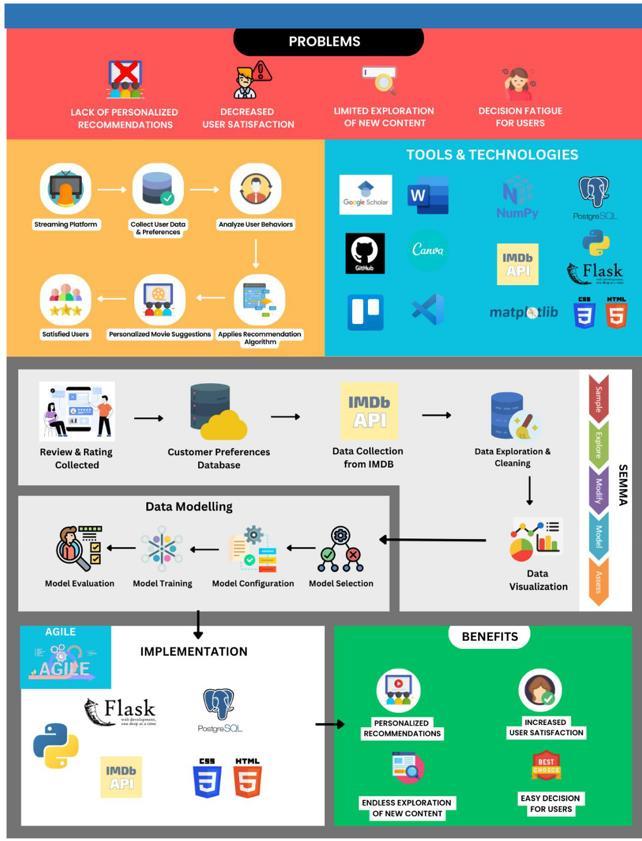
Fig -2:Developmentintegration.
8.1
During the stage of processing the data, the raw data on movies is obtained from various sources such as IMDb Python,awidelyusedprogramminglanguage,aswellasa number of its associated libraries, such as Pandas, are utilized so that data can be manipulated and cleaned. At thispointintheprocess,thedataiscleanedbyorganizing it, getting rid of duplicates, and dealing with values that are missing. By utilizing tools such as Jupyter notebooks, exploratory data analysis was made more simpler [28]. This made it possible to more quickly and readily gain insightsintothecharacteristicsofadataset.
During the process of making machine learning algorithms, the scikit-learn package in Python was given
the most attention This is because of its superior functionality.Withintheconfinesofthislibrary,anumber of different recommendation algorithms, such as those based on content, collaborative filtering, and hybrid approaches, are methodically developed and optimized. These algorithms make use of NumPy for numerical computations and Matplotlib for visual representations in a seamless manner, which contributes to an increased level of algorithm transparency [29]. The evaluation of models is a crucial part of this phase of the development process. During this part of the process, the accuracy of the recommendation algorithms is subjected to scrutiny The computation of fundamental metrics, such as Root Mean Squared Error (RMSE) and Mean Absolute Error (MAE), which serve as benchmarks for analyzing the performance of algorithms, is an integral part of this evaluation process [30]. This all-encompassing way of making machine learning algorithms ensures the creation of reliable and effective selection systems, which makes theuser'sexperienceofchoosingmoviesbetteroverall.
The backend development phase is centered on the establishmentoftheintricatelogicandfunctionalitiesthat underpin the recommendation system's operation. The backend was built using technologies like Python's Flask, which is a micro web framework, and machine learning techniques. This was done without any problems [31]. Because of this integration, the system is able to handle userdatainanefficientmanner,analyzeindividualtastes, and offer personalized movie suggestions in an expert manner. In addition to this, the backend design has a smooth interface with the database for which PostgreSQL was used, which makes it possible for user-related and movie-specific data to be retrieved and stored in an equally seamless manner [32]. This focused effort in backend development provided a fluid and dynamic interaction between the user interface and the recommendation algorithms, which ultimately improved the precision and relevancy of the movie suggestions that arepresentedtousers.
During the period of development known as frontend development, the user-facing interface was developed withtheuseofimportantwebtechnologiessuchasHTML, CSS, Bootstrap and JavaScript This frontend interface connected seamlessly with the backend by making API requests, which made it possible to easily retrieve userspecific movie recommendations that had been precisely designed. The use of an integrated development environment (IDE), Visual Studio Code was done so that thedevelopmentprocesscouldbestreamlined.Thisledto a significant improvement in both the effectiveness and quality of the frontend code. This rigorous approach to front-end development resulted in the building of an
International Research Journal of Engineering and Technology (IRJET) e-ISSN: 2395-0056
Volume: 11 Issue: 07 | July 2024 www.irjet.net p-ISSN: 2395-0072
intuitive and user-friendly interface that was able to interact without any friction with the back-end recommendation system [33]. As a direct consequence of this,theuserexperiencehasbeennoticeablyimproved.As a consequence of this, users are now able to effortlessly explore and discover tailored movie choices that are cateredtotheiruniquetastesandpreferences.
Thisresearchsetouttoconductanin-depthinvestigation of three important machine learning algorithms that are frequentlyusedinthemoviebusinessinordertooptimize movie recommendation systems and provide users with accurate and individualized movie ideas. The goal of this research was to provide users with correct and relevant movie suggestions. Major goal was to achieve a full knowledge of major three recommendation algorithms, which includes collaborative filtering, content-based filtering and hybrid techniques, as well as their functions in the generation of personalized movie recommendations, and this was done by conducting painstaking research and conducting extensive experiments[34].
In order to get the process started, each algorithm was meticulously configured by taking into account their numerous characteristics and then adjusting them until they reached their maximum potential. The Python programming language and its flexible libraries, like as NumPy, Pandas, and Scikit-learn, proved to be an invaluable resource when it came to the implementation and optimization of the algorithms. Main objective was to make certain that each algorithm is able to effectively handlelargevolumesofmoviedataandgeneraterelevant recommendationsinatimelymanner.
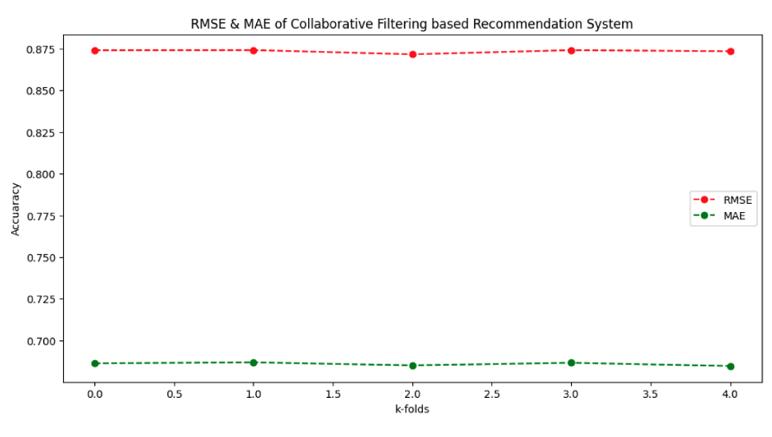
Chart -1:RMSE&MAEofCollaborativeRecommendation System
Theevaluationdatasetthatwasemployedfortheresearch played a pivotal role, and it included significant user ratingsandpreferencesfor movies [35].It wasabsolutely
necessary to have access to such a vast and varied data source in order to accurately evaluate the performance of the algorithms in forecasting the preferences and actions of the users. Because of the magnitude and complexity of the information, it was necessary to employ skilled data handling and manipulation strategies, which were then expertly implemented using Python modules. The researchers relied on two important metrics the Root MeanSquaredError(RMSE)andtheMeanAbsoluteError (MAE) in order to conduct a quantitative analysis of the correctnessofthemovie recommendations[36]. Withthe use of these measurements, measuring the differences between the projected movie ratings and the actual ratings provided by the users was possible, which provided us with essential insightsonthe performance of each algorithm. The outcomes of our trial and research revealed insightful takeaways of great value. The performance of content-based filtering was found to be limited when it came to capturing user preferences that wentbeyondmoviecharacteristics,despitethefactthatit displayed proficiency in making recommendations based on movie characteristics. Collaborative filtering, on the other hand, relied on user behavior to propose movies. It exhibited greater adaptability to individual preferences andencounteredfewerdifficultywhenitcametohandling sparsity and scalability issues, but it did meet these challengesperiodically.
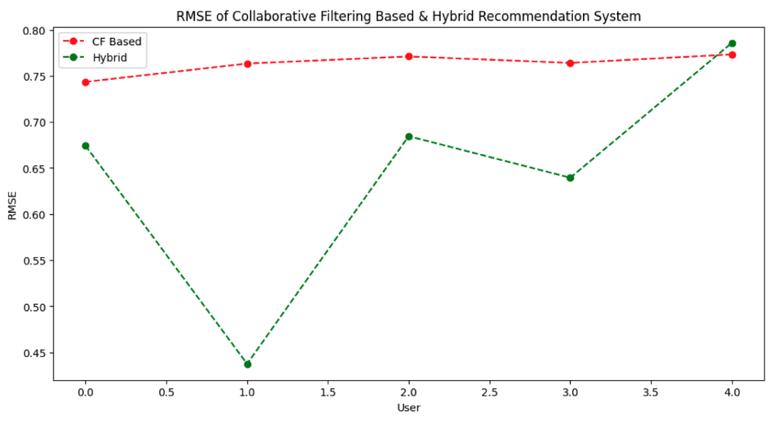
The hybrid recommendation algorithm stood out as the most promising alternative after being evaluated in light of the benefits and drawbacks associated with each individual technique. The hybrid approach skillfully merged the best features of content-based and collaborative filtering methods to address the limitations ofboth[37].Thehybridstrategyprovideda balancedmix of personalized and contextually appropriate movie recommendations by drawing on data relating to user activity and movie attributes. The comparative analysis that used RMSE and MAE provided more evidence of the superiority of the hybrid method. In comparison to content-based and collaborative filtering methods, its forecasts displayed a substantially reduced mistake rate,
Volume: 11 Issue: 07 | July 2024 www.irjet.net p-ISSN: 2395-0072
which is indicative of a higher degree of accuracy in its recommendations. The capability of the hybrid technique to reduce the number of incorrect predictions has increased user happiness, which has encouraged users to investigateandfindothermoviesthataretailoredtotheir preferences.
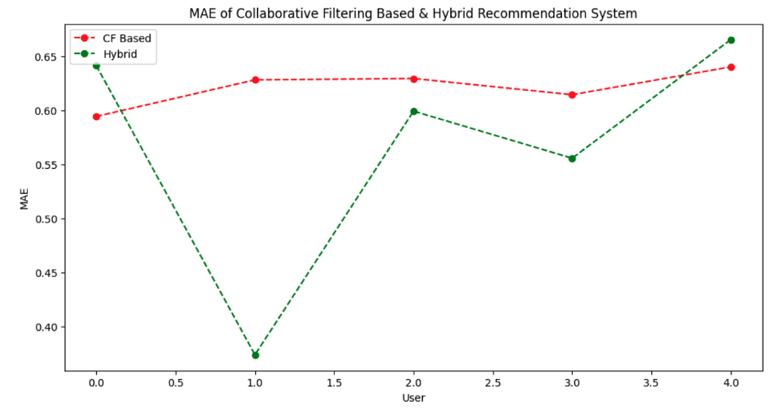
In addition, the study highlighted the adaptability of the hybrid algorithm to the various preferences of users as well as the ever-changing trends in the film industry. The hybrid strategy, which had the capability to continuously learn from user interactions, constantly modified recommendation strategies to match the ever-changing landscape of user preferences and trends. This versatility is particularly valuable in the dynamic movie industry, which is marked by continually shifting consumer preferences and industry trends. The findings of the research demonstrate the efficiency of the hybrid recommendation algorithm in terms of providing precise and individualized recommendations for movies. The hybrid approach provides a powerful option for movie platforms that are looking for ways to increase user engagement and happiness. This is accomplished by combining the benefits of content-based filtering with collaborative filtering. In the ever-changing landscape of the movie industry, the development and evaluation of these algorithms generated vital insights, setting the framework for constructing strong and efficient movie recommendation systems. Moving forward, the hybrid approach has a significant potential to alter the cinematic experience by empowering people to discover a large diversity of movies that cater to their specific tastes and preferences. This is because the hybrid approach combines elements of both traditional and digital filmmaking.
The study of a movie recommendation system's deployment uncovered a number of obstacles with the potential to negatively affect the system's effectiveness and the quality of the user experience. The lack of easy
access to complete and high-quality film databases was a major obstacle. While there are several movie databases available, it might be difficult to guarantee the data is correctandcomprehensive.Sometimes,recommendations for movies can be insufficient or misleading because they lacknecessaryinformationorcontainerrors.
The scarcity of available data also proved to be a serious obstacle. Most users only rate a small subset of movies, making it difficult to draw conclusions about their tastes and opinions. Since collaborative filtering algorithms rely so largely on user interactions and preferences, this sparsity hinders their capacity to provide correct recommendations [38]. Matrix factorization and other forms of advanced collaborative filtering can be used for rating prediction and sparsity reduction by way of data imputation. The configuration of the recommendation model was another obstacle. The success of the machine learning algorithms relies on the correct choice of parameters and hyperparameters. Algorithms have varying configuration needs, and if not properly established, they may not function as expected. This calls for a cycle of modifying and evaluating different parameters to arrive at the most precise and trustworthy suggestions.
Inaddition,thereareprivacyanddatasecurityissuesthat mustberesolvedbeforeamovierecommendationsystem can be implemented. When making suggestions, movie streaming services frequently collect private information fromusers,suchastheirmovietastesandviewinghabits. In order to prevent data breaches and maintain user privacy, it is crucial that this information be kept secure. To safeguard user information and guarantee conformity with data protection laws, strong data encryption and accesscontrolmethodsmustbebuiltintothesystem.The ever-changing landscape of user tastes and industry tendencies makes it difficult to keep a movie recommendation system fresh and accurate. Both users' preferences and the availability of new films will evolve over time [39]. For this reason, maintaining an accurate recommendation model through regular monitoring and updatesisessential.Recommendationscanbekeptup-todate and correct through the use of methods such as online learning, which enables the model to respond to real-timeinput.Solvingtheissueofaslowstartupfroma coldstartisanothermajor obstacle.Whennewuserssign upfortheserviceornewfilmsarereleased,thealgorithm may not have enough information to make accurate suggestions.Togetaroundthisproblem,untilenoughuser interaction data is collected, a hybrid recommendation approach can be used to provide early recommendations basedonmoviequalities.Big-scalemovieplatformswitha big user base can be hampered by the computational complexity of recommendation algorithms. Real-time suggestion generation and processing large datasets can putastrainonasystem.Improvecomputationalefficiency International Research Journal of Engineering and Technology (IRJET) e-ISSN: 2395-0056
Volume: 11 Issue: 07 | July 2024 www.irjet.net p-ISSN: 2395-0072
and user satisfaction by using effective algorithms and improving code implementation. Successful movie recommendation systems rely heavily on user input and feedback [40]. For the sake of system enhancement, it is crucial to gain insight into user happiness and to solicit feedback on the usefulness of recommendations. User feedback loops and sentiment analysis can be used to continuously assess the system's effectiveness and providepersonalizedsuggestions.
It is clear that there are several obstacles to overcome while developing a movie recommendation system, including those relating to data quality, algorithm setup, privacy, and the dynamics of the users themselves. To conquer these obstacles, cutting-edge methods, iterative tuning, and stringent safety precautions are required. Movie streaming services may improve customer retention and loyalty by removing these roadblocks and fostering more active users. Users can have a more fulfilling cinematic experience and increase their movie knowledge with the help of a well-optimized recommendation engine that suggests films that match theirspecificpreferences.
Severalmoralissuesarehighlightedduringtheprocessof creating and deploying machine learning algorithms for movie recommendation systems. In order for the algorithms to provide users with personalized and relevant movie recommendations, they must overcome inherent ethical obstacles involving issues of privacy, prejudice, transparency, and permission. Users' right to privacy is a major ethical issue Movie recommendation systems typically capture a vast swath of user data, including user preferences, viewing history, and demographics. Protecting this kind of private data is essential for avoiding abuse and leaks of personal information provided by users. Data encryption, permissionsmanagement,andsafestoragearejustfewof the must-haves for safekeeping of sensitive information. Thepotentialforrecommendationalgorithmstobebiased is also an important ethical factor to address. These systems learn from past user activity and ratings to provide recommendations. A lack of diversity in film suggestions may result from biased training data that reinforces preexisting prejudices and tastes [41]. To ensure diversity and justice in recommendations, it is thought that careful data curation and the application of approaches that minimize prejudice, such as fairnessaware algorithms, are required. In terms of ethics, recommendationsystems,transparencyandexplainability are essential features. Users can gain more faith in the system if they know the thought process behind the algorithms used to generate movie recommendations. Providing clear justifications for the choices made by "blackbox"algorithmsiscomplicatedbytheusageofdeep
learning models It is generally agreed that the recommendation process would benefit from greater opennessifinterpretablealgorithmsandmethods,suchas explainableAI,wereincorporated.
Giving users choice and control over their data is a major ethical concern. Movie streaming services must get consumers' explicit consent before collecting and using their data for personalized recommendations. Users shouldbeabletocontrolhowmuchoftheirdataisshared and how they share it. By making privacy rules and consent processes easily understandable, you give consumers more control over their personal information. It is also important to examine the possibility for unexpected repercussions when using recommendation algorithms. If people are only recommended specific genresofmovies,theymayneverbeexposedtonewideas or perspectives. This can reinforce preexisting tastes and preferences,makingitharderforpeopletofindnewfilms by chance [42]. Users need to be given a wide variety of film options while being protected from algorithminduced homogenization, thus finding a happy medium between the two is crucial. Furthermore, there are moral issues with using film reviews for commercial gain. Without taking into account users' interests and preferences, movie recommendations made just for financial gain might create a dishonest user experience and destroy confidence. A sustainable and ethical movie recommendation system must strike a compromise betweenbusinessneedsanduserwants.Thereisadanger that self-reinforcing loops that reinforce current preferences will form as movie recommendation algorithmscontinuouslylearnandadapttouserbehavior. This can prevent people from seeing a wide variety of content and prevent them from trying new things like indiefilmsorgenres.Inordertopromoteserendipityand freshness while still maintaining personalization, it is believed that careful algorithm design and content selection are required So, A more responsible and usercentric movie recommendation experience can be achieved by adhering to ethical principles throughout development to increase user trust, engagement, and satisfaction.
In spite of the fact that the system for recommending movies was developed and put into operation without a hitch,itisimportanttorecognizetheconstraintsthatwere placed on this project. To begin, the investigation only used previously collected data and did not include any data from the present moment [43]. As a direct consequence of this, the system's capability of real-time adaptation to quickly shifting user preferences was severely hindered. In addition, the research concentrated on a particular group of movie genres and user preferences, which might not have covered all of the
2395-0056
Volume: 11 Issue: 07 | July 2024 www.irjet.net p-ISSN: 2395-0072
varied interests of users to the fullest extent possible. In addition, the recommendation system was created and assessed inside of a regulated context, and real-life user interactions were replaced with computer simulations. Thiswasdonesothatthesystemcouldbemoreaccurately predicted. It's possible that user feedback and behavior willbedifferentintherealworld,despitethefactthatthe research provided useful insights into the efficacy of various recommendation systems. When interpreting the findingsandapplyingtherecommendationsysteminrealworld circumstances, it is important to keep these constraintsinmind.
The research project has uncovered important areas that need further development in order to improve the movie recommendation system. Integrating real-time data sources would improve responsiveness and adaptability, allowing the algorithm to dynamically adjust to shifting trendsanduserpreferences.Thiswouldbemadepossible by improving overall responsiveness and adaptability. Widening the range of film subgenres that are taken into account when making recommendations would appeal to a larger audience, whilst taking a more user-centric approachwouldresultinmorepreciseandindividualized choices [44]. The incorporation of social data, such as reviewswrittenbyusersandinteractionsonsocialmedia platforms, has the potential to improve the process of making recommendations and to encourage a sense of community among users. The effectiveness of the system could be evaluated using A/B testing with real users and thecollectionoffeedback todirectfurtherimprovements. It is absolutely necessary to continue research and developmenteffortsaimedatoptimizingrecommendation algorithms, particularly hybrid techniques, if one want to achievebothaccuracyandefficiency.Theconvenienceand involvement of users could be significantly improved by extending the recommendation system to mobile applications Ifthesefutureworkareasareaddressed,the movie recommendation system will be able to continuously improve in order to fulfill the requirements of its customers. A cutting-edge recommendation system can be developed by placing an emphasis on user-centric design, ongoing research, and advanced algorithm development. This will drive customer loyalty and businessexpansion.
This research conducted a comprehensive study of movie recommendation algorithms, aiming to provide optimal effectiveness in delivering accurate and tailored movie suggestions. The comprehensive examination of various recommendation procedures, such as collaborative filtering, content-based filtering, and hybrid approaches, revealed their advantages and disadvantages. The results
showed that hybrid recommendation systems performed better than their single-algorithm counterparts by providing users with more relevant and personalized movie recommendations. These hybrid models improved movie streaming services' ability to retain and attract customersbycombiningthestrengthsofmachinelearning anddata analytics.Limitationsindata availabilityandthe complexity of the model architecture presented problems for the project. These challenges were overcome by meticulously setting and assessing the algorithms to create a reliable and effective movie recommendation system. The ethical implications of the recommendation system were taken under careful consideration during its design and rollout. To increase users' faith in the system, we prioritized safeguarding their personal information, providing them with clear information, and making objective content recommendations. While the study did answertheinitialquestionsandgoals,itdidnotovercome alloftheproblemsthatwerefirstidentified.Dynamicuser preferences and real-world aspects could not be fully explored due to a lack of real-time data and the project's scope. Potential future enhancements include taking advantage of real-time data, including social interactions, andextendingthesystemtomobiledevices.Maintaininga competitiveedgeinthedynamicfilmindustrywillrequire constant investigation into and improvement of recommendationsystems.
[1] MyCarrier, "How Our Movie-Watching Culture is Changing," Dec. 21, 2021. [Online]. Available: https://mycarrier.telkom.co.id/article/how-ourmovie-watching-culture-is-changing.[Accessed:Jun.9, 2023].
[2] S. Apáthy, "History of recommender systems." [Online]. Available: https://onespire.net/news/history-of-recommendersystems.[Accessed:Jun.10,2023].
[3] G.Geetha,M.Safa,C.Fancy,andD.Saranya,"AHybrid Approach using Collaborative Filtering and Contentbased Filtering for Recommender System," 2018. [Online]. Available: https://iopscience.iop.org/article/10.1088/17426596/1000/1/012101.[Accessed:Jun.10,2023].
[4] S.-B. Tsai, "Personalized Movie Recommendation Method Based on Deep Learning," 2021. [Online]. Available: https://www.hindawi.com/journals/mpe/2021/6694 237/.[Accessed:Jun.11,2023].
[5] N. Tintarev and J. Masthoff, "The Effectiveness of Personalized Movie Explanations: An Experiment Using Commercial Meta-data," presented at the
International Research Journal of Engineering and Technology (IRJET) e-ISSN: 2395-0056
Volume: 11 Issue: 07 | July 2024 www.irjet.net p-ISSN: 2395-0072
RecSys '08, July 2008. [Online]. Available: https://www.researchgate.net/publication/2211361 98_The_Effectiveness_of_Personalized_Movie_Explana tions_An_Experiment_Using_Commercial_Meta-data. [Accessed:Jun.11,2023].
[6] F.Faisal,"Impactofcontrollabilityonusersatisfaction in movie recommendation system," Aug. 2022. [Online]. Available: https://www.researchgate.net/publication/3629441 17_Impact_of_controllability_on_user_satisfaction_in_ movie_recommendation_system. [Accessed: Jun. 11, 2023].
[7] S. Das, "Building a Movie Recommendation System with Machine Learning," Nov. 9, 2020. [Online]. Available: https://www.analyticsvidhya.com/blog/2020/11/cre ate-your-own-movie-movie-recommendationsystem/.[Accessed:Jun.11,2023].
[8] D. Hinkle, "How Streaming Services Use Algorithms," Aug. 18, 2021. [Online]. Available: https://amtlab.org/blog/2021/8/algorithms-in-streamingservices.[Accessed:Jun.11,2023].
[9] G. Denison, "Ethical considerations in research: Best practices and examples," Mar. 23, 2023. [Online]. Available: https://www.prolific.co/blog/ethicalconsiderations-in-research-best-practices-andexamples.[Accessed:Jun.12,2023].
[10] E. O. George, "Top 5 ethical considerations in research," Jan. 19, 2023. [Online]. Available: https://www.paperpal.com/blog/researcherresources/phd-pointers/top-5-ethical-considerationsin-research/.[Accessed:Jun.14,2023].
[11] P. Juneja, "Desk Research - Methodology and Techniques." [Online]. Available: https://www.managementstudyguide.com/deskresearch.htm.[Accessed:Jun.15,2023].
[12] KevinS, "Desk Research - a Vital Part of an Effective Market Research Strategy," Jul. 8, 2022. [Online]. Available: https://www.advantagemi.co.uk/post/desk-researchfinding-the-insight-gold-nuggets. [Accessed: Jun. 17, 2023].
[13] Abby, "Netflix: History, Founding, and Controversies," Dec. 2, 2022. [Online]. Available: https://historycomputer.com/netflix-history/. [Accessed: Jun. 19, 2023].
[14] R.Arun,"ACaseStudyonNetflixMarketingStrategy," Jul. 27, 2023. [Online]. Available: https://www.simplilearn.com/tutorials/marketingcase-studies-tutorial/netflix-marketing-strategy [Accessed:Jun.20,2023].
[15] Reco, "Netflix recommendation system: How it works," Apr. 5, 2022. [Online]. Available: https://recoai.net/netflix-recommendation-systemhow-it-works/.[Accessed:Jun.20,2023].
[16] L. Hardesty, "The history of Amazon's recommendation algorithm," Nov. 22, 2019. [Online]. Available: https://www.amazon.science/the-historyof-amazons-recommendation-algorithm. [Accessed: Jun.21,2023].
[17] Gokul, "Decoding Amazon's Recommendation System." [Online]. Available: https://www.argoid.ai/blog/decoding-amazonsrecommendation-system.[Accessed:Jun.22,2023].
[18] N.TintarevandJ.Masthoff, "Designingandevaluating explanations for recommender systems," in RecommenderSystemsHandbook,Springer,2010,pp. 479-510.
[19] G. Lobzhanidze, "Disney’s Customer Experience Excellence." [Online]. Available: https://www.qminder.com/blog/customerservice/disney-customer-experience/. [Accessed: Jun. 24,2023].
[20] Forbes, "How Disney Plus Personalizes Your Viewing Experience," Apr. 21, 2020. [Online]. Available: https://www.forbes.com/sites/insightsteradata/2020/04/21/how-disney-plus-personalizesyour-viewing-experience/.[Accessed:Jun.24,2023].
[21] N. K. Patel, "How Disney+ Hotstar is using Machine Learning and Artificial Intelligence," Oct. 21, 2020. [Online]. Available: https://www.linkedin.com/pulse/how-disneyhotstarusing-machine-learning-aritificial-patel/. [Accessed: Jun.24,2023].
[22] TechSathi,"Cinemaghar:ANewWayToWatchNepali Movies," Jan. 7, 2021. [Online]. Available: https://techsathi.com/cinemaghar-app. [Accessed: Jun.25,2023].
[23] N. Shrestha, "Cinemaghar Gold: A Nepali video streamingplatformwithgreatpromises,"Jan.3,2021. [Online]. Available: https://www.gadgetbytenepal.com/cinemaghar-goldstreaming-service/.[Accessed:Jun.25,2023].
[24] Martin Chautari, "The evolution of Nepali cinema: Understand major changes of 5 decades in 5 points," Apr. 12, 2023. [Online]. Available: https://english.onlinekhabar.com/the-evolution-ofnepali-cinema.html.[Accessed:Jun.25,2023].
International Research Journal of Engineering and Technology (IRJET) e-ISSN: 2395-0056 Volume: 11 Issue: 07 | July 2024 www.irjet.net p-ISSN: 2395-0072
[25] D.Cohen,M.Lindvall,andP.Costa,"Anintroductionto agilemethods,"Adv.Comput.,vol.62,no.03,pp.1-66, 2004.
[26] Nimble, "Overview of Agile Methodology." [Online]. Available: https://www.nimblework.com/agile/agilemethodology/.[Accessed:Jun.26,2023].
[27] M. Rogalewicz and R. Sika, "Methodologies of knowledge discovery from data and data mining methods in mechanical engineering," Management and Production Engineering Review, vol. 7, no. 4, pp. 97-108,2016.
[28] T. Kluyver et al., "Jupyter Notebooks a publishing formatforreproduciblecomputationalworkflows,"in Elpub,2016,pp.87-90.
[29] F. Pedregosa et al., "Scikit-learn: Machine learning in Python," The Journal of Machine Learning Research, vol.12,pp.2825-2830,2011.
[30] T. O. Hodson, "Root-mean-square error (RMSE) or meanabsoluteerror(MAE):whentousethemornot," Jul. 19, 2022. [Online]. Available: https://gmd.copernicus.org/articles/15/5481/2022/. [Accessed:Jul.4,2023].
[31] F. A. Aslam, H. N. Mohammed, and P. S. Lokhande, "EfficientWayOfWebDevelopmentUsingPythonAnd Flask,"Int.J.Adv.Res.Comput.Sci.,vol.6,no.2,2015.
[32] S. Paul, "Beginner's Guide to PostgreSQL," Feb. 2019. [Online]. Available: https://www.datacamp.com/tutorial/beginnersintroduction-postgresql.[Accessed:Jul.6,2023].
[33] J. Ortiz and A. Aryal, "Introducing Responsive Web Design in Web Development Instruction," ACET J. Comput.Educ.Res.,vol.16,no.1,pp.1-16,2022.
[34] T. Sebastian, "Collaborative Filtering vs. Hybrid Recommender System with practical Implementation in PyTorch," Aug. 22, 2022. [Online]. Available: https://medium.com/@tonydain9_78432/comparing -collaborative-filtering-based-recommender-andhybrid-recommender-system-cb785efdb15a [Accessed:Jul.6,2023].
[35] E. Çano and M. Morisio, "Hybrid recommender systems:Asystematicliteraturereview,"2017.
[36] S.NajafiandZ.Salam,"EvaluatingPredictionAccuracy for Collaborative Filtering Algorithms in Recommender Systems," [Online]. Available: https://kth.divaportal.org/smash/get/diva2:927356/FULLTEXT01.pd f.[Accessed:Jul.6,2023].
[37] SaturnCloud, "Hybrid Recommender Systems." [Online]. Available: https://saturncloud.io/glossary/hybridrecommendation-system/.[Accessed:Jul.10,2023].
[38] M. Goyani and N. Chaurasiya, "A review of movie recommendation system: Limitations, Survey and Challenges," ELCVIA: Electronic Letters on Computer VisionandImageAnalysis,vol.19,no.3,p.18,2020.
[39] B. Kumar and N. Sharma, "Approaches, issues and challenges in recommender systems: a systematic review,"IndianJ.Sci.Technol.,vol.9,no.47,pp.1-12, 2016.
[40] M. H. Mohamed, M. H. Khafagy, and M. H. Ibrahim, "Recommender systems challenges and solutions survey," presented at the 2019 International Conference on Innovative Trends in Computer Engineering(ITCE),pp.149-155,2019.
[41] K. Sorbán, "Ethical and legal implications of using AIpowered recommendation systems in streaming services,"2021.
[42] H. DeLeon, "The Ethical and Privacy Issues of Recommendation Engines on Media Platforms," Apr. 24, 2019. [Online]. Available: https://towardsdatascience.com/the-ethical-andprivacy-issues-of-recommendation-engines-onmedia-platforms-9bea7bcb0abc. [Accessed: Jul. 12, 2023].
[43] D. Croushore, "Frontiers of real-time data analysis," Journal of Economic Literature, vol. 49, no. 1, pp. 72100,2011.
[44] B. Marr, "How To Use Real-Time Data? Key Examples And Use Cases," Mar. 14, 2022. [Online]. Available: https://www.forbes.com/sites/bernardmarr/2022/0 3/14/how-to-use-real-time-data-key-examples-anduse-cases/.[Accessed:Jul.16,2023].