
International Research Journal of Engineering and Technology (IRJET) e-ISSN: 2395-0056
Volume: 11 Issue: 06 | Jun 2024 www.irjet.net p-ISSN: 2395-0072
International Research Journal of Engineering and Technology (IRJET) e-ISSN: 2395-0056
Volume: 11 Issue: 06 | Jun 2024 www.irjet.net p-ISSN: 2395-0072
Nitinchand Patil1 , Viraj Jadhav2 , Rajesh Adam2
1Associate Professo, Dept. of Mechanical Engineering, NK Orchid college of Engineering & Technology, Solapur, Maharashtra, India
2UG Students, Dept. of Mechanical Engineering, NK Orchid college of Engineering & Technology, Solapur, Maharashtra, India ***
Abstract - The rubber industry generates a significant amount of airborne nylon particles, posing a serious health hazard to workers and contributing to environmental pollution. To address this issue, one of the main challenges is the development of efficient and cost-effective methods for producing nylon particles with the desired properties. Nylon particles must be small enough to capture, but they must also be large enough to be easily filtered out of the air. A novel nylon particle arresting system has been designed. This system effectively captures and removes nylon particles from the air, creating a cleaner and safer work environment.
Key Words: Nylon Fiber, Rubber Particles, Air Pollution, Tyre, Recycling, Human Health.
1. INTRODUCTION
Everyyearhugenumbersoftyresoffourandtwowheelers have been replaced with new one. Hence there is need to process the used tyres on daily basis because of large quantity. India is the world’s third largest producer and fourthlargestconsumerofnaturalrubber.Theautomobile industry is the largest consumer of rubber in India. India produces 6.5 lakh tyres every day Looking to the rate of growthoftheautomobileindustry,thetyreproductionwill increaseexponentiallyinfuture.Itwasreportedthataround 80.1millioncarsandutilityvehiclesand236.4milliontwo wheelerswillbeontheroadsby2035. Itwasestimatedthat everyyear nearabout 1.6 billionwastetyres is generated worldwide.Indiacontributes6%ofthewastetyre.Indiahas big market of tyre recycle. Tyre recycle industry in India importsaround300000tonnesoftyreseveryyear.Theyare subjecttothermochemicaltreatmentsandseparationinhigh temperaturetoproduceofrubber,nylon,industrialoiland otherderivatives.
Pollution from these tyre recycling industries is a big concern.Everyyearmanyrubberortyrerecyclingindustries were shut down after finding that the units were flouting environmentalnormsandwereresponsibleforhighlevelsof pollution[1]
GujratRubberPolymerisonesuchunitwheretheusedtyres areprocessed.Themajorobjectivesoftheprocessingunit aretoextractrubberandthenylonfromit.Thisextractedor
recycled rubber is used to manufacture tyres. The nylon strands separated from the tyre rubber is also reused in variousapplications.
Theairpollutionisoneofthegreatestscourgesofthisera.It notonlyaccountforitsimpactonclimatechangebutalsoits impact on public and individual health due to increasing morbidityandmortality.Therearemanypollutantsthatare majorfactorsindiseaseinhumans.Amongthem,Particulate Matter(PM),particlesofvariablebutverysmalldiameter, penetrate the respiratory system via inhalation, causing respiratoryandcardiovasculardiseases,reproductiveand central nervous system dysfunctions, and cancer [2] The effectofPMisillustratedinthetable1[3]
Table-1 Particlesizeanditspenetration
Particle size(μm)
>11
7-11
4.7-7
Penetration degree in human respiratory system
Passageintonostrils
Passageintonasalcavity
Passageintolarynx
Researchwascarriedintheresidentialindoorroomsforthe airpollutionanditwasobservedthatSyntheticfragments and fibres accounted, on average, for 4% of the total identifiedparticles,whilenonsyntheticparticlesofprotein and cellulose constituted 91% and 4%, respectively. Polyester was the predominant synthetic polymer in all samples(81%),followedbypolyethylene(5%),andnylon (3%) [4] The significance of recycling of waste rubber in protecting the environment and conserving energy is discussed.Various kindsof recyclingapproaches towaste rubberaresummedup.[5]
Chronic exposure studies suggest relatively broad susceptibility to cumulative effects of long-term repeated exposure to fine particulate pollution, resulting in substantive estimates of population average loss of life expectancyinhighlypollutedenvironments.[6]
Inthisresearchworkthecausesofairbornenylonparticles were investigated and the solution to arrest these air
International Research Journal of Engineering and Technology (IRJET) e-ISSN: 2395-0056
Volume: 11 Issue: 06 | Jun 2024 www.irjet.net p-ISSN: 2395-0072
pollutantnylonparticleswasdesignedandsubmittedtothe industryforimplementation.Thiswillhelpinreducingthe indoorairpollution.
In this work, the process of the recycling tyre was investigated.Themajorfocuswasonidentifyingthecausesof airborne nylon particles in the indoor environment. After extensivefloorstudy,majornylonairbornelocationswere identified.
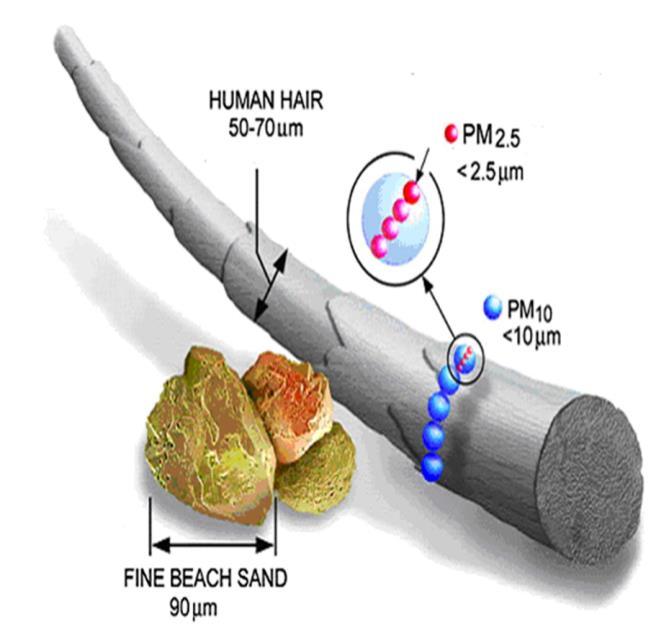
As per the World Health Organization (WHO) estimates, particulate matter (PM) air pollution is leading cause of mortality worldwide. Approximately 800,000 premature deathseachyearisreportedduetoPMairpollution.Many studiesreportedtheeffectandrelationshipbetweenPMair pollutionresponsibleforrespiratoryillness Morefocuswas giventostudyeffectofPMairpollutiononthecardiovascular system. It was revealed through the research that lung function,respiratorysymptomsandmortalityarethemajor areas of concerns due to PM air pollution [7] The size of particlesplaysmajorroleinthepotentialforcausinghealth problems.Therearetwokindofparticleswhichareinhalable coarseparticleshavingdiameterof2.5to10μmandsecond oneisfineparticleshavingdiametersmallerthan2.5μm[8]. The comparison of particle size shown in fig.1 was demonstratedbyGuaitaR[9]
Itiscommonfactthat,thePMconcentrationlevelsinindoor environment is more than those of outdoors. Several activitiescangenerateparticulatesinindoorenvironmentfor examplecooking,pets,walkingacrossthecarpet,household products washing machines and office equipment such as printersandphoto-copiers. Theconstructionmaterialsof the house, the arrangement and size of rooms, and the
numberofwindowsforventilationmayberesponsiblefor PM.[10]
Itwasobservedthattheparticleshavingdiameterlessthan 10μmhavethemostimpactonhumanhealthandothersize particles have less impact. Due to their excessive penetrability,theparticlescanpenetrateintherespiratory tractanditstartwiththenasalpassagestothealveoli and fromthereintothelungs[11].Dependingontheparticlesize, itsdepositiondepends.5and10μmparticlesdepositsinthe tracheobronchialtreeand1and5μmparticlesdepositsin therespiratorybronchiolesandthealveoli[12].Thereisgas exchange in the lungs and can even penetrate the lung. Finally, it will lead to major health problem by the blood stream 1μmandlesssizeparticlesingeneralbehavelikegas molecules. It penetrates the alveoli and finally it may translocateintothecelltissue[13].Therewasadatawhich showedthat8%increaseinlungcancermortalityfora10 μg/m3 elevation in PM2.5 [14]. (Pope et al., 2002). The relationshipbetweenlungcancermortalityandairpollution havealsobeendemonstrated[15].(Dockeryetal.,1993)
Figure2.showstheflowdiagramoftyrerecyclingprocess installedatGRP.Theusedtyresweredumpedintheopen storearea.Thenitwasbroughttowashingcenterandsentto primarycutters.Thecuttyrepiecesarefedtoshredderand thenitispassedontogrinderwherethenylonandrubber wereseparated.Theconveyorbeltwithmeshwereusedto separatethenylonandrubber.
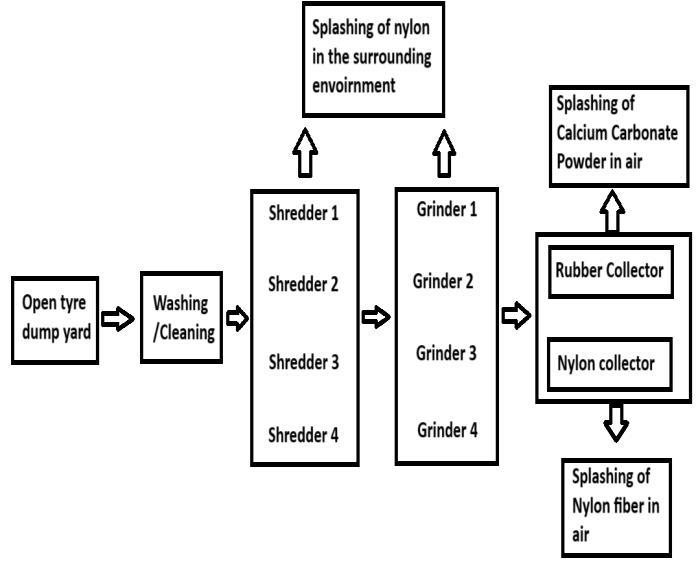
Fig.2. Flowdiagramoftyrerecyclingprocess
Thedetailedinvestigationoftheprocesshelpedtoidentify the spreader locations. Visual inspection and experiential investigationwerecarriedouttolocateexactpointsofair pollutions.
www.irjet.net p-ISSN: 2395-0072
population.ManycitiesofIndiaisexperiencingrapidurban growth. Because of this huge urbanization, WHO found majorIndiancitiesaremostpollutedcitiesduetoparticulate matterairpollution.106.38and58.59μg/m3wastheannual averageconcentrationsofPM10andPM2.5inIndiancities respectively reported by WHO (2018) [17]. It was also observed in a study that 1 million deaths annually are related to PM in India. This number is 1/7 of the global deathsandinSouthandSoutheastAsianregionitamounts 69%[18].
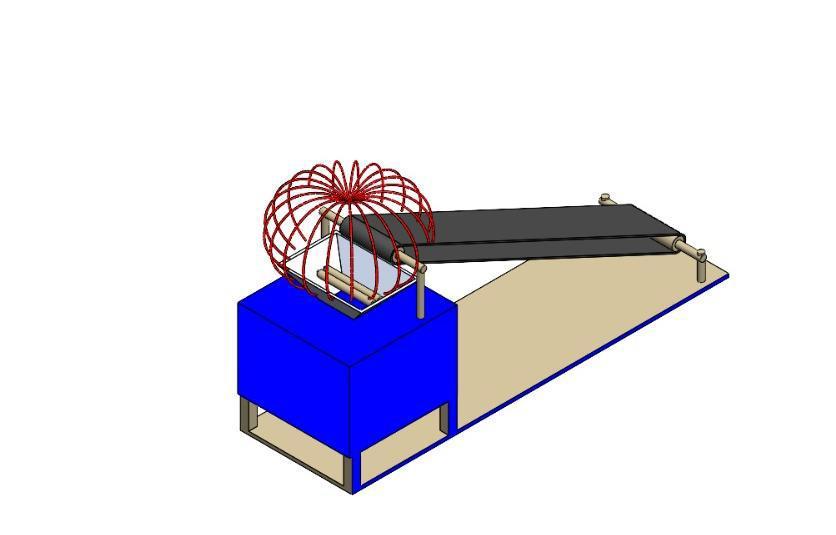
Thesimplesolutiontoarrestthespreading particleswere designed. An umbrella balloon was designed to catch the splashing nylon particles. These nylon fiber arresting umbrellaballoonsweremountedateachsplashinglocation.
Becauseofthelightweightofsplashingparticlesnylonfiber andrubberparticles,therewasneedtoavoidsplashingof these particles. It can be done by two methods firstly by modifyingtheprocessitselfandsecondlybyarrestingthe splashingparticles.Modifyingtheprocessispossiblebutitis not economical and whole process need to be revamped. Second method of arresting the particles is easy and economical.
Figure 3 show the flying particle arresting mechanism designedtocollecttheflyingparticlesintheclosedchamber. When the conveyor releases the crushed tyre rubber and nylonparticlesinthehopper,thelightweightparticlesflyin the air. This designed mechanism does not allow the particlestomixwithair.Itpreventstheparticlesandfibers fromsurroundingatmosphereandhenceair.
The umbrella balloon is made up of the polyester fabric material available at local market and the wire frame is designedandfabricated.Theumbrellawireframeiscovered withthehelpoffabricmaterial.Theumbrellawireframeis mounted at the top of the hopper where the conveyor releases the crushed rubber and nylon fibers. When the crushedrubberandnylonflyintheair,theumbrellaarrest theparticlesandarecollectedinthecollectingringprovided atthebottomoftheumbrella.
3. Results and Discussion
ArecentstudyfromtheWorldHealthOrganization(WHO) shows that PM concentration is linked to 7 million global deathsperannumwithahighcontributionfromSoutheast Asia and Western Pacific regions. These deaths are attributedto6%lungcancer,33%strokeand36%ischemic heartdiseaseasperWHOreports(2014)[16].Urbanization rateofIndiaishighestinAsiancountriesanditis31%.Itis predicted that by 2050, it would add 416 million urban
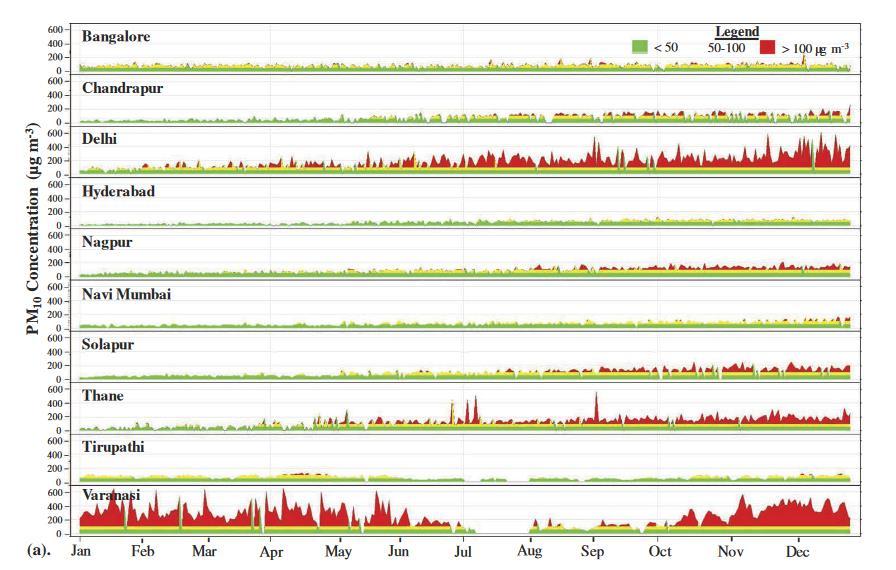
Figure 4 shows the daily PM10 concentration trend in 10 selected cities in India. In these selected cities, Varanasi, Delhi and Thane has high PM10 value of 261.92 μg/m3 186.83 μg/m3 and 132.51 μg/m3 respectively. Compared with these, other cities reported 48.26 and 98.79 μg/m3 PM10concentration Itwasalsofoundthatasmallcitylike Solapurisrecorded200μg/m3PM10concentrationbecause ofdustyatmosphereduetodryland[19]
Theobservedresultsshowthatbyemployingthedeveloped mechanism,theairpollutionatallthegrinderlocationwas reduced by about 60%. In few of the locations it was observed that air pollution due to flying nylon fiber was reduced by 80%. The rubber dust spread over the surroundingfloorwasalsoobservedtobereducedbyabout 70%.
Asthehumanhealthisatriskduetoairpollutionandthat too because of PM2.5 and PM10,there wasneed to either modifytheprocessesresponsibleforpollutionortodesigna mechanismtoarrestthepollutingparticles.Inthiswork,a mechanismwasdesignedtoarresttheflyingnylonfiberand rubberparticlesinanindoortyrerecyclingindustrylocated at Solapur, Maharashtra. It was observed that the air pollutionduetonylonfiberwasreducedby60-80%.Theair pollutionduetorubberparticlewasreducedby70%.This willhelpinprotectingthehumanlife.
International Research Journal of Engineering and Technology (IRJET) e-ISSN: 2395-0056
[1] AathiraPerinchery,“TreadCarefully:DraftNotification Wants Tyre Companies to Take Charge of Waste,” Jan 2022,TheWire.
[2] Ioannis Manisalidis, Elisavet Stavropoulou, AgathangelosStavropoulos,andEugeniaBezirtzoglou, “EnvironmentalandHealthImpactsofAirPollution:A Review,”FrontPublicHealth,February2020,Volume8, Article14,pp1-13.
[3] Hiba Gul and Bijay Kumar Das, “The Impacts of Air Pollution on Human Health and Well-being: A Comprehensive Review,” October 2023, Journal of EnvironmentalImpactandManagementPolicy.
[4] Alvise Vianello, Rasmus Lund Jensen, Li Liu & Jes Vollertsen, “Simulating human exposure to indoor airborne microplastics using a Breathing Thermal Manikin,” June 2019, Scientific Reports volume9, Articlenumber:8670
[5] Yi Fang, Maosheng Zhan & Ying Wang, “The status of recycling of waste rubber,” April 2001, Materials & Design22(2),123-128
[6] C. Arden Pope III, Epidemiology of Fine Particulate Air Pollution and Human Health: BiologicMechanismsandWho'satRisk,”Environmental HealthPerspectivesVolume108,Issuesuppl4,August 2000Pages713–723
[7] Jonathan O. Anderson, Josef G. Thundiyil & Andrew Stolbach, “Clearing the Air: A Review of the Effects of Particulate Matter Air Pollution on Human,” Health Journal of Medical Toxicology, 2012, Volume8,pages 166–175
[8] Ki-HyunKim,EhsanulKabir,ShaminKabir,“Areview on the human health impact of airborne particulate matter”EnvironmentInternationalVolume74,January 2015,Pages136-143
[9] GuaitaR,PichiuleM,MateT,LinaresC,DiazJ,“Short-term impact of particulate matter (PM2.5) on respiratory mortality in Madrid,” Int J Environ Health Res 2011, 21:260–74.
[10]Madureira J, Paciência I, Fernandes EO, “Levels and indoor–outdoorrelationshipsofsize-specificparticulate matter in naturally ventilated Portuguese schools,” J ToxicolEnvironHealthA2012;75(22–23):1423–36
[11]Londahl J, Pagels J, Swietlicki E, Zhou JC, Ketzel M, MasslingA,“Aset-upforfieldstudiesofrespiratorytract deposition of fine and ultrafine particles in humans,” J AerosolSci2006;37(9):1152–63.
[12]Londahl J,MasslingA, PagelsJ,SwietlickiE,VaclavikE, LoftS,“Size-resolvedrespiratory-tractdepositionoffine and ultrafine hydrophobic and hygroscopic aerosol particles during rest and exercise,” Inhal Toxicol 2007;19(2):109–16.
[13]Valavanidis A, Fiotakis K, Vlachogianni T, “Airborne particulate matter and human health: toxicological assessmentandimportanceofsizeandcompositionof particles for oxidative damage and carcinogenic mechanisms,” J EnvironSci HealthC Environ Carcinog EcotoxicolRev2008;26(4):339–62.
[14]PopeCA3rd,BurnettRT,ThunMJ,CalleEE,KrewskiD, Ito K, Thurston GD, “Lung cancer, cardiopulmonary mortality,andlong-termexposuretofineparticulateair pollution,”2002,JAMA287:1132–1141
[15]DockeryDW,PopeCA3rd,XuX,SpenglerJD,WareJH, FayME,FerrisBGJr,SpeizerFE.,“Anassociationbetween airpollutionandmortalityinsixU.S.cities,”NEnglJMed 329,1993,1753–1759.
[16]WHO.2014.Worldhealthorganizationreleases7million premature deaths annually linked to air pollution. http://www.who.int/mediacentre/news/releases/2014/ air-pollution/en/.
[17]WHO. 2018. Global ambient air quality database 2018 update. https://www.who.int/airpollution/data/cities/en/
[18]Shi Y, Matsunaga T, Yamaguchi Y, Li Z, Gu X, Chen X, “Long-term trends and spatial patterns of PM2.5inducedprematuremortalityinSouthandSoutheastAsia from1999to2014,”SciTotalEnviron,2018,615:177–186.
[19]N.ManojkumarandB.Srimuruganandam,“Healtheffects ofparticulatematterinmajorIndiancities”International Journal of Environmental Health Research Volume 31, 2021-Issue3,258-270.
Volume: 11 Issue: 06 | Jun 2024 www.irjet.net p-ISSN: 2395-0072 © 2024, IRJET | Impact Factor value: 8.226 | ISO 9001:2008