
International Research Journal of Engineering and Technology (IRJET) e-ISSN: 2395-0056
Volume: 11 Issue: 06 | Jun 2024 www.irjet.net p-ISSN: 2395-0072
International Research Journal of Engineering and Technology (IRJET) e-ISSN: 2395-0056
Volume: 11 Issue: 06 | Jun 2024 www.irjet.net p-ISSN: 2395-0072
Shivani Nai1 , Mr.Nagendra Kumar2, Mr. Prateek Gupta3
1Reseacrh Scholar, Department of CSE, Shri ram Institute of Science and Technology, Jabalpur, M.P.
2Professor, Departmet of CSE, Shri Ram Institute of Science and Technology, Jabalpur, M.P.
3Professor, Departmet of CSE, Shri Ram Institute of Science and Technology, Jabalpur, M.P.
Abstract – Diabetesisachronicdiseasethatoccurswhen thebodycannotuseinsulinproperlyorthepancreascannot produce enough hormones to control blood sugar. High bloodsugarisasymptomofdiabetes,agroupofmetabolic diseases.Thetwomostcommontypesofdiabetesaretype1 and type 2, but there are other types, such as gestational diabetes,whichoccurduringpregnancy.Thereisanincrease inthenumberoftype1diabeticpatients.Thegeneticdisease called type 1 diabetes has a long incubation period and usually manifests itself early in life. People with type 2 diabeteshavecellsthatdonotrespondtoinsulin.Itchanges over time and mostly depends on people's lifestyle. Accordingtothe2022reportoftheinternationaldiabetes federation,approximately382millionpeopleworldwideare currentlyliving withdiabetes.Thisnumberisexpected to increaseto592 million in2035.Oneof themostcommon causes of tissue and organ damage and dysfunction, includingblindness,kidneyfailure,heartfailure,andstroke, is diabetes. Therefore, early diagnosis of diabetes is important. This project focuses on the use of machine learning such as logistic regression, knn, svc, ann, and random forest to predict diabetes. Each algorithm is calculated to determine the accuracy of the model. Additionally,thehighestaccuracyof96.00%wasachievedin logistic regression using the pso-based optimization technique.
Keywords: Diabetes Detection, Blood Glucose, Feature Selection,MachineLearning,deepLearning,PSO,Accuracy.
Diabetes is a non-communicable disease that affects the control of blood sugar levels in the body. Blood glucose concentrationisnormallyregulatedbyinsulinandglucagon, twohormonessecretedbythebeta(β)andalpha(α)cellsof the pancreas, respectively. The normal release of the two hormonesregulatesbloodsugarlevelsinthebodybetween 70 - 180 mg/dl (4.0 - 7.8 mmol/l). Insulin lowers blood sugar, while glucagon increases blood sugar. However, abnormalityofthesehormonescanleadtodiabetes.There are many types of diabetes, many different types, but the mostcommontypesaretype1diabetes,type2diabetesand gestationaldiabetes(gdm).Type1diabetesismorecommon inchildren;whiletype2diabetesismorecommoninadults and the elderly, gdm is more common in women and is
diagnosedduringpregnancy.Whileinsulinsecretion does not work in type 1 diabetes due to the destruction of pancreaticbetacells,thereisadisorderininsulinsecretion andfunctionintype2diabetes.Gdmisaglucoseintolerance first diagnosed during pregnancy; it may be mild, but it is alsoassociatedwithhighbloodsugarandhighinsulinlevels duringpregnancy.Allofthesetypescancausealackofblood sugarinthebody,whichcanleadtoseriousdiseasesinthe body.Inotherwords,whenbloodsugarrisesabovenormal, this condition is called hyperglycemia. On the other hand, whenitdecreasesandfallsbelownormal,theconditionis calledhypoglycemia[3]-[5].Forexample,hyperglycemiacan cause chronic problems and lead to kidney disease, retinopathy,heart disease andothertissuedamage, while hypoglycemia can cause temporary short-circuits. It can causekidneydisease,retinopathy,heartandheartdisease, andothertissuedamagecanleadtodiabeticcoma[1],[3], [4].Diabeteshasbecomeanimportanthealthproblem in today'sworldduetoitsprevalenceinchildrenandadults. According to [6] , [7] , approximately 8.8% of adults worldwide had diabetes in 2015, and this number was approximately 415 million and is expected to reach approximately642millionby2040.Duringthistime,more than 500,000 children were killed and approximately 5 millionpeopledied.Ontheotherhand,theglobaleconomic burdenofdiabeteswasestimatedtobeapproximately673 billiondollarsin2015,andisexpectedtoreach802billion dollars in 2040. Self-monitoring of blood glucose (smbg) usingfingertipbloodglucosemetersisadiabetestreatment method introduced three years ago [8], [9]. In this way, diabeticsinvasivelymeasuretheirbloodsugarlevelsthree tofourtimesadaybyusingathumbglucometertoprickthe skinoftheirfingers.Theideaistoprovidethis:toincrease insulinresistance.However,inadditiontobeinglaborious andlaborious,thismethodcanonlybeunderstoodifinsulin estimation is obtained from small smbg samples. In other words, this may cause the blood sugar in the blood to be higherthannormal.Toovercomethisproblem,continuous bloodglucosemonitoring(cgm)hasbeenintroduced,which canprovidemaximuminformationaboutchangesinblood sugarwithinafewdays,allowingagoodtreatmentdecision tobemadeforpeoplewithdiabetes.Inthisway,bloodsugar concentration is constantly monitored thanks to small devices/systemsthatmonitortheglucoselevelintheblood environment. These systems can be invasive, minimally invasive or noninvasive. Moreover, cgm systems can be
International Research Journal of Engineering and Technology (IRJET) e-ISSN: 2395-0056
Volume: 11 Issue: 06 | Jun 2024 www.irjet.net p-ISSN: 2395-0072
dividedintotwotypes:retrogradesystemsandimmediate systems[10].Theintroductionandavailabilityofnewtypes ofcgmdevices/machineshavebroughtnewopportunities for diabetics to easily manage their diabetes. Most cgm devices today often use a minimally invasive device to calculateandrecordthepatient'scurrentbloodsugarevery minute by measuring interstitial fluid (isf). These systems/deviceshavelittleeffectbecausetheydamagethe skinbutnotthebloodvessels.Therearealsonon-invasive methods to measure blood glucose concentration, such as usingelectricalcurrentthroughtheskinintobloodvesselsin thebody[11].
Additionally,e-healthintheformoftelemedicinenotonly allowsdoctorstoseepatientsregularlyremotely,butalsoto send cgm to the hospital's remote database to predict hypoglycemia/hyperglycemia and other complications in diabetes management. One of the challenges of diabetes management is the prevention of hypo/hyperglycemic events; this can be overcome by estimating blood sugar levelsbasedoncgm/smbgandothermethods(e.g.Exercise, diet,insulin,etc.).Therefore,itisimportanttodeveloptools forprocessingandinterpretingcgm/smbgandblood-related datatoobtainfuturebloodglucoseresults.Forthispurpose, dataminingplaysanimportantroleinthedevelopmentof tools such as diabetes diagnosis and prediction [12], [13]. Data mining is the process of extracting important information from large amounts of data to discover previously unknown patterns, patterns, and relationships thatcanbeusedtodeveloppredictivemodels[14].Inthe literature, different data mining-based blood sugar predictionmethodsandmethodshavebeendevelopedwith various models. This technology extracts, analyzes and interprets diabetes data to make medical decisions. A generalflowisshownbelow:
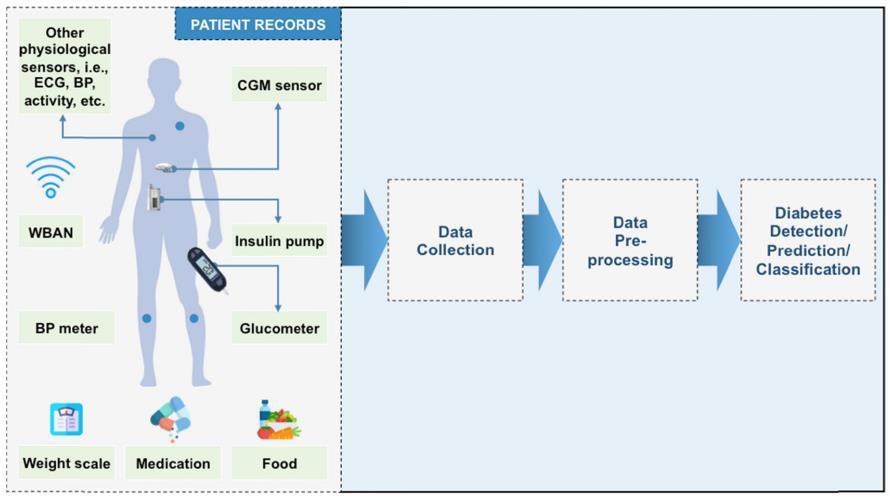
Fig.1.1: Agenericflowofdiabetesdetectionand predictiontechniques[15].
The motivation for using machine learning for diabetes diagnosisstemsfromitsabilitytoimprovetheaccuracyand efficiency of diabetes diagnosis, prediction, and management.Diabetesmellitusisatypeofmetabolicdisease causedbyhighbloodsugarlevels,andearlydiagnosisand
intervention are crucial for effective treatment and preventionofcomplications.Herearesomemotivationsfor usingmachinelearningfordiabetesdiagnosis:
1.Earlydetectionandprevention:machinelearningmodels can analyze large amounts of data, including patient data, genetics,andlifestyledata,toidentifypatternsthatindicate diabetesrisk.Earlydetectionleadstotimelyintervention, changes in life, and prevention of infection. Improved accuracy:machinelearningalgorithmscanprocessdifferent datasuchasgeneticdata,medicalhistoryandlifestyle.By consideringmanyvariables,thesemodelscanprovidemore accurate predictions and help doctors make informed decisions. Personalized medicine: machine learning can create personalized treatment plans based on patient information. This approach takes into account the unique characteristics of each patient, allowing interventions to better control diabetes and improve overall health. It can improve early diagnosis, increase accuracy, advance personalized medicine, and provide better and more effectivetreatmentforpeoplewithdiabetes.
Smart devices have the potential to revolutionize the management and treatment of diabetes by providing a personalized, data-driven approach [16]. Below are a few applicationsofwisdomindiabetesmanagement:
1.Itprovidesinsightintodifferentpatternsandpredictsthe nextstageofdiabetes.Thisallowspatientsanddoctorsto makebetterdecisions.Thishelpsdiabeticsandhealthcare professionalsmanagediabetes.Effectiveuseofinsulin[17]
-closed-loopsystem:artificialintelligence-supportedclosedloopinsulindeliverysysteminstantlyautomaticallyadjusts the insulin dose according to blood sugar. This system is designed to control blood sugar in a single target without havingtoconstantlydealwithitmanually.Recommendsthe bestdietforinsulinsensitivity.Medicationcomplianceand personalcareplanning
-artificial intelligence supported applications: mobile applicationsequippedwithartificialintelligencecanremind patients to take medications, monitor compliance, and provide recommendations for lifestyle changes based on personalhealthinformation.-Personalizedtreatmentplan: artificial intelligence can analyze various patient data, including genetic information, to create a personalized treatment plan. This will help improve drug selection and dosage to achieve good results [18]. Early detection of problems-retinalscanning:artificialintelligencealgorithms cananalyzeretinalimagestodetectearlysignsofdiabetic retinopathy, a complication of diabetes. Early diagnosis allowsfortimelyinterventionandpreventionofblindness [19].Thisleadstoearlyinterventiontopreventtheproblem. Patienteducationandsupport
International Research Journal of Engineering and Technology (IRJET) e-ISSN: 2395-0056
Volume: 11 Issue: 06 | Jun 2024 www.irjet.net p-ISSN: 2395-0072
-chatbots and virtual assistants: ai-powered chatbots can provide ongoing support to diabetic patients, provide information, answer questions, and help manage lifestyle. Patient behavior data to identify patterns to help doctors tailor education and support to meet specific needs and problems. This should be done in collaboration with healthcare providers to ensure a balance between technologyandpersonalcare.Regulatoryandethicalissues also need to be considered to ensure the safety and effectivenessofaiapplicationsinhealthcare.
2.2 Detection of diabetic behaviour using machine learning
Machine learning algorithms can be used to diagnose diabetes by analyzing different types of data, including clinicaldata,diagnoses,andevennon-traditionaldatasuch asimagedata[20][21].Herearesomewaystousemachine learningtodiagnosediabetes:
1.Medicaldataanalysis:
-predictivemodels:machinelearningmodelscanbetrained basedonmedicalhistorydatatopredictdiabetesrisk.These models often take into account factors such as age, body mass index (bmi), family history and lifestyle. . This will includeinformationaboutbloodsugarlevels,hba1cvalues andotherclinicalsigns.Labresults:
-bloodtestsandbiomarkers:machinelearningcananalyze bloodtestresultsanddiabetesbiomarkerssuchasincreased blood sugar, hba1c levels, and lipid profile. Algorithms identifypatternsandpatternsthatmayindicatediabetesor diabetes.Imagingdata:
-retinalimaging:machinelearningalgorithmscananalyze retinalimagestodetectsignsofdiabeticretinopathy,aneye disease associated with diabetes. Early diagnosis of retinopathyisimportanttopreventvisionloss.
4.Geneticinformation:
- Genomic analysis: machine learning can analyze genetic information to identify genetic markers or patterns associated with diabetes risk. This method is part of the developmentofprecisionmedicine.Mobilehealth(mHealth) data:
-Wearable: machine learning algorithms can analyze data from wearable devices that track physical activity, sleep patterns, and other life factors. This information will be helpfulinassessingdiabetesrisk.Behavioranalysis:
-Healthbehaviormonitoring:machinelearningcananalyze behavioraldatasuchasfoodintake,physicalactivitylevels, andmedicationadherence.Changesinbehaviormayindicate theneedforfurtherevaluation.Federateddatamodels:
- Integration of multiple data sources: many machine learningmodelsbenefitfromcombiningdatafrommultiple sources. Comprehensive models that take into account clinicaldata,genetics,andlifestylefactorscanprovidemore accurate prediction of diabetes risk. It is important to rememberthatmachinelearningcanbea valuabletoolin diagnosing diabetes, but it must be supported by clinical information.Interpretingpatientcareandmakingdecisions isbestaccomplishedthroughthecollaborationofhealthcare professionals and intelligent tools. Additionally, ethical considerations and patient identity should be prioritized when developing and implementing machine learning modelsforclinicaluse.Thecollaborationwascarriedoutas shown in [22], which investigated and analyzed methods based on diabetes diagnosis, prediction and classification. Variousdata miningtechniquesfordiabetesdiagnosis are reviewedanddiscussedin[23].Similarly,areviewoftheuse of data mining and related data, methods, software, and methodsindiabetestreatmentwasconductedin[24].Based onthisreview,itwasdeterminedthatdataminingplaysan importantandscientificallyprovenroleinglycemiccontrol. Thedataisusedonlytoextractimportantinformationfrom blood sugar data, ultimately helping diabetics control glycemiccontrol.Similarly,in[25],theuseofdifferentdata mining methods, including neural networks (ann), for the assessmentandclassificationofdiabeteswasinvestigated. Thestudyfoundthatannoutperformedothermethodswith 89% prediction accuracy. And support vector machines (svm) to evaluate diabetes metrics using noise-free and noise-freedatafromtheuniversityofcalifornia,irvine(uci) machinelearningdatarepository[27].Fromthecomparison of these technologies, it can be seen that the j48 classifier performs better when the data is noisy, with 73.82% accuracy. In noisy data, knn (k=1) and random forest are better than the other two methods with 100% accuracy. Also,in[18],acomparisonofninedifferentmethodsbased ondiabetespredictionfromthepimaindiandiabetesdataset (pidd)fromtheucimachinelearningrepositorywasmade with the help of data paper search tools such as weka, tanagra and Matlab [27]. According to the performance analysis, the best products in weka, Tanagra, and Matlab were j48graft, nb, and adaptive neuro-fuzzy inference system (anfis) with 81.33%, 100%, and 78.79% accuracy, respectively. Similarly, comparison and performance evaluationofvariousmaterialsarepresentedin[28].
Inthissectionthedetailsaregivenabouttheproposedidea based on the feature engineering for detection of diabetic patients. Thethesisisbeingdevelopedinpythonlanguage. All the steps of machine learning like data preprocessing, feature analysis, feature extraction and model building is usedinthiswork.Thestepsusedfortheproposedmodelis detailedbelowalongwiththearchitecture.
International Research Journal of Engineering and Technology (IRJET) e-ISSN: 2395-0056
Volume: 11 Issue: 06 | Jun 2024 www.irjet.net p-ISSN: 2395-0072
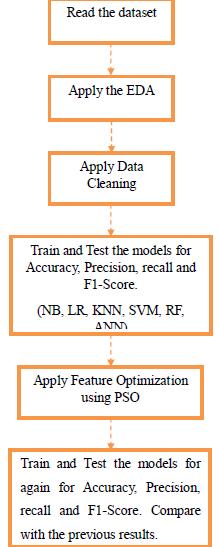
Fig.3.1:Proposedmodelordiabetesdetection.
Followingdatacleaningstepsareapplied:
1.Replacedrinkerto1andnon-drinkerto0.
2.ReplaceTypeofDiabetesT1DMto1andT2DMto0.
3.ReplaceinAcuteDiabetic Complicationsfromnoneto0 anddiabeticketoacidosisto1.
4.ApplyLabelEncodingtocolumnAlcoholdrinkinghistory byreplacing1with“drinker”and0with“non-drinker”.
5. Apply Label Encoding to column “Type of Diabetes”, by replacing1with“T1DM”and2with“T2DM”.
6. Apply Label Encoding to column “Acute Diabetic Complications”, by replacing diabetic ketoacidosis with 1 andnonewith0.
7. Apply one hot encoding on Diabetic Microvascular Complications.
3.1 Proposed Algorithm
After the EDA and the feature engineering is completed, trainingandtestingwillstart.
Start.
1.Putallcolumnsinxexcept“TypeofDiabetes”.
2.Dividethedataintotrainsetandtestsetwithsize=0.2.
3.ApplyGaussianNaiveBayesandprinttheresults.
4.ApplyKNNandprinttheresults.
5.ApplyLogisticRegressionandprinttheresults.
6.ApplyRandomForestandprinttheresults.
7.ApplyANNandprinttheresults.
8.ApplyFeatureOptimizationusingPSOalgorithm.
9.Repeatstep3to7.
10.ComparetheResults.
11.Exit.
End.
AftertheEDA,nowwewillbuildourmodelusingmachine learningclassifiers.Thesnapshotsareshowbelow:
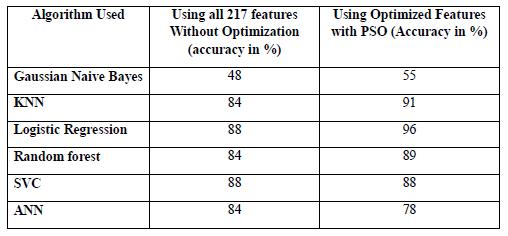
Fig. 4.1: comparisonsofResultsintermsofaccuracy.
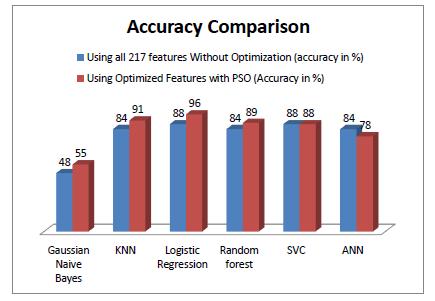
Fig. 4.2: Accuracycomparisonchart.
International Research Journal of Engineering and Technology (IRJET) e-ISSN: 2395-0056
Volume: 11 Issue: 06 | Jun 2024 www.irjet.net p-ISSN: 2395-0072
5. Conclusion
Inconclusion,leveragingmachinelearningforthedetection ofType-2diabetespresentsapromisingavenueinthefield of healthcare. Through the analysis of various patient parameters such as demographic information, medical history, and biomarkers, machinelearning algorithms can efficientlyidentifyindividualsatriskoralreadyaffectedby Type-2diabetes.
Byutilizingrobustdatasetsandemployingdiversemachine learning techniques such as logistic regression, decision trees, support vector machines, and neural networks, researchers and healthcare professionals can develop accurateandreliablepredictivemodelsforearlydetection andintervention.
Moreover, the integration of advanced technologies like wearable devices and remote monitoring systems can further enhance the effectiveness of these models by providingreal-timedatastreamsforcontinuousmonitoring andanalysis.
However, it's important to acknowledge the challenges associatedwiththeimplementationofmachinelearningin clinical settings, including data privacy concerns, model interpretability, and the need for rigorous validation and regulatoryapproval.
6. References
[1] P.Dua,F.J.Doyle,andE.N.Pistikopoulos,“Modelbased blood glucose control for type 1 diabetes via parametricprogramming,''IEEETrans.Biomed.Eng.,vol.53, no.8,pp.1478_1491,Aug.2006.
[2] American Diabetes Association, “2. Classification and diagnosis of diabetes: Standards of medical care in diabetes_2020,'' Diabetes Care, vol. 43, no. 1, pp. S14_S31, Jan.2020.
[3] G.Sparacino,F.Zanderigo,S.Corazza,A.Maran,A. Facchinetti, and C. Cobelli, “Glucose concentration can be predictedaheadintimefromcontinuousglucosemonitoring sensortime-series,''IEEETrans.Biomed.Eng.,vol.54,no.5, pp.931_937,May2007.
[4] S.Guerra,A.Facchinetti,G.Sparacino,G.D.Nicolao, and C. Cobelli, “Enhancing the accuracy of subcutaneous glucose sensors: A real-time deconvolution-based approach,'' IEEE Trans. Biomed. Eng., vol. 59, no. 6, pp. 1658_1669,Jun.2012.
[5] J.M.Norris,R.K.Johnson,andL.C.Stene,“Type1 diabetes_Early life origins and changing epidemiology,'' LancetDiabetesEndocrinol.,vol.8,no.3,pp.226_238,Mar. 2020.
[6] NationalDiabetesStatisticsReport,2020.Accessed: Jan. 15, 2021. [Online]. Available: https://www.cdc.gov/diabetes/pdfs/data/statistics/nationa l-diabetes-statistics-report.pdf
[7] ID Federation. IDF DIABETES ATLAS 9th Edition 2019. Accessed: Jan. 15, 2021. [Online]. Available: https://diabetesatlas.org/en/
[8] L. Olansky and L. Kennedy, “Finger-stick glucose monitoring: Issues of accuracy and specificity,'' Diabetes Care,vol.33,no.4,pp.948_949,Apr.2010.
[9] J. B. Buse, D. J.Wexler, A. Tsapas, P. Rossing, G. Mingrone,C.Mathieu,D.A.D'Alessio,andM.J.Davies,“2019 update to: Management of hyperglycaemia in type 2 diabetes,2018.AconsensusreportbytheAmericandiabetes association (ADA) and the European association for the study of diabetes (EASD),'' Diabetologia, vol. 63, no. 2, pp. 221_228,Feb.2020.
[10] M.Langendam,Y.M.Luijf,L.Hooft,J.H.D.Vries,A. H.Mudde,andR.J.Scholten,“Continuousglucosemonitoring systems for type 1 diabetes mellitus,'' Cochrane Database Syst. Rev., vol. 2012, no. 1, pp. 1_144, 2012, Art. No. CD008101.
[11] C. Choleau, J. C. Klein, G. Reach, B. Aussedat, V. Demaria-Pesce, G. S.Wilson, R. Gifford, and W. K.Ward, “Calibration of a subcutaneous amperometric glucose sensor:Part1.Effectofmeasurementuncertaintiesonthe determination of sensor sensitivity and background current,'' Biosensors Bioelectronics, vol. 17, no. 8, pp. 641_646,Aug.2002.
[12] D.SisodiaandD.S.Sisodia,“Predictionofdiabetes usingclassificationalgorithms,''ProcediaComput.Sci.,vol. 132,pp.1578_1585,Jun.2018.
[13] H. Kaur and V. Kumar, “Predictive modelling and analyticsfordiabetesusingamachinelearningapproach,'' Appl.Comput.Inform.vol.16,pp.1_11,Jul.2020.
[14] K. Kincade, “Data mining: Digging for healthcare gold,''InsuranceTechnol.,vol.23,no.2,no.2,pp.2_7,1998.
[15] F.A.Khan,K.Zeb,M.Al-Rakhami,A.DerhabandS.A. C.Bukhari,"DetectionandPredictionofDiabetesUsingData Mining:AComprehensiveReview,"inIEEEAccess,vol.9,pp. 43711-43735,2021,doi:10.1109/ACCESS.2021.3059343.
[16] P.MaitiandC.Chakravarty,"AIBasedAutomated Detection&ClassificationofDiabeticRetinopathy,"20237th International Conference on Computation System and InformationTechnologyforSustainableSolutions(CSITSS), Bangalore, India, 2023, pp. 1-6, doi: 10.1109/CSITSS60515.2023.10334199
International Research Journal of Engineering and Technology (IRJET) e-ISSN: 2395-0056
Volume: 11 Issue: 06 | Jun 2024 www.irjet.net p-ISSN: 2395-0072
[17] T. Pala and A. Y. Camurcu, “Evaluation of data miningclassificationandclusteringtechniquesfordiabetes,'' MalaysianJ.Comput.,vol.2,no.1,pp.1_9,2014.
[18] R.M.RahmanandF.Afroz,“Comparisonofvarious classificationtechniquesusingdifferentdataminingtoolsfor diabetesdiagnosis,''J.Softw Eng.Appl,vol.6,no.3,p.85, 2013.
[19] V. Karthikeyan, I. P. Begum, K. Tajudin, and I. S. Begam,“Comparativeofdataminingclassificationalgorithm (CDMCA) in diabetes disease prediction,'' Int. J. Comput. Appl.,vol.60,no.12,pp.26_31,Dec.2012.
[20] P. Thirumal and N. Nagarajan, “Utilization of data miningtechniquesfordiagnosisofdiabetesmellitus:Acase study,''ARPNJ.Eng.Appl.Sci,vol.10,no.1,pp.8_13,Jan. 2015.
[21] G. Visalatchi, S. J. Gnanasoundhari, and M. Balamurugan, “A survey on data mining methods and techniquesfordiabetesmellitus,''Int.J.Comput. Sci.Mobile Appl.,vol.2,no.2,pp.100_105,2014.
[22] I.Kavakiotis,O.Tsave,A.Salifoglou,N.Maglaveras,I. Vlahavas, and I. Chouvarda, “Machine learning and data mining methods in diabetes research,'' Comput. Struct. Biotechnology.J.,vol.15,pp.104_116,Jan.2017.
[23] D.TomarandS.Agarwal,“Asurveyondatamining approachesforhealthcare,''Int.J.Bio-Sci.Bio-Technol.,vol. 5,no.5,pp.241_266,Oct.2013.
[24] M. Marinov, A. S.M. Mosa, I. Yoo, and S. A. Boren, “Data-mining technologies for diabetes: A systematic review,''J.DiabetesSci.Technol.,vol.5,no.6,pp.1549_1556, Nov.2011.
[25] M.DurairajandK.Priya,“Breastcancerprediction usingsoftcomputingtechniques a survey,''Int. J.Comput. Sci.Eng.,vol.6,no.8,pp.135_145,Aug.2018.
[26] J.P.KandhasamyandS.Balamurali,“Performance analysis of classifier models to predict diabetes mellitus,'' ProcediaComput.Sci.,vol.47,pp.45_51,May2015.
[27] A. Tsanas and A. Xifara, “Accurate quantitative estimation of energy performance of residential buildings usingstatisticalmachinelearningtools,''EnergyBuildings, vol.49,pp.560_567,Jun.2012.
[28] L. Tapak, H. Mahjub, O. Hamidi, and J. Poorolajal, “Real-datacomparisonofdataminingmethodsinprediction ofdiabetesinIran,''HealthcareInformat.Res.,vol.19,no.3, no.3,pp.177_185,2013.