
International Research Journal of Engineering and Technology (IRJET) e-ISSN: 2395-0056
Volume: 11 Issue: 06 | Jun 2024 www.irjet.net p-ISSN: 2395-0072
International Research Journal of Engineering and Technology (IRJET) e-ISSN: 2395-0056
Volume: 11 Issue: 06 | Jun 2024 www.irjet.net p-ISSN: 2395-0072
Mr. Kanji H Siju1, Mr. Navneet K Prajapati2
1Lecturer, Dept of Mechanical Engineering, Government Polytechnic Bhuj, Gujarat, India
2Lecturer, Dept of Mechanical Engineering, Government Polytechnic Bhuj, Gujarat, India
Abstract - This paper examines the history, status, and prospects of 3D printing, also known as additive manufacturing. It begins with the early development of 3D printing and highlights key technological advancements thathaveshapedthefield.Thepaperdiscussesvarioustypes of 3D printing technologies, such as, Fused Deposition Modelling (FDM), Stereolithography (SLA) and Selective Laser Sintering (SLS), along with new and emerging methods. It explores the use of 3D printing in different industrieslikeprototyping,healthcare,aerospace,consumer products, automotive and construction. The paper also covers the range of materials used in3D printing, including metals,plastics,biocompatiblematerials,andcomposites.
The benefits of 3D printing include rapid prototyping, customization, environmental advantages, on-demand production, and the ability to create complex designs. However, there are challenges such as limited material options, the need for post-processing, issues with speed and scalability, intellectual property concerns, and environmental impact. Future trends are explored, focusing on new materials, faster production methods, integration with traditional manufacturing, and new applications like foodprintingandlarge-scaleconstruction.
The paper concludes by emphasizing the transformative potential of 3D printing, which is set to continue revolutionizing manufacturing. Ongoing research and developmentwillensurethat3Dprintingplaysakeyrolein the future of production, driving innovation and sustainability.
Key Words: 3D printing, Fused Deposition Modelling, Stereolithography,SelectiveLaserSintering
3D printing, also called additive manufacturing, is a groundbreaking technology that builds three-dimensional objects layer by layer from digital models. Unlike traditional subtractive manufacturing, which removes materialtoshapeanobject,3Dprintingaddsmaterialstep by step to form complex and customized structures. This process includes various technologies, such as Fused DepositionModelling(FDM),Stereolithography(SLA),and SelectiveLaserSintering(SLS).
3D printing has greatly impacted modern manufacturing, changing the way products are made. This technology offers several key benefits that have led to its increasing useinvariousindustries:
1. Rapid Prototyping and Iteration: 3D printing allows for quick and cost-effective production of prototypes,supportingiterativedesignprocesses. This speeds up product development and boosts innovationinmanufacturing[1].
2. Customization and Personalization: Unlike traditionalmethods,3Dprintingcancreatehighly customized and personalized products. This is especially useful in healthcare, where patientspecific implants and prosthetics are made to fit individualneeds[2].
3. Reducing Material Waste: Traditional manufacturing often produces a lot of waste. 3D printing, however, uses only the material needed, makingitamoresustainableoption[3].
4. Complex Geometric Designs: 3D printing excels atcreatingcomplexandintricatedesignsthatare difficult or impossible with traditional methods. This is particularly useful in industries like aerospace,automotive,andarchitecture[4].
5. On-Demand Production: 3D printing supports on-demand and localized production, reducing the need for large warehouses and extensive manufacturing facilities. This can lead to more efficientandresponsivesupplychains[5].
The inception of 3D printing traces back to innovative concepts and experimentsthatlaidthe foundationfor the transformative technology we know today. This section explores the key milestones and early endeavours that pavedthewayfortheevolutionof3Dprinting.
International Research Journal of Engineering and Technology (IRJET) e-ISSN: 2395-0056
Volume: 11 Issue: 06 | Jun 2024 www.irjet.net p-ISSN: 2395-0072
In the early 1980s, Dr. Hideo Kodama, a Japanese researcher, proposed the concept of a layer-by-layer approach for fabricating three-dimensional models using photopolymers. His work, titled "Automatic Method for Fabricating a Three-Dimensional Plastic Model with Photo-Hardening Polymer" [6], laid the theoretical groundworkforsubsequentdevelopments.
Stereolithography (SLA): Charles W. Hull, an American inventor, is credited with the invention of stereolithography,apivotal3Dprintingtechnology.In 1984,Hullfiledapatentfor"ApparatusforProduction of Three-Dimensional Objects by Stereolithography" [7]. This marked the birth of the first commercially viable 3D printing technology, where UV light is used tosolidifylayersofliquidresin.
Fused Deposition Modelling (FDM): ScottCrump,an American engineer, developed Fused Deposition Modelling (FDM) in the late 1980s. In 1989, Crump patented his inventionunderthe title "Apparatus and Method for Creating Three-Dimensional Objects" [8]. FDM involves extruding thermoplastic material layer bylayertoconstruct3Dobjects.
Selective Laser Sintering (SLS): Dr.CarlDeckardand Dr.JosephBeamanattheUniversityofTexasatAustin introduced SelectiveLaserSintering(SLS)inthemid1980s. Their work, "Method and Apparatus for Producing Parts by Selective Sintering" [9], described a process where a laser selectively fuses powdered materialtocreate3Dobjects.
Advancements in Materials and Processes: Throughout the late 1980s and 1990s, ongoing research and experimentation led to the exploration of various materials beyond polymers, including metals and ceramics. These developments expanded thepotentialapplicationsof3Dprinting.
Theearlyconceptsandexperimentsin3Dprintingsetthe stage for a technological revolution, establishing the groundwork for diverse applications across industries. From theoretical frameworks to patented inventions, thesepioneeringeffortslaidthefoundationforthediverse arrayof3Dprintingtechnologieswehavetoday.
The evolution of 3D printing has been marked by significanttechnological breakthroughs,eachcontributing to the advancement and diversification of additive manufacturing. This section highlights major milestones and innovations that have shaped the trajectory of 3D printing.
1992: Continuous Liquid Interface Production (CLIP): A breakthrough in speed and precision, CLIP was developed by Joseph DeSimone and his team at Carbon3D. This technology uses a continuous liquid interface to cure photosensitive resins, allowing for rapidandsmooth3Dprinting[10].
1995: Powder Bed Fusion Advancements: The mid1990s saw advancements in powder bed fusion techniques. EOS, a German company, introduced the EOSINTP350,aselectivelasersintering(SLS)system that improved the accuracy and resolution of printed objects[11].
2002: Multi-Material 3D Printing: Object Geometries (nowpartofStratasys)introducedPolyJettechnology, enabling the simultaneous deposition of multiple materials with varying properties in a single print. This was a significant leap in achieving diverse materialcharacteristicswithinasingleobject[12].
2009:DevelopmentofHigh-SpeedSintering(HSS):Dr. Neil Hopkinson introduced High-Speed Sintering, a new approach that uses infrared radiation to selectively fuse powdered materials. This breakthrough significantly increased the speed of the 3Dprintingprocess[13].
2011: Metal 3D Printing with Selective Laser Melting (SLM): The commercialization of Selective Laser Melting (SLM) for metal 3D printing marked a major milestone. Companies like EOS and Concept Laser played key roles in bringing this technology to industrialapplications[14].
2015:CarbonReinforces3DPrintingwithContinuous Composites: Carbon3D expanded on its CLIP technology by introducing continuous composite materials. This innovation allowed for the incorporation of reinforcing fibres within printed objects,enhancingstructuralstrength[15].
2017: Desktop Metal Introduces Bound Metal Deposition (BMD): Desktop Metal introduced a new approach to metal 3D printing with Bound Metal Deposition. This technology uses metal powders mixedwitha polymer binder,offeringa cost-effective andaccessiblemethodforproducingmetalparts[16].
2019: Nanoscale 3D Printing with Two-Photon Polymerization: Advances in two-photon polymerization techniques allowed for nanoscale 3D printing. This breakthrough, achieved by researchers at the Vienna University of Technology, enabled the creation of intricate structures at the molecular level [17].
2020: Large-Scale 3D Printing with Construction Techniques:Thefieldofconstruction3Dprintingsaw
International Research Journal of Engineering and Technology (IRJET) e-ISSN: 2395-0056
Volume: 11 Issue: 06 | Jun 2024 www.irjet.net p-ISSN: 2395-0072
remarkable progress, with companies like ICON and COBOD showcasing large-scale 3D printing for buildingconstruction.This breakthroughopenednew possibilitiesinarchitecturalapplications[18].
2022: AI-Enhanced 3D Printing Algorithms: The integration of artificial intelligence into 3D printing algorithmsgainedprominence,optimizingprintpaths, minimizing material usage, and enhancing overall efficiency. This marked a significant leap toward intelligentandadaptiveadditivemanufacturing[19].
These major technological breakthroughs have propelled 3D printing into new frontiers, expanding its applications and capabilities. From increased speed to novel material combinations,eachinnovationhasplayedacrucialrole in shapingthelandscapeofadditivemanufacturing.
3.1 Stereolithography (SLA)
3.1.1 How SLA Works
Stereolithography (SLA) is a form of additive manufacturing that uses a vat of liquid photopolymer resin.Anultraviolet(UV)lasertracesacross-sectionofthe objecttobeprintedonthesurfaceoftheliquid,solidifying the resin wherever the laser touches. The build platform thendescendsbyalayer,andtheprocessrepeats,withthe laser tracing and solidifying subsequent layers until the entireobjectisprinted[20].
3.1.2 Applications and Notable Examples
Prototyping: SLA is widely used for creating highly detailed prototypesduetoitsabilitytoproduceparts withsmoothsurfacesandfinefeatures[21].
Dental and Medical Models: SLA is used to create precise dental Molds, surgical guides, and anatomical models[22].
Jewellery: JewellersuseSLAforcreatingintricateand detailedjewelleryprototypesandcastableMolds[23].
Consumer Products: SLA is employed in the design and prototyping of consumer products, including electronichousings,toys,andfashionaccessories[24].
3.2 Fused Deposition Modelling (FDM)
3.2.1 Operational Principles of FDM
Fused Deposition Modelling (FDM) works by extruding a thermoplastic filament through a heated nozzle. The nozzle moves in the X and Y directions to deposit the materiallayerbylayerontothebuildplatform.Eachlayer solidifies as it cools, and the platform lowers to allow the nextlayertobeaddeduntil theentireobjectiscompleted [25].
3.2.2 Advantages and Limitations
Advantages:
Cost-Effective: FDM is one of the most affordable 3D printing technologies, making it accessible for hobbyistsandsmallbusinesses[26].
Material Variety: FDM supports a wide range of thermoplastics, including PLA, ABS, PETG, and more [27].
Ease of Use: FDM printers are relatively simple to operateandmaintain[28].
Limitations:
Surface Finish: FDM parts often have visible layer lines and may require post-processing to achieve a smoothfinish[29].
Strength and Durability: FDM-printed parts may have lower mechanical properties compared to those producedbyothermethods[30].
Detail Resolution: FDM is less suitable for parts requiringhighdetailandprecision[31].
3.3.1
Selective Laser Sintering (SLS) uses a laser to sinter powdered material, binding it together to form a solid structure. The process begins with a thin layer of powdered material spread across the build platform. The laser selectively fuses the powder according to the digital model, and the platform lowers to allow the next layer of powder to be applied and sintered. This continues until thepartisfullyformed[32].
3
Nylons (Polyamides): Commonly used for functional prototypes and end-use parts due to their strength anddurability[33].
Elastomers: Flexible materials for producing rubberlikeparts[34].
Metals: Metal powders such as aluminum, titanium, andstainlesssteelareusedinadvancedSLSprocesses forindustrialapplications[35].
3.3.3 Applications
FunctionalPrototypes:SLSisidealforcreatingstrong, functional prototypes that can withstand rigorous testing[36].
International Research Journal of Engineering and Technology (IRJET) e-ISSN: 2395-0056
Volume: 11 Issue: 06 | Jun 2024 www.irjet.net p-ISSN: 2395-0072
End-Use Parts: Used for low-volume production of end-use parts, particularly in aerospace, automotive, andmedicalindustries[37].
Complex Geometries: SLS can produce complex geometries that would be difficult or impossible to achievewithtraditionalmanufacturingmethods[38].
3.4 Emerging Technologies
3.4.1 Highlighting New and Experimental 3D
Printing Technologies
1 Continuous Liquid Interface Production (CLIP):
HowItWorks:CLIPusesacontinuoussequenceofUV images projected through an oxygen-permeable windowtocureaphotosensitiveresin.Thisallowsfor rapid, continuous production rather than the traditionallayer-by-layerapproach[39].
Potential Impact: CLIP significantly increases printing speedandsurfacequality,makingitsuitableforhighvolumeproduction[40].
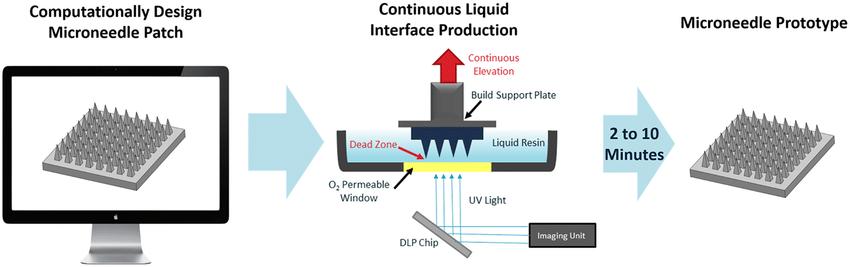
ContinuousLiquidInterfaceProduction(CLIP)
2 Digital Light Processing (DLP):
How It Works: Like SLA, DLP uses a digital light projector to cure photopolymer resin. The primary difference is that DLP projects an entire image of a layeratonce,curingitmorequicklythanSLA[41].
Potential Impact: DLP offers high speed and resolution, making it ideal for applications requiring finedetails,suchasdentalandjewellerymodels[42].
3 Multi-Jet Fusion (MJF):
How It Works: MJF uses an inkjet array to selectively apply fusing and detailing agents across a bed of powder, which is then fused by infrared light. This
process allows for high-speed production and fine featureresolution[43].
Potential Impact: MJF is expected to revolutionize industries by providing faster production times and superior material properties compared to traditional powder-basedmethods[44].
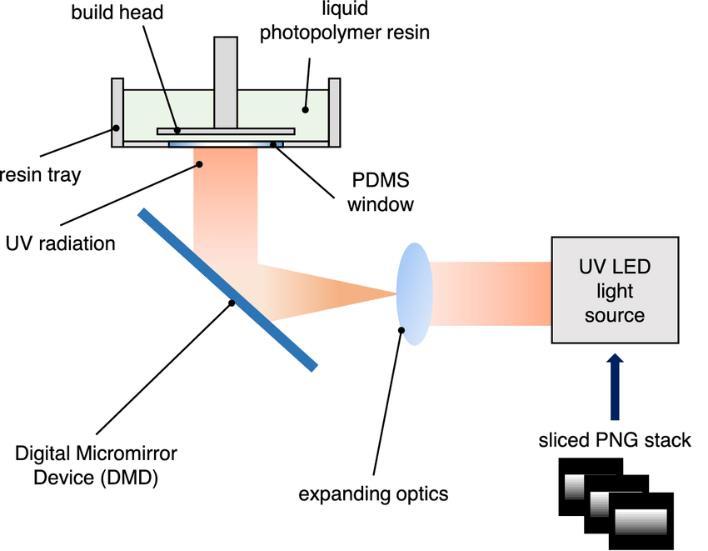
Fig.2: DigitalLightProcessing(DLP)
4 Multi-Jet Fusion (MJF):
How It Works: MJF uses an inkjet array to selectively apply fusing and detailing agents across a bed of powder, which is then fused by infrared light. This process allows for high-speed production and fine featureresolution[43].
Potential Impact: MJF is expected to revolutionize industries by providing faster production times and superior material properties compared to traditional powder-basedmethods[44].
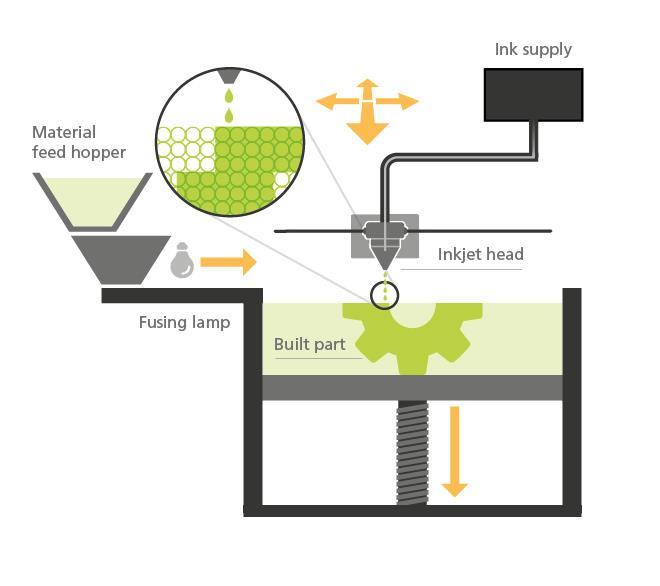
Fig.3: Multi-JetFusion(MJF)
International Research Journal of Engineering and Technology (IRJET) e-ISSN: 2395-0056
Volume: 11 Issue: 06 | Jun 2024 www.irjet.net p-ISSN: 2395-0072
5 Bioprinting:
How It Works: Bioprinting uses a layer-by-layer method to deposit living cells and biocompatible materials to create tissue-like structures. This technology aims to produce functional biological tissuesandorgans[45].
Potential Impact: Bioprinting holds the potential to transform healthcare by enabling the creation of custom implants, tissue regeneration, and even organ transplants[46].
6 4D Printing:
HowItWorks:4Dprintinginvolves3Dprintedobjects that can change shape or properties over time in response to external stimuli such as heat, light, or moisture[47].
Potential Impact: 4D printing could lead to innovations in adaptive materials, self-assembling structures,andsmarttextiles[48].
These emerging technologies are pushing the boundaries of what is possible with 3D printing, promising to further enhance its capabilities and applications across a wide range of industries. By continuing to innovate, the field of 3D printing is set to make even more significant contributionstomanufacturingandbeyond.
4.1
Rapid prototyping using 3D printing has revolutionized product development across various industries. Companies such as Ford and General Electric (GE) have integrated 3D printing into their prototyping processes, drastically reducing the time and cost associated with developing new products. For example, Ford uses 3D printingtocreateprototypepartsfortheirvehicles,which allowsforfasteriterationandrefinement[49].
3D printing enables designers and engineers to produce prototypes quickly and efficiently, facilitating rapid iteration and testing. This capability allows for the identification and resolution of design flaws early in the developmentprocess,leadingtoimprovedproductquality and reduced time to market. The ability to create functional prototypes that closely resemble the final product also enhances communication and decisionmakingamongstakeholders[50].
Bioprinting has emerged as a groundbreaking application of 3D printing in the medical field. Researchers have successfully printed tissues such as skin, cartilage, and evensmall-scaleorgansusinglivingcellsandbiomaterials. One notable advancement is the development of 3Dprinted skin grafts for burn victims, which can be customized to match the patient's skin color and texture [51]. Additionally, scientists are exploring the potential of bioprinting to create functional organ tissues for transplantation, which could address the critical shortage ofdonororgans[52].
3D printing technology allows for the creation of highly customized medical implants and prosthetics tailored to individual patients. This customization enhances the fit, comfort,andfunctionalityofthedevices.Forexample,3Dprintedtitaniumimplantsareusedinorthopedicsurgeries to replace damaged bones with precise, patient-specific components.Similarly,prostheticlimbscanbe3Dprinted to match the exact anatomical structure and aesthetic preferences of the wearer, improving their quality of life [53].
Theaerospaceandautomotiveindustrieshavebeenatthe forefront of adopting 3D printing for manufacturing complex parts. In aerospace, companies like Boeing and Airbususe3Dprintingtoproducelightweightcomponents that reduce fuel consumption and increase efficiency. A notable example is GE Aviation's LEAP engine, which features3D-printedfuelnozzlesthatarelighterandmore durable than conventionally manufactured counterparts [54]. In the automotive sector, BMW and Audi utilize 3D printing to produce custom tools, fixtures, and even enduse parts, enhancing production flexibility and reducing costs[55].
3D printing has opened new possibilities for creating customized consumer goods, allowing individuals to personalizeproductsaccordingtotheirpreferences.From fashion and jewellery to home decor and electronics, 3D printingenablestheproductionofuniqueitemsthatcater to individual tastes and requirements [56]. Examples of UniqueandPersonalized3DPrintedItems:
Fashion and Jewellery: Designers are using 3D printing to create intricate and customizable fashion accessories and jewellery pieces. For instance, companies like Nervous System offer customizable
International Research Journal of Engineering and Technology (IRJET) e-ISSN: 2395-0056
Volume: 11 Issue: 06 | Jun 2024 www.irjet.net p-ISSN: 2395-0072
3D-printed jewellery that customers can modify onlinebeforeprinting[57].
Home Decor: 3D printing allows for the creation of bespoke home decor items, such as lamps, vases, and furniture,tailoredtothespecificstyleanddimensions desiredbythecustomer[58].
Electronics and Gadgets: Customized phone cases, headphones, and even drone parts can be 3D printed to meet the specific needs and preferences of users, providingauniquetouchtoeverydayitems[59].
4.5 Architecture and Construction
4.5.1 3D Printing in Architectural Model-Making
Architects and designers are increasingly using 3D printing to create detailed and accurate scale models of their designs. This technology enables the production of complex geometries and intricate details that would be difficult to achieve with traditional model-making techniques. 3D-printed architectural models provide a tangible representation of a design, facilitating better communicationwithclientsandstakeholders[60].
4.5.2 Construction Applications and Innovations
The construction industry is exploring the potential of 3D printing for building structures and components. Innovationssuchas3D-printedconcretewallsandhouses are gaining traction, offering benefits like reduced labour costs, faster construction times, and greater design flexibility. For example, the company ICON has developed a 3Dprintingsystemcapableofconstructingsmall homes in just 24 hours, addressing the need for affordable housing solutions [61]. Additionally, 3D printing enables the creation of complex architectural elements, such as customized facades and structural components, that enhancebothaestheticsandfunctionality[62].
5.1 Plastics
5.1.1 ABS and PLA Characteristics
ABS (Acrylonitrile Butadiene Styrene): ABS is a robust, durable plastic commonly used in 3D printing duetoitsstrengthandimpactresistance.Ithasahigh melting point, making it suitable for objects that require higher temperature tolerance. ABS is also known for its smooth finish and ease of postprocessing,suchassandingandpainting[63].
PLA (Polylactic Acid): PLA is a biodegradable plastic derived from renewable resources like corn starch or sugarcane. It is favored for its ease of use, lower printing temperatures, and less warping compared to ABS. PLA emits a sweet Odor when printed and
produces a glossy finish. However, it is less durable andheat-resistantthanABS[64].
Applications and Considerations
ABS Applications: ABS is widely used in the automotiveand electronics industries for prototyping and manufacturing durable parts such as housings, enclosures, and functional prototypes. It is also popularinthecreationoftoysandconsumerproducts [65].
PLA Applications: PLA is often used in the medical field for creating biodegradable implants and in the food industryfor producing eco-friendlypackaging. It is also popular among hobbyists and educators for creating models, prototypes, and decorative items [66].
5.2.1
Recent advancements in metal 3D printing have significantly expanded its capabilities and applications. TechnologieslikeDirectMetalLaserSintering(DMLS)and Electron Beam Melting (EBM) have enabled the productionofcomplexmetalpartswithhighprecisionand excellent mechanical properties. These processes involve thelayer-by-layerfusionofmetalpowdersusingalaseror electronbeam,respectively[67].
5.2.2 Aerospace and Medical Applications
Aerospace: Metal 3D printing is transforming the aerospace industry by enabling the production of lightweight, high-strength components that can withstand extreme conditions. For example, GE Aviation produces 3D-printed fuel nozzles for jet engines, which are 25% lighter and five times more durablethantraditionallymanufacturedparts[68].
Medical:Inthemedicalfield,metal3Dprintingisused to create custom implants and surgical instruments tailored to individual patients. Titanium, a biocompatible metal, is commonly used for implants such as hip joints and dental prosthetics due to its strength,lightweight,andcorrosionresistance[69].
5.3.1 Exploring Materials Compatible with Biological Systems
Biocompatible materials are specifically designed to interactsafelywithbiologicalsystems.Thesematerialsare essentialformedicalapplications,suchasimplants,tissue engineering, and drug delivery systems. Common biocompatible materials used in 3D printing include medical-gradepolymers,ceramics,andcomposites[70].
International Research Journal of Engineering and Technology (IRJET) e-ISSN: 2395-0056
Volume: 11 Issue: 06 | Jun 2024 www.irjet.net p-ISSN: 2395-0072
in
Tissue Engineering: 3D printing with biocompatible materials enables the creation of scaffolds that mimic the extracellular matrix of tissues. These scaffolds support cell growth and tissue regeneration, making themvaluableforresearchandregenerativemedicine [71].
Custom Medical Devices: Biocompatible materials are used to produce custom medical devices, such as hearing aids, dental aligners, and prosthetics, tailored totheuniqueanatomyofeachpatient[72].
Drug Delivery Systems: 3D printing allows for the fabricationofcomplex drug deliverysystemsthatcan release medication at controlled rates, improving the efficacyandsafetyoftreatments[73].
5.4 Composites and Advanced Materials
Composite materials combine two or more distinct substances to create a material with superior properties. In3Dprinting,compositesoftenincludeamatrixmaterial (suchasapolymer)reinforcedwithfibers(suchascarbon fiber, glass fiber, or Kevlar). These materials offer enhanced mechanical properties, such as increased strength,stiffness,anddurability[74].
Applications in High-Performance
Aerospace: Composite materials are widely used in the aerospace industry to produce lightweight yet strong components, reducing the overall weight of aircraft and improving fuel efficiency. Parts like airframes, panels, and brackets are commonly made fromcarbonfiber-reinforcedcomposites[75].
Automotive: The automotive industry leverages composite materials for producing high-performance parts that require strength and weight savings, such as body panels, chassis components, and interior parts.These materialscontributeto improvedvehicle performanceandfueleconomy[76].
Sports Equipment: Advanced composites are used in themanufacturingofsportsequipment,suchasracing bicycles, tennis rackets, and golf clubs, where high strength-to-weight ratios and durability are crucial [77].
6.1 Rapid Prototyping and Iteration
Case Studies Demonstrating Time and Cost Savings:
Rapid prototyping is one of the most significant advantagesof3D printing.Itallowsforthequick creation
of physical models from digital designs, enabling faster iteration and refinement. For example, automotive companieslikeBMWhavereportedsignificant reductions in development time and costs by using 3D printing for prototyping parts and tools. By producing prototypes within days instead of weeks, companies can test and modifydesignsmoreefficiently,leadingtoquickermarket entry [78]. Similarly, GE's use of 3D printing for turbine blade prototypes has cut down the production cycle from months to weeks, substantially reducing costs and time [79].
6.2 Customization and Personalization
Examining the Impact of Personalized Manufacturing:
3D printing has revolutionized the ability to customize products to individual specifications. This technology allows for the creation of unique, personalized items withouttheneedformassproduction.Inthemedicalfield, for instance, custom implants and prosthetics can be tailored to fit the exact anatomical requirements of patients, improving comfort and functionality. Dental aligners, hearing aids, and orthopedic devices are commonly personalized using 3D printing [80]. In consumermarkets,companieslikeNikeandAdidasuse3D printing to offer customizable footwear, enhancing customersatisfactionandengagement[81].
Reducing Material Waste and Promoting Sustainability:
3Dprintingisinherentlymoresustainablethantraditional manufacturing methods because it is an additive process, which means material is only used where it is needed, significantly reducing waste. For example, traditional subtractive manufacturing methods can waste up to 90% ofthematerial,whereas3Dprintingcanreducethiswaste to near zero [82]. Additionally, 3D printing can use recycled materials, such as recycled plastics and metals, further promoting environmental sustainability. The potentialtoproduceitemslocallyalsoreducesthecarbon footprintassociatedwithtransportationandlogistics[83].
How 3D Printing Enables Intricate and Complex Shapes:
Oneoftheuniqueadvantagesof3Dprintingisitsabilityto create complex and intricate designs that would be impossible or very difficult to achieve with traditional manufacturing techniques. This capability is particularly beneficial in industries such as aerospace and medical devices, where lightweight structures with complex geometries are crucial. For example, 3D-printed lattice structures used in aircraft components can provide the
International Research Journal of Engineering and Technology (IRJET) e-ISSN: 2395-0056
Volume: 11 Issue: 06 | Jun 2024 www.irjet.net p-ISSN: 2395-0072
same strength as solid parts but with significantly less weight [84]. In the medical field, intricate structures like porous implants, which promote bone in-growth, are feasiblethanksto3Dprinting[85].
6.5 On-Demand Production
Benefits for Small-Scale and Localized Manufacturing:
3D printing facilitates on-demand production, allowing manufacturers to produce parts as needed rather than maintaining large inventories. This flexibility is especially valuable for small-scale and localized manufacturing, reducing storage costs and minimizing the risk of overproduction. On-demand production is also advantageous for creating spare parts and replacements, as it eliminates the need for extensive warehousing. For instance, the US Navy uses 3D printing to produce spare parts for ships on-demand, which is particularly useful in remote or difficult-to-reach locations [86]. This approach not only saves space and reduces costs but also ensures thatpartsareavailablewhenandwheretheyareneeded.
7.1 Limited Material Options
Challenges in Material Diversity for Certain Applications:
While 3D printing has made significant strides, the range of materials available is still limited compared to traditionalmanufacturingmethods.Thislimitationposesa challenge for applications that require specific material properties,suchashigh-temperatureresistanceorspecific mechanical strengths. For instance, certain highperformance engineering plastics and metals that are essential in aerospace and automotive industries are not yet fully optimized for 3D printing [87]. The development ofnewmaterialsandtheenhancementofexistingonesare crucial for expanding the applications of 3D printing acrossvariousindustries[88].
7.2 Post-Processing Requirements
Addressing the Need for Finishing Processes:
3D printed parts often require significant post-processing to achieve the desired surface finish and mechanical properties.Post-processingcanincludesanding,polishing, painting,andthermaltreatments,whichaddtotheoverall production time and cost. For example, parts produced using Selective Laser Sintering (SLS) or Fused Deposition Modelling (FDM) typically have rough surfaces and may require additional steps to smooth and refine [89]. This need for extensive post-processing can offset some of the time and cost advantages of 3D printing, making it less competitiveforcertainapplications.
Analyzing Limitations in Production Speed and Scalability:
Although 3D printing is excellent for prototyping and small-batch production, it faces challenges in terms of speed and scalability when compared to traditional manufacturing techniques like injection moulding or CNC machining. Producing large quantities of parts can be time-consuming and expensive due to the layer-by-layer nature of 3D printing. For example, while 3D printing can producea smallbatchofcustompartsefficiently,itisless suitableformassproductionwherethousandsofidentical parts are needed quickly and cost-effectively [90]. Enhancing the speed and scalability of 3D printing technologiesisessentialforbroaderindustrialadoption.
The Impact of 3D Printing on Intellectual Property Rights:
Theabilitytoeasilyreplicateanddistributedigitaldesigns poses significant challenges to intellectual property (IP) rights. Unauthorized reproduction of patented designs or copyrighted products can occur with the widespread availabilityof3Dprintersanddigitalblueprints.Thisissue raises concerns about the enforcement of IP laws and the protection of creators' rights. For instance, there have been instances where patented products were reverseengineered and printed without permission, leading to legal disputes and economic losses for the original creators [91]. Developing robust legal frameworks and technological solutions to protect IP in the era of digital manufacturingiscrucial.
Discussing the Environmental Considerations Associated with 3D Printing:
While 3D printing offers several environmental benefits, such as reduced waste and local production, it also presents some environmental challenges. The production anddisposalof3Dprintingmaterials,particularlyplastics, can contribute to environmental pollution if not managed properly. Moreover, the energy consumption of 3D printers, especially those using high-powered lasers or heating elements, can be significant. For example, the production of certain plastic filaments involves chemical processes that may release harmful emissions, and the disposal of used or failed prints contributes to plastic waste [92]. Addressing these environmental concerns through the development of eco-friendly materials and energy-efficient technologies is essential for sustainable growthin3Dprinting.
International Research Journal of Engineering and Technology (IRJET) e-ISSN: 2395-0056
Volume: 11 Issue: 06 | Jun 2024 www.irjet.net p-ISSN: 2395-0072
8.1 Advances in Materials Science
Predictions for the Development of New 3D Printing Materials:
The future of 3D printing heavily relies on advancements in materials science. Researchers are continually developing new materials that possess enhanced properties such as increased strength, flexibility, and temperature resistance. For instance, there is a growing interest in creating multifunctional materials that can conduct electricity, change color, or respond to environmental stimuli [93]. Additionally, biocompatible, andbiodegradablematerialsareexpectedtobecomemore prevalent, expanding the potential for medical applications and reducing environmental impact. Innovationslikethesewillsignificantlybroadentherange of applications for 3D printing, making it more versatile andefficient[94].
8.2 Increased Speed and Efficiency
Innovations Aimed at Improving Production Speed:
One of the primary limitations of current 3D printing technologies is the relatively slow production speed. However, ongoing research and development are focused on overcoming this challenge. Innovations such as continuous liquid interface production (CLIP) and multijet fusion (MJF) have already demonstrated significant improvements in printing speed and efficiency [95]. Additionally, advancements in parallel processing and multi-nozzle systems are being explored to further enhance production capabilities. These technological advancements are expected to make 3D printing more competitive with traditional manufacturing methods, especiallyforlarge-scaleproduction[96].
The Evolving Role of 3D Printing in Conjunction with Traditional Manufacturing Methods:
As 3D printing technology matures, its integration with traditional manufacturing processes is becoming more seamless.Hybridmanufacturing,whichcombinesadditive and subtractive techniques, is gaining traction. This approach leverages the strengths of both methods such as the precision of CNC machining and the design flexibility of 3D printing to create complex and highquality parts [97]. Additionally, the use of 3D printing for creating Molds and tooling for injection moulding and castingisbecomingmorewidespread,reducingleadtimes and costs. This synergy between additive and traditional manufacturing processes is expected to optimize production workflows and expand the capabilities of manufacturers[98].
Discussing Potential Future Applications such as Food Printing and Construction:
The applications of 3D printing are continually expanding intonewandinnovativefields.Foodprinting,forexample, isanemergingareawherecustomizedandnutritiousfood items can be created using 3D printing technology. This innovation holds potential for personalized nutrition and sustainable food production [99]. In the construction industry, large-scale 3D printers are being developed to create building components and even entire structures, offering faster and more cost-effective solutions for housingandinfrastructure projects[100]. Other potential applications include 3D-printed textiles, pharmaceuticals, and even organs for transplantation. As the technology advances, the possibilities for new applications continue to grow, promising to revolutionize various industries [101].
In conclusion, the journey of 3D printing, or additive manufacturing, has been nothing short of transformative, impacting numerous industries along the way. From its humble beginnings as a prototyping tool to its status as a method for crafting intricate, tailor-made products, 3D printing has come a long way. Throughout this exploration, we have delved into its historical evolution, diverse technologies, broad applications, and the array of materialsutilized.
Undoubtedly, 3D printing offers a plethora of advantages, including rapid prototyping and unparalleled customization. However, it is not without its challenges, such as limited material options and the need for extensivepost-processing.Yet,thefuturelookspromising, withongoingadvancementsinmaterials,speed,efficiency, and applications poised to revolutionize manufacturing even further. These innovations herald a new era of possibilities, driving innovation and presenting fresh opportunitiesacrossindustries.
As we look ahead, continuous research and development will be pivotal in overcoming current limitations and unlocking the full potential of 3D printing. With each stride forward, this groundbreaking technology continues to redefine the boundaries of what is achievable, promisingafuturewhereimaginationknowsnobounds.
[1] Anderson,T.,&Sherman,D.(2007).RapidPrototyping Technology:SelectionandApplication.MarcelDekker.
[2] Ventola, C. L. (2014). Medical Applications for 3D Printing: Current and Projected Uses. P&T, 39(10), 704–711.
International Research Journal of Engineering and Technology (IRJET) e-ISSN: 2395-0056
Volume: 11 Issue: 06 | Jun 2024 www.irjet.net p-ISSN: 2395-0072
[3] Gebler, M., Schoot, U., Rosen, R., & Lindemann, U. (2014). Economic implications of 3D printing: Market structure models in light of additive manufacturing revisited. International Journal of Production Economics,149,209-218.
[4] Kietzmann, J., Pitt, L., & Berthon, P. (2015). Disruptions,decisions,anddestinations:Entertheage of 3-D printing and additive manufacturing. Business Horizons,58(2),209-215.
[5] Kusiak,A.,&Jain,A.(2018).Integrationof3Dprinting and smart manufacturing. Journal of Manufacturing Systems,48,157-169.
[6] Kodama,H.(1981).AutomaticMethodforFabricating a Three-Dimensional Plastic Model with PhotoHardening Polymer. Review of Scientific Instruments, 52(11),1770.
[7] Hull,C.W.(1986).ApparatusforProductionofThreeDimensional Objects byStereolithography.U.S.Patent No.4,575,330.
[8] Crump, S. S. (1989). Apparatus and Method for Creating Three-Dimensional Objects. U.S. Patent No. 5,121,329.
[9] Deckard, C., & Beaman, J. J. (1989). Method and Apparatus for Producing Parts by Selective Sintering. U.S.PatentNo.4,863,538.
[10] Tumbleston, J. R., et al. (2015). Continuous liquid interface production of 3D objects. Science, 347(6228),1349-1352.
[11] Gibson,I.,Rosen,D.W.,&Stucker,B.(2010).Additive manufacturing technologies: 3D printing, rapid prototyping, and direct digital manufacturing. Addison-Wesley.
[12] Lipton, J. I., et al. (2005). A multi-material model for simulation of rigid and flexible materials. ACM TransactionsonGraphics(TOG),24(3),1176-1184.
[13] Hopkinson,N., Hague, R.,& Dickens,P.(2006).Rapid manufacturing: An industrial revolution for the digitalage.JohnWiley&Sons.
[14] Gibson, I., et al. (2015). Additive manufacturing technologies: 3D printing, rapid prototyping, and directdigitalmanufacturing.Springer.
[15] ISO/ASTM International. (2019). ISO/ASTM 52900:2015(en) Standard Terminology for Additive Manufacturing GeneralPrinciples Terminology.
[16] Saeidi, K., & Karimi, A. (2020). A review on 3D printing of polymers for tissue engineering applications.PolymerTest,90,106643.
[17] Schubert, M., et al. (2017). Two-photon polymerization:aversatiletoolfornanofabricationof 3Dstructures.Nanophotonics,6(1),681-701.
[18] Chua, C. K., Leong, K. F., & Lim, C. S. (2017). Rapid prototyping: principles and applications. World Scientific.
[19] Moroni, G., de Wijn, J. R., & van Blitterswijk, C. A. (2006). 3D Fiber-Deposited Scaffolds for Tissue Engineering: Influence of Fiber Arrangement and Porosity on Mechanical Properties. Acta Biomaterialia,2(6),453-462.
[20] Hull, C. W. (1986). Apparatus for Production of Three-DimensionalObjectsbyStereolithography.U.S. PatentNo.4,575,330.
[21] Gibson,I.,Rosen,D.W.,&Stucker,B.(2015).Additive Manufacturing Technologies: 3D Printing, Rapid Prototyping, and Direct Digital Manufacturing. Springer.
[22] Ventola, C. L. (2014). Medical Applications for 3D Printing: Current and Projected Uses. P&T, 39(10), 704–711.
[23] GalanTucci,L.M.,Percoco,G.,AngelElli,G.,Lopez,P., & Rizzi, C. (2008). A new integrated system for the automatic design and rapid prototyping of jewellery. Computer-AidedDesign,40(3),331-337.
[24] Bertolo, P. J. (Ed.). (2011). Stereolithography: Materials,ProcessesandApplications.Springer.
[25] Crump, S. S. (1989). Apparatus and Method for Creating Three-Dimensional Objects. U.S. Patent No. 5,121,329.
[26] Wohlers,T.T.(2011).WohlersReport2011:Additive Manufacturing and 3D Printing State of the Industry Annual Worldwide Progress Report. Wohlers Associates.
[27] Cicala, G., Latteri, A., Virgillito, C., & La Rosa, A. D. (2018). Recyclable Thermoplastic Polymers for AdditiveManufacturing.Materials,11(10),1987.
[28] Wittbrodt, B., & Pearce, J. M. (2015). The effects of PLA color on material properties of 3-D printed components.AdditiveManufacturing,8,110-116.
[29] Mohamed, O. A., Masood, S. H., & Bhowmik, J. L. (2015). Optimization of fused deposition modelling processparameters:areviewofcurrentresearchand prospects.AdvancesinManufacturing,3(1),42-53.
[30] Compton, B. G., & Lewis, J. A. (2014). 3D-printing of lightweight cellular composites. Advanced Materials, 26(34),5930-5935.
International Research Journal of Engineering and Technology (IRJET) e-ISSN: 2395-0056
Volume: 11 Issue: 06 | Jun 2024 www.irjet.net p-ISSN: 2395-0072
[31] Turner,B.N.,Strong,R.,&Gold,S.A.(2014).Areview ofmeltextrusionadditivemanufacturingprocesses:I. Process design and modelling. Rapid Prototyping Journal,20(3),192-204.
[32] Deckard, C., & Beaman, J. J. (1989). Method and ApparatusforProducingPartsbySelectiveSintering. U.S.PatentNo.4,863,538.
[33] Kruth, J. P., Leu, M. C., & Nakagawa, T. (1998). Progress in Additive Manufacturing and Rapid Prototyping.CIRPAnnals,47(2),525-540.
[34] Goodridge, R. D., Tuck, C. J., & Hague, R. J. (2012). Laser sintering of polyamides and other polymers. ProgressinMaterialsScience,57(2),229-267.
[35] Bai,J.,Goodridge,R.D.,Yuan,S.,Zhou,K.,&Hague,R. J. M. (2017). Additive manufacturing of metallic components. Rapid Prototyping Journal, 23(4), 536547.
[36] Hopkinson, N., Hague, R. J., & Dickens, P. M. (Eds.). (2005). Rapid Manufacturing: An Industrial RevolutionfortheDigitalAge.Wiley.
[37] Leary, M. (2019). Design for Additive Manufacturing: OptimizingValueChainEfficiency.Elsevier.
[38] Wang,P., Smith,A.,Guldberg,R.E.,&Wei,M.(2016). In vitro characterization of human mesenchymal stem cells on 3D printed scaffolds with controlled poresize.Biofabrication,8(4),045015.
[39] Tumbleston, J. R., Shirvanyants, D., Ermoshkin, N., Janusziewicz, R., Johnson, A. R., Kelly, D., ... & DeSimone, J. M. (2015). Continuous liquid interface production of 3D objects. Science, 347(6228), 13491352.
[40] Carbon, Inc. (2015). Continuous Liquid Interface Production (CLIP) Technology. Carbon Technical Documentation.
[41] Gallardo, J. M., & Gomes, A. (2012). Digital Light Processing (DLP) 3D Printing Technology. Journal of ManufacturingProcesses,14(1),96-104.
[42] Petrovic,V.,Gonzalez,J.V.H.,Ferrando,O.J.,Gordillo, J. D., Puchades, J. R., & Griñan, L. P. (2011). Additive layered manufacturing: sectors of industrial applicationshownthroughcasestudies.International JournalofProductionResearch,49(4),1061-1079.
[43] Stratasys, Ltd. (2016). Multi-Jet Fusion (MJF) Technology.StratasysTechnicalDocumentation.
[44] Klocke, F., & Sangermann, H. (2017). Hybrid Manufacturing: Applications and Developments in
Metal Additive Manufacturing. Procedia CIRP, 63, 451-456.
[45] Murphy, S. V., & Atala, A. (2014). 3D bioprinting of tissuesandorgans.NatureBiotechnology,32(8),773785.
[46] Mironov, V., Visconti, R. P., Kasyanov, V., Forgacs, G., Drake,C.J.,&Markwald,R.R.(2009).Organprinting: tissue spheroids as building blocks. Biomaterials, 30(12),2164-2174.
[47] Tibbits, S. (2014). 4D printing: multi-material shape change.ArchitecturalDesign,84(1),116-121.
[48] Ge, Q., Dunn, C. K., Qi, H. J., & Dunn, M. L. (2014). Active materials by four-dimension printing. Applied PhysicsLetters,105(13),131901.
[49] Wohlers,T.T.(2011).WohlersReport2011:Additive Manufacturing and 3D Printing State of the Industry Annual Worldwide Progress Report. Wohlers Associates.
[50] Lipson,H.,&Kurman,M.(2013).Fabricated:TheNew Worldof3DPrinting.JohnWiley&Sons.
[51] Murphy, S. V., & Atala, A. (2014). 3D bioprinting of tissuesandorgans.NatureBiotechnology,32(8),773785.
[52] Mironov, V., Visconti, R. P., Kasyanov, V., Forgacs, G., Drake,C.J.,&Markwald,R.R.(2009).Organprinting: tissue spheroids as building blocks. Biomaterials, 30(12),2164-2174.
[53] Ventola, C. L. (2014). Medical Applications for 3D Printing: Current and Projected Uses. P&T, 39(10), 704–711.
[54] GE Additive. (2017). The GE9X: Using Additive Manufacturing to Create the World's Largest Jet Engine.GEAdditiveTechnicalDocumentation.
[55] BMW Group. (2018). Additive Manufacturing: 3D Printing at the BMW Group. BMW Group Press Documentation.
[56] Lipson,H.,&Kurman,M.(2013).Fabricated:TheNew Worldof3DPrinting.JohnWiley&Sons.
[57] Economides,N.(2017).Jewellery3DPrinting:HowIt isTransformingtheIndustry.3DPrintingIndustry.
[58] Wohlers,T.T.(2011).WohlersReport2011:Additive Manufacturing and 3D Printing State of the Industry Annual Worldwide Progress Report. Wohlers Associates.
International Research Journal of Engineering and Technology (IRJET) e-ISSN: 2395-0056
Volume: 11 Issue: 06 | Jun 2024 www.irjet.net p-ISSN: 2395-0072
[59] Malone,E.,&Lipson,H.(2007).ThePersonalDesktop FabricatorKit.RapidPrototypingJournal,13(4),245255.
[60] Burry, M., & Burry, J. (2016). Prototyping for Architects: Real Building for the Next Generation of DigitalDesigners.Thames&Hudson.
[61] ICON. (2019). 3D-Printed Homes: Addressing AffordableHousing.ICONTechnicalDocumentation.
[62] Khoshnevis, B. (2004). Automated Construction by Contour Crafting Related Robotics and Information Technologies. Automation in Construction, 13(1), 519.
[63] Rafiq, M. I., Meyer, C., Hasanov, S., & El-Khatib, M. (2018). Mechanical and thermal properties of 3D printed ABS using fused deposition modelling: A comprehensive review. Materials Research Express, 5(11),115301.
[64] Wittbrodt, B., & Pearce, J. M. (2015). The effects of PLA color on material properties of 3-D printed components.AdditiveManufacturing,8,110-116.
[65] Wohlers,T.T.(2011).WohlersReport2011:Additive Manufacturing and 3D Printing State of the Industry Annual Worldwide Progress Report. Wohlers Associates.
[66] Tymrak, B. M., Kreiger, M., & Pearce, J. M. (2014). Mechanicalpropertiesofcomponentsfabricatedwith open-source 3-D printers under realistic environmental conditions. Materials & Design, 58, 242-246.
[67] Gu, D., Meiners, W., Wissenbach, K., & Poprawe, R. (2012). Laser additive manufacturing of metallic components: materials, processes, and mechanisms. InternationalMaterialsReviews,57(3),133-164.
[68] GE Additive. (2017). The GE9X: Using Additive Manufacturing to Create the World's Largest Jet Engine.GEAdditiveTechnicalDocumentation.
[69] Bose,S.,Vahabzadeh,S.,&Bandyopadhyay,A.(2013). Bone tissue engineering using 3D printing. Materials Today,16(12),496-504.
[70] Murphy, S. V., & Atala, A. (2014). 3D bioprinting of tissuesandorgans.NatureBiotechnology,32(8),773785.
[71] Mironov, V., Visconti, R. P., Kasyanov, V., Forgacs, G., Drake,C.J.,&Markwald,R.R.(2009).Organprinting: tissue spheroids as building blocks. Biomaterials, 30(12),2164-2174.
[72] Ventola, C. L. (2014). Medical Applications for 3D Printing: Current and Projected Uses. P&T, 39(10), 704–711.
[73] Wang, L., & Ye, X. (2018). Advances in 3D-printed drugdeliverysystems.ResearchJournalofPharmacy andTechnology,11(7),3219-3226.
[74] Compton, B. G., & Lewis, J. A. (2014). 3D-printing of lightweight cellular composites. Advanced Materials, 26(34),5930-5935.
[75] Hopkinson, N., Hague, R. J., & Dickens, P. M. (Eds.). (2005). Rapid Manufacturing: An Industrial RevolutionfortheDigitalAge.Wiley.
[76] Jacobs, P. F. (1992). Rapid Prototyping & Manufacturing: Fundamentals of Stereolithography. SocietyofManufacturingEngineers.
[77] Gibson,I.,Rosen,D.W.,&Stucker,B.(2015).Additive Manufacturing Technologies: 3D Printing, Rapid Prototyping, and Direct Digital Manufacturing. Springer.
[78] Gibson,I.,Rosen,D.W.,&Stucker,B.(2015).Additive Manufacturing Technologies: 3D Printing, Rapid Prototyping, and Direct Digital Manufacturing. Springer.
[79] GE Additive. (2017). The GE9X: Using Additive Manufacturing to Create the World's Largest Jet Engine.GEAdditiveTechnicalDocumentation.
[80] Ventola, C. L. (2014). Medical Applications for 3D Printing: Current and Projected Uses. P&T, 39(10), 704–711.
[81] Holley, P. (2018). The rise of customized sneakers and3Dprintingtechnology.TheWashingtonPost.
[82] Ford, S., & Despeisse, M. (2016). Additive manufacturing and sustainability: an exploratory study of the advantages and challenges. Journal of CleanerProduction,137,1573-1587.
[83] Berman, B. (2012). 3-D printing: The new industrial revolution.BusinessHorizons,55(2),155-162.
[84] Leary, M. (2019). Design for Additive Manufacturing: OptimizingValueChainEfficiency.Elsevier.
[85] Bose,S.,Vahabzadeh,S.,&Bandyopadhyay,A.(2013). Bone tissue engineering using 3D printing. Materials Today,16(12),496-504.
[86] Scott,C.(2016).USNavyOfficiallyAdds3DPrinterto USS Essex, Is Now First-Ever Operational US Navy VesseltoUse3DPrinting.3DPrint.com.
International Research Journal of Engineering and Technology (IRJET) e-ISSN: 2395-0056
Volume: 11 Issue: 06 | Jun 2024 www.irjet.net p-ISSN: 2395-0072
[87] Ngo,T.D.,Kashani,A.,Imbalzano,G.,Nguyen,K.T.,& Hui,D.(2018).Additivemanufacturing(3Dprinting): A review of materials, methods, applications, and challenges.CompositesPartB:Engineering,143,172196.
[88] Ford, S., & Despeisse, M. (2016). Additive manufacturing and sustainability: an exploratory study of the advantages and challenges. Journal of CleanerProduction,137,1573-1587.
[89] Kruth, J. P., Leu, M. C., & Nakagawa, T. (1998). Progress in additive manufacturing and rapid prototyping.CIRPAnnals,47(2),525-540.
[90] Weller, C., Kleer, R., & Piller, F. T. (2015). Economic implicationsof3D printing: Marketstructuremodels considering additive manufacturing revisited. International Journal of Production Economics, 164, 43-56.
[91] Bradshaw, S., Bowyer, A., & Haufe, P. (2010). The Intellectual Property Implications of Low-Cost 3D Printing.Scripted,7(1),5-31.
[92] Gebler,M.,SchootUiterkamp,A.J.,&Visser,C.(2014). A global sustainability perspective on 3D printing technologies.EnergyPolicy,74,158-167.
[93] Ngo,T.D.,Kashani,A.,Imbalzano,G.,Nguyen,K.T.,& Hui,D.(2018).Additivemanufacturing(3Dprinting): A review of materials, methods, applications, and challenges.CompositesPartB:Engineering,143,172196.
[94] Huang, S. H., Liu, P., Mokasdar, A., & Hou, L. (2013). Additive manufacturing and its societal impact: a literature review. The International Journal of AdvancedManufacturingTechnology,67,1191-1203.
[95] Tumbleston, J. R., Shirvanyants, D., Ermoshkin, N., Janusziewicz, R., Johnson, A. R., Kelly, D., ... & DeSimone, J. M. (2015). Continuous liquid interface production of 3D objects. Science, 347(6228), 13491352.
[96] Mellor, S., Hao, L., & Zhang, D. (2014). Additive manufacturing: A framework for implementation. International Journal of Production Economics, 149, 194-201.
[97] Flynn, J. M., Shokrani, A., Newman, S. T., & Dhokia, V. (2016). Hybrid additive and subtractive machine tools – Research and industrial developments. International Journal of Machine Tools and Manufacture,101,79-101.
[98] Villalpando, I., Eiliat, H., & Urbanic, R. J. (2014). An optimizationapproachforcomponentsbuiltbyfused
deposition modeling with parametric internal structures.ProcediaCIRP,17,800-805.
[99] Liu,Z.,Zhang,M.,Bhandari,B.,&Wang,Y.(2017).3D printing: Printing precision and application in food sector.TrendsinFoodScience&Technology,69,8394.
[100] Lim, S., Buswell, R. A., Le, T. T., Austin, S. A., Gibb, A. G., & Thorpe, T. (2012). Developments in construction-scale additive manufacturing processes. AutomationinConstruction,21,262-268.
[101] Murphy, S. V., & Atala, A. (2014). 3D bioprinting of tissues and organs. Nature Biotechnology, 32(8), 773-785.