
International Research Journal of Engineering and Technology (IRJET) e-ISSN:2395-0056
Volume: 11 Issue: 06 | Jun 2024 www.irjet.net p-ISSN:2395-0072
International Research Journal of Engineering and Technology (IRJET) e-ISSN:2395-0056
Volume: 11 Issue: 06 | Jun 2024 www.irjet.net p-ISSN:2395-0072
Pradeep Jidugu1, Praveen BM1,* and Bharath K. Devendra2
1Department of Chemistry, Srinivas University, Institute of Engineering and Technology, Srinivas Nagar, Mukka, Mangaluru-574146, Karnataka
2Department of Chemistry, M.S. Ramaiah College of Arts, Science and Commerce, MSR Nagar, MSRIT Post, Bengalru-560054, Karnataka
Abstract- The class of heterocyclic nitrogen compounds with the greatest biological activity includes cyanopyridine and pyridines, which are utilized in the development of anticancer drugs These artificial sources are a powerful class of chemicals used in the treatment of idiopathic pulmonary fibrosis, pancreatic cancer, liver cancer, prostate cancer and, breast cancer among other cancers The outcomes of recently published articles are compiled in this review. Important tests in the development of anticancer drugs, pyridine and cyanopyridine derivatives with their different anticancer properties are described, and their potential anticancer activity is proved in vitro, in vivo, or through in silico research This study discusses recent developments in pyridine and cyanopyridine compounds, which are grabbing prospects for cancer therapy.
Key Words: Cancer, Tumor, Pyridine, Cells, Heterocyclic Compounds.
Prostate and breast cancer, which primarily affect men and women and have a high incidence and fatality rate, have affected the majority of people worldwide in this century. The most widespread cancer in the men is prostate cancer, which is tailed by lung cancer [1-3] This growing tumor, which usually first appears in people over 50, is caused by aberrant cells found in the prostate tissue. It can spread to surrounding tissues, lymph nodes, and even bones if left untreated. Similarly, aside from skin cancer, breast cancer is also the highest frequent cancer in females [4-6] Current therapeuticapproachesincluderadiation,chemotherapy,andsurgery;nevertheless,thesedrugshavedrawbacksandside effects. Thus, it is crucial to continue studying and creating novel small-molecule medications to treat prostate cancer. Numerous small-molecule medications have demonstrated therapeutic benefits in the medication of breast and prostate cancer in recent years [7]. In order to support the development of more potent and cutting-edge medications for the efficient control of prostate and breast cancer, this study purposes to deliver a thorough analysis of the clinical applications and synthetic techniques of numerous noteworthy small molecule drugs that have been approved to treat thesetwocancers
Finding novel compounds for the treatment of cancer is an enticing prospect thanks to heterocyclic blocks containing heteroatoms.Systematically,heterocycles,orcompoundscomprisinga heterocycle molecule,accountforroughly85%of allmoleculesexhibitingbiologicalactivity.Mostoften,theinvolvedstructuresofheterocycleshavenitrogenasabackbone. Theseattributesarehighlightingthecriticalrolethatheterocyclesplayinthediscoveryanddesignofnoveldrugs[8].The mostcommonformsofheterocycliccompoundscontainingnitrogenarefoundinantibiotics,vitamins,andhormones.
N-containing heterocycles makeup 60% of small molecularmedications,accordingto FDAdatabases, demonstrating the structural significance of the nitrogen-bearing heterocyclic molecules in therapeutic innovation and development The nitrogenatomsofheterocycliccompoundsareeasilyboundtoDNAbyhydrogenbonding.TheNatom'shydrogenbonding affinity for DNA is the source of the anticancer or antitumor action Moreover, pyridine derivatives and cyanopyridine serveasprospectiveanti-cancerdrugsinthefieldofanti-cancerresearch Amultitudeofbiologicalactivities,includingthe development of cancer, have been connected to these cyanopyridine and pyridine backbone configurations. Current medicalresearchhasfocusedagreatdealofinterestonpyridineandcyanopyridinederivativesbecauseoftheirpotential totreata numberof malignantillnesses,including myeloidleukemia,idiopathic pulmonaryfibrosis,prostatecancer,and breastcancer [10].Among theauthorized medications havingpyridine moietyare Sorafenib,Vismodegib, Crizotinib,and Regorafenib.
The pharmacological and therapeutic qualities of pyridine and its derivatives have led to their development and a significant space in synthetic organic chemistry. There are already over 7,000 medications with pyridine as their main ingredient. In contrast, it is anticipated that compounds related to agriculture and pharmaceuticals will require
International Research Journal of Engineering and Technology (IRJET) e-ISSN:2395-0056
Volume: 11 Issue: 06 | Jun 2024 www.irjet.net p-ISSN:2395-0072
cyanopyridine derivatives [11-13] Cyanopyridines are deeply involved in effective treatment for a vast collection of illnesses.Manyremarkablebiologicalproperties,likeantifungal,anticancer,andantifungalactivity,antimicrobialactivity, were produced by cyanopyridine derivatives. This review highlights the potential of pyridine and cyanopyridine derivatives in the development of anticancer medicines by summarizing the findings of several studies on these compounds[14].
Pyridines belong to a class of nitrogenous heterocycles that can be synthesized using various methods to produce new compounds with anticancer and antitumor characteristics. Many synthetic medications work incredibly well as chemotherapeutics.Pyridinesareatypeofheterocyclescarryingnitrogenthatcanbesynthesizedbyavarietyofmethods to produce new compounds with anticancer and antitumor characteristics [15] On the other hand, numerous artificial derivativesarereadyforthepyridines.
Al-Majid et al (2019) synthesized N,N'-malonamide derivatives via Michael addition reaction shows various anticancer activities.Thesynthesizedcompoundstestedagainstcertaincancercelllines, with,MCF-7,SAS,MDA-MB-231,PC-3,HuH7,HepG2 andCT-116cellsThirteenderivativesweredescribed,andsixofthesecompoundsshownremarkableanticancer activity toward MDA-MB-231 ([IC50 = 5 ± 0.5 µM], IC50 = 5 ± 0.25 µM, , [IC50 = 7 ± 1.12 µM], [IC50 = 45 ± 3 µM]), and [IC50 = 18 ± 0.87 µM]. The substituted chloropyridine and p-trifluoromethylphenyl demonstrated considerable toxicity (IC50 = 4.5 ± 0.3 µM) in contradiction of Huh7 cells from liver tumor and effective influence (IC50 = 6 ± 0.78 µM) comparedtoHCT116humancolorectalcancercells.Al-Majidetal.(2019)usedOpenEyeModelingtocarryoutsuccessful moleculardockinginvestigations.
Fig.1 N,N'-malonamidederivatives
Using the MTT colorimetric assay and using standard reference of etoposide drug, Sharmila Rani et al. (2021) described the combination of a novel series of amide containing imidazo[1,2-a]pyridine products and the anticancer activities against breast cancer cell lines (MDAMB 231 and MCF7), prostate cancer cell lines (DU 145) and lung cancer cell lines (A549). The compounds containing 0.021 ± 0.0012 μM, 0.091 ± 0.0053 μM, 0.24 ± 0.032 μM, and 0.95 ± 0.039 μM, IC50 valuescorrespondingly,demonstratedthemaximumefficacyinantitumourbehaviourhostiletoDU145,MCF-7,A549,and MDA-MB-231celllines.Thesecompoundswerefunctionalizedwithimidazo[1,2-a]pyridinederivatives.
Fig. 2 Amidefunctionalizedimidazo[1,2-a]pyridinederivatives
El-Naggaretal.(2018)createdeffectiveanticancerdrugsusingcompoundsofpyridineandurea.Thecompoundsbasedon pyridine-urea were assessed in vitro for their ability to suppress the proliferation of the breast cancer cell line (MCF 7) ThefurthermostactivecongenersagainstMCF-7cellswerecompoundscontaining-Cl,-CF3,and-OCH3(IC50valueis1.88 µM 0.22 and after 48 h therapy, 0.80 µM and 0.11 after 72 h treatment, correspondingly), by higher activity when associatedtothereferencedrugdoxorubicin(IC50valueis1.93µM)medication.
International Research Journal of Engineering and Technology (IRJET) e-ISSN:2395-0056
3 Pyridine-ureaderivatives
Thefusioncomplexes of pyridine-coumarin/attachedpyridinewas developedand produced byFayedetal.(2019).They were experimented against the human being cancer cell lines HepG 2, HCT 116, A549, and MCF 7, to determine their anticancer activities. Methyl, pyridine, and cyano substituted compounds exhibited the extremely growing repressive effects critical of the MCF 7 cell line, with IC50 values ranging from 1.1 to 2.4 μM. These substances caused cell cycle detentionintheG2/Mstage,followedbytheapoptoticcelldeath,accordingtoflowcytometricexamination.Thecaspase3 activityintheMCF7cellsalsobeenconfirmedtheseresultsbymeansoftesting.
Fig. 4 Coumarin-pyridine/fusedpyridinehybridderivatives
Kutlu and colleagues [Kutlu et al. (2022)] produced a new series of platinum complexes with pyridine derivatives, and they also examined their anticancer effectiveness in contradiction of human cancer cell lines. The IC 50 values for the amine-andfluorine-substitutedpyridineplatinumcomplexesweredeterminedtobe52.45μMand25.79μM,respectively. ThemostlikelymolecularstructureforthemoststablecomplexeswasidentifiedbyKutluandassociates.Findingthemost likely molecular structure for the most stable compounds using the DFT/MPW1PW91 technique with LanL2DZ basis. Calculationswerealsoperformedforthemolecule lowestoccupied molecularorbital, electrostaticpotential, andhighest occupied molecular orbital. Using a combination DTA/TG system, the complexes' thermal breakdown processes were examined.TheFWOandKASmethodswereusedtocalculatethedecompositionkinetics.

NaphthaleneandfuranmoietieswerefoundinpyridinederivativesreportedbyAhmedetal.(2019).Theanti-proliferative propertiesofeachnewlysynthesizedchemicalwereexaminedinvitroincontradictionoftheHePG2andMCF7celllines. Whencomparedtothecommonmedicationdoxorubicin,thecompoundsshowedapromisinggrowthinhibitoryeffecton thetwocelllines.CyanoaminederivativesdemonstratedapositiveeffectonMCF-7(IC50=5.52±0.3)andHePG-2(IC50=
Volume: 11 Issue: 06 | Jun 2024 www.irjet.net p-ISSN:2395-0072 © 2024, IRJET | Impact Factor value: 8.226 | ISO 9001:2008 Certified Journal | Page600
International Research Journal of Engineering and Technology (IRJET) e-ISSN:2395-0056
6.93±0.4).AnimiminederivativeexhibitedremarkablecytotoxicpropertiesagainstMCF-7(IC50=7.26±0.8)andHePG2(IC50=8.98±0.9).
Fig. 6 Pyridinederivativesbearingnaphthaleneandfuranmoieties
In2019,Abdallahetal.reportedbymeansofmulticomponentreactions(MCR),inbasicconditionscontainingavarietyof aromatic aldehydes, amino tetrahydro benzo thiophene derivatives reacted with various active methylene reagents, like ethylmalononitrileandcyanoacetatetoprepareandillustratethiazoleandthiazolepyridinederivatives.Additionally,the purposeofthisstudy istoassessthesyntheticcompounds'invitrocytotoxicactivity incontradictionofcancercelllines. Altogetherthesynthesizedcompoundsshowedsignificantactivitywhenrelatedtothestandarddrug.Whenappliedtothe six cancer cell lines, several pyrano thiazole and thiazolo[4,5-b] compounds exhibited the strongest anticancer activity. Furthermost effective (IC50 > 10μM) at inhibiting Pim‐1 activity were amine and cyano derivatives, with IC50 range of 0.39and0.26μM,correspondingly.Intheassay,SGI1776wasutilizedasaoptimisticcontrol,withanIC50of0.048μM.
7 Pyranthiazole&thiazolepyridineproducts
According to Altay et al. (2019), Ag2(μ-mef)2(2-pymet)2 is one of two Ag(I) complexes. [Ag2(μ-mef)2(2-pyet)2], Using elemental, SCXRD, FT-IR, thermal, and analytical methods, 2-pyridinemethanol, 2-pyridineethanol, and mefenamic acid were synthesized and characterized. While mefenamic acid complex was produced as a microcrystalline powder, 2pyridineethanol complex was created as a single crystal. There is a binuclear structure in complex 1. The small Ag-Ag distance(2.8710(10)Å)betweensilver(I)ionscausestheargentophilicinteraction.Thebinuclearmetalcoreisformedby acarboxylatooxygen-bridgeconnectingtwoAg(I)centers Thecomparablestructuresofbothcomplexeswereverifiedby thermal analysis investigations and FT-IR spectra. The two complexes' in vitro antiproliferative activity was assessed in contradictionofthecancercelllinesHepG2,HT29,andMCF7.Usingflowcytometryanalysis,intracellularROSproduction and the apoptotic effects from both compounds was examined in the MCF7 cell line. Both complexes demonstrated considerable antiproliferative activity with stronger selectivity for cancer cells other than the normal cells, according to theresultsoftheXTTandLDHexperiments.Furthermore,theassayusingAnnexinVandpropidiumiodidedemonstrated that the amount of apoptotic cells in MCF7 cells rose as Ag(I) complex concentrations increased Additionally, both complexes significantly improved the synthesis of reactive oxygen species (ROS) in MCF7 cells, indicating a potential prooxidant function of the newly produced Ag(I) complexes. When combined, these results offer strong evidence for the potentialvalueofAg(I)complexesasinnovativeanticancermedicinesincontradictionofvariousformsofcarcinogenesis
Volume: 11 Issue: 06 | Jun 2024 www.irjet.net p-ISSN:2395-0072 © 2024, IRJET | Impact Factor value: 8.226 | ISO 9001:2008
International Research Journal of Engineering and Technology (IRJET) e-ISSN:2395-0056
Volume: 11 Issue: 06 | Jun 2024 www.irjet.net p-ISSN:2395-0072
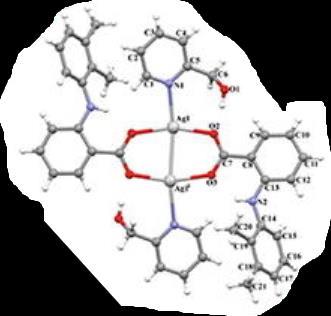
8 SinglecrystalXRDstructureofAg(I)complexe
2019's Gangireddy et al. created, manufactured, and assessed the in vitro cytotoxicity of a quantity of new imidazole pyridine derivatives. Compounds containing fluorine, such as 2-fluorophenyl Methanone, pyridinyl imidazo pyridinyl) piperazine derivative, and (3-fluorophenyl) The effective cytotoxic profile of pyridinyl imidazo pyridinyl) piperazine derivative was observed against MDA MB231, HeLa, and HepG2. Comparing complexes (IC50 value is 0.8 μM) and (IC50 valueis 3.5μM)againstHeLa,theywereshown to be morepotentthanthecontrol complex Paclitaxel (IC50 valueis2.8 μM).ComparingCompound7htoPaclitaxel(IC50=0.56μM;IC50=1.9μM,HepG2,MDAMB-231)itwasalsodiscoveredto beeffectiveagainstMDAMB-231(IC50=6.9μM)andHepG2(IC50valueis2.0μM)correspondingly.Itwasalsodiscovered thatcompound7ewaseffective opposedtoHepG2(IC50 valueis 9.8μM)celllines. Incomparisonto reported imidazole pyrimidine derivatives, synthesized piperazine substituted pyridine derivatives (IC50 value is 3.5μM) and (IC50 value is 5.8μM)demonstrated1.8-foldand1.4-foldriseinanti-proliferativeactivity.AgainstHelacelllines, imidazolepyrimidine diazepanylmethanone(IC50valueis6.54μM)andFluorophenyl imidazolemethanone(10f,IC50valueis6.12μM)were tested. The proposed complexes were able to attach with several targets, as evidenced by molecular docking studies showing thatthey occupied theactivesitesofthe colchicineand estrogen receptor. Thesecompounds' biological activity suggeststhattheymaybeusedintreatmentprotocols
Ya-Ling Song et al. (2019) demonstrated the antitumor effectiveness of steroidal pyridine derivatives using molecular docking.Severalsteroidalpyridinederivativesweresynthesizedusingmoleculardockingsoftware,withasteroidserving asthecarriernucleus anda pyridineheterocycleacting asa pharmacophore on the D-ring. These compounds were then investigated for their potential anticancer effects. The substances were investigated as potential anticancer medicines afterbeingcreatedassmallmoleculeinhibitors.Themoleculewascreatedusingasingle-potmulti-componentsynthesis, andtheinvitroanticanceractivityoftheresultantcompoundswasassessed. Priortotreatment,fourcancercelllinesthat were naturally developing were employed. Out of all the substances that were tested for anticancer activity. The treated cells' morphology showed the most noticeable modifications, according to reports. The corresponding IC50 values for hepg2,skov3,mcf-7,hela,and12.39±0.14μM,5.088±0.05μM,and8.81±0.25μM,respectively,wereasfollows.Inthe sameway,thevaluesformcf-7,epg2,hepg2,skov3,andepg2were8.457±0.14μM,13.84±1.04μM,7.025±0.33μM,and 6.283±0.12μMaccordingly.
International Research Journal of Engineering and Technology (IRJET) e-ISSN:2395-0056
Volume: 11 Issue: 06 | Jun 2024 www.irjet.net p-ISSN:2395-0072
Theantitumorefficacyofnewpyridinederivativesbasedondiphenyl etherwasreportedbyVermaetal.(2019). HepG2, A549, and Vero cell lines were used as test subjects to create a variety of distinct 2-amino substituted phenyl nicotinonitriles. Thetwocompoundsthatshowedthegreatestactivity againstthe A-549cell line amongthose thatwere examined were -OH substituted diphenyl ether-based pyridine (IC50 16.74±0.45 μM) and -OCH3 substituted diphenyl ether-based pyridine (IC50 10.57±0.54 μM). The 3b- and 3p-induced apoptosis has been further investigated by DNA fragmentation analysis and the AO/EB (ethidium bromide /acridine orange) nuclear staining methodology. Using this methodofstainingA-549cells,itwaspossibletoseethatthecellstreatedwith-OHand-OCH3 substituteddiphenyletherbased pyridine had undergone morphological changes that indicated a decrease in cell viability and the beginning of apoptosis. ObservationsofDNAfragmentationintonucleosomesprovidedadditionalevidencethatcompound3b-treated cells had undergone cell death. The G2/M phase cell cycle arrest that compound 3b-treated A549 cells underwent was confirmed by flow cytometry studies. Further in in silico investigations verified the medications' in vitro anticancer efficacy,asdemonstratedbydockscoreandbindingenergyvalues.
Conclusion
Over the past two decades pyridine core molecules plays a vital role in the anti-tumour pharmacopeia field. More than 80%ofanti-cancerdrugsarebasedonpyridinecoremoiety.Inthedesignandsynthesisofanticancerdrugsthepyridine substituted molecules is getting more fascination to the scientist because of its biological properties. In this review anticanceractivityofsomeofthepyridinederivativessuccessfullyreported.
References
1. S. Hirabayashi, Y. Li, N. Ohta, A. Ishibashi, Y. Yoshikawa, B. Lin, M. Fumimoto, T. Takehara, K. Nunomura, T. Suzuki, J. Haruta,K.Nimura,M.Arisawa, Tetrahedron Lett. 2023, 114,154288.
2. Prasanna BM, Praveen BM, Hebbar Narayana, Venkatesha TV, Tandon HC (2014) Ketosulfone drug as a green corrosioninhibitorformildsteelinacidicmedium.IndEngChemRes53,2014,8436–8444.
3. A.A.Shafi,A.E.Yen,N.L.Weigel,Pharmacol.Ther.2013,140,223–238.
4. R.B.Marques,N.F.Dits,S.Erkens-Schulze,W.M.vanWeerden,G.Jenster,PLoSOne2010,5,13500.
5. D.Poirier,R.Maltais,J.A.Rousseau,J.Roy,S.Phoenix,F.Cortés-Benítez,R.Lecomte,Bioorg.Chem.2022,129,106145.
6. W.Jiang,X.Wang,C.Shu,Q.Hou,K.Yang,X.Wu,Bioorg.Chem.2022,119,105575.
7. N.Formaggio,M.A.Rubin,J.-P.Theurillat,Oncogene2021,40,1205–1216.
International Research Journal of Engineering and Technology (IRJET) e-ISSN:2395-0056
8. SiegelRL,MillerKD,JemalA.Cancerstatistics,2017.CACancerJClin.2017;67(1):7-30.
9. Praveen, B. M., Prasanna, B. M., Mallikarjuna, N. M., Jagadeesh, M. R., Hebbar, N., & Rashmi, D. Investigation of anticorrosive behaviour of novel tert-butyl 4-[(4-methyl phenyl) carbonyl] piperazine-1-carboxylate for carbon steel in1MHCl.Heliyon,7(2),2021,e06090.
10. D. Teyssonneau, H. Margot, M. Cabart, M. Anonnay, P. Sargos, N.-S. Vuong, I. Soubeyran, N. Sevenet, G. Roubaud, J. Hematol.Oncol.2021,14,51.
11. C.Thomas,Y.Ji,C.Wu,H.Datz,C.Boyle,B.MacLeod,S.Patel,M.Ampofo,M.Currie,J.Harbin,K.Pechenkina,N.Lodhi,S J.Johnson,A.V.Tulin,Proc.Natl.Acad.Sci.USA2019,116,9941–9946.
12. S.Wang,J.-T.Shi,X.-R.Wang,H.-X.Mu,X.-T.Wang,K.-Y.Xu,Q.-S.Wang,S.-W.Chen,Bioorg.Chem.2023,133,106412.
13. M.Crumbaker,L.Khoja,A.M.Joshua,Cancers2017,Vol.9.
14. H.Wang,C.Li,X.Liu,M.Ma,Bioorg.Med.Chem.2022,61,116707.
15. C.Li,Y.Han,Z.Wang,Y.Yu,C.Wang,Z.Ren,Y.Guo,T.Zhu,X.Li,S.Dong,M.Ma,Eur.J.Med.Chem.2023,247,115030.
16. Y.-Y.Yang,W.-L.Wang,X.-T.Hu,X.Chen,Y.Ni,Y.-H.Lei,Q.-Y.Qiu,L.-Y.Tao,T.-W.Luo,N.-Y.Wang,Bioorg.Chem.2023, 132,106356.
17. B.K. Devendra, B.M. Praveen, V.S. Tripathi, D.H. Nagaraju and K.O. Nayana. Pt-Rh Alloy Catalysts for Hydrogen GenerationdevelopedbyDirectCurrent/PulseMethod.JournaloftheIranianChemicalSociety.19,1913-1922(2021)
18. Y.-M.Kang,H.-M.Kim,M.Lee,H.-J.An,Int.J.Mol.Sci.2021,22,12000.
19. Al-Majid,A.M.,Islam,M.S.,Atef,S.,El-Senduny,F.F.,Badria,F.A.,Elshaier,Y.A.,Ali,M.,Barakat,A.andMotiurRahman, A.F.M.,2019,Molecules,24,7,1332.
20. Rani, C.S., Reddy, A.G., Susithra, E., Mak, K.K., Pichika, M.R., Reddymasu, S. and Rao, M.V.B., 2021, Med. Chem. Res., 30,74.
21. El-Naggar,M.,Almahli,H.,Ibrahim,H.S.,Eldehna,W.M.andAbdel-Aziz,H.A.,2018,Molecules,23,6,1459.
22. Fayed,E.A.,Sabour,R.,Harras,M.F.andMehany,A.B.,2019,Med.Chem.Res,28,1284.
23. Kutlu, E., Emen, F.M., Kismali, G., Kınaytürk, N.K., Kılıç, D., Karacolak, A.I. and Demirdogen, R.E., 2021. J. Mol. Struct., 1234,130191.
24. Ahmed,M.H.,El‐Hashash,M.A.,Marzouk,M.I.andEl‐Naggar,A.M.,2019.J.Heterocycl.Chem.,56,1,114.
25. B.K. Devendra, B.M. Praveen, V.S. Tripathi, H.P. Prashanth Kumar, K.R. Chethana. The development of platinumrhodium alloy coatings on SS304 using a pulse/direct electrodeposition technique and their application to antibacterialactivity.JournaloftheIndianchemicalsociety.99(6)2022,100466
26. Abdallah,A.E.,Mohareb,R.M.andAhmed,E.A.,2019.J.Heterocycl.Chem.,56,11,3017.
27. Altay,A.,Caglar,S.,Caglar,B.andSahin,Z.S.,2019.InorganicaChim.Acta,493,pp.61-71.
28. Reddy Gangireddy, M., Mantipally, M., Gundla, R., Nayak Badavath, V., Paidikondala, K. and Yamala, A., 2019. ChemistrySelect,4,46,13622.
29. Boraei,A.T.,Eltamany,E.H.,Ali,I.A.,Gebriel,S.M.andNafie,M.S.,2021,Bioinorg.Chem.,111,104877.
30. Varadaraj S, Shreeprakash B, B.M. Praveen, B.K. Devendra, The Effect of graphene content on the corrosion and mechanical properties of an electrodeposited Ni-Graphene coating. Applied Surface Science Advances. 11 (2022) 100310
31. Song,Y.L.,Tian,C.P.,Wu,Y.,Jiang,L.H.andShen,L.Q.,2019,Steroids,143,53.
32. Verma,R.,Bairy,I.,Tiwari,M.,Bhat,G.V.andShenoy,G.G.,2019,Mol.Divers.,23,541.
Volume: 11 Issue: 06 | Jun 2024 www.irjet.net p-ISSN:2395-0072 © 2024, IRJET | Impact Factor value: 8.226 | ISO 9001:2008 Certified