
International Research Journal of Engineering and Technology (IRJET) e-ISSN:2395-0056
Volume:11Issue:06|Jun2024 www.irjet.net p-ISSN:2395-0072
DDDS:DRIVER DROWSINESS DETECTION SYSTEM
M.Vinoth#1 Muvva Kamalesh#2 Kaku Jagadeesh#3 P.V Sai Yoshith#4
Assistant Professor, Department of Electronics and Communication Engineering, Chennai Institute of Technology, Muvva. Kamalesh, Department of Electronics and Communication Engineering, Chennai Institute of Technology Kaku Jagadeesh, Department of Electronics and Communication Engineering, Chennai Institute of Technology P.V Sai Yoshith, Department of Electronics and Communication Engineering, Chennai Institute of Technology Tamilnadu, India
ABSTRACT - The Sleepy Driver Detection System (SDDS) stands as a crucial advancement in automotive safety, specifically designed to mitigate accidents stemming from drowsy driving. Employing a sophisticated blend of sensors and advanced algorithms, it continuously monitors the driver's state, identifying signs of drowsiness in real-time. Key elements encompass infrared cameras, facial recognition technology, steeringanglesensors,andbiometricsensorssuchasheartrate monitors, collectively offering a comprehensive insight into the driver's behavior and physiological condition. The SDDS software meticulously analyzes data from these sensors, evaluating parameters like eye movement, blink frequency, facial expressions, and steering patterns. Upon checking and analyzing signs of drowsiness or tiredness, this promptly issues audible and visual alerts, thereby averting of these accidents that are caused by driver tiredness. Its adaptability to diverse vehicles and driving conditions establishes it as an indispensable tool for bolsteringroadsafety, effectively curbing drowsydriving-relatedincidents.
Keywords – Driver Drowsiness System, Sensor Technology, AlertSystem,Real-timeSafety.
I. INTRODUCTION
The principal aim of a Driver Drowsiness Monitoring and Detection System (DDMDS) is to elevate road safety by effectively identifying and addressing the risks associated with drowsy or fatigued driving. Drowsy driving presents a substantial threat on the roads, potentially compromising a driver'sability to reactswiftlyandmake informeddecisions, leadingtoaccidentswithpotentiallyfatalconsequences.
TheDDMDSfulfillsseveralessentialobjectives:
Early Identification of Drowsiness: Itconsistentlymonitors the driver's state utilizing various sensors, including facial recognition,eyetracking,andbiometricsensors.Byanalyzing real-time data, it can detect subtle indications of drowsiness beforetheyescalate.
Driver Alert System: Upon detecting signs of drowsiness, the system promptly issues audible and visual alerts. These
alerts serve to notify the driver, making them cognizant of their impaired condition and encouraging corrective actions, suchastakingabreakorswitchingdrivers.
Accident Prevention: The primary objective is to avert accidents resulting from drowsy driving. By intervening at the appropriate moment, the DDMDS has the potential to preventthedriverfrommakingcriticalerrorsthatmightlead toacollision.
Augmenting Overall Road Safety: Drowsy driving not only jeopardizesthedriverbutalsoposesriskstopassengersand otherroadusers.Bydiminishinginstancesofdrowsydrivingrelated accidents, DDMDS contributes to overall road safety, potentiallysavinglivesandreducinginjuries.
Customization and Versatility: DDMDS can be customized for various vehicles and driving conditions, establishing it as a flexible safety feature applicable to diverse transportation scenarios,fromlong-haultruckingtodailycommuting.
Data Analytics: The system can amass and store data, offering valuable insights into driver behavior and drowsiness patterns. This data can be utilized for further researchandrefiningsafetymeasures.
II. LITERATURE SURVEY
Based on the fact that driver fatigue is a common trouble inside the area of safety, the driver Drowsiness tracking and Detection system (DDMDS) changed into researched and developed. these structures play an critical position in reducing the risks associated with drowsy riding. Many research have investigated the performance of various sensors and algorithms in DDMDS. In this example, infrared cameras have been shown to be useful in monitoring facial temperature, at the same time as facial recognition era has tested effective in detecting symptoms which include eyelid drooping and yawning. steerage perspective sensors help examine using behavior, while biometric sensors, including coronaryheartfeesensorsandEEGsensors,provideabetter knowledge of physiological measurements.device getting to know and deep learning have converted the DDMDS
International Research Journal of Engineering and Technology (IRJET) e-ISSN:2395-0056
Volume:11Issue:06|Jun2024 www.irjet.net p-ISSN:2395-0072
panorama by using enabling actual-time evaluation of more thanonesensorstatistics.studiesindicatesthesignificanceof integrating more than one measures to ensure accurate drowsinessdetection.Thetakealookatalsoaddressesissues with the warning gadget, highlighting the want for a nonintrusivealertwhichcaneffectivelyawakendrowsydrivers.
1.Sensor Technologies: [A Sahayadhas,K Sundaraj,M Murugappan-Sensors,2012 - mdpi.com]Review thevarious sensor technologies used in DDMDS, including infrared cameras, facial recognition cameras, steering angle sensors, andbiometricsensors.Discusstheirstrengthsandlimitations indetectingdriverdrowsiness.
2. Data Processing and Analysis: [M Ngxande,JR Tapamo… - 2017 pattern recognition…, 2017ieeexplore.ieee.org]Explore the signal processing and data analysis techniques employed in DDMDS. Discuss the role of machinelearning(ML)inreal-timedrowsinessdetection.
3.Multi-Modal Data Fusion: [EO Andreeva,P Aarabi,MG Philiastides - Information Fusion …, 2004spiedigitallibrary.org]InvestigatehowDDMDScombinesdata from multiple sensors to improve accuracy. Analyze the benefits of integrating data on eye movement, facial expressions,steeringbehavior,andphysiologicalindicators.
4.DrowsinessDetection Algorithms: [MKHussein,TM Salman,AH Miry… - 2021 1st Babylon…, 2021ieeexplore.ieee.org] Examine the development and effectivenessofdrowsinessdetectionalgorithms.Discussthe thresholds, features, and criteria used to determine driver drowsinesslevels.
5.Real-Time Alert Mechanisms: [AK Biswal,D Singh,BK Pattanayak - and mobile computing,2021hindawi.com]Explore the design and evaluation of alert mechanisms in DDMDS. Assess the auditory,visual,andhapticfeedbackmethodsusedtoawaken drowsydrivers.
6.User Interface and Customization: Discuss the user interface aspects of DDMDS, including how drivers interact with the system. Explore customization options that allow driverstotailoralertsettingstotheirpreferences.
7.Integration with Vehicle Control: [Anil kumarbiswal,Debabratasingh,Binod kumar andMingHourYang,2021https://org/10.1155/2021/662 7217]Investigate the integration of DDMDS with vehicle control systems. Evaluate the potential for DDMDS to proactivelyadjustvehicleparameterstopreventaccidents.
8.Effectiveness and Impact Studies: [PM Forsman,BJ Vila, RA Short, CG Mott…- Accident Analysis &…, 2013 -
Elsevier]Reviewstudiesthatenterstherealworldthatmostly effects on DDMDS in lowering drowsy drivinng accidents. AnalyzetheimpactofDDMDSonroadsafety.
9.Challenges and Ethical Considerations: [E Perkins,C Sitaula,M Burke… - IEEE Transactions on…, 2022ieeexplore.ieee.org]Discuss the challenges and ethical concerns associated with DDMDS, such as privacy issues relatedtofacialrecognitionandbiometricdatacollection.
10.FutureTrendsandResearchDirections: [YAlbadawi,M Takruri,M Awad- Sensors, 2022 - mdpi.com]Explore emerging trends in DDMDS research, including the use of novel sensors, improved machine learning models, and integration with autonomous driving technology. Identify areas where further research is needed to enhance DDMDS capabilities.
11.Drowsiness Prediction Models: [M Ngxande,JR Tapamo… - 2017 pattern recognition…, 2017ieeexplore.ieee.org]Investigateresearchonpredictivemodels that anticipate driver drowsiness before it reaches a critical level.Reviewstudiesthatfocusonearlywarningsystemsand theireffectivenessinpreventingdrowsydrivingincidents.
12.Cross-CuIturaI and Demographic Variations: [MA Granie, C Thevenet,F Varet… - Transportation…, 2021journals.sagepub.com]Analyze studies that examine how driver drowsiness varies across different cultures, age groups, and demographics. Explore whether DDMDS should betailoredto specificpopulationsordrivingenvironments.
13.ReguIatory and Legal Considerations: [JM Cori, JE Manousakis,S Koppel… - Physiological…, 2021iopscience.iop.org]Discuss the regulatory landscape governing DDMDS deployment and usage.Examine legal and liability issues associated with the implementation of these systems.
III. PROPOSED SYSTEM
The proposed Sleepy Driver Detection System (SDDS) presents an innovative solution to the pressing issue of drowsy driving. Utilizing advanced sensor technology and artificial intelligence, this system integrates various sensors, including infrared and facial recognition cameras, biometric sensors, and steering angle sensors, for comprehensive realtime monitoring of driver behavior and physiology. Through intricate data analysis encompassing eye movements, facial expressions, steering behavior, heart rate variability, EEG patterns, and skin conductance, the SDDS accurately identifies signs of drowsiness. Proactive alert mechanisms, customized to driver preferences, gently awaken drowsy individuals, enhancing overall road safety. A user-friendly interface, vehicle integration options, and a commitment to
International Research Journal of Engineering and Technology (IRJET) e-ISSN:2395-0056
Volume:11Issue:06|Jun2024 www.irjet.net
privacy and data security ensure the system's accessibility and reliability. The proposed DDMDS not only detects drowsiness but also actively intervenes to mitigate potential accidents,addressingacriticalaspectofroadsafety.
Advantages:
1.AccurateDrowsinessDetection:
The advanced sensor technology and actual-time data evaluation inside the proposed DDMDS permit relatively particular detection of driver drowsiness. simultaneously considering more than one indicators reduces false alarms, ensuring welltimedinterventionwhileauthenticdrowsiness isdiagnosed.
2.Preventativesignals:
Thesystemgeneratesproactiveandnon-intrusiveindicators, incorporating audible, visible, and haptic comments. This allows drivers to stay alert without distraction, appreciably decreasing the danger of accidents resulting from drowsy using.
3.Reducedaccidentcosts:
Through averting accidents resulting from drowsy using, the DDMDS enables diminish scientific fees, assets damage, and misplaced productiveness, resulting in extensive price financialsavingsforpeopleandsociety.
4.Non-stopimprovement:
Designed for non-stop improvement, the DDMDS features informationstorageandevaluationcompetenciesthatpermit ongoing improvements to device performance and street safety.drowsy driving, these systems contribute significantly to reducing accidents, injuries, fatalities, and property damage.

OpenCV is overwhelmingly a method for ongoing picture preparing which has liberated from cost executions on most
p-ISSN:2395-0072
recent PC vision calculations. It has all necessary PC vision calculations
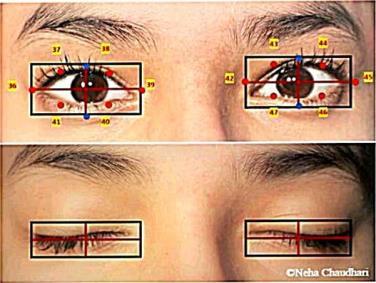
PERCLOStechniquerecommendsthatlanguorisestimatedby ascertaining the level of the eyelid 'hangs'. Sets of eye open andeyeshuthavebeenputawayintheproductlibrarytobe utilized as a boundary to separate whether the eyes is completely open or completely shut. For eyelids to hang, it occursin much moreslow timeas the individual isgradually nodding off. Consequently, the progress of the driver's lazinesscanberecorded.
Sleepiness can be distinguished by utilizing face territory recognition. The techniques to identify sleepiness inside the face territory shift because of languor. Sign in are more noticeable and clear to be identified at the face territory, we can identify the eyes area. From eyes identification, the creator expressed that there are four kinds of eyelid development that can be utilized for laziness location. They aretotallyopen,totalclose, andinthecenterwherethe eyes arefromopentocloseandtheotherwayaround.
The calculation measures the picture caught in a dark scale strategy; where the tone from the pictures is then changed into highly contrasting. Working with highly contrasting pictures is simpler on the grounds that lone two boundaries must be estimated. The creator at that point plays out the edgediscoverytoidentifythe edgesof eyessothe estimation oftheeyelidterritorycanbedetermined.
The issue happening with this technique is that the size space of the eye may shift starting with one individual then ontothenext.Somebodymayhavelittle eyesandappearsas though it is drowsy yet some are most certainly not. Other than that, if the individual wearing glasses there is a hindrancetodistinguisheyearea
ALGORTITHM:
1.Startthecode
2.Inputdriversvideoisdisplayed
3.Closedeyecountissetto0
4.Itchecksthestatusoftheeye
5.Ifeyesareclosedthenclosedeyecountisincremented
International Research Journal of Engineering and Technology (IRJET) e-ISSN:2395-0056
Volume:11Issue:06|Jun2024 www.irjet.net
6.Thenalarmisgenerated
7.Ifuseropenstheeyescountbecomesnormalto0
8.ifnotamessageisbeingsentwithlocationforhelp
OUTPUTS:
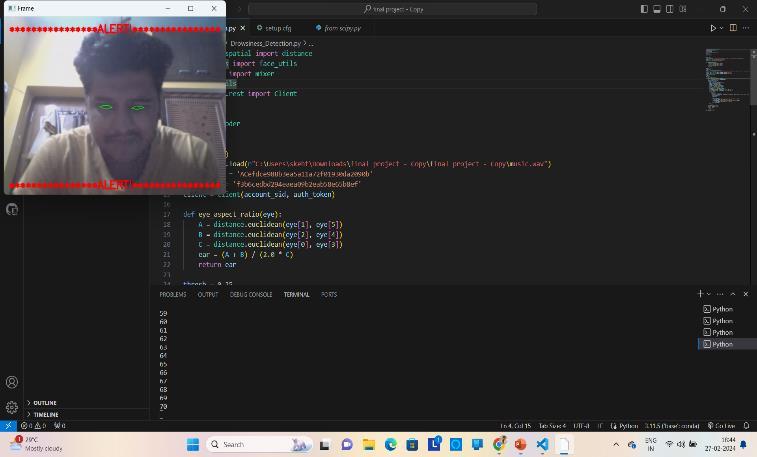
Fig.4Alertalarmsoundforwakingthedriver

Fig.5Text
Ifuserwon’topenhiseyesevenafterthealarmthenmessage issentwithlocationofdriver
FUTURE ENHANCEMENT:
1.Adaptive AI Algorithms: Utilizing AI algorithms that adapt and evolve over time, learning from individual driver patterns and behaviours to tailor drowsiness detection thresholdsandalertsforeachdriveruniquely.
2.Multimodal Sensor Fusion: Integration of multiple sensors like EEG for brainwave monitoring, heart rate sensors, and additional behavioural tracking mechanisms to create a comprehensive understanding of the driver’s physiological state.
IV. CONCLUSION
Fig.3Flowdiagram
SleepyDriver DrowsinessDetection(SDDS)arevital toolsfor preventing accidents that are caused by tired drivers with real-time monitoring and alerting features, SDDS enhances
International Research Journal of Engineering and Technology (IRJET) e-ISSN:2395-0056
Volume:11Issue:06|Jun2024 www.irjet.net p-ISSN:2395-0072
road safety by prompting drivers to stay alert this helps in reduction of accident cases, if the user is tired and feeling drowsy this system will be ringing alarm if user closes eyes eventheniftheuserdidnotwakeupthenamessageisbeing sent to the user. Thereby the reducing the risk of accidents due to drowsy and sleepy driving this system is very much helpfulanduseful.
V. REFERENCES
1. National Highway Traffic Safety Administration Drowsy Driving. [(accessed on 10 May 2021)]; Available online: https://www.nhtsa.gov/risky-driving/drowsy-driving
2.National Institutes of HealthDrowsiness. [(accessed on10 May2021)]:Availableonline: https://medlineplus.gov/ency/article/003208.htm#:~:text= Drowsiness%20refers%20to% 20feeling%20abnormally, situations%20or%20at%20inappropriate%20times
3.ArakawaT.Trendsandfutureprospectsofthedrowsiness detectionand estimation technology. Sensors. 2021;21:7921. doi: 10.3390/s21237921. [PMC free article] [PubMed] [CrossRef][GoogleScholar]
4. National Safety Council Drivers are Falling Asleep Behind the Wheel. [(accessed on 10 May 2021)]. Available online: https://www.nsc.org/road-safety/safety-topics/fatigueddriving
5.National Sleep Foundation Drowsy Driving. [(accessed on 10 May 2021)]. Available online: https://www.sleepfoundation.org/articles/drowsy-driving
6.Liu, C., Lv, W., Yang, Y., &Lv, C. (2018). Driver drowsiness detectionbasedonheartratevariabilityandwaveletanalysis IEEEAccess,6,4695046960
7.Muralidhar, R., Suresh, S. S., & Chethan, H. B. (2017). Realtime driver fatigue detection using deep learning neural network. In Proceedings of the International Conference on Intelligent Computing and Control Systems (ICICCS) (pp. 1170-1175).
8.Abdel-Qader, I. ,&Hammouri, A. (2019). Real-time driver drowsiness detection system using convolutional neural networks. In Proceedings of the 2019 5th ICCAR (pp. 679684).
9.Li, Y. , Ren, Y. , Zhang, Z. , & Li, X. (2018). Driver tiredness detection which is based on multimodal information fusion using convolutional neural networks. IEEE Access, 6, 5278452792.
10.Khurana, A. , Sundararajan, V. , & Subramanian, S. (2018). Areview ofdrowsydriver monitoringsystem.In checking of the2018ACM/IEEE9thICCPS(pp.290).
11.Park, M., & Kim, J. (2020). Driver fatigue detection using multimodaldeeplearning.IEEEAccess,8,108179-108188.
12.Wu, B. , Yang, D., & Xue, Y. (2018). A survey of driver fatigue monitoring systems. In Proceedings of the 2018 IEEE andICRA(pp.7481-7488).
13.He, Y. ,& Wu, C. (2019). A visiondriver drowsiness, tiredness or sleepiness detection system using DL. In Proceedingof2019IEEEIntelligentVehiclesSymposium(IV) (pp.2633-2638).
14.Naranjo, J. E., &Onieva, E. (2017). Detection of driver drowsinessusingartificialneuralnetworks.InProceedingsof the 2017 IEEE/RSJ International Conference onIROS (pp.4221-4226).
15.Ding, Y., Zhao, C., & Zhuang, Z. (2017). Real-time driver drowsinessdetectionusingnetworksthatareneural.In2017 23rdInternationalConferenceonAutomationandComputing (ICAC)(рр.1-б).
16. Singh, S., & Gupta, P. (2019). A review on driver drowsiness detection systems. Transportation Research Part F:TrafficPsychologyandBehaviour,65,620-641.
17. Li, X., Zhang, D., & Guo, W. (2020). Real-time driver drowsinessdetectionbasedontheneuralnetworks
18.Sharma,A.,Saini,A,.&Bansal,R.(2019).Acomprehensive review on vision-based driver drowsiness monitoring systems.20(11),4122-4147.
19.Doss,S.D.,Sreedharan,S.,&Singh,K.D.(2018).Areview on driver drowsiness detection systems. Journal of Ambient IntelligenceandHumanizedComputing,9(1),21-45.
20.G Sikander,SAnwar- IEEETransactionsonIntelligent…, 2018 - ieeexplore.ieee.org… The model that is very much interactive and having neuralmode that is targeted for agencies that suggestregulatingtheir… an improvedfatiguedetectionsystem