
International Research Journal of Engineering and Technology (IRJET) e-ISSN: 2395-0056
Volume: 11 Issue: 06 | Jun 2024 www.irjet.net p-ISSN: 2395-0072
International Research Journal of Engineering and Technology (IRJET) e-ISSN: 2395-0056
Volume: 11 Issue: 06 | Jun 2024 www.irjet.net p-ISSN: 2395-0072
Abhijeet Yadav1, Mr. Jonty Choudhary2, Mr. Pravek Sahu3
1Research Scholor, M. Tech. (Structural Engg.)
2Assistant Professor, Department of Civil Engineering,
3Assistant Professor, Department of Civil Engineering, Jhada Sirha Government Engineering College, Jagdalpur Chhattisgarh
Abstract - Concrete is the most utilized building material worldwide, after water. It is well-known for having strong compressive and tensile properties. Concrete curing contributes to its durability; therefore, in order to prevent water shortages, we propose the idea of self-curing concrete as an alternative to immersion. This study aims to determine the impact of adding polyethylene glycol-400 as an additive to concrete with a weight percentage of 1% for M30 grade concrete mix. We choose internal curing where external curing is not possible, such as in places with limited water supplies or when human access is restricted. A significant factor in the development of the concrete's microstructure and pore structure is internal curing, often known as self-curing.
Key Words: conventional concrete, Self-curing concrete Self-Curing agent PEG-400, Compressive strength, Tensilestrength.
Concrete is the most common building material due to its strengthanddurability,makingitalow-costoption.Itmay be bent and sized to form highways, bridges, and other infrastructure. Concrete is extremely durable, tough, and hard. The most versatile material is suitable for any form ofbuildingproject.Thebulkofcivilengineeringstructures useconcreteastheirprimaryengineeringmaterial.Itslow cost, high durability, and convenience of on-site fabrication contribute to its popularity as a basic building material in construction. Concrete, like other engineering materials, must be developed for strength, durability, and workability. introduction of new generation admixtures. Higher grades of concrete with good workability are achievable.
Curing is primarily intended to maintain the moisture content of the concrete by avoiding its loss of moisture whileitisstrengthening.Controllingthepaceandamount of moisture movement in concrete during cement hydrationisknownascuring.
Concrete can be internally cured, also known as selfcuring, to introduce more moisture for improved cement hydration and decreased self-desiccation. With the use of PEG-400, concrete's water loss is reduced and its water capacity is increased as compared to regular concrete. Becausetheconcreteismixedandplacedcorrectly,typical concrete gains its strength through external curing. In orderforconcreteconstructiontohaveadequatestrength andlongevity,curingisnecessary.
Because of the disparity in chemical potentials, moisture evaporationfromanexposedsurfaceoccurscontinuously. When cement hydrates, chemical shrinkage takes place, resulting in the creation of empty holes and a drop in relative humidity. This causes the cement paste to selfdesiccate and lose its moisture content, which results in theformationofmicrocracksandcapillarypores,theweak areasinthematrix.
In order to prevent self-desiccation and preserve relative humidity, self-curing is employed. free energy that exists between the liquid and vapor phases. The content and characteristics of the self-curing agents, such as water absorption, pore structure, grain size distribution,andmechanicalproperties,arecloselylinked to the performance of the self-curing concrete system. Significant autogenous deformation and (early-age) cracking may occur when this water is not easily accessible.Emptyporesareproducedinthecementpaste as a result of the chemical shrinkage that takes place duringcementhydration.This shrinkageandreduction in internalrelativehumiditymayresultinearly-agecracking.
Initially, self-curing was suggested as a way to deal with the self-desiccation of the concrete. The mechanism by which tiny inclusions scattered throughoutconcreteretainwaterduringmixingandupto setting time then release it after cement hydration is knownasself-curing.Maintainingthemoisturecontent of concrete is essential because cement hydration loses effectiveness when relative humidity falls below 80%. Insufficient water availability during concrete curing can
International Research Journal of Engineering and Technology (IRJET) e-ISSN: 2395-0056
Volume: 11 Issue: 06 | Jun 2024 www.irjet.net p-ISSN: 2395-0072
cause cement hydration to stop and result in unfavorable characteristics.
A novel method for keeping concrete warm and moist for increased strength and durability has emerged recently: self-curing concrete. The idea behind self-curing concrete isthatadmixtures,whichhavethecapacitytoabsorbhuge amountsofwaterduringmixing,areusedtosupplywater fromaninternalsource.
2. AIM:
To achieve strength without compromising workability, M-30-grade concrete contains 1% PEG-400 by weight of cement.
2.1 OBJECTIVE:
to investigate how the curing ingredient (PEG400) affects the concrete's strength characteristics.
Enhancing the concrete with PEG-400. UtilizingPEG-400
Determine the compressive and tensile strengths oftheconcrete.
Make inferences about the compressive and tensile strengths of conventional and self-curing concretebasedonthedata.
The main objective of our project is to make concretewhilesimultaneouslyusinglesswater.
Itiseasytouse,anditwillincreasestrengthatthe sametime.
3. Literature Review
Sudharson G et.al, 2021 studied the effect of self-curing agent PEG-400 on fresh and hardened properties of M30 grade of concrete and compared with conventional concrete. It is concluded that the increases in dosage of PEG increases the workability of concrete. Compressive strength, split tensile strength and Flexural Strength of self-cured concrete is found to be higher when compared with conventional concrete. Also, the performance of the concrete can be improved with the addition PEG as a selfcuringagent.
Azhagarsamy and Sundaraman 2016 studied thestrengthanddurabilitypropertiesofconcrete usingwatersolublepolyethyleneglycol(PEG400) 0.5% as self-curing agent using M20 grade concrete.Thecompressivestrengthat3,7and28
days have been obtained with normal curing and self-curingcondition.Itwasfoundthatanaverage increase in compressive strength of 12.73% and split tensile strength 13.31% with 0.5% of PEG400.Thisshowsthatself-curing concreteshowed a better performance than the conventional concrete.
Tyagi (2015) Various proportions of PEG-400 (0.5 to 2) percent of the cement weight in concrete were investigated. In the current investigation,OPCcementwasusedinaccordance to IS 12269-1987. The experiments were conducted on M25 and M40 grades to link the outcomes of both grades with conventional concrete. The optimum value for M40 grade was observed at 0.5% and 1% for the M25 grade of PEG-400 in concrete. However, the indicated values significantly enhance concrete strength propertiesanddurability.
Wen-Chen Jau (2008) the studyused self-curing concretetoreducetheusageofahighpercentage offreshwaterintheconcrete.Thepurposeofselfcuring concrete is to eliminate the need for manual curing after casting and finishing the concrete.Self-curingconcreteengrossesmoisture from the air and retains the water for proper hydration ofcement.Ina conventional technique, the hydration process continuously evaporates water from the surface of the concrete, which results in losses of strength characteristics. The resultssignifiedtheadditionofaself-curingagent improvedthecompressivestrengthpropertiesby about10%comparedtothenon-curedproperties ofconventionalconcrete.
4.1 PEG, or polyethylene glycol: Substances that are difficult to dissolve in water are mixed with lowmolecular-weight solvents, including polyethylene glycol, or PEG. A typical liquid condensation polymer used in concrete is PEG, which is made of ethylene oxide and water.Itdissolveseasilyinwaterandisinsolubleinether, paraffin, oil, and fats, but is readily soluble in ethanol, glycol, water, chloroform, and acetone. PEG is a common ingredient in medicinal products, largely for hygienic reasons. It is nontoxic, odorless, neutral, lubricating, nonvolatile, and non-inflaming. When PEG is added to concrete,itformsathinshellaroundthewatermolecules, trapping the water particles. Since the shell that forms around the water particles prevents the water from evaporating and lowers the rate of evaporation, more water is available for the hydration process. Early-age shrinkage cracks will decrease since water is available throughout the strength-gain phase. Additionally, by
International Research Journal of Engineering and Technology (IRJET) e-ISSN: 2395-0056
Volume: 11 Issue: 06 | Jun 2024 www.irjet.net p-ISSN: 2395-0072
reducing the requirement for external curing, this helps conservewater.Itiswidelyrecognizedasanadditiveused inconcretetoreduceshrinkage.PEGhasadensityof1.13 g/cm3, a slight odor, and appears to be harmless. When polyethyleneglycol isadded toconcrete,itimprovesboth the material's ability to store water and its compressive strength.ThePEG-400wasemployedinthisstudy.Alowmolecular-weighttypeofPEGiscalledPEG-400.
4.2 Cement: Every type of construction requires cement. The key component of concrete-forming paste that binds aggregateandfillsinspacesbetweenitiswater.Cementis a highly rounded substance with cohesive and adhesive qualities that acts as a binding medium for the individual components. Ordinary Portland cement is utilized in the design mix. The mix designs for grades M–30 is prepared using the chemical compositions of ordinary Portland cement. There were no lumps in the freshly used cement. Using IS 456:2000, the water-to-cement ratio for this mix designis0.45.
S. No. Property Result Permissible limit
1 Specificgravity 3(confirmingtoIS40311988part11)
2 Normal consistency 33%(confirmingto40311988part4)
3 Initialsettingtime finalsettingtime 32mins 420minsto9hours (confirmingto4031-1988 part5)
4 Finenessof cement(By 90micronsieve)
3.6%retainedNotexceed 10%confirmingto(40311988part3)
Table:1 Properties of Cement
Properties of Cement
4.3 Fine Aggregate: Afineaggregateisonethathasasize of no more than 4.75 mm. The fine aggregate fills in the spacesleftbythebindingofthematerial.Thisexperiment employed natural river sand that had a maximum size of 4.75 mm. Sand zone II, which is reachable locally, has a specific gravity of 2.5, a fineness modulus of 2.7, and a waterabsorptionof1.18%,confirmingI.S.383-1970.
4.4 Coarse aggregate: 30 to 40 percent of concrete with coarse particles is void. I.S. 383-1970 states that 20 mmsized crushed granite stone with a specific gravity of 2.5 anda finenessmodulus of2.7isacceptable. They work in many different areas of the construction industry. This substance is essential to the building process. Constructionaggregatehasasizerangeof4.75to20mm.
4.5 Water: Concreteacquiresitsstrengthandworkability fromthehydrationofcementinthepresenceofwater.Itis advisable to add water to concrete sparingly, even if adding too much water can lead to segregation. Water is an essential component of concrete since it actively participates in the chemical reaction with cement. It is vital to carefully evaluate both quantity and quality because it helps make the cement gel that gives strength. Water that met IS 456-2000 standards was portable and used for both mixing and curing in the experimental operation.
For this project mix design by Indian standard recommended method for concrete mix design based on {IS10262-2019} M30 grade of concrete mix is taking by me.
(A) Design Required:
1.Gradedesignation=M30
2.Typeofcement=OPC-53
3.MaximumSizeofaggregate=20mm
3.Degreeofsitecontrol=Good
4.Exposurecondition=Severe
5.Workability=75mm
6.Methodofconcreteplacing=manual
7.Minimumcementcontent=320kg/m3
(B) Test result for material:
1.Specificgravityofcement=3.01
2.Specificgravityofcoarseaggregate=2.61
3.Specificgravityoffineaggregate=2.5
4.Waterabsorptionofcoarseaggregate=0.99%
5.Waterabsorptionforfineaggregate=1.18%
6.Conformingzoneofsand=zoneII
7.Typeofaggregate=uniformlygradedaggregate.
(C) Target mean strength = 38.25 N/mm2
(D) Selection of water cement ratio = 0.45
(E) Selection of water content = 207.26 kg/m3
(F) Cement content =425.73 kg/m3
(G) Coarse aggregate (per m3) = 1066.75 kg
(H) Fine aggregate (per m3) = 600.10 kg
International Research
Volume: 11 Issue: 06 | Jun 2024 www.irjet.net
Workability test: Constructing a concrete workability testisnecessarysinceconcretecanbemixed,transported, and used in certain applications. The slump test is the method most often used to assess workability. This test, which can be conducted at the construction site or in a laboratory, is the most widely used technique for determining the consistency of concrete. Three layers of freshly mixed concrete are added to the slump cone, and each layer is tamped 25 times using a normal rod. It doesn't measure every element that affects workability. Nonetheless, it serves as a practical control test and provides information about the consistency of concrete across batches. The mis ratio for conventional concrete is C:S:A :: 1:1.40:2.50 and for self-curing concrete is C:S:A :: 1.1.41:2.52
Table -2 Slump Values of Conventional Concrete.
Compressive Strength test:
Table- 3 Slump Values of Concrete with PEG-400:
Prepare the concrete using PEG-400, just like you would conventionalandself-curingconcrete,basedontheresults of the slump cone. PEG-400's inclusion improves workability.
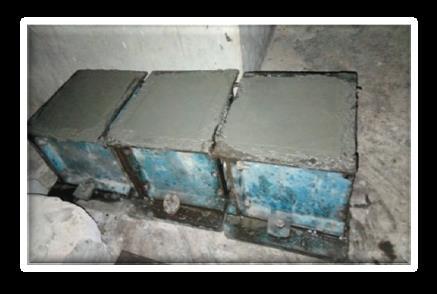
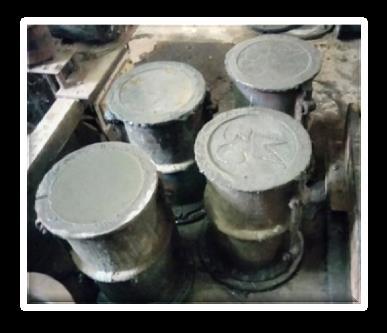
5.1 CASTING SCHEDULE: The casting of the specimens wasdoneasperIS 10086-1982:preparation ofmaterials, weighingofmaterials,andcastingofcubes,cylinders,and beams.Themixing,compacting,andcuringofconcreteare done according to IS 516:1959. The plain samples of cubes, cylinders, and beams were cured for 28 days in a water pond, and the specimens with PEG400 were cured for28daysatroomtemperaturebyplacingtheminshade. The M30 grades of concrete are designed, as is the materialrequiredpercubicmeterofconcrete.
Concrete's ability to support a compressive load while braking is one of its qualities. Aggregate properties, such as strength, grading, and size and shape, affect concrete's compressive strength. Uniformly graded aggregate providesincreasedperformanceandbetterinterlocking.
Aconcrete sample measuring150 ×150 ×150 ×150 mm was cast, and it was tested for 3, 7, 14, and 28 days to determine its compressive strength. A universal testing machine serves as the apparatus for determining compressivestrength.
Equation (1) allows us to calculate the compressive strength.CompressivestrengthisequaltoP/��
Aisthecross-sectionalarea(150×150×150mm),andP is the applied load. The outcome showed that PEG-400 treatment enhanced the mechanical properties of selfcuringconcrete.
International Research Journal of Engineering and Technology (IRJET) e-ISSN: 2395-0056
Volume: 11 Issue: 06 | Jun 2024 www.irjet.net p-ISSN: 2395-0072
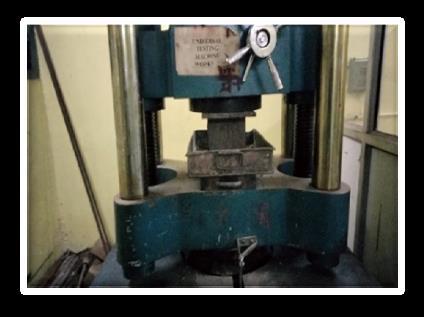
Fig-3 Compressive strength test in UTM
Table- 4 Compressive Strength results for Conventional Concrete
2)
TABLE-5 Compressive Strength results for sample PEG-400 as self-curing concrete:
2000KN capacity. On the specimen, the maximum load that was applied is noted. By using equations, we can determinethesplittensilestrength.Splittensilestrength= 2P/πDL,whereP=load,D=diameterofthecylinder,and L=lengthofthecylinder.
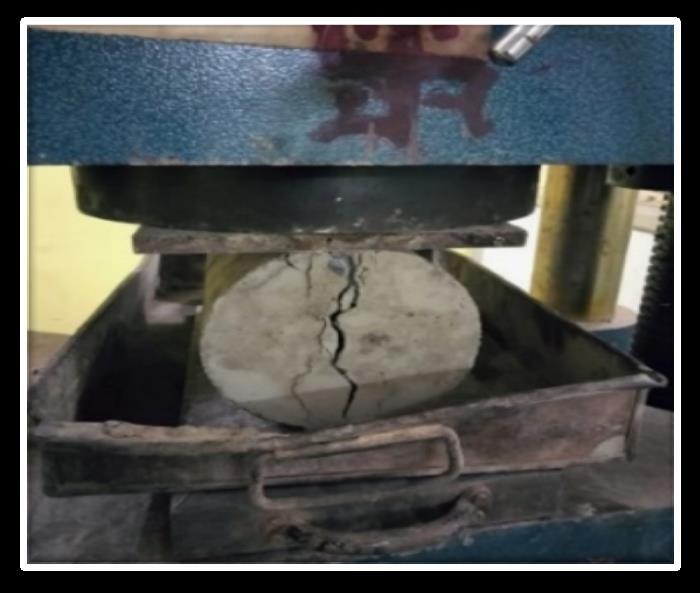
Fig- 4: Split tensile strength test in UTM
Table- 6 Tensile Strength results for Conventional Concrete
Chart-1: Compressive strength after 3-, 7-, 14-, and 28days vs Self curing concrete.
Split tensile strength:
To find the split tensile strength using cylinders of 150 mm in diameter and 300 mm in height. The cylinder was cast,anditwastestedin3,7,14,and28days.Thesample is examined using a universal testing machine with a
Table -7 Tensile Strength results for sample PEG-400 as self-curing concrete
International Research Journal of Engineering and Technology (IRJET) e-ISSN: 2395-0056
Volume: 11 Issue: 06 | Jun 2024 www.irjet.net p-ISSN: 2395-0072
Civil Engineering, R V College of Engineering, Bengaluru,Karnataka,India.
2. Wen-Chen Jau, ‘‘Self-Curing Concrete”, United States Patent Application Publication, (2008), Pub.No:U.S.2008/0072799A1.
3. EL-DIEB A. 2007. Self-curing concrete: Water retention, hydration and moisture transport. Construction and Building Materials. 21, 12821287.
4. IS 383:1970 Code for fine and coarse aggregate forconcrete.
Chart-2: Tensile strength after 3-, 7-, 14-, and 28-days vs Self curing concrete.
With respect to mix-30, PEG-400 achieved 1% compressive, and tensile strengths based on the previouslyindicatedresult.
Chemical admixtures should be used to make high-qualityconcrete.
The average 7.73% increase in compressive strength was obtained by using PEG-400 selfcuring concrete as opposed to conventional concretecuringata7-dayage.
The average increase in compressive strength measured at 28 days was 13.33% when selfcuring PEG 400 concrete was used in place of conventionalconcretecuring.
Becausethebuildingindustryisexpandingfaster, there is more construction taking place. For the curing process, the construction industry also usesalotofwater.
ACKNOWLEDGEMENT:
The authors are grateful to the department of civil engineering. Jhada Sirha Government Engineering College JagdalpurChhattisgarh.Theauthorswouldliketoexpress their sincere thanks to the Principal and HOD of Jhada Sirha Government Engineering College Jagdalpur Chhattisgarh,forapprovingtheprojectandformakinguse the resources of the college for the successful completion oftheproject.
1. M.Lokeshwari,B.R.PavanBandakli,S.R.Tarun,P. Sachin, Venkat Kum.ar Under Graduate Students, “A review on self-curing concrete” Department of
5. Concrete Technology: Theory and Practice by M. S.Shetty
6. ConcreteTechnology:TheoryandPracticebyM.L Gambhir.
7. ConcreteTechnology:byS.S.Bhavikatti.
8. IS 10262:2009 Recommended Guidelines for Concrete Mix Design Bureau of Indian standard NewDelhi.
9. BureauofIndianStandardsIS516:1959Methods ofTestsforStrengthofConcrete.
10. Indian Standard code456:2000 of practice for general structural use of plain and reinforced concrete.