
International Research Journal of Engineering and Technology (IRJET) e-ISSN: 2395-0056
Volume: 11 Issue: 06 | Jun 2024 www.irjet.net p-ISSN: 2395-0072
International Research Journal of Engineering and Technology (IRJET) e-ISSN: 2395-0056
Volume: 11 Issue: 06 | Jun 2024 www.irjet.net p-ISSN: 2395-0072
Deep Modi1 , Kishan Pala2 , Aakash Suthar3
1M Tech Student, L.J. University, Ahmedabad
2Kishan Pala/3Aakash Suthar, Assistance Professor, structural Engineering Department, L.J. University, Ahmedabad, India.
Abstract - Today's A detailed study of the progressive collapse analysis of multi-story buildings subjected to blast loading is now required due to the severe damage to property and life caused by recent terrorist attacks on the infrastructure. Research has typically been conducted using the Alternative Path Method (APM) with sudden column removal while neglecting the ideal site for blast loading. In this thesis, 3D models of a steel building with six stories and direct blast load modelling are suggested. Additionally, the impact of blast loading has been assessed at numerous sites. Two different types of explosive events vehicle-borne and package bomb have been taken into consideration. By employing a numerical model of the structure created with the " STAAD PRO " SOFTWARE, the blast load is analytically computed. By using a published example of a 20-story steel building that was subjected to blast load, the numerical model is validated. The collapse of steel buildings has been postulated as a possible outcome of the finite analysis, and proposals have been made to control it. By using a published example of a 7-story steel building that was subjected to blast load, the numerical model is validated. The collapse of steel buildings has been postulated as a possible outcome of the finite analysis, and proposals have been made to control it.
Key Words: Steel Structure, Blast, STAAD PRO, APM, Collapse, Vehicle Bomb, Package Bomb, G+20 Storey.
1.INTRODUCTION
Theinvestigationofblastimpactsonstructureshasbeenthe subjectofformaltechnicalinvestigationformorethansixty years. An explosion caused by a bomb inside or in close proximitytoabuildingcanledtodamagetothebuilding's externalandinternalstructuralframeworks,thecollapseof walls,thefragmentationoflargeareasofwindows,andso forth.Lossoflifeandinjuriestooccupantscanoccurdueto various factors, including direct blast effects, structural collapse,fire,andsmoke.
Traditional structures are generally not designed to withstandblastloads,andbecausethemagnitudesofdesign loadsaresignificantlylowerthanthose producedbymost explosions,traditionalstructuresaresusceptibletodamage fromexplosions.Theloadingfromablastanditseffectsona structure are influenced by several factors, including the weightofthecharge, thelocationof the blast(or standoff distance),andthegeometricconfigurationandorientationof
the structure (or direction of the blast). The structural response will vary depending on how these factors come together.
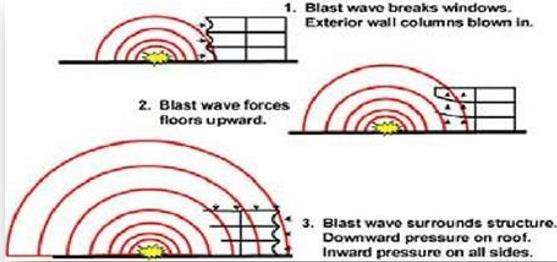
The initial manifestation of the explosion's shock wave is observedtoinducethefragmentationofwindows,exterior walls, and exterior columns, as illustrated in the visual representationdisplayedinfigure1.
Following this, the vigorous character of the shock wave impelstheelevationofthefloorsandslabs,asdepicted in thegraphicaldepictionprovidedinfigure1.
Lastly, the shock wave envelops the edifice, leading to a downward force exerted on the roof andinwardpressure exerted on all sides of the structure, as presented in the illustratedrepresentationappearinginfigure1.
Theoccurrencerecognizedasairblastencompassesablast wavethatprovokesanaugmentationinairpressureinthe proximityofaarchitecturalformation
In the event of immediate ground disturbance, when an explosiveiseitherpartiallyorfullysubmergedbeneaththe exterior of the ground, it yields a lateral oscillation of the ground, resembling an earthquake but with a discernible frequency.
International Research Journal of Engineering and Technology (IRJET) e-ISSN: 2395-0056
Volume: 11 Issue: 06 | Jun 2024 www.irjet.net p-ISSN: 2395-0072
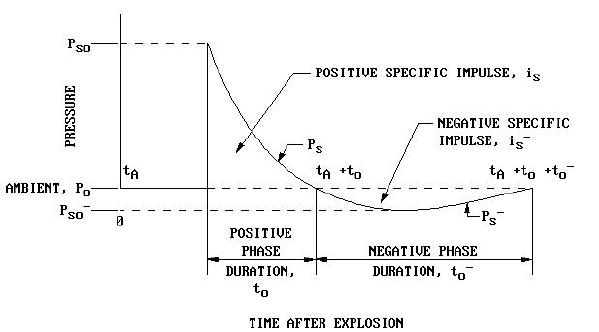
TheAnabruptincreaseinmagnitudeandreleaseofenergy in an extreme manner, typically accompanied by the production of exceedingly high temperatures and the expulsionofgases,isdefinedasanexplosion.Explosionscan manifest in either the form of deflagration or detonation, contingent upon the rate of combustion during the event. Deflagration occurs as a result of the ignited reaction of thermal conductivity, whereby the subsequent layer of colder material isignited by the hot burning material and subsequently combusted. which entails a supersonic exothermicfrontthatrapidlyacceleratesthroughamedium, ultimately leading to the propagation of a shock front directlyinitspath.
Yang Ding [1] demonstrates that whereas moment columns are good at resisting blast loads, gravity columnsaresignificantlyimpactedbyit.Accordingto Yang Ding , there is a significant risk of VBIEDs (vehicle-borne improvised explosive devices) in externalcolumns.Forthisreason,havingastructure withamomentframeattheexteriorfaceisessential foreffectiveexplosionresistance.
H.M.Elsanadedy[2]Analyzethesix-storysteel-framed buildinginRiyadhthatwasthetargetofa terrorist assaultandoffera preventivemethodtolessenthe impactoftheblastloadbylimitingvehicleaccessto thebuildingviaperimetercontrol.Ifthisisn'tfeasible, theoutsideexposedgroundfloorcolumncouldneed to be strengthened with a double-walled façade system, diagonal bracing, steel plate additions, concreteencasement,orshearwalls.
FengFu[3]Afteranalyzingthe20-storybuildingfor interior blast events, it was determined that a package bomb could only seriously harm specific structuralmembersandthatitwouldbedifficultto blow up the entire structure. By improving the column'sductilityandshearcapacity,thiseffectcan bemitigated.
JennySideri[4]demonstrateshow,oncetheexplosion attack has ended, the building's big column section withtheperimetermoment-resistantframesactsasa safety valve to maintain the system's structural integrity. Additionally, he looks into buildings with insiderigidcoreRC,andhecomestotheconclusion that the reaction of the entire system cannot be stabilizedbyanexternalcolumn.
YangDing[5]conductedananalysisonsteelframes subjected to confines explosion and post-explosion fire.Heconcludedthattheexteriorfaceofthesteel frameshouldhaveMRF(MomentResistanceFrame) columns.Additionally,heconcludedthatthecorner compartmentissubjectedtoacombinedhazardcase, whiletheperipheralcompartmentistheweakestpart forfirecasesalone.
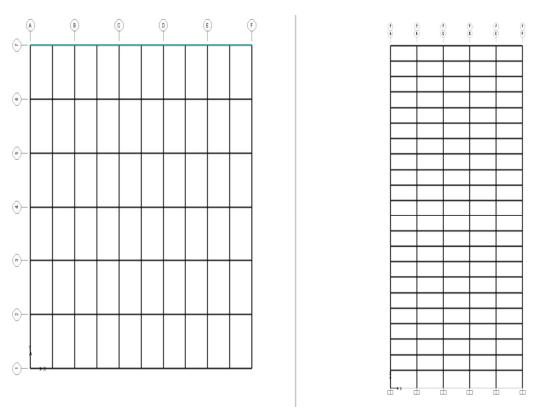
Inthenumericalstudycarriedoutherein,theG+20storey steel buildingisconsidered. Figure1and2show3Dview andelevationofsteelbuildinginstaadpro.
Thedetailsforgeneratingstructuralmodelinthesoftware aregivenasfollow:
Heightofparkingstorey:3.5m
Heightofstorey(otherthanparking):3m
SpanofbayinXdirection:7.5m
SpanofbayinYdirection:6.25m
Plandimensionofbuilding:37.5x37.5m
Numberofstorey:G+20
Gradeofsteel:Fe345
Loading:DeadLoad,LiveLoad,WindLoad,andBlast Load.
Loadcombinationconsiderforblastloadare
1.2DL+LL+BL
DL+0.35LL+BL
DL+0.25LL+BL
Comparativeanalysisiscarriedoutforthesamefor differentcriterialikedisplacement,stressandcost impact.
International Research Journal of Engineering and Technology (IRJET) e-ISSN: 2395-0056
Volume: 11 Issue: 06 | Jun 2024 www.irjet.net p-ISSN: 2395-0072
Firstofall,considerthebuildingssubjectedtoaburstwitha yieldcomparabletomanytonsoftrinitrotoluene(TNT)ata specific standoff distance. The problem is described as follows:
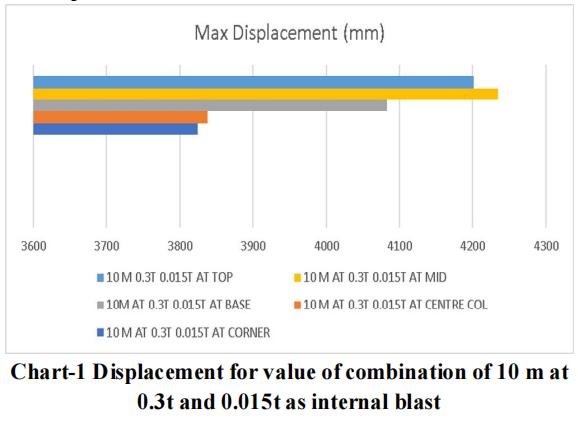
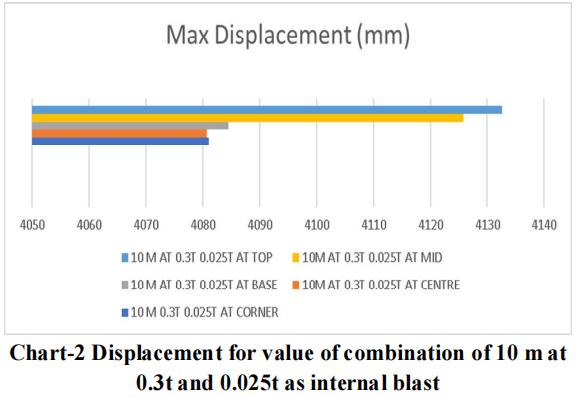
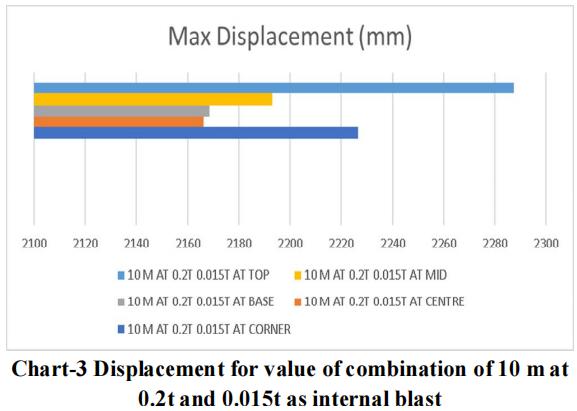
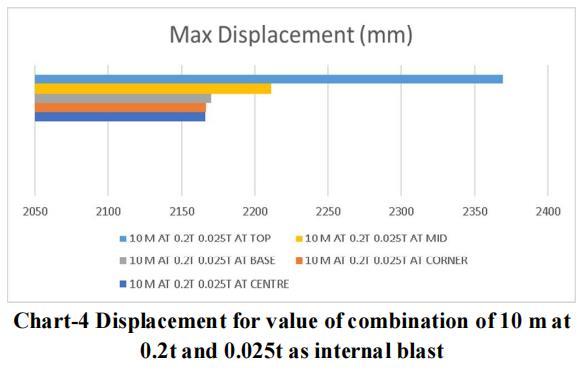
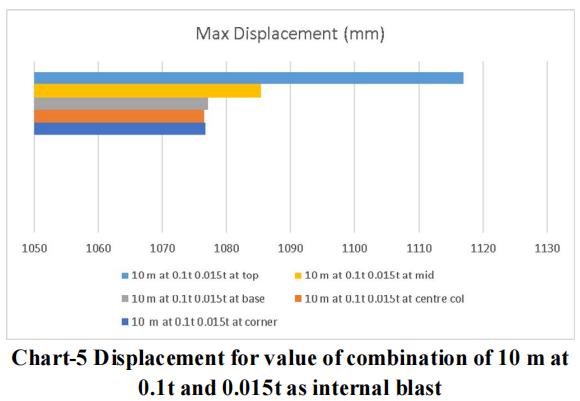
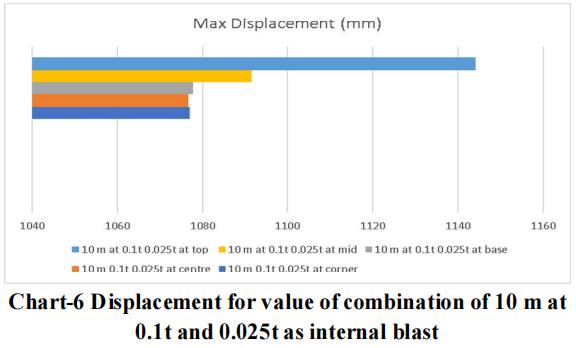
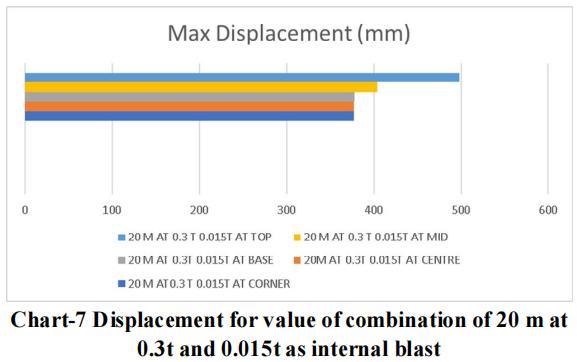
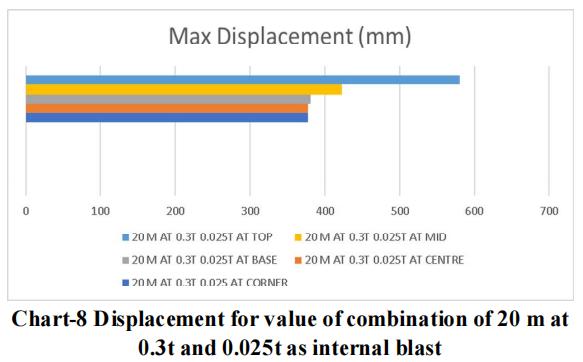
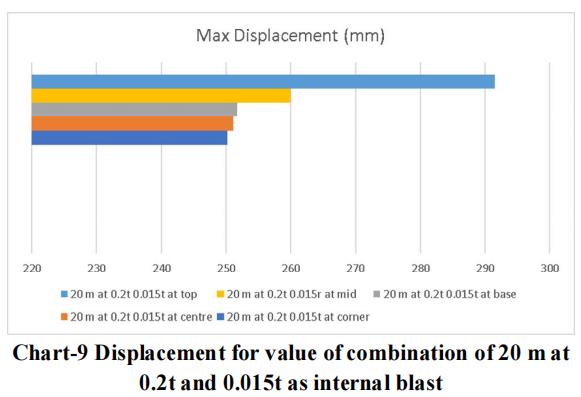
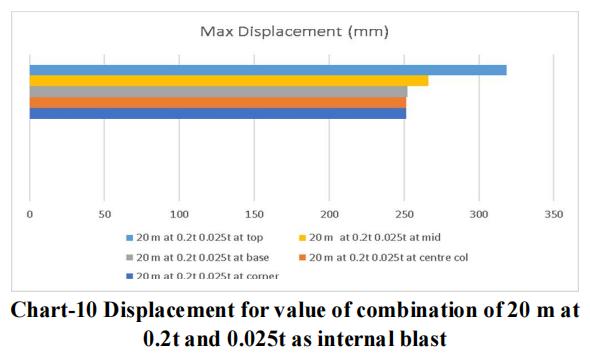
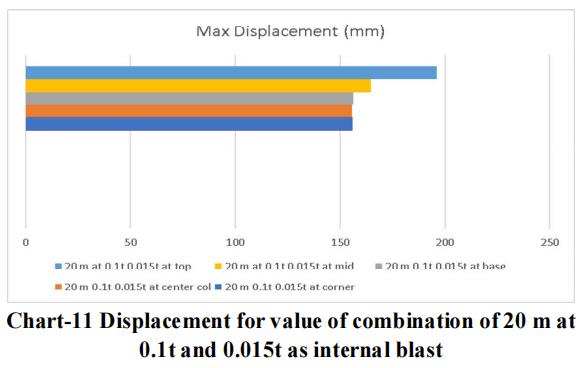
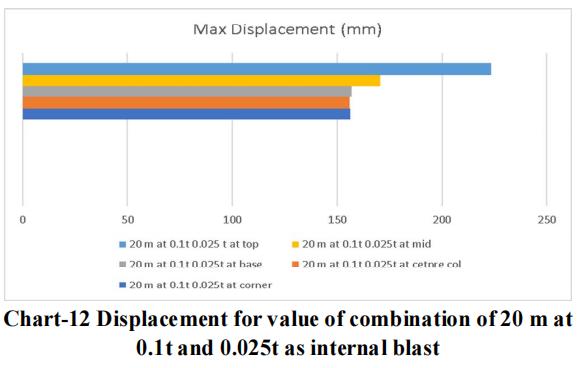
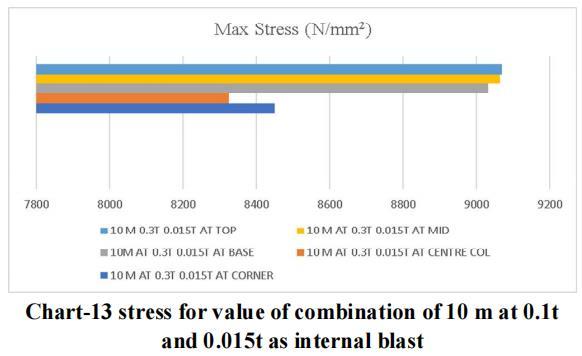
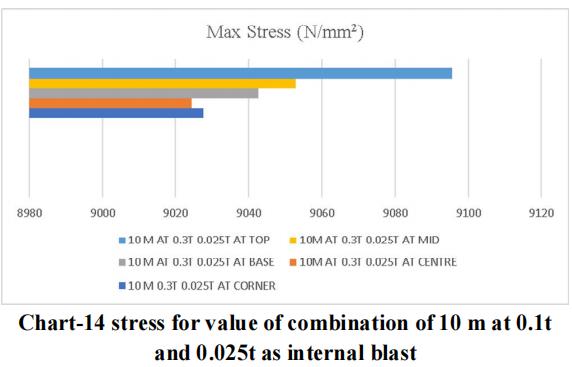
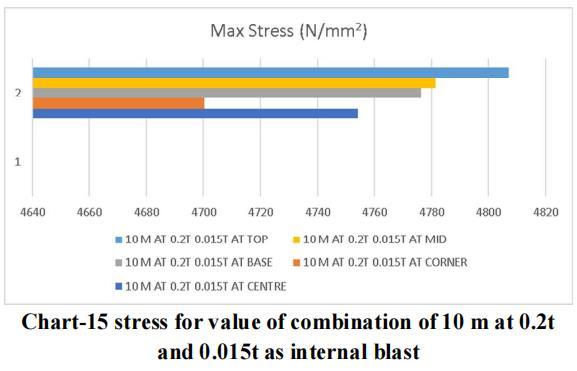
Theinternalblastevent'sintensityismeasuredat0.025tand 0.015t, whereas the exterior blast event's intensity is measured at 0.1t, 0.2t, and 0.3t (VBIED). Ten and twenty metersareconsideredthestand-offdistancesforexternal blast events. Four positions are taken into account for internalexplosionevents:thecornercolumnattheparking lot, the center column at the parking lot first floor, the midstory,andthetopstory.Sixtymodelswereanalyzedin all.
Based on the specification to IS 4991: 1963, blast load pressureonthebuildinginformofatriangularloadis calculatedasfollows:
CharacteristicofBlast
ScaledDistance,X=D/W[9]
Where,D=Distanceofthebuildingfromthegroundzero W=ExplosivechargesinTonne
Here,assumingPa=1.00kg/cm2(AmbientAirPressure) Internalblastpressureiscalculatedas ΔP=13(W/V)[6]
Metricpressureisinbar,Wisthemassofexplosiveinkg,V istheconfinedvolumeofairincubicmeter.
For the value of scaled distance, various blast parameters are selected from the table 1 of IS 4991:1968.
Theseparametersare:
Pso=PeakSideonOverpressure(kg/cm2)
Pro=PeakReflectedOverpressure(kg/cm2)
Q0=DynamicPressure(kg/cm2)
Td=DurationofEquivalentTriangularPulse (Milliseconds)
T0=PositivePhaseDuration(Milliseconds)
Td=ValuecorrespondingtoX/W1/3
T0=ValuecorrespondingtoX/W1/3
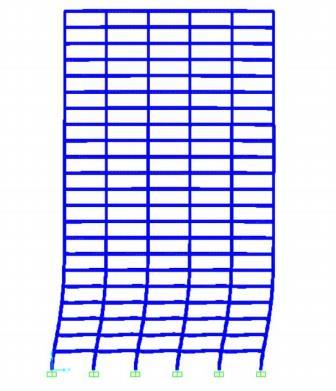
Comparingtheresultfordifferentgeometrieswithdifferent loadingconditionfordisplacementandstresses.
International Research Journal of Engineering and Technology (IRJET) e-ISSN: 2395-0056
Volume: 11 Issue: 06 | Jun 2024 www.irjet.net p-ISSN: 2395-0072
International Research Journal of Engineering and Technology (IRJET) e-ISSN: 2395-0056
Volume: 11 Issue: 06 | Jun 2024 www.irjet.net p-ISSN: 2395-0072
International Research Journal of Engineering and Technology (IRJET) e-ISSN: 2395-0056
Volume: 11 Issue: 06 | Jun 2024 www.irjet.net p-ISSN: 2395-0072
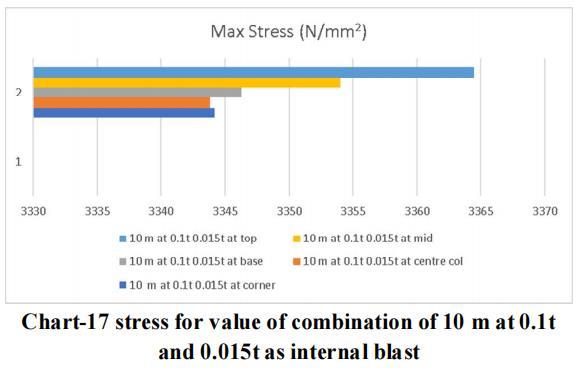
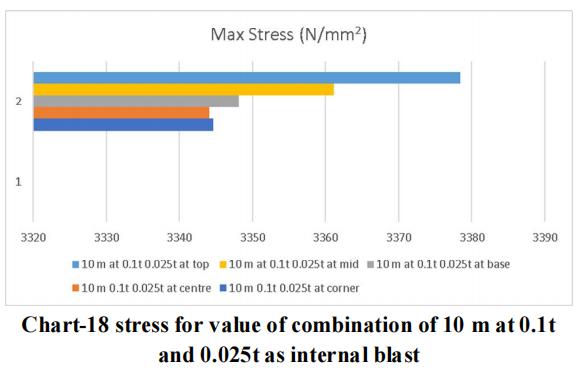
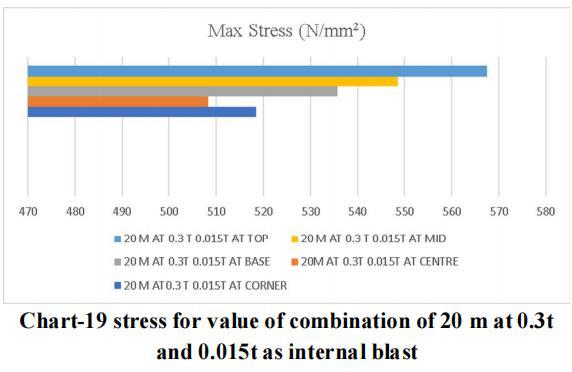
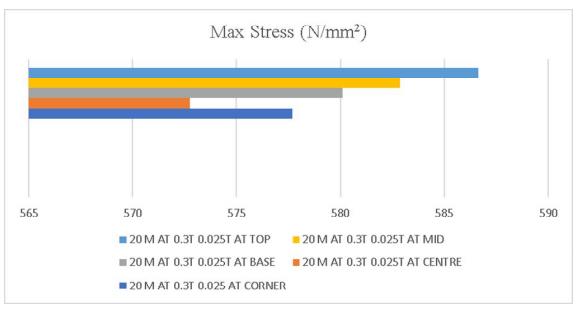

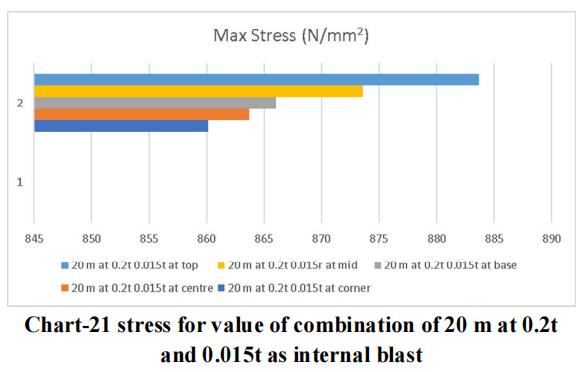
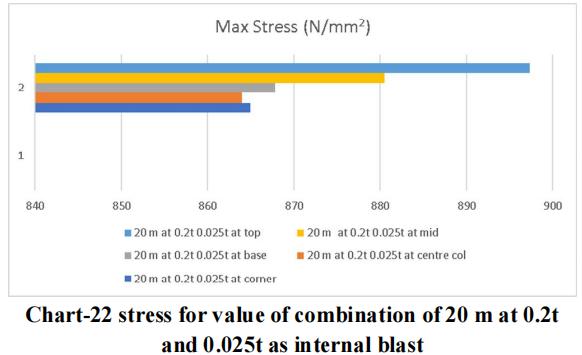
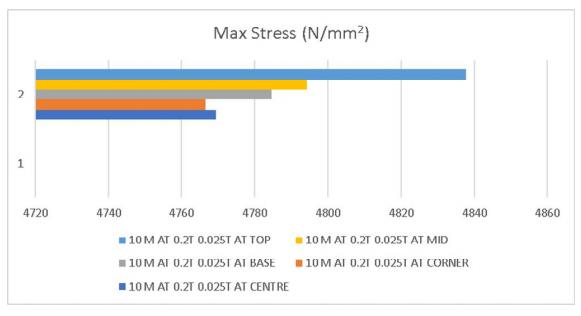
Thelargestchargeof10mwithanexternalblastof0.3tonne andaninsideblastof0.025tonneatthetoplocationyields themaximumdisplacementandstressvalue,asperthedata. Therefore,forblastresistantdesign,thesamecrosssection qualities should be included throughout all storeys. Itisadvisedthatappropriatesecuritymeasuresbetakenfor the important structure, or that appropriate measures be takentoensurethattheexplosionoccursasfarawayfrom the structure as possible. Tree plantations and other obstaclesshould be positionedinfrontofthestructure to resistblastloadandsafeguardit.
I am grateful to God Almighty for providing me with the healthandknowledgenecessarytodothisendeavor.Iowe Asst. Prof. Abbas Jamani for his assistance in helping me identify a noteworthy topic and in gathering academic sources. I want to express my gratitude to the entire professorsatLJIET'sCivilEngineeringDepartmentforallof theirassistancewiththisproject.Mysinceregratitudegoes out to my parents, sister, brother, and friends for their unwaveringsupportandencouragementalongthecourseof thiseffort.
International Research Journal of Engineering and Technology (IRJET) e-ISSN: 2395-0056
Volume: 11 Issue: 06 | Jun 2024 www.irjet.net p-ISSN: 2395-0072
[1] Yang Ding , Xiaran Song ,Hai tao zhu,“Probabilistic progressivecollapseanalysisofsteelframestructureagainst blastloads”,EngineeringStructure,2017,ELSEVIER.
[2]H.M.Elsanadedy,T.H.Almusallam,Y.R.Alharbi,Y.A.Al–salloum,H.Abbas,“Progressivecollapsepotentialofatypical steelbuildingduetoblastattacks”,Journalofconstructional SteelResearch,2014,ELSEVIER.
[3] Feng Fu, “Dynamic response and robustness of tall buildingunderblastloading”,JournalofConstructionalSteel Research,2013,ELSEVIER.
[4] Lucia Figulia,Chiara Bedonb,Zuzana Zvakováa,Stefan Jangla, Vladimír Kavickýa, “Dynamic analysis of a blast loadedsteelstructure”,ProcediaEngineering,2017,Elsevier.
[5]YangDing,YeChan,YanchaoShi,“Progressivecollapse analysisofasteelframesubjectedtoconfinedexplosionand post explosion fire”, Advances in StructuralEngineering ,2016,©SagePublicationsInc.
[6] ZHANG Xiuhua , DUAN Zhongdong , ZHANG Chunwei , “Numerical SimulationOf Dynamic Response And Collapse For Steel Frame Structures Subjected To BlastLoad”, Springer,2008,©SPRINGER.
[7]TapanSabuwala,DanielLinzell,TheodorKrauthammer, “Finite Element AnalysisOf Steel Beam To Column ConnectionsSubjectedToBlastLoads”,InternationalJournal ofImpactEngineering,ELSEVIER.
[8]CameronB.Ritchie,JeffreyA.Packer,MichaelV.Seica, andXiao-LingZhao,“BehaviorOfSteelRectangularHollow Sections Subject To Blast Loading”, Journalof Structural Engineering,28/09/17,©ASCE.
[9]UMESHJAMAKHANDI1,Dr.S.B.VANAKUDRE,“Design AndAnalysisOfBlastLoadOnStructures”,(IRJET),2015.
[10] Amr A. Nassr, A. Ghani Razaqpur, Michael J. Tait3, Manuel Campidelli4 and SimonFoo, “Experimental PerformanceofSteelBeamsunderBlastLoading”,Journal OfPerformance Of Constructed Facilities ,225/01/15,© ASCE.
[11] C. V. R. Murty ,“guidelines on measures to mitigate effectsofterroristattacksonbuildings”,IndianInstituteof Technology,Kanpur,DocumentNo: IITK-GSDMA.
[12]IS4991(1968):Criteriaforblastresistancedesignof structuresforexplosionsaboveground[CED39:Earthquake Engineering].
2024, IRJET | Impact Factor value: 8.226 |