
International Research Journal of Engineering and Technology (IRJET) e-ISSN:2395-0056
Volume: 11 Issue: 06 | Jun 2024 www.irjet.net p-ISSN:2395-0072

International Research Journal of Engineering and Technology (IRJET) e-ISSN:2395-0056
Volume: 11 Issue: 06 | Jun 2024 www.irjet.net p-ISSN:2395-0072
S.B.S.S. Bharadwaj1 , P. Thrilochan Reddy2 , Dr. Diana moses3
1Student, Dept of Artificial Intelligence and Data Science, Methodist college of engineering and technology, Telangana, India
2Student, Dept of Artificial Intelligence and Data Science, Methodist college of engineering and technology, Telangana, India
3Professor, Dept of Computer Science and Engineering, Methodist college of engineering and technology, Telangana, India
Abstract- Machine learning (ML) is a computers ability to help computer systems recognize patterns from data and draw conclusions from it. It allows machines to learn from data and make better decisions using various algorithms without being explicitly programmed. In the current era of artificial intelligence and machine learning, choosing the best model and adjusting its hyperparameters for the available variety of data is a very chaotic process. Here comes automated machine learning systems (Auto-ML), which provide a dynamic way to streamline this process and help overcome this challenge. By utilizing a variety of assessment measures including accuracy, RMSE, and MAE values, our study provides a clear comparison of the Auto-ML technique to the conventional manual approach. This research gives us a strong knowledge of the computational effectiveness and scalabilityofthemodels foragivendata
Key Words- Hyperparameter Tuning, Artificial Intelligence, Auto-ML, Accuracy, computational efficiency.
In recent years, the proliferation of machine learning (ML) applications in various fields has emphasized the importanceofeffectivelyselectingofappropriatemodels and fine-tuning hyperparameters for optimal performance.
The traditional approach to this task often involves manual research, where data scientists repeatedly try different algorithms and hyperparameter settings, a process that consumes both time and resources. However, the emergence of automatic machine learning (Auto-ML) systems offers a promising alternative by automating these labour-intensive tasks, which can democratizeMLadoptionandaccelerateinnovation.
The goal of this research is to compare an Auto-ML system that can automatically select the best-fit ML
model for a given data set with hyperparameter optimizationtoatraditional machinelearningapproach This system aims to streamline the ML pipeline from data processing to model evaluation using the latest technology in algorithm selection, hyperparameter optimization and performance evaluation. Through comprehensive evaluation, we aim to compare the performance of our Auto-ML system with manual methods and evaluate its performance in terms of predictiveaccuracy,computationalefficiency,andeaseof use.
The importance of this research lies in its potential to revolutionize the landscape of ML model development anddeployment.Byautomatingthelabour-intensiveand error-prone aspects of model selection and hyperparametertuning,
AutoML can democratize ML knowledge, allowing industry professionals of diverse experience to harness the power of advanced predictive analytics. Additionally, by systematically comparing Auto-ML with manual approaches, we try to provide insight into the trade-offs involved and identify scenarios where each approach excels.
Here, we are going to use different machine learning models like RandomForest classifier, logistic regression, Support Vector Machines and K-Nearest Neighbour classifier for manual approaches and .For Auto-ML approaches,wewillusetheH2OAuto-MLmodelandthe Auto-WEKA tool. We are going to use the most popular IRIS dataset for both the approaches. We will compare and evaluate using various parameters like model accuracy,RMSEandMAEvalues.
ThisresearchprojectcontributestotheongoingAuto-ML debate by introducing a new approach to automatic model selection and hyperparameter tuning. By empirically evaluating the performance of our Auto-ML system compared to manual approaches, we aim to
International Research Journal of Engineering and Technology (IRJET) e-ISSN:2395-0056
Volume: 11 Issue: 06 | Jun 2024 www.irjet.net p-ISSN:2395-0072
inform about the potential benefits and limitations of applyingautomatedtechniquestotheMLprocess.
There have been many research studies carried out on automated machine learning systems, all of which have usedasignificantnumberofAuto-MLalgorithms.Oneof the research projects Conducted by thiloshan Nagaraj and guhanathan poravi focuses on automated machine learning (Auto-ML) systems, emphasizing the need to automate manual model creation processes. The article analyses existing Auto-ML approaches, with a specific focus on key components such as preprocessing, feature engineering, and model selection engines. The study highlights the importance of integrating functional end products, affordable data centers, Python-centric research, and neural networks for future Auto-ML advancements
Another project ,conducted by Adithya Balaji and alexander allen compares the performance of different automaticmachinelearningframeworksonclassification and regression datasets. While machine learning excels inclassification,whileTPOTperformswellinRegression tasks the study emphasizes the importance of unbiased data analysis and suggests further research into specific techniques and other Auto-ML frameworks. The performance of various frameworks are presented in a researchstudycarriedoutbyMatthiasFeurer,Katharina Eggensperger, Stefan Falkner, Marius Lindauer and FrankHutterinthecontextofmeta-learning
In a research carried out by Jonas M. Kubler and VincentStimper,the mean deviation of the witness function is used as the test statistic with the aim of optimizing the power of the test by minimizing the squared loss. Experimental results show variable performance when testing different Auto-ML variants, with Auto-ML(class) performing similarly to MSE, while Auto-ML(bin) shows reduced performance. The study reveals that longer training times do not significantly affect the results in the original material. Auto-ML models like TPOT and H2O achieve around 81-82% accuracy, while manual models reach 100%. From the research conducted by Gururaj N Kulkarni, Sateesh Ambesange, Vijayalaxmi A and Anindita Sahoo, it can be concluded that Auto-ML saves time but may require additionaltuningforimprovedaccuracy
The Developmentof Auto-ML and potential benefitsand Auto-ML architecture are discussed in a research paper by Chahal Vadalmiya, Nisha Gandhi, Gauri Khotele, Ansh Mishra and Prof. Rohini Jadhav Future developments include the implementation of a graphical user interface to cater to non-technical users, further streamlining the feature engineering process and enhancing model
accuracy as suggested by Akshat Chaturvediin his researchproject.
Finally the research conducted by Nalawade Shruti, , Konde Priyadarshani, , Aashlesha Modhe, Bhise Sneha, Pokharkar Gayatri, and Bhalerao D.N emphasizes the significance of automated systems in maintaining data, ensuring rapid operations, and enhancing security throughautomatedmachinelearningsystems.
In the proposed methodology, this study explores mixed methodapproach We have explored various methods of implementing Auto-ML and have opted for two techniquesforthisresearchareH2OAuto-MLmodeland Auto Weka tool for Auto-ML approaches, ML algorithms like Random-Forest classifier, K-Nearest Neighbour classifier, Support Vector Machines and logistic regression are taken up for the conventional manual approach.Hyperparametertuningis carriedoutby THE GridsearchCVmethod
3.1.H2O
Developed by H2O.ai, H2O Auto-ML revolutionizes the machine learning model development process by automatingcriticalstepsinthepipeline. Withafocuson simplicity and efficiency, it selects optimal algorithms adapted to dataset characteristics and prediction tasks, from traditional methods such as random forests to state-of-the-artdeeplearningarchitectures.Thestrength of the platform lies in its automated hyperparameter optimization, which uses advanced techniques such as Bayesianoptimizationandwebsearchtoefficientlytune modelsettingsformaximumperformance.
In addition, H2O Auto-ML incorporates aggregate learning,combiningknowledgefromdifferentmodelsto improvepredictionaccuracyandreliability.
ScalabilityisakeyfeatureofH2OAuto-ML,allowingitto smoothly handle large datasets. By leveraging parallel processingcapabilities,theframeworkacceleratesmodel training and evaluation processes, making it ideal for high-datareal-worldapplications.
H2O Auto-ML provides a comprehensive solution for automating machine learning tasks, significantly reducing manual intervention and accelerating the journeyfromdatatoinsight.
Auto-WEKAisanautomatedmachinelearningtoolinthe WEKA series designed to streamline the model building process by automating model selection and hyperparameter optimization. It evaluates various
International Research Journal of Engineering and Technology (IRJET) e-ISSN:2395-0056
Volume: 11 Issue: 06 | Jun 2024 www.irjet.net p-ISSN:2395-0072
algorithmsintheWEKAlibrary,toidentifythebestfitfor agivendatasetandpredictiontask.
Using techniques such as Bayesian optimization and genetic algorithms. Auto-WEKA effectively tunes model hyperparameters to improve performance. Users can customize the tool by setting evaluation metrics and calculationtimelimits.
Auto-WEKA integrates cross-validation methods to accurately evaluate model performance and provides metrics such as accuracy, RMSE and MAE score for evaluation.
3.3.Comparision
As we know Auto-ML is completely responsible for modelselectionandhyperparametertuning Weevaluate and compare this model with traditional manual approachesforwhichwehavetakenseveralalgorithms.
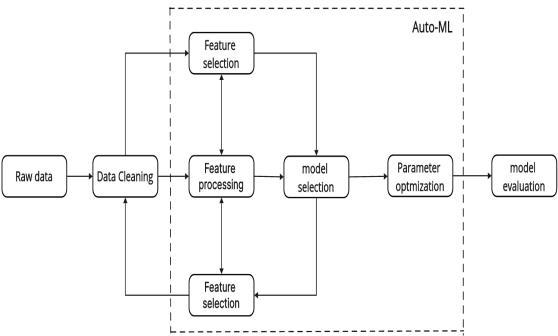
Fig -1:ArchitectureofAuto-ML
For manual approaches we have taken Random-Forest classifier, SVM, Logistic regression, Gradient boosting and KNN classifiers with the GridSearchCV hyperparameter tuning technique with a 5 fold crossvalidation measure for both approaches, we iterate througheachalgorithm
H2OandAuto-WEKAareusedfortheimplementationof the Auto-ML approach where the complete model selectiontoevaluationiscarriedoutdynamically
Both approaches are compared using various measures like model accuracy, computational efficiency and scalability.
Using the conventional manual approach of machine learning models, we obtain the highest accuracy of the model by optimizing the parameters to be 90.9% this accuracy was further improved by hyperparameter tuning resulted in 100.0% accuracy achieved by several linearmodelsforthisdataset.
Through efficient exploratory data analysis and parameter optimization ,the manual approach was able toachievethislevelofaccuracy.
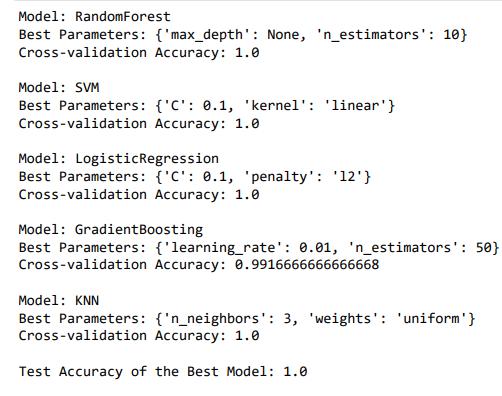
Fig -2:H2OAuto-MLResults
For the Auto-ML approach, we used the H2O Auto-ML library in python After hyperparameter tuning, we can observethatthestackedensemblemodelwasthebestfit withanaccuracyof79.3%forthisdataset.
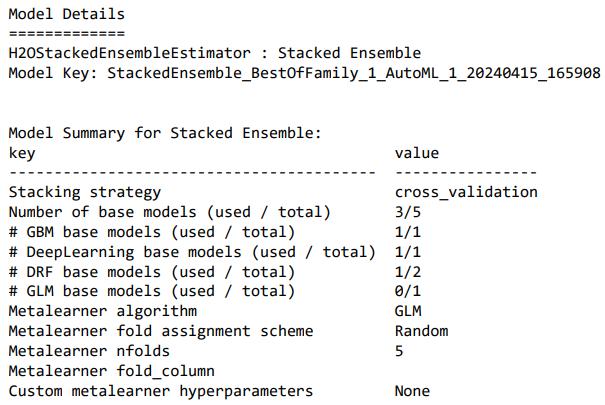

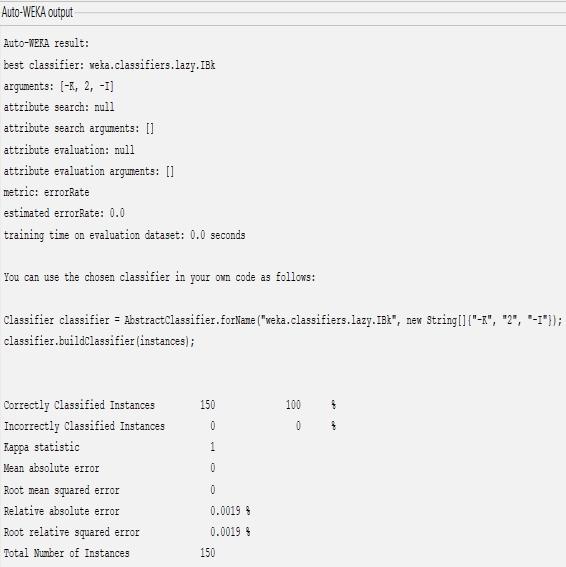
Fig -3:H2OAuto-MLResults
Another tool used for the Auto-ML approach is AutoWEKA, which resulted in an accuracy of 100.0% for the k-Nearest Neighbour classifier making it the best fit for this dataset It has took 935 configurations for different classifiers with different parameters to obtain the best outputforthisdata
International Research Journal of Engineering and Technology (IRJET) e-ISSN:2395-0056
Volume: 11 Issue: 06 | Jun 2024 www.irjet.net p-ISSN:2395-0072

Together, our research highlights the nuanced dynamics of Auto-ML and manual approaches in the context of machinelearningmodel development.Through rigorous testing and analysis, we found that while Auto-ML systems demonstrate impressive performance and scalability, manual approaches are often superior for scenarios that require fine-tuning and domain-specific expertise.
Our results emphasize the importance of considering task complexity, resource constraints, and operational expertise when choosing between Auto-ML and manual methods. Auto-ML platforms systematically iterate through various algorithms, hyperparameters, and preprocessing techniques to find the best performing model,makingmachinelearningaccessibletouserswith little domain knowledge, On the other hand manual approach requires not only domain and technical knowledge but also an enormous amount of time and computational efficiency. Finally, each having its own prosandconsthatarecompletelytaskanddataspecific.
Through our research we conclude that improvising models can also be achieved by combining both approaches in a hybrid framework promising to maximizethebenefitsofautomationandharnesshuman intelligencewhereitismosteffective.
Youcanaccesstheprojectfilesusingthislink:
https://drive.google.com/file/d/1F_NY9MZqGJx7kPuXx C7frNJTUJvvwzYp/view?usp=sharing
[1] A Review on Automated Machine Learning (AutoML) Systems, Thiloshon Nagarajah, Guhanathan Poravi,I2CT2019.
[2] Benchmarking Automatic Machine Learning Frameworks,AdithyaBalaji,AlexanderAllen,2018.
[3] Auto-Sklearn 2.0: Hands-free Auto-ML via MetaLearning, Matthias Feurer, Katharina Eggensperger, Stefan Falkner, Marius Lindauer, Frank Hutter, JMLR,2022.
[4] AutoML Two-Sample Test, Jonas M. Kubler, Vincent Stimper,2023.
[5] Efficient and Robust Automated Machine Learning, Matthias Feurer, Aaron Klein, Katharina Eggensperger, Jost Tobias Springenberg, Manuel Blum,FrankHutter,UniversityofFreiburg,Germany.
[6] Comparision of diabetic prediction AutoML model withcustomized model,GururajN Kulkarni, Sateesh Ambesange, Vijayalaxmi A, Anindita Sahoo, ICAIS2021.
[7] Development of auto-ml tool, Chahal Vadalmiya, Nisha Gandhi, Gauri Khotele, Ansh Mishra, Prof. RohiniJadhav,IRJET,2023.
[8] Automatic Feature Engineering tool for Machine learning,AkshatChaturvedi,IRJET,2021.
[9] Automatic question paper formation system, Nalawade Shruti, , Konde Priyadarshani, , Aashlesha Modhe, Bhise Sneha, Pokharkar Gayatri, Bhalerao D.N,IRJET,2024.