
International Research Journal of Engineering and Technology (IRJET) e-ISSN: 2395-0056
Volume: 11 Issue: 06 | Jun 2024 www.irjet.net p-ISSN: 2395-0072
International Research Journal of Engineering and Technology (IRJET) e-ISSN: 2395-0056
Volume: 11 Issue: 06 | Jun 2024 www.irjet.net p-ISSN: 2395-0072
Aarti1, Sonali Kapoor2
1Assistant Professor, AIT CSE, Chandigarh University, Punjab, India
2Senior Technical Trainer, AIT CSE, Chandigarh University, Punjab, India
Abstract - big data analytics is a powerful tool for extracting valuable insights from vast datasets to inform business decision making. However, the reliability of big data analytics remains a topic of debate. This review paper aims to provide a comprehensive evaluation of the reliability of big data analytics for business decision making by exploring its strengths, limitations, and potential challenges by analyzing the current literature and case studies to identify the factors that affect the reliability of big data analytics and its impact on the decision-making process.
Key Words: Big data analytics, Reliability, Business decision making, Data quality, Data bias, Data privacy, Big Data Analytics, Reliability Assessment.
Inthedigitalage,businessesaregeneratingvastvolumesof dataatanunprecedentedrate,leadingtotheemergenceof BigDataanalyticsasapowerfultoolforextractingvaluable insights. In the pursuit of data-driven decision-making, organizationshaveincreasinglyturnedtoBigDataanalytics togainacompetitiveadvantageandenhancetheirstrategic capabilities.However,astherelianceonBigDataanalytics grows,sodoestheneedtocriticallyassessitsreliabilityand effectiveness for business decision-making. This research paperaimstoevaluatethereliabilityofBigDataanalyticsin the context of business decision-making, examining its strengths,
Limitations, and potential impact on organizational outcomes.
The proliferation of Big Data has enabled businesses to explore new avenues of growth, optimize processes, and identifycustomertrends.Byharnessingsophisticateddata analyticstechniques,organizationscanuncoverpatternsand correlationswithintheirdata,providingthemwithvaluable insights for informed decision-making. Scholars and practitionersalikehaverecognizedthepotentialofBigData analyticsasatransformativeforceinthebusinesslandscape [1][3]. Nevertheless, the integration of Big Data analytics into decision-making processes also raises important questionsaboutitsreliabilityandthedegreetowhichitcan betrustedtoyieldaccurateandactionableresults.
Big Data analytics is a formidable process that entails extracting invaluable insights from extensive and heterogeneousdatasets,commonlydenotedasBigData[1]. Thesedatasetsencompassstructured,semi-structured,and unstructured data generated at high velocity from diverse sources like social media, sensors, devices, and online activities[2].Totacklethechallengesposedbythesecolossal datasets,BigDataanalyticsharnessesadvancedtechniques, tools,andalgorithms[3].
ThejourneyofBigDataanalyticscomprisesseveralpivotal stages [4][5]. It initiates with data collection, wherein informationisamassedfromamyriadofsources,spanning transactional databases, social media platforms, web logs, and sensors [6]. Subsequently, the collected data finds its abodeindistributedandscalablestoragesystems,suchasthe Hadoop Distributed File System (HDFS) or cloud-based storagesolutions[7].Toprocessandmetamorphosethese massive datasets, technologies like MapReduce, Apache Spark,orotherdistributedprocessingframeworkscomeinto play [8][9]. This facilitates effective data analysis and exploration, employing an array of statistical, machine learning,anddataminingtechniques[10][11].Theinsights derived from this analysis are then presented in easily comprehensible formats, such as graphs, charts, or dashboards,aidingdecision-makersingraspingtheoutcomes [12].
BigDataanalyticscastsitswidenetacrossvariousindustries and domains [13][14]. In the realms of business, finance, healthcare, marketing, manufacturing, and beyond, organizations harness these insights to steer data-driven decisions, enrich product offerings, and augment overall business performance [15][16][17]. As technological advancementsunfurl,BigDataanalyticsispoisedtoassume an increasingly pivotal role in steering innovation and transformative changes across diverse industries, thereby cementing its stature in the contemporary data-driven landscape[18].
The fusion of Big Data and Business Intelligence (BI) empowers organizations to gain a competitive edge, streamlineprocesses,andelevatedecision-makingprocess
International Research Journal of Engineering and Technology (IRJET) e-ISSN: 2395-0056
[19][20].Acomprehensiveliteraturereviewilluminatesthe real-worldapplicationsofBigData
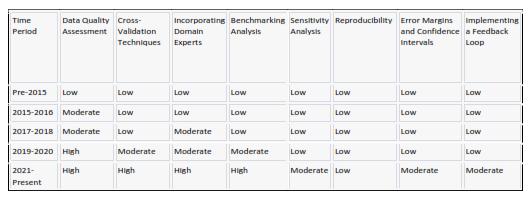
Table-1:UsageandAdoptionofreliabilitymetricswithtime
Analyticsanditstransformativeinfluenceonorganizations [21].Itunderscoresthetangibleinsightsgleanedthroughthe utilization of Big Data, paving the way for better decisionmakingandstrategicplanning[22].Moreover,scholarshave delved into the theoretical understanding of Big Data analytics' capabilities within organizations, identifying factorsthatimpactitssuccessfulimplementation[23].
The review accentuates the importance of data-driven decision-making and its potential advantages [24]. OrganizationsareprogressivelyembracingBigDataanalytics toenhancetheirbusinessintelligenceanddecision-making mechanisms. This trend is further reinforced by the identification of emerging research directions in Business Intelligence and Analytics, offering avenues for further breakthroughsinthedomain.AsBigDataassumestheroleof the "fourth paradigm" of science, its potential impact on diversescientificdomains,includingmaterialsinformatics, shinesthrough.
Furthermore,thereviewdelvesintotherealmofdelivering Big Data analytics as a service for business intelligence, presentingbothopportunitiesandchallenges.Itexploresthe concept of querying databases using natural language, suggestingpotentialframeworksforefficientdataretrieval.It alsoacknowledgesthegrowingsignificanceofsocialmedia BigDataanalytics,asorganizationsincreasinglydiscernthe valueofextractinginsightsfromvasttrovesofsocialmedia data.
ThereviewtraversestheterrainofBigDataanalyticsinthe financial sector, where it has been harnessed in financial statementaudits,revealingitspotentialtoenhancefinancial analysisandreporting.Additionally,itprobesintotherealm ofBigDataanalyticsine-commerce,placingemphasisonits implementation from both the vendor and customer perspectives.Thisholisticapproachtoe-commerceanalytics empowers businesses to optimize their processes and enhancecustomerexperiences.
In conclusion, the literature review furnishes valuable insightsintothemultifacetedlandscapeofBigDataanalytics and its reliability for business decision-making. The realworldapplicationsandtheoreticalunderstandingshowcased intheresearchpapersunderscorethetransformativeimpact of data-driven decision-making on organizations. As new research frontiers emerge, the potential for further advancementsinBIandanalyticsbecomesevident,offering exciting Opportunities for harnessing data to drive innovationandgaincompetitiveadvantagesacrossvarious industriesanddomains.
The reliability of Big Data analytics in business decisionmaking is of paramount importance to ensure that the insightsderivedfromtheanalysisareaccurate,trustworthy, and appropriate for guiding organizational strategies. To achievethis,variousadditionalmetricsandtechniquescanbe employed to ensure that the insights derived from data analysis are accurate, consistent, and trustworthy. These metrics and techniques play a vital role in assessing and enhancingthereliabilityofdata-drivendecision-makingin thebusinessdomain:
Confusion Matrix: In the context of classification tasks, a confusion matrix can be employed to evaluate the reliability of predictive models. It provides a breakdown of true positives, true negatives, false positives, and false negatives, helping assess the accuracy and precision of the modelsinmakingcriticalbusinessdecisions.
Root Mean Square Error (RMSE) and Mean Absolute Error (MAE): When using Big Data analyticsforpredictivepurposesinbusiness,RMSE andMAEserveasessentialmetricstomeasurethe reliability of predictive models. Lower RMSE and MAEvaluessignifygreaterreliabilityinforecasting outcomes.
R-squared (R2):Inbusinessanalytics,R-squaredis a key metric for assessing the reliability of regression models. It quantifies the proportion of varianceinthedependentvariableexplainedbythe independent variables, aiding in evaluating the model's effectiveness in supporting business decisions.
Cronbach's Alpha: Whendealingwithsurveysor questionnairesinthebusinesscontext,Cronbach's Alpha is crucial for assessing the reliability of multiplesurveyitems.Itensuresthatthequestions areinternallyconsistentandreliableinmeasuring specificconstructsthatinfluencedecision-making.
Inter-rater Reliability: In cases where human judgments or evaluations are integral to business decision-making,inter-raterreliabilitymetricslike Cohen's Kappa orFleiss' Kappa can be used. They
Volume: 11 Issue: 06 | Jun 2024 www.irjet.net p-ISSN: 2395-0072 © 2024, IRJET | Impact Factor value: 8.226 |
International Research Journal of Engineering and Technology (IRJET) e-ISSN: 2395-0056
Volume: 11 Issue: 06 | Jun 2024 www.irjet.net p-ISSN: 2395-0072
gauge the agreement among different raters or assessors,enhancingthereliabilityofhuman-based assessments.
Bootstrap Resampling: In the business world, bootstrap resampling techniques are valuable for estimatingthereliabilityofstatisticalanalyses.They enable the calculation of confidence intervals and helpassessthestabilityofkeybusinessmetrics.
Monte Carlo Simulation: MonteCarlosimulations canbeappliedtoassessthereliabilityofbusiness modelsandstrategiesundervariousscenarios.By generatingrandomsamples,thistechniqueaidsin understanding the potential outcomes and uncertaintiesassociatedwithdecisionalternatives.
Cross-Validation: Cross-validation methods,such as k-fold cross-validation or leave-one-out crossvalidation, are instrumental in evaluating the reliability of predictive models used in business decision-making.Theyensurethatmodelsperform consistentlyacrossdifferentsubsetsofdata.
BayesianAnalysis:Bayesianmethodsofferarobust frameworkforassessingthereliabilityofresultsin businessanalytics.Theyenabletheincorporationof prior knowledge and beliefs, helping decisionmakersmakemoreinformedandreliablechoices.
ReliabilityPlotsandCharts:Visualizations,suchas reliabilityplotsorcalibrationcurves,canbeutilized in the business context to assess the alignment of predictedprobabilitieswithactualoutcomes.These visual aids provide insights into the reliability of predictivemodelssupportingbusinessdecisions. Selectingtheappropriatereliabilitymetricsandtechniques depends on the specific business analytics objectives, the natureofthedata,andthecriticalityofthedecisionsbeing made. Employing these methods ensures that data-driven business decisions are based on reliable and trustworthy insights, ultimately contributing to more successful and informedoutcomes.
Comparison of Reliability Metrics in Business Analytics
Confusion Matrix
Strengths:Providesdetailedinsightsintotheperformanceof aclassificationmodel.
Helpsinunderstandingtypesoferrors(falsepositives,false negatives).
Easytointerpret.
Weaknesses: Only applicable to classification problems. Doesn't provide a single measure of performance. Requiresbalanceddatasetsforeffectiveevaluation.
Root Mean Square Error (RMSE) and Mean Absolute Error (MAE)
Strengths: Suitable for regression problems. RMSE is sensitive to large errors, while MAE is robust to outliers.
Easytocalculateandinterpret.
Weaknesses:
RMSE can be overly influenced by large errors. Doesnotprovideinformationaboutthedirectionoferrors. MAEdoesnotpenalizelargeerrorsasheavilyasRMSE.
R-squared (R2)
Strengths:Measurestheproportionofvarianceexplainedby themodel.
Useful for comparing the explanatory power of different models.
Easytointerpret.
Weaknesses:Can be misleading with non-linear models. Doesn't account for the number of predictors, leading to overfittinginsomecases.
R2doesnotindicateifamodelisappropriate.
Cronbach's Alpha
Strengths: Measuresinternalconsistencyofsurveyortest items.
Ensures reliability of psychological and educational measurements.
Easytocalculate.
Weaknesses:
Only applicable to surveys and questionnaires. Assumes unidimensionality (all items measure the same construct).
Sensitivetothenumberofitemsinthetest.
Inter-rater Reliability (Cohen's Kappa, Fleiss' Kappa)
Strengths:Measuresagreementbetweendifferentratersor evaluators.
Useful for ensuring consistency in subjective assessments. Canhandlemultipleraters(Fleiss'Kappa).
Weaknesses:
Only applicable to categorical data. Can be affected by the prevalence of categories. Requires a sufficient number of raters for accurate assessment.
Bootstrap Resampling
Strengths: Provides estimates of confidence intervals and standard errors. Non-parametric, does not assume normal distribution. Canbeappliedtovarioustypesofdataandmodels.
Weaknesses:
Computationallyintensive.
Canbesensitivetotheoriginalsample
Resultsdependonthenumberofresamples.
International Research Journal of Engineering and Technology (IRJET) e-ISSN: 2395-0056
Volume: 11 Issue: 06 | Jun 2024 www.irjet.net p-ISSN: 2395-0072
Monte Carlo Simulation
Strengths: Models the impact of uncertainty in complex systems.
Generatesadistributionofpossibleoutcomes. Flexibleandapplicabletovariousbusinessscenarios.
Weaknesses:
Requires a large number of simulations for accuracy. Canbecomputationallyexpensive. Results depend on the accuracy of input probability distributions.
Cross-Validation
Strengths: Reduces overfitting by validating model performanceondifferentsubsets. Providesamorerobustestimateofmodelperformance. Canbeusedwithvarioustypesofpredictivemodels.
Weaknesses: Computationally intensive, especially with largedatasets.
Resultscanvarydependingonthedatapartitioning. Notalwayssuitablefortime-seriesdata.
Bayesian Analysis
Strengths: Incorporates prior knowledge into the analysis. Provides a probabilistic framework for decision-making. Canhandlecomplexmodelsandsmallsamplesizes.
Weaknesses: Computationally intensive, especially with complexmodels.
Requires specification of prior distributions, which can be subjective. Resultscanbesensitivetothechoiceofpriors.
Reliability Plots and Charts
Strengths: Providesvisualinsightsintomodelperformance. Helps in identifying miscalibration and model reliability. Canbeusedtocomparemultiplemodelsvisually.
Weaknesses: Interpretation can be subjective. Requires expertise to correctly create and analyze plots. Lesseffectivewithoutsufficientdatapoints.
Classification Problems: Confusion Matrix, Inter-rater Reliability.
Regression Problems:RMSE,MAE,R-squared. Surveys and Questionnaires:Cronbach'sAlpha. GeneralReliabilityandRobustness:BootstrapResampling, MonteCarloSimulation,Cross-Validation,BayesianAnalysis.
Visual Assessment:ReliabilityPlotsandCharts. Eachmetrichasitsspecificusecase,andchoosingtheright one depends on the context and nature of the business problembeingaddressed.
Eachofthementionedreliabilitymetricsandtechniqueshas its unique strengths and applications in the context of business decision-making. The suitability of a particular metricortechniquehingesonthespecificcharacteristicsof thedata,theobjectivesoftheanalysis,andthenatureofthe businessscenarioathand.Forinstance,theConfusionMatrix isbestsuitedforclassificationproblemswherethereliability ofclasspredictionsisparamount,allowingforanassessment ofaccuracyandprecisioninbinaryoutcomescenarios.Onthe otherhand,metricslikeRootMeanSquareError(RMSE)and MeanAbsoluteError(MAE)excelinregressionanalysisand forecasting tasks, offering quantitative measures of predictionerrorforprecisenumericalpredictions.R-squared (R2) is highly effective for evaluating the reliability of regressionmodels,particularlyinquantifyingtheproportion of variance explained by the model, which aids in gauging predictive power. Meanwhile, Cronbach's Alpha finds its relevance when dealing with surveys or questionnaires in businessdecision-making,ensuringthereliabilityofmultiitem scales and measurements of latent constructs. Interraterreliabilitybecomesessentialwhenhumanjudgments playapivotalrole,assessingtheagreementamongdifferent assessors or raters to ensure consistency. Bootstrap resampling is valuable for estimating confidence intervals andgaugingthestabilityofkeybusinessmetrics,shedding light on the uncertainty tied to data-driven conclusions. Monte Carlo Simulation offers insights into potential outcomes anduncertainties,makingit useful forassessing the reliability of business models and strategies under diverse scenarios. Cross-validation is ideal for evaluating predictive model reliability, guaranteeing consistent performanceacrossdifferentdatasubsets.BayesianAnalysis servesbusinesseswellbyincorporatingpriorknowledgeand beliefs into decision-making, navigating uncertainty using bothsubjectiveandobjectiveinformation.Lastly,Reliability PlotsandChartsprovidevisualassessmentsofthealignment between predicted probabilities and actual outcomes, particularly beneficial in scenarios where probabilistic decision-makingiscentral.Inconclusion,theselectionofthe most suitable reliability metric or technique for business decision-makingiscontingentuponthespecificrequirements and characteristics of the decision problem, necessitating careful consideration of data, objectives, and decision contexts
In conclusion, the reliability of Big Data analytics in the realmofbusinessdecision-makingisanimperativefacetthat underpins the effectiveness and trustworthiness of datadriven insights. While a range of reliability metrics and techniques are available, their suitability depends on the unique characteristics of the data, the objectives of the analysis,andthenatureofthebusinesscontext.Anuanced
International Research Journal of Engineering and Technology (IRJET) e-ISSN: 2395-0056
understanding of these metrics and techniques enables organizationstomakeinformedchoiceswhenassessingthe accuracy,precision,andcredibilityoftheiranalyticsresults. Whetherit'semployingConfusionMatricesforclassification problems, Root Mean Square Error (RMSE) and Mean AbsoluteError(MAE)forregressionandforecastingtasks, or R-squared (R2) for evaluating regression models, businesseshaveatoolkitattheirdisposaltoensurereliable data-drivendecision-making.Additionally,theincorporation ofdomain-specificreliabilitymeasures,suchasCronbach's Alpha for surveys or Inter-rater Reliability for human judgments,addsanextralayerofrigortotheprocess.
BootstrapResamplingandMonteCarloSimulationprovide essential insights into the uncertainty associated with businessmetricsandstrategies,enablingdecision-makersto grasp the potential range of outcomes. Cross-validation techniques ensure model consistency across diverse data subsets,fosteringrobustpredictions.BayesianAnalysis,on the other hand, empowers organizations to blend prior knowledge and data-driven insights, navigating the complexitiesofdecision-makinginuncertainenvironments. Finally,ReliabilityPlotsandChartsoffervisualclarityonthe alignment between predicted probabilities and actual outcomes, a crucial aid in scenarios where probabilistic decision-makingtakescenterstage.
Ultimately, the choice of which reliability metric or techniquetoemployhingesontheuniquedemandsofeach business decision and the specific nuances of the data landscape. By selecting the most appropriate reliability assessmentmethod,organizationscanenhancethequalityof their data-driven decisions, bolster their strategies, and foster more successful outcomes in the dynamic world of business.
[1]M.Schroeck,R.Shockley,J.Smart,D.RomeroMorales,and P.Tufano, “Analytics: The real-world use of big data,” IBM GlobBusServ.,12,2012.
[2] “Yesterday, Today and Tomorrow of Big DataScienceDirect.” https://www.sciencedirect.com/science/article/pii/S187 7042815036265(accessedMar.05,2022).
[3] Z. Sun, H. Zou, and K. Strang, “Big Data Analytics as a Service for Business Intelligence,” in Open and Big Data ManagementandInnovation,Cham,2015,pp.200–211.doi: 10.1007/978-3-319-25013-7_16.
[4]M.Cao,R.Chychyla,andT.Stewart,“BigDataAnalyticsin Financial Statement Audits,” Account. Horiz., vol. 29, p. 150219103526005,Feb.2015,doi:10.2308/acch-51068.
[5] M. Q. Shabbir and S. B. W. Gardezi, “Application of big data analytics and organizational performance: the mediatingroleofknowledgemanagementpractices,”J.Big Data, vol. 7, no. 1, p. 47, Dec. 2020, doi: 10.1186/s40537020-00317-6.
[6] K. Vassakis, E. Petrakis, and I. Kopanakis, “Big Data Analytics:Applications,ProspectsandChallenges,”inMobile Big Data, vol. 10, G. Skourletopoulos, G. Mastorakis, C. X. Mavromoustakis,C.Dobre,andE.Pallis,Eds.Cham:Springer InternationalPublishing,2018,pp.3–20.doi:10.1007/9783-319-67925-9_1.
[7]K.Kambatla,G.Kollias,V.Kumar,andA.Grama,“Trends inbigdataanalytics,”J.ParallelDistrib.Comput.,vol.74,no. 7,pp.2561–2573,Jul.2014,doi:10.1016/j.jpdc.2014.01.003.
[8]S.S.AlrumiahandM.Hadwan,“ImplementingBigData AnalyticsinE-Commerce:VendorandCustomerView,”IEEE Access, vol. 9, pp. 37281–37286, 2021, doi: 10.1109/ACCESS.2021.3063615.
[9] S. Akter and S. F. Wamba, “Big data analytics in Ecommerce: a systematic review and agenda for future research,”Electron.Mark.,vol.26,no.2,pp.173–194,May 2016,doi:10.1007/s12525-016-0219-0.
[10] M. Jayakrishnan, A. K. Mohamad, and M. mohdyusof, “Understanding Big Data Analytics (BDA) and Business Intelligence (BI) Towards Establishing Organizational PerformanceDiagnosticsFramework.,
[11] Lei Li , Jiabao Lin , Ye Ouyang , Xin (Robert) Luo , “Evaluating the impact of big data analytics usage on the decision-makingqualityoforganizations.
[12]SangeetaandK.Sharma,"Qualityissueswithbigdata analytics,"20163rdInternationalConferenceonComputing forSustainableGlobalDevelopment(INDIACom),NewDelhi, India,2016,pp.3589-3591.
[13] M. Fatima Ezzahra, A. Nadia and H. Imane, "Big Data Dependability Opportunities & Challenges," 2019 1st InternationalConferenceonSmartSystemsandDataScience (ICSSD), Rabat, Morocco, 2019, pp. 1-4, doi: 10.1109/ICSSD47982.2019.9002676.
[14] X. Wu, X. Liu and S. Dai, "The reliability of Big Data," 2014IEEE7thJointInternationalInformationTechnology and Artificial Intelligence Conference, Chongqing, China, 2014,pp.295-299,doi:10.1109/ITAIC.2014.7065054.
Volume: 11 Issue: 06 | Jun 2024 www.irjet.net p-ISSN: 2395-0072 © 2024, IRJET | Impact Factor value: 8.226 |
|
International Research Journal of Engineering and Technology (IRJET) e-ISSN: 2395-0056
Volume: 11 Issue: 06 | Jun 2024 www.irjet.net p-ISSN: 2395-0072


Ms. Aarti, Assistant Professor in the Department of CSE-APEX, Chandigarh University. Specializing in data analytics and Python.Myfocusisontheartificial intelligenceandmachinelearning.
Er SonaliKapoor,SeniorTechnical TrainerintheDepartmentofCSEAPEX, Chandigarh University. Specializing in web design and user experience, My focus on the integration of design tools and development platforms to streamlineworkflowsandenhance collaborationinthedigitaldesign process.