
International Research Journal of Engineering and Technology (IRJET) e-ISSN:2395-0056
Volume: 11 Issue: 06 | Jun 2024 www.irjet.net p-ISSN:2395-0072
International Research Journal of Engineering and Technology (IRJET) e-ISSN:2395-0056
Volume: 11 Issue: 06 | Jun 2024 www.irjet.net p-ISSN:2395-0072
Sakshi N. Mahajan1, Sakshi L. Karale2, Shilpa B. Patil3,Prof. D. O. shirsath4
123BTECH Student, 4Assistant Professor Department of Electronics and Telecommunication Engineering, Padmbhooshan Vasantraodada Patil Institute of Technology, Budhgaon(Sangli)
Abstract: The significant growth in the number of vehicles and the long intervals between traffic lights make traffic control more challenging nowadays. To address this issue, we can implement an image-processing-based traffic-light control system. In placeof electronic sensors, the proposed system will detect vehicles through images. The cameras positionednext to thetraffic signal will takepicturesof the lanes,andtheImageProcessingtechniqueinPythonmaybe used to calculate the number of vehicles in each lane. And the lane with the highest count will take precedence over the other lanes. The traffic light is regulated by the amount oftrafficontheroad,thususingthistechnologyisbeneficial for analysis and performance. With the modern world continuously becoming very fast-paced each and every person is always trying to make the most of his time. It is very much required that any person doesn't waste a lot of hiscrucialtimeonapettyactivityliketraveling.Alongwith this driving in streets with a lot of traffic has been scientifically proven to be the cause of very high mental strainandpressure.Soitisabasicrequirementinmodernday cities to have a dynamic model of the traffic signal to controlthetransportationinthearea
Keywords: Traffic signal control, image processing, object detection, YOLOv4, traffic light
1.INTRODUCTION
Coming tothepresentcase oftrafficlights across thecities, itcanbenotedthatitisstaticandisalwaysthesameforany lane, even though the traffic in those lanes may not be the same.Thiscausessomelanestobecomeemptywhilesome lanes are too congested and this is a waste of time for people and also a waste of resources as a lot of fuel is wastedwhilenotmoving
Along with this in congested lanes the traffic light is for a very less duration, so many people tend to cut the traffic light and this may be the cause of various road accidents. Coming to the most important point of why we require dynamic traffic lights is that there are many emergencies occurring and it is required for emergency vehicles like police, ambulance, and fire trucks to reach these situations inthepropertimeasthisisthecaseoflifeordeath.Forall these reasonswecansay thatdynamic trafficcontrol is the bestsolution.Inadynamictrafficlightthewaitingtimeofa signal changes with respect to the number of cars in the laneandthusnearlyallthelanesbecomeequallycongested
or equally empty. Thus the average waiting time of all the peopleatthetrafficlightisreduced.
Dynamic Traffic System Based On Real Time Detection of TrafficCongestion[1], The paperproposesa dynamictraffic system that takes in present traffic footage and calculates the percentage congestion and based on this, allocates the timer to each signal.Uses image processing for Background subtractionandEdgeDetection.
Smart Traffic Light Switching/Traffic Density Calculation usingVideoProcessing[2],Thispaperpresentsamethodto use live video feed from the cameras at traffic junctions for real time traffic density calculation using video and image processing. Used for 4 way junction detection which shows 35% improvement in congestion and allows Traffic light synchronizationenablingfreeflowoftraffic.
Density and Time based Traffic Control System using Video Processing [3], This paper discusses the idea of a traffic signal system by detecting traffic density and adjusting the signal accordingly. Uses haar cascade algorithm providing highaccuracy.
Existing System:
OpenCV accompanies a coach just as identifier. In the event thatyou need to prepare yourown classifier for any article like vehicle, planes and so on you can utilize OpenCV to makeone.
Itsfullsubtletiesaregivenhere:
CascadeClassifierTraining.
Proposed Solution:
After preprocessing like resizing and cropped images, Haar cascadeclassifierisusedto detect whetherthere isa single face detected or not. Figure 3 demonstrates the flow chart fortheproposedsystem.Edge,line,andcentersurroundare the features of Haar which are acting as inputs. By these cascade features the test of the image is done. The features of Haar are divided into various different stages. Stage by stage the window will be tested. Usually, initial stages will
International Research Journal of Engineering and Technology (IRJET) e-ISSN:2395-0056
Volume: 11 Issue: 06 | Jun 2024 www.irjet.net p-ISSN:2395-0072
have less Haar-like features. If the first stage window fails, then it is to be discarded and the next stages will not be tested. If all the stages successfully passes then it is consideredtobefaceisdetectedandcheckswiththeimages alreadystoredindatabaseofraspberryPi.Theadvantageof Haarcascadeclassifiersisfastdetectionspeedcomparedto otherclassifiers.
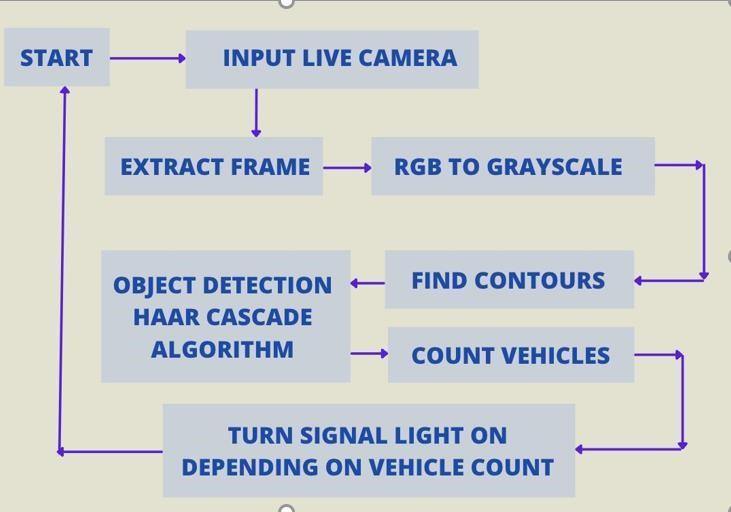
Figure1:Blockdiagram
Withthetrafficincreasingdaybydayineachandeverycity the static system of the present day is becoming time consuming and inconvenient. It comes to our notice when weseesomelanesbeingcompletelyfullandstillsufferingin red light stoppage for a long time while some lanes are so emptythatproviding them a longgreenlighttime doesnot makeanysense.
Thesetupusesthecascadeclassifier(XMLfile)modelwhich is a trained model having data on vehicle detection. The code traffic2.py uses this trained model to find the number of vehicles. The code is given an input of four random images,showingvehiclesatatrafficstoponefromacamera input and other three from the images folder, herein the XMLfileisexecutedbythecurrentrunningcode.
Thevehicledetectionandcountingoperationexecutesand4 variables store the count on the number of vehicles from eachofthe4inputimagesrespectively.Thevariablespassed aregivenasinputtotheGPIOpinstodisplayred,yellowand green light operation a four way traffic signal in synchronization with each other using the signal modules. After getting image from live camera it extracts the frame whreitcapturesasignleframefromavideo.
It is very important step for further vehicle dtetion and count. After we got a frame image converts from rgb to graycycle this process helps to simplify the further complications. After successful Conversion of image to graycycle every repeating object from image is stored in
memory by help of counters. later with the help of haar cascade vehicles are detected after detection of vehicle it counts the vehicle which helps to detect the density on the road.Onthebasisofdensitypreferencesignallightswillbe turnonandoff.
Prioritizing the traffic light if the presence of emergency vehicles like ambulances, police vans or fire trucks is detected in the particular lane so that these emergencies can be handled in a better way. Allowing face detection in this system so that green light for pedestrians can also be brought into use. The accuracy of the system can be improved by bettering the data set in Haar Cascade Algorithm. Identificationofvehiclesinvariousanglesbythe system can be brought into the haar cascade to improve its accuracy.
After taking the live image of traffic we will get vehicle count on road image. It will give preference on based of density of vehicles. Signal turn on and off according to preference. We took below picture as a example for lane one.
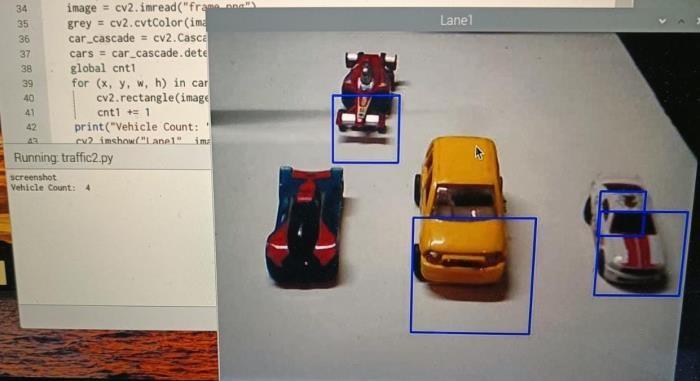
As we can see in above image it detects the vehicle and on basisofcarcountbelowpictureshowsussignalturngreen forlaneone.
International Research Journal of Engineering and Technology (IRJET) e-ISSN:2395-0056 Volume: 11 Issue: 06 | Jun 2024 www.irjet.net p-ISSN:2395-0072
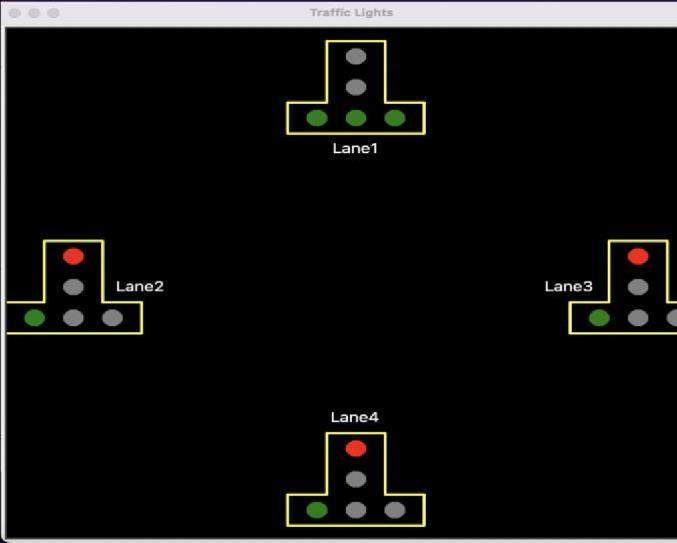
Above same execution is carried out for Lane 2, 3 and 4 as well.ThevehiclesateachLanearedetectedcontinuouslyin a while loop and vehicle count results are obtained, accordinglythedelayforthegreenlightisset.
Various methods of managing traffic are present but traffic lightmonitoringisthemostimportantmethodsothatloads of time is saved by the people who are traveling. Our dynamictrafficsignalenablesroadaccidentstobereduced byalargeamount.Itprovidesanefficientalgorithmtosave timespentontraveling WeconcludedthatiflimitedRAMis presentthenHaarCascadeisagreatwaytogetthingsgoing which can run this Algorithm properly but with very poor detection accuracy. We also concluded that the Yolo AlgorithmrequiresahighamountofRAM(morethan1GB) for highly accurate results.. Hence the code terminates abruptly. Finally concluded that our solution is the best alternative possible in the market as it provides a fast and accuratewaytoreducetimeconsumedintraffic.
1) By Aditya Rao, Akshay Phadnis, Atul Patil, Tejal Rajput and Dr. Prof. Pravin Futane On 2018 Fourth International Conference on Computing Communication Control and Automation (ICCUBEA)
2) By Anurag Kanungo, Ayush Sharma and Chetan Singla On 2014 RAECS UIET Panjab University Chandigarh
3) By Tanvi Sable, Nehal Parate, Dharini Nadkar, Swapnil Shinde On ITM Web of Conferences 32 (ICACC-2020)
4) Sai Surya Prakash Moka,Sai Manikanta Pilla, S.Radhika, “Real-Time Density Based Traffic SurveillanceSystemIntegratedwithAcousticBased Emergency Vehicle Detection”, 4th International Conference on Computer, Communication and SignalProcessing(ICCCSP),(2020)
5) Uthara E. Prakash, Athira Thankappan, “Density Based Traffic Control System Using Image Processing”, International Conference on Emerging
Trends and Innovations in Engineering and TechnologicalResearch(ICETIETR),(2018).