
International Research Journal of Engineering and Technology (IRJET) e-ISSN: 2395-0056
Volume: 11 Issue: 06 | Jun 2024 www.irjet.net p-ISSN: 2395-0072
International Research Journal of Engineering and Technology (IRJET) e-ISSN: 2395-0056
Volume: 11 Issue: 06 | Jun 2024 www.irjet.net p-ISSN: 2395-0072
1PG Student, Department of Civil Engineering, Mar Baselios College of Engineering and Technology, Trivandrum, Kerala, India
2Professor, Department of Civil Engineering, Mar Baselios College of Engineering and Technology, Trivandrum, Kerala, India ***
Abstract - The behavior of reinforced concrete (RC) deep beams is intricate and crucial for structural design andsafety. This study aims to conduct a comparative analysis of the strength and behavior ofRC deepbeamsdesignedaccordingto the Indian Standard IS 456 (2000) and the AmericanConcrete Institute (ACI) 318 (2019) codes through experimental investigation. Six specimens, three designed under each code, were prepared using M30 grade concrete and subjected to three- point loading to assess load-deflection response, crack width, and strain distribution. Additionally,theshearstrength and load-deflection response were compared with results obtained using the strut and tie model based on the ACI 318 (2019) code. The study aims to ascertain the efficacy of different design approaches in predicting the strength of RC deep beams by comparing experimental findings withexisting strength prediction models. The specimens, reinforced with steel bars as per IS 456 (2000) and ACI 318 (2019)codes,were tested, with the ACI 318 model exhibiting superior shear strength prediction. Results indicated that the ACI 318designed beams displayed 25.7% higher ultimate load capacity compared to those designed using IS 456. Moreover, ACI 318-designed beams exhibited enhanced flexural parameters such as ultimatecapacity,deflection,andductility, surpassing IS 456-designed beams by 25-35%. Utilizing the strut and tie model for deep beam reinforcement design improved flexural behavior, resulting in lower crack widths and higher energy absorption capacities. Overall, the study concludes that ACI 318-designed models outperform IS 456designed models in terms of strength and behavior of RC deep beams, highlighting the effectiveness of the ACI 318 approach in structural design.
Key Words: Deepbeams,Reinforcedconcrete,crackwidth, IS456,ACI318,strut-and-tiemodeling
Infrastructure initiatives within countries have greatly benefited from Reinforced Concrete (RC) constructions, playing a pivotal role in advancing economic growth [1]. Ensuring the long-term survival of these structures are crucialforpromotingeconomicgrowth,criticaltoanation's functioninganddevelopmentt.Deepbeamsarecommonly used in the design of pile-supported foundations, transfer girdersfortallbuildings,andbendingcapsforbridges[2].As per IS 456(2000) deep beams structural elements where
effectivespan-to-height ratioislessthan or equal to2 for simply supported, or if they are continuous beams with a ratiolessthanorequalto2.5[3].
In contemporary construction practices, RC deep beams provideenhancedstructuralperformanceandload-carrying capacity,makingthemsuitableforsupportingheavyloads overlargespans[4].Indeepbeamsthereisadeviationfrom linearityinthestraindistributionand sheardeformations becomeconsiderablylargerthantheflexuraleffects.Since deformationpredominatesinthebehaviorofdeepbeams, theconventionalassumptionsmadeaboutplanesectionsin normalbeamanalysisarenolongersufficient.Asaresult,a designstrategyfocusedonthefailuremechanismsuniqueto deepbeamsisrequired[5].
Due to their small span-to-depth or shear span-to-depth ratio, stress trajectories in deep beams are disrupted, rendering conventional simple beam design procedures inapplicable. ACI 318(2019) incorporates more advanced analyticalmethodsandexperimentaldatatoprovidesafer andmoreefficientdesignsfordeepbeams[6]
Differentdesigncodesprovideguidelinesandmethodologies forthedesignof deep beams,eachwith itsownapproach andcriteria.Twoprominent designcodesfordeep beams are IS 456 (2000) and ACI 318 (2019) [3], [7]. This code addresses various aspects of deep beam design, including flexural, shear and axial forces, as well as detailing requirements for reinforcement. Additionally, ACI 318 (2019) introduces the concept of the strut and tie model (STM),aversatiledesigntoolrecommendedforaddressing complexstressdistributionsindeepbeams[7].Thebeams thatbelongtothedeepmembercategoryaredistinguished bythefactthatcompressivestressesaredirectlytransmitted fromtheloadingtosupportingpoints(struts),whoseends meetwithtensilestresses(ties)atparticularpoints(nodes) to create the appearance of a truss [8]. In experimental investigations the deep beams with reinforcement strut higher than control deep beam with IS 456 (2000) reinforcementandwithlessdisplacement[9].
DeepbeamsconsistoftworegionsastheB-regionandDregion.IntheB-region,linearstraindistributionsimplifies analysisanddesignbasedonflexuraltheory.Conversely,the D-region involves discontinuities such as openings,
International Research Journal of Engineering and Technology (IRJET) e-ISSN: 2395-0056
Volume: 11 Issue: 06 | Jun 2024 www.irjet.net p-ISSN: 2395-0072
alterations in geometry, concentrated loads, and shear forces.Thesecomplexities,includingintricatestrainchanges andlargeconcentrationsofstresstrajectories,necessitatea more advanced method of analysis and design for deep beamsintheD-region[10]
Inordertoensurethestructuralintegrityandsafetyofdeep beam elements, IS 456 (2000) offers guidelines for reinforcement detailing, such as bar sizes, spacing, and detailing requirements. However, the significance of Dregion, which is crucial for the design of deep beam to be used as a structural element in infrastructures, is not specified.TheAmericanConcreteInstituteACI318-14code definesdeepbeamsas"StructuralMembersloadedonone faceandsupportedontheoppositefacesuchthatstruts-like compressionelementscandevelopbetweentheloadsand thesupportsandthatsatisfyeithera)Clear-spandoesnot exceed four times the overall member depth or b) Concentrated loads exist within a distance of 2h from the face of the support”, whereas the ACI code specifies the designofD-regionusingstrutandtiemethod[11].
Astudyiscrucialforbridgingtheexistinggapinknowledge regarding the efficiency of different design codes in predictingandoptimizingtheload-bearingcapacityofdeep beams. Additionally, insights into the structural performance, ductility, and failure mechanisms of deep beams under varying loading conditions are essential for advancingdesignstandardsandpracticeswithintherealm ofreinforcedconcreteconstruction.Presentstudyaimstofill this research gap by conducting a comprehensive comparative analysis between RC deep beams designed underIS456(2000)andACI318(2019),providingvaluable insightsforstructuralengineersanddesigners.Deepbeams playavitalroleintheinfrastructuresuchasbridges,flyover, pile foundation etc. and the construction of service lines
alongthesestructuresareconsidered to be uneconomical andtimeconsuming.Therefore,theopeningsindeepbeams areprovidedtocarrytheseservicelinesandthedesignfor theseopeningcanbedoneusingstrutandtiemethodonlyas per ACI Code. Hence it is necessary to conduct an experimental investigation analyze the structural performancecapacityofbothtypeofdeepbeamsdesigned usingACI318(2019)andIS456(2000)codes.
3.1Material Properties and Mix Proportion
Materialsandmixobtainedinthisinvestigationsuitablefor M30gradeconcretewhichisgenerallyusedinRCdeepbeam structures.PortlandPozzolanacement,manufacturedsand passing through 4.75 mm sieve size, serves as the fine aggregate and conforming to zone 11 of IS 3831970(reaffirmed 2002), crushed granite, with aggregate sizesof20mm,isutilizedasthecoarseaggregate.Themix proportion obtained was of the ratio 1:1.88:3.27 with a watercementratioof0.45andthemixdesignwasdoneas perIS10262(2019).
3.2.1 Specimen
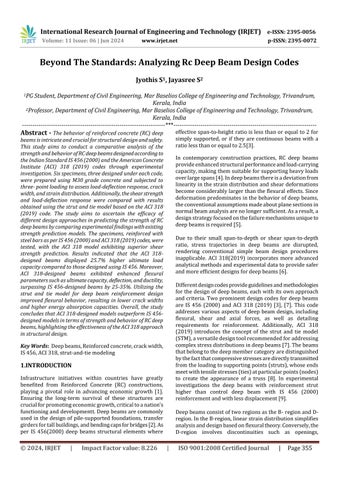
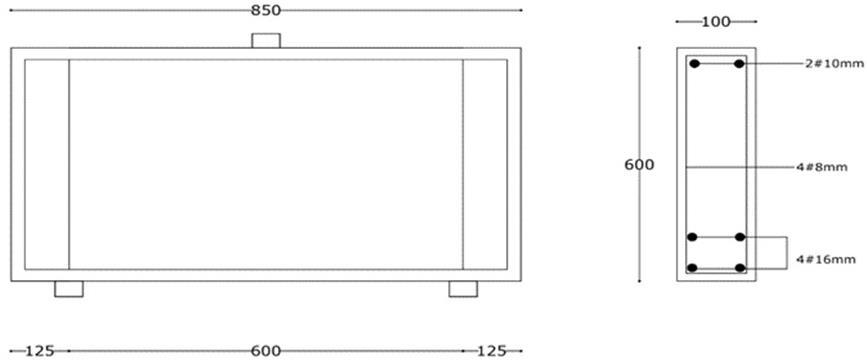
The deep beam specimen was prepared according to the reinforcement arrangement specified in both IS 456:2000 andACI318:2019.Sixreduced-scaleRCdeepbeamswere preparedinthisstudy.Thesizeofthespecimentaken200x 650 x 1000 mm. Three deep beams were prepared in accordancewithdesigncodeIS456:(2000),denotedbyISas illustratedinFigure1,andthreedeepbeamsastheSTMin accordance with ACI 318:(2019), denoted by ACI as illustratedinFigure2.
International Research Journal of Engineering and Technology (IRJET) e-ISSN: 2395-0056
Volume: 11 Issue: 06 | Jun 2024 www.irjet.net p-ISSN: 2395-0072
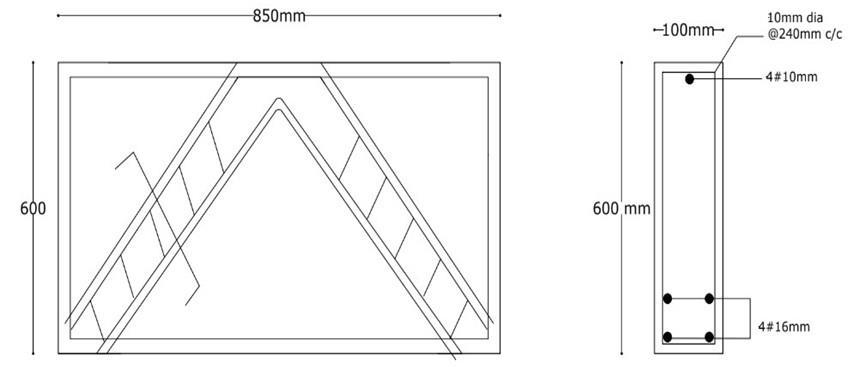
The reinforcement ratio(p), forall specimenswas1.14%. The main steel bars in the IS designated beams are of diameter16mm,whilethoseintheACIdesignatedbeams having diameter of 12 mm. These parameters ensure consistency and comparability among the test specimens, facilitatingacomprehensiveanalysisoftheirbehaviorand performance
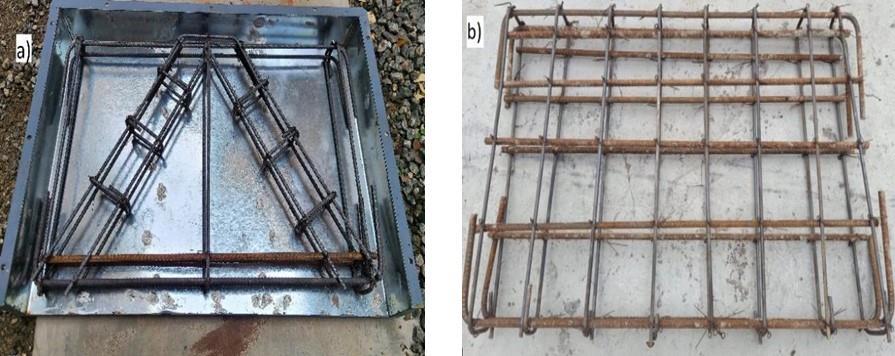
Strain gauges were affixed to the top and bottom steel reinforcementinsideforspecimensdesignatedasIS,while
forspecimensdesignatedaccordingtoACI,twostraingauges were attached to the strut portion and one to the bottom steel reinforcement. The mould setup, along with the reinforcement,isdepictedinFigure3.Vibrationwasgivento theconcretewhilepreparingwithoutdisturbingthestrain gauges. After 24 hours of casting, the specimens were demouldedandplacedinacuringtankfor28days,covered withjutesacksforprotection.
3.2.2
The strain in the concrete was monitored with Linear VariableDifferentialTransformers(LVDTs)werefixedtothe topandbottomfrontfacesofthebeam.AnLVDTwasalso installedatthebottommid-spantorecordbeamdeflection inrelationtoappliedloads.Companioncubes,whichwere castnexttotheconcretedeepbeamspecimensandtestedon the testing day as well, were used to check the average compressivestrengthoftheconcretematrix.
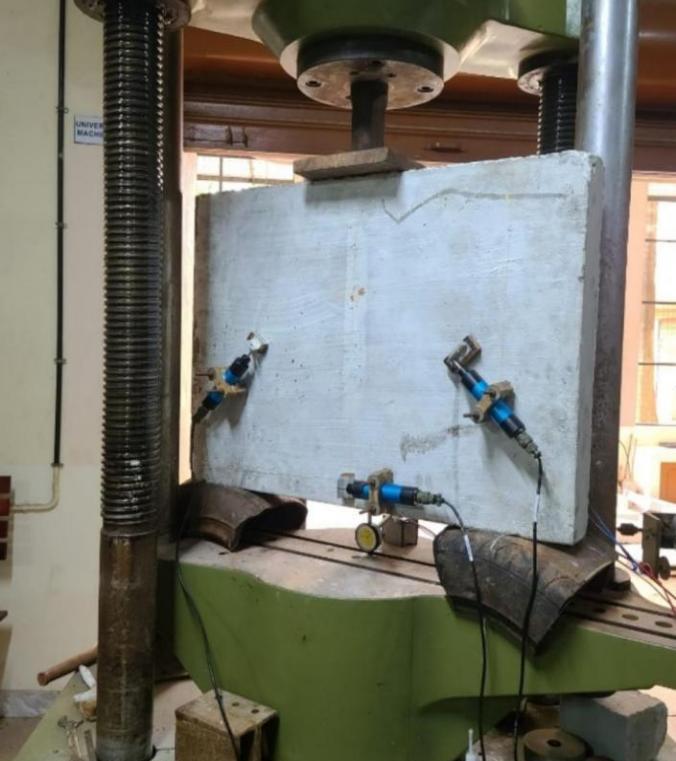
The test setup, shown in Figure 4, features one hinged supportandanothersidewitharollersupport.Toprevent thecrushingofthesupportbaseduringloading,acutpiece ofrubbertyreisplacedabovethesteelsupports,withajute sack layered on top. This arrangement ensures uniform distributionofappliedloadandreactionforcesonboththe topandbottomsurfacesofthebeams.Theloadwasapplied onthecentreofrectangular100x100steelplates.
International Research Journal of Engineering and Technology (IRJET) e-ISSN: 2395-0056
Volume: 11 Issue: 06 | Jun 2024 www.irjet.net p-ISSN: 2395-0072
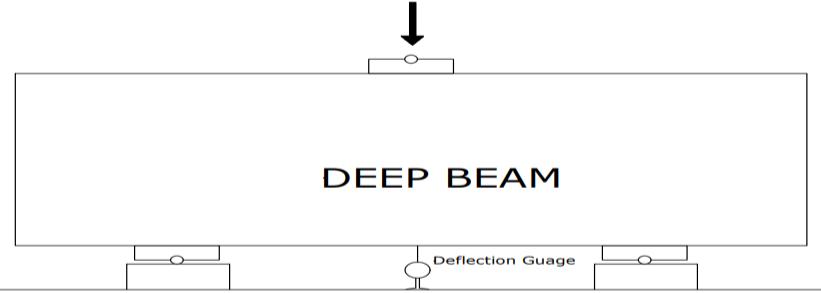
TestsetupshowninFigure5,a1000kNUniversalTesting Machine(UTM)wasusedandcentralloadwasappliedforall specimens.Inordertopreciselymeasurebeamdeflection, dialgaugeswithaminimumcountof0.01mmaremounted beneatheachbeamatthemid-span.Thesteelframe,which is positioned to apply one-point loading to the beam specimen,receivetheforceappliedbythehydrauliccylinder atitscenter.Throughoutthetestingprocess,accurateand regulatedloadingconditionswereensuredbythedepicted configuration, whichdemonstratesa steadyapplicationof weights at intervals of 10 KN. The width of crack was measured using a crack detecting microscope of 50x magnification.
4.1
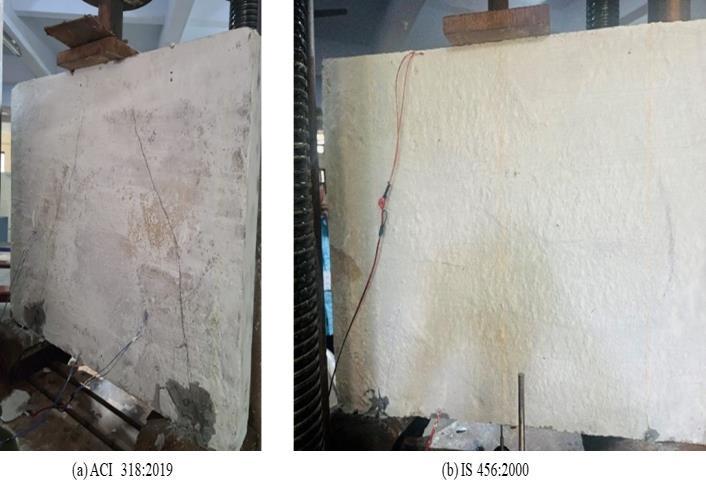
Twotypesofcrackswereidentifiedinitially:flexuralcracks and shear cracks. Flexural cracks originating from the bottomofthespecimenandextendingverticallytowardsthe neutralaxisofthebeam.Theshearcracks,whichmanifestas diagonal fissures in the shear span of the beam were propagated towards the center span. Prior to failure, the responsesofallspecimenswereconsistent.Whentheload was applied noticeable concrete crushing at the supports werenoted.Diagonalcracksobservedweredevelopedatthe bottom of the beam as the load reached to 40–50% of its maximumload.Afterthat,thesecrackswerepropagatedin thedirectionofthemainstrut,andthentowardstheinner edge of the support. Simultaneously, diagonal fissures widenedintheshearspancenterastheystretchedalongthe beam. Eventually, a brittle mode that was identified as diagonalsplittingfromthesupporttotheloadingpointwas foundresponsibleforthefailureofeveryspecimen.Figure6 showsthecrackpatternatvariousloadstages,andthesame wasconsistentlynotedforallspecimens.
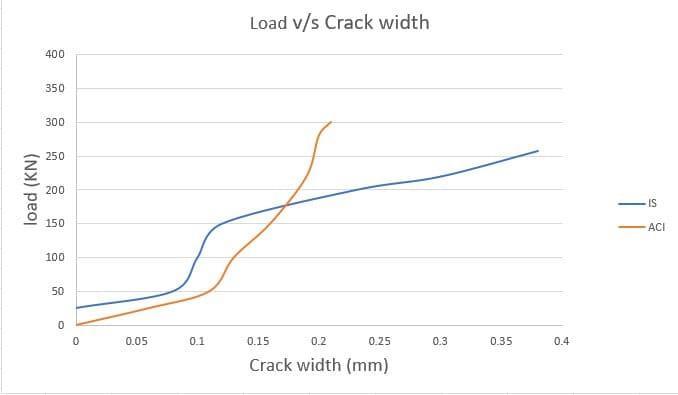
ISandACIspecimenexhibitsignificantvariationsintheload vscrackwidthplotasshowninFigure7.Initiallythecrack width is almost same for both IS and ACI specimens, afterwardsISspecimenshowsgreaterobservedcrackwidth whichmaybeduetotheSTMimplementationsuccessfully mitigates fracture formation and prevents further crack propagation.
Whilelimitedcrackformationisacceptableindeepbeams, the crack widths in IS beams just barely exceeded over acceptable bounds, while beams developed in accordance withSTMstayedwithinacceptablebounds.Notably,nearthe bottomofthebeams,fracturewidthsweremorenoticeable in the direction of the excessive tension side in ACI specimen.
International Research Journal of Engineering and Technology (IRJET) e-ISSN: 2395-0056
Volume: 11 Issue: 06 | Jun 2024 www.irjet.net p-ISSN: 2395-0072
The Load vs Midspan Deflection curve illustrates the relationshipbetweenappliedloadandmidspandeflection forthetestedspecimens.Inbothcasesastheloadincreases, themidspandeflectionincreases,whichcanbenotedfrom Figure8.
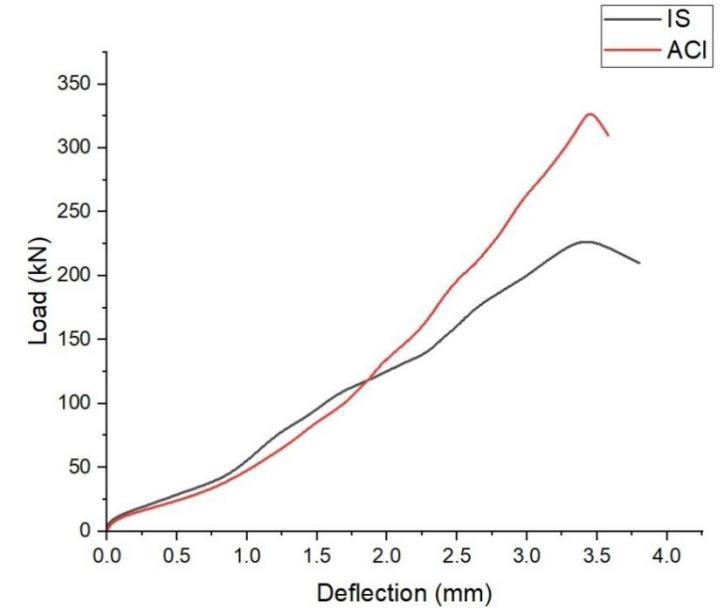
Fig-8: LoadVsMidspanDeflectionCurveofTestedSpecimens
Midspandeflectioncorrespondingtoultimateloadarenoted theloadingprocessofeachspecimen,apredominantlinear relationshipbetweenloadanddisplacementwasobserved initially, indicating elastic behavior. However, as loading progresses,theload-versus-displacementcurvetransitions into a nonlinear phase, signifying the onset of plastic deformation and yielding within the material. The occurrenceofthefirstcrackloadandtheultimateloadofthe specimens was calculated, with results indicating that the
ACIspecimensdemonstratenotablyhigherultimatestrength comparedtothosedesignedaccordingtoIS.
Theinitialcrackload,ultimateloadandenergyabsorption capacityofthespecimenswerecalculatedandtabulatedin Table 1. These values offer insights into the structural performanceandresilienceofeachbeamdesign,aidingin the comparative analysis of their effectiveness in withstandingappliedloads.
Table -1: InitialCrackLoad,UltimateLoad,YieldloadandEnergyAbsorptionofSpecimens
International Research Journal of Engineering and Technology (IRJET) e-ISSN: 2395-0056
Volume: 11 Issue: 06 | Jun 2024 www.irjet.net p-ISSN: 2395-0072
Thesevaluesofferinsightsintothestructuralperformance and resilience of each beam design, aiding in the comparativeanalysisoftheireffectivenessinwithstanding appliedloads.
The curvature of a beam is directly influenced by its deflection.Figure9illustratestheMomentVsCurvatureof thetestedspecimens,delineatingthreedistinctstages. This graphprovidescrucialinsightsindesigningbeamstosafely carryloadswithoutfailure,monitoringstructuralhealth,and advancingmaterialsandstructuraldesigns.
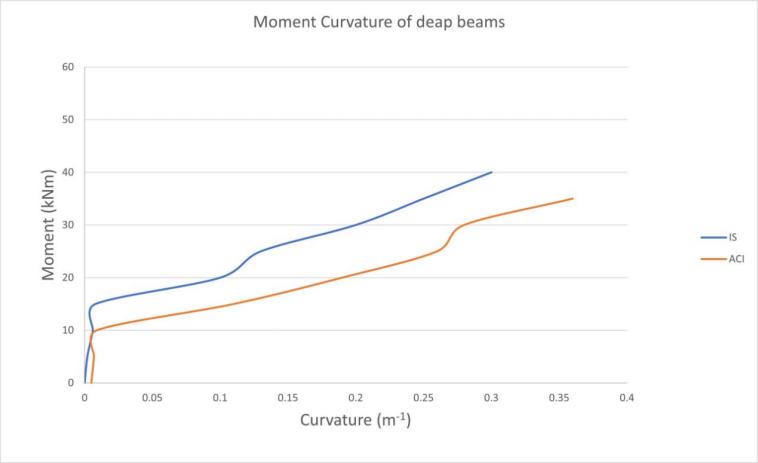
Fig-9: MomentVsCurvatureofTestedSpecimens
ItwasobservedthatspecimensdesignedaccordingtoACI displayed greater curvature compared to those designed usingIS.Thisdifferenceincurvaturesuggestsvariationsin thestructuralbehaviorofthebeamsunderload.Specifically, ACI specimens exhibited a higher degree of eccentricity, leading to increased curvature values. This finding underscores the importance of considering design code specificationsinpredictingandunderstandingthebehavior ofreinforcedconcretebeams,particularlyintermsoftheir deflectionandcurvaturecharacteristics.
ThedisplacementductilityindexvaluesfortheISspecimen calculated as 8.2, while the ACI specimen demonstrate a slightlyhighervalueof9.92.Theresultssuggeststhatbeams designedwiththeACIcodeusingtheSTMapproachpossess greater deformationcapacitycompared tothose designed with IS. This observed difference in ductility can be attributedtotheenhancedloadcarryingcapacityofbeams achievedthroughtheapplicationofthestrutandtiemethod forreinforcementdetailing.Thestrutandtiemethodoffersa morerefinedandoptimizedapproachtodistributingloads within the beam, thereby improving its overall structural performanceandabilitytowithstanddeformationwithout failure.
Consequently, the higher displacement ductility indices observed in the specimens designed with the ACI code indicatetheirenhancedabilitytoabsorbenergyandundergo largerdeformationsbeforereachingfailure,highlightingthe efficacyoftheACIapproachinenhancingtheductilityofRC deepbeams.
Thestudyconductedacomprehensiveanalysisofreinforced concrete (RC) deep beams designed according to the IS 456(2000) and ACI 318(2019) codes, focusing on various structural performances. Key observations revealed the presenceofflexuralandshearcracks,withdiagonalsplitting failurebeingthepredominantmode.Crack widthanalysis showedthatACIbeamshadslightlynarrowerwidthsdueto the reinforcement pattern specified by the strut-and-tie model (STM). Additionally, ACI-designed beams demonstrated a remarkable 25.7% higher ultimate load capacityandexhibited25-35%higherflexuralparameters compared to IS-designed beams. The energy absorption capacitiesofACIbeamswerenotablyhigher,asevidencedby theirmoment-curvaturerelationshipsandductilityindices, furtheremphasizingtheirsuperiorperformance.Theuseof STM in ACI-designed beams resulted in improved flexural behavior, characterized by lower crack widths and higher energy absorption capacities. These findings highlight the effectivenessoftheACI318 (2019) codeinenhancingthe load-carrying capacity and structural performance of RC deep beams. Future research could explore the impact of various percentages of openings in RC deep beams, investigating how different opening configurations affect beam behavior and performance. This would provide valuable insights for structural engineers and designers, contributingtoadvancementsindesigncodesandpractices withinthefieldofreinforcedconcreteconstruction.
[1] Shukla,B.K.,&Gupta,A.(2020).Mixdesignandfactors affectingstrengthofperviousconcrete.InAdvancesin Structural Engineering and Rehabilitation: Select Proceedings of TRACE 2018 (pp. 125-139). Springer Singapore.
[2] Deep Beam Group. Experimental study on reinforced concretedeepbeam.J.Build.Struct.1987,4,23–35.
[3] Choi,Y.W.,Lee,H.K.,Chu,S.B.,Cheong,S.H.,&Jung,W. Y. (2012). Shear behavior and performance of deep beams made with self-compacting concrete. International Journal of Concrete Structures and Materials,6,65-78.
[4] J. Schlaich, K. Schaefer, M. Jennewein, Toward a consistent design of structural concrete, PCI J. 32 (3) (1987),
International Research Journal of Engineering and Technology (IRJET) e-ISSN: 2395-0056
Volume: 11 Issue: 06 | Jun 2024 www.irjet.net p-ISSN: 2395-0072
https://doi.org/10.15554/pcij.05011987.74.150bll74–150.
[5] Augustino,D.S.,Kanali,C.,Onchiri,R.O.,&Kabubo,C. (2023).Simplifiedshearequationofdeepconcretebeam considering orientation effect of opening and mechanical properties of fibre-concrete interface. Heliyon,9(3).
[6] Standard,IS456:(2000).Plainandreinforcedconcretecodeofpractice.NewDelhi:BureauofIndianStandards.
[7] Abdulabbas, A. H., & Ismael, M. A. (2022). Structural Behavior of Reinforced Concrete Deep Beams with Inclined Circular Holes. Diyala Journal of Engineering Sciences,66-74.
[8] Abbas,R.M.,&Hussein,L.T.(2023).Transientresponse andperformanceofprestressedconcretedeepT-beams withlargewebopeningsunderimpactloading.Journal of the Mechanical Behavior of Materials, 32(1), 20220268.
[9] Haider K.Ammash & Maryam M. AL-Mousawi (2020). Effectofdevelopmentreinforcementstrutinconcrete deep beam.IOP Conf.series .Materials Science and Engineering1076(2021)012090
[10] Schlaich,J.,&Schafer,K.(1991).Designanddetailingof structural concrete using strut-and-tie models. StructuralEngineer,69(6),113-125.
[11] ACICommittee318.2014.Buildingcoderequirements forstructuralconcrete(ACI318-14)andCommentary (318R-14).ACI,FarmingtonHills.
[12] Ashour, A.F. Tests of Reinforced Concrete Continuous DeepBeams.Struct.J.1997,94,3–12
[13] Recommendationsforaninternationalcodeofpractice for reinforced concrete (1964), ACI and cement and concreteAssociation,London
© 2024, IRJET | Impact Factor value: 8.226 | ISO 9001:2008
|