
International Research Journal of Engineering and Technology (IRJET) e-ISSN:2395-0056
Volume: 11 Issue: 06 | Jun 2024 www.irjet.net p-ISSN:2395-0072

International Research Journal of Engineering and Technology (IRJET) e-ISSN:2395-0056
Volume: 11 Issue: 06 | Jun 2024 www.irjet.net p-ISSN:2395-0072
Sangeetha Arumugam 1 , Kalaivani .S 2
1 Assistant Professor, Department of Computer Science, Dr G R Damodaran College of Science (Autonomous), Coimbatore - 641 014.
2 Assistant Professor, Department of Computer Science, Dr G R Damodaran College of Science (Autonomous), Coimbatore - 641 014.
Abstract: ThepresentIOTsystemwillbecentredonthe subject of agriculture's digitization. The rise of several new firms in the agtech sector that focus on innovative digital technologies in agriculture. The need for development employing emerging technologies in the agriculture area will arise due to the high demand for food, the scarcity of natural resources, and the unpredictabilityofagriculturalproduction.Asaresultof the global technology revolution, small farmers are becomingfamiliarwiththemostrecentdevelopmentsin mobilenetworksthroughsmartphonesandotherrelated technologies All of these are contributing to the development of new digitally agriculture systems. We know agriculture is the crucial occupation for the rural peopleandabout70%oftheIndianpopulationdepends upon agriculture sector for their livelihood. The major challengefacedduetourbanizationinagriculturesector are rise in environmental pollution, climate change, degradationofsoilandwaterquality.Andtheseallfactor will directly decrease the income from farming industry that will become the reason for mass migration of rural peopletocities.Theefficiencyofthesoil,themonitoring of temperature and humidity, the efficacy of fertiliser, the tracking of equipment, the remote monitoring of storehouses,andotheraspectsmayallbeobservedwith the use of IOT-based sensor technology. A lower cost of progressinagriculturewillresultfromtheintegrationof wireless sensor networks (WSN) and the internet of things (IOT). Smart agriculture tools used to find the result from the IOT-based sensors, which include tracking, humidity, moisture, and temperature sensors. This review provides an overview of Smart Agriculture in IoT, exploring its components, applications, sensors, andchallenges.
Keywords: Smart Agriculture tools, IoT, WSN Sensors, Irrigation, Agricul.ture.
Smart agriculture, also known as precision agriculture, leverages advanced technologies to enhance farming practices, ensuring higher productivity and sustainability. It involves the integration of Internet of Things (IoT) devices, big data analytics, artificial
intelligence (AI), and other cutting-edge technologies to monitor, manage, and optimize agricultural activities. The objective is to address the growing global demand for food, cope with the challenges posed by climate change, and improve the efficiency of agricultural practices[1]
Since 60% to 70% of India's economy is based on agriculture, agriculture is important to the country's growth in terms of food production. Groundwater is gradually running out due to unplanned consumption. The Internet of Things (IOT) is another significant development in the history of technology. In the future, IOT will be able to feed billions of people on Earth through its significant contribution to agriculture [2] There is no need to worry about scheduling irrigation according to crop or soil conditions because the entire system is micro control based and can be controlled from a distance via wireless transmission. The nation is made up of a sizable region of agricultural land. Consequently, what is required is a planned out distributed number of sensor nodes and scattered pumpingunitstousethewaterefficientlyandpumpthe water to those specific locations covered by the sensor units[3].
A specific data management architecture is required for thepurposeofservingasareferenceforresearchinthe sectorofagriculture,asnewtechnologiesareconstantly developingandextensiveresearchisbeingconductedin this area. Additionally, the most important thing is to keep the information straight, thus it should be well managed for agricultural research purposes. Database management software is used to collect data, which is done in a more secure manner than with file-based systems. The primary concept behind the Internet of Things is to link various electronic sensors via a system and gather data from these sensors later on, which can be retrieved in any way. This data can be transferred to any cloud software, allowing an operator to analyse and processthedatathathasbeengathered[4].
Using techniques like emailing or texting people, the operator can use the data from the cloud programme to alert people. Cloud computing software stores a vast
International Research Journal of Engineering and Technology (IRJET) e-ISSN:2395-0056
Volume: 11 Issue: 06 | Jun 2024 www.irjet.net p-ISSN:2395-0072
amount of meteorological, soil, and agricultural data in order to quickly and accurately derive insights about a given area. Many years later, this recorded material can still be retrieved or reviewed. The data is carefully examined before offering the ideal requirements or necessitiesforafarm[5].
2. Components of IoT in Smart Agriculture
The components of IoT in smart agriculture involve several key layers and technologies that collectively enhance agricultural efficiency and productivity. Here arethemaincomponents.
A. Sensor Nodes and Actuators:
Sensors: These are critical for data collection and includedevicesthatmeasuresoilmoisture,temperature, humidity, light intensity, and other environmental parameters. These sensors are often connected to microcontrollers and communicate through wired or wirelessnetworks.
Actuators: Thesedevicesperformactionsbasedondata received, such as adjusting irrigation levels, opening greenhousewindows,oractivatingheatingsystems[6]
B. Network Layer:
This layer is responsible for data transmission. It employs various communication technologies such as Wi-Fi, Bluetooth, 4G/5G, and specialized IoT communication protocols like LoRa, NB-IoT, and 6LowPAN.Thenetworklayerensuresthatdatacollected from sensors reach the processing units and that commands from the control systems are delivered back totheactuators[7]
C. Middleware Layer:
MiddlewareactsasaninterfacebetweenIoTdevicesand applications,managingdata aggregationandprocessing. It hides the complexity of the hardware from the applications, providing a standardized way for software tointeractwithdifferenttypesofIoTdevices.Thislayer
often utilizes cloud computing, edge computing, and artificial intelligence to offer real-time data processing andanalysis[8].
D. Service Layer:
This layer provides common services for IoT applications, such as data storage, anomaly detection, diagnostics, and decision-making support. Technologies used in this layer include machine learning, big data analytics, and cloud services. It helps in generating actionable insights and predictions that aid in making informeddecisionsaboutfarmmanagement[9].
E. Application Layer:
The application layer is where end-users interact with the system. It includes user interfaces like mobile apps or web platforms that allow farmers to monitor conditions, receive alerts, and control IoT devices remotely. This layer utilizes data from the lower layers to provide comprehensive insights and visualizations, facilitating tasks such as crop monitoring, irrigation management,andpestcontrol.
These components work together to create a robust IoT ecosystem for smart agriculture, enabling precision farming and efficient resource management. The integration of these technologies helps in optimizing agricultural practices, improving crop yields, and reducingenvironmentalimpact[10].
3. Sensors used for IoT in smart agriculture
Insmartagriculture,varioustypesofsensorsareusedto monitor and manage agricultural activities more efficiently. Here are some of the key types of sensors commonlyusedinIoTforsmartagriculture.
A. Soil Sensors:
Soil Moisture Sensors: To maximise irrigation, determinethevolumetricwatercontentofthesoil.
Soil Temperature Sensors: Track the temperature of the soil to promote crop development and seed germination.
Soil pH sensors: Determine theacidityandalkalinityof thesoiltoguaranteeidealgrowthconditionsforvarious crops.
Soil Nutrient Sensors: Determinetheconcentrationsof vital nutrients such as potassium, phosphorus, and nitrogen[11].
B Climate Sensors:
Temperature sensors: Track the outside temperature toshieldcropsfromharshmeteorologicalevents.
International Research Journal of Engineering and Technology (IRJET) e-ISSN:2395-0056
Volume: 11 Issue: 06 | Jun 2024 www.irjet.net p-ISSN:2395-0072
Humidity sensors: Determine the amount of moisture in the air to assist in controlling the demands for wateringandplanthealth.
Light sensors: Determine the amount of sunshine a plantreceivestomaximiseitsexposuretoit.
Rainfall sensors: Use rainfall data to control irrigation times[12]
C. Water Sensors:
Water Flow Sensors: To identify leaks and maximise water use, measure the volume of water passing via irrigationsystems.
Water Quality Sensors: Check if the salinity, turbidity, andpHlevelsofthewater areappropriateforirrigation [13].
D. Crop Sensors:
Optical sensors: Measure plant health, chlorophyll content, and disease detection using various light wavelengths.
Multispectral and hyperspectral sensors: Gather informationatvariouswavelengthstoassesscrophealth andidentifypotentialstressors[14].
E. Livestock Sensors:
Wearable Sensors: Track health, location, and activity levelsoflivestock.
Microchips: These allow for individual animal identificationandhealthtracking.
F. Pest and Disease Sensors:
Insect Traps with Sensors: Monitor pest numbers by counting them to effectively implement control measures.
Disease Detection Sensors: Use alterations in plant biomarkerstofindearlyindicatorsofplantillnesses.
G. Environmental Sensors:
CO2 Sensors: Measure carbon dioxide levels to ensure optimalconditionsforphotosynthesis.
Gas Sensors: Detect harmful gases like ammonia or methane, especially in enclosed agricultural environmentslikegreenhouses.
H. Location Sensors:
GPS Sensors: Provide precise location data for equipmentandcropmapping.
RFID Tags: Usedfortrackinglivestockandassetswithin thefarm.
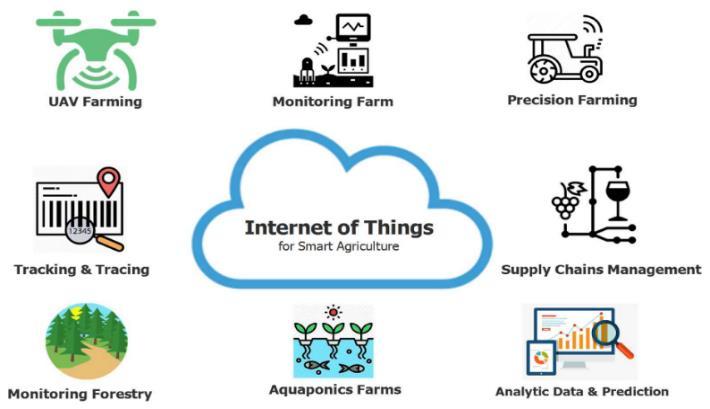
The Internet of Things (IoT) has significantly impacted agriculture by introducing advanced technologies that enhanceefficiency,productivity,andsustainability.Here aretenkeyapplicationsofIoTinagriculture,
Weatherstationsareamongthemostwidelyusedsmart agricultural devices, as they integrate many smart farming sensors. They are situated across the area and gather different types of environmental data before sendingittothecloud.Withthemeasurementssupplied, one may utilise them to map the environment, choose suitable crops, and implement the necessary actions to increasetheirproductivity(precisefarming)[15]
Some examples of such agriculture IoT devices are allMETEO,SmartElements,andPycno.
B. Greenhouse automation
Farmers often manage the greenhouse atmosphere via hand involvement. They may obtain precise real-time data on greenhouse parameters including illumination, temperature,soilquality,andhumiditybyusingInternet of Things (IoT) sensors. Weather stations can autonomously modify the circumstances to fit the specified criteria in addition to obtaining environmental data. In particular, an analogous principle is applied by greenhouse automation systems. Among other IoT agriculture solutions, Farmapp and Growlink provide thesekindsoffeatures[16].
C. Crop management
Crop management devices are another kind of IoT product used in agriculture and a component of precisionfarming.Theyshouldbepositionedinthefield to gather information unique to crop farming, such as temperature, precipitation, leaf water potential, and generalcrophealth,justlikeweatherstations[17].
As a result, you can keep an eye on the growth of your crops and any irregularities to efficiently ward against illnesses or pests that can reduce your production. Arable and Semios are two excellent examples of realworldapplicationsforthisusecase.
D. Cattle monitoring and management
IoT agricultural sensors are available to monitor the health and record the performance of farm animals, much as crop monitoring. Data on the health, welfare, and physical position of livestock are gathered with the
International Research Journal of Engineering and Technology (IRJET) e-ISSN:2395-0056
Volume: 11 Issue: 06 | Jun 2024 www.irjet.net p-ISSN:2395-0072
use of tracking and monitoring livestock. These sensors, forinstance,candetectunwellanimals,allowingfarmers to isolate them from the herd and prevent infection. Farmers may save personnel costs by using drones to track animals in real-time. This functions similarly to petcare-relatedIoTdevices[18].
For instance, SCR from Allflex and Cowlar uses smart agricultural sensors (collar tags) to provide information on the herd as a whole as well as temperature, health, activity,andnutritioninsightsforeachindividualcow.
Precision farming, often referred to as precision agriculture,iscentredonproductivityandprecise,datadriven decision-making. It's also among the most popular and successful uses of IoT in farming. Farmers areableto gathera widerange ofdata on manyaspects of the field microclimate and ecosystem, such as temperature, humidity, illumination, soil quality, CO2 levels, and insect infestations, by utilising Internet of Things sensors. With the use of this data, farmers may save costs, grow healthier and more productive crops, and determine the ideal quantities of water, fertiliser, andpesticidesfortheirplants[19]
Forexample,CropXbuildsIoTsoilsensorsthatmeasure soil moisture, temperature, and electric conductivity enabling farmers to approach each crop’s unique needs individually. When paired with geographic information, this technique aids in the creation of accurate soil maps foreveryfield.SimilarservicesareprovidedbyMothive, whichaidsfarmersinloweringwaste,raisingyields,and enhancingfarmsustainability[20]
The use of agricultural drones to smart farming is perhaps one of the most exciting developments in agritech. Drones, often referred to as unmanned aerial vehicles, or UAVs, are more capable of gathering agricultural data than satellites and aircraft. In addition totheirsurveillancecapabilities,dronesmaycarryouta wide range of jobs that traditionally needed human labour, such as crop planting, eradicating pests and illnesses, agricultural spraying, crop monitoring, and more[21]
For instance, DroneSeed constructs drones to plant plants in deforested areas. These drones are six times more productive to utilise than human labour. A costeffective Sense Fly agricultural drone, the eBee SQ, employs multispectral image analysis to assess crop health[22].
Predictive data analytics and precision agriculture go handinhand.Theuseofdataanalyticsbyfarmershelps them make sense of the vast amounts of highly relevant real-time data that IoT and smart sensor technologies provide, enabling them to make critical forecasts about crop harvesting time, disease and pest risks, yield volume, and other related topics. Farming, which is essentiallyverydependentontheweather,maybemade more predictable and controlled with the use of data analyticstechnologies[23]
For instance, farmers may get crop quality and volume ahead of time, as well as their susceptibility to adverse weathereventslikedroughtandflooding,withtheuseof the Crop Performance platform. Additionally, it lets farmers choose yield features that will enhance crop quality and optimise the amount of water and nutrients availabletoeachcrop[24].
IoTintegrationinsmartagriculturehasshowntohavea great deal of promise for improving farming methods sustainability, efficiency, and production. Farmers are now able to obtain real-time insights into crop health, soil conditions, and environmental factors by deploying sensors, automating irrigation systems, and using data analytics. This technical breakthrough lowers labour costs,boostsagriculturalyields,andoptimisestheuseof resources like water and fertilisers. IoT adoption in agriculture, however, is confronted with several obstacles,suchashighupfrontcosts,therequirementfor technicalknow-how,andworriesaboutdatasecurity.
This paper considered all these aspects and highlighted theroleofvariouscomponents,sensorsandapplications of IoT in smart agriculture. Future research in this area should concentrate on removing these obstacles by creating affordable Internet of Things technologies and approachable user interfaces that farmers of all sizes may readily embrace. Furthermore, for smooth integration and data interchange, improving the interoperability of IoT platforms and devices will be essential.Enhancingcybersecurityprotocolsshouldbea top priority in research to prevent breaches and exploitation ofprivateagriculturedata.Furthermore, by utilising developments in artificial intelligence and machine learning, farmers will be able to respond proactively to possible problems by utilising predictive analytics and decision-making processes. IoT has the ability to completely transform agriculture and support sustainable agricultural methods and global food security by carrying out more innovation and tackling theseissues.
International Research Journal of Engineering and Technology (IRJET) e-ISSN:2395-0056
Volume: 11 Issue: 06 | Jun 2024 www.irjet.net p-ISSN:2395-0072
References
1.Soussi,A.,Zero,E.,Sacile,R.,Trinchero,D.,&Fossa,M. (2024). Smart Sensors and Smart Data for Precision Agriculture: A Review. Sensors, 24(8), 2647DOI: 10.3390/s24082647
2. Roy, M. N., Das, S., Mitra, R., & Mukherjee, D. (2024). Groundwaterandclimatesmartagriculture:Areflection from West Bengal, India. Mitigation and Adaptation Strategies for Global Change, 29(45) DOI: 10.1007/s11027-024-10137-1
3. Wei Li, Muhammad Awais, Weimin Ru, Weidong Shi, Muhammad Ajmal, Saad Uddin, and Chenchen Liu (2020). Review of Sensor Network-Based Irrigation SystemsUsingIoTandRemoteSensing,1-14.
4. Görkem Giray andCagatay Catal (2021), Design of a Data Management Reference Architecture for SustainableAgriculture,13(13),
5. Yadav, K., & Singh, K. (2020). Application of cloud computing in agricultural development: A review. Journal of Agricultural Science and Technology, 22(3), 543-556.
6. Khanna, A., & Kaur, S. (2019). Evolution of Internet of Things (IoT) and its significant impact in the field of precision agriculture. Computers and Electronics in Agriculture,157,218-231.
7. Centenaro, M., Vangelista, L., Zanella, A., & Zorzi, M. (2016). Long-range communications in unlicensed bands: The rising stars in the IoT and smart city scenarios.IEEEWirelessCommunications,23(5),60-67.
8.Bandyopadhyay,S.,&Sen,J.(2011).InternetofThings: Applications and challenges in technology and standardization. Wireless Personal Communications, 58, 49-69.
9. Botta, A., De Donato, W., Persico, V., & Pescapé, A. (2016). Integration of cloud computing and Internet of Things: A survey. Future Generation Computer Systems, 56,684-700.
10. Bhakta, I., & Phadke, S. (2020). Internet of Things (IoT) in agriculture: Smart farming. Proceedings of the International Conference on Inventive Research in ComputingApplications,1-5.
11. Brown, A. B., & Johnson, C. D. (2020). Soil temperaturemonitoringforsustainableagriculture.InK. Green (Ed.), Advances in Agricultural Technology (pp. 45-60).Springer
12. Soussi, A., Zero, E., Sacile, R., Trinchero, D., & Fossa, M. (2024). Smart Sensors and Smart Data for Precision Agriculture:AReview.Sensors,24(8),2647
2024, IRJET | Impact Factor value: 8.226 |
13. Sharma, D. P., & Sharma, M. P. (2009). pen spark exclamation Water quality management in agriculture. JournaloftheIndianSocietyofSoilScience,57(1),1-12.
14. Fahey, T., Pham, H., Gardi, A., Sabatini, R., Stefanelli, D.,Goodwin,I.,&Lamb,D.W.(2021).Activeandpassive electro-optical sensors for health assessment in food crops.Sensors,21(1),171
15. Aghighi, H., Azadbakht, M., & Naseri, M. (2019). Integration of smart farming sensors with weather stations for precise agriculture. Journal of Agricultural andFoodInformation,20(4),290-305.
16 Dutta, P., Shrimali, D., & Gite, S. (2021). IoT-based greenhouse monitoring and control system for smart farming.Journal ofAmbient IntelligenceandHumanized Computing,12(8),9643-9654.
17. Aggarwal, S., Kumar, A., & Singh, M. (2020). Internet of Things for monitoring and control of agricultural processes: Crop management, smart farming, and automation. Computers and Electronics in Agriculture, 170,105251.
18 Trilles, S., Beltrán, V., & Torres-Sospedra, J. (2018). Smart farming: Integration of IoT sensors and cloud computing for greenhouse monitoring. Sensors, 18(9), 2748.
19 Chlingaryan, A., Sukkarieh, S., & Whelan, B. (2018). Machine learning approaches for crop yield prediction andnitrogenstatusestimationinprecisionagriculture:A review. Computers and Electronics in Agriculture, 151, 61-69.
20.Al-Garadi,M.A.,Mohamed,A.,Du,X.,Ali,I.,&Guizani, M. (2020). A survey of machine and deep learning methods for internet of things (IoT) security. IEEE CommunicationsSurveys&Tutorials,22(3),1646-1685.
21 Meng, X., Pan, Y., & Zhang, Z. (2020). Integration of UAV remote sensing and machine learning for crop monitoringandmanagement:Areview.RemoteSensing, 12(13),2081.
22 Alvey, E., & Kane, M. (2021). Innovations in reforestation: A case study on the use of DroneSeed's UAV technology. Journal of Environmental Management, 280,111694.
23. Chen, S., Yang, L., & Chung, W. (2019). A predictive analytics framework for precision agriculture. ComputersandElectronicsinAgriculture,167,105033.
24 Mishra, V. N., & Singh, V. P. (2020). Use of machine learning in predicting crop yield and its potential applicationsinmodernagriculture.InternationalJournal ofAgriculturalandBiologicalEngineering,13(1),1-12.