
International Research Journal of Engineering and Technology (IRJET) e-ISSN: 2395-0056
Volume: 11 Issue: 06 | Jun 2024 www.irjet.net p-ISSN: 2395-0072
International Research Journal of Engineering and Technology (IRJET) e-ISSN: 2395-0056
Volume: 11 Issue: 06 | Jun 2024 www.irjet.net p-ISSN: 2395-0072
Poreddy Jayaraju1, Dr. Aashiq Banu2
1 Phd Scholar ,Department of Computer science & Eng. Indian Institute of Technology Bhilai, Chhattisgarh, India
2Assistant Professor Department of Computer Science Eng. Koneru Lakshmaiah Education Foundation, Hyderabad-500075, Telangana, India.
Abstract - Rice is one of the major cultivated crops in India which is affected by various diseases at various stages of its cultivation. It is very difficult for the farmers to manually identify these diseases accurately with their limited knowledge. For disease management, farmers spending lot of time and resources and they detect the diseases through their penniless naked eye approach which leads to unhealthy farming. The advancement of technical support in agriculture greatly assists for automatic identification of infectious organisms in the rice plants leaves. The convolutional neural network algorithm (CNN) is one of the algorithms in deep learning has been triumphantly invoked for solving computer vision problems like image classification,objectsegmentation, image analysis, etc. In our work, VGG16 is a type of CNNmodel utilized with transfer learning approach for recognizing diseases in rice leaf images. The parameters of the proposed model is optimized for the classification task and obtained a good accuracy of 97.57%.
Key Words: CNN Deep Learning Fine-tuning Rice leaf diseasesTransferlearning
1.INTRODUCTION
Timelyandaccuratediagnosisofplantdiseasesiscrucialfor sustainable agriculture and resource management. While some diseases lack visible symptoms, most are identified through optical observation by experienced plant pathologists. However, climate changes and the spread of diseasescanchallengeevenskilledpathologists.InIndia,a major rice producer, agriculture contributes 19.9% to the GDP,withricebeingastaplecrop.Diseasesaffectingricecan significantlyimpactfarmers'profits.Thus,anautomaticdata processing expert system for early disease detection is essential. Deep learning, particularly convolutional neural networks(CNNs),offersrobustsolutionsforplantdisease classificationandotheragriculturalchallengesbyeffectively processingvisualdataandlearningspatialrelationships.
2.Related work
Alotofresearchershavedevelopeddisparatearchitectures intherecentyearsfortheplantleafdiseasesdiagnosis by usingmachinelearninganddeeplearningalgorithms.2020). Convolutional Neural Network (CNN) is one of neural
networks used most frequently in deep learning, Amit KumarSinghetal.usedSupportVectorMachine(SVM)to classifynormalriceleavesanddiseasedriceleaves,andthe classification accuracy reached 82% (Duan et al., 2017). MohsenAzadbakhtetal.usedwheatleafhyperspectraldata andmachinelearningmethodstodetectwheatleafrust,and reachedaconclusionthatsupportvectorregressionhadthe besteffectsinthiscaseaftercomparingtheresultsoffour machine learning methods (Azadbakht et al., 2019). Comparativelyspeaking;theperformanceisveryordinary. Unliketraditionalmachinevisionalgorithms,whichrequire manualfeatureextractionandclassification,CNNonlyneeds to input the image data into the network, and the selflearning ability of the network can complete the image classification(Xieetal.,2020),thisresearchusesCNNasthe researchmethod.
Deep learning has been applied rapidly in image recognition (Xiong et al., 2021; Naranjo-Torres et al., Krishnamoorthy N et al. (2021) proposed a InceptionResNetV2 (Convolutional Neural Network) with transfer learning to identify rice plant diseases (Krishnamoorthy N et al. 2021). In this classification Solemane Coulibalya et al. (2019) applied a VGG16 model withtransferlearningapproachfordetectingthediseasein milletcrop(Coulibalyetal.,2019).Thisworkcollected124 leaf images and split into mildew diseases and healthy categories.TheVGG16modelobtainedanaccuracyof95%
N. Nandhini et al. (2020) proposed a machine learning algorithms such as SVM, K-NN, and decision trees for classifying the diseases in the plant leaves (Nandhini and Bhavani,2020).
Task,theauthorsused6classesofimagesfortrainingand achievedanaccuracyof95.67%forInceptionResNetV2.
3. Materials and methods: Inthissection,theprocedure of the projected work is segregated into seven steps processesforcategorizingriceleafdiseaseswhichshowsin Fig.1(Fig.2).
3.1. Rice disease types and dataset description: The rice image dataset has been collected over the past few monthsmostlyfromthecultivationfieldsofRaipur,
International Research Journal of Engineering and Technology (IRJET) e-ISSN: 2395-0056
Volume: 11 Issue: 06 | Jun 2024 www.irjet.net p-ISSN: 2395-0072
The dataset consists of 4020 images, images of diseased leaves of rice consisting of five most common diseases namelyBacterialLeafBlight,BrownSpot,FalseSmut,Leaf Blast,sheathblightThereare516imagesofHealthyleaves. Therewereanumberofdifficultiesfacedwhilecollectingthe data like poor illumination and Each and every image has only one disease. The dataset has been split into 80% training,10%validationand10%testing.Theclassification functionwasimplementedusingVGG16.
3.2. Image Pre-processing and Augmentation:Image pre-processingenhancesrawinputdata,improvingmodel accuracyandefficiencybypromotingmeaningfulinsights.In thisstudy,thecollecteddatasetimageswithRGBcoefficients (0–255)andvaryingdimensionswererescaledandresized forconsistency.
Duringpre-processing,imagepixelvalueswererescaledto 0–1andresizedto224x224x3pixels.Imageaugmentation techniques, including rotation, vertical and horizontal flipping,shearing,andrandomzooming,wereappliedusing the Image Data Generator class to expand the training dataset.(Fig.4)
4.1.CNNwithouttransferlearning
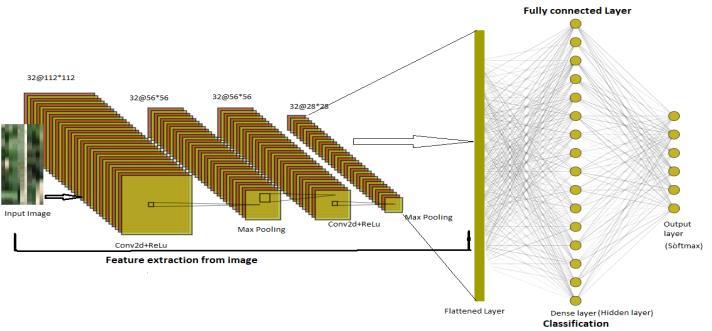
Itisaverysimpleneuralnetwork.Itonlyhas6layers, among which there are 2 convolution layers, 2 down samplinglayersand1fullyconnectedlayerthatarefollowed bytheoutputlayer.Theinputimagesaresettothesizeof 224x224x3.Itconsistsofaseriesofconvolution,activation andpoolinglayersinthefeatureextraction.Themodelused fortheproposedsystemisshowninFig.5.
Convolutional layer is the building block of Convolutional NeuralNetwork(Liuetal.,2018).Convolutionlayersuse3 by 3 filters with strides. It is used to derive the related featuresoftheinputimagethroughthefiltersthathaveset of automatic learnable parameters (weights). Activation function used is ReLU. ReLU is an unsaturated activation elevates performance of the model better than saturated activationfunctions.Maxpoolinglayersusesa3by3pooling window with stride value is 2 and functioning down
samplingoperationoninputactivationmaps.Itisapooling operationthatselectsthemaximumelementfromtheregion ofthefeaturemapcoveredbythefilter.Flatteninglayeris used to transform the data into single dimensional array whichisusedasinputtothefullyconnectedlayer.Thereare three sets of fully connected layer with 112,56 and 6 neurons which classifies the images into different classes that it belongs. Softmax activation function is used in the thirdfullyconnectedlayer.Itreturnstheprobabilityforeach classandthetargetclasswillhavethehighestprobability.

Fig.8.VGG-16Architecturefine–tunedwiththelasttwo layerswith128DenseFCLayerand6DenseSoftmax Layerastheoutput
images were resized to 224x224x3 pixels. Image augmentation techniques, including rotation and flipping, were applied using the Image Data Generator class. The model was compiled using the Adam optimizer and categorical_crossentropy loss function, and training was stopped at 200 epochs. A comparison with a custom CNN modelshowedsuperiorperformanceoftheVGG-16based approach Figure 2 and Figure 8 depict the VGG-16 architectureandproposedmodel,respectively
Transfer learning leverages knowledge from pre-trained modelstoimprovegeneralizationandreducetrainingtime, particularly useful when limited labelled data is available. Weutilizedthepre-trainedVGG Net,fine-tuningitforour specificdatasettobuildaneffectiveclassificationmodel.
5. Parameters for evaluation and Experimental Analysis (Metrics): We use the following metrics to analyzetheperformanceofvariousmodels;
5.1.ConfusionMatrix:Consideringthestatisticsofcorrect detections (also known as true positives), misdetections (also known as false negatives), true negatives, and false positives, we can evaluate the performance of the models withtheindicatorsincludingtheAccuracy,Precision,Recall, andF1Scoreasinequations1,2,3and4.
International Research Journal of Engineering and Technology (IRJET) e-ISSN: 2395-0056
Volume: 11 Issue: 06 | Jun 2024 www.irjet.net p-ISSN: 2395-0072
5.2. Accuracy
Itworkswellforbalanceddatasetandcalculatesacloseness oftheevaluationwiththeactualvalue.
Accuracy=(TP+TN)/TP+FP+TN+FN) (1)
5.3. Precision
Precision=TP/(TP+FP) (2)
5.4. Recall
Recall=TP/(TP+FN) (3)
5.5.F1-score
F1−score=2TP/(2TP+FP+FN) (4)
Thisinferencewillbesupportiveforustoachieveareliably skilled model for our plant leaf diseases recognition task. Where,truepositive(TP),truenegative(TN),falsepositive (FP),andfalse negative(FN)arethe elementsusedinthe evaluationmetrics
The experiment was accomplished with components of windows 11 PC, GPU runtime assigned by Google Colaboratory, Google drive 16 GB storage space, 64 bit operatingsystem.Thetrainingandvalidationprocessesof thedeepneuralnetworkswereenabledwiththeKeras2.8.3 frameworkandTensorFlowbackend.
7. Results and discussion
Thisportionshowsandaddressestheresultderivedbythe proposedmethodology.Afine-tunedpre-trainedmodeland simpleCNNwereexperimentedwithtrainingandtestsets contain11236and2700instancesrespectively.
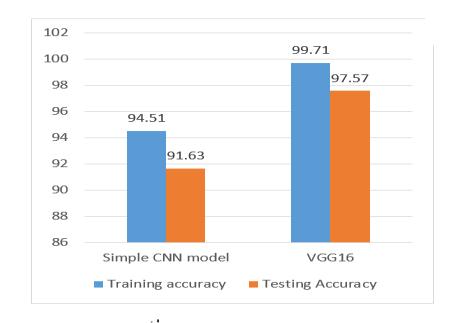
Fig.10.Trainingandtestaccuracyoftheproposedmodels.
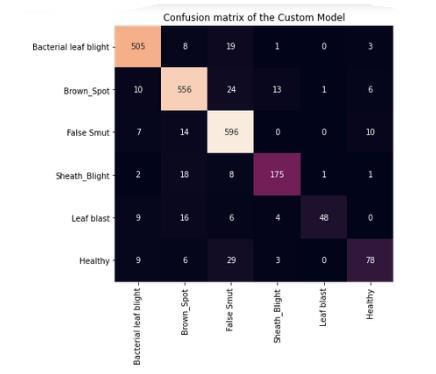
Fig. 10 shows the accuracy of CNN models for rice leaf diseases classification. Fig. 11 illustrates the confusion matrix is evaluating the performance of the models on a classificationtask.Itshowstheclassificationaccuracyscore for discrete classes and it also useful to calculate the
accuracy,precision,recall,andf1scorewhichshowinFig. 12.
TheFigure11illustratesimagesthataremisclassifiedbythe proposed Simple CNN model. The misclassifications are described in details in the below section for each of the diseasetype.
leaf Blast:ImagebelongstoleafBlastbutitisclassifiedas BrownSpotastheimageisblurred.Thereasoncouldbethe presenceofsmallbrownspotsinthesamericeleaf.
Bacterial Leaf Blight:Imagesareclassifiedasfalsesmutbut they belong to Blight category. The reason could be poor illuminationandblurringofimage.
Healthy: ImagesarehealthybutitisclassifiedasFalsesmut probablybecausetheimageisblurredandcontrastispoor.
Brown Spot: ImagesbelongtoBrownSpotbutareclassified asBlastandSheathblight.Onereasoncouldbethepresence ofsmallblastlesionsontheleaf.Inthebrownspotlesions resembletheblastlesion.
False smut: ImagesbelongtoFalsesmutbutareclassified asbrownspotandhealthy.Onereasoncouldbethepresence ofsmallblastlesionsontheleaf.Inthebrownspotlesions resemble the blast lesion and the image is blurred and contrastispoor.
Sheath blight: Images belongs to sheath blight but it is classified as Brown Spot and false smut as the image is blurred.Thereasoncouldbethepresenceofsmallbrown spotsinthesamericeleaf.
International Research Journal of Engineering and Technology (IRJET) e-ISSN: 2395-0056
Volume: 11 Issue: 06 | Jun 2024 www.irjet.net p-ISSN: 2395-0072
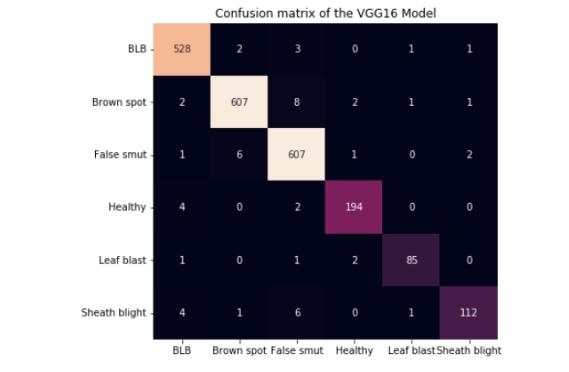
Observation:Itproducessignificantlylessfalsepositiveand falsenegative,asobservedfromtheconfusionmatrixand Diagonalvaluesaremore.
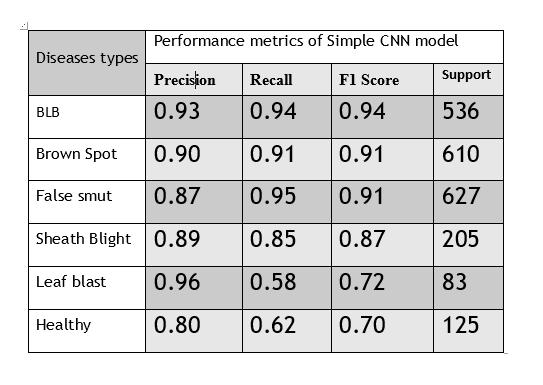
12.PerformanceMetricsforproposedmodelsi.e.,a) SimpleCNN,andb)VGG16
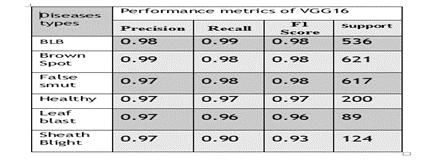
12.PerformanceMetricsforproposedmodelsi.e.,b) VGG16
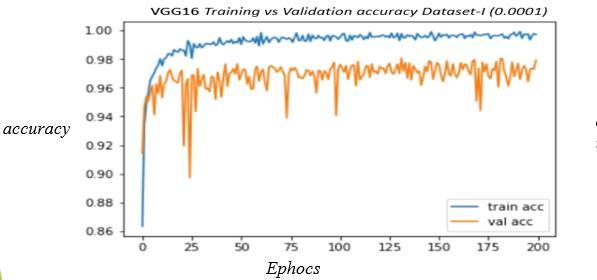
Fig.13.Trainingandvalidationaccuraciesforproposed modelsi.e.,a)SimpleCNN,and b)VGG16
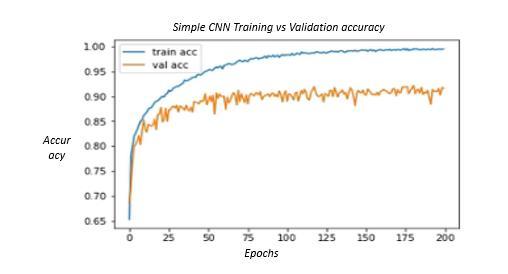
Observation of Fig 13:In VGG16Trainingandvalidation curves are moving closely whereas in simple CNN model curvesarenotmovingtogetherwecouldobserveinthe(a)
8. Conclusion
In this study, we demonstrated a pre-trained deep convolutional neural network of VGG16 with transfer learningapproachforthedetectionofriceleafdiseases.The three major attacking diseases of rice plant Bacterial Leaf Blight,BrownSpot,FalseSmut,LeafBlast,sheathblightand healthy class are considered for this research. The simple CNNmodelwasfine-tunedusingdifferenthyperparameters andachievedtheaccuracyof91.63%byrunning200epochs. VGG16hasattainedanoptimizedaccuracyof97.57%using 200 epochs and by fine-tuning several hyper parameters. Futureworkwillbetheexplorationonconvolutionalneural networkforcategorizingfurthertypesofricediseasesand other plant leaf diseases. And we will use the object detection algorithmstodetectthediseases,Additionally,we like to utilize nature inspired algorithms for selecting the best hyper parameters automatically for fine-tuning the CNN
International Research Journal of Engineering and Technology (IRJET) e-ISSN: 2395-0056
Volume: 11 Issue: 06 | Jun 2024 www.irjet.net p-ISSN: 2395-0072
1. Sankaran,S.,Mishra,A.,Ehsani,R.,Davis,C.,2010.A reviewofadvancedtechniquesfordetectingplant diseases. Comput. Electron. Agric. 72, 1–13. https://doi.org/10.1016/J.COMPAG.2010.02.007.
2. Arsenovic,M.,Karanovic,M.,Sladojevic,S.,Anderla, A.,Stefanovic,D.,2019.SolvingCurrentLimitations of Deep Learning Based Approaches for Plant Disease Detection. Symmetry (Basel). 11,939. https://doi.org/10.3390/sym11070939
3. Duan, Y., Liu, F., Jiao, L., Zhao, P., Zhang, L., 2017. SAR image segmentation based on convolutionalwaveletneuralnetworkandmarkovrandomfifield. PatternRecogn.64,255–267.
4. Azadbakht, M., Ashourloo, D., Aghighi, H., et al., 2019. Wheat leaf rust detection at canopy scale under differentLAIlevelsusingmachine learning techniques.Comput.Electron.Agric.156,119–128.
5. Xie,W.,Ma,G.,Zhao,F.,etal.,2020.PolSARimage classificationviaanovelsemisupervisedrecurrent complex-valued convolution neural network. Neurocomputing.
6. Coulibaly, S., Kamsu-Foguem, B., Kamissoko, D., Traore, D., 2019. Deep neural networks with transferlearninginmilletcropimages.Comput.Ind. 108,115–120.
7. Nandhini, N., Bhavani, R., 2020, January. Feature extraction for diseased leaf image classification using machine learning. In: 2020 International Conference on Computer Communication and Informatics(ICCCI).IEEE,pp.1–4.
8. Liu,B.,Zhang,Y.,He,D.,Li,Y.,2018.Identificationof apple leaf diseases based on deep convolutional neuralnetworks.Symmetry10(1),11
9. Zhang,R.,Sathishkumar,V.E.,JacksonSamuel,R.D., 2020. Fuzzy efficient energy smart home management system for renewable energy resources.Sustainability12(8),3115.
2024, IRJET | Impact Factor value: 8.226 | ISO 9001:2008