
International Research Journal of Engineering and Technology (IRJET) e-ISSN:2395-0056
Volume: 11 Issue: 06 | Jun 2024 www.irjet.net p-ISSN:2395-0072
International Research Journal of Engineering and Technology (IRJET) e-ISSN:2395-0056
Volume: 11 Issue: 06 | Jun 2024 www.irjet.net p-ISSN:2395-0072
Anand Gautam1, Dipti Ranjan Tiwari2
1Master of Technology, Computer Science and Engineering, Lucknow Institute of Technology, Lucknow, India
2Assistant Professor, Department of Computer Science and Engineering, Lucknow Institute of Technology, Lucknow, India
Abstract - In recent years, the automotive sector has experienced a significant shift, driven by the rapid advancement of artificial intelligence (AI) and machine learning (ML) technologies. These progressions are not only altering traditional manufacturing methods but also revolutionizing the operation, maintenance, and overall experienceofvehicles.Oneofthemostnotableapplicationsof AI and ML in the automotive industry is the creation of autonomous driving systems. These systems utilize intricate algorithms and sensor technologies to perceive the environment, make instantaneous decisions, and navigate autonomously without human intervention. Additionally, AI and ML are fostering advancements in predictive maintenance, allowing vehicles to predict and address mechanical issues before they worsen, thereby increasing reliabilityandminimizingdowntime.Furthermore,AI-driven safetyfeatures,suchascollisionavoidancesystemsanddriver assistance programs, are becoming standard across vehicle models, enhancing human capabilities and reducing the likelihoodofaccidents.Moreover,AI-poweredpersonalization isreshapingthein-carexperience,withintelligentassistants, voice recognition, and adaptive entertainment systems tailoring interactions to individual preferences. As the automotiveindustryrapidlyadoptsAIandMLtechnologies,it is on the brink of a profound transformation, ushering in an eraofsafer, moreefficient, and personalizedtransportation.
Key Words: Artificial intelligence, machine learning, automotive industry, autonomous driving, predictive maintenance,vehiclesafety,personalizeduserexperiences, deeplearning
The history of artificial intelligence (AI) and machine learning (ML) in the automotive industry is a narrative of technological progression intertwined with the pursuit of safer,moreeffectivetransportationsolutions.TherootsofAI inautomobileswereplantedinthemid-20thcentury,with initial advancements like cruise control and anti-lock brakingsystems.However,itwasnotuntilthelate20thand early21stcenturiesthatAIandMLtrulybegantotransform the automotive sector. Innovations in computer vision facilitated the creation of advanced driver-assistance systems (ADAS), capable of detecting pedestrians, identifyingtrafficsigns,and evenaidingin parking.Inthe
meantime,MLalgorithmsempoweredautonomousvehicles togleaninsights fromvast amounts ofdata, refining their decision-making capabilities and navigating intricate surroundings. Companies such as Tesla, Google (Waymo), andtraditionalautomakersmadesignificantinvestmentsin AI and ML research, pushing the boundaries of what was achievable on the road. Presently, AI and ML are fundamental components of contemporary vehicles, propellingadvancementsinsafety,efficiency,andtheoverall drivingexperience.Astheautomotiveindustrycontinuesto adopt these technologies, the future holds the promise of even more exhilarating progress, with fully autonomous vehiclespoisedtoredefineourperceptionoftransportation.
The automotive sector boasts a rich and dynamic history characterized by technological advancements, evolving consumer preferences, and fluctuations in the global economy. Originating in the late 19th century, visionaries suchasKarlBenzandHenryFordlaidthegroundworkfor what would emerge as a fundamental element of contemporarysociety:theautomobile.Overtheyears,the industryunderwentrapidtransformation,withinnovations likeassemblylinemanufacturing,mass-producedvehicles, andsafetyenhancementsbecomingstandardpractice.From thepost-wareconomicupsurgetotheoilcrisesofthe1970s andtheglobalizationofproduction,theautomotivefieldhas confrontednumerousobstacleswhileconsistentlypushing theboundariesofengineeringanddesign.Inrecenttimes, the sector has encountered new disruptions such as the emergence of electric vehicles (EVs), autonomous driving technology,andtheemphasisonsustainability.Pioneering companieslikeTeslahavereshapedconventionalnotionsof automotive capabilities, while conventional automakers haveracedtoadjusttoevolvingconsumerpreferencesand regulatorydemands.Theautomotiveindustryfindsitselfata critical juncture, striving to strike a balance between honoringitshistoricallegacyandthenecessitytoinnovate for a sustainable and interconnected future. With the increasingprevalenceofelectricandautonomousvehicles, the industry's landscape is undergoing significant metamorphosis, not only influencing our modes of transportation but also shaping broader societal and environmentalramificationsofmobility.
International Research Journal of Engineering and Technology (IRJET) e-ISSN:2395-0056
Volume: 11 Issue: 06 | Jun 2024 www.irjet.net p-ISSN:2395-0072
Artificialintelligence(AI)andmachinelearning(ML)have become essential technologies driving revolutionary advancementsintheautomotivesector.Theirsignificance lies in their capacity to enhance safety, efficiency, and the overall driving experience while paving the way for the future of transportation. In terms of safety, AI-powered systems like advanced driver-assistance systems (ADAS) employsensorsandalgorithmstoidentifypotentialhazards, prevent collisions, and aid drivers in navigating intricate roadenvironments.Thesesystemscandetectpedestrians, cyclists,andothervehicles,therebyreducingthelikelihood of accidents and saving lives. Moreover, ML algorithms empower autonomous vehicles to continually learn from real-world data, enhancing their decision-making abilities andadaptabilitytovarious drivingconditions.Apartfrom safety,AIandMLalsoplayavitalroleinoptimizingvehicle performance and efficiency. They facilitate predictive maintenance,enablingmanufacturerstopredictandaddress mechanicalissuesbeforetheyescalate,therebyminimizing downtimeandreducingmaintenanceexpenses.Additionally, AI-drivennavigationsystemscanoptimizerouteplanning, trafficmanagement,andenergyconsumption,leadingtofuel savingsandenvironmentalsustainability.Astheautomotive industryembracesAIandML,theirtransformativeinfluence extendsbeyondindividualvehiclestorevolutionizeentire ecosystems,includingurban mobility,logistics,andpublic transportation. By leveraging the potential of these technologies,automakersarenotonlyshapingthefutureof mobilitybutalsoredefiningtheinteractionbetweenhumans andmachinesintheautomotivedomain.
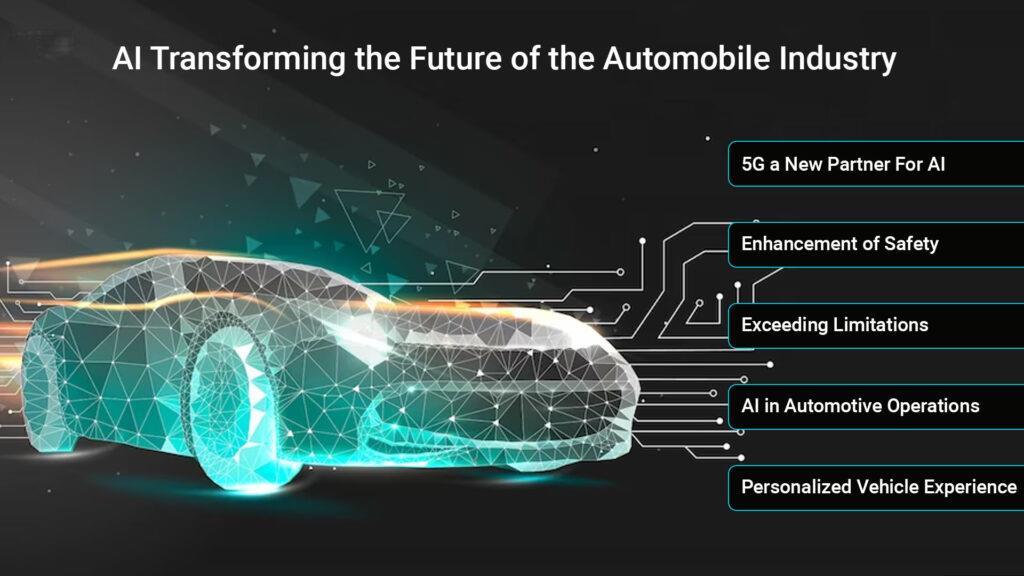
Intheautomotivesector,artificialintelligenceandmachine learning are driving a multitude of state-of-the-art applicationsthataretransformingthelandscapeofvehicle design, production, functionality, and safety. Some of the presentapplicationscomprise:
3.1.Advanced
AdvancedDriverAssistanceSystems(ADAS)areacuttingedgetechnologythatutilizesArtificialIntelligence(AI)and MachineLearning(ML)algorithmstoimprovevehiclesafety. These systems offer a wide range of features that include adaptivecruisecontrol,lane-keepingassistance,automatic emergency braking, and pedestrian detection. By incorporatingthesetechnologiesintovehicles,driverscan experience a safer and more secure driving experience. Adaptive cruise control helps maintain a safe following distance from the vehicle ahead, while lane-keeping assistance ensures that the vehicle stays within the designated lane. Automatic emergency braking can detect potential collisions and apply the brakes to prevent accidents, and pedestrian detection helps alert drivers of pedestrians in their vicinity. Overall, the integration of AI andMLalgorithmsinADAStechnologiesisrevolutionizing the automotive industry by prioritizing driver safety and reducingtheriskofaccidentsontheroad.
3.2.Autonomous
Artificialintelligence(AI)andmachinelearning(ML)playa crucial role in the advancement of autonomous vehicle technology.Theseinnovativetechnologiesempowervehicles toanalyzeandinterprettheirsurroundings,makeinformed decisions, and operate safely without the need for human control. Leading companies such as Waymo, Tesla, and Cruiseareattheforefrontofthedevelopmentofself-driving cars, pushing the boundaries of what is possible in the automotiveindustry.ByharnessingthepowerofAIandML, these companies are revolutionizing transportation and paving the way for a future where self-driving cars are a commonsightontheroads.
Automotive companies are increasingly utilizing artificial intelligence(AI)andmachinelearning(ML)technologiesto forecast the potential failure of vehicle components. By implementingtheseadvancedtechnologies,companiesare able to anticipate maintenance needs and prevent unexpected downtime, ultimately leading to improved vehicle performance, enhanced reliability, and decreased maintenance expenses. This proactive approach not only benefits the companies but also enhances the overall customerexperiencebyensuringthatvehiclesareinoptimal conditionandrunningsmoothly.TheintegrationofAIand
International Research Journal of Engineering and Technology (IRJET) e-ISSN:2395-0056
Volume: 11 Issue: 06 | Jun 2024 www.irjet.net p-ISSN:2395-0072
ML in the automotive industry marks a significant shift towards more efficient and cost-effective maintenance practices.
Artificialintelligence(AI)andmachinelearning(ML)have revolutionized the automotive manufacturing industry by completely transforming production processes. These advanced technologies play a crucial role in optimizing production lines, predicting equipment failures, and enhancing quality control measures. Through the implementation of AI and ML, manufacturers are able to harnessthepowerofpredictiveanalytics,adaptiverobotics, and autonomous guided vehicles (AGVs) to streamline operationsandsignificantlyimproveoverallefficiency.This integrationofcutting-edgetechnologyhasledtoaparadigm shift in the way automotive manufacturing is conducted, pavingthewayformoreintelligent,automated,andprecise processesthatultimatelyresultinhigherqualityproducts andincreasedproductivity..
Artificial intelligence-powered voice assistants, such as AmazonAlexaandGoogleAssistant,areincreasinglybeing incorporated into vehicles to offer drivers a seamless and hands-freeexperience.Theseadvancedsystemsenableusers toeffortlesslycontrol a widerange offunctions,including navigation,entertainment,andcommunication,allwithout takingtheirhandsoffthewheelortheireyesofftheroad.By leveragingthepowerofAItechnology,thesevoiceassistants arerevolutionizingthedrivingexperience,makingitsafer, more convenient, and more enjoyable for drivers and passengers alike. With the integration of these intelligent voice assistants, vehicles are becoming smarter and more connected than ever before, ushering in a new era of automotiveinnovation.
Artificial intelligence (AI) and machine learning (ML) algorithmsareutilizedtoanalyzevariousaspectsofdriver behavior,preferences,andbiometricdatainordertocreate apersonalizedin-carexperience.Thesealgorithmsworkto adjust settings such as seat position, climate control, and infotainmentcontentbasedontheindividual'suniqueneeds andpreferences.Byleveragingtheseadvancedtechnologies, vehicles are able to enhance comfort and convenience for drivers and passengers alike, ultimately improving the overalldrivingexperience.Thislevelofpersonalizationnot onlycaterstothespecificpreferencesofeachindividualbut also ensures a seamless and enjoyable journey for all occupantsofthevehicle.
Artificialintelligence(AI)poweredalgorithmsplayacrucial role in optimizing fuel consumption for vehicles. These algorithmsworkbyanalyzingvariousfactorssuchasdriving patterns,trafficconditions,andvehicleperformancedatain real-time. By doing so, they are able to make accurate predictions and adjustments that ultimately lead to a significant reduction in emissions and operating costs. Additionally,theuseofAIalgorithmshelpsinmaximizing fuel efficiency, ensuring that vehicles are running at their mostoptimallevel.Overall,theintegrationofAItechnology in fuel consumption optimization has proven to be highly effectiveinpromotingsustainabilityandcost-effectiveness inthetransportationindustry.
Asvehiclesbecomemoreconnectedthroughtechnology,the useofartificialintelligence(AI)andmachinelearning(ML) has become essential in identifying and preventing cybersecuritythreats.Theseadvancedtechnologiesplaya crucial role in protecting vehicle systems from potential hacking and unauthorized access, ensuring the safety and securityofbothdriversandpassengersontheroad.Through the implementation of AI and ML, automakers are able to stay ahead of cyber threats and continuously improve the cybersecuritymeasuresinmodernvehicles.
Ethicalconsiderationsinautonomousdrivingposeintricate challengesthatnecessitatecarefulnavigationtosafeguard thesafetyandwell-beingofbothoccupantsandotherroad users. One of the most notable ethical dilemmas revolves around the notion of moral decision-making in situations whereaccidentsareinevitable.Autonomousvehiclesmust be programmed to make instantaneous decisions in scenarioswherehumanlivesareatrisk,promptinginquiries intohowthesedecisionsshouldbeprioritized.Forinstance, should an autonomous vehicle prioritize the safety of its occupants over pedestrians or cyclists in a collision scenario? Moreover, issues pertaining to liability, accountability, and transparency in decision-making algorithms must be resolved to ensure legal and ethical responsibilityintheoccurrenceofaccidents.Additionally, concernsregardingdataprivacyandcybersecurityemerge due to the extensive gathering and utilization of personal information and sensor data by autonomous vehicles. Resolving these ethical considerations necessitates collaboration among policymakers, industry stakeholders, ethicists, and technologists to establish clear guidelines, standards, and regulations governing the development, deployment, and operation of autonomous driving technology. Furthermore, ongoing public engagement and education are vital to cultivate trust and acceptance of autonomousvehicleswhileensuringthatethicalprinciples
International Research Journal of Engineering and Technology (IRJET) e-ISSN:2395-0056
Volume: 11 Issue: 06 | Jun 2024 www.irjet.net p-ISSN:2395-0072
remainparamountintechnologicaladvancementswithinthe automotivesector.
Theintegrationofartificialintelligence(AI)withautomotive systemspresentsaplethoraoftechnicalobstaclesthatmust be surmounted to guarantee the reliability, safety, and efficacyofAI-drivenfunctionalities.Onenotablechallenge involvesthenecessityforrobustandefficienthardwareand software platforms capable of processing and analyzing copiousamountsofdatainreal-time.AIalgorithmsdemand potent computational resources to execute tasks such as object detection, decision-making, and sensor fusion, promptingthecreationofspecializedhardwareaccelerators andhigh-performancecomputingarchitecturescustomized for automotive applications. Furthermore, ensuring the interoperability and compatibility of AI algorithms with existing automotive systems and protocols presents a challenge, particularly as vehicles become increasingly interconnectedandintricate.
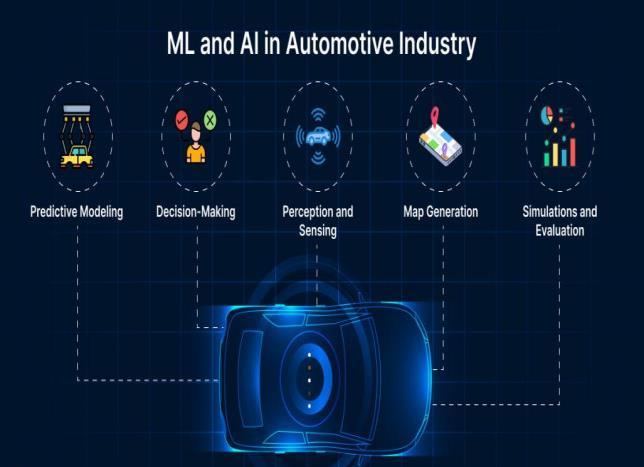
Anothercrucialissueliesinthevalidationandverificationof AI models for safety-critical applications, particularly in autonomous driving. AI-based systems must undergo thorough testing and validation procedures to guarantee theirdependabilityandresilienceacrossvariousoperating scenarios and exceptional cases. Furthermore, addressing theethicalandregulatoryramificationsofintegratingAIinto automotive systems, such as privacy concerns, liability matters,andadherencetosafetyprotocols,posessignificant hurdles that demand meticulous examination and collaboration among stakeholders. Lastly, mitigating cybersecurity threats linked to AI-driven functionalities, including susceptibilities to adversarial assaults and unauthorizedentry,remainsanongoingobstaclethatcalls for continuous surveillance, risk evaluation, and security fortifications. Conquering these technical hurdles necessitatescooperationamongautomotivemanufacturers, AI experts, regulatory entities, and cybersecurity professionalstoformulatecomprehensiveresolutionsthat
leveragethetransformativecapabilitiesofAIwhileensuring the safety, security, and dependability of forthcoming automotivesystems.
The amalgamation of artificial intelligence (AI) with the Internet of Things (IoT) presents a vast opportunity to revolutionize vehicles into intelligent, interconnected entitiesthatcanimprovesafety,efficiency,andtheoverall driving experience. By merging AI and IoT technologies, vehicles can utilize real-time data from a network of interconnected sensors, devices, and systems to enable intelligentdecision-makingandautomation.
OnesignificantapplicationofAIinconjunctionwithIoTin smart vehicles is predictive maintenance, where AI algorithmsscrutinizedatafromonboardsensorstomonitor thehealthandperformanceofvehiclecomponentsinrealtime, predicting potential failures before they occur and schedulingmaintenanceproactively.Inaddition,AI-powered predictive analytics can enhance route planning and navigationbyanalyzingtrafficpatterns,weatherconditions, and historical data to recommend the most efficient and safestroutesfordrivers.
Moreover, AI-driven IoT platforms facilitate vehicle-tovehicle (V2V) and vehicle-to-infrastructure (V2I) communication, enabling the exchange of information between vehicles and roadside infrastructure to improve trafficflow,lessencongestion,andenhancesafetythrough featureslikecollisionavoidanceandadaptivecruisecontrol. Furthermore, AI-enabled IoT solutions allow for personalized in-car experiences by utilizing data from connected devices and sensors to adjust settings such as climate control, entertainment preferences, and seating positions based on individual user preferences and biometric data. The integration of AI with IoT has the potential to transform the automotive industry by establishing a connected ecosystem of smart vehicles that canprovideenhancedsafety,efficiency,andconveniencefor bothdriversandpassengers.
In this section of the literature review, we have study the previous research work based on the AI and ML in the automotiveindustry.Thesummaryofthepreviousresearch workisgivenbelow:
Avik et al. The future of artificial intelligence (AI) and machine learning (ML) in the automotive industry is very promising. The key to advancing in this field lies in the continuous improvement of sensors, data processing techniques,andmachinelearningalgorithms.Byenhancing automotiveperceptionthroughthesetechnologies,wecan createsaferandmoreefficientautonomousdrivingsystems.
International Research Journal of Engineering and Technology (IRJET) e-ISSN:2395-0056
Volume: 11 Issue: 06 | Jun 2024 www.irjet.net p-ISSN:2395-0072
In a recent article, a special issue delves into the latest developmentsinsensors,sensorsystemarchitectures,data processingmethods,andmachinelearningapplicationsfor automotive perception. The focus is on improving feature representation to achieve high-level semantic understanding, which is crucial for the successful implementationofAIandMLintheautomotivesector.These advancements are paving the way for a future where vehiclescanperceiveandinteractwiththeirenvironmentin amoreintelligentandintuitivemanner.
Cole: Machine learning is playing a crucial role in the automotive industry by revolutionizing how fuel consumptionandmaintenancecostsarepredictedforheavyduty vehicles. By leveraging data-driven decision-making, machinelearningisdrivingadvancementsinsustainability andefficiencywithinthetransportationsector.Inarecent research paper, a novel machinelearning-based approach was introduced to forecast fuel consumption and maintenanceexpensesspecificallyformediumandheavyduty vehicles. This innovative method offers significant potential for the transportation industry to not only decrease emissions but also lower operating costs, ultimatelyleadingtoamoresustainableandefficientsystem overall. By incorporating machine learning into these predictions,companiescanmakemoreinformeddecisions that have a positive impact on both the environment and theirbottomline.
Rafiya et al. Machinelearningisbeingincreasinglyutilized in Intelligent Vehicular Systems (IVS) to monitor drivers' diabetes,highlightingthepromisingintegrationofAI/MLin automotivesafetyandhealthmonitoringsystems.Thisstudy presentsanewmethodformonitoringdrivers'diabetescare byincorporating wearablesensors,machinelearning,and VANET technology. The results of this approach demonstratedsuperioraccuracyratesrangingfrom90.3% to 99.5%, surpassing other algorithms and previous methods. This innovative use of technology not only enhancesdriversafetybutalsoshowcasesthepotentialfor AI/ML integration in healthcare applications within the automotiveindustry.
Freek et al. Therapidprogressofmachinelearninginthe field of artificial intelligence is causing a significant transformationinindustriessuchasrobotics.Moreover,the automotivesectorisonthebrinkofarevolutionarychange as AI and ML technologies are set to enhance efficiency, safety, and autonomous functionalities. This paper delves into interviews with robotics engineers who are at the forefront of discussing the latest advancements in AI, focusing particularly on the role of machine learning. It is evidentthatthecontinuousevolutionofAI,especiallyinML, is not only reshaping the existing business models of numerous companies but also giving rise to entirely new ones.TheintegrationofAIandMLisprovingtobeagamechanger in various sectors, paving the way for innovative solutionsandunprecedentedgrowthopportunities.
Niklas et al. Thepaperdelvesintotheintricaterelationship between artificial intelligence (AI) and machine learning (ML), offering a comprehensive framework for creating intelligent agents and a detailed typology for AI-driven information systems. This insightful research lays the foundationforadvancingfuturestudiesintheautomotive industry by shedding light on the critical role of ML in developing intelligent agents. Additionally, a systematic typology for AI-based information systems is put forth, providing a structured approach for understanding and categorizing these complex systems. The conceptual frameworkoutlinedinthispaperservesasavaluableguide for researchers and industry professionals seeking to harnessthepowerofAIandMLindrivinginnovationand efficiencywithintheautomotivesector.
Gupta et al. Artificialintelligenceandmachinelearningare settorevolutionizetheautomotiveindustrybysignificantly impacting intelligent transportation systems, sustainable trafficmanagement,andvehicleefficiency.Thispaperdelves intothecrucialdriversthatarepropellingthecurrentand future development of Intelligent Transportation Systems (ITS), focusing on intelligence and sustainability as key objectives. Intelligence in ITS is not only about enhancing efficiency but also ensuring safety and sustainability. By incorporating intelligence into various components of the ITSlandscape,suchasminimizingcarbonfootprint,reducing resourcewastage,andaddressingotherfactorsinfluenced bytechnologicaladvancements,amorerobustandeffective transportationsystemcan beachieved. Theintegration of intelligence and sustainability is vital for the future of the automotive industry and the overall advancement of transportationsystemsworldwide.
Gourav et al. The future of artificial intelligence (AI) and machinelearning(ML)intheautomotiveindustryispoised to revolutionize the way we think about transportation. These technologies are paving the way for autonomous vehiclesthatarenotonlysaferandmoreefficient,butalso more intelligent in their decision-making processes. By leveraging advanced technologies and frameworks, the automotive industry is on the cusp of a major transformation.Inarecentarticle,theauthorsdelveintothe critical role that AI and ML play in enhancing the safety, efficiency, and capabilities of autonomous vehicles. They highlighttheimportanceofadheringtosafetystandardsand address the challenges associated with object detection, cybersecurity,andV2Xprivacyinthecontextofautonomous vehicles.Byexaminingtherisksandbenefitsofconceptual autonomous technology, the authors shed light on the potentialimpactoftheseadvancementsontheautomotive industry. The integration of AI and ML in autonomous vehicles represents a significant step forward in the evolutionoftransportation.Asthesetechnologiescontinue toadvance,wecanexpecttoseeevengreaterimprovements in safety, efficiency, and overall performance in the automotivesector.ThefutureisbrightforAIandMLinthe
International Research Journal of Engineering and Technology (IRJET) e-ISSN:2395-0056
Volume: 11 Issue: 06 | Jun 2024 www.irjet.net p-ISSN:2395-0072
automotiveindustry,andweareonlyscratchingthesurface ofwhatispossible.
Yong et al. TheintegrationofAIandmachinelearninginthe automotive industry is paving the way for advanced technologiesandinnovations.Oneofthekeyaspectsofthis developmentistheimplementationofcutting-edgetoolslike TensorFlow and Keras to drive intelligent vehicle design. These technologies enable the creation of sophisticated automationandcontrolsystemsthatcanrevolutionizethe way vehicles operate. In a recent research paper, a groundbreakingprojectwasshowcasedwhereanintelligent trackingcarwasdesignedandsuccessfullycompleted.The carutilizedthepowerfuli.MXRT1064asitscoreprocessor, along with two electromagnetic rods serving as tracking sensors. Additionally, a steering gear and a motor were incorporatedtoformthemotioncontrolsystemofthecar. What sets this project apart is the application of neural networkalgorithmsinboththetrainingandoperationstages oftheintelligenttrackingcar.Thisnovelapproachallowsfor more efficient and precise navigation, making the vehicle capableofhandlingcomplextaskswithease.TheuseofAI and machine learning in this context demonstrates the immensepotentialthesetechnologiesholdforthefutureof theautomotiveindustry.
Kais et al. Machine learning prediction models have revolutionized quality control practices in the automotive industry, as illustrated in a recent case study focusing on bumperbeams.Thisstudyhighlightstheimmensepotential ofartificialintelligence(AI)inenhancingqualityassurance processeswithintheautomotivesector.Theutilizationofa machinelearningmodeltoforecasttheplacementofmilled holes in the subsequent beam has yielded promising outcomes. The findings suggest that certain holes can be accurately predicted with high precision, while others exhibit lower accuracy levels. This innovative approach signifies a significant advancement in quality control methodologieswithintheautomotivemanufacturingrealm, pavingthewayformoreefficientandeffectiveprocessesin thefuture.
Byoungman et al. TheoptimizedAudioVideoBridge(AVB) system implemented in automotive networks is a gamechanger when it comes to real-time image processing for ArtificialIntelligence(AI)algorithms.Thisinnovativesystem is set to revolutionize the field of autonomous driving by utilizing adaptive encoding techniques and powerful GPU algorithms. The main focus of this system is to provide a detailed design and optimization algorithm for in-vehicle networking technologies, specifically the Ethernet AVB technology. It is believed that the integration of AI algorithmsinautonomousdrivingwillgreatlyenhancethe ability to understand and analyze images in real-time, leadingtosignificantadvancementsintheindustry.Withthe AVB system in place, the future of autonomous vehicles looksbrighterthaneverbefore.
Stauder & Niklas. Artificial intelligence(AI) andmachine learning (ML) technologies play a crucial role in the automotiveindustrybyhelpingpredictsequencedeviations in production lines. This predictive capability not only enhancesefficiencybutalsoreducesdisruptions,ultimately leadingtoamorestreamlinedandproductivemanufacturing process.Byaccuratelyforecastingsequencedeviationsearly on,manufacturerscanimplementpreemptivemeasuresto maintain the smooth flow of production and prevent any potentialdisorderfromarising.Studieshaveshownthatas much as 50% of major deviations can be anticipated in advance,highlightingthesignificantimpactthatAIandML can have on improving the overall performance and reliability of automotive production. This trend points towardsapromisingfutureforthecontinuedapplicationof thesetechnologiesintheautomotivesector,pavingtheway for even greater advancements and innovations in the industry.
Vijay. The convergence of computational intelligence, machinelearning,andtheInternetofThings(IoT)insectors such as the automotive industry indicates a shift towards moresophisticatedautomationanddatasharing,whichin turn improves monitoring and control systems. By incorporating this cutting-edge approach along with IoT, businesses are able to streamline their operations by utilizing the latest internet technology, enabling remote monitoringandcontrolcapabilities.Thisintegrationnotonly enhancesefficiencyandproductivitybutalsoopensupnew possibilitiesforfutureadvancementsinautomationanddata exchangewithinvariousindustries.
Syed et al. Machine learning plays a crucial role in the Internet of Vehicles (IoV), offering significant benefits in termsofroadsafety,trafficmanagement,anddataprivacy. Byleveragingmachinelearningalgorithms,IoVsystemscan optimize edge computing decisions and enhance security mechanisms, leading to notable advancements in the automotiveindustry.Thispaperexploresthetopicfurther by conducting a critical review that includes analytical modelingtechniquesforoffloadingmobileedge-computing decisions. The focus is on utilizing machine learning and DeepReinforcementLearning(DRL)approachesspecifically tailoredforIoVapplications.Throughthisin-depthanalysis, the potential of machine learning in IoV is highlighted, showcasing its ability to revolutionize the way vehicles interactwitheachotherandtheirsurroundingenvironment.
Tingting et al. MachineLearningisavitalcomponentinthe evolution of Intelligent Transportation Systems, as it significantly contributes to improving road safety, optimizing traffic flow, and promoting environmental sustainability.ByharnessingthepowerofMachineLearning, theautomotiveindustryismovingtowardsthedevelopment of more intelligent and secure vehicles. In this comprehensiveanalysis,weexplorethecurrentlandscapeof howMLtechnologyisbeingutilizedacrossadiversearrayof ITS applications and services. Additionally, we highlight
International Research Journal of Engineering and Technology (IRJET) e-ISSN:2395-0056
Volume: 11 Issue: 06 | Jun 2024 www.irjet.net p-ISSN:2395-0072
potentialfuturepathwaysforITStocontinueleveragingand maximizingthebenefitsofMachineLearningtechnology. Meenakshi. Machine learning is on the brink of transformingtheautomotivesectorthroughadvancements inautonomousdriving,predictivemaintenance,andsafety features, as highlighted in the abstract and title. The taxonomyofmachinelearning,encompassingitsdefinition, terminology, and potential applications across different industrysectors,isthoroughlyexamined.Additionally,this analysis identifies several research gaps that need to be addressedinordertofullyleveragethepotentialofmachine learningintheautomotiveindustry.
8.CONCLUSION
In conclusion, the review paper has outlined the revolutionary potential of artificial intelligence (AI) and machinelearning(ML)intheautomotivesector,predictinga fundamentalchangeinvehicledesign,productionprocesses, andoperationalcapabilities.Bycombiningstate-of-the-artAI algorithms with sophisticated sensor technologies, anticipatory analytics, and self-governing systems, automotive stakeholders have the opportunity to unlock unparalleled possibilities for innovation, safety improvement,andefficiencyenhancement.Nevertheless,as the industry progresses into this era of intelligent automation, crucial factors like ethical considerations, regulatoryframeworks,andcybersecuritydemandsmustbe carefullyattendedtoinordertoensuretheresponsibleand sustainableintegrationofAIandMLtechnologies.Through collaborativeeffortsamongacademia,industrypioneers,and policymakers, the envisioned future of AI and ML in the automotivedomaincanbeactualized,promotingalandscape characterized by elevated performance, enriched user experiences,andareimaginedconceptofmobility.
1. Ali,E.S.,Hasan,M.K.,Hassan,R.,Saeed,R.A.,Hassan,M. B., Islam, S., Nafi, N. S., & Bevinakoppa, S. (2021). Machine learning technologies for secure vehicular communicationinInternetofvehicles:Recentadvances and applications. Security and Communication Networks, 2021, 1–23. https://doi.org/10.1155/2021/8868355
2. Ali,M.A.,Irfan,M., Khan, T., Khalid,M. Y.,& Umer, R. (2023). Graphene nanoparticles as data generating digital materials in industry 4.0. Scientific Reports, 13(1).https://doi.org/10.1038/s41598-023-31672-y
3. An,B.,&Kim,Y.(2022).Imagelink throughadaptive encoding data baseandoptimized GPUalgorithm for real-time image processing of artificial intelligence. Journal of Web Engineering/Journal of Web Engineering on Line. https://doi.org/10.13052/jwe1540-9589.21215
2024, IRJET | Impact Factor value: 8.226 |
4. Bathla, G., Bhadane, K. V., Singh, R. P., Kumar, R., Aluvalu,R.,Krishnamurthi,R.,Kumar,A.,Thakur,R.,& Basheer,S.(2022).Autonomousvehiclesandintelligent automation:applications,challenges,andopportunities. Journal of Mobile Information Systems, 2022, 1–36. https://doi.org/10.1155/2022/7632892
5. Guo,Y.,Wu,S.,Yu,W.,Wen,C.,Li,L.,&Fu,Q.(2023a). Applicationandimplementationofartificialintelligence technology for intelligent vehicle. Journal of Physics. Conference Series, 2508(1), 012049. https://doi.org/10.1088/1742-6596/2508/1/012049
6. Guo,Y.,Wu,S.,Yu,W.,Wen,C.,Li,L.,&Fu,Q.(2023b). Applicationandimplementationofartificialintelligence technology for intelligent vehicle. Journal of Physics. Conference Series, 2508(1), 012049. https://doi.org/10.1088/1742-6596/2508/1/012049
7. Gupta,B.B.,Agrawal,D.P.,Sajjad,M.,Sheng,M.,&Del Ser,J.(2022).GuesteditorialArtificialIntelligenceand Deep Learning for Intelligent and Sustainable Traffic andVehicleManagement(VANETS).IEEETransactions onIntelligentTransportationSystems,23(10),19575–19577.https://doi.org/10.1109/tits.2022.3208785
8. Katreddi,S.(2023).DevelopmentofMachineLearning based approach to predict fuel consumption and maintenancecostofHeavy-DutyVehiclesusingdiesel and alternative fuels. https://doi.org/10.33915/etd.11780
9. Kuehl, N., Schemmer, M., Goutier, M., & Satzger, G. (2022).Artificialintelligenceandmachinelearning.EM, 32(4), 2235–2244. https://doi.org/10.1007/s12525022-00598-0
10. Lonsdale, H., Jalali, A., Gálvez, J. A., Ahumada, L., & Simpao, A. F. (2020). Artificial intelligence in Anesthesiology: Hype, hope, and hurdles. Anesthesia andAnalgesia/Anesthesia&Analgesia,130(5),1111–1113.
https://doi.org/10.1213/ane.0000000000004751
11. Msakni, M. K., Risan, A., & Schütz, P. (2023). Using machinelearningpredictionmodelsforqualitycontrol: a case study from the automotive industry. Computational Management Science, 20(1). https://doi.org/10.1007/s10287-023-00448-0
12. Santra, A., Pandharipande, A., Wang, P., Gürbüz, S. Z., Ibañez‐Guzmán,J.,Cheng,C.,Dauwels,J.,&Li,G.(2023). Guest editorial Special issue on Sensing and Machine Learning for Automotive Perception. IEEE Sensors Journal, 23(11), 11116. https://doi.org/10.1109/jsen.2023.3267662
13. Sohail, R., Saeed, Y., Ali, A., Alkanhel, R., Jamil, H., Muthanna,A.,&Akbar,H.(2023).AMachineLearning-
International Research Journal of Engineering and Technology (IRJET) e-ISSN:2395-0056
Volume: 11 Issue: 06 | Jun 2024 www.irjet.net p-ISSN:2395-0072
Based Intelligent Vehicular System (IVS) for driver’s diabetes monitoring in vehicular Ad-Hoc Networks (VANETs). Applied Sciences, 13(5), 3326. https://doi.org/10.3390/app13053326
14. Stauder, M., & Kühl, N. (2021). AI for in-line vehicle sequencecontrolling:developmentandevaluationofan adaptivemachinelearningartifacttopredictsequence deviationsinamixed-modelproductionline.Flexible Services and Manufacturing Journal, 34(3), 709–747. https://doi.org/10.1007/s10696-021-09430-x
15. Stulp, F., Spranger, M., Listmann, K. D., Doncieux, S., Tenorth, M., Konidaris, G., & Abbeel, P. (2022). Innovation Paths for Machine Learning in Robotics [Industry Activities]. IEEE Robotics & Automation Magazine, 29(4), 141–144. https://doi.org/10.1109/mra.2022.3213205
16. Vijayakumar, K. (2021). Computational intelligence, machine learning techniques, and IOT. Concurrent Engineering, Research and Applications, 29(1), 3–5. https://doi.org/10.1177/1063293x211001573
2024, IRJET | Impact Factor value: 8.226 |