
International Research Journal of Engineering and Technology (IRJET) e-ISSN:2395-0056
Volume: 11 Issue: 06 | Jun 2024 www.irjet.net p-ISSN:2395-0072
International Research Journal of Engineering and Technology (IRJET) e-ISSN:2395-0056
Volume: 11 Issue: 06 | Jun 2024 www.irjet.net p-ISSN:2395-0072
1Tulsi Bhalani, 2Ami Mehta
1PG Scholar, Computer Science and Engineering, Dr. Subhash University, Gujarat, India
2Assistant Professor, Computer Engineering, Dr. Subhash University, Gujarat, India
Abstract - Diabetes Mellitus, a chronic metabolic disorder affecting millions worldwide, presents substantial challenges to both healthcare systems and individual human beings. In this study the use of machine learning algorithms to prognosis diabetes by focusing on long term outcomessuchasdiseaseprogression,complicationsetc.by using the dataset of diabetes patients records, various machine learning models are trained and evaluated like as SVM, Naïve Bayes, decision tree, random forest, logistic regression, gradient boosting etc. for compaction of treatment strategies and to get improved patient outcome. The highest accuracy is obtained from the hybrid of Correlation Feature Selection technique with XGB Algorithmthatis89%.
Key Words: Diabetes Mellitus, Prognosis, Chronic metabolic disorder, Machine learning, Disease progression, Support Vector Machine (SVM), Decision tree, Random forest, Logistic regression, Gradient boosting, Patient outcomes, XGB Algorithm, Hybrid model, Healthcare, Correlation Feature Selection
Diabetes mellitus is a pervasive and chronic health condition that affects millions of individuals worldwide. Characterized by high blood glucose levels, diabetes can lead to severe complications, including cardiovascular disease,nervedamage,andkidneyfailure,ifnotmanaged properly. The World Health Organization estimates that the prevalence of diabetes has been steadily increasing, underscoring the urgent need for effective management andinterventionstrategies.
A critical aspect of managing diabetes is the ability to accuratelypredictitsprogression.Earlyprognosisallows for timely intervention, potentially preventing severecomplicationsandimprovingthequalityoflifefor patients. However, traditional prognostic methods often fall shortduetothecomplexandmultifactorial nature of thedisease.
In recent years, machine learning has emerged as a powerfultoolinthefieldofhealthcare,offeringadvanced techniques for analyzing large datasets and uncovering patterns that may not be apparent through conventional methods. Machine learning algorithms can process vast amounts of patient data, including medical history,
lifestyle factors, and genetic information, to predict
diseaseoutcomeswithhighaccuracy.
Thisstudyaimstoleverage machinelearningtoenhance the prognosis of diabetes. By employing supervised Learning algorithms, we seek to develop a predictive model that can identify patients at high risk of disease progression and suggest personalized intervention strategies. The following sections will delve into the methodology, dataset, and specific machine learning techniquesused,followedbyananalysisoftheresultsand theirimplicationsforclinicalpractice
1.1 Problem Statement:
Diabetesprognosticmodelsareusuallydetachedtreating patients as homogeneous entities within the groups that are uniform. Machine learning algorithms have the potential to identify specific variations in health parameters and lifestyle, leading to more customized and effective prognostic models. A more accurate and comprehensive prognosis is made feasible by the integration of genetic information, wearable data, and electronic health records in healthcare. This method provides an in-depth view of an individual's health. The analysis of long-term information is made possible by the use of machine learning algorithms, whereas traditional modelsmaynotbeabletofullycapturetemporalpatterns. This method contributes to the identification of patterns andtrends,resultinginamorethoroughprognosis
1.2
According to the research India ranks second behind China in Diabetes. The number of people suffering from Diabetes is increasing, there is continuous change in the statistics and frequent updates are required. The cause of Diabetes between the ages of 20-79 years in India is recorded8.9%.AsperthecurrentresearchDiabetescases in adults are expected to reach 100 million by 2030. Currently1in6adultsarerecordedwithdiabetes.
As the statistics are increasing rapidly we have proposed the research to predict the occurrence of diabetes by analyzing the symptoms such as Pregnancies, Glucose,BloodPressure,SkinThickness,Insulinandmany more.
International Research Journal of Engineering and Technology (IRJET) e-ISSN:2395-0056 Volume: 11 Issue: 06 | Jun 2024 www.irjet.net p-ISSN:2395-0072
Here we use machine learning for prognosingDiabetes.
There are mainly three types of machine learning algorithms like Supervised Learning, Unsupervised Learning and Reinforcement Learning. Here we have taken the labeled dataset so that we are using the supervised learning algorithm. There are many algorithmssuchasNaïveBayes,SupportVectorMachine, DecisionTree,KNNetc.
Implementa feedback mechanismtoenhancemachine learning models' performance. Tailor models to individual patient characteristics, considering genetic, lifestyle, and environmental factors. Explore integrating diverse data sources like genetic information, health records, and lifestyle information for a comprehensive understanding ofdiabetesrisk.Machinelearningmodels can be used to identify trends, allocate resources efficiently, and design targeted public health interventions for diabetes. Collaboration between researchers,healthcareprofessionals,datascientists,and technology experts is encouraged for a comprehensive approach. Long-term studies are conducted to assess the effectiveness of these models, ensuring accuracy and adaptability to individual health changes. Ethical concerns related to data privacy and bias are addressed, and guidelines are developed to ensure ethical deployment. Cost-effectiveness and economic impact of early intervention and prevention strategies are also evaluated.
According to [1] the researcher have used AHDHS StackingMethodologywhichgenerates93.09%Accuracy. Theyhaveusedlivedatasetforinput.
By concluding they have said AHSDHS Stacking algorithmcanbeusedforbothT1DMandT2DM andcan be used for other diseases too, similarly [2] the Researcher have used methodology Multilayer Perceptron,SupportVectorMachine,RandomForestwith thattheaccuracygeneratedisSVM96%MLP98%.They haveconcludebysayingMorebalancedDatasetshouldbe usedtogetbetterAccuracy.
According to [3] LSTM, BILSTM, Feed Forward Neural Network methodology used and the highest Accuracy is Generated by Random Forest the highest accuracy of 82.26%. The research gap says that This model can be appliedtotherealpatientdataset.
In[4]RandomForest,DecisionTree,KNN,NaïveBayes MethodologiesareusedfromthatthehighestAccuracyis Generated by Random Forest with Accuracy 92.6%. In future work To compete with state-of-the-art models achieving above 90% accuracy, the implementation of ensemblemodelsshouldbeutilized.
In [5]Random Forest, Decision Tree, KNN, andNaïve Bayes methodologies the generated Accuracy is 75%. The researchers have concluded that Linear Regression with ensemble techniques should be used to increase the accuracy. In [6]Naive Bayes, Decision Trees, Random Forests, and Logistic Regression the Accuracy generated is 78% the researcher concluded that Comparison of state-of-the-art techniques such as XGBoost, AdaBoost, or high-layer DNNs would probably provide better insights regarding the predictive limitations of the constructed dataset.
The purpose of the proposed research is to prognosis if the patient is diabetic or not, based on features like Pregnancy, BMI, Insulin, Diabetes Pedigree Function, Age, and Outcomes by using a Support Vector Machine(SVM), Linear Regression, Decision Tree, KNN, Random Forest, XG-Boosting. The goal of this Research is to increase accuracyofPrognosisofdiabetes.
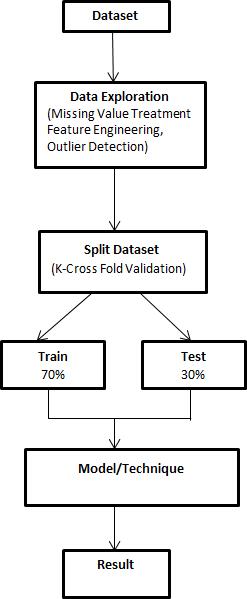
An accurate, multidisciplinary approach combining knowledge from data science, machine learning, and medical science is required when researching the prognosis of diabetes using machine learning. In this regard, it is necessary to consider several important aspects:
1.
Compiling comprehensive patient data entails obtaining data on clinical measurements such as BMI, HbA1c, and
International Research Journal of Engineering and Technology (IRJET) e-ISSN:2395-0056 Volume: 11 Issue: 06 | Jun 2024 www.irjet.net p-ISSN:2395-0072
blood glucose levels, as well as demographics, medical history,andlifestylefactors.
Furthermore,theapplicationofbiosensorsandwearables for tracking physical activity levels and continuous glucose monitoring (CGM) can be investigated for the real-timemonitoringofphysiologicaldata.
2. Pre-processing Data:
For data cleaning, it involves handling missing values, outliers,andinconsistencieswithinthedataset.
HereintheMissingValueTreatmenttheentireDatasetis searchedandfindsthemissingvalue.
Outlierisusedtodetectthecontrastdatafromtheentire Dataset.
Toobserve,theOutlierInterquartileRange(IQR)isused.
ThelocalOutlierFactor(LOF)methodisusedinanomaly detectiontoidentifyoutliersinadataset.
3. Feature Selection:
In Feature Selection, two techniques are used which are theInformationGainandCorrelationmatrixMethod.
InInformationGain,themostrelevantfeaturesforagiven task are selected, which measures the effectiveness of a feature in classifying or predicting a target variable by quantifying the amount of information gained about the targetvariablewhenthefeatureisknown.
The Graph for Prognosing the Diabetes with Information GainTechniqueisas:
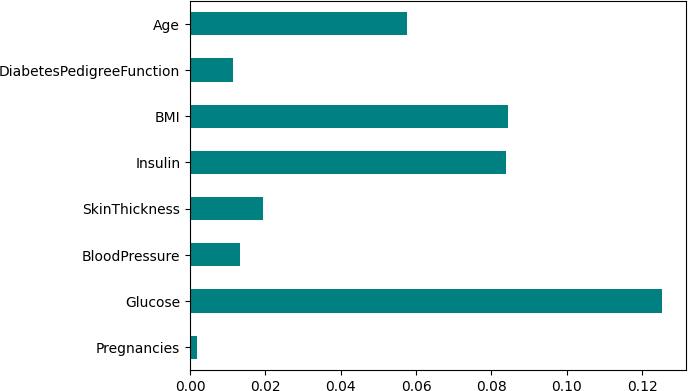
Fig.2 FeatureSelectionUsingInformationGain
Here Features like Glucose, BMI, Insulin, and Age are selectedwhichareprocessedwiththeOutcomeFeature.
Correlation-based feature selection is a technique used to identify relevant features for prognosis. The basic idea is to measure the correlation between each feature of the Dataset and the target variable, and select the features withthehighestcorrelation.
The Graph for Prognosing the Diabetes with correlation Techniqueisas:
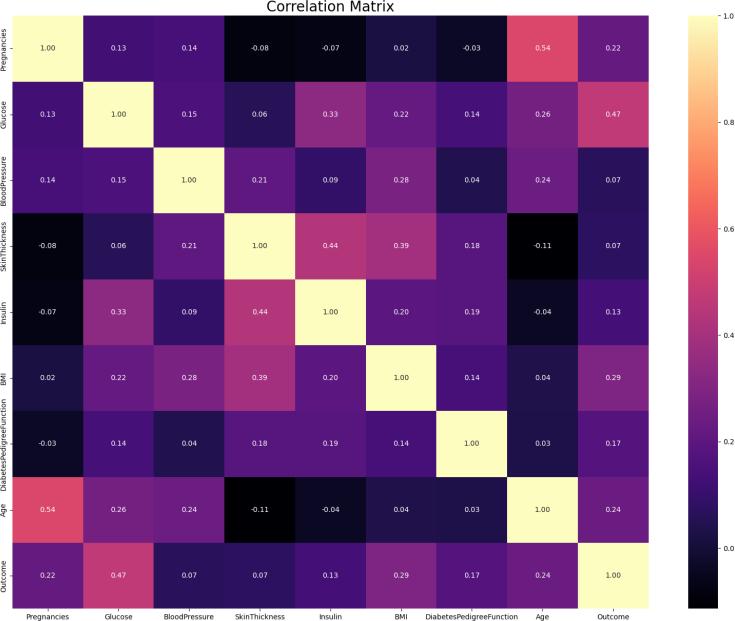
Fig. 3 FeatureSelectionUsingCorrelation
Here Features like Glucose, BMI, and Insulin are selected whichareprocessedwiththeOutcomeFeature.
4. Splitting Dataset:
The Datasetis Split in the ratioof 70%-30%intoTraining DatasetandTestingDataset
The Selected Features from the Feature Selection Techniquesaregivenasinputtothe TrainingDataset;the Outcome Feature is given input as a Testing Dataset. SplittingofDatasetisdonebyCross-ValidationTechnique.
5. Model Evaluation:
For Evaluating the Result various Models are tested like Logistic Regression, Gradient-Boosting, SVM, Decision Tree, KNN, and Random Forest with Hybrid of Feature Selection Techniques like Information Gain and CorrelationMatrix.
International Research Journal of Engineering and Technology (IRJET) e-ISSN:2395-0056
Volume: 11 Issue: 06 | Jun 2024 www.irjet.net p-ISSN:2395-0072
TheResulttableisasfollows:
Models Accuracy (Information Gain)
LR 0769737 (0.048256)
KNN 0761842 (0.039671
CART 0702632 (0064782)
RF 0756579 (0.048256)
SVM 0769737 (0045675)
XGB 0.753947 (0054585)
Accuracy(Correlation )

0.848684(0.036866)
0.840789(0.023866)
0.857895(0.024826)
0.881579(0.026316)
0.853947(0.036488)
0.890789(0.020427)
[Comparisons of Feature Selection Technique with CorrelationTechnique]
6. Evaluation Matrices:
To assess the performance of the model, select
appropriate evaluation metrics such as accuracy. Assess theclinicalrelevanceofthesemeasurestomakesurethey supportthegoalsofdiabetesprognosis.
Accuracy
Accuracy=TotalNumberofPredictionsNumberofCorrectPr edictions×100%
Inthisequation:
"Number of Correct Predictions" refers to the number of predictions made by a model that match the actual outcomes.
"Total Number of Predictions" is the total number of predictionsmadebythemodel.
AsDiabetespatientsarerapidlyincreasingdaytodayitis very crucial to predict diabetes according to its features like BMI, Glucose, Skin- Thickness, Diabetes Pedigree Function, Pregnancies, etc. to get proper treatment and control before it causes, predict diabetes at early stage variousMachineLearningTechniquesareused.
FromthedatasetwhichisreferredfromtheKaggletwo Feature Selection Techniques Information Gain and
Correlation Methods are used for the Feature Selection, by using Information Gain the selected Features are: Glucose, BMI, Insulin, and Age. By using Correlation Method the features like Glucose, BMI, and Insulin are selected, and the features from individual methods are given as input to the Various Machine Learning Algorithms like Logistic Regression, Random Forest, DecisionTree,SVM,ExtremeGradientBoosting,KNNand compared by using these two Feature Selection techniques. Better results are generated from the Correlation Method hybrids with various Machine LearningAlgorithmsmentioned.
In the future one can extend the work by using an accurate and live dataset with the hybrid correlation TechniquewithMultiLayerPerceptron.
[1] Zaiheng Zhang. “A novel evolutionary ensemble prediction model using harmony search and.” Elseiver,vol. 100605,2023,p.3.
[2] MaximillianTanea, and Matthew. “Using Machine Learning for the Prediction of Diabetes.” ELSEVIER, vol.20,2020.
[3] PriyankaRajendra. “Prediction of diabetes using logistic regression and ensemble techniques.” ELSEVIER,vol.1, 2020.
[4] FAZAKIS, NIKOS. “Machine Learning Tools for LongTerm Type2.” IEEE,vol.2021.
[5] SaúlLangaricaa, c. “A meta-learning approach to personalized blood glucose prediction in type 1.” ELSEVIER, vol.2,2021.
[6] VictorChanga,∗.“Anassessmentofmachinelearning modelsandalgorithmsforearly.” ELSEVIER,2021.
[7] A. Z. Woldaregay, E. Årsand, S. Walderhaug. “Datadriven modeling and prediction of blood glucose dynamics: Machine learning applications in type 1 diabetes.”vol.98, 2019.
[8] Y.-F. Du, H.-Y. Ou, E. A. Beverly, and C.-J. Chiu. “Achieving glycemic control in elderly patients with type 2 diabetes: A critical comparison of current options.”vol.9,2014.
[9] Y.Gao, Y. Xiao,R.Miao,J.Zhao,M.Cui,G. Huang, and M.Fei. “Theprevalenceofmildcognitiveimpairment withtype2 diabetes mellitus among elderly people in China: A cross-sectionalstudy.”vol.62,2016.
[10]D. “Diagnosis and classi_cation of diabetes mellitus,'' Diabetescare.Mellitus.”vol.28,2015.
International Research Journal of Engineering and Technology (IRJET)
Volume: 11 Issue: 06 | Jun 2024 www.irjet.net
[11]M. K. Hasan, M. A. Alam, D. Das, E. Hossain and M. Hasan. “Diabetes Prediction Using Ensembling of Different Machine Learning Classifiers.” IEEE, vol. 8, 2020.
[12]
Ilango, B. Nithya and Dr. V. ``Predictive Analytics in HealthCare Using Machine Learning Tools and Techniques”, International Conference on Intelligent Computingand ControlSystems.”vol.7,2017.+
[13]
Classification and diagnosis of diabetes: Standards of medical care in diabetes_2020.” Association, AmericanDiabetes,vol.43,2020.
[14]
Ahuja, H. Naz and S. “Deep learning approach for diabetes prediction using PIMA Indian dataset.” J. DiabetesMetabolic Disorders,vol.19,2020.
[15]
Y. Liu, Q. Wang, K. Wu, Z. Sun, Z. Tang, X. Li, B. Zhang. “Anthocyanins’ effects on diabetes mellitus and islettransplantation.”2022.