
International Research Journal of Engineering and Technology (IRJET) e-ISSN: 2395-0056
Volume: 11 Issue: 06 | Jun 2024 www.irjet.net p-ISSN: 2395-0072

International Research Journal of Engineering and Technology (IRJET) e-ISSN: 2395-0056
Volume: 11 Issue: 06 | Jun 2024 www.irjet.net p-ISSN: 2395-0072
Kaina Shaikh1
1Department of Artificial Intelligence and Data Science, Vidya Pratishthan’s Kamalnayan Bajaj Institute of Engineering & Technology, Baramati, India.
Abstract - Node classification is a pivotal task in network analysis,focusedonpredictingnodelabelsbyleveragingboth nodefeaturesandthegraphstructure.Ourstudyevaluatesthe effectiveness of Graph Neural Networks (GNNs) for node classification, concentrating on three models: Graph Convolutional Networks (GCN), Graph Attention Networks (GAT), and GraphSAGE. We also propose a fusion model that integrates the strengths of GCN, GAT, and GraphSAGE to enhanceclassificationaccuracy.Experimentswereconducted on a network derived from a book dataset, aiming to classify main versus supporting characters in a novel. We benchmarkedthese GNNmodelsagainsttraditional machine learning algorithms, including Random Forest and Support Vector Machine (SVM). Our results show that the fusion GNN model achieved the highest accuracy, surpassing individual GNNmodelsandperformingonparwithtraditionalmachine learning models. The performance of the fusion model highlights the potential of hybrid approaches in node classification tasks. This research provides valuable insights into the comparative advantages of different GNN architectures and their practical applications in network analysis.
Key Words: Node Classification, Network analysis,Graph Neural Networks (GNNs), Graph Convolutional Network (GCN),GraphAttentionNetwork(GAT),GraphSAGE
1.INTRODUCTION
One of the core tasks in graph-based learning is node classification,whichinvolvesmakingpredictionsaboutthe labelsofnodesinanetwork basedontheirattributesand relationships.GraphNeuralNetworks(GNNs)haveemerged aseffectivetoolsforthispurpose,exploitinggraphstructure toboostpredictionaccuracy.
In this study, we focus on the relationships between charactersofnovelinabookdataset,wherecharactersare represented as nodes and interactions between them are shownbyedges.Understandingtheserelationshipsiscritical forcharacteranalysis,narrativecomprehension,andother literarystudies.Ourgoalistoenhancetheperformanceof node classification tasks associated with character interactions by identifying complex patterns through the applicationofsophisticatedGNNmodels
ThispaperpresentsacomparativeanalysisofvariousGNN models for node classification, specifically examining the interaction network of book characters in a novel. Each characterisrepresentedasanode,andinteractionsbetween charactersaredepictedasedges.Weutilizedthreepopular GNN architectures: Graph Convolutional Network (GCN), Graph Attention Network (GAT), and GraphSAGE. Additionally, wedeveloped a fusion model that integrates thesethreeGNNstoenhanceclassificationperformance.
To provide a comprehensive comparison, traditional machine learning models, including Random Forest and SupportVectorMachine(SVM),werealsoimplemented.The performanceofeachmodelwasevaluatedbasedonaccuracy metrics, with the fusion GNN model achieving the highest averageaccuracyof99.86%.Thisperformanceunderscores the potential of GNNs, especially the fusion approach, in effectively handling node classification tasks in complex networkdata.
Byanalyzingtheinteractionnetworkofbookcharacters,this study demonstrates the strengths and weaknesses of different GNN models and traditional machine learning approaches. The results provide valuable insights for researchers and practitioners working on similar node classification problems in various domains, especially in literary analysis and social network exploration within fictionalsettings.
Thetechniqueusedin[1]fornodeclassificationisbasedon Graph Neural Networks (GNNs), notably Graph Convolutional Networks (GCN) and Graph Attention Networks. GNNs, particularly GCNs and GATs, have been acknowledged for their capacity to successfully capture structural information from complicated graphs. GCNs combine information from nearby nodes with properties from the core node, capturing both local and global relationships.Incontrast,GATsuseattentiontechniquesto allow nodes to choose attend to informative neighbors throughouttheaggregationprocess[3].
TheGraphConvolutionalNetwork(GCN)model[2],which usesaneffectivelayer-wisepropagationruledevelopedfrom a first-order approximation of spectral convolutions on graphs,isthefoundationfornodecategorization.Themodel
International Research Journal of Engineering and Technology (IRJET) e-ISSN: 2395-0056
Volume: 11 Issue: 06 | Jun 2024 www.irjet.net p-ISSN: 2395-0072
can efficiently encode both graph structure and node featuresaccordingtoKipfandWelling'stechnique[2],which makesitespeciallyusefulforsemi-supervisedclassification problems. Because GCNs may combine data from neighboringnodeswiththeirownattributes,theycanbetter capturelocalandglobaldependenciesinthenetwork,which improvesclassificationperformance.
A simplified technique [4] to node classification in Graph Neural Networks that decouples feature aggregation from network depth.Asoftmaxfunctionisapplied row byrow, and the cross-entropy error is computed for all labeled training instances. The gradients of the loss are then propagatedbackwardthroughtheGNNlayers. Oncetrained, themodelmaybeusedtopredictthelabelsofnodesinthe test set, confirming its suitability for node classification tasks.
3.1 Dataset
Thedatasetusedinthisstudycontainsinteractionsbetween charactersfromabook,specificallyfocusingonthenetwork
ofrelationshipswithina fictionalsetting.Itcomprises684 entries,whereeachentryrepresentsaninteractionbetween twocharacters.Thekeycolumnsinthedatasetare:
Source:Thecharacterinitiatingtheinteraction
Target:Thecharacterreceivingtheinteraction.
Type: The nature of the interaction, which in this datasetisuniformly'Undirected',indicatingmutual interactions.
Weight:Thefrequencyorstrengthoftheinteraction, representedasanintegervalue.
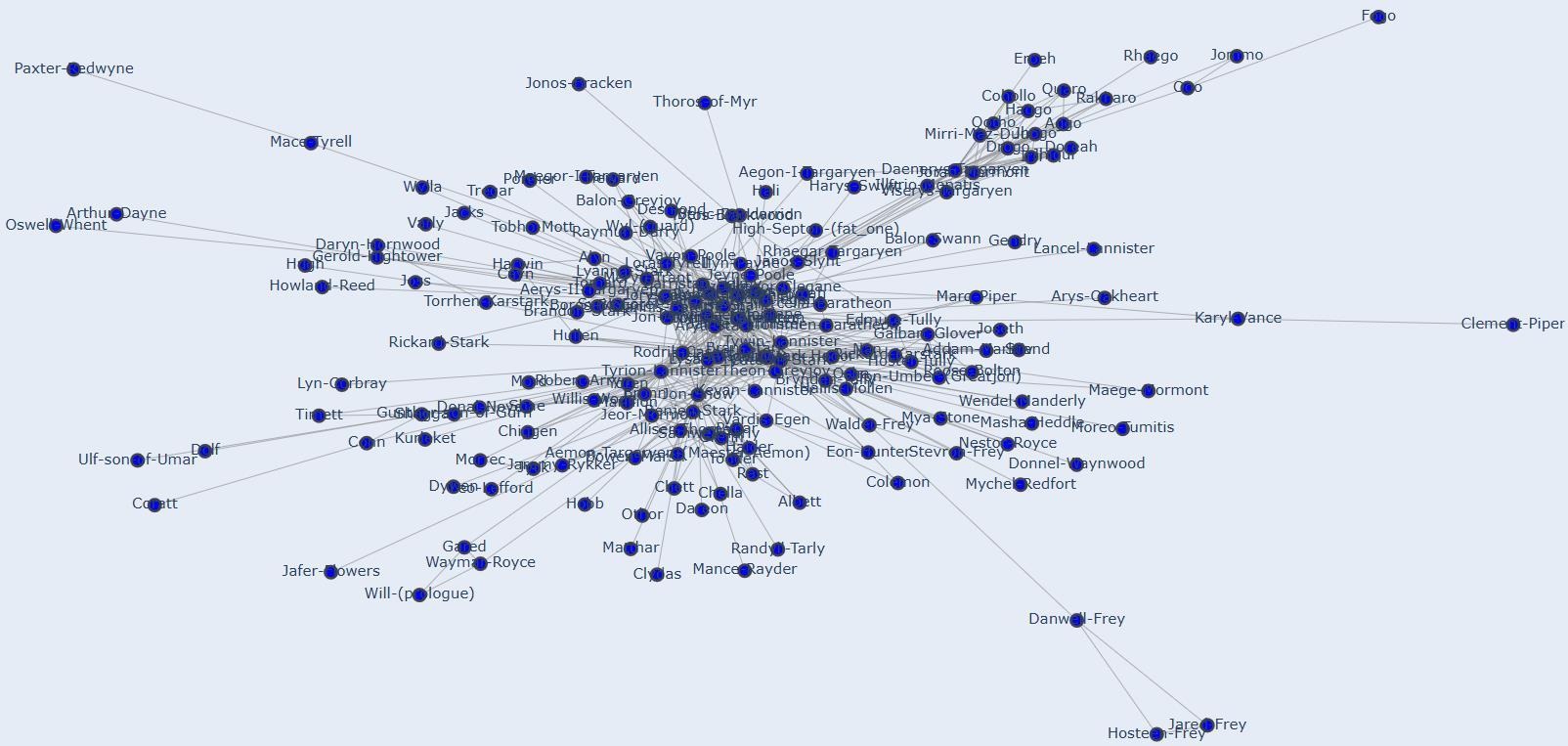
This dataset effectively captures the complex web of relationships among the characters, enabling a detailed analysis of their interactions. Nodes in the corresponding graphrepresentindividualcharacters,whileedgesrepresent interactions between them. The fig-1 shows the graph networkofthecharactersinthebookdatasetwithoutnode classificationofmaincharactersvs.supportingcharactersin a novel The weight attribute quantifies the interaction frequency,providingadditionalcontexttotherelationships.
3.2 Architecture
Thearchitectureofthisstudyencompassesacomparative analysis of several state-of-the-art machine learning and graph neural network (GNN) models, culminating in the development ofa novel FusionGNN model.Eachmodel is meticulouslydesignedtoharnessthestructuralandfeature-
basedintricaciesofthedataset,facilitatingtheclassification of nodes representing characters and their interactions withinthebookdataset.
To build a baseline, we used standard machine learning models, particularly Random Forest and Support Vector
International Research Journal of Engineering and Technology (IRJET) e-ISSN: 2395-0056
Volume: 11 Issue: 06 | Jun 2024 www.irjet.net p-ISSN: 2395-0072
Machine.Thesemodelsweretrainedusingcentralitymetrics toretrievenodeattributesfromthenetwork:
DegreeCentrality:Representsthetotalnumberof connectionsofnodes
Betweenness Centrality: Indicates how often the nodeshowsuponshortestpathwaysconnectingthe nodes.
ClosenessCentrality:Calculatetheaveragelengthof shortestpathbetweennodesinthenetwork
Thesefeaturesprovideaquantitativemeasureofanode's prominenceandinfluencewithinthenetwork,servingasthe input for our traditional machine learning models. The datasetwasdividedintotrainingandtestsets,withan80-20 split, and models were evaluated based on their classificationaccuracy.
3.2.2 Graph Neural Networks (GNNs):
GraphNeuralNetworksarewell-suitedforlearninggraphstructureddata.WeimplementedthreeGNNarchitectures: Graph Convolutional Network (GCN), Graph Attention
Network(GAT),andGraphSAGE,[6]eachleveragingunique mechanismstoprocessandlearnfromgraphdata.
GCNs apply spectral graph convolutions to aggregate informationfromanode'slocalneighborhood[2].OurGCN model comprises two convolutional layers, which sequentially refine node embeddings. This approach captures local structural information and node features throughgraphconvolutions, enabling effectivelearning of noderepresentations
GATs introduce attention mechanisms to weigh the importanceofneighboringnodes[3].Ourmodelconsistsof twographattentionlayers,withmulti-headattentioninthe first layer to enhance the model's expressive power. The attentionmechanismallowsthemodeltofocusonthemost relevant neighbors, improving the quality of the learned nodeembeddings.
GraphSAGEsamplesafixed-sizeneighborhoodforeachnode and aggregates information to generate node embeddings [6].OurmodelincludestwoGraphSAGElayers.Thismethod scalesefficientlytolargegraphsandcapturesbothlocaland contextualinformationthroughtheaggregationprocess.
3.2.3 Proposed Fusion
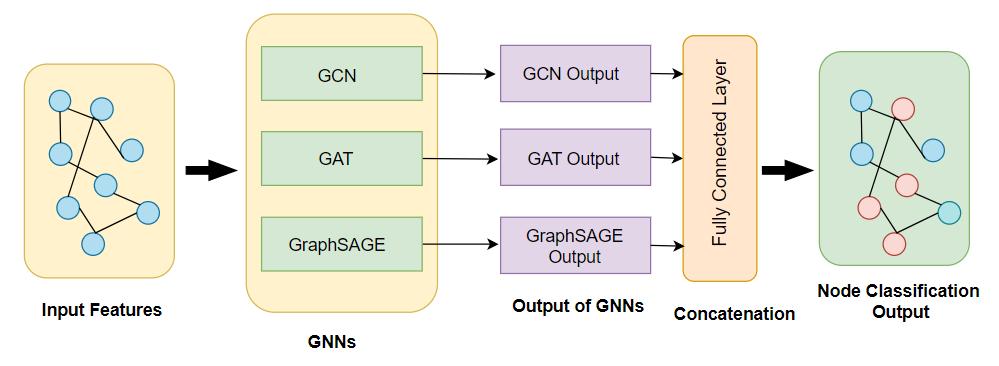
The Fusion GNN model in fig-2 is an innovative approach designedtointegratethestrengthsofthreedistinctgraph neuralnetworkarchitectures:GCN,GAT,andGraphSAGE.By leveragingthecomplementaryfeaturesandmechanismsof these models, the Fusion GNN aims to provide a comprehensiveandrobustsolutionfornodeclassification tasks, particularly in the context of understanding relationshipsbetweencharactersinabookdataset.
1. Concatenation Layer: The outputs from the final layers of the GCN, GAT, and GraphSAGE branches are concatenated. This concatenation forms a comprehensive node representation that
encapsulatesthediversefeatureslearnedbyeach individualbranch.
2. Fully Connected Layer: The concatenated representationisfedintoafullyconnectedlayer(or a series of such layers). This layer acts as a classifier,transformingtherichnoderepresentation intoclassprobabilities.
3. Softmax Activation: The final classification layer appliesasoftmaxactivationfunction,outputtinga probability distribution over the classes for each node.
International Research Journal of Engineering and Technology (IRJET) e-ISSN: 2395-0056
Volume: 11 Issue: 06 | Jun 2024 www.irjet.net p-ISSN: 2395-0072
TheFusionGNNistrainedusingtheAdamoptimizer,with hyperparametersfine-tunedforoptimalperformance.The traininginvolvesminimizingthenegativelog-likelihoodloss, usingnodelabelsasthetarget.
Themodelistrainedovermultipleepochsuntilconvergence. Themodel’sperformanceisevaluatedbasedonclassification accuracy and other relevant metrics. The accuracy is computed by comparing the predicted labels with the groundtruthlabelsforthetestsetnodes.
4.RESULTS AND DISCUSSION
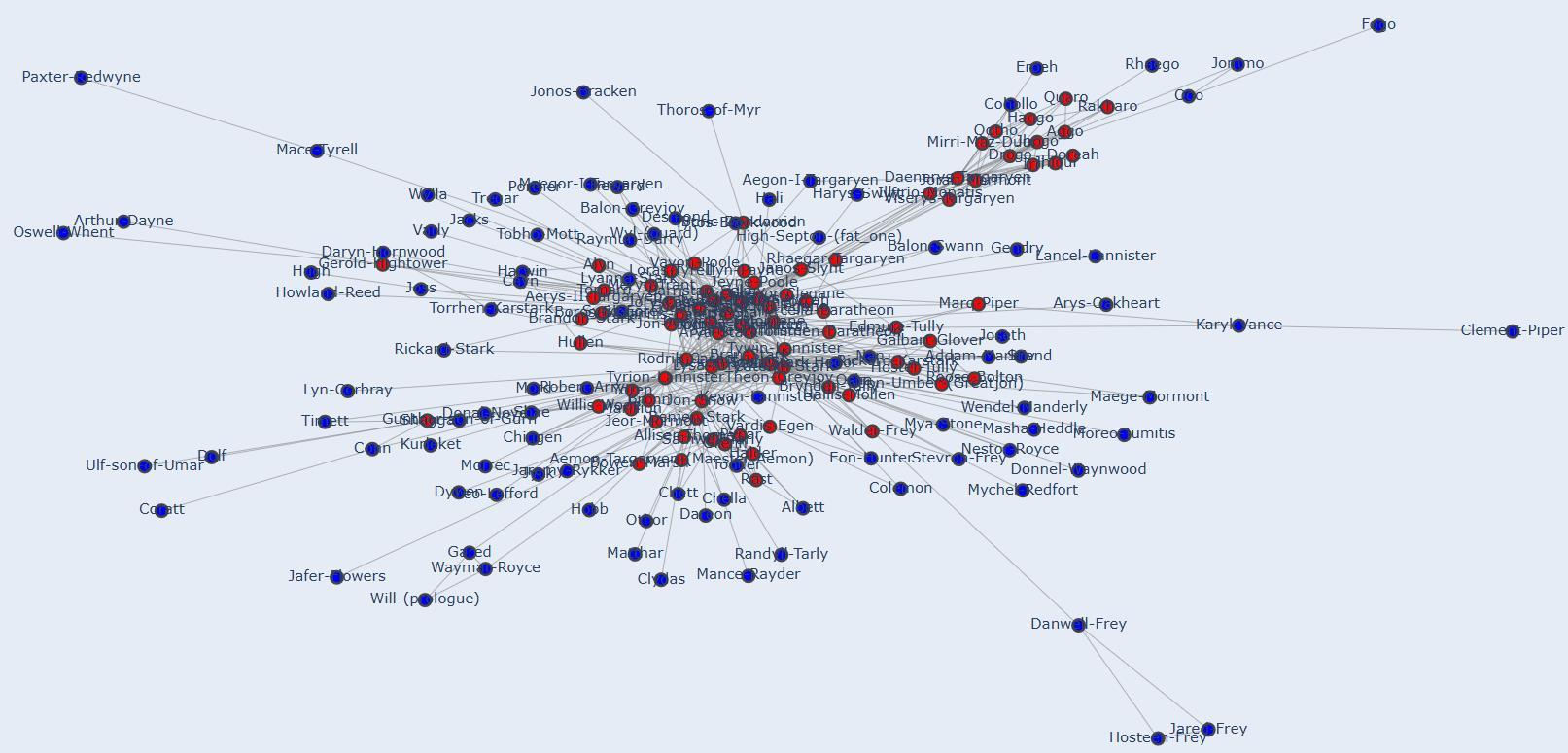
Inthissection,wepresenttheresultsofourexperimentson node classification using various models, including traditionalmachinelearningapproachesandgraphneural networks.Weconductedextensiveevaluationstocompare theperformanceofRandomForest,SupportVectorMachine (SVM),GCN,GAT,GraphSAGE,andtheproposedFusionGNN model.Ourresultsdemonstratetheefficacyofgraphneural networks in capturing complex relationships between characters in the book dataset and highlight the superior performanceoftheFusionGNNmodelshowninfig-3.
4.1 Evaluation Metrics
Theprimarymetricusedforevaluatingtheperformanceof the models was accuracy, defined as the ratio of correctly predictednodestothetotalnumberofnodesinthetestset. Additionally,weprovidedetailedclassificationreportsfor eachmodel,includingprecision,recall,andF1-score.
4.2 Accuracy Comparison
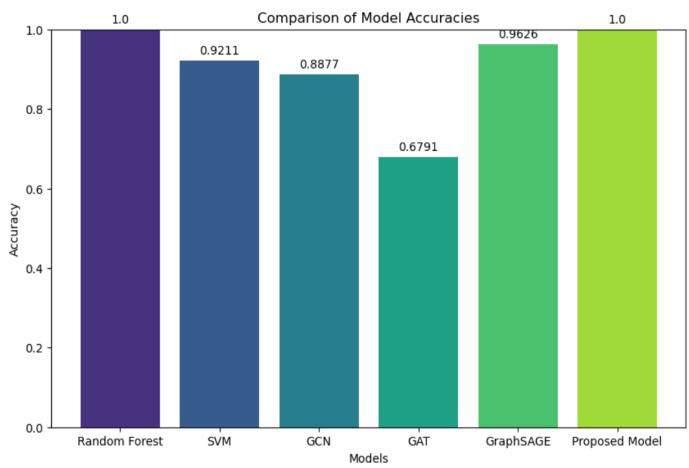
Ourexperimentsyieldedacomprehensivesetofresultsthat underscore the comparative performance of different models in the task of node classification within our book dataset.Theevaluationwasprimarilycenteredaroundthe accuracymetric,whichservesasarobustindicatorofeach model'seffectivenessinpredictingthecorrectlabelsforthe nodes.Theaccuracyresultsforeachmodelaresummarized intheTable-1.
Our proposed Fusion GNN model achieved the highest accuracyamongthegraphneuralnetworkmodelswithan impressive 1.0000. This model integrates the strengths of GCN, GAT, and GraphSAGE, effectively combining spectral and spatial features to enhance node classification performance. The Fusion GNN's superior accuracy underscores the benefits of leveraging multiple GNN architectures to capture a wide range of structural and feature-basednuanceswithinthegraph.
The comparative accuracy of each model is visually represented in the accompanying bar graph. This graph providesaclearillustrationoftherelativeperformanceof eachmodel,withtheFusionGNNmodelstandingoutdueto its highest accuracy. The visualization underscores the effectiveness of the Fusion GNN model in leveraging the combinedstrengthsofvariousGNNapproachestoachieve superiorclassificationresults.
International Research Journal of Engineering and Technology (IRJET) e-ISSN: 2395-0056
Volume: 11 Issue: 06 | Jun 2024 www.irjet.net p-ISSN: 2395-0072
Table-1: Comparisonofaccuraciesofdifferentmodelson 200epochs
variedlevelsofsuccess,reflectingtheiruniqueapproaches toaggregatingandprocessingnodeinformation.
BysynthesizingthestrengthsofGCN,GAT,andGraphSAGE, theFusionGNNadeptlybalancestheextractionofspectral andspatialfeatures,therebyofferingaholisticandrefined classification mechanism. This superior performance not onlyunderscorestheefficacyofmulti-modelintegrationbut also paves the way for future research into hybrid GNN architecturesforcomplexgraph-basedtasks.
Overall,theresultsofourstudydemonstratetheefficacyof graph neural networks in node classification tasks and highlightthesignificantadvantagesofourproposedFusion GNN model in achieving high accuracy and robust performance.
In this research, we embarked on a comprehensive exploration of node classification within a book dataset, focusingontherelationshipsbetweencharactersinanovel through the lens of various machine learning and graph neuralnetwork(GNN)models.Ourstudy'sprimaryobjective wastobenchmarktraditionalclassificationmodelsagainst advanced GNN architectures, culminating in the developmentandevaluationofanovelFusionGNNmodel.
The results unequivocally highlight the potential and prowess of graph-based models in capturing complex relational data inherent in graph structures. While traditionalmodelslikeRandomForestandSVMshowcased robustperformancewithhighaccuracyscores,theintrinsic ability of GNNs to harness topological and feature-based information of nodes provided a more nuanced understandingofthedataset.TheGCN,GAT,andGraphSAGE modelsdemonstratedsignificanteffectiveness,albeit with
Inconclusion,thisresearchsubstantiatesthecriticalroleof GNNs in advancing node classification methodologies, particularlywithindatasetscharacterizedbyintricateinternode relationships. The development and success of the Fusion GNN model exemplify the advancements possible throughinnovativeintegrationofdiverseGNNparadigms.As wemoveforward,theseinsightsprovidearobustfoundation for further exploration and refinement of graph neural networks, promising enhanced analytical capabilities and broaderapplicabilityinvariousdomainsreliantongraphstructureddata.
[1] H. Noor, N. Islam, M. S. Hossain Mukta, N. S. Binti Kamarudin, M. A. Khan Raiaan and S. Azam, "Determining the Optimal Number of GAT and GCN Layers for Node Classification in Graph Neural Networks," 2023 IEEE 8th International Conference On Software Engineering and Computer Systems (ICSECS), Penang, Malaysia, 2023, pp. 111-116, doi: 10.1109/ICSECS58457.2023.10256323.
[2] T. N. Kipf and M. Welling, “Semi-supervised classificationwithgraphconvolutionalnetworks,”arXiv preprintarXiv:1609.02907,2016.
[3] Veličković,Petar,Guillem Cucurull,ArantxaCasanova, AdrianaRomero,PietroLio,andYoshuaBengio."Graph attention networks." arXiv preprint arXiv:1710.10903 (2017).
[4] Maurya, Sunil & Liu, Xin & Murata, Tsuyoshi. (2022). Simplifying approach to node classification in Graph NeuralNetworks.JournalofComputationalScience.62. 101695.10.1016/j.jocs.2022.101695.
[5] Xiao, Shunxin, Shiping Wang, Yuanfei Dai, and Wenzhong Guo. "Graph neural networks in node classification: survey and evaluation." Machine Vision and Applications 33,no.1(2022):4.
[6] S. Mithe and K. Potika, "A unified framework on node classificationusinggraphconvolutionalnetworks," 2020 SecondInternationalConferenceonTransdisciplinaryAI (TransAI), Irvine, CA, USA, 2020, pp. 67-74, doi: 10.1109/TransAI49837.2020.00015.