
International Research Journal of Engineering and Technology (IRJET) e-ISSN: 2395-0056
Volume: 11 Issue: 06 | June 2024 www.irjet.net p-ISSN: 2395-0072

International Research Journal of Engineering and Technology (IRJET) e-ISSN: 2395-0056
Volume: 11 Issue: 06 | June 2024 www.irjet.net p-ISSN: 2395-0072
Md. Asif Ahmed1, Umme Tahmina Toma1, Joy Podder1 , Abdullah-Al Abid2 , Bijoy Podder3
1Department of Civil Engineering, European University of Bangladesh, Dhaka-1216, Bangladesh
2Department of Civil Engineering, Lamar University, Beaumont, Texas, USA
3Department of Electrical Engineering, Ramaiah University of Applied Sciences, Bangalore, India
Abstract - Pervious Concrete which is also known as porous concrete, permeable concrete or zero fines concrete is a specialized classification of concrete characterized by its high permeability, allowing liquid to pass through it directly. The composition of pervious concrete involves primarily large aggregates with minimal fine aggregates, resulting in a concrete paste that coats the aggregates and permits water permeation through the slab. Its popularity is growing due to its capacity to reduce drainage system overload, with flow rate of water that is around 0.34 cm per second. Pervious concrete is commonly utilized in several applications, including parking pavements with low loading intensity, pathways, walkways, and roads. Pervious concrete acknowledged by EPA which is known as Environmental Protection Agency for its application in sustainable development, storm management and pollution control is created by a proper combination of cement, sand and gravel or cursed stone. Its light color and open-cell structure help mitigate heat absorption from the sun, subsequently reducing heat emission into the atmosphere and minimizing environmental heating. Notably, pervious concrete offers cost-effective installation and acts as a filtration system for storm water, diminishing the influx of pollutants into rivers and ponds. Moreover, it supports tree growth by facilitating better water infiltration into the soil. This study conducted experimental analysis on the behavior of pervious concrete, specifically investigating its workability, compressive strength, split tensile strength, and permeability. The analysis was carried out using 3 different w/c ratios of 0.35, 0.40 and 0.45.
Key Words: Pervious concrete, Mix proportion, Porosity, Compressive Strength, Tensile Strength
Over time, construction technology has undergone significantadvancements,enablingtheswiftcompletionof variousstructureswithinamonthusingmoderntechniques. It'swidelyacknowledgedthatconcreteisindispensablefor economical construction. "Concrete" is derived from the Latin word “concretes” meaning to grow together [1,14] Constituting cement, aggregate, and water, concrete undergoesachemicalprocesscalledhydrationuponmixing andplacement,solidifyingintoadurablematerial.Concrete servesmyriadpurposesinconstruction,frompavementsto architectural structures, foundations, overpasses, and parking structures. Though rigid with high compressive
strength, concrete lacks in tensile strength, which is often bolsteredbyreinforcingbars[15].Concretepropertiesbothin initial and hardened states, are controlled by the relative proportions of cement, aggregate and water. Notably, this water-cement ratio significantly influences concrete strength,withanincreaseleadingtoexcessivebleedingand reducedstrength [3]
High-performance concrete commonly utilizes standard Portlandcementandincludesothercementitiouselements as by-products, which is a prevalent technique in the industry. Pervious concrete is an unconventional material composedoflargepiecesofaggregate,cement,water,and verylittleornosand[2].Itischaracterizedbyastructurethat hasemptyspacesoropenings,allowingforthepassageofair or water [4] This composition facilitates natural water drainageandgroundwaterreplenishment,distinguishingit fromconventionalconcreteorasphalt.Commonlyreferred toaszerofinesconcrete,perviousconcreteexhibitsavoid space of almost 15%-30%, with pores ranging from 0.08inchs-0.32inches(2mm-8mm),allowingwaterpassage withoutcompromisingtheconcretematrix [9,12].Inlightof climatic imbalances leading to land drying up, there's a growing trend towards adopting pervious concrete or porous pavement in communities, municipalities, and businesses [5,6]. This material possesses the durability and cost-effectivenessofconventionalconcretewhilealsohaving the potential to deal with storm water runoff and restore localwatershedsystems [3] .
Laboratorytestingaccordingtorelevantcodesisimportant tomeasurethepropertiesofmaterialsusedinvariousmixes ofconcrete.Inthisstudy,bindingmaterialssuchascement, coarse aggregate such as stone chips and fine aggregates such as sand were examined to ensure compliance with standards and facilitate mix design of concrete for the appropriatestrengthrequirements [7] .
OrdinaryPortlandcement(OPC):OPC,acrucialcementtype, isfinelygroundPortlandcementclinkerandisclassifiedinto threegradesbasedon28-daystrength:33grade,43grade, and53grade.Qualityimprovementsincementproduction, including the use of high-grade limestone, modern equipment, and finer grinding, enhance cement qualities.
International Research Journal of Engineering and Technology (IRJET) e-ISSN: 2395-0056
Volume: 11 Issue: 06 | June 2024 www.irjet.net p-ISSN: 2395-0072
The use of higher grade cement offers advantages in producingstrongerconcrete.Throughouttheinvestigation, 53GradeOPC(SevenRing Cement)wasutilized,carefully storedtopreventmoisture-inducedpropertydeterioration. Cementunderwentvarioustestsincludinginitialandfinal setting time, specific gravity, fineness, and compressive strength [10]
Aggregates: Aggregates, constituting the bulk of concrete, provide dimensional stability. Employing aggregates in multiple sizes enhances mix density, with fine aggregates crucial for workability and mixture uniformity. They aid cement paste in suspending coarse aggregate particles, ensuring plasticity, and preventing segregation during transport.Aggregatescontributesignificantlytoconcrete's properties and must meet specific requirements for workability, strength, durability, and economy. Coarse aggregates, retained over a 4.75mm IS sieve, were used, including crushed gravel or stone, uncrushed gravel, and partially crushed gravel. Table 1 and Table 2 shows the locallyavailablecoarseaggregateswithamaximumsizeof 20mm were utilized, washed to remove impurities and tested as per IS: 383-1970 for properties such as specific gravity.Sieveanalysiswasconductedtoassessparticlesize distribution. In Table 3, the mixer proportion of concrete showed.
Table 3: MixtureProportionsofPerviousConcrete
ID
*W= Water, C= Cement, CA= Coarse Aggregate and TV= Theoretical Void
Sample Preparation and
Mixingconcretewasdonewithapan-typemixerwitha capacityof200liters.Thequantitiesofmaterialsusedtocast cylinders and other specimens were determined and measured with an automated weight balance. Under the specifications set by ASTM C192, concrete cylinder specimens with dimensions of 100 mm x 200 mm were manufactured.Thesespecimensweresaturatedsurfacedry (SSD) and manufactured with 100 mm x 200 mm dimensions.A200literpan-styleconcretemixerwasusedto mixtheconcrete [11].Theamountsofmaterialsneededfor castingcylindersandothersamplesweremeasuredusinga weighing scale. The mix included aggregates (CA) in a surface dry (SSD) condition. Concrete cylinder samples measuring100mmx200mmwereproducedfollowingthe ASTMC192guidelines.Oncecompactedtheformedconcrete samples were placed under damp jute bags for a day. Afterward they were taken out of the molds and stored under wet jute bags. The concrete specimens were submerged in water a day before testing. Before testing beganthesamplesweretakenoutofthewateranysurface moisturewas.Theyunderwenttheinspections.Intotal72 concretecylinderspecimenswerecreatedforthisresearch study.
Compressiveandsplit-tensiletestswereperformedonthe applicable samples in accordance with the ASTM C39 and ASTMC496standards,respectively [13].Inordertoevaluate the voids inside the concrete, a cylindrical sample was immersedinacontainerofwaterthathadbeenmarkedwith a measuring scale. The subsequent rise in the volume of waterwasthenmeasured.Thecylinderwasgentlyagitated toremoveanyairbubbles.Thefollowingformulawasused todeterminetheinterconnectedporosity:

International Research Journal of Engineering and Technology (IRJET) e-ISSN: 2395-0056
Volume: 11 Issue: 06 | June 2024 www.irjet.net p-ISSN: 2395-0072
Here,'V0'representstheairvoidpercentageinconcrete,'V1' isthevolumeofthecylinderincludingthevoidsand'V2'is thevolumeofthewatercontainerthatisincreaseddueto theimmersionofthecylinder.

Due to the complex and linked pore structure in pervious concrete, traditional techniques used to measure the hydraulicconductivityinconventionalconcretemaynotbe directlyapplied.Afallingheadpermeabilitycellwascreated by Hossain et al. (2010) to determine the hydraulic conductivity of pervious concrete [8]. The value of the coefficientofpermeability(k)wasdeterminedbyusingthe equation: Where‘a’and‘A’indicatesthecross-sectionalareasofthe sample and the tube, respectively, ‘L’ indicates the specimen’s length, ‘h1’ and ‘h2’ denote the initial and final headlevelsand‘t’isthetimetakenforthewatertodescend fromtheinitialheadtothefinalhead.
Accordingtoearlierstudies,thebestcompressivestrengthin durationof28daysandbetterpermeabilityareachievedin porousconcretewhenfineparticlesareabsent(Yang&Jiang, 2003).Inthisstudywithnoamountsoffineaggregates,the specimensthatunderwentcompressivestrengthsplittensile andpermeabilitytestscontainedwater-cementratiosof0.35, 0.40and0.45showedinChart1, Chart2andChart3.Itis reasonable to state that the compressive strengths of conventional concrete cannot be surpassed by pervious concreteasgivenbytheexperiments.Perviousconcretehasa significantporosity,whichlowersthevaluesofcompressive strength. The compressive test results exhibited similar patternsofvaluesirrespectiveofthedurationoftheweeks thespecimensarecured.InChart1(a)andChart1(b),onthe 7th and14th daysofcuring,conventionalconcretedisplayed thehighestvaluesofcompressivestrengthforaw/cratioof 0.40, measuring 15 N/mm2 and 18 N/mm2 respectively. Whereastheperviousconcreteshowedhighervaluesforw/c ratioof0.35measuring12.5N/mm2and15.5N/mm2onthe 7thand14thdayrespectively.Itcanbeseenthatastimewent on,thestrengthdifferentialgapgetsreduced.Forw/cratios of0.35,0.4and0.45,thedifferencesbetweencompressive strengthsofconventionalconcreteandperviousconcreteare 10.71%,20%and37.03%respectivelymeasuringin7days. And in 14 days, the differences are 6.06%, 16.67% and 26.47% respectively for the three w/c ratios. In span of 7 days, the strength gain for pervious concrete is seemingly higher.Analyzingthecompressivetestresultsofspecimens of 28 days shown in Chart 1(c), both conventional and perviousconcretespecimensshowedhigherstrengthforw/c ratioof0.40.20N/mm2,22.5N/mm2,21N/mm2 werethe compressivestrengthvaluesforconventionalconcreteand
16N/mm2,21.2N/mm2,20.8N/mm2werethecompressive strengthvaluesforperviousconcreteforw/cratiosof0.35, 0.40 and 0.45 respectively. So, the differences between compressivestrengthsofconventionalconcreteandpervious concrete are 0.95%, 5.78% and 20% for the three water cement ratios of 0.35, 0.4 and 0.45 respectively. Here the differential gap is rather less and as water cement ratio is loweredperviousconcretegainsmorestrength.Forw/cratio of0.35boththeconcretespecimensexhibitedapproximately similarvaluesofstrengthresults.
Conventional Concrete
Pervious Concrete
Chart -1(a): ComparisonofCompressivestrengthfor7 days(N/mm2)
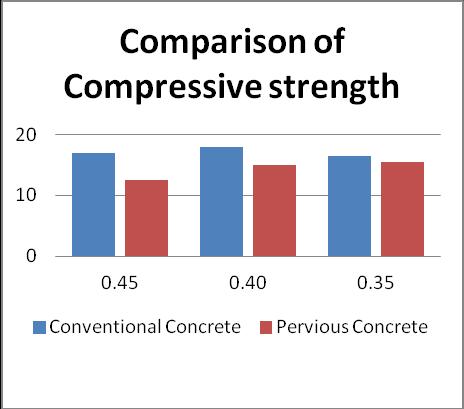
Chart -1(b): ComparisonofCompressivestrengthfor14 days(N/mm2)
Research
Volume: 11 Issue: 06 | June 2024 www.irjet.net p-ISSN: 2395-0072
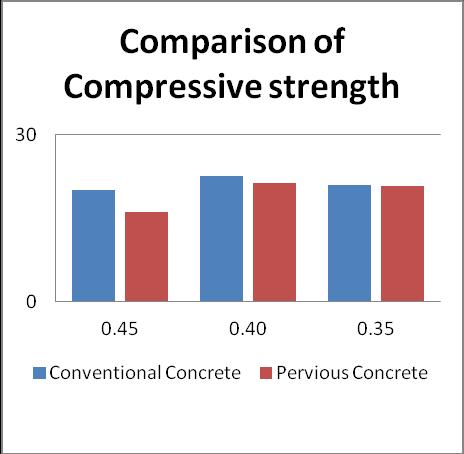
Chart -1(c): ComparisonofCompressivestrengthfor28 days(N/mm2)
Thefindingsofthesplittensiletestsshowedasimilartrend, indicatinghigherstrengthsforconventionalconcretewitha w/cratioof0.4%.Forperviousconcrete,resultscamequite same for both the w/c ratios of 0.40 and 0.35. In 7 days, showninChart2(a),thesplittensilevaluesforconventional concrete and pervious concrete are 1.86 N/mm2 and 1.54 N/mm2 respectively with a gap of 17.2% for w/c ratio of 0.4%.The14dayscuredspecimenshadsplittensilevalues for conventional concrete and pervious concrete of 2.19 N/mm2and2N/mm2 respectivelywithagapof8.67%for 0.40w/cratioand2.04N/mm2and2.01N/mm2with1.47% gap for 0.35 w/c ratio shown in Chart 2(b). While The 28 dayscuredspecimens,showninChart2(c),hadsplittensile valuesforconventional concreteandpervious concrete of 2.54N/mm2and2.41N/mm2respectivelywithagapof5.12 %for0.40w/cratioand2.47N/mm2and2.4N/mm2 with 2.83%gapfor0.35w/cratio.Thesplittensilestrengthfor perviousconcreteincreasesin28daysbuttheleastgapof valuesbetweenconventionalconcreteandperviousconcrete wasachievedwith0.35w/cratio.Therefore,awater-cement ratioof0.35contributedtoimprovedoutcomesinbothsplit tensileandcompressivetestsforperviousconcrete.
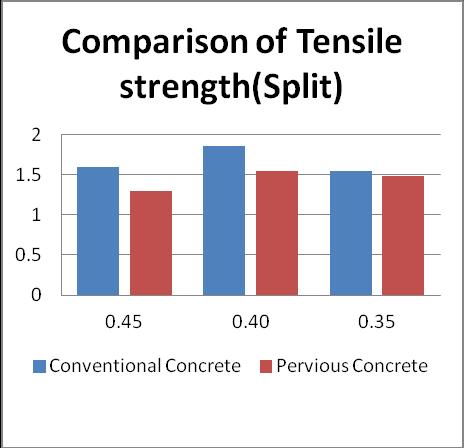
Chart -2(a): ComparisonofSplitTensilestrengthfor7 days(N/mm2)
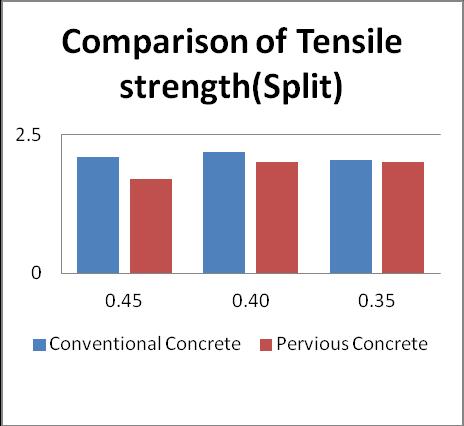
Chart -2(b): ComparisonofSplitTensilestrengthfor14 days(N/mm2)
International Research Journal of Engineering and Technology (IRJET) e-ISSN: 2395-0056
Volume: 11 Issue: 06 | June 2024 www.irjet.net p-ISSN: 2395-0072
Chart -2(c): ComparisonofSplitTensilestrengthfor28 days(N/mm2)
Forw/cratiosof0.35,0.40and0.45thedurationsofpassing timeof1Lwaterare8.5,10and12.5secondsforpervious concrete shown in Chart 3. The lowest values of water passingtimeareseenatw/cratiosof0.35,suggestingthat reducing w/c ratios can enhance the quality of pervious concrete'swaterpermeability.
Chart -3: ComparisonofPermeabilityfor28days(insec for1Lwater)
3. CONCLUSIONS
Aftertheinvestigationofthisstudyfollowingstatementcan bedrawn:
1) Cases, under investigation, adhere to the ACI specifications concerning strengths such as compressive strength, split tensile strength, void percentage,andpermeability.
2) In comparison to conventional concrete, much betterresultcanbefoundforperviousconcrete.
3) For permeability case, same better result can be foundforlowerw/cratio.
4) Perviousconcreteissuitableforapplicationssuch asparkingareas,pathways,androadwaysdesigned forlightvehiclessuchaspassengercars,rickshaws, andauto-rickshaws.
5) Analyzingalltheresults,inw/cratioof0.35,found the best result in each and every sector in comparison of other w/c ratios for pervious concretetype.
Information compiled in this research is sourced from variousresearchworks.Theauthorsexpressgratitudetothe students and lab technicians for their contributions in collecting both laboratory and field data relevant to this research.Financialbackingforthisstudywasprovidedby the European University of Bangladesh (EUB), Dhaka, Bangladesh, as part of a project focused on fostering Sustainable Development of Construction Practices in Bangladesh.
[1] Ajamu S.O., Jimoh A.A. “Evaluation of structural Performance of Previous Concrete in Construction” , InternationalJournalofEngineeringandTechnologyVolume 2No.5,May,2012
[2] Ashley,E.2008.“UsingPreviousConcretetoAchieve LEEDTM points concrete in focus.” National Ready Mixed ConcreteAssociation,SilverSpring,MD.
[3] AydaS.AgarOzbekJaapWeerhejim,ErikSchlangen, KlaasvanBreugel,“Dynamicbehaviourofporousconcrete under drop weight impact testing” ,Cement & Concrete Compositesvol.39,2013,pp.1-11
[4] Ayda S. Agar –Ozbek, JaapWeerhejim, Erik Schlangen,KlaasvanBreugel,“Investigatingporousconcrete with improved strength: Testing at different scales” a constructionandBuildingMaterialsVol.41,2013,pp.480490
[5] Chindaprasirt P., Hatanaka s., “Cement paste characteristics and porous concrete properties”, ConstructionandBuildingMaterails,vol.No.22,2008,pp. 894-901
[6] ChopraManoj,“CompressiveStrengthofPrevious ConcretePavements,”FloridaDepartmentofTransportation. Retrieved1October2012.
[7] Delatte N. J. 2007. “Structural Design of Previous Concrete Pavement.” Preprint paper 07-0956, TRB 2007
International Research Journal of Engineering and Technology (IRJET) e-ISSN: 2395-0056
Volume: 11 Issue: 06 | June 2024 www.irjet.net p-ISSN: 2395-0072
Annual Meeting CD-ROM. TransportaionResearch Board, Washington,DC.
[8] Adresi, M., Yamani, A., Tabarestani, M. K., & Rooholamini, H. (2023). A comprehensive review on perviousconcrete. Construction and Building Materials, 407, 133308.
[9] Xiong,B.,Li,C.,Xu,J.,Lu,X.,Tian,B.,Chen,B.,...&Liu, W.(2023).Influenceofdeeppenetratingsealeronconcrete surfaceperformance. Magazine of Concrete Research, 75(22), 1151-1164.
[10] Jonsén, P., Häggblad, H. Å., Troive, L., Furuberg, J., Allroth, S., & Skoglund, P. (2007, January). Green body behaviour of high velocity pressed metal powder. In Materials Science Forum (Vol. 534, pp. 289-292). Trans TechPublicationsLtd.
[11] Khan,M.Y.,AbdulKarim,Z.A.,Aziz,A.R.A.,&Tan,I. M. (2014). Experimental investigation of microexplosion occurrenceinwaterindieselemulsiondropletsduringthe Leidenfrosteffect. Energy & Fuels, 28(11),7079-7084.
[12] Zega,C.J.,&DiMaio,A.A.(2009).Recycledconcrete made with different natural coarse aggregates exposed to hightemperature. Construction and building materials, 23(5), 2047-2052.
[13] Kuo, W. T., Liu, C. C., & Su, D. S. (2013). Use of washed municipal solid waste incinerator bottom ash in perviousconcrete. Cement and Concrete Composites, 37,328335.
[14] Surahyo, A., Surahyo, L., & Luby. (2019). Concrete construction (pp.61-88).SpringerInternationalPublishing.
[15] Barman,N.K.,Bhattacharya,S.S.,&Alagirusamy,R. (2024).Textilestructuresinconcretereinforcement. Textile Progress, 56(1),1-229.