
International Research Journal of Engineering and Technology (IRJET) e-ISSN: 2395-0056
Volume: 11 Issue: 06 | Jun 2024 www.irjet.net p-ISSN: 2395-0072

International Research Journal of Engineering and Technology (IRJET) e-ISSN: 2395-0056
Volume: 11 Issue: 06 | Jun 2024 www.irjet.net p-ISSN: 2395-0072
Mousab Abibi Abdi1 , Rafet Akdeniz2 ,
1MS Student, Computer Engineering, Istanbul Aydin University, Istanbul, Turkey
2Professor, Computer Engineering, Istanbul Aydin University, Istanbul, Turkey
Abstract - : Femoral neck fractures represent a critical orthopedic problem to their complexity and possible complications. For this reason, it is crucial to detect these fractures quickly and accurately for proper clinical management. This study use YOLOv8 model to detect and classify femoral neck fractures in X-ray images. The performanceof YOLOv8is97.9%in mAP50, 93.5inprecision and 62.5% in mAP50-95. Our proposed system consist data collection, preprocessing, trainingandtestingthe modeland model deployment. The proposed model shows potential for automated detection and classification of femoral neck fractureswhichprovidesvaluableassistance toradiologists.
Key Words: Femoral neck fracture, deep learning, YOLO, YOLOv8, X-Ray images.
1.INTRODUCTION
Femoralneckfracturesareasignificantcauseofdeathand disability in the elderly [1], [2]. While examining pelvis radiographs,slippingfemurfracturesaresometimesmissed, and their delayed diagnosis means an increase in costs as well as harmful outcomes [3]. Consequently, the effectiveness of any recommendation for treatment may depend on a prompt and accurate diagnosis. In practice, doctorsandradiologistsuseX-rayimagestofindfractures. Detectingthesefracturesthroughmanualchecksorwiththe helpofaconventionalX-raymachineisalaboriousandtimeconsumingprocess.
Infournon-Level-1traumahospitalemergencyrooms,975 radiographypatientswithsubsequentCT1showed68falsenegativecases.Thegreatertrochanter,ilium,andpubisare the areas with the most often overlooked fractures [3]. Osteoporotic hip fractures account for 14% of those occurring in the United States of America (USA), but they represent 72% of costs related to healthcare caused by osteoporotic fractures [3]. Costs are the other part of the story.Patientswhocannotwalkbythemselvesare40%after a hip fracture; the other 60% cannot do at least one daily livingactivity,while80%haveadditionallimitationssuchas no driving anymore after these kinds of fractures have affectedtheirpelvises.
Additionally,itiswidelyacceptedthatcurrenttechnologies such as x-ray, CT scan, or MRI are not always enough to diagnose severe healing abnormalities [4] like delayed unionsornon-unionsinpatientswithfemurfractures.There is a necessity to introduce AI-based solutions to
revolutionize the approach by allowing for more uniform andalgorithm-drivenanalysis.TheseadvancesinAI-driven approaches offer great ways for better-automated image segmentation and local feature extraction, which may replace subjective radiographic union scoring with a standardandportablealgorithm-basedevaluationofsevere injurieslikefemurfractures.
Studieshavefoundthattheuseofdeeplearningtechniques in femoral neck fracture detection is promising. In recent research, advanced deep-learning techniques were implemented to automate the detection and classification processforfemoralneckfractures,withanaccuracyrateof 92.3%intwo-classpredictioncasesand86.%inthree-class prediction[5].Inanotherstudy,deeplearningandgenetic algorithmapproacheswereused,inwhichasensitivityvalue of83%wasrecorded,aspecificityvalueof73%,andanF1 score value of.78, respectively [6]. The level of accuracy achieved in this particular study shows that combining geneticalgorithmswithdeeplearningcanenhancefracture detection.
Furthermore, the YOLOv8 algorithm is applied for the detectionoffracturesinpediatricwristtraumax-rayimages, attainingameanaverageprecision(mAP)of.638%underan overlap of 50% [7]. This is an indication that YOLOv8 performswellinidentifyingfractureswithinpediatriccases accurately. Another deployed YOLOv8 model on femur fracturedetectiongaveoutanmAPscoreof0.842ata50% overlapthresholdforbothprecision0.85andrecall0.83[8].
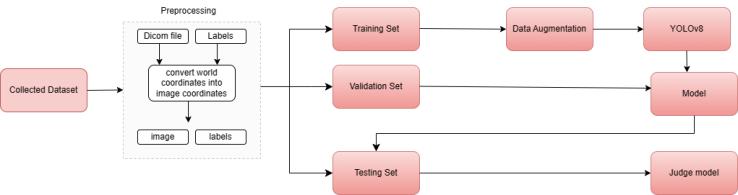
Ourproposedfemoralneckfracturedetectionsystemusing YOLOv8 is based on a well-structured machine learning pipeline.Thefirststepinvolvescollectingdatabyacquiring originalradiographsoffemoralnecks.Thisisthenfollowed by preprocessing, where images undergo various enhancement procedures,suchasimageaugmentation. In
International Research Journal of Engineering and Technology (IRJET) e-ISSN: 2395-0056
Volume: 11 Issue: 06 | Jun 2024 www.irjet.net p-ISSN: 2395-0072
thetrainingandtestingphases,theYOLOv8modelistrained on the prepared dataset. The model learns to detect and classify fracture and normal patterns using its advanced deeplearningarchitecture,initiatingiterativetestsforfinetuning its parameters and validating applicable accuracy levels at each stage. Finally, the model was deployed to differentiatebetweennormalfemoralnecksandthosewith fractures.
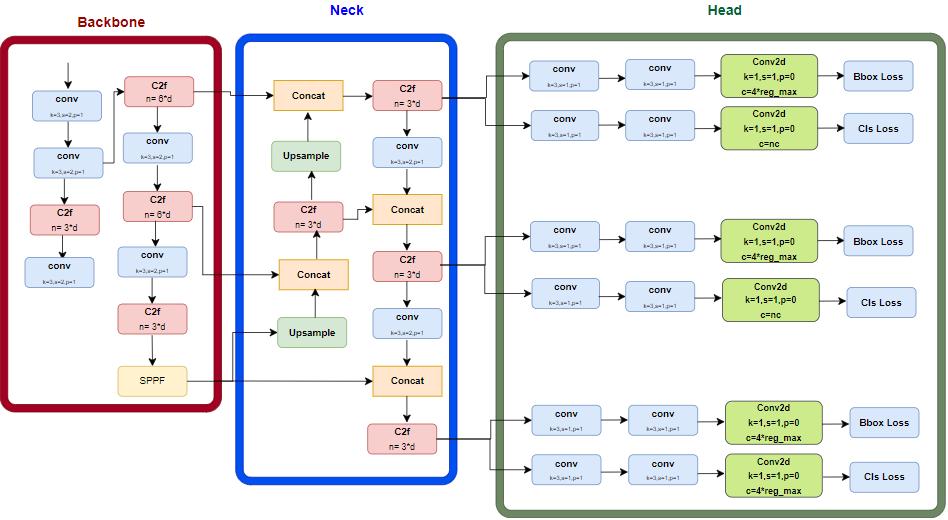
YOLOv8consistofbackboneforfeatureextraction,followed byaneckforrefinementandaheadforpredictingbounding boxes, class probabilities, and confidence scores. Postprocessinginvolvesfilteringandnon-maximumsuppression toproducethefinalobjectdetectionresults.
A.
The backbone constitutes a pre-trained Convolutional NeuralNetwork(CNN)thatextractsfeaturesfromtheinput image. In YOLOv8, a modified version of CSPDarknet53 architecture consist of 53 convolutional layers is used. It utilizescross-stagepartialconnectionswhichhelpimprove theflowofinformationbetweendifferentlayersenhancing its ability to capture low or high-level features from an image.
B.
Theneckisresponsibleformergingfeaturemapsthatare extracted from the output of backbone through various methodslikePathAggregationBlocksorFeaturePyramid Network (FPN) at various scales so that it can be able to detectobjectsofdifferentsizes.
C. Head
The head is composed of multiple convolutional layers followedbyseveralfullyconnectedlayers.Itisonthispart that we predict bounding boxes, object classes as well as confidencescoresforalldetectedobjects.
Initialy we used a dataset of 475 imagesdivided into two classes:"broken"and"normal."Toensurereliabletraining, we separated the original dataset into three subsets: training, validation, and test. A Python script was used to achieve this split, with 70% of the data (332 images) allocatedrandomlytothetrainingset,20%(95images)to the validation set, and 10% (47 images) to the test set. Followingthesplit,wefocusedsolelyondataaugmentation forthetrainingset
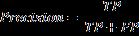
Evaluate the capacity or performance of object detection models by means of Precision. Precision is how well the modelcanavoidgivingfalsepositives.
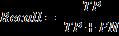
Recallorsensitivityreferstotheportionofrightpredicted items (true positives) from all actual items found in a dataset; this shows that every pertinent occurrence of an object within an image was covered by the model. To calculaterecalluse
mAP50evaluatestheaverageprecisionoverallclasseswhile assessingitsabilityat50%IoUcriterion.Intersectionover Union (IoU) measures the overlap between ground truth boundingboxesandpredictedboundingboxes
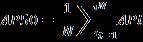
Itsscoreisobtainedbytakingthemeanaverageprecision fordifferentIoUthresholdsfrom50%through95%.These thresholdsembodythesensitivityofthemodelindetecting objectsthathavevariablelevelsofoverlapwiththegroundtruthboundingboxes.

International Research Journal of Engineering and Technology (IRJET) e-ISSN: 2395-0056
Volume: 11 Issue: 06 | Jun 2024 www.irjet.net p-ISSN: 2395-0072
Duringthetrainingofthemodel,weinitiallyset300epochs buthadanearlystoppagethatshowsusthatourbestepoch are within 150 epoch. We trained the model with Adam optimizer known for its effectiveness with small datasets and set the image size to be 800*800 to allow the model capturedetailedfeatures.
Table 1 ValidationresultsofYOLOv8foreachclasseson thedataset
Table 2. ShowshowourYOLOv8outperformsFasterR-CNN duetoitssingle-stagearchitecture.Inaddition,ourmodel reducescomputeloadbypredictingboxesaswellasclass scoresconcurrentlyinsteadofusingamulti-stagetechnique likeFaster-RCNN.
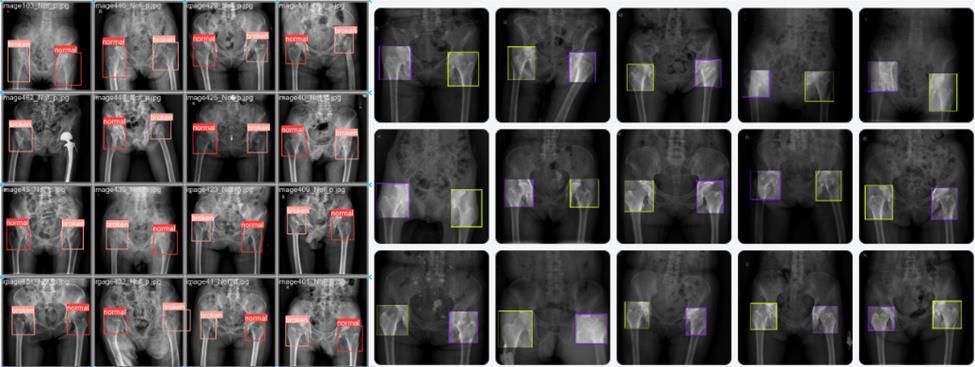
Fig 4. Example of femoral neck fracture detection on X-ray images left side predicted images right manually labeled images.
Examiningthevalidationresultsofourmodelforeachclass showssimilaritiesinthemodel'sperformanceacrossclasses asshownin Table 1.Acrossallclasses,theAdamoptimizer consistently exhibits effective optimization, with a parametercountof25.8million.Themodel'smeanAverage Precision(mAP50)of97.9%indicateshowwellitcandetect objects across the dataset. The Broken class has better performance metricsthan theNormal class,witha higher mAP50-95%of63.1%andaprecisionof92.9%.
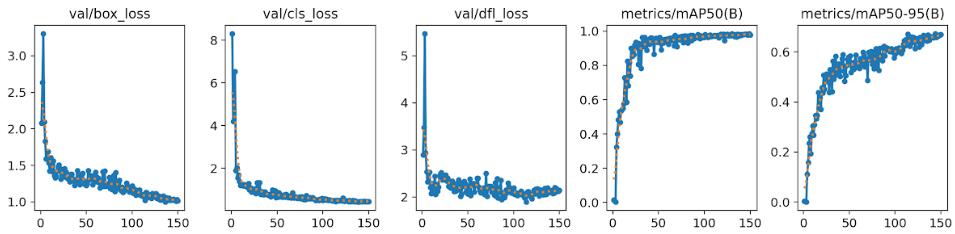
Fig 3 ValidationsgraphsforYOLOv8m
Fig 3.Displaysgraphsdepictingtheresultsforbothtraining andvalidationsets.Thisfigureconsistsofthreecategoriesof losses(boxloss, clsloss,dflloss)aswellasPrecision,Recall, mAP50,mAP50-95values.
4.4 Comparison
WecomparedtheperformanceofaYOLOv8mmodelanda FasterR-CNN(Region-basedConvolutionalNeuralNetwork) variation. Faster R-CNNis a traditional object detection framework that uses a region proposal network (RPN) to create region proposals before moving on to a detection networkforclassificationandboundingboxregression.
Table 2. ComparisonofYOLOv8andFasterRCNN
Models
Thisstudyaimstosupportphysiciansandinterndoctorsby introducingtheusageofYOLOv8modeltodetectandclassify femoral neck fracture from X-ray images. The results of modelshowsthatitdetectbetterthanotherdeeplearning models Basedonourresultwehaveshownthatintegrating AI based solution into clinical practice, doctors and radiologists can benefit from a reliable tool that aids in quickerandmoreaccuratediagnosis,potentiallyleadingto betterpatientcareandoutcomes.
The research could expand on this foundation by incorporating larger datasets and additional imaging techniques, paving the way for even more accurate and versatilediagnostictools.
[1] R.JuandW.Cai,“Fracturedetectioninpediatricwrist traumaX-rayimagesusingYOLOv8algorithm,” SciRep, vol. 13, p. 20077, 2023. doi: 10.1038/s41598-02347460-7.
[2] R.Marks,J.P.Allegrante,C.R.MacKenzie,andJ.M.Lane, “Hipfracturesamongtheelderly:Causes,consequences, andcontrol,”ScienceDirect,2003.
[3] M.Weitz,C.Schwartz,andM.H.Scheinfeld,“Radiologic blindspotsinhipandpelvicradiographs,”EmergRadiol, vol.30,pp.569–575,2023.doi:10.1007/s10140-02302156-3.
[4] P. Schwarzenberg, S. Darwiche, R. S. Yoon, et al., “Imaging modalities to assess fracture healing,” Curr Osteoporos Rep, vol. 18, pp. 169–179, 2020. doi: 10.1007/s11914-020-00584-5.
International Research Journal of Engineering and Technology (IRJET) e-ISSN: 2395-0056
Volume: 11 Issue: 06 | Jun 2024 www.irjet.net p-ISSN: 2395-0072
[5] S. Mutasa, S. Varada, A. Goel, et al., “Advanced deep learningtechniquesappliedtoautomatedfemoralneck fracture detection and classification,” J Digit Imaging, vol.33,pp.1209–1217,2020.doi:10.1007/s10278-02000364-8.
[6] S.Beyaz,K.Açıcı,andE.Sümer,“Femoralneckfracture detection in X-ray images using deep learning and genetic algorithm approaches,” Joint Diseases and RelatedSurgery,vol.31,no.2,pp.175-183,2020.
[7] R.-Y.JuandW.Cai,“Fracturedetectioninpediatricwrist trauma X-ray images using YOLOv8 algorithm,” arXiv preprintarXiv:2304.05071,2023.
[8] D. Xie, H. Yu, Z. Du, H. Wang, X. Shen, and Z. Wang, “Femurfracturedetectionbasedondeeplearningmodel YOLOv8,” in Proc. 2nd Int. Seminar Artif. Intell., Networking Inf. Technol. - Vol. 1: ANIT, SciTePress, 2023,pp.190-193.doi:10.5220/0012277300003807.