
International Research Journal of Engineering and Technology (IRJET) e-ISSN: 2395-0056
Volume: 11 Issue: 06 | Jun 2024 www.irjet.net p-ISSN: 2395-0072

International Research Journal of Engineering and Technology (IRJET) e-ISSN: 2395-0056
Volume: 11 Issue: 06 | Jun 2024 www.irjet.net p-ISSN: 2395-0072
Deepika KC1 , Hajira Nigar C2
1Assistant professor Department of civil engineering, BIT College, Bangalore, Karnataka 2MtechStudent Department of civil engineering, BIT College, Bangalore, Karnataka
Abstract - Nanotechnology, a multidisciplinary science focusing on enhancing material properties at the atomic level, holds immense potential to overcome limitations in various scientific domains. While extensively utilized in material science and electronics, its application in civil engineering, particularly in improving concrete, remains relativelyunderstudied.Concrete,afundamentalmaterial in civil engineering, faces challenges in resisting tensile stresses due to inherent weaknesses in cement components. To address this issue, research explores leveraging nanoscale materials with unique properties, including enhancedtensileandflexuralstrength.
Thisstudyinvestigatestheefficacyofgrapheneoxide(GO),a nanomaterial, in enhancing the strength of mortar against tension and bending stresses. GO offers advantages such as effective dispersion in water, facilitating its incorporation into cement matrices without forming agglomerates. By utilizing GO water dispersion as mix water, the cement components can be imbued with graphene oxide throughout thestructure.
The research objective entails an extensive literature review on the impact of nanomaterials on cement mortar, focusing on the effect of graphene oxide on cement and fly ash mortar. Experimental findings demonstrate significant improvements in mortar strength performance with the incorporationofgraphene oxide.
Key Words: Nanotechnology, Graphene oxide, Cement mortar, Tensile strength, Flexural strength, Material science, Civil engineering
1.INTRODUCTION
Nano material modification of cement-based material is anactiveareaofresearchatpresent.Still,whencompared to other engineering field, concrete technology has been slow to catch the emerging enhancements through nano technology. This is mainly due to the lack of basic understanding of concrete at nano level and the risk factorsinvolvedindispersionofnanomaterialsuniformly inthecementmatrix.
However, the recent developments of the experimental techniquesavailablehavefacilitatedtostudytheconcrete at micro and nano levels. Many researches work suggest
addition of suitable nano particles into concrete to alter many properties of concrete. As a part of project this section outlines the findings of few important works relatedtoGrapheneOxideanditsincorporationincement phase.
A great number of researches have been performed to Understand the nature of nanomaterials and their effect on the properties of concrete. A comparative analysis of this work has been presented in the summary of this chapterwhichwillhighlightthesignificanceofeachwork. Out of the numerous works done in the field only a few relevantworkshavebeenhighlightedinthenextsection.
From the work carried by the researchers on incorporation of nana materials into the cement mortar and concrete it can be concluded that different nana materialscanbeincorporatedtoimprovetheperformance and strength properties of cement mortar and concrete. Few investigations were carried out on performance of mortar incorporating graphene oxide. Extensive research is needed to explore the possibility of incorporation of Graphene Oxide and study the performance and behavior ofmortarandconcrete.
1. To explore how varying concentrations of graphene oxide impact the compressive strength, flexural strength,andtensilestrengthofconcrete.
2. To assess the characteristics of cement-fly ash mortar withandwithoutgrapheneoxide.Incorporatingpartial cement replacement with fly ash and complete sand replacement with M-sand in concrete is preferred due to advantages like improved workability, reduced cementusage,anddecreasedpermeability.
2.1
Cement, sand, fly ash, and graphene oxide are procured fromreliablesources.Basictestsareconductedoncement andsandtoensurequality:
International Research Journal of Engineering and Technology (IRJET) e-ISSN: 2395-0056
Volume: 11 Issue: 06 | Jun 2024 www.irjet.net p-ISSN: 2395-0072
2.1.1 Specific gravity test for cement
Specific gravity of cement -The specific gravity of fresh batch of OPC generally ranges between 3.1 to 3.18, when tested as per Le Chatelier's flask method specified in IS 403(11)1988. Test conducted on the cement used, gave out the value of specific gravity as 2.88, within the established range of value. In general, the specific gravity ofcementistakenas3.15.
2.1.2 Normal consistency test for cement
Thishelps in determining watercontentfor othertests of setting time test, compressive strength test. Test was carried out as per IS 4031(4) using Vicat apparatus and the value water to be added for normal consistency (P), wasrecordedas26%byweightofcement.
2.1.3 Initial and final setting time tests for cement
Thistestusesthewatercontentof0.85Pasobtainedinthe consistency test and is done as per IS 4031(5). The specified setting time for 43 grade OPC as in IS 8112 shouldnotbelessthan30minutesincaseofinitialsetand not more than 600 minutes for final set. The recorded setting time for the cement used is 80 minutes for initial setand250minutesforfinalset,thussatisfied
2.1.4 Compressive strength test for sand
Strength test is carried out as per IS 4031(6). Mortar of cementtoM-sandratio1:3isadoptedandcastedin70mm cube moulds as test specimens. Results of cement tests conductedhavebeenpresented
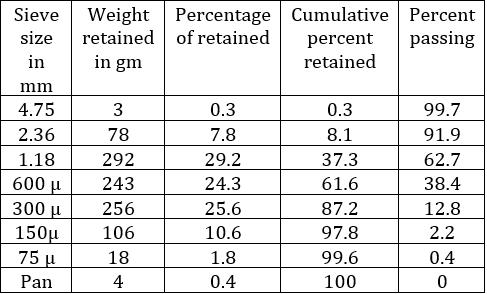
2.1.5 Sieve analysis for sand
Table 1. Sieve analysis
2.2 Concrete mix Proportion
Themortarmixwasproportionedforcementtosandpart by weight, considering the minimum void% mix CalculatedasperIS2386(3)-1963.
The bulk density and specific gravity of different mortar mixes were calculated. Kerosene was used in finding out thespecificgravityofmortarmixbypycnometermethod
Table 2. Dry mortar mix void %
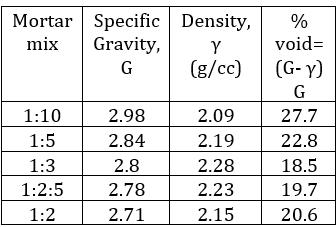
Fromthetableitisobservedthatthemortarofcementto sand proportion-1:3 by weight, showed the least void percentage and the same was chosen as the test mortar mixproportionforsubsequentstudies
2.3
About 2g of powdered graphite is mixed with 100ml of concentrated H2SO4 at room temperature, serving as an oxidizingagenttomakeithydrophilic.Themixtureisthen cooled to 5°C for 30 minutes. 8.0g of KMnO4 is slowly added while stirring and maintaining the temperature below10°C.Next,100mlofwaterisaddedandmixedfor1 hour,thendilutedto300ml.20mlof30%H2SO4isadded toreduceresidualKMnO4.Thesolidistreatedwith800ml of5%HCl solutiontoremovemetal ionsanddiluted with water to reach a pH of 6. The resulting Graphene oxide is dried at 45°C for 24 hours to obtain a nano-sized amorphousproduct.
Exfoliation of the bulk Graphene oxide in an ultrasonic bathwith wateryieldsa greyish-brown,semi-transparent dispersion. Finally, the Graphene oxide is reduced to mono-layered Graphene using a reductant such as Hydrazine, despite its high toxicity. The company limits the dispersion of Graphene oxide in water to a maximum of 5 grams per liter. Different dosages of Graphene oxide dispersed in 5 liters of water are as follows: 0.02% GO dispersion - 0.2 grams GO per liter. This suspension, used with a water-cement ratio of 0.7, provides the required quantity of GO for incorporation into cement mortar by weightpercentofcement
To ensure thorough mixing and dispersion of Graphene Oxide, an electrically operated Hobart mixer meeting IS 2250-1981 standards should be used. Cement and sand mustbemixeddryuntilauniformcolorisachievedbefore addingwater.Themixer'svanesshouldrotatewhilewater isadded,andmixingshouldcontinuefor3to5minutesfor optimalblending.
The nanocomposite preparation involves suspending graphene oxide in distilled water and sonicating for 3 hours until a homogeneous solution form. OPC is then added,maintaininga water-to-cementratioof0.5.Sandis
International Research Journal of Engineering and Technology (IRJET) e-ISSN: 2395-0056
Volume: 11 Issue: 06 | Jun 2024 www.irjet.net p-ISSN: 2395-0072
added last. The cement mortar is then placed on smooth glasstopreventsamplegrinding.
Throughout the ripening process, samples should be storedinahumiditychamberataconstanttemperatureof 20°C.
2.5
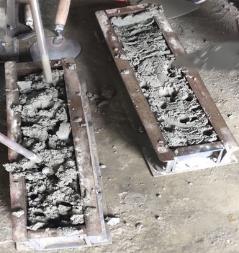
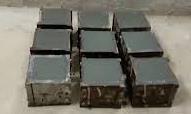
Moulds werefilled withatleast2layersofmortarincase of smaller dimension moulds. Tamping done using a squareheadedlightweighttamperrodbygiving25blows uniformly all along the mortar surface for successive layers.Top layer is finished by giving smooth finish and allowed to set without disturbance for a day's duration beforede-moulding.
2.6
Demoulding of Test Specimens should occur between 16 and 24 hours after creation. If the mortar hasn't gained enough strength for demoulding without damage, wait an additional 24 hours. When removing specimens, disassemblethemouldcompletelytopreventdamage.Use a waterproof crayon or ink to mark each specimen for identification after demoulding. Thoroughly clean the mould to prevent leakage and irregular shapes. Carefully demould specimens to avoid breakage and cure them for anadequatenumberofdaysbeforetesting.
2.7
It is mentioned in IS 456-2000, that a minimum curing period of 28 days has to be practiced in case of OPC used withoutanymineraladmixtures.Curingperiodsshouldbe adopted for 28 days testing of mortar. However, only compressiontest,flexuretestandtensiletestwerecarried out for on mortar cubes and briquettes respectively and theremainingtestsaredonejustafter28daysofcuring.
Performed tests on the cured specimens to evaluate their freshpropertiesandstrengthcharacteristics
2.8.1
Measuring the flow of mortar to assess workability. The freewatertocementratiowasdeterminedfor90to100%
flow plain cement mortar when tested on flow table, as perIS1199-1959.
2.8.2
Thistestgivestheamountofstress,whichthemortarcan resist before failure. It will be carried out in accordance withIS2250-1981asshownin50 mmmouldareused to cast mortar cubes as testing specimens. Curing period of 28 days are suggested to check for early strength developmentandlaterstrengthincrements.
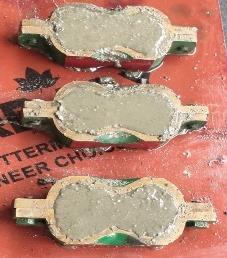
Cement,asknownisweekinresistingtensilestressesdue to its brittle nature. It is by this test where we can calculate the tensile strength of the cement component. Mortar briquettes of standard dimension specified in IS 4456(1)-1967 will be casted in suitable mould, and allowedtosetfor24hoursbeforede-moulding.Thenafter thenecessarycuringperiod,thetestspecimensaretested against tensile stresses, with briquettes placed within a jawholdertestset-up
2.8.4
Flexural strength (sometimes called the modulus of rupture) is actually a measure of tensile strength in bending. PCC flexural strength testing is carried out on a 40 x 40 x 160 mm (1.57-inch x 1.57-inch x 6.30-inch) cementmortarbeam.Thebeamisthenloadedatitscenter pointuntilfailure.
3.RESULT
The main result from the paragraph is that incorporating nanomaterials, specifically graphene oxide (GO), into cement mortar can significantly increase both compressiveandtensilestrength.Pastresearchhasshown up to a 27% increase in compressive strength and 3.7 times increase in tensile strength compared to traditional levels. This suggests that GO holds promise for enhancing the strength of cement mortar, potentially addressing issues related to microcrack development and improving theoveralldurabilityofconcretestructures
3.1 Compressive Strength
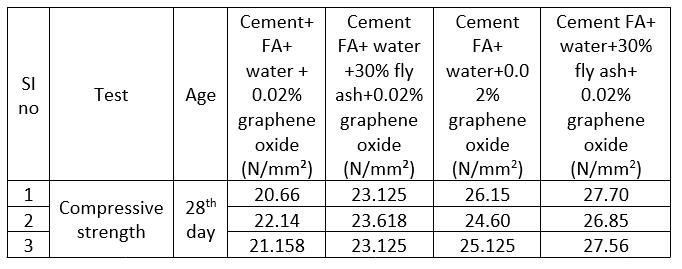
Table 3: Compressive Strength Results
International Research Journal of Engineering and Technology (IRJET) e-ISSN: 2395-0056
Volume: 11 Issue: 06 | Jun 2024 www.irjet.net p-ISSN: 2395-0072
3.2 Tensile strength
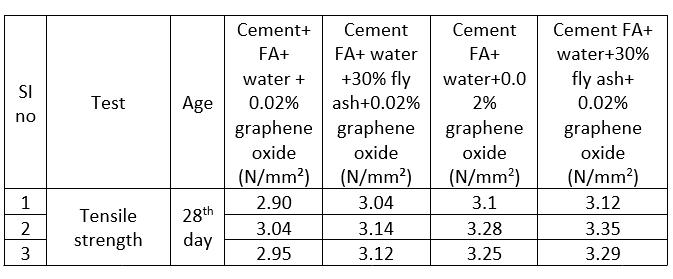
Table 4: Tensile Strength Results
3.3 Flexural Strength
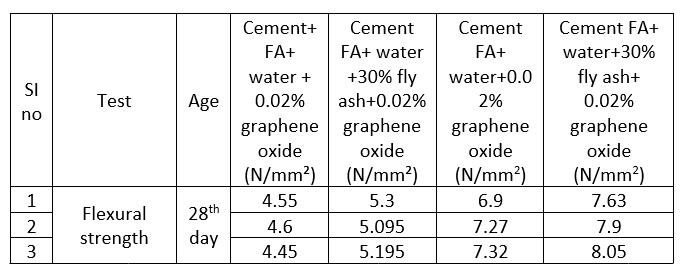
Table 5: Flexure Strength Results
Based on the experimental findings, the following conclusionscanbemade:
There was a notable increase in both concrete compressive strength and flexural strength during the earlystagesofhardening.
Theadditionof30%flyashresultedinan11%increasein compressive strength, while the addition of 0.02% graphene oxide led to a 23% increase. Furthermore, combining 0.02% graphene oxide with 30% fly ash resultedina28%increaseincompressivestrength.
Fly ash had minimal impact on tensile strength. A 4.6% increase was observed with 30% fly ash, and an 8.44% increase was noted with 0.02% graphene oxide. Additionally, combining 0.02% graphene oxide with 30% flyashledtoa9.89%increaseintensilestrength.
Flexural strength saw a 15% increase with 30% fly ash and a substantial 58% increase with 0.02% graphene oxide. Moreover, combining 0.02% graphene oxide with 30% fly ash resulted in a remarkable 73.51% increase in flexuralstrength.
These findings suggest that graphene oxide shows promise as a material for enhancing the flexural strength of cement mortar, as indicated by the results of the presentstudy.
1. Influence of Graphene Oxide can be examined when incorporated into concrete mix. Compatibility with suitablesuper-plasticizercanbearrivedat.
2. Combination of Pozzolanic materials such as Fly ash, silica fumes etc. with Graphene Oxide, can be analyzedfortheirimpactonconcreteproperties.
3. Theuseofgrapheneoxidehasthepotentialtodeliver stronger,lesspermeableconcretestructuresenabling anewgenerationofconcretedesigns.
4. 3Dgraphenenewmaterial,spongelikeconfiguration with density of just 5%, can have strength 10times thatofsteel
1. Alam, S.N., Shar- ma, N. and Kumar, L. (2017) Synthesis of Graphene Oxide (GO) by Modified Hummers Method and Its Thermal Reduction to Obtain ReducedGrapheneOxide(rGO).Graphene,
2. Hunain Alkhateb et.al, "Materials Genome for Graphene-Cement Nanocomposites", and Journal of Nano mechanics Micromechanics Vol3, Issue 3 [September2013]ASCE6,1-18.
3. Hangfang Sun et.al, "Effect of graphene oxide/graphene Hybrid on Mechanical properties of cement Mortar and Mechanism Investigation" Nano materials[7Jan2020]
4. [Changjiang Liu et.al," Research progress on individual effect of graphene oxide in cement -based materials and its synergistic effect with other nano materials"[26Jan2020]
5. ThidatipJanjaroenet.al,"Themechanicalandthermal properties of cement CAST mortar/Graphene Oxide Composites materials". International journal of concretestructureandmaterials[2022]
6. Gang Xu et.al, "Influence of graphene oxide in a chemicallyactivatedflyash"Fuel[7Apr2018]
7. ChangjiangLiuet.al,"Theeffectofgrapheneoxideon the mechanical properties, impermeability and corrosion resistance of cement mortar containing mineral admixtures" Case Studies in Construction MaterialsVolume17,[December2022]
8. ZhiqiangWeiet.al,"Theroleofsucroseonenhancing properties of graphene oxide reinforced cement composites containing fly ash" Construction and BuildingVolume293,[26July2021]
International Research Journal of Engineering and Technology (IRJET) e-ISSN: 2395-0056
Volume: 11 Issue: 06 | Jun 2024 www.irjet.net p-ISSN: 2395-0072
9. Alexander Gladwin Alex et.al, "Review on effects of graphene oxideonmechanical andmicrostructure of cement-based materials". Construction and Building Materials,Volume360,[19December2022]
10. Karthik Chintalapudi etal, "Enhanced chemical resistance to sulphuric acid attack by reinforcing Graphene Oxide in Ordinary and Portland Pozzolana cement mortars". Case Studies in Construction MaterialsVolume17,[December2022]
11. Veerandra Kumar C. Khed.et.al, Optimization of grapheneoxideincorporatedinflyash-basedonselfcompacting concrete volme01, issue (November 2022)
12. Yahvi Wang et.al, "effects of graphene oxide on mechanical properties of cement mortar and its strengthening mechanism (construction and mechanism technology) , volume 07 issues (November2019)
13. Alikbargholampouret.al,"formsofgrapheneoxideto reduce graphene oxide: impact on physico chemical and mechanical properties of graphene cement and its composites (Department of process international maritimetechnology,volume04(November2017)
14. Padmanaban ilango van.et.al, "exprimental investigation on graphene oxide composites with flyash concrete (Directory of research journals) volume09no3issuejune2016
15. Juliamarczewka.et.al"influenceoftheflyashandthe prior freezing and thawing on sulphate resistance of cement mortar (Department of civil engineering and architectureoftechnology) volume57,issuesAugust 2018
16. Influence of graphene oxide on sulfate attack and carbonationofconcretecontaining recycledconcrete aggregate"byChiranjiakumariandAhmad(2020).
17. Sharma etal.(2018)investigatedtheinfluenceofGO on the compressive strength, flexural strength, and sulfateresistanceofcement-flyashmortar.
18. “Effect of graphene oxide on properties of fly ash cementmortar"byS.S.Jadhav(2018)
19. “Economical graphene reinforced fly ash cement composite made with recycled aggregates for improved sulphate resistance and mechanical performance"bySharmaandArora(2018)
20. “The paper investigates the influence of graphene oxide on the sulfate attack and carbonation of concrete containing recycled concrete aggregate" by Chiranjiakumari,S&Ahmad,R(2019)