
International Research Journal of Engineering and Technology (IRJET) e-ISSN: 2395-0056
Volume: 11 Issue: 06 | Jun 2024 www.irjet.net p-ISSN: 2395-0072
International Research Journal of Engineering and Technology (IRJET) e-ISSN: 2395-0056
Volume: 11 Issue: 06 | Jun 2024 www.irjet.net p-ISSN: 2395-0072
Shankar Tejasvi
1 , Merin
Meleet
1
1Department of Information Science and Engineering, RV College of Engineering Bengaluru, Karnataka, India ***
Abstract - Theemergingdisciplineoftext-to-videosynthesis combines computer vision and natural language understanding to create coherent, realistic videos that are basedonwrittendescriptions.Theresearchisanendeavourto provide a bridge between the fields of computer vision and natural language processing by using a robust text-to-video production system. The system's main goal is to convert text prompts into visually appealing videos using pre-trained models and style transfer techniques, providing a fresh approachtocontent development.Themethoddemonstrates flexibilityandeffectiveness byincludingwell-knownlibraries like PyTorch, PyTorch Lightning, and OpenCV. The work emphasises the potential of style transfer in boosting the creativequalityofvisualoutputsbyemphasisingitscapability to make videos with distinct styles through rigorous experimentation.Theoutcomesillustratehowlanguageclues andartisticaestheticscanbesuccessfullycombined,aswellas the system's ramifications for media production, entertainment, and communication. This study adds to the rapidly changing field of text-to-video synthesis and exemplifies thefascinatingopportunities that result fromthe fusion of artificial intelligence and the production of multimedia content.
Key Words: Text to Video, Pre- Trained Models, Style Transfer, Multimedia Content Creation, Natural Language Processing
Natural language processing (NLP) and computer vision haverecentlycometogethertorevolutionisethewaythat multimediamaterialisproduced.Afascinatingareaofthis confluenceistext-to-videocreation,whichincludescreating visual stories out of written prompts. Due to its potential applications in a variety of industries, including entertainment,education,advertising,andcommunication, this developing topic has attracted significant attention. Text-to-video generation offers a cutting-edge method of information sharing by enabling the transformation of writtendescriptionsintocompellingvisualcontent.
The complexity of text-to-video production is explored in thiswork,withafocusonusingpre-trainedmodelsandstyle transfer methods. The work's goal is to make it easier to convert textual cues into dynamic video sequences by utilising the strength of well-known frameworks like
PyTorch, PyTorch Lightning, and OpenCV. Contextual information from the input text is extracted in this procedure,andtheinformationisthenconvertedintovisual components.
The main goal of the work is to investigate how linguistic andvisualcluesmightbecombinedtoproducemoviesthat accurately convey textual material while also displaying stylistic details. A key component of this system, style transferenablestheadoptionofcurrentvisualstylesonto the produced videos, producing visually stunning results that exemplify creative aesthetics. The system aims to demonstratetheeffectivenessofitsmethodologyinvideo production with a variety of styles, so showcasing the possibilitiesforinnovationandcustomization.
This work contributes to the changing environment of content creation as artificial intelligence and multimedia continue to converge by providing insights into the opportunities made possible by the interaction between language and visual. The research highlights the gamechangingpossibilitiesofAI-drivenmultimediasynthesisby showcasing the capabilities of text-to-video production combinedwithstyletransfer.
The method for zero-shot picture categorization that is suggestedinthisstudymakesuseofhumangazeasauxiliary data. A paradigm for data collecting that involves a discriminating task is suggested in order to increase the information content of the gaze data. The paper also proposes three gaze embedding algorithms that exploit spatial layout, location, duration, sequential ordering, and user'sconcentrationcharacteristicstoextractdiscriminative descriptorsfromgazedata.Thetechniqueisimplemented on the CUB-VW dataset, and several experiments are conductedtoevaluateitseffectiveness.Theresultsshowthat human gaze discriminates between classes better than mouse-clickdataandexpert-annotatedcharacteristics.The authors acknowledge that although their approach is generalizable to other areas, finer-grained datasets would benefit from utilising different data collection methodologies. Overall, the suggested strategy provides a morepreciseandorganicwaytoidentifyclassmembership inzero-shotlearningcontexts.[1]
International Research Journal of Engineering and Technology (IRJET) e-ISSN: 2395-0056
Volume: 11 Issue: 06 | Jun 2024 www.irjet.net p-ISSN: 2395-0072
ThestudyintroducesConsistentGenerativeQueryNetworks (CGQN), a novel model that might successfully construct upcoming frames in a video sequence without requiring consecutiveinputandoutputframes.Inordertoeffectively and simultaneously sample frames that are temporally consistent at all time, the model first generates a latent representationfromanysetofframes.TheCGQNconsumes inputframesandsamplesoutputframesentirelyinparallel, enforcing consistency of the sampled frames. This is accomplished by training on several correlated targets, samplingagloballatent,andusingadeterministicrendering network.Incontrasttoearliervideopredictionmodels,this. Additionally,thestudyoffersstrongexperimentalevidence intheformofstochastic3Dreconstructionandjumpyvideo forecaststobackupthemethodology.[2]
Usingthetechniquepresentedinthisstudy,motionbluris producedfromapairofunexposedpicturesusinganeural networkarchitecturewithadifferentiable"lineprediction" layer.Thescientistsdevelopedasyntheticdatasetofmotionblurred images using frame interpolation techniques, and thentheyevaluatedtheirmodelonagenuinetestdataset. Theapproachismoresuitableforteachingdata synthesis online using deep learning and faster than frame interpolation.[3]
TiVGAN,orText-to-Image-to-VideoGenerativeAdversarial Network, is a network that produces films from text synopses. A single image is first produced using the framework's incremental evolutionary generator, which then gradually turns that image into a video clip with the appropriate length. The generator stabilizes the training processwhileconditioningontheinputtextusinganumber of techniques, including a two-stage training procedure, a progressive growth strategy, and a feature matching loss. Thenetworkistrainedusingacombinationofadversarial loss,featurematchingloss,andperceptualloss.Theprecise organizational structureof thenetwork isprovided inthe additionalmaterial.[4]
This study reviews in-depth the most recent video GenerativeAdversarialNetworks(GANs)models.Thepaper begins by recapping earlier reviews of GANs, identifying gapsintheresearch,andprovidinganoverviewofthemain advancementsmadebyGANsmodelsandtheirvariations. After dividing video GAN models into unconditional and conditionalmodels,theresearchreviewseachcategory.The conclusionoftheworkisthediscussionofprobablefuture directionsforvideoGANsresearch.Overall,thiswork isa valuableresourceforanyoneinterestedinthemostrecent developmentsinvideoGANmodelsandtheirpotentialuses inarangeofindustries.[5]
Creatingadomain-specificontologyandpreparingacorpus ofphysicsquestionsandanswersareallstepsintheprocess of putting PhysNLU into practice. Multiple-choice physics questions are available from PhysNLU to test one's
commandofnaturallanguage.Itgeneratessuggestionswhile evaluating the explanation's coherence with the use of automatic metrics and human annotations. A platform for crowdsourcingexpertannotationsisbuiltintotheproduct.A helpfultoolforassessinghowwellNLPmodelsunderstand physics and generate logical explanations is PhysNLU. It enhances NLU evaluation in the physics domain and increases the robustness of the NLP systems in this particularsubject.[6]
This paper presents a novel method for producing videos thatmakesuseofdiffusionprobabilisticmodels.Basedon theconceptsofdiffusionprocesses,theauthorsproposea method that iteratively alters a noise distribution to resemble the target distribution. They emphasise how ineffectivethetechniquesnowemployedformakingmovies areatcapturingcomplextemporaldynamicswhileproviding a full study of those techniques. The suggested diffusion probabilisticmodeleffectivelymodelsvideodatabyutilising the temporal links between frames. The authors demonstratetheeffectivenessoftheirmethodonnumerous videodatasetsandcompareittostate-of-the-artmethods. Theresultsshowthatthediffusionmodelgeneratesvideos withbettertemporalcoherenceandrealismthatareofthe highestquality.Thepaperpresentsapotentandsuccessful strategy based on diffusion probabilistic modeling, advancingthefieldofvideocreation.[7]
The paper introduces a novel video production technique based on video diffusion models. The authors propose extending diffusion probabilistic models to handle sequentialdata,suchasmovies.Theydiscussthetechnical detailsoftheirstrategy,whichentailsiterativelyapplyinga diffusion process to create each frame of a video. The authorsdemonstratetheeffectivenessoftheirapproachby training video diffusion models on various video datasets anddisplayingthegeneratedfilms.Theyalsocomparetheir strategytoothercutting-edgemethodsforproducingvideos, indicating that it performs better in terms of capturing complex temporal dynamics and visual quality. The study advancesthefieldofvideogenerationbyprovidingafresh andeffectivewayutilisingvideodiffusionmodels.[8]
CogVideo, a comprehensive pretraining technique for transformer-basedtext-to-videogeneration,isintroducedin the paper. The authors propose a novel architecture that comprisesatwo-stagepretrainingproceduretocaptureboth textual andvisual data.Intwostages,a languagemodel is refinedusingahugevideodatasetafterbeingpretrainedon a sizable text corpus in the first stage. Additionally, they createabrand-newpretrainingobjectiveknownasCrossmodalGenerativeMatching(CGM)inordertoalignthetext andvideorepresentations.TheperformanceofCogVideoon several text-to-video production jobs is evaluated by the authorsincomparisontoothermethods.Thefieldoftext-tovideogenerationdevelopswiththeadventofastrongand effectivepretrainingtechniqueusingtransformers.[9]
International Research Journal of Engineering and Technology (IRJET) e-ISSN: 2395-0056
Volume: 11 Issue: 06 | Jun 2024 www.irjet.net p-ISSN: 2395-0072
Theinventionofawaytogeneratetextfromvideowithout textfromvideodata.Theauthorssuggestanovelframework called Make-a-Video that combines a text-to-image model with a video prediction model. The text-to-image model initially builds a static image representation based on the input text, and then the video prediction model gradually creates future frames by using motion information. By training these models in a self-supervised manner, the authorsdemonstratethatitispossibletocreatefilmsfrom text descriptions without the need for coupled text-video data.Theproposedapproachistestedonseveraldatasets, confirmingitseffectivenessincreatingengaginganddiverse videos.Thestudyprovidesacontributiontothefieldoftextto-video creation by outlining a promising technique that does away with the need for text-video training pairings. [10]
This study introduces Imagen Video, a technique for producinghigh-definitionvideosthatmakesuseofdiffusion models.Theauthorsproposeanextensionofthediffusion probabilisticmodeldesignedspecificallyfortheproduction of high-quality films. They create a hierarchical diffusion approach to capture both geographic and temporal dependencies inside the video frames. After being trained withavarietyofnoiselevels,themodelcreateseachframe byiterativelyconvertingthenoise.Theauthorsdemonstrate ImagenVideo'seffectivenessusingvariousvideodatasets, emphasisingitsabilitytocreatehigh-resolutionfilmswith improved visual clarity and coherence. High-definition videosarecreatedthroughanefficientprocedure.[11]
The article provides a brief introduction to DiffusionDB, a massive prompt gallery dataset designed for creating and testingtext-to-imagegenerativemodels.Thewritersaddress theissueoflimiteddiversityandqualityinexistingprompt databasesbygatheringasignificantcollectionofvariedand aesthetically beautiful questions. Each of the several text promptsinDiffusionDBhasahigh-qualityimagedrawnfrom an open-access library. A vast variety of visual concepts, objects,situations,andstyleswereexplicitlyincludedinthe dataset when it was designed. In order to assess the diversityandcoverageofthepromptgalleries,theauthors alsoofferevaluationindicators.Theydevelopandevaluate cutting-edge text-to-image generative models to demonstrate DiffusionDB's utility. The paper's large-scale promptgallerydatasetisavaluabletoolthatenablesmore thoroughtrainingandevaluationoftext-to-imagegenerative models.[12]
In this study, Text2Video-Zero, a novel technique for creating zero-shot films using text-to-image diffusion models, is introduced. The authors present a method that employs pre-trained text-to-image models to create video sequences directly from written descriptions without the needforvideo-specifictraining.Bycustomisingthediffusion processontextualinputs,themodelmaygenerateavariety of intriguing and well-coordinated video frames. They
demonstrateText2Video-Zero'seffectivenessanditsability tocreateconvincingandartisticallybeautifulfilmsusinga variety of video datasets. With the use of trained text-toimage models and only textual descriptions, the method offersazero-shotapproachthatmakesitpossibletocreate videos.[13]
The paper presents a novel approach for text-to-image synthesisusinggenerativeadversarialnetworks(GANs).The authorsproposeamodelthatincorporatesatextencoder,an image generator, and a discriminator network. The text encoder transfers textual descriptions to an embedding spacethatthepicturegeneratorusestosynthesiseimages. Thediscriminatornetworkdistinguishesbetweenrealand fake images and offers feedback to aid in the creation of images.Bycomparingtheir modeltobenchmarkdatasets, the authors show how effectively it can generate visually coherent and semantically meaningful images from text inputs.Bydoingthis,thegapbetweenwrittenexplanations andthedevelopmentofrealisticimagesiseffectivelyclosed. [14]
ThisworkintroducesPromptify,amethodfortext-to-image generation that combines interactive prompt exploration withmassivelanguagemodels.Theauthorsproposeanovel framework that combines human input with important language models to generate high-quality images from textual prompts. With Promptify, users may iteratively tweak the prompt and get rapid visual feedback from the model. This interactive research allows users to precisely controltheproductionofthedesiredimagebyalteringthe promptphrasing.ThesuccessofPromptifyisdemonstrated by the authors via user studies and comparisons with alternativestrategies,emphasisingimprovedimagequality andusersatisfaction.[15]
The proposed text-to-video synthesis system employs a systematicmethodologythatseamlesslyintegratestextual descriptions with visual content to produce coherent and realisticvideos.
Thevideosproducedareavailablein2classes:
GenericVideos
EnhancedVideos
Thefollowingflowdiagramrepresentsthestepsinvolvedin theproposedsystem:
International Research Journal of Engineering and Technology (IRJET) e-ISSN: 2395-0056
Volume: 11 Issue: 06 | Jun 2024 www.irjet.net p-ISSN: 2395-0072
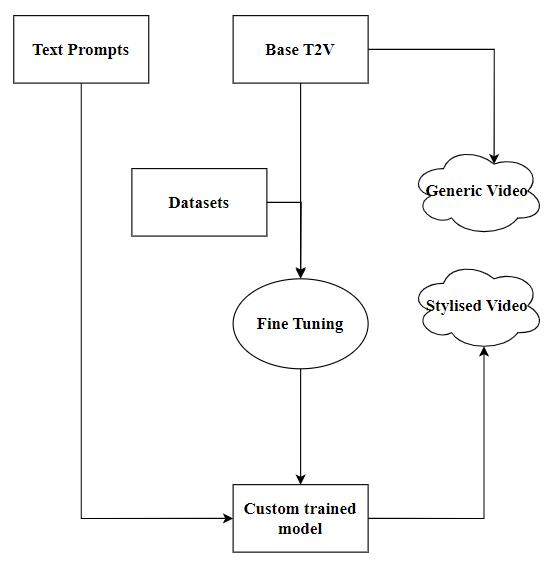
The process of video generation from given text prompt involvesthefollowing6-stageprocess:
1. EnvironmentSetup:
Ensure CUDA availability in the notebook settingsforGPUacceleration.
Install Miniconda, granting execution permissionsandsettingtheinstallationpathto /usr/local.
Replace the system's Python version with version3.8usingupdate-alternatives.
Install necessary packages using apt-get and python3-pip.
2. ProjectSetupandDependencies:
ClonetheVideoCrafterprojectrepositoryand navigatetotherelevantdirectory.
Set the PYTHONPATH to include the project directory.
InstallrequiredPyTorchandrelatedpackages withspecifiedversionsforcompatibility.
Install additional libraries such as PyTorch Lightning, OmegaConf, and OpenCV using python3-pip.
Install packages like AV and MoviePy for multimediaprocessing.
3. ModelAcquisitionandConfiguration:
Clone the VideoLORA model repository and movethemodelstotheappropriatedirectory.
Define the available VideoLORA styles and theircorrespondingpaths.
4. Text-to-VideoGeneration(BaseModel):
Set the desired text prompt and output directory.
Specifythepathtothebasemodelcheckpoint anditsconfiguration.
Execute sample_text2video.py with provided parametersforbasetext-to-videogeneration.
Display the resulting video using HTML to showcasethegeneratedcontent.
5. Text-to-Video Generation with Style Transfer (VideoLORA):
Select a VideoLORA style from the available optionsbasedonthechosenLORA_PATH.
Set the prompt, output directory, and style parameters.
Executesample_text2video.pywithadditional parametersforVideoLORAintegration.
Display the style-transferred video using HTMLtovisualizethesynthesizedcontent.
6. ResultVisualization:
Extract the latest video file generated in the outputdirectory.
ConvertthevideointoadataURLfordisplay usingbase64encoding.
Display the video animation in the notebook usingHTMLandthedataURL.
3.1 PyTorch:
Inthissystem,PyTorch,aflexibleandpopulardeeplearning framework,isessential.Thecreationofsophisticatedneural networksfortext-to-videosynthesisismadepossiblebyits dynamiccomputationgraphandautomaticdifferentiation. PyTorch excels at managing a variety of model topologies and provides a high level of flexibility that is essential for adjustingtothecomplexitiesofproducingvideosfromtext input.Additionally,thespeedofcomputationissubstantially increased by its GPU acceleration capabilities, making it a crucialelementforeffectivelyprocessinghugeamountsof data during training and inference. The integration of cutting-edge deep learning algorithms in this system is further streamlined by PyTorch's large ecosystem of prebuiltmodulesandcommunitysupport.
3.2 PyTorch Lightning:
Byremovinglow-leveltrainingloopdetailsandstreamlining distributed training, PyTorch Lightning boosts efficiency. Thispackageautomatesdataparallelism,checkpointing,and GPUallocation,enablingthesystemtoscaleupsmoothlyto take advantage of the hardware resources. PyTorch Lightningimprovescodereadabilityandmaintainabilityby theuseofstandardisedprocedures,promotingteamwork. Its built-in support for cutting-edge features like gradient accumulation and mixed-precision training optimises trainingeffectivenesswhileusinglessmemory.Thesystem can concentrate on model architecture and experimental design thanks to PyTorch Lightning, expediting the
International Research Journal of Engineering and Technology (IRJET) e-ISSN: 2395-0056
Volume: 11 Issue: 06 | Jun 2024 www.irjet.net p-ISSN: 2395-0072
3.3
To manage video data, the system relies on OpenCV, the Open Source Computer Vision Library. Its extensive collection of features enables effective image processing, frameextraction,andvideofileI/O.Withtoolstoimprove video quality and coherence, OpenCV's capabilities also include feature detection, object tracking, and video stabilisation.Additionally,thefactthatitsupportsavariety of picture formats guarantees compatibility with multiple multimediasources,whichisessentialwhenworkingwith heterogeneousdatainthetext-to-videopipeline.Thesystem usesOpenCVtoprovidereliablevideomanipulation,which isessentialforturningwrittendescriptionsintoaesthetically appealingandcohesivevideooutputs.
3.4 AV:
AmultimedialibrarycalledAVgivesthesystemtheabilityto managesophisticatedaudiovisualdata.Thislibrarymakesit possibletoseamlesslycombineaudioandvideoelements, assuringsynchronisationandimprovingtheoverallusability of the output films. AV is excellent at managing codecs, handling multimedia metadata, and parsing and decoding videofiles.Thesystem'sadaptabilityisfurtherincreasedby itssupportforseveralvideoformatsandstreaming,which acceptsvariousdatainputsandoutputformats.Thesystem incorporates AV to ensure that the final movies appropriately reflect the intended storylines and styles developedfromthetextpromptswhilealsomaintainingthe integrityofmultimediacontent.
The system uses MoviePy, a video editing library, as its creative toolbox for enhancing video outputs. The system can smoothly incorporate transitions, apply visual effects, andassemblefilmsthankstoitssimple-to-useAPI.Theuse of text and picture overlays with MoviePy's capabilities enablestheinclusionofextrainformationorbrandinginto thevideos.Itmakesiteasiertocreatepolished,professionallevelvideosbecausetoitsabilitytoconcatenatevideos,cut segments, and alter video characteristics. A wide range of multimedia players and platforms are supported by MoviePy's integration with several video file formats, ensuringcompatibilitywiththeoutputvideoswithavariety ofviewers.ThesystemusesMoviePytoaddanartisticlayer tothegeneratedvideos,improvingtheirvisualappealand narrativequality.
Thesystem'sresultsshedimportantlightontheefficacyand potential of the suggested text-to-video generating methodology. The produced videos show an impressive conversionofwritteninformationintolivelyvisualtales.The system's ability to grasp textual nuances and visually
communicatethemisdemonstratedbytheunderlyingtextto-video model's effective transformation of prompts into cohesive video sequences. By including style transfer throughVideoLORA,thecreatedvideosarefurtherimproved andareinfusedwithdistinctiveartisticstylesthatmatchthe selected prompts. The outcomes highlight how well the systemcombinedcomplexvisualcomponentswithlanguage cluestoproducevideosthatareresonantinbothsubstance andstyle.
TheselectionofVideoLORAstyleshasabigimpactonthe personalityandatmosphereofthegeneratedvideosinthe contextofstyletransfer.Thesuccessfulintegrationofartistic styles highlights the opportunity for individualised and flexiblevideocontentproduction.Thesystem'srelianceon effective libraries like PyTorch and PyTorch Lightning furthersimplifiesthegenerationprocessandenablesquick testing and improvement. The system's demonstrated capabilities,supportedbyreliableandrepeatablefindings, set the groundwork for subsequent developments in multimedia synthesis, stimulating further research and development at the nexus of computer vision and natural languageprocessing.
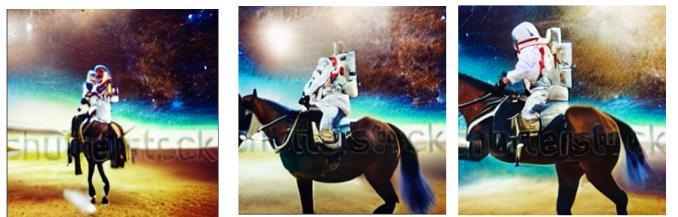
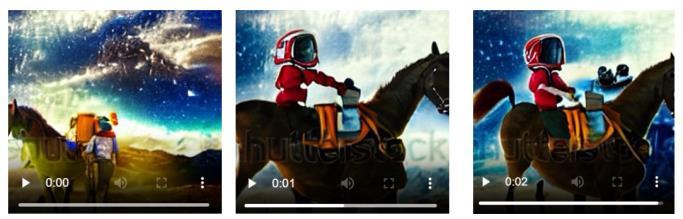
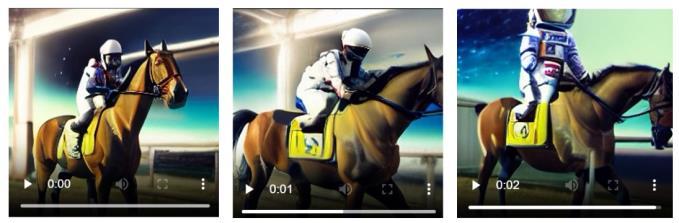
Thefollowingdiagramsillustratethevariousimageframes ofvideosgeneratedusingthevariousmodelclasses:
TextPrompt:Anastronautridinghorseinouterspace
International Research Journal of Engineering and Technology (IRJET) e-ISSN: 2395-0056
Volume: 11 Issue: 06 | Jun 2024 www.irjet.net p-ISSN: 2395-0072
By utilising the synergy between natural language processing and computer vision, this system acts as a creative and dynamic investigation of text-to-video production. The system successfully connects textual promptsandvisuallyappealingvideooutputsbyintegrating pre-trainedmodels,styletransfer,andacomprehensiveset of libraries like PyTorch, PyTorch Lightning, OpenCV, AV, MoviePy,andOmegaConf.Thecombinationoflanguageclues withvisualaestheticsrevealsthepotentialforthecreationof creative content across a range of fields, including communication,education,andentertainment.Thesystem's methodology'sapplicationandadaptabilityarehighlighted bythemethodicalwayinwhichitwasimplemented,which wasfoundedoneffectivecodeexecutionandbestpractises. This system adds to the changing landscape of content creation by highlighting the capabilities of AI-driven multimedia synthesis, paving the door for interesting developments at the nexus of artificial intelligence and multimediatechnologies.
Despite the established text-to-video synthesis system's excellentachievements,thereareseveraldrawbackstoits current design that must be acknowledged. The model's dependenceonitstrainingdataisanoteworthyrestriction; deviations from the training corpus may lead to errors. Additionally,real-timeapplicationscanbehamperedbythe highcomputingdemandsoftrainingandproducingmovies. Future versions could concentrate on improving model generalisation and increasing computing effectiveness to addresstheselimitations.
Therearemanyopportunitiesforgrowthandimprovement in the future. The system's realism and congruence with human perception might be strengthened by the incorporationofuserfeedbackthroughhumanevaluations. Investigatingmethodstoincorporatefiner-grainedcontrol over video qualities, like style and mood, could produce a variety of results. The dataset's flexibility to different settings might be improved by adding a variety of textual stimuli.Additionally,improvementsintransferlearningand multimodalpre-trainingmayopenupnewpossibilitiesfor text-to-videosynthesis.Whileadmirable,thisstudysystem onlytouchesthesurfaceofabroadfield,leavingplentyof potential for creativity and inquiry at the dynamic confluenceoftextandvisualinformation.
[1] Karessli, N., Akata, Z., Schiele, B., & Bulling, A. (2017). Zero-Shot Image Classification using Human Gaze as AuxiliaryInformation.InProceedingsoftheIEEEConference
onComputerVisionandPatternRecognition(CVPR),45254534.doi:10.1109/CVPR.2017.679
[2]Kumar,A.,Eslami,S.M.A.,Rezende,D.,Garnelo,M.,Viola, F.,Lockhart,E.,&Shanahan,M.(2019).Consistentgenerative querynetworksforfutureframepredictioninvideos.arXiv preprintarXiv:1807.02033.
[3]Brooks,T.,&Barron,J.T.(2019).Generatingmotionblur from unblurred photos using neural networks. In Proceedings of the IEEE/CVF Conference on Computer Vision and Pattern Recognition (CVPR), 6840-6848. doi:10.1109/cvpr.2019.06840
[4]Kim,D.,Joo,D.,&Kim,J.(2020).TiVGAN:Text-to-imageto-video generative adversarial network. IEEE Access, 8, 153113-153122.doi:10.1109/access.2020.2986494
[5]Aldausari,N.,Sowmya,A.,Marcus,N.,&Mohammadi,G. (2022). Review of video generative adversarial networks (GANs)models.ACMComputingSurveys,55(2),Article30. doi:10.1145/3487891
[6]Meadows,J.,Zhou,Z.,&Freitas,A.(2022).PhysNLU:A tool for evaluating natural language understanding in physics.InProceedingsofthe13thConferenceonLanguage Resources and Evaluation (LREC 2022), 4904-4912. doi:10.18653/lrec-2022-4904
[7]Yang,R.,Srivastava,P.,&Mandt,S.(2022).Videocreation using diffusion probabilistic models. arXiv preprint arXiv:2203.09481.
[8]Ho,J.,Salimans,T.,Gritsenko,A.,Chan,W.,Norouzi,M.,& Fleet, D. J. (2022). Video generation using video diffusion models.arXivpreprintarXiv:2204.03409.
[9]Hong,W.,Ding,M.,Zheng,W.,Liu,X.,&Tang,J.(2022). CogVideo: Large-scale pretraining for transformer-based text-to-videogeneration.arXivpreprintarXiv:2205.15868.
[10]Singer,U.,Polyak,A.,Hayes,T.,Yin,X.,An,J.,Zhang,S., Hu,Q.,Yang,H.,Ashual,O.,Gafni,O.,Parikh,D.,Gupta,S.,& Taigman,Y.(2022).Make-a-Video:Text-to-VideoGeneration withoutText-VideoData.arXivpreprintarXiv:2209.14792
[11]Ho,J.,Chan,W.,Saharia,C.,Whang,J.,Gao,R.,Gritsenko, A., Kingma, D. P., Poole, B., Norouzi, M., Fleet, D. J., & Salimans, T. (2022). Imagen Video: High-Definition Video Generation using Diffusion Models. arXiv preprint arXiv:2210.02303.
[12]Wang,Z.J.,Montoyo,E.,Munechika,D.,Yang,H.,Hoover, B., & Chau, D. H. (2022). DiffusionDB: A sizable prompt gallery dataset for text-to-image generative models. arXiv preprintarXiv:2210.11890.
International Research Journal of Engineering and Technology (IRJET) e-ISSN: 2395-0056
[13] Khachatryan, L., Movsisyan, A., Tadevosyan, V., Henschel, R., Wang, Z., Navasardyan, S., & Shi, H. (2023). Text2Video-Zero:Zero-ShotVideoGenerationusingText-toImageDiffusionModels.arXivpreprintarXiv:2303.13439.
[14]Reed,S.,Akata,Z.,Yan,X.,Logeswaran,L.,Schiele,B.,& Lee, H. (2016). Text-to-image synthesis using generative adversarialnetworks.InProceedingsoftheIEEEConference onComputerVisionandPatternRecognition(CVPR),47944803.doi:10.1109/cvpr.2016.296
[15]Brade,S.,Wang,B.,Sousa,M.,Oore,S.,&Grossman,T. (2023).Promptify:Interactivepromptexplorationfortextto-imagegeneration.arXivpreprintarXiv:2304.09337.
Volume: 11 Issue: 06 | Jun 2024 www.irjet.net p-ISSN: 2395-0072 © 2024, IRJET | Impact Factor value: 8.226 | ISO 9001:2008