
International Research Journal of Engineering and Technology (IRJET) e-ISSN: 2395-0056
Volume: 11 Issue: 06 | Jun 2024 www.irjet.net p-ISSN: 2395-0072
International Research Journal of Engineering and Technology (IRJET) e-ISSN: 2395-0056
Volume: 11 Issue: 06 | Jun 2024 www.irjet.net p-ISSN: 2395-0072
Surya K U 1 , K V Mahesh Chandra 2
1MTech Student, Dept. of Civil Engineering, BIT college, Bangalore, Karnataka
2 Assistant Professor, Dept. of Civil Engineering, BIT college, Bangalore, Karnataka
Abstract - This paper provides a detailed overview of column strengthening strategies utilizing Basalt Fiber Reinforced Polymer (BFRP) composites. With the growing demandforretrofittingandincreasingload-carryingcapacity in existing structures, BFRP is now recognized as a useful material because of its outstanding mechanical qualities, corrosion resistance, and environmental sustainability. The review discusses a wide range of topics, including BFRP properties, different strengthening procedures, experimental research, analytical models, and design guidelines for BFRP strengthened columns
Key Words: Column, Basalt Fibre Reinforced Polymer (BFRP),Strengthening,Wrapping,CompressionStrength
1.INTRODUCTION
Old reinforced concrete structures frequently suffer from weakenedconcreteandinsufficientreinforcing,whichleads to instability. To address this issue, engineers use approachessuchaswrappingcolumnswithsteeljacketsor fiber-reinforced cementitious matrix (FRCM) composites. Thesemethodsimprovethestructuralintegrityandseismic resilience of the columns. Steel jackets, FRCM composites, Ferro cement jackets, and fiber-reinforced polymer (FRP) jacketsareamongthewaysutilizedtoincreasethestrength and ductility of these columns, particularly in key stress zones.Studiesshowthattechnologiessuchassteeljackets and FRCM composites considerably enhance the performanceofreinforcedconcretecolumns
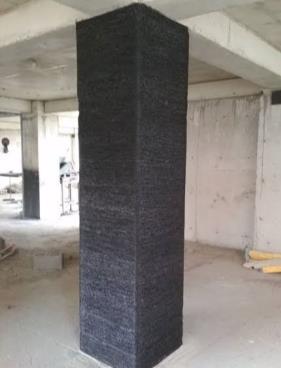
FiberReinforcedPolymer(FRP)havebeenusedintheform ofexternalwrappingsuchthatitwillstrengthentheexisting structure.Significantresearchesarebeingcarriedoutinthis fieldforthepastfewdecades,astheneedforstrengthening hasbeengrown rapidly,andmanydesignguidelineshave beenpublishedforFiberReinforcedPolymerreinforcements includingcolumnconfinement.Themethodofapplicationof these fibers is of great importance. From the application point of view, the FRP products are placed, according to varioustechniques,suchthattheincaseofdiscretefibers they are dispersed in the matrix and fiber sheets they are wrapped around the structures. When the load is applied axially to a concrete column, there will be the lateral expansion, and it can be restrained by the effect of confinement provided by the FRP laminates. A lateral confinementpressurewillbeprovidedbyFRPwhichdelays the softening of the column under the various loading
conditions and has shown to enhance the strength and ductilityofthecolumn.
FRP,acompositematerialthatcombinesapolymermatrix withfiberswithtypicallyglass,carbon,oraramid,likewise basalt,paper,wood,orasbestosiswidelyusedinindustries such as aerospace, automotive, marine, and construction. Theresearchersinvestigatedtheeffectofwrappingconcrete cylinderswithvariousFRPmaterialsandbondingsizeson theirstrength.Theirfindingsshowedthatcriticalelements suchasthewrappingmaterial’selasticityandPoisson’sratio have a significant influence on the strength of covered concrete
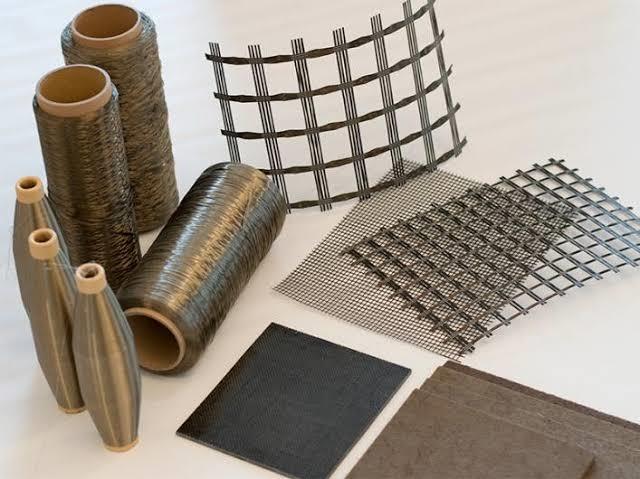
Basalt Fiber Reinforced Polymer (BFRP) composites have developed as a possible alternative to traditional construction materials because to its superior mechanical qualities,durability,longevity,andaffordability
Fibers produced from basalt are made from the natural volcanicrockbasaltusingacomplexprocessthatincludes melting,extrusion,andspinning.Theresultantfibershave great tensile strength, superior corrosion resistance, and thermal stability. Then these fibers are combined with a polymermatrix,suchasepoxyorpolyesterresin,tocreate Basaltfiberreinforcedpolymercomposites.Toacquirethe appropriate mechanical qualities, the basalt fibers are conceived with polymer resin before being cured under regulatedconditions
BFRPcompositeshaveauniquesetqualitythatmakethem appropriate structural reinforcement applications. High tensilestrength,rigidity,resiliencetocorrosionandthermal stability. Additionally, BFRP composites are lightweight, makingthemsimpletotransportandinstall.Furthermore, basalt fibers are non-toxic and non-carcinogenic, unlike typical reinforcement materials like fiberglass or carbon fiber
Duetotheusageof basaltfibersproducedfromabundant basalt rock around the world, BFRP composites provide environmentalbenefits.Unlikecarbonfibers,whichhavea large environmental footprint due to petroleum-based manufacture,basaltfibershaveasmallcarbonfootprintand arerenewable.Inaddition,BFRPcompositesarerecyclable, whichreducestheirenvironmentalimpact.
International Research Journal of Engineering and Technology (IRJET) e-ISSN: 2395-0056
Volume: 11 Issue: 06 | Jun 2024 www.irjet.net p-ISSN: 2395-0072
BFRP is being used in construction in a number of ways, offeringcreativewaystoimproveStrengtheningandother characteristics
1.Exceptional Strength-to-Weight Ratio:BFRPcomposites are stronger than steel while being much lighter, which means they are suitable for situations where weight reductionisatoppriority.
2.Unmatched Corrosion Resistance: Unlike steel, BFRP composites can withstand corrosion and degradation in extremesituationssuchasmarineorchemicalsettings.
3. Versatile Design Possibilities: BFRP composites are easily molded into complicated shapes, allowing for increaseddesigninnovationandadaptability.
4. Long-Term Cost Savings: Despite greater initial costs thansteel,BFRPcompositesoffermajorsavingsinthefuture due to its resilience, low maintenance, and increased lifespan.
5. Sustainability Focus: Basalt fiber they are made from natural, renewable materials, BFRP composites are environmentallyfriendlyandcanberecycledattheendof theirusefullife,reducinglandfillwasteandpollution.
Arathi Krishna et al. [2018] [1]
This research investigates how covering short concrete columns with BFRP jackets can improve their strength. Accordingtotheabstract,employingBFRPinsteadofsteel can reduce corrosion and increase column strength. The studyemploysexperimentsandmodelstodeterminehow effectivelyBFRPjacketsfunctioninstrengtheningcolumns. Theyincludefactorssuchaswhetherthecolumnisentirely orpartiallywrapped,aswellasthenumberofBFRPlayers used.TheresultstatesthatcoveringcolumnswithBFRPcan significantly strengthen them, particularly when fully covered. Adding more layers of BFRP to the columns can increasetheirstrength.Thestudyalsocomparestheresults toseveralmodels,discoveringthatonemodeloccasionally provides higher estimations of strength than the real experiments Overall, this research presents how BFRP jackets can additionally increase the strength of short concretecolumns.Itrecommendscompletelycoveringthe columns in BFRP for the greatest results and provides valuableinformationforengineersandresearchers.
Chiadighikaobi Paschal Chimeremeze et al. [2019] [2]
Thisstudydiscussesmakingconcretecolumnsstrongerby coating them in BFRP. It shows that while columns in structuresarecrucialforsupportingthestructure'sweight, they can weaken over time. The study assessed how well BFRPcanstrengthenconcreteblocksbymakingthemmore difficult to break. The results showed that adding BFRP increasedthestrengthandflexibilityoftheblocks.Thepaper alsoindicatesthatthefibersinBFRPmaynotalwayslineup correctly,affectinghowefficientlyitsupportsstructures.It shows that when concrete columns with BFRP age, their strengthincreases.Overall,thisstudyhelpsusunderstand how to make concrete columns stronger using BFRP, but moreresearchisneededtoknowexactlyhowwellitworks indifferentsituations.
Zhiqiang Dong et al. [2023] [3]
The research describes a unique composite technique for enhancetheperformanceofconcretecolumnsbycombining high-density polyethylene (HDPE) and fiber-reinforced polymer(FRP)confinementwithrubberconcretefilling.The work uses extensive experimental testing and theoretical modelingtoevaluatetheeffectsofcriticalvariablessuchas HDPEtubediameter,FRPsheetlayers,andrubberparticle addition on the compressive strength and deformation capacityofthespecimens.Theresultsshowthatthehybrid confinementsystemimprovestheloadcapacityandductility ofconcretecolumns,especiallyinearthquake-proneareas. While the work presents the results and practical consequences clearly, From the recommendation for developmentareenhancingfigureandtableclarity,diving deeper into model assumptions, and expanding on future researchpossibilities Overall,theworkprovidesexcellent
International Research Journal of Engineering and Technology (IRJET) e-ISSN: 2395-0056
Volume: 11 Issue: 06 | Jun 2024 www.irjet.net p-ISSN: 2395-0072
insights and makes major contributions to the field of structural engineering. The study describes a novel composite technique for increasing the performance of concrete columns that incorporates high-density polyethylene (HDPE) and fiber-reinforced polymer (FRP) confinementwithrubberconcreteinfill.Thestudyemploys difficult experimental testing and theoretical modeling to evaluatetheeffectsofcrucialvariablessuchasHDPEtube diameter,FRPsheetlayers,andrubberparticleadditionon thecompressive strengthanddeformationcapacityof the specimens. The findings indicate that the hybrid confinementsystemincreasestheloadcapacityandductility ofconcretecolumns,particularlyinearthquake-proneareas. Whiletheworkeffectivelyconveystheresultsandpractical repercussions, ideas for improvement include enhancing figureandtableclarity,diggingdeeperintothemodel.
L.M. Abd el-Hafez et al. [2023] [4]
Theexperimentalstudyonbasaltfiber-reinforcedpolymers (BFRP)forstrengtheningreinforcedconcrete(RC)columns presents comprehensive findings that underscore the effectivenessofBFRPinenhancingstructuralperformance. Through systematic investigation of various parameters such as strengthening materials, techniques, and loading conditions, the study demonstrates significant improvements in energy absorption, crack propagation resistance,andload-bearingcapacity.Notably,BFRPwraps andbars,aswell ashybrid FRPsystems,showpromise in increasing the ultimate load capacity of RC columns, with substantial enhancements observed under both eccentric and concentric loading conditions. Moreover, the study highlights the importance of optimizing wrapping techniques and considering column geometry in strengthening design. The incorporation of BFRP reinforcement,particularlythroughnear-surfacemounted (NSM) techniques, is shown to greatly improve column behavior, further emphasizing the potential of BFRP in enhancing structural resilience. Overall, the research providesvaluableinsightsintotheapplicationofBFRPinRC column strengthening, with implications for advancing structuralperformanceanddurabilityinpractice.
Tejash Pate et al. [2018] [5]
The research conducts a thorough examination of 13 different column types, evaluating their work in different strengthening approaches, including FRP wrapping. It indicatesthatFRPwrappinggreatlyimprovesaxialloadand displacementcapacity,withfullywrappedcolumnsfailing primarily due to ruptures in the FRP material. The study further stresses the effectiveness of partial top and topbottom strengthening methods, demonstrating significant increasesinload-carryingcapacityanddisplacementcontrol overnon-strengthenedorpartiallystrengthenedcolumns. Furthermore,theaxialstress-strainbehaviorisinvestigated, revealingdiscretephasesandtrendsthatmatchtovarious strengthening configurations. Importantly, the work
validatestheaccuracyofpredictionmodels,demonstrating theirutilityinbuildingFRP-confinedRCcolumns.Notably, the results indicate that BFRP materials have comparable performancetoGFRPatapotentiallylowercost,makingita compelling choice for practical applications. Overall, the paperprovidesvaluable knowledge intothe behaviorand strengtheningofRCcolumns,offeringpracticalimplications forstructuralengineeringpractice.
Sayed Abd El-Baky [2021] [6]
ThisexperimentalstudyinvestigatestheaxialbehaviorofRC columns reinforced with either steel or Basalt Fiber Reinforced Polymer (BFRP) bars. The research design is strong,withthreeRCcolumnsevaluatedundercompression loadingtofailure,eachhavingasquarecross-sectionof200 mm width and 2000 mm height. Key aspects such as reinforcementtypeandloadeccentricity(bothcentricand non-centric,withatinyeccentricityof5cm)arethoroughly considered, resulting in a comprehensive analysis of the columnsperformanceundervariousscenarios.Thestudy's findings show a number of key discoveries. To begin, it is found that utilizing BFRP bars results in a minor loss in column load capacity when compared to typical steel reinforcement.However,BFRPbarsreduceaxialshortening inthestudiedcolumns,indicatingpossiblebenefitsforlongtermstructuralstabilityandlongevity.Also,thestudyshows that BFRP bars cause higher strain levels in the main reinforcement than typical columns, which could have ramifications for design and structural behavior. Furthermore,thestudyhighlightstheinfluenceofeccentric loading,demonstratingasignificantdropinloadcapacityfor BFRP bar specimens under such conditions, showing limitationsinspecificloadingscenarios.Overall,thisstudy sheds light on the utilization of BFRP bars in RC columns, highlighting both advantages and limits over typical steel reinforcement.Thefindingsaddtothebodyofknowledge about alternative reinforcement materials in structural engineering and offer engineers and designers practical advice when deciding whether BFRP bars are suitable for specific structural applications. More study might look at additional characteristics and loading circumstances to betterunderstandthebehaviorofBFRP-reinforcedcolumns and maximize their performance in practical engineering applications.
Basedonevaluationsofnumerousstudiesonenhancingthe strengthofconcretecolumnswithfiber-reinforcedpolymers (FRP), it is clear that these techniques have immense potentialtoimprovestructuralperformance.ArathiKrishna etal.(2018)andChiadighikaobiPaschalChimeremezeetal. (2019) both emphasize the efficiency of Basalt Fiber ReinforcedPolymer(BFRP)inreinforcingcolumns,although furtherstudyisneededtofullycomprehenditspossibilities. Zhiqiang Dong et al. (2023) present a unique composite approach that incorporates high-density polyethylene
International Research Journal of Engineering and Technology (IRJET) e-ISSN: 2395-0056
Volume: 11 Issue: 06 | Jun 2024 www.irjet.net p-ISSN: 2395-0072
(HDPE) with FRP, with promising results, particularly in earthquake-prone areas. L.M. Abd el-Hafez et al. (2023) underlinethefulladvantagesofBFRPintermsofstructural resilienceandload-bearingcapacityTejashPateetal.(2018) investigate the performance of various strengthening methods, verifying the efficacy of FRP wrapping and emphasizing the potential economic benefits of BFRP materials. Collectively, these studies highlight the significance of FRP technologies in developing structural engineeringpractice,withBFRPemergingasaparticularly promising approach for increasing the strength and durabilityofconcretecolumns.
[1] ArathiKrishna,MiluMaryJacob,K.SaravanaRajaMohan “Experimental Study on Strengthening of RC Short Columns with BFRP Sheets”, International Journal of Engineering&Technology-2018.
[2] Chiadighikaobi Paschal Chimeremeze “Assessment of Compression strength of Concrete Columns Confined withBasaltFibreReinforcedPolymer”,MATECWebof Conferences·2019.
[3] TianhaoHan,JianghaoJi,ZhiqiangDong,HongZhu,Gang Wu “Compression behavior of concrete columns strengthened by a hybrid BFRP/HDPE tube coupled with a crumb rubber concrete cladding layer”, ScienceDirect-2019.
[4] Sayed Abd El-Baky, Sameh Yehia, Arafa M. A. Ibrahim and Abdullah Moubarak “Behavior of Columns Reinforced with BFRP Bars in case of Centric and EccentricConditions”,InternationalJournalofScientific &EngineeringResearch-2021.
[5] Tejash Patel, Sanjay Salla, Sandip Vasanwala and Chetankumar Modhera “Strengthened of a Square RC Columns using BFRP and GFRP: The Experimental Investigations”TRENDSINSCIENCES-2022.
[6] AsaadM.H.Kadhim,HeshamA.Numan,andMustafaO¨ zakça “Flexural Strengthening and Rehabilitation of Reinforced Concrete Beam Using BFRP Composites: FiniteElementApproach”-2019.
[7] Ling Zhou, Qing Liu, Shengqiang Ma and Xia Han “EccentriccompressionbehavioroflongPoplarcolumns externallyreinforcedbyBFRP”JournalofWoodScience2021.
[8] SaraKadhimandMustafaOzakça“Flexuralperformance ofRCbeamsexternallystrengthenedwithasingle-layer of basalt fiber reinforced polymer sheets” Green CompositesforStructuralApplications-OriginalArticle2022.
[9] Adnan AL-Sabahi. “Behavior of Reinforced concrete columns strengthened with ferrocement under compression load “, world journal of engineering and technology”,(2016).
[10] CemYalcinandOsmankaya“experimentalstudyonthe behavior of reinforced concrete columns using FRP materials”,(2004).


SuryaKU(1BI22CSE14) M-techStudent DepartmentofCivilEngineering BangaloreInstituteofTechnology suryakugowda@gmail.com
KVMaheshChandra AssistantProfessor Department of Civil Engineering BangaloreInstituteofTechnology maheshchandrakv@bitbangalore .edu.in