
International Research Journal of Engineering and Technology (IRJET) e-ISSN:2395-0056
Volume: 11 Issue: 06 | Jun 2024 www.irjet.net p-ISSN:2395-0072
International Research Journal of Engineering and Technology (IRJET) e-ISSN:2395-0056
Volume: 11 Issue: 06 | Jun 2024 www.irjet.net p-ISSN:2395-0072
Akshay Rathod, Pranav Muley, Mrs. Aparna More
ENTC Department pes Modern collge of engineering, Pune
Abstract – An electronic commutation system, as opposed to a mechanical commutator and brushes, powers a brushless DC (BLDC) motor, which is a synchronous electric motor that runs on direct current (DC) electricity. In BLDC motors, current to torque and voltage to rpm have linear relationship. This linearity provides an excellent opportunity to use the BLDC motor in conventional ceiling fans. This project seeks to practically implement a BLDC motor as a ceiling fan and introduce several BLDC fan speed control methods. This fan is implemented with three different modes of operations-manual mode, auto mode, remote control mode. In manual mode, speed is controlled by potentiometer. In Auto mode, the speed of fan is automatically changed as per room temperature, for this LM35 sensor is used. In Remote control, mode the speed can be adjusted by remote controller device. IR sensor is used for remote control operation.
Keywords-Brushless DC (BLDC) motors, ceiling fans, energy efficiency, electronic switch controller
Inthefast-growingeraof21st centurywherepowerconsumptionisatitspeakduetoheavyindustrialrevolutionization andurbanizationinIndia,lotofpowerisconsumedascomparedtoitsgeneration.Tocounterthis,fanswithBLDCwere introduced, so as to generate a greater output with very less input power. According to recent studies residential sector hasbecome the topmost powerconsumingsector due tovarious factorslike day-dayhome appliances.After a thorough studyonresidentialpoweruses,ithasbeendiscoveredthataloneceilingfanconsumes7%oftotalpowersupplywhichis morethancombinedpowerconsumedbyTVandfridge Themainpurposeofourprojecttoreducepowerconsumptionof fanby50%withoutinterruptingtheperformanceandfeatures.
AbrushlessDC(BLDC)motorisasynchronouselectricmotorthatoperatesondirectcurrent(DC)electricityandfeatures anelectroniccommutationmechanisminplaceofamechanicalcommutatorandbrushes.Currenttotorqueandvoltageto rpminBLDCmotorsarelinearlyrelated.ThislinearityoffersagreatchancetoemployBLDCmotorsintraditionalceiling fans. This study offers the actual power measurements in contrast to ordinary ceiling fans, as well as the practical installationofsuchBLDCmotorforceilingfanapplication.
In[1],V.Champa etal.highlightsthedrawbacksofinductionmotor(IM)ceilingfans,suchasconsumption of powerand limitedcontrol.BLDCmotorsareintroducedasasolution,offeringenergyefficiency,reliability,andprecisespeedcontrol. Adopting BLDC ceiling fans in homes can save a significant amount of energy; high voltage BLDC fans with active boost powerfactorcorrection(PFC)forincreasedefficiencyarethesubjectofthisdiscussion.theBLDCmotorcontrolschemes, distinguishingbetweensensor-basedandsensor-lessmethodsTechniquesforalignandgo,sluggishfirstcycle,andinitial positiondetectionareamongthemanysensor-lesscontrolapproachescoveredindetail.Thefeaturesofsensor-basedand sensor-lessBLDCmotorcontrolarecomparedinatable.
In [2], Tahir Izhar et al. The global energy crisis and the need for energy efficiency and conservation at both micro and macrolevels aredescribed.Itemphasizestheimportanceofintegratingenergy-efficienttechnologiesinto basicdomestic electrical appliances, with a specific focus on ceiling fans. Conventional ceiling fans with single-phase induction motors consume a significant amount of electricity, approximately 80 watts. These fans contribute significantly to residential electricityconsumption,especiallyinwarmerregions.
In[3],SushrutManuSingh etal.TheperformanceofaregulatedrectifierwithseveralDC-DCconverter-basedsystemsin order to determine how effective it is in driving a Brush less DC (BLDC) motor for ceiling fans. The suggested model includes proportional-resonant (PR) control for the rectifier and closed-loop control for the BLDC motor, which includes speed and hysteresis current regulation. To validate the suggested model, the study comprises simulations run on the MATLAB/SIMULINK platform. The outcomes show increased speed and torque control throughout a range, as well as an improved power factor. Brushless DC motors are becoming more and more popular for use in electric vehicles, HVAC
International Research Journal of Engineering and Technology (IRJET) e-ISSN:2395-0056
Volume: 11 Issue: 06 | Jun 2024 www.irjet.net p-ISSN:2395-0072
systems, and ceiling fans because of their good torque-to-weight ratio, excellent speed control, and great efficiency. The studyemphasizestherequirementforenergy-efficientceilingfanmotorsolutions
In [4], Stefan Leitner et al, introduces a novel design for an outer-rotor BLDC claw-pole motor, specifically designed for sub-fractionalhorsepowerfanapplications.Traditionalskewingtechniquesusedtoreducecoggingtorqueinsuchmotors often result in undesirable axial magnetic forces, leading to noise and reduced bearing system lifetimes. The proposed designemploys V-shapedclaw-poles,enablingcoggingtorquereductionthroughskewing while balancingaxial magnetic forces.Unlikeothertechniques,thesedesignimprovementscanbeincorporatedwithoutincreasingmanufacturingcosts. Thisisparticularlyimportantforcost-sensitiveapplicationssuchasautomotiveauxiliarydrives.
In[5],GuoqinWangetal.ThedesignofaBrushlessDirectCurrent(BLDC)controllerforanautomobileenginecoolingfan systemwithindependentintellectualproperty isalsoused Thecontrollerisdesignedtocontrolafour-phasesensorless BLDCmotorwithbifilarwindings.Itutilizesahalf-wavecircuit,whichprovideshightorqueperformancecomparabletoa full-bridge circuit, but with lower cost, higher efficiency, and greater reliability. The controller employs a multi-task operation algorithm designed for automotive electronic control systems. This algorithm separates tasks such as out-ofstep protection, over-current protection, over/under-voltage protection, open/short circuit protection, and communicationdiagnostics basedontheir priorityand utilizestime-basedmulti-task operationto ensurehigh reliability andreal-timeperformance.
ThecapacitytocontrolspeedoverawiderangeisaBLDCmotor'smostnotablecharacteristic.Therearevariouswaysto regulatethespeed.
Mode Choice
Therearethreedifferentcontrolmodesthatcanadjustthefanspeed:manual,auto,andremotecontrol,whichisoperated by a switch. Every mode has benefits of its own. The pulse width from the micro controller ATmega16 to the ESC (Electronic Switch Controller) is adjusted to control speed, independent of the operating mode. The output from the microcontrollerdeterminesthespeedoftheBLDCmotor,whichiscontrolledbytheESC
1) In manual mode when operating manually, the potentiometer is used to modify the pulse width from the micro controller,whichinturncontrolsthespeed.Throughthe potentiometer,thereferencevoltagecanbeadjusted tocontrol thepulsewidth.
Onecanregulatethemotor'sspeedbyadjustingthepulsewidth.
2)SetinAuto
TheLM35temperaturesensorisutilizedinautomode. Itmeasuresthetemperatureof the room andadjuststheLM35's output voltage accordingly, which modifies the micro controller's input. When working manually, the micro controller's pulse width is adjusted using the potentiometer, which then regulates the speed. The pulse width can be controlled by varying the reference voltage via the Potentiometer. The pulse width can be adjusted to control the motor's speed. regulated by varying the pulse from the microcontroller; in this case, a change in ambient temperature will alter the LM35'soutputvoltage,whichwillalterthemicrocontroller'spulsewidth.Themicrocontrollerisconfiguredtodetectthese modifications.
3)ModeofRemoteControl
When in remote control mode, an IR Sensor is utilized for wireless control and a remote controller regulates the operatingspeed.Therearetwoswitchesontheremote controllerforcontrollingspeed:upanddownswitchesusedforregulatingtheoperatingspeed.
ControllingSpeedofmotor:
Speed(RPM)=Power( ) Voltage(V)
International Research Journal of Engineering and Technology (IRJET) e-ISSN:2395-0056
Volume: 11 Issue: 06 | Jun 2024 www.irjet.net p-ISSN:2395-0072
If we want the motor to spin at 1400 RPM, we need to apply a voltage of 1 volt (1400 KV × 1V = 1400 RPM 1400 KV×1 V=1400RPM).
Ifwewantthemotortospinat7000RPM, weneedto applya voltageof5volts(1400KV ×5V= 7000RPM1400KV×5 V=7000RPM).
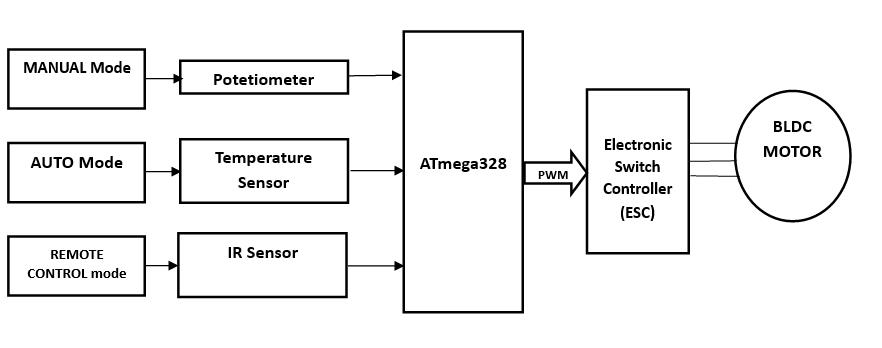
The aim of this project is to develop an energy-efficient fan using BLDC motor, with different modes of speed control. Thismodelcomprisesofmotoringpart,microcontrollerpartandcontrollingpart. Figure4.1showstheblockdiagramof theimplementedsystem.
Motoring part includes BLDC motor (1400KV). The speed of the motor is controlled by an ESC (Electronic Speed Controller).Thespeedofthemotorvariesaccordingtothevariationinthepulsewidthofthemicrocontroller.
Atmega16microcontrollerisprogrammedforgeneratingpulseswhichisfurthervariedwiththeinputcontrolsignal.
The controlling part has three sections such as potentiometer, an LM35 temperature control and a RF module, among whichanyofthemodescanbeselectedaccordingtotherequirementofuser.
The model is implemented with three modes of working- manual mode, automatic mode and remote control mode. In manual mode, speed can be controlled by adjusting a potentiometer. In auto mode, speed is automatically controlled accordingtotheroomtemperaturewiththehelpofatemperaturesensorwherethesensorsensestheroomtemperature and compares it with the reference temperature. Speed is varied according to the difference between the two temperatures-reference and room temperatures. In remote control mode operation, speed can be adjusted by using a remotecontrollercontrolwithIRsensor
1.UnderstandingBLDCTechnologyBrushLessDCMotors(BLDC):UnlikeconventionalbrushedDCmotors,BLDCmotors useelectroniccommutationinsteadofmechanicalbrushes.This resultsinhigherefficiency,lessmaintenance,andlonger life.
2.KeyComponentsofaBLDCFan
Motor:TheheartoftheBLDCfan,whereefficiencygainsaremostsignificant.
ElectronicController:Managesthecommutationelectronicallyandoptimizespowerusage.
FanBlades:Aerodynamicdesigntoreduceairresistanceandnoise.Ensuresoptimalairflowandminimalvibration.
3.DesignConsiderations
International Research Journal of Engineering and Technology (IRJET) e-ISSN:2395-0056
Volume: 11 Issue: 06 | Jun 2024 www.irjet.net p-ISSN:2395-0072
ElectronicController:
CommutationControl:ImplementefficientalgorithmslikeField-OrientedControl(FOC)forprecisemotorcontrol.
PWMTechniques:UsePulseWidthModulation(PWM)toefficientlyregulatemotorspeed.
SensorlessControl:Iffeasible,implementsensorlesscontroltoreducecomplexityandcost.
AerodynamicDesign:
BladeShape:Optimizethebladeshapeforminimaldragandmaximalairflow.
Material:Uselightweight,durablematerialslikecompositestoenhanceefficiency.
AngleofAttack:Adjustthebladepitchforoptimalperformanceatvariousspeeds.
4.PrototypingandTesting
Prototyping:Buildprototypesbasedontheoptimizeddesigns.
PerformanceTesting:Measureefficiency,airflow,noiselevels,anddurability.
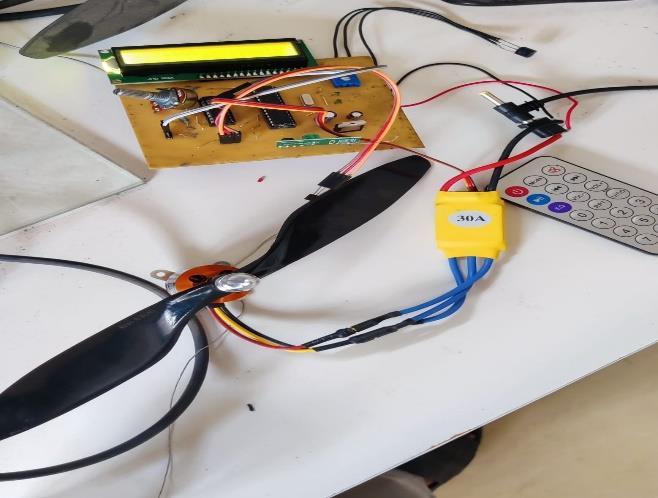
Thisprojectincludesafanwiththreedifferentmodes.manualmode,automatedmodeandremotecontrolmodethatcan beusedtochangethespeedoftheBLDCmotor.Thisenergyefficientfanallowsforvariablespeedcontrol,dependingon the user's preference using various approaches. The speed can change by adjusting the duty cycle of the waveform. The dutycyclecanbeadjustedusingthreedifferentmethodsmanually.BrushlessDCmotorsarefrequentlymoreeffectivein turningelectricalenergyintomechanicalenergy.BrushedDCmotorsarelessefficientatconverting electricalenergyinto mechanicalenergycomparedtobrushlessDCmotors.ACmotorsexperiencesignificantelectricalandfrictionallosses.
A ceiling fan solution based on BLDC motors will shed light on the current situation, the difficulties encountered in coming up with a solution, and some of the fundamental principles governing DC, BLDC, and AC motors in general. This project analyses the best technological strategy to be used for energy utilization and gives an overview of the several componentsthatmakeupthesolution.Theenergycrisis isamongtheprimaryproblemswearecurrentlyfacing. Theuse ofenergy-efficientequipmentcanhelpusconserveenergy.WehaveBLDCfansbecauseenergy-efficientfansareonesuch measurethathasasignificantfunctioninreducingthepowerconsumption.Ithasalongerlifespan,isverycompatible,and haslineartorque-speedcharacteristics
International Research Journal of Engineering and Technology (IRJET) e-ISSN:2395-0056
Volume: 11 Issue: 06 | Jun 2024 www.irjet.net p-ISSN:2395-0072
VII.REFERENCE
[1]AmitKumar,“SingleSwitchBoost-FlybackPFCConverterforBLDCMotorDriveusedinCeilingFan”,2020IEEE International Conference on Computing, Power and Communication Technologies (GUCON) Galgotias University, GreaterNoida,UP,India.Oct2-4,2020,Doi:10.1109/GUCON48875.2020.9231164
[2] Tahir Izhar,” Energy Efficient Five Phase BLDC Ceiling Fan” 2018 2nd International Conference on Energy ConservationandEfficiency(ICECE)Lahore,Pakistan,Doi:10.1109/ECE.2018.8554979
[3] Sushrut Manu Singh,” A Comparative Investigation of Single Stage and Two Stage Converters for BLDC Ceiling Fan”20222ndAsianConferenceonInnovationinTechnology(ASIANCON)Pune,India.Aug26-28,2022.Doi: 978-16654-6851-0/22/
[4]StefanLeitner,”Low-CostBLDCClaw-PoleMotorDesignforFanApplicationswithReducedCoggingTorqueand BalancedAxialForces”2020IEEEAppliedPowerElectronicsConferenceandExposition(APEC)NewOrleans,LA,USA Doi:10.1109/APEC39645.2020.9124114
[5]Jun-HyukChoi,”OntheFeasibilityoftheBrushlessDC(BLDC)MotorandControllerfor42VAutomotiveCooling Fan System” 2007 IEEE International Electric Machines & Drives Conference Antalya, Turkey, Doi: 10.1109/IEMDC.2007.383625
[6]AnchalSaxena,”PerformanceandCostComparisonofPMBLDCmotorsforCeilingFan”2014IEEEInternational ConferenceonPowerElectronics,DrivesandEnergySystems(PEDES)Doi:
[7] Meihua Xu,” High Efficient BLDC Controller for Automobile Cooling Fan” 2010 International Conference on IntelligentSystemDesignandEngineeringApplicationDoi:
[8] Vashist Bist,” A Single Sensor Based PFC Zeta Converter Fed BLDC Motor Drive for Fan Applications” IEEE CIEP’96,2019,pp.132-137Doi:978-1-4673-0766-6/12/$31.00
[9] S Veeraraghavan,” Experimental studies and performance evaluation of Solar PV powered BLDC motor drive with an integrated MPPT in fan applications” IEEE Conference on Industrial Electronics and Applications (ICIEA), 2011June21-232018.doi:978-1-4799-4398-2/14/$31.00
[10]UtkarshSharma,”BLDCMotorCeilingFanUsingaBridgelessIsolatedPFCSEPICConverter”IEEETransactions onIndustrialInformatics,vol.14,no.11,pp.4895-4904,Nov.2018.doi:978-1-7281-6664-3/20/$31.00
[11]KRRajagopal,”DevelopmentofExternalRotorSingle-PhasePMBLDCMotorBasedDriveforCeilingFan”IEEE PESC’04,vol.3,pp.2277–2281,20-25June2004,Aachen,Germany.Doi:978-1-4244-7781-4/10/$26.00
[12] Kaveh Razzaghi,” A Novel Method for Measuring Rotational Speed of BLDC Motors Using Voltage Feedback; IEEE International Conference on Systems, Man and Cybernetics, pp. 473-478, 2019.doi: 978-1-4673-16903/12/$31.00
[13] Dahaman Ishak,” Improved Speed Operation of Sensor less BLDC Motor Drives Using IIR Digital Filter” IEEE Transaction.IndustrialApplication.,Vol.39,no.6,pp.1730–1740Nov./Dec.2003.doi:978-1-4244-8946-6/10/$26.00
[14]MichaelBufe,”BLDCMotorforFanApplicationwithAutomaticallyOptimized CommutationAngle”201935th AnnualIEEEPowerElectronicsSpecialistsConference.Doi:0-7803-8399-0/04/$20.00
[15]GuoqinWang,” HighEfficientBLDCController forAutomobileCoolingFan” 2016International Conferenceon IntelligentSystemDesignandEngineeringApplication.Doi:978-0-7695-4212-6/10$26.00
[16]S.Manoharan,”AReviewofIndianScenarioonEnergyConservationinCeilingFansPoweredbyBLDCMotors” 2021InnovationsinPowerandAdvancedComputingTechnologies(I-PACT).Doi:978-1-6654-2691-6/21/$31.00
[17] V. Champa,” Development of speed control for High Voltage BLDC ceiling fan using Regulator” 2021 IEEE MysoreSubSectionInternationalConference.Doi:978-0-7381-4662-1/21/$31.00
International Research Journal of Engineering and Technology (IRJET) e-ISSN:2395-0056
Volume: 11 Issue: 06 | Jun 2024 www.irjet.net p-ISSN:2395-0072
[18] Kunihisa Tashiro,” Numerical Analysis of Brushless DC Motor for Indoor High Volume Low Speed Fan” 2021 IEEEIndustrialElectronicsandApplicationsConference(IEACon). Doi:978-1-7281-9253-6/21/$31.00
[19]StefanLeitner,”NovelBentSteelSheetStripBasedTwo-PoleSingle-PhaseBLDCMotorTopologyforLow-Cost Fan Applications” IEEE Transactions on Industry Applications, vol. 56, no. 4, pp. 3679–3690, 2020.Doi: 978-1-72815135-9/21/$31.00
[20] Jiang Sun, “Current spike and efficiency optimization by using dynamic model of open-loop voltage mode single-phase BLDC cooling fan motor” 2017 IEEE 2nd Information Technology, Networking, Electronic and AutomationControlConference(ITNEC)Chengdu,China,Doi:10.1109/ITNEC.2017.8284968