
International Research Journal of Engineering and Technology (IRJET) e-ISSN: 2395-0056
Volume: 11 Issue: 06 | Jun 2024 www.irjet.net p-ISSN: 2395-0072

International Research Journal of Engineering and Technology (IRJET) e-ISSN: 2395-0056
Volume: 11 Issue: 06 | Jun 2024 www.irjet.net p-ISSN: 2395-0072
1Assistant Professor, Department of Computer Science and Engineering, EASA College of Engineering and Technology, Coimbatore, Tamil Nadu, India
2Assistant Professor, Department of Artificial Intelligence and Data Science, Kathir College of Engineering, Coimbatore, Tamil Nadu, India
3Assistant Professor, Department of Computer Science and Engineering, EASA College of Engineering and Technology, Coimbatore, Tamil Nadu, India
Abstract: This paper introduces an efficient method for extracting key events from sports videos by leveraging scoreboard detection. The approach involves training a supervisedlearning-basedobject detectionalgorithm(YOLO) on a dataset of 1200 images. Once the scoreboard is detected in video frames, it is cropped out, and image processing techniques are applied to reduce noise. An Optical Character Recognizer (OCR) extracts the score, and a rule-based algorithm generates precise timestamps for critical moments during the game. The proposed method achieves an average F1 Score of 0.979 across different sports, making it valuable for sports analysis. This implementation is in Python 3.7.
Index Terms - Automatic Key-Event Extraction, Sports Videos, Scoreboard Detection, YOLO (You Only Look Once), Image Processing, Optical Character Recognizer (OCR), Timestamp Generation.
TheEntertainmentIndustryandSportsVideosSportsplaya significant role in the entertainment industry, attracting a vastaudienceworldwide.Withtheincreasingaccessibilityof theinternet,sportsviewershiphassurged.However,many individualsstruggletofindtimetowatchfull-lengthmatches due to their busy lives. As a result, there is a growing preference for shorter, summarized versions of sports events.Manualsummarizationorhighlightgenerationisa labor-intensive process that requires professional video editing tools. Unfortunately, this approach imposes limitations on the amount of video footage that can be effectivelysummarizedwithinagiventimeframe.
Someofthepreviousworkinthisareaincludesthe use of ORB (Oriented Fast, Rotated Brief) to identify BRS (bowler run sequence) in cricket and classify them as important [1]. Pushkar Shukla et al. In [3], they used the intensity of the operator's gestures to determine the occurrence of events. A. Javed et al. wicket). Extracting featuresfromfootballvideosforcontentusing3DCNN(3D convolutional neural network) and LSTM (long-term
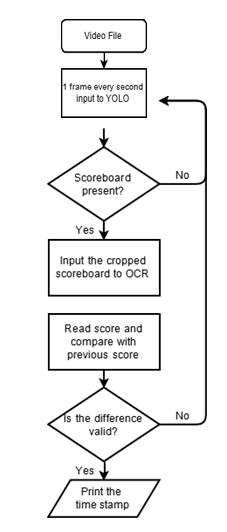
memory)[5]and[6].Shingrakhiaetal.(network).J.Yuetal. Althoughthesearenewtechniques,theyallfocusonasingle aspectforthesubjectandaredifficulttotranslatetoother movements. Others, such as P. Kathirvel and others, have attemptedtogeneralizeacrossdifferentsports.Thisworks for games that don't require a whistle or for background noiseetc.Itfailswhenthewhistlecannotbeheardduetothe neural network works and uses it to identify important events in the game called Kendo (Japanese fencing). This includes cricket, football etc. It doesn't work very well in multiplayer games like. In this paper, we propose a computationally cheap method to extract outcome-based valuesfromascoreboardaboutagame.CallYOLOandtrain ittodeterminethedesiredscoreofthegame.Wethenruna sampleofimagestakenfromthemovieataframerateofone framepersecondandrunOCRonthemtokeeptrackofthe scores.Ifthescoreischangedbysomeforwardincrement (for example, in a baseball match), the increment of the variable score will be set to 4/6 and the increment of the wicket difference will be set to 1 because the difference between the wicket1 indicates that it is an event and therefore should occur in the context of the match. In football, the delta will appear during the match and the incrementwillbeclosedcorrectly.Ourmodelisverysimple, onlyneed250-300pointsoffootagetotrainandanyonecan useitforanysportsvideousingthemethodwithknowledge ofsportstoadjustthetimeincrement.Theremainderofthis articleisorganizedasfollows.Section3describesYOLOand whywechose YOLO, Section4 presentsthe methodology, Section5presentstheresultsandperformanceofourmodel, and finally Section 6 presents conclusions and limitations/futurework.
2.1.1 COMPARISONOFOBJECTDETECTIONALGORITHMS
TherearemanytargetdetectionalgorithmssuchasR-CNN [12],FasterR-CNN[13],andYOLO.Inthissection,wewill discuss the reasons why we prefer YOLO. This is done by showingotheralgorithms,theirlimitations,andhowYOLO addresses/overcomes these limitations. Region based convolutionNeuralNetwork(R-CNN):Theaimistodivide
International Research Journal of Engineering and Technology (IRJET) e-ISSN: 2395-0056
Volume: 11 Issue: 06 | Jun 2024 www.irjet.net p-ISSN: 2395-0072
theimageinto2000smallareasandthenfindtheobjectsin eachareaandalsoaddthedistancestoimprovethereality. Limitations:Ittakesalotoftimetorank2000sites.Itisnot applicable for instant detection as each image requires approximately47secondsprocessing(classification).Faster R-CNN:Thenetworkitselflearnsregionalrecommendations. ItisfasterthanR-CNNand R-CNN[14],but thealgorithmis stillnotsuitableintermsofperformance.Itcanbeseenthat almosteveryalgorithmreliesonthreetaskstoachievethe detectiongoal:1)UsetheRegionalRecommendationmethod tocreatepotentialboundingboxesintheimage.2)Runthe classifierontheseboxes.3).ThisiswhereYOLOcomesinto play. Predict bounding boxes and probability using a convolutional neural network. Predictions with the threshold(maximumIOU)areconsidereddetectionandthe rest are discarded. It is currently the fastest algorithm available, with a speed of approximately 45 frames per second.Limitation:Duetothelimitedspaceofthealgorithm, thealgorithmcannotdetectsmallobjects.
ThealgorithmdividestheinputimageintoanS×Sgrid.If thecenterofanobjectfallsintoagridcell,thatgridcellis responsiblefordetectingthatobject.Eachgridcellpredictsa fixednumberofboundaryboxesandconfidencescoresfor thoseboxestolocatetheobject.Trainingdataisabounding box along with the class label(s). This is referred to as ’groundtruthbox’,Grid-BasedDetection:1)YOLOdivides the input image into an S × S grid. 2) Each grid cell is responsible for detecting objects that fall within its boundaries.3)Ifthecenterofanobjectfallsintoagridcell, thatcellistaskedwithdetectingthatobject.BoundingBox Prediction: 1) For each grid cell, YOLO predicts a fixed numberofboundingboxes(rectangularregions)andtheir associated confidence scores. 2) These bounding boxes represent potential object locations. 3) The predicted boundingboxesincludeinformationaboutthemidpoint(bx, by),height(bh),andwidth(bw).ClassPrediction:1)YOLO alsopredictsclassprobabilitiesforeachdetectedbox.2)It assignsaclasslabel(e.g.,“person,”“car,”“soccerball”)tothe detectedobject.3)Theclassprobabilitiesarerepresentedby thevectorcn,wherencorrespondstothenumberofobject classesthemodelcandetect.LinearActivationFunction:1) YOLOusesalinearactivationfunctionforthefinallayer.2) Forotherlayers,itemploysaleakyrectifiedlinearactivation function. Loss Function: 1) YOLO calculates the loss using sum-squarederrorbetweenpredictionsandgroundtruth.2) Thelossfunctionincludesthreecomponents: Classification Loss: Squared error of class conditional probabilities for eachclass. Localization Loss: Measureserrorsinpredicted boundaryboxlocationsandsizes(consideringonlythebox responsible for detecting the object). Confidence Loss: Associatedwiththeconfidencescoreforeachboundingbox predictor.Thefinallosscombinesthesecomponents.
The model was trained using a list of different scores consisting of approximately 250 to 300 images (a total of approximately 1300 images were used for one category) [16].Ofthe300imagesinagroup,approximately200to240 wereusedastrainingdataandtheremainingimageswere usedastesting/validationdata.Percentageofdataisused fortrainingand20%isusedforvalidation.Themodelwas trainedapproximately11timeswithsizesetto4andIOUset to0.5(outof11times,eachmodeldroppedbelow 1).Atotal of3modelsaretrained(usingpre-trainedmodelsprovided byImageAIandretrainingthem),1foreachgame(cricket, football,kabaddi).1.Thescoreformatusing250imagescan produceverygoodresults.
UsingOpenCVwecanextractoneframepersecondfroma video sequence (e.g. 1 in 30 frames per second for 30FPS video)andfeeditintothemodel.Whetherthesampleoutput imagecontainsscores Ifso, return the combination ofthe image'sscores.Therateofthefeedimageiskeptat1frame persecondofthevideosequencesothattheerrorbetween theoutputtimeoftheeventandthecorrecttimestampofthe eventismorethan1second.Althoughalowervaluereduces jobcomplexityandimprovesperformance,itstillcausesthe mosterrors;forexampleavalueof0.2framespersecondin a video interval or an interval of 1 image per second > 5 secondswillresultinamaximumerrorof5secondswhichis unacceptable.
Ifthemodelfindsthescoreintheimage,thescorewillbe deducted from the image. Then, the following image operationswillbeperformedonthe imageobtainedfrom thescore:usethresholdtoconverttheimagetobinary,find thecontoursoftheimageanddefinetheROI(imageregion) around each contour as separate contours, crop the areas fromtheimagetocreateseparateimages,eachcontaining1 numberorsymbol.Alltheseregionsarefedtothetrained OCR [17], which returns the score in the current frame. TherearemanyOCRsontheinternet,butnoneofthemgive goodresultsinreadingthescoresbecauseaftercroppingthe score image becomes smaller and hence the resolution issues decrease. Therefore, we trained a convolutional neuralnetwork(includingthehiddenlayer)onthe5code setsusedinthisproject.Thismeansthattheclassification accuracy of OCR goes from zero to almost 100%. The standard model has 1 CNN layer, the filter size is 40, the hidden layer has 128 neurons, the kernel size is 3x3, the model is trained using adam optimizer and sparse classificationcrossentropylossfunction.Themodelhas14 neuronsintheoutputlayer,correspondingtothe14groups ofcharactersthatitcanrecognize,whicharenumbers(0,1,
International Research Journal of Engineering and Technology (IRJET) e-ISSN: 2395-0056
Volume: 11 Issue: 06 | Jun 2024 www.irjet.net p-ISSN: 2395-0072
2, 3, 4, 5, 6, 7, 8, 9) and the training scores. There are the followingspecialcharacters:‘|’,‘P’,‘-‘and‘:’(Thecharacters ‘|’, ‘-‘and‘:’arereservedinthegenericsandthesymbol"P" means:apowerplayincricket.
1. Before processing the video, 10 frames (each taken30secondsapart)areextractedfromthe video and fed toYOLO.Theoutputlocationsof these 10 frames are averaged to get a tighter boundonthescoreboard.
2. A threshold on the minimum size of individual contoursisusedtoeliminategranularnoise.
3. Regular Expression pattern matching is used to eliminaterandomscoressuchas12-3-0.
3.5 RegEx
A RegEx, or Regular Expression, is a special sequence of charactersthathelpsyoumatchorfindotherstringsorsets ofstrings,usingaspecializedsyntaxheldinapattern[18]. RegExcanbeusedtocheckifastringcontainsthespecified pattern of characters. Regular expressions are used extensivelyforpatternmatchingeverywhere.Forexamplein onlineforms,aregularexpressionisgenerallyusedtoverify thattheemailidenteredbytheuserisavalidemailidlike so: r’([a-zA-Z0-9. ])+@(gmail|outlook|apple|live|hotmail|yahoo)(.com)’.This will match a string containing [a-zA-Z0-9. ] - any combination of characters a to z (upper and lower case), digits,periodsandunderscoresfollowedbythe@character
followedby(gmail|outlook|apple|live|hotmail|yahoo)-the emaildomainsGmail,Outlook,Apple,Live,Hotmail,yahoo followed by .com. Ifa match of the patternis foundinthe stringinputbytheuser,thenitisconsideredavalidemailid. RegEx is also used to check the strength and validity of a password,forexample,r’[a-zA-Z0-9@#&]{8,}’canbeused toonlyacceptapasswordthatisatleast8characterslong and contains only a-z (upper and lower case) digits and specialcharacters@,#,-,and&.Similarly,aphonenumber can be verified using r’(\+91)?(\d{10}|\d{8})'. This will match a string that contains only digits, is either 10 or 8 characterslong,andhasanoptional+91atthefront.
ThescoreoutputbyOCRwillbecomparedwiththescoreof the previous frameandthe difference betweenthe scores willbeusedtodeterminewhetheraneventoccurredinthe current frame as some prerequisites. For example - If the difference in a sports match is 6, 4, 3, 5 or the wicket difference is1,itisconsidered aneventandthedurationof theCustomframeshouldbedisplayedalongwiththetypeof eventthatoccurred.Usingthesetimelogs,landmarkscanbe extractedusingstaticnumbersbeforeandaftertheeventis detected (for example, 7 seconds before the event and 7 secondsaftertheevent).
4.1 Performance of Trained Scoreboard Detection Models
AllYOLOmodels(3models,1modelpergamegroup)were testedonimagesoftheirownlevelgamesusinganIOUvalue of0.5. These imagesare not part ofthetraining materials andareindifferentresolutions(between360pand1080p) toensurestandardimagequality.Theresultsareshownin Table1.
Table1:PerformanceofTrainedDetectionModels
4.2 Performance on Video Footage
The plan was tested with a total of 6 hours 35 minutes of kabaddi,footballandcricketvideoclips. Theperformance metricsusedherearePrecision,Recall,andF1Score,andthe IOUvalueissetto0.5.
© 2024, IRJET | Impact Factor value: 8.226 | ISO 9001:2008
| Page
International Research Journal of Engineering and Technology (IRJET) e-ISSN: 2395-0056
Volume: 11 Issue: 06 | Jun 2024 www.irjet.net p-ISSN: 2395-0072
Some terms related to precision, recall, and accuracy (the followingdefinitionshavebeenderivedfrom[19]):
Truepositives– Thesearethecorrectlypredictedpositive values which meansthat the actual class (ground truth)is ‘scoreboard’andthepredictedclassisalso‘scoreboard’.
Truenegatives-Thesearethecorrectlypredictednegative values which meansthat the actual class (ground truth)is ‘notscoreboard’andpredictedclassisalso‘notscoreboard’.
False positives - These are the wrongly predicted positive valueswhichmeansthattheactualclass(groundtruth)is‘no scoreboard’andpredictedclassis‘scoreboard’.
Falsenegatives-Thesearethewronglypredictednegative values which meansthat the actual class (ground truth)is ‘scoreboard’butpredictedclassin‘notscoreboard’.table1 tabletypestyles
Class Predicted: ’scoreboard’ Predicted: ’not scoreboard’
GroundTruth: ’scoreboard’
GroundTruth: ’notscoreboard’
TruePositives FalsePositives
FalseNegatives TrueNegatives
Precision is defined as the ratio of correctly predicted observations to the total predicted positive observations.
Precision= TP TP+FP
Recallisdefinedastheratioofcorrectlypredicted positive observations to the total observations in the actualclass.


5. Conclusion, Limitations and Future Work
F1 Score is defined as the weighted average of PrecisionandRecall.Therefore,thisscoretakesbothfalse positivesandfalsenegativesintoaccount.
F1Score= 2∗(Precision ∗ Recall) Precision + Recall
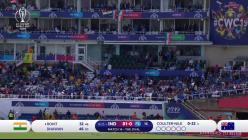
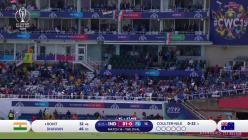
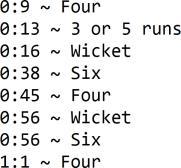
Sincethemodelanalyses1framefrom1secondofthe videosequence,thedetectedeventsarewithin1secondof their actual occurrence. Figures 2 through 11 show the working of the model by depicting imagesat different stagesofthealgorithm.
Thispaperpresentsadeeplearningmodeltorecordsports videos and display the timing of important events. It uses YOLO to analyze the score and then some python code to detecttheresult.ThemodelwasimplementedusingPython 3.7andTensorFlow1.13onacomputerrunningWindows 10 with a 1.90 GHz, Core i5-4460T CPU, 4 GB RAM. Other software used for this model includes OpenCV, Keras API, andPython'sImageAImodule.Theaverage(allgroups)F1 scoreoftheoutputis0.979.Themodelcanbetrainedand sent to other groups (for example, it can be used to write
International Research Journal of Engineering and Technology (IRJET) e-ISSN: 2395-0056
Volume: 11 Issue: 06 | Jun 2024 www.irjet.net p-ISSN: 2395-0072
instructionsforvideos).Belowwedescribethelimitationsof thecurrentimplementationanddescribefuturework:



9:CroppedScoreboard

Figure10:InputtotheOCR
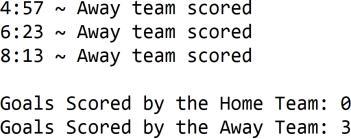
Figure11:OutputoftheAlgorithm
• AneedforcustomOCRemergedastheexisting OCRs could not detect the text or were giving falseoutput.TheOCRusedintheprojectworks onveryspecifickindsoftexts,wewouldliketo make it moregeneralized as part of a future project.
• The algorithm currently works for mp4 videos only,weplantoextendthealgorithmtoworkon differentvideoformats.
• Becauseoflimitationsofhardware,videoclips extraction was not possible and only the timestampsofkeyeventsaretheoutput. Inthe future,weplantoextractthehighlightclips.
Wealsoplantogeneralizethescoreboarddetectionmodelto detectanykindofscoreboardsoastomitigate the need to train the model on new scoreboard classes. This can be achieved by training the model on a very large image database.
Here we conclude our paper and express our heartfelt gratitude towards Professor Hansa Shingrakhia, who mentoredusthroughoutourjourney.
[1] D. Ringis and A. Pooransingh, “Automated highlight generation from cricket broadcasts usingorb,”in2015IEEEPacificRimConference on Communications, Computers and Signal Processing(PACRIM),pp.58–63,2015.
[2] P. Shukla, H. Sadana, A. Bansal, D. Verma, C. Elmadjian, B. Raman, and M. Turk, “Automatic cricket highlight generation using event-driven and excitement-based features,” in 2018 IEEE/CVF Conferenceon Computer Vision and Pattern Recognition Workshops (CVPRW), pp. 1881–18818,2018.
[3] HariR.andWilscyM.,“Eventdetectionincricket videosusingintensityprojectionprofileofumpire gestures,”in2014AnnualIEEEIndiaConference (INDICON),pp.1–6,2014.
[4] A Javed, A. Irtaza, Y. Khaliq, H. Malik, and M. Mahmood,“Replayandkey-eventsdetectionfor sports video summarization using confined elliptical local ternary patterns and extreme learningmachine,”Ap-pliedIntelligence,022019.
[5] R.Agyeman,R.Muhammad,andG.S.Choi,“Soccer videosummarizationusingdeeplearning,”in2019 IEEE Conference on Multimedia Information Processing and Retrieval (MIPR), pp. 270–273, 2019.
[6] M.Z.Khan,S.Saleem,M.A.Hassan,andM.Usman Ghanni Khan, “Learning deep c3d features for soccer video event detection,” in 2018 14th International Conference on Emerging Technologies(ICET),pp.1–6,2018.
[7] H. Shingrakhia and H. Patel, “Emperor penguin optimizedeventrecognitionandsummarization for cricket highlight generation,” Multimedia Systems,vol.26,no.6,pp.745–759,2020.
[8] H.Shingrakhia andH.Patel, “Sgrnn-amandhrfdbn:ahybridmachinelearningmodelforcricket videosummarization,” The Visual Computer, 04 2021.
[9] Y.Junqing,L.Aiping,andH.Yangliu,“Soccervideo eventdetectionbasedondeeplearning,”inMultiMediaModeling,(Cham),pp.377–389,Springer InternationalPublishing,2019.
International Research Journal of Engineering and Technology (IRJET) e-ISSN: 2395-0056
Volume: 11 Issue: 06 | Jun 2024 www.irjet.net p-ISSN: 2395-0072
[10] P. Kathirvel, M. Manikandan, and K. Soman, “Automatedrefereewhistle sounddetectionfor extraction of highlights from sports video,” International Journal of Computer Applications, vol.12,122011.
[11] A. Tejero-de-Pablos, Y. Nakashima, T. Sato, N. Yokoya,M.Linna,andE.Rahtu,“Summarization of user-generated sports video by using deep actionrecognitionfeatures,”IEEETransactionson Multimedia,vol.20,no.8,pp.2000–2011,2018.
[12] R.B.Girshick,J.Donahue,T.Darrell,andJ.Malik, “Rich feature hierarchies for accurate object detectionandsemanticsegmentation,”CoRR,vol. abs/1311.2524,2013.
[13] S.Ren,K.He,R.Girshick,andJ.Sun,“Fasterr-cnn: Towards real-time object detection with region proposal networks,” in Advances in neural informationprocessingsystems,pp.91–99,2015.
[14] R. Girshick, “Fast r-cnn,” in Proceedings of the IEEE international conference on computer vision,pp 1440–1448,2015
[15] J. Redmon and A. Farhadi, “Yolov3: An incremental improvement,”arXiv,2018.
[16] “How to train a yolo model.” https://medium.com/deepquestai/train-objectdetection-ai-with-6-lines-of-code-6d087063f6ff.
[17] “Digit recognition using cnn.” https://towardsdatascience.com/imageclassification-in-10-minutes-with-mnist-dataset54c35b77a38d.
[18] “Accuracy, precision, recall and f1 score: Interpretation of performance measures.” https://blog.exsilio.com/all/accuracy-precisionrecall-f1-score-interpretation-of-performancemeasures/.
[19] “Google colaboratory.” https://colab.research.google.com.
[20] C.Guntuboina,A.Porwal,P.Jainand,H.Shingrakhia, “Video summarization for multiple sports using deep learning,”2022 In:Proceedings of the internationale-conferenceonintelligentsystems and signal processing, vol.1370, pp643–656. doi:10.1007/978-981-16-2123-9_50.