
International Research Journal of Engineering and Technology (IRJET) e-ISSN: 2395-0056
Volume: 11 Issue: 06 | Jun 2024 www.irjet.net p-ISSN: 2395-0072

International Research Journal of Engineering and Technology (IRJET) e-ISSN: 2395-0056
Volume: 11 Issue: 06 | Jun 2024 www.irjet.net p-ISSN: 2395-0072
Abhijeet Yadav1 , Mr. Jonty Choudhary2 , Mr. Pravek Sahu3
1Research Scholar, M. Tech. (Structural Engg.)
2Assistant Professor, Department of Civil Engineering,
3Assistant Professor, Department of Civil Engineering, Jhada Sirha Government Engineering College, Jagdalpur Chhattisgarh India.
Abstract - Concrete is the most commonly utilized building material worldwide, second only to water. Among its wellknown properties are its strong compressive and tensile properties. We recommend self-curing concrete as an alternative to immersion in order to prevent water shortages because curing increases the durability of concrete. The purpose of this study is to determine the effects of adding 1% ofthe weight ofpolyethylene glycol-400asanadditivetoM30grade concrete mix. Internal curingisthemethodweusewhen exterior curing is not an option, such as in locations with limited water supplies or restricted access for humans. Internal curing, often known as self-curing, is an essential process in the formation of concrete's pore structure and microstructure.
Key Words: Conventional concrete, Self-curing concrete, Self-Curing agent PEG-400, Compressive strength, Tensile strength, Flexural strength, cost comparison.
1.INTRODUCTION:
Because it is inexpensive and has strength and durability, concreteisthemostwidelyusedbuildingmaterial.Itmaybe sized and twisted to create bridges, roads, and other infrastructure. Concrete is incredibly hard, resilient, and long-lasting.Anytypeof buildingprojectcanbenefitfrom using the most adaptable material. Concrete serves as the mainbuildingmaterialforthemajorityofcivilengineering structures.Itsgreatdurability,affordability,andeaseofonsitemanufacturingallplayapartinitswidespreaduseasa fundamental building material in construction. The development of concrete's strength, durability, and workabilityisnecessary,justlikeitiswithothertechnical materials.introductionofadmixturesofanewgeneration.It is possible to get higher grades of concrete with good workability.
Controllingthepaceandvolumeofmoisturetransferfrom concreteduringcementhydrationisknownascuring.Itcan bedoneeitherduringtheprocessofmakingconcretegoods orafterithasbeenputinplace,givingthecementtimeto hydrate.Inorderfortheconcretetoreachitsfullstrength anddurability,curingmustbedoneforasuitableamountof time, as cement hydration does take days or even weeks rather than hours. Temperature regulation may also fall
under the category of curing because it influences how quickly cement hydrates. The qualities of the concrete, its intendedapplication,andthesurroundingconditionscanall affecthowlongittakestocure.theintendedapplicationand the environmental factors, such as the surrounding atmosphere'stemperatureandrelativehumidity.
Self-curingisamethodthathelpsprovidemoremoistureto concretesothatthecementhydratesmoreeffectivelyand self-desiccates less. When compared to regular concrete, PEG-400 helps reduce water loss in the concrete and increasesitswatercapacity.Becauseappropriatemixingand placementof theconcreteresultinstrength,conventional concreterequiresexternalcuring.Normalhydrationcanbe accomplished by external curing, which involves applying water to the concrete surface. This is because it has been established that proper hydration of cement concrete projectsishighlyvitaltoachievingdurabilitycriteria.The idea behind self-curing compounds is to decrease water evaporationfromconcrete,increasingthematerial'sability to retain water in comparison to regular concrete. It was discoveredthatself-curingagentsforconcretecanbemade fromwater-solublepolymers.
2.
M-30-grade concrete contains 1% PEG-400 by weight of cement to provide strength without compromising workability.
2.1
ToexaminetheimpactofPEG-400,thecuring agent, on the strength properties of the concrete.
Analyzetheconcrete'scompressiveandtensile strengths. Based on the information, draw conclusions regarding the compressive and tensile strengths of conventional and selfcuringconcrete.
Our project's primary goal is to produce concretewithlesswaterwhilemaintainingits simplicity of use and strength-boosting properties.
International Research Journal of Engineering and Technology (IRJET) e-ISSN: 2395-0056
Volume: 11 Issue: 06 | Jun 2024 www.irjet.net p-ISSN: 2395-0072
Azhagarsamy and Sundaraman 2016 studiedthe strengthanddurabilitypropertiesofconcreteusing watersolublepolyethyleneglycol(PEG400)0.5% asself-curingagentusingM20gradeconcrete.The compressivestrengthat3,7and28dayshavebeen obtained with normal curing and self-curing condition.Itwasfoundthatanaverageincreasein compressive strength of 12.73% and split tensile strength13.31%with0.5%ofPEG-400.Thisshows that self-curing concrete showed a better performancethantheconventionalconcrete.
Tyagi (2015) VariousproportionsofPEG-400(0.5 to2)percentofthecementweightinconcretewere investigated. In the current investigation, OPC cementwasusedinaccordancetoIS12269-1987. TheexperimentswereconductedonM25andM40 grades to link the outcomes of both grades with conventionalconcrete.TheoptimumvalueforM40 grade was observed at 0.5% and 1% for the M25 grade of PEG-400 in concrete. However, the indicated values significantly enhance concrete strengthpropertiesanddurability.
Patel and Pitroda (2013) used PEG 400in conventional concrete as an admixture for better hydration. The effect of admixture (PEG 400) on compressive strength, split tensile strength and modulus of rupture by varying the percentage of PEG by weight of cement from 0% to 2% were studied.Thetestresultindicatesthatuseofwatersoluble polymers in concrete has improved performanceofconcrete.About1%ofPEG400by weight of cement was optimum for M20 grade concreteforachievingmaximumstrength.
4.1 PEG, or polyethylene glycol: Substances that are difficulttodissolveinwateraremixedwithlow-molecularweight solvents, including polyethylene glycol, or PEG. CondensationpolymerPEG-n,whichisamixtureofethylene oxide and water, is frequently used in liquid form in concrete. PEG traps the water particles in concrete by forming a thin shell around the molecules of water. More waterisavailableforthehydrationprocessbecausetheshell thatformsaroundthewaterparticlesstopsthewaterfrom evaporating and reduces the rate of evaporation. Additionally, this contributes to water conservation by loweringtheneedforexternalcuring.Itiswellknownthat thisadditionlowersshrinkageinconcrete.PEGappearsto be innocuous, has a density of 1.13 g/cm2, and has a faint smell.
4.2 Cement: Thekeycomponentofconcrete-formingpaste thatbindsaggregateandfillsinspacesbetweenitiswater. Cement is a highly rounded substance with cohesive and adhesive qualities that acts as a binding medium for the individualcomponents.ThemixdesignsforgradesM–30is prepared using the chemical compositions of ordinary Portlandcement.Therewerenolumpsinthefreshlyused cement. Using IS 456:2000, the water-to-cement ratio for thismixdesignis0.45.
4.3 Fine Aggregate: Afineaggregateisonethathasasizeof no more than 4.75 mm. Sand zone II, which is reachable locally,hasaspecificgravityof2.51,afinenessmodulusof 2.7,anda waterabsorption of1.19%,confirmingI.S.3831970.
4.4 Coarse aggregate: 20 mm is the nominal size of the aggregateusedinconstructionwithaspecificgravityof2.65, as per I.S. 383-1970. In the construction process, this substanceisessential.
4.5 Water: Water is an essential component of concrete since it actively participates in the chemical reaction with cement.WaterthatmetIS456-2000standardswasportable and used for both mixing and curing in the experimental operation.
5. MIX DESIGN FOR CONCRETE:
Mix design by Indian standard recommended method for concretebasedon{IS10262-2019}M30gradeofconcrete mixistakingbyme.
(A) Design Required for concrete:
1.Gradedesignation=M30
2.Typeofcement=OPC-53
3.Sizeofaggregate=20mmnominalsize
3.Degreeofsitecontrol=Good
4.Exposurecondition=Severe
5.Workability=75mm
6.Methodofconcreteplacing=manual
7.Minimumcementcontent=320kg/m3
(B) Test result for material:
1.Specificgravityofcement=3.13
2.Specificgravityofcoarseaggregate=2.65
3.Specificgravityoffineaggregate=2.51
4.Waterabsorptionofcoarseaggregate=0.98
5.Waterabsorptionforfineaggregate=1.19
6.Conformingzoneofsand=zoneII
7.Typeofaggregate=uniformlygradedaggregate.
(C) Target mean strength = 38.25 N/mm2
(D) Selection of water cement ratio = 0.45
International Research Journal of Engineering and Technology (IRJET) e-ISSN: 2395-0056
Volume: 11 Issue: 06 | Jun 2024 www.irjet.net p-ISSN: 2395-0072
(E) Selection of water content = 209.65 kg/m3
(F) Cement content =421.75 kg/m3
(G) Coarse aggregate (per m3) = 1093.21 kg
(H) Fine aggregate (per m3) = 606.82 kg
5.1 Tests on concrete:
Workability test: concretecanbemixed,transported,and usedinaspecificapplication.Themostpopularmethodfor assessing workability is the slump test. Three layers of freshly mixed concrete are added to the slump cone, and eachlayeristamped25timesusinganormalrod.Itdoesn't measure every element that affects workability. The mix ratioforconventionalconcreteisC:S:A::1:1.42:2.57andfor self-curingconcreteisC:S:A::1.1.43:2.52
Table-1 SlumpValuesofConventionalConcrete.
S. No. W/C
Table-2 SlumpValuesofConcretewithPEG-400
Compressive Strength test:
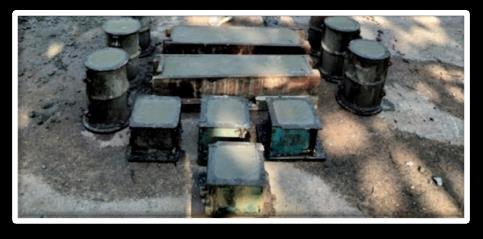
Casted concrete cube 150 ×150 × 150mm size and it was tested for 7, 14 and 28 days. Compressive Strength =P/�� where, P is the applied load; A is the cross-sectional area (150×150×150mm).
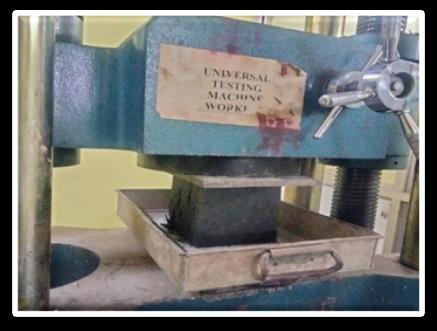
Fig-2: CompressivestrengthtestinUTM
85 03 0.45 83
PEG-400'sinclusionimprovesworkability.
6. RESULT AND DISCUSSION:
6.1 CASTING PROGRAM:
The casting of the specimens was done as per IS 100861982.Theplainsamplesofcubes,cylinders,andbeamswere curedfor28daysinawaterpond,andthespecimenswith PEG400 were cured for 28 days at room temperature by placing them in shade. The strength parameters of selfcured concrete were compared with conventional cured concreteat7days,14daysand28days.
Table-3 CompressiveStrengthresultsforConventional Concrete S. No. Age (Days)
2)
Table-4 CompressiveStrengthresultsforself-curing concrete:
S.
2)
International Research Journal of Engineering and Technology (IRJET) e-ISSN: 2395-0056
Volume: 11 Issue: 06 | Jun 2024 www.irjet.net p-ISSN: 2395-0072
Chart-1: Compressivestrengthforconventionalconcrete after7-,14-,and28-daysvsSelfcuringconcrete.
Split tensile strength:
Using cylinders of 150mm diameter and 300mm height cylinders.Cylinderwascastanditwastestedin7,14,and28 days. Split tensile strength = 2P/πDL, where P= load, D = diameterofcylinder,L=lengthofthecylinder.
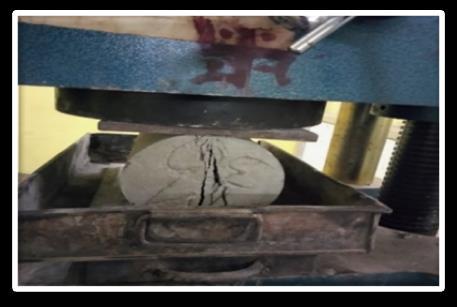
Table-5 TensileStrengthresultsforself-curingconcrete:
Chart-2: Tensilestrengthafter7-,14-,and28-daysvsSelf curingconcrete.
Flexural Strength test:
Thebeamspecimenofsize150×150×700mmistestedon universal testing machine with a 2000 KN load for point loadingtocreateapurebending.Themaximumappliedload onspecimenisrecorded.Observedthatthestrengthofthe concretemixat7,14,and28days. fstrength=WL/bd2
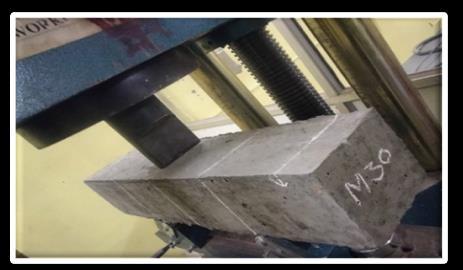
Table-6 TensileStrengthresultsforself-curingconcrete:
Table-8 FlexuralStrengthresultsforself-curingconcrete:
International Research Journal of Engineering and Technology (IRJET) e-ISSN: 2395-0056
Volume: 11 Issue: 06 | Jun 2024 www.irjet.net p-ISSN: 2395-0072
Thecostofinternallycuredconcreteislessascompareto conventionalconcrete.
8. CONCLUSION:
1. TheaforementionedresultindicatesthatPEG-400 achieves 1% of the mix-30's compressive, tensile, andflexuralstrengths.
Chart-3: flexuralstrengthafter7-,14-,and28-daysvsSelf curingconcrete.
7 RATE ANALYSIS AND COST COMPARISON:
Itwasfoundthat1m3 ofconcreterequire3m3 ofwaterfor curing[1].Theattemptwasmadetofindouttheratesand comparisonbetweentheconventionalconcreteandinternal curedconcretehaving1%ofdosageofPEG-400including thecostofwaterrequiredforcuringandalabor.
TotalMaterialRequired
sand=121.688kg.=1.40Rs/kg
Aggregate=217.728kg.=2.81Rs/kg
Cementrequirement=86.40kg.=7Rs/kg
Volumeofcube=3.375×10⁻³m-3,Cubecast=6
Volumeofcylinder=5.310×10⁻³ m-3,Cylindercast=6
Volumeofbeam=15.75×10⁻³ m-3,beamcast=6
Cost of construction for Conventional Concrete: Grade Requirement
(Rs.)
for curing 0.21m3 800 Rs/m3 175
for curing 2hrs./day 300×7 2100
Total=2895Rs.
Cost of construction for Internal cured concrete:
Grade Requirement
(Rs.) Amount (Rs.) M30
m3 8470 620
Labor for curing 0 0 0
Total=1088Rs.
2. Using self-curing PEG-400 concrete instead of traditionalconcretecuringattheagesof7and28 resulted in an average increase in compressive strengthof11.99%and12.77%,respectively.
3. Thereisasignificantexpansionintheconstruction sector,whichleadstomoreconstructionactivities. Theconstructionindustryalsousesalotofwater, and the curing process wastes more water every day. The use of alternative methods, such as selfcuring mechanisms, is required to attain sustainabilityinwatermanagement.
4. Utilizing PEG-400 was determined to be the superiorchoiceinordertoproduceinternallycured concretewithoutsacrificingitsstrength.
9. SCOPE OF RESEARCH:
Thechemicaladditionneedstomaketheconcrete moreworkable.
tocontrastthestrengthcharacteristicsofconcrete producedusingacuringcompound polyethylene glycol with concrete produced using traditional curing.
10. REFERENCES:
1. M.Lokeshwari,B.R.PavanBandakli,S.R.Tarun,P. Sachin,VenkatKum.arUnderGraduateStudents,“A reviewonself-curingconcrete”DepartmentofCivil Engineering,RVCollegeofEngineering,Bengaluru, Karnataka,India.
2. EL-DIEB A. 2007. Self-curing concrete: Water retention, hydration and moisture transport. Construction and Building Materials. 21, 12821287.
3. D.S. Vijayan, S. Aravindan, D. Parthiban, R. Sanjay Kumar, B. Saravanan, Yumnam Robert An experimental study on mechanical and durable properties of self-curing concrete by adding admixture Department of Civil Engineering, AarupadaiVeeduInstituteofTechnology,Vinayaka MissionsResearchFoundation,Paiyanoor,Chennai 603104,India.
International Research Journal of Engineering and Technology (IRJET) e-ISSN: 2395-0056
Volume: 11 Issue: 06 | Jun 2024 www.irjet.net p-ISSN: 2395-0072
4. Shikha Tyagi, (2015), “An Experimental InvestigationofSelfCuringConcreteIncorporated with Polyethylene Glycol as Self Curing Agent”, InternationalResearchJournalofEngineeringand Technology (IRJET), Vol. 2, Issue 6, ISSN: 23950056,pp.129-132.
5. IS 10262:2019 Recommended Guidelines for ConcreteMixDesignBureauofIndianstandardNew Delhi.
6. BureauofIndianStandardsIS516:1959Methodsof TestsforStrengthofConcrete.
7. Indian Standard code456:2000 of practice for general structural use of plain and reinforced concrete.
8. Dieb A.S, “Self-curing concrete: Water retention, hydrationandmoisturetransport,Constructionand BuildingMaterialsjournal,2007,Vol21,pp12821287.
9. IS383:1970Codeforfineandcoarseaggregatefor concrete.
10. ConcreteTechnology:TheoryandPracticebyM.S. Shetty.
11. NattMakul“Advancedsmartconcrete-Areviewof currentprogress,benefitsandchallenges.
12. LkalaivaniExperimentalinvestigationofself-curing concreteusingpolyethyleneglycol.
13. Rahul Parvez Memon “A Review: Mechanism, materialandpropertiesofself-curingconcrete.