
International Research Journal of Engineering and Technology (IRJET) e-ISSN: 2395-0056
Volume: 11 Issue: 06 | Jun 2024 www.irjet.net p-ISSN: 2395-0072

International Research Journal of Engineering and Technology (IRJET) e-ISSN: 2395-0056
Volume: 11 Issue: 06 | Jun 2024 www.irjet.net p-ISSN: 2395-0072
Liladhar1, Mr. Yogeshwar Sahu2, Mr. K. S. Ramaiah3
1Research Scholar, M. Tech. (Structural Engg.)
2Assistant Professor, Department of Civil Engineering,
3Assistant Professor, Department of Civil Engineering, Jhada Sirha Government Engineering College, Jagdalpur Chhattisgarh India.
Abstract - - The fastest-spreading self-healing bacteria found in concrete is the best example of a self-sustaining unit. Concrete that increases its strength is a true advancement in the field of concrete technology. both growing fractures in the structure and compressive strength. Concrete constructions often fail due to cracks, which shorten their lifespan. Nowadays, additional chemicals or additives are utilized, such as bacteria and calcium lactate, a powder that is used in the mixing process, to prevent these cracks from occurring. In the past, these fissures could have resulted from shrinking or creeping or from adding too much water when mixing the concrete. This study will also address two problems that are commonly associated with concrete.
Key Words: Conventionalconcrete,bacterialconcrete, bacteria(bacillusSubtilis),calciumlactate,compressive strength, Tensile strength, Flexural strength, environment.
1.INTRODUCTION:
Concreterankssecondgloballyintheconstructionbusiness. Thefundamentalmaterialusedinbuildingconstructionis chosenbecauseofitsaffordability,strength,anddurability. Measuring,mixing,andaddingbacteriaandcalciumlactate tothemixtureyieldsahomogenousmixtureinthecontextof concrete technology. Concrete is "work compacted" by placingitinthemolds,lettingitset,andthencontinuously moisteningitfor28days.Sporescontainingthesebacteria areappliedtoconcrete.Manyresearchersuseawidevariety of microorganisms. Nonetheless, Bacillus subtilis was employedinthisstudy.Extendedlifespansandefficacyare essential for bacteria employed as self-healing agents, as theyshouldbeabletorepaircracks.
1.1 Bacterial Concrete:
Ontheconcrete'spreparedwithbacteria(bacillussubtilis) with mineral admixture (calcium lactate) for bacterial concrete. It is possible for moisture to seep into cracks in most concrete, exposing unreached cement grains. Then, hydrationproductscouldfillinandsealthecrack,resuming thehydrationprocess.
1.2 Merits and Demerits:
1. Improvement in compressive strength of concrete.
2. Preventcrackinginconcrete.
3. Reduce maintenance and increases material durability
4. Cost of bacterial concrete is more than conventionalconcrete.
5. ThereisnoIScodeorothercodeisavailablefor bacterialconcrete.
6. Skilled labor is required for preparation of material.
2. AIM:
1. Comparing bacterial concrete to traditional concrete, the former exhibits to improved tensile compressive, and flexural strengths.
2. Bacterial concretecanprevent additional damage fromhappeningbypatchingcracksastheyappear, which lowers maintenance expenditures.
3. Bacterial concrete is thought to be more environmentallyfriendlythanregularconcrete,in additiontoitscapacityforself-healing.
2.1 Objectives of bacterial concrete:
1. Waterseepsgeneratesmallcracksinastructureby corrodingthesteelreinforcinganddeterioratingthe concrete, ultimately causing the structure to disintegrate.
2. This is a result of the fractures being filled with bacterialconcreteandtheconstructionhasalonger lifespanbecauseofbacterialconcrete.
3. Decrease upkeep and lengthen the lifespan of materials.
International Research Journal of Engineering and Technology (IRJET) e-ISSN: 2395-0056
Volume: 11 Issue: 06 | Jun 2024 www.irjet.net p-ISSN: 2395-0072
S. Sanjay, S. Neha, and R. Jasvir (2016), This paper was presented the experimental investigationonbacterialconcretetoincrease thestrengthofbioconcreteandtoinformthe processinvolvedinthe bacterial concrete.To know the calcite crystals formed in bacterial concrete analysis of microstructure has been donethatisusedforthepotentialtorecovery the cracks in bacterial concrete and also to informthebiologicalreactioninconcrete.Asa result, has been got because of good adaptability of nutrient broth medium of bio concrete at 28 days attained better strength whencomparetoconventionalconcrete.
B. Chithra P Bai and V. Shibi,thispaperwas presented, bacterial concrete with various bacterialsolutionof103ml,105mland107ml and they have been used B. Subtilis bacteria speciesinthisexperimentandalsobioconcrete is formed by 10%,20%, and 30% fly ash replacing cement by its mass. The Ultrasonic Pulse Velocity, split tensile, Flexural and compressive strength tests have been doing after 28 and 56 days for M30 grade. All mechanical properties of bio concrete enhancingat10%flyashreplacingcementand by105mlbacterialsolutionachievedmaximum valuesforall testtheyconducted.Finally,the precipitation of CaCO3 due to bacteria in the concrete by bio technology concept that improves mechanical properties of fly ash concrete.
4.1 Cement: WeusedregularPortlandcement(grade53)in thisinvestigation.OPCisperfectforconstructionbecauseof itsstrongcompressivestrength,superiorworkability,and durability,amongotherqualities.
Table-1: Properties of cement:
4
4.2 Fine Aggregates and coarse Aggregate: This study usedriversand,whichhasafinenessmodulusof2.45.Fine
aggregatehasaspecificgravityof2.45.andcoarseaggregate isdefinedascoarseaggregatewithasizegreaterthan4.75 mm.Thecoarseaggregatehasaspecificgravityof2.66.
4.3 Water: Oneofthemostcrucialcomponentsofbacterial concrete iswater,whichaidsinthe reaction with calcium lactateuponcontact.InaccordancewithISCodes3025-1904 and456-2000,weusedregulartapwater.
4.4 Calcium Lactate: WiththeformulaC6H10CaO6,calcium lactate is a white, crystalline salt. Calcium hydroxide or calcium carbonate can react with lactic acid to produce calcium lactate. We are employing three different percentagesofcalciumlactatebytheweightofthecementin thisstudy:6%,8%,and10%.Calciumhydroxideorcalcium carbonate can react with lactic acid to produce calcium lactate. We are using various percentages in this investigation.
Table-2: Properties of calcium lactate:
Chemicalformula C6H10CaO6
Appearance Whitepowder
Solubilityinwater
7.8g/100ml
Odor Efflorescent
Density
Solubility
1.49g/cmcub
Solubleinethanol
Molarmass 218.22g/mol
4.5 Bacteria: We employed the Bacillus subtilis bacteria, commonlyreferredtoasgrassbacillusorhaybacillus,inthis investigation.Thisbacteriumiscatalase-positiveandgrampositive.Thesebacteriaarestringentaerobesthatproduce endospores. However, more recent research has demonstrated that Bacillus subtilis can grow without oxygen.These bacteria usuallyhavearod-shapedtexture, measuringbetween4and10micrometersinlengthand0.25 and1.0micrometersindiameter.
Whenthisbacteriumcomesintocontactwithcalciumlactate inthepresenceofwaterdroplets,itcanproduceprecipitate. This bacterium can withstand pH levels between 7 and 9, and the choice of bacteria is entirely dependent on the water's pH level. The percentage of bacteria used for this investigation was 5%, 7%, and 9% based on the cement's weight.
Types of bacteria:
1.Bacilluspasteurii.
2.Bacillussubtilis.
3.Cohnii.
4.Sphaericus.
5.Bacilluscoli.
International Research Journal of Engineering and Technology (IRJET) e-ISSN: 2395-0056
Volume: 11 Issue: 06 | Jun 2024 www.irjet.net p-ISSN: 2395-0072
Mix design by Indian standard recommended method for concretemixdesignbasedon{IS10262-2019}M30gradeof concretemixistakingbyme.
(A) Design Required:
1.Gradedesignation=M30
2.Typeofcement=OPC-53
3.MaximumSizeofaggregate=20mm
3.Degreeofsitecontrol=Good
4.Exposurecondition=Severe
5.Workability=75mm(assumed)
6.Methodofconcreteplacing=manual
7.Minimumcementcontent=320kg/m3
(B) Test result for material:
1.Specificgravityofcement=3.15
2.Specificgravityofcoarseaggregate=2.66
3.Specificgravityoffineaggregate=2.45
4.Waterabsorptionofcoarseaggregate=1%
5.Waterabsorptionforfineaggregate=1.16%
6.Conformingzoneofsand=zoneII
7.Typeofaggregate=uniformlygradedaggregate.
(C) Target mean strength = 38.25 N/mm2
(D) Selection of water cement ratio = 0.45
(E) Selection of water content = 207.48 kg/m3
(F) Cement content =361.87 kg/m3
(G) Coarse aggregate (per m3) = 1097.678 kg
(H) Fine aggregate (per m3) = 591.488 kg
4.7 Tests on concrete:
Workability test: Theslumptestisthemethodmostoften usedtoassessworkability.Thistest,whichcanbeconducted attheconstructionsiteorinalaboratory,isthemostwidely usedtechniquefordeterminingtheconsistencyofconcrete. ThemixratioforconventionalconcreteisC:S:A::1:1.39:2.59 andforbacterialconcreteisC:S:A::1.1.63:3.03
Table-3 SlumpValuesofConventionalConcrete. S.
Table-3 SlumpValuesofConventionalConcrete.
5. RESULT AND DISCUSSION:
5.1 Casting Program:
The casting of the specimens was done as per IS 100861982:preparationofmaterials,weighingofmaterials,and casting of cubes, cylinders, and beams. The mixing, compacting,andcuringofconcretearedoneaccordingtoIS 516:1959.Theplainsamplesofcubes,cylinders,andbeams werecuredfor28daysinawaterpond.
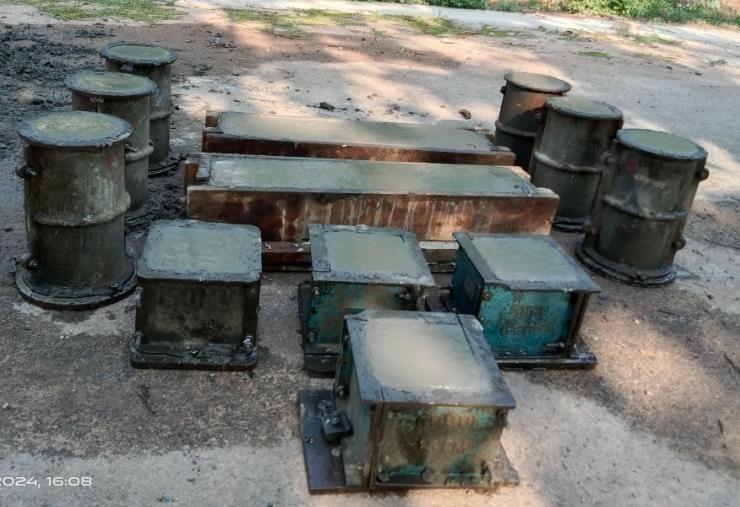
Fig-1: CastingofCube,BeamandCylinder
Compressive Strength test:
A 150 × 150 × 150 mm concrete sample was cast, and its compressivestrengthwasmeasuredafter7and28daysof testing.Itispossibletocomputethecompressivestrength usingequation(1).P/��equalscompressivestrength.Pisthe appliedload,andAisthecross-sectionalarea(150×150× 150mm).
International Research Journal of Engineering and Technology (IRJET) e-ISSN: 2395-0056
Volume: 11 Issue: 06 | Jun 2024 www.irjet.net p-ISSN: 2395-0072
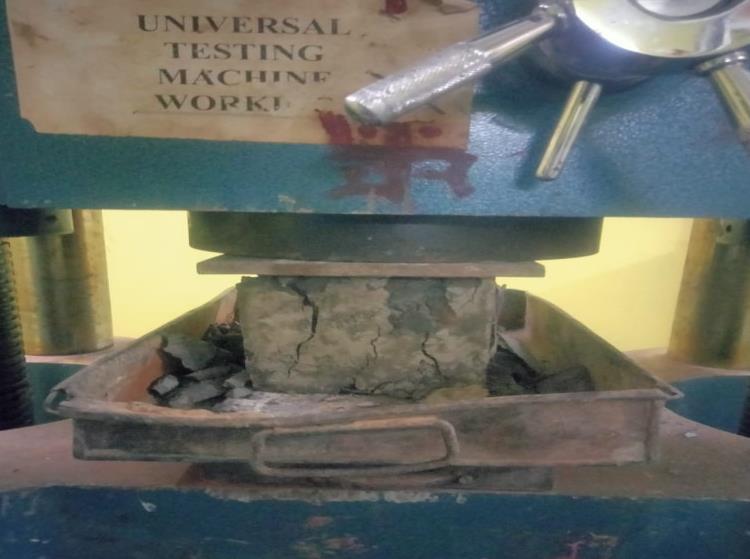
Compressivestrengthtestsofconcrete.
TABLE-5:CompressiveStrengthresultsforConventional Concreteandbacterialconcrete:
Using cylinders of 150 mm in diameter and 300 mm in height.Thecylinderwascast,anditwastestedin7and28 days.Byusingequations,wecandeterminethesplittensile strength.Splittensilestrength=2P/πDL,whereP=load,D= diameterofthecylinder,andL=lengthofthecylinder.
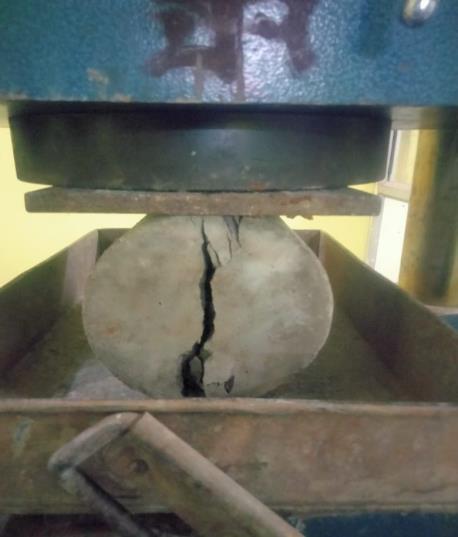
TABLE-6: TensileStrengthresultsforConventional Concreteandbacterialconcrete:
@ThecompressivestrenghtofM30gradeconcreteasperIS – 456:2000, is 30Mpa or 30N/mm2 after 28 days of conventionalconcrete.
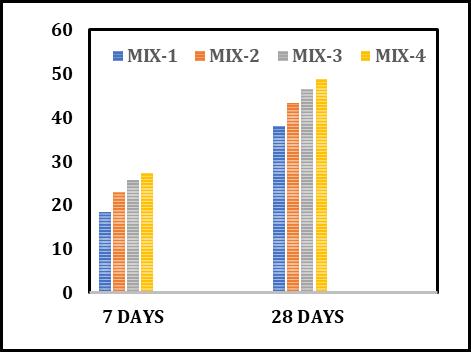
Chart-1: Compressivestrengthforconventionalconcreteafter7, and28-daysvsbacterialconcrete.
@TheSplittensilestrenghtofM30gradeconcreteasperIS – 456:2000, is 4.87 N/mm2 after 28 days of conventional concrete.
International Research Journal of Engineering and Technology (IRJET) e-ISSN: 2395-0056
Volume: 11 Issue: 06 | Jun 2024 www.irjet.net p-ISSN: 2395-0072
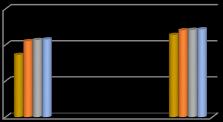
Chart-2: Tensilestrengthforconventionalconcreteafter 7,and28-daysvsbacterialconcrete.
Flexural Strength Test:
A universal testing equipment is used to test a beam specimenmeasuring150x150x700mm.Apointloading forceof2000KNisappliedtothespecimentoproducepure bending.Recordedistheappliedloadonthespecimen.noted the concrete mix's strength after seven and twenty-eight days.
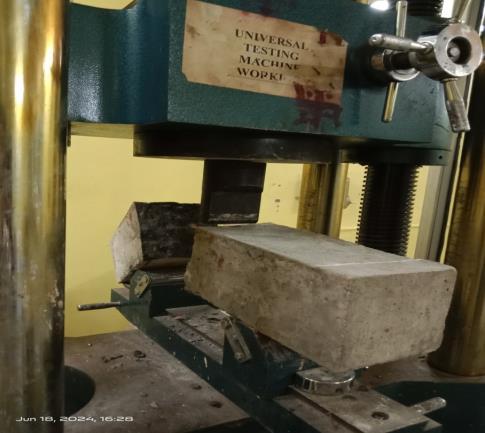
Fig- 4: FlexuralstrengthtestinUTM
TABLE-7: FlexuralStrengthresultsforconventional concreteandbacterialConcrete:
@TheflexuralstrenghtofM30gradeconcreteasperIS –456:2000, is 3.83 N/mm2 after 28 days of conventional concrete.
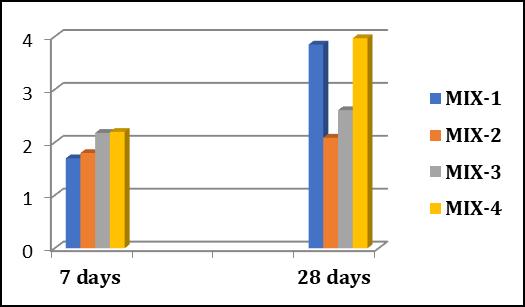
Chart-3: flexuralstrengthforconventionalconcreteafter7,and 28-daysvsbacterialconcrete.
6.
Comparing the compressive strength of 10% calcium lactate and 5% bacteria mixed concrete strengthwithstandardconcrete,thedifferencewas 24%after7daysofcuring.
After28days,thehighestcompressivestrengthof 28.06% was achieved with a 10% calcium lactate and5%bacteriummixconcrete
The study's findings demonstrate that, in comparisontoconventionalconcrete,thestrength ofbacterialconcreteishigher.
Tensile strength of 10% calcium lactate and 5% bacterialmixturesresultsina6.8%improvementin concretestrengthovertraditionalconcrete.
Ten percent calcium lactate and five percent bacteriacombinetocreateconcretewithaflexural strengththatis2.90%higherthanregularconcrete.
Theadditionofmicroorganismsandcalciumlactate willmaketheconcretemoreworkable.
In some aspects, the substance is better than conventionalabiotic-reinforcedconcrete.
long-termviabilityforseveralfactors.
Numerousapplicationscallfortheuseofbacterial concrete, including the lining of tunnels, walls, floors,bridges,highways,andmaritimestructures.
International Research Journal of Engineering and Technology (IRJET) e-ISSN: 2395-0056
Volume: 11 Issue: 06 | Jun 2024 www.irjet.net p-ISSN: 2395-0072
1. N. Ganesh Babu and Dr. S. Siddiraju “An experimental study on strength and fracture Propertiesofself-healingconcrete”.
2. Jacobsen, S.; Sellevold, E.J. “self-healing of high strength concrete after deterioration by freeze/thaw.Cem.Concr.Res.1995,26,55–62.
3. Rakesh Chidara, Rahul Nagulagama, and Smitha Yadav,AchievementofEarlyCompressiveStrength inConcreteUsingSporosarcinapasteuriiBacteriaas an Admixture: Hindawi Publishing Corporation AdvancesinCivilEngineeringVolume2014,Article ID435948,
4. Indian Standard code456:2000 of practice for general structural use of plain and reinforced concrete.
5. IS383:1970Codeforfineandcoarseaggregatefor Concrete.
6. ConcreteTechnology:TheoryandPracticebyM.S. Shetty and Concrete Technology: Theory and PracticebyM.LGambhir.
7. Ms. B. Arthi1, Ms. K. K. Dhaarani: A study on strengthandself-healingcharacteristicsofBacterial concrete: International Journal of Engineering TrendsandTechnology(IJETT)
8. Meera C. M., Dr. Subha V. Strength and Durability assessmentOfBacteriaBasedSelf-HealingConcrete: IOSR Journal of Mechanical and Civil Engineering (IOSR-JMCE) e-ISSN: 2278-1684, p-ISSN: 2320334X,PP01-07
9. IS 10262:20019 Recommended Guidelines for ConcreteMixDesignBureauofIndianstandardNew Delhi.
10. J.Rex,J.SelwynBabu,S.PoojaSriReddy:Strength and Durability Aspects of Bacterial Concrete: InternationalJournalofInnovativeTechnologyand Exploring Engineering (IJITEE) ISSN: 2278-3075, Volume-8Issue-2S2December,2018.
11. BureauofIndianStandardsIS516:1959Methodsof TestsforStrengthofConcrete.
12. S. Sunil Pratap Reddy, M.V. Seshagiri Raob, P. Aparnac and Ch. Sasikalac: PERFORMANCE OF STANDARD GRADE BACTERIAL (BACILLUS SUBTILIS) CONCRETE: ASIAN JOURNAL OF CIVIL ENGINEERING(BUILDINGANDHOUSING)VOL.11, NO.1(2010).