
International Research Journal of Engineering and Technology (IRJET) e-ISSN:2395-0056
Volume: 11 Issue: 06 | Jun 2024 www.irjet.net
p-ISSN:2395-0072

International Research Journal of Engineering and Technology (IRJET) e-ISSN:2395-0056
Volume: 11 Issue: 06 | Jun 2024 www.irjet.net
p-ISSN:2395-0072
Rajesh N* , Manjesh yadav** , Thejash H. S.** , Avinash Vishnu**, Vinayaka V.**
*Assistant Professor Department of Electronics and Communication Engineering, Maharaja Institute of Technology Mysore
Belwadi, Srirangapatna, Mandya Dist, Karnataka, India rajeshn_ece@mitmysore.in
** UG students Department of Electronics and Communication Engineering, Maharaja Institute of Technology Mysore
Belwadi, Srirangapatna, Mandya Dist, Karnataka, India
Abstract- ASystem-on-Chip(SoC)architecturewithmultiple processors,alongsideintegratedmemoryandcontrollogic,is a powerful approach in modern computing. The multiprocessing-basedSoCarchitectureiscommonlyusedin thelatestelectronicdevices suchasSmartphone,tabletsand smart wristwatches with large memory sizes. The data handling in these highly memory-dense devices is a critical task, and it needs special attention for smooth operation of the devices. The project proposes a memory controller to exchange data between various processors and input-output devices to tackle these challenges. The controller block uses an AXI (Advanced eXtensible Interface) which is parallel protocol to communicate with other blocks of SoC’s. A proposed controller block controls the data flow between memory and different SoC components and processors. A memoryaccesscontroller(MAC)ispresentedtomanageand accelerate data transmission speed and reduce the processors’activityforSoC-baseddevices.
Index Terms- System-on-Chip (SoC), Advanced eXtensible Interface(AXI),MemoryAccessController(MAC)
memory controller is a fundamental component within computing systems, serving as a crucial interface between the central processing unit (CPU) and various types of memory modules. Its primary function is to manage the efficient flow of data between the processor and memory subsystems, ensuring that read and write operations occur seamlessly. Acting as a bridge, the memory controller translates memory access requests initiated by the CPU into specific commands that are understood by the memory devices. This translation process involves address decoding, where memoryaddressesgenerated bytheCPUaremapped tophysicallocationsinthememorymodules.
Furthermore, memory controllers are responsible for coordinating the timing and protocol necessary for data transfer between the CPU and memory. They generate
controlsignalsandtimingsequencestosynchronizethedata exchangeprocess,adheringtothetimingconstraintsdictated by the memory standards. By orchestrating data transfers with precision, memory controllers optimize memory performance and minimize latency, thereby enhancing overallsystemefficiency.
In addition to managing data transfer, memory controllers oftenincorporatefeaturesforerrordetectionandcorrection. Moreover, memory controllers may support advanced memory management techniques such as interleaving and memorybanking,whichfurtheroptimizememoryaccessand utilization.
In VLSI (Very Large-Scale Integration) design, memory controllers are pivotal components that facilitate efficient data exchange between the processor and memory modules. Acting as an intermediary, these controllers manage various aspects of memory operations, including data transfer, addressdecoding,andtimingcontrol.Theytranslatememory accessrequestsfromtheCPUintoappropriatecommandsfor the memory devices, ensuring seamless communication between the two components. Memory controllers play a critical role in optimizing system performance by orchestrating data transfers with minimal latency and maximizingmemorybandwidthutilization.Additionally,they oftenincorporatefeaturesforerrordetectionandcorrection, enhancingsystemreliabilityanddataintegrity.Ascomputing systems evolve and memory technologies advance, memory controllers continue to adapt, offering support for new memory standards and optimizing memory access for diverse workloads and applications. In essence, memory controllers are fundamental to the efficient operation of modern computing systems, enabling seamless interaction betweentheprocessorandmemorysubsystems.
Overall, memory controllers play a critical role in enabling efficient communication between the CPU and memory subsystems in computing systems. By overseeing data transfer, address decoding, timing control, and error
International Research Journal of Engineering and Technology (IRJET) e-ISSN:2395-0056
Volume: 11 Issue: 06 | Jun 2024 www.irjet.net
detection, they contribute to the seamless operation and optimalperformanceofmoderncomputingplatforms.
The procedure of designing and implementing involves a systematic approach. Initially, clear requirements are specified, encompassing byte-level access capability, supported memory types, and performance metrics. Next, a thorough understanding of the memory interface protocols and timing constraints is crucial for compatibility. SystemVerilog is then utilized to implement the design, employing modules, interfaces, and state machines to encapsulate functionality and promote modularity. Throughout the process, thorough testing and verification ensure that the memory controller meets specifications and performsefficiently.
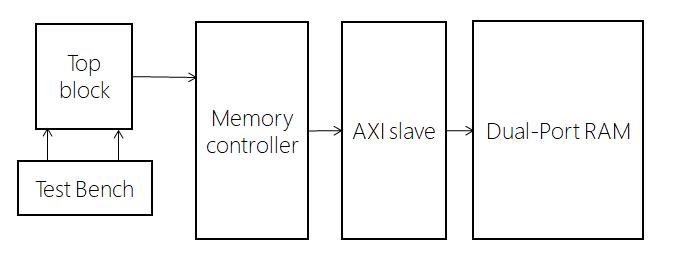
Fig.1:AXIMemory-controllerblock
Figure 1 above shows the overview of the design. We construct the blocks separately and then the complete designs are instantiated by the top block. The test benches areappliedtothetopblock.
Dual-port RAM is 32-bit width and 8-bit depth. It consists of two ports for dual operation of read-write. It is active high designed block. We can access the any of the two ports by configuringthesignals.
Memory controller block is the main part of the system. It is thecontrollingunitofthesystem.Itisbrainofthesystem.It commands the dual-port RAM. It stores the details like address and data to be transmitted into and from the memory.ItactsasmastercommandingtheAXIslave.
AXIslaveistheintermediatebetweenmemorycontrollerand RAMitisparallel protocol.Itcontrolsthedata flowbetween the memory controller and RAM. It actsas a bridge between memorycontrollerandRAM.
Memory Controller:
p-ISSN:2395-0072
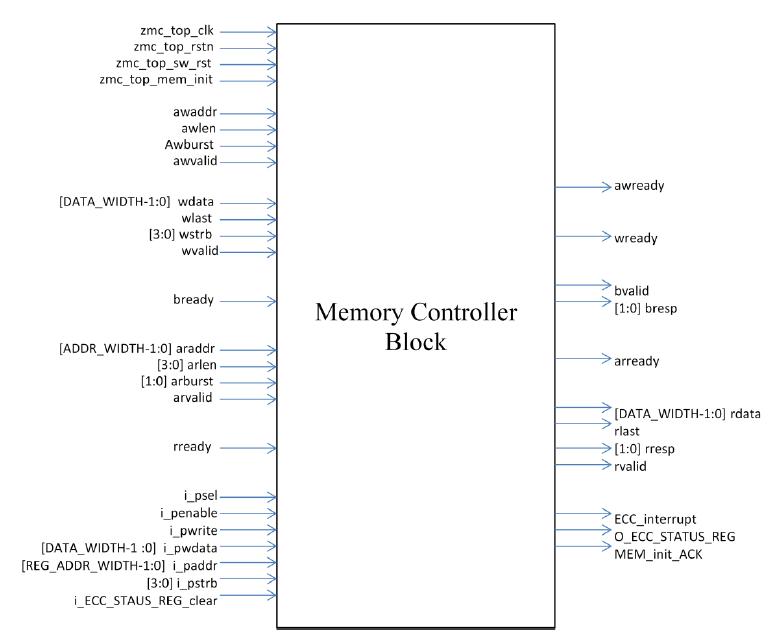
Fig.2:Memorycontrollerblock
Memorycontrolleristheintermediateblockunitwhichisthe heartofourdesign.Ittakesthecommandfromthetopblock. We can say this unit as CPU of our design. It gives the commandtoAXIslavetooperatethedual-portRAM.
It is the main unit which performs the operation of readwriteintoandfromthedual-portRAM.
Figure 2 shows the block of memory controller. It has the followingsignalstooperate:
• Memorycontrollersignals
• Writeaddresschannelsignals
• Writedatachannelsignals
• Writeresponsechannelsignals
• Readaddresschannelsignals
• Readdatachannelsignals
• Registerssignals
A memory controller is a critical component in digital systems responsible for managing the interaction between the CPU or processing unit and the memory subsystem. Its primary function is to ensure efficient and reliable access to memory resources, including RAM, ROM, and other storage devices.
At its core, the memory controller orchestrates the flow of data between the CPU and memory modules, handling tasks
International Research Journal of Engineering and Technology (IRJET) e-ISSN:2395-0056
Volume: 11 Issue: 06 | Jun 2024 www.irjet.net p-ISSN:2395-0072
suchasaddressdecoding,datatransfer,andtimingcontrol.It translates memory access requests from the CPU into the appropriatecommandsandsignalsforaccessingthememory modules, ensuring that data is read from or written to the correctmemorylocationsinatimelymanner.
Moreover,memorycontrollersoftenincorporatefeaturesfor optimizing memory performance and reliability, such as caching, error detection and correction, and memory interleaving. These capabilities help enhance system throughput,reduceaccesslatency,andensuredataintegrity, therebyimprovingoverallsystemperformanceandstability.
In summary, the memory controller plays a crucial role in enabling efficient and reliable communication between the CPU and memory subsystem in digital systems, contributing significantly to their overall performance and functionality. Its proper design and implementation are essential for achieving optimal system performance and meeting the requirementsofvariouscomputingapplications.
AXI slave:
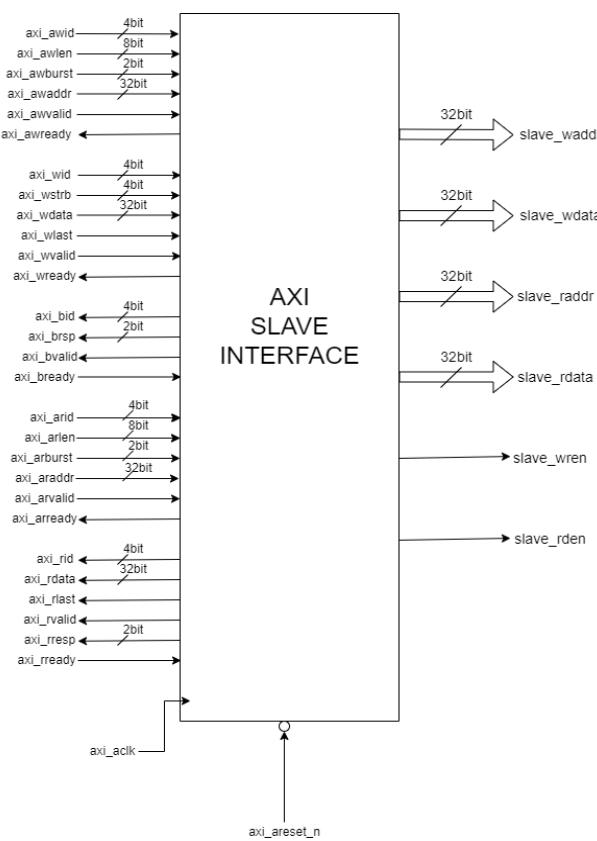
Advanced eXtensible Interface (AXI) is a part of ARM Advanced Microcontroller Bus architecture specifications. It is a parallel high-performance, synchronous, high-frequency, multi-initiator, multi-target communication interface, mainly designed for on-chip communication. The AXI-4 protocol is thefourthgenerationoftheAMBAinterfacespecifications.It is an update to AXI3 which is designed to enhance the performance. It includes the following enhancements: Supportforburstlengthsupto256bits,asshowninfigure3
The AXI protocol is burst-based and defines the following independenttransactionchannels:
• readaddress
• readdata
• writeaddress
• writedata
• Writeresponse.
Dual-port RAM:
RAM_clk
RAM_rstn
RAM_en

RAM_wr_en
[ADDR_WIDTH1:0]
RAM_wr_addr

Dualport
RAM
[MEMROY_DAT

A_WIDTH-1:0]
RAM_rd_data
Fig.4:Dual-portRAM
Dual-port RAM (Random Access Memory) is a type of memory that allows two independent accesses to the memory array simultaneously. Each port typically has its owndatainput,dataoutput,andaddressinput,allowingtwo different devices or components to access the memory simultaneouslywithoutinterferingwitheachother,asshown infigure4.
International Research Journal of Engineering and Technology (IRJET) e-ISSN:2395-0056
Volume: 11 Issue: 06 | Jun 2024 www.irjet.net p-ISSN:2395-0072
The design consists of Memory controller acting as master anddual portRAMasslavetoperformthe read-write.Ithas fivechannelstoperformtheoperation,asshowninfigure5:
• Readaddresschannel
• Readdatachannel
• Writeaddresschannel
• Writedatachannel
• Writeresponsechannel
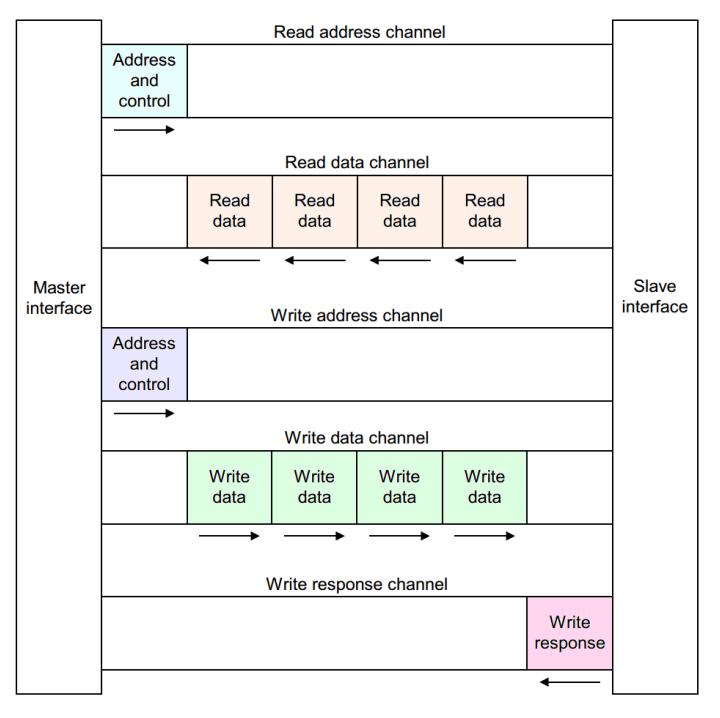
Fig.5:OperationsofMemorycontrollerandAXIslaveto drivedualportRAM
FPGA or Field Programmable Gate Arrays can be programmed or configured by the user or designer after manufacturing and during implementation. Hence, they are otherwise known as On-Site programmable. Unlike a Programmable Array Logic (PAL) or other programmable device, their structure is similar to that of a gate-arrayor an ASIC. Thus, they are used to rapidly prototype ASICs, or asa substitute for places where an ASIC will eventually be used. This is done when it is important to get the design to the market first. Later on, when the ASIC is produced in bulk to reduce the NRE cost, it can replace the FPGA. The programming of the FPGA is done using a logic circuit diagram or a source code using a Hardware Description Language(HDL)tospecifyhowthechipshouldwork.FPGAs have programmable logic components called ‚logic blocks, and a hierarchy or reconfigurable interconnects which facilitate the ‚wiring‛ of the blocks together. The
programmable logic blocks are referred to as configurable logicblocksandreconfigurableinterconnectsarereferredto as switch boxes. CLBs can be programmed to perform complex combinational functions, or simple logic gates. In most FPGAs the logic blocks also include memory elements, which can be as simple as flip-flops, or as complex as completeblocksofmemory.
Major Implementation steps:
1. Understanding of AXI protocol and Read-WriteModify operations to know the data flow from and intotheMemoryblock.
2. Design of dual port RAMS to store and retrieve the data.
3. DesignofMemorycontrollerunittocontrolthedata flowinthedualportRAMS.
4. Design of AXI slave for AXI protocol-based data transmissionandreceptionfromthedualportRAM.
5. Design of top block to instantiate the lower-level blocks.
6. Verifying the functionalities of top block by using testbench.
Tools and Resources:
1. RTLDesigning:Cadencexcelium
2. Verification:Simvision
3. Synthesis:Genus
The test case used here is using direct test bench. Simply, memory flash is assumed to be initially stores some data in specific addresses. The scenario as follows, the host sends read command and then the initially stored data is transferred into the buffer to be serialized and sent to the host on the data serial link. Write command is issued by the host to store new data in the memory flash core. The host sendsthedataformontheserialdatalinktobestoredinthe buffer. Then the data in the buffer is transferred to the memoryflashcore.Theolddataandnewdatabothareexist inthememorycore,i.e.nooverwriteoccurred.Finally,erase commandisissuedbythehosttodeleteallstoreddatainthe memoryflashcore.Thecommandistransferredfromhostto deviceserially.Ittakes19simulationclockcyclestostorethe whole command frame in the device registers. Data to be transferred between the memory flash core and the buffer takesjust1simulationclockcycle.Noticethatbeforethehost
International Research Journal of Engineering and Technology (IRJET) e-ISSN:2395-0056
Volume: 11 Issue: 06 | Jun 2024 www.irjet.net p-ISSN:2395-0072
begins the communication with the device, it must reset the device; so hardware reset will be issued before the read command.
• First, the host assert hardware reset pin for 1 clock cycle,afterthisresetpinde-assertedagainasshown infigure6.
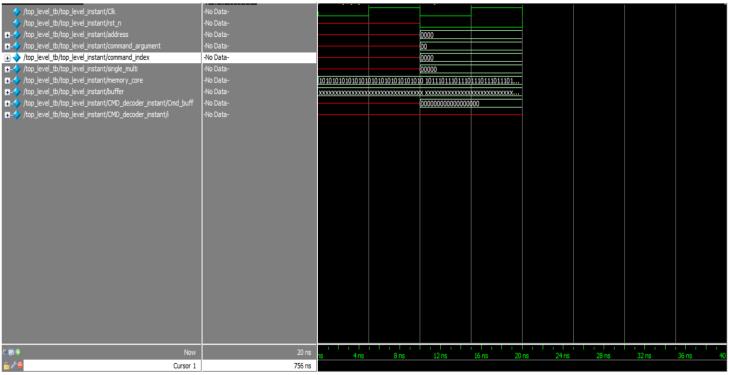
Fig.6:Resetpinassertedfor1clockcycleandthede-asserted
• Memoryflashcoreisinitiallysoresomerandomdata blocks–6datablocksfromaddress0htoaddress5h asshowninfigure6.
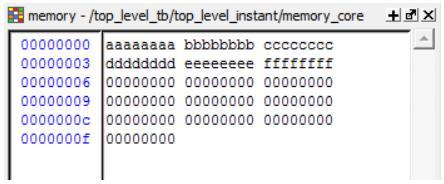
Fig.6:Memoryflashcoreisinitializedwithrandomdata
• Hoststartstoissuereadcommandasshownin figure7,atclockcycle220thereadcommandframe iscompletelystoredinthedevice.
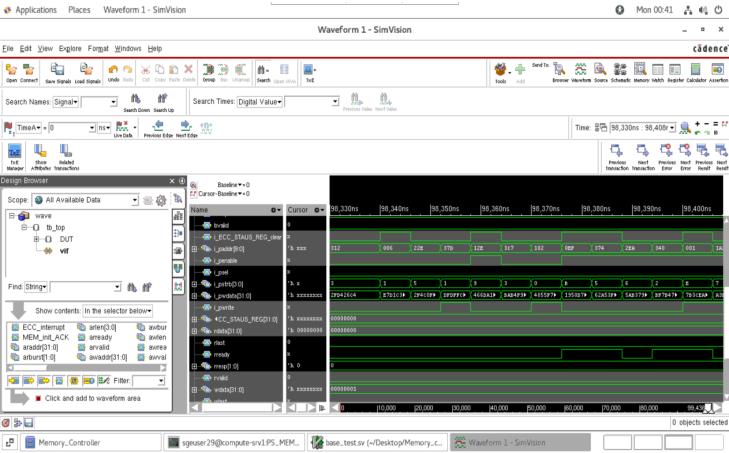
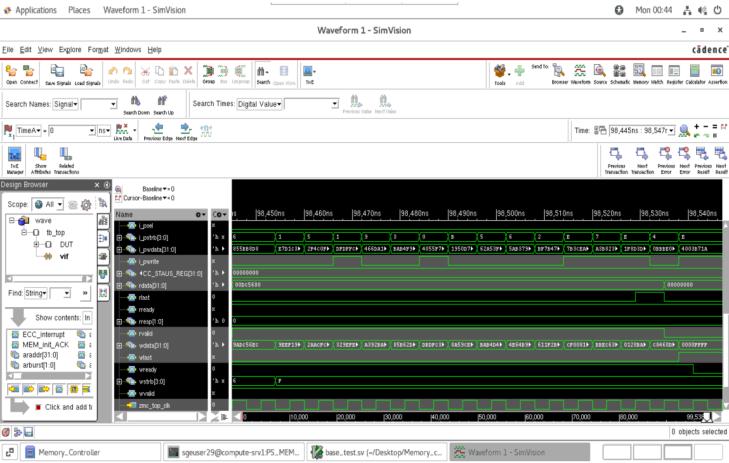
7:Memoryflashcoreistransferredsuccessfullytothe buffer
• Newdataistransferredfrombuffertotheflash memorycoresuccessfully
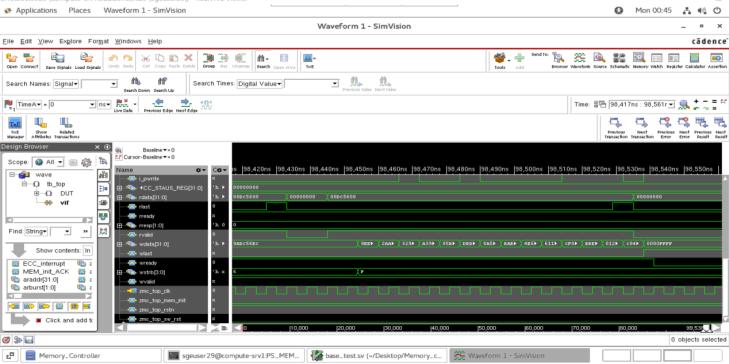
Fig.8:Newdataistransferredfrombuffertothememory coresuccessfully
• The design of the memory controller built is synthesized using cadence genus where the gate
International Research Journal of Engineering and Technology (IRJET) e-ISSN:2395-0056
Volume: 11 Issue: 06 | Jun 2024 www.irjet.net p-ISSN:2395-0072
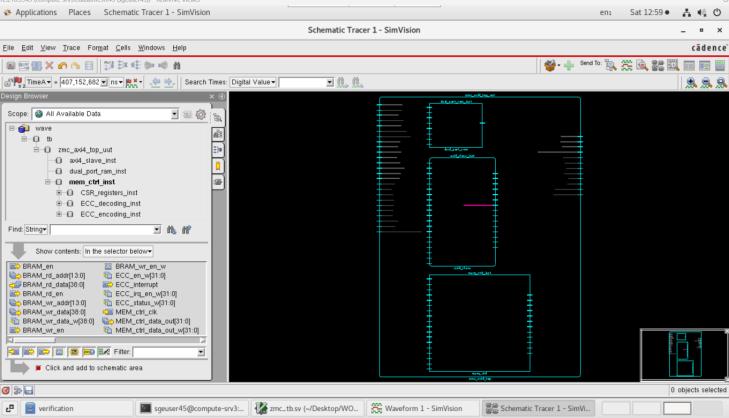
level netlistalongwiththe block interleavingcanbe seeninthesystem.
• The figure 9 shows the design where individual block explained above in the block diagram can be seen.
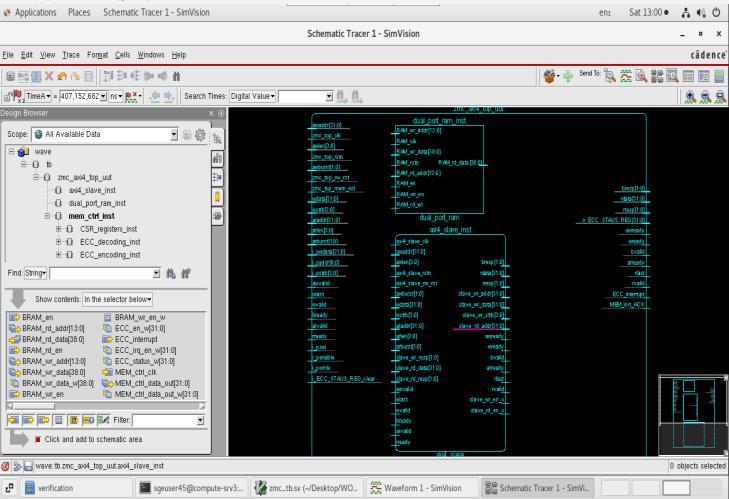
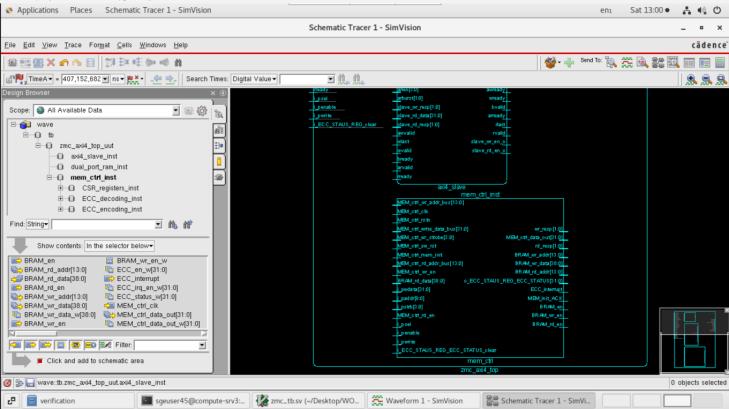
• ThedesigncontainstheMemorycontrollerunit alongwithdual-portRAMwhichisinterfacedusing AXIprotocolasshowninthefigure10andfigure11
VI. Conclusion
The memory controller architecture, designed and verified using Verilog and SystemVerilog UVM, respectively, showcases a balance between simplicity and integration, seamlessly merging Flash and DRAM memory types. Its design prioritizes power efficiency, aligning with global trends, and incorporates powerful features from six diverse protocols for enhanced functionality. With support for paralleloperations,uptotwosimultaneousoperationsboost performance, while its multi-point to single-point model enables communication with multiple hosts, though limited tofourinaswitchingmanner.Manufacturersbenefitfromits configurable nature, adaptable to various applications, while data security remains paramount, with encryption implemented in both memory cores to safeguard against potential hacks. This architecture serves as a blueprint for future designs, providing invaluable insights into essential featuresforupcomingarchitecturaldevelopments.
For every door your close in research, two new doors are opened. This section discusses interesting future work and openissuesinthecontextofthiswork.Althoughthisproject containsa lotof importantfeatures,more advanced features canbeimplementedinbydevelopingtheusedtechniquesin the proposed memory controller. The current design implementationcanmoveintherestoftheFPGAdesignflow to get the memory controller. The future scope of memory controllersforbyteaccessinSystem-on-Chip(SoC)designsis poised for significant advancements driven by emerging trends such as the proliferation of IoT and edge computing, thedemandforAIandmachinelearningacceleration,andthe adoptionofheterogeneousmemoryarchitectures.
International Research Journal of Engineering and Technology (IRJET) e-ISSN:2395-0056
Volume: 11 Issue: 06 | Jun 2024 www.irjet.net p-ISSN:2395-0072
[1] Mohammed Altaf Ahmed and Jaber Aloufi, “A Smart Memory Controller forSystem on Chip-Based Devices”,in Department of Computer Engineering, College of Computer Engineering & Sciences, Prince Sattan Bin Abdulaziz University,Alkharj-11942,SaudiArabia.
[2]. Rashmi Samanth, Subramanya G. Nayak, “Design and SV BasedVerificationofAMBAAXIProtocolforSOCIntegration” in International Journal of Recent Technology and Engineering (IJRTE) ISSN: 2277-3878 (Online), Volume-8 Issue-2,July2019.
[3] Khaled Khalifa,HaythamFawzy,SamehEl-Ashry,Khaled Salah, “Memory Controller Architectures: A comparative Study”bySamehEl-Ashryon20September2015.
[4] Gregorio Zlotnik and Aaron Vansintjan, “Memory: An Extended Definition” in Clinique de la Migraine de Montreal, Montreal, QC, Canada, 2 Department of Film, Media and Cultural Studies, Birkbeck, University of London, London, UnitedKingdom.
[5] Mohammed Altaf Ahmed, Abdullah Aljumah and M. GulamAhmad,“DesignandImplementationofdirectmemory access controller for embedded systems” in Department of Computer Engineering, College of Computer Engineering & Sciences, Prince Sattam Bin Abdulaziz University, Alkharj 11942,SaudiArabia.
[6] Prof.Dr.MohamedRizk,AlexandriaUniversityDr.Khaled Salah, Mentor Graphics Egypt, “Thesis book of Universal MemoryController”,AlexandriaUniversity,Egypt,July2014.
[7] Balakrishna K. Rajesh N “Design of remote monitored solar powered grass cutter robot with obstacle avoidance usingIoT”,GlobalTransitionsProceedingsVolume3,Issue1, June2022,Pages109-113
[8] Rajesh N Li-Fi (Light Fidelity): The Future Vision In Wireless Communication, IJRECE Volume 9,Issue3 JULYSEPT2021ISSN:2393-9028(PRINT)|ISSN:2348-2281|
[9]M.Rajendra and N.Suresh Babu. ‘‘Speed and Area optimized Design of DDR3 SDRAM (Double Data Rate3 Synchronously Dynamic RAM) Controller for Digital TV Decoders”, International Journal of Engineering Trends and Technology”,2013,Vol.06Issue4,pp204-211.
[10] Ms.Seema Sinha and Md.Tariq Anwar. ‘‘design and verificationofddr3memorycontroller”.InternationalJournal of Advanced Technology in Engineering and science, 2014, Vol.02,Issue05,pp.199-207