
The Bond Between the Bituminous Paving Layers: Lab Scale Assessment.
Aruan Kumar
PG Scholar Department of Civil Engineering, Mewar University, Gangrar Rajasthan 312901
Abstract
A bituminous surface is a multi-layered structure consisting of surfacing, base, and subbase courses on a subgrade. An interfaceisdefinedasaboundarybetweenanytwoconsecutivelayers.Asaresult,adequatebondingbetweenthelayers at the interfaces is required to ensure that multiple layers function as a single composite structure. In the case of nonbituminous or bituminous-non-bituminous layers,anadequate bondis formed becauseof the mechanical interlockingof the aggregate surfaces. However, the state of the bond at the interface of any two bituminous layers has a significant impact on the stress distribution across pavement layers under traffic loads, as well as the pavement's overall performance. Bituminous tack coats are applied before overlay to improve adhesion or bonding between the two bituminous layers. This study assessesthe interface bond strength of two types of bituminous layer mixtures in the laboratory. The cylindrical specimens were tested for bond strengthat four normal service temperatures,250, 300, 350, and400C,usingdifferenttypesoftack coatsat varying applicationrates.Thespecimenswerepreparedaccordingtothe normal Marshall Procedure, first for theunderlying layer,then for thetack coat,andfinallyforthetoplayerin thesame mould.Twotypesoflayercombinationshavebeentried,namely(i)BituminousConcrete(BC)layeronDenseBituminous Macadam(DBM)samplesand(ii)SemiDenseBituminous Concrete(SDBC)layeronBituminousMacadam(BM)samples. Similarly, different types of tack coat materials namely bitumen, Cationic Rapid Setting with low viscosity (CRS-1) and Cationic Medium Setting with high viscosity (CMS-2) emulsions have been used for the interface bond between the said bituminous layers. The prepared samples were tested using a bond strength device attached to the loading frame of the Modified Marshall Testing Apparatus. The interlayer bond strength is observed to be temperature-dependent, and it decreasesasthetesttemperatureincreases.Ithasalsobeenobservedthatthebondstrengthisaffectedbythetypeoftack coatusedandtheconditionsofthetypeofcombination.Theoptimalamountoftackcoatvariesdependingonthetypeof tackcoatusedandthelayercombination.
Keywords: Interlayer Bond strength, Tack coat, Bituminous layer combination, Bond strength device.
Introduction
Highways are the foundation of a country's progress and development. All developed and developing countries typically have an ongoing strategy of maintaining and building road infrastructure or improving existing roads. To improve the existing road infrastructure in response to increased traffic, reinforce the existing pavement layer by combining it with anotherlayeroftheappropriatematerialcompositionandthickness.Flexiblepavementsaretypicallydesignedand builtin multiple layers to ensure effective stress distribution across the layers under varying heavy traffic loads. The viscous nature of the flexible pavement allows its various layers to withstand significant plastic deformation, despite distresses causedbyrepeatedheavyloadingovertime,whichisthemostcommonfailuremode.Theflexiblepavementfunctionsasa single structure due to good bonding between the different layers interfacing. The adhesion conditions at the layer interfacearethoughttohaveasignificantimpactonthepavementstressdistribution.Pooradhesionatthelayerinterface can reduce the structural strength of the pavement system and lead to premature failures. Bituminous tack coats are applied before overlay to improve layer bonding. Bituminous emulsions are typically used as tack coats. Despite their widespread use, pavement engineers disagree about the effectiveness of tack coats in improving adhesion between the twolayers.Thistackcoatisalsomadeofathinlayerofbitumenresidue,anditspurposeistoprovideadequateadherence between the layers. If the quantity of bituminous emulsions used is greater or less than the required one, the interface bondingwillnotbesatisfactory.
1.1 Failures arise due to inadequate bonds.
Several premature pavement failures have been caused by a loss of bond between two layers of hot mix asphalt (HMA). Poor adhesion between pavement layers has been widely observed to contribute to significant pavement overlay distressesandmanyprematurefailures.Slippagefailureandlayerdelamination.Slippagefailureworsensasthepavement layers slide against one another, and the top layer typically separates from the lower layer. This type of failure occurs
International Research Journal of Engineering and Technology (IRJET) e-ISSN:2395-0056
Volume: 11 Issue: 06 | Jun 2024 www.irjet.net p-ISSN:2395-0072
because of a lack of bond between two top important pavement layers, and it is most visible at high horizontal force at pointswheretrafficisacceleratingordecelerating,suchastrafficsignalsandhorizontalcurves. Delaminationisasection of a surface layer that has separated from the pavement. This type of failure is caused by layer slippage and weak interlayerbondsbetweenpavementlayers.Otherpavementproblemshavebeenlinkedtoreducedbondstrengthbetween pavement layersintheshapeof a crescent.The word"tack" refersto a typeof stickiness. The coatisa thinlayer.Atack coatisalightapplicationofabituminousemulsionbetweenpavementlayers,typicallyappliedinathinlayerbetweenan existingandnewlyconstructedbituminoussurface.
The purpose of glue or sticky materials, such as tack coats, is to provide appropriate adhesive interlock between paving layerssothattheyreactasamonolith.Theemulsifyingagentcouldbesoap,dust,orcolloidalclays.Theemulsifyingagent keepsbituminousparticlessuspendedinwater,reducingthebitumenconsistencyatambienttemperaturefromsemi-solid to liquid. As a result, at normal temperatures, liquefied bitumen is easier to spread over a surface. When this liquid bitumenisappliedtoacleanbitumensurface,thewaterevaporatesfromtheemulsion,leavingathinlayerofbituminous residueonthepavement.
Usually,hotbituminousbinder,cutbackbitumenorbituminousemulsionsareusedastackcoat materialsforconstruction purposes. The use of bituminous emulsions as a tack coat material is escalating instead of cutting back asphalt or hot bituminousbinder. Itcan be appliedatlowerapplicationtemperaturescomparedtocutbackbitumenorhotbituminous binder, so it is easy to handle in field conditions. Emulsified bitumen does not contain any harmful volatile chemicals, comparativelypollution-freeandenvironmentallyfriendly.
Review of Literature
Bituminous pavements are typically built in multiple layers, and proper bonding between adjacent layers is required for optimal performance. However, this is not always the case, and poor bonding conditions have resulted in numerous prematurepavementfailures.Thefailureofinterfacebondsinpavinglayersisprimarilycausedbyshearforces.Interlayer shearperformancehasrecentlyreceivedsignificantattention.Thesestudieshavetypicallyresultedinthedevelopmentof a novel test method or instrument for determining interface bond strength. Various organizations and researchers have usedavarietyoftestmethodstoevaluatepavementinterlayerbondstrengthperformance.
Uzanetal.(1978)usedadirectsheartestdevicetoevaluatea60-70penetrationasphaltbinderasatackcoatat five application rates. The tests were carried out at two different temperatures: 77-1310 F (25 and 550 degrees Celsius). Thetackcoatwasappliedtothebottomlayer,and3cm(1.8in)ofmixwascompactedontop.Thedirectsheardevicewas designedwiththespecimensizeinmind,andthedisplacementratewaskeptconstantat2.5mm/min(0.098in/min).The shear strength was measured at five different normal loading pressures: 0.05, 0.5, 1.0, 2.5, and 5 Kg/cm2. When the test temperaturedropsandnormal pressurerises,theshearstrengthincreases.Theobservedoptimumtack coatapplication rateforthisstudywas1.0Kg/m2at25°C.
Molenaaretal.(1986)atDelftUniversityofTechnologyusedasheartestdevicetoassesstheshearresistanceof thetackcoatattheasphaltlayerinterface.ThedevicewasmountedonastandardMarshallStabilityloadingpress,which appliedaloadatarateof0.85mm/second.Thisdeviceheldthebottompartofthecompactedcylindricalspecimenswhile applyingshearloadperpendiculartothetoplayer'sspecimenaxis.
In Canada, Mrawira and Damude (1999) used a direct shear test to determine the interface bond strength. The specimens were obtained as field cores from active pavements. Cores were assembled in six subsets based on pavement age.The mixandmaterialsusedinall specimens were identical.The coreswere trimmedto a heightof8cm(3.15inch), and0.2to0.3L/m2ofSS1emulsionwasappliedtothetopsurfaceofthelayer,withsettimesoflessthanonehour.After thetackcoathascured,a16mmnominalmaximumaggregatesizeiscompactedonthecoreintwolifts using75Marshall blowsperliftasanoverlay.Thespecimenswereallowedtocurefortwoweeksatroomtemperaturebeforebeingcutinto rectangular shapes and placed in a water bath at 220C (750F) for thirty minutes. The specimens were sheared using a guillotine-stylemachinewithaconstantdisplacementrateof1mm/min.
Mohammad et al. (2002) evaluated the bond strength of the tack coat used in the interface of the bituminous pavinglayersbyusingtheSuperpavesheartestershowninFigure2.2,whichconsistsofashearboxsetupfor150mm(6 inches) diameter specimens. The specimens were compacted up to 50 mm and a tack coat was applied at five different applicationrates(0.0to0.9L/m2),thesampleswereallowed to cure,anda second lift wasplacedontopandcompacted. The tack coat bond strength was evaluated with two PG asphalt binders (PG 64-2P and PG 76-22M) and four emulsified asphalts(CRS-2P,CSS-1,SS-1andSS-1h).Thetestwasconductedontwotest temperatures 25and550C (77and1310F). They observed CRS-2P emulsion as the best performer and 250C (770F) test temperature gives five times more shear strengththan550C(1310C).
International Research Journal of Engineering and Technology (IRJET) e-ISSN:2395-0056
Volume: 11 Issue: 06 | Jun 2024 www.irjet.net p-ISSN:2395-0072
Sangiorgi et al. (2002) modified the Leuter shear strength test device in Germany to evaluate interlayer bond strengthusingasimpledirectsheartestmethod.Thedevicewasmountedonthe MarshallandCBRloadingpresses.The specimenswereusedfora testwitha diameterof150 mm,whichcouldbefieldcoresor laboratoryfabricated. Theload wastransferredtothespecimenataconstantdisplacementrateof50mm/minwhilekeepingthetemperatureat200°C. Toreducefriction,theshearingplaneswereseparatedbya4.8mmgap.ThistestingdeviceisstandardinAustriaandhas beenadoptedintheUnitedKingdom.Tosimulateactualconditions,threedifferentinterfacetreatmentswereconsidered: (i) with tack coat emulsion, (ii) contaminated with dirt but without tack coat emulsion, and (iii) with tack coat emulsion andathinfilmofdirt.Theresultsrevealedthatthebestinterfacebondstrengthwasachievedwithaninterfacetreatment prepared with an emulsified tack coat, whereas the poorest bond conditions were observed on a dirty surface without emulsion.
Sholar et al. (2002) developed a simple direct shear test device to measure the shear strength of field cores at their interface. The test was performed at 25oC (77oF), with a constant rate of loading of 50.8 mm/min (2in/min). The fieldcoreswereobtainedfromtestsectionswithno tack,andwith0.091,0.266and0.362l/m2 (0.02,0.06,0.08gal/yd2) tackcoatapplicationrate.
Several organizations and researchers described in the preceding paragraphs developed and studied various devices using various testing methodologies to assess the bond strengths of the bituminous pavement interlayer. Tack coatsshouldbeappliedinanoptimalquantityinathinlayertocovertheentiresurfaceoftheapplicationarea.Toolittle tackcoatisequivalenttonotackcoatanddoesnotprovideastronginterfacebond.Ontheotherhand,toomuchtackcoat cancauseslippagefailure.Theapplicationratemustbedeterminedbythetextureofthesurfacethatwillreceivethetack coat.
Methodology
The study's experimental methodology involved determining the maximum interlayer bond strength of two different bituminouslayercombinations(DBM/BCandBM/SDBC).Inthisexperiment,thespecimensweresubjectedtodirectshear force at a constant displacement rate of 50.8 mm/min until they failed. A customized simple device referred to as the modified Marshall test apparatus was fabricated for the testing of the double-layer composite bituminous samples to evaluatetheinterlayerbondstrength.ThemethodologyadoptedforthisprojectisshowninFigure3.1.
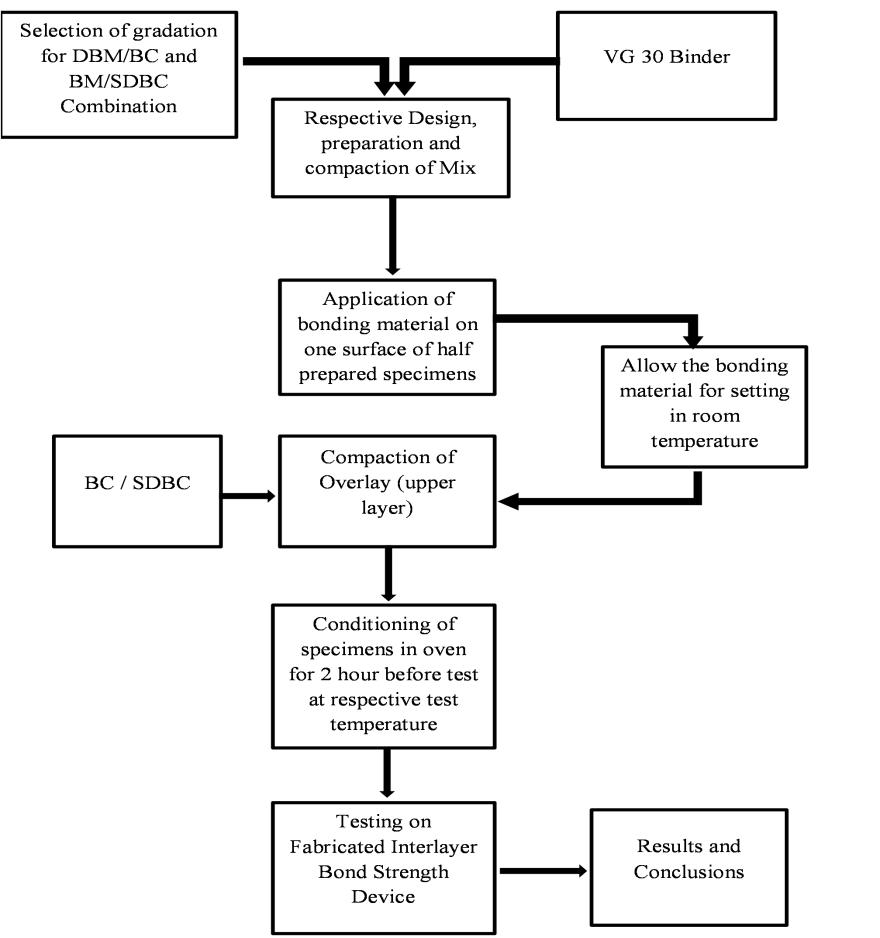
3.1 Methodology of the experimental work
1.2 Materials Used
1.2.1
Aggregates
Thislaboratorycasestudyincludestwotypesofbituminouslayersoncylindricalspecimens.Onehasbeencreatedusinga compositeofalowerlayerofdensebituminousmacadam(DBM)andanupperlayerofbituminousconcrete.Anothertype hasbeencreatedusingbituminous macadam(BM)asthebasecourse(lowerlayer)andsemi-densebituminousconcrete (SDBC)astheoverlay.Twobituminous-composedlayerswerepreparedusingaggregatesgradedaccordingtotheMinistry ofRoadTransportandHighways(2001),asshowninTables3.1,3.2,3.3,and3.4,respectively.DBMandBMmixes,which use relatively larger aggregates, are not only stiff or stable but also cost-effective because they use less bitumen and require less breaking and crushing energy or effort. BC and SDBC mix with smaller aggregates with higher bitumen content,whichaddsflexibilityandincreasesdurability.Theaggregatesmustbeclean,hard,durable,cubicalinshape,and freeofdust,friablematter,organicorotherharmfulmaterial.Thecoarseaggregatesarecrushedgravelhardmaterialthat mustbe retainedona 4.75mmsieve,whilethefineaggregatesmustpassthrough a 4.75mmsieveand beretainedona 75-micron sieve. MORT&H recommended a 25 mm nominal maximum aggregate size (NMAS) for the DBM Base Course and13mmNMASfortheBCBinderCourse.Italsorecommended19mmNMASfortheBMbasecourseand13mmNMAS for the SDBC course. The specific gravity of aggregates used for preparing the specimens in the laboratory is 2.80. The physicalpropertiesoftheaggregatesfoundinthelaboratoryaregiveninbelowtable3.5.
1.2.2
Filler
Portlandslagcement(Grade43)collectedfromthelocalmarketpassing0.075 mmISsievewasusedasfillermaterialto increasethebindingpropertybetweentheaggregatesinthepreparation ofspecimens.Itsspecificgravityhasbeenfound inlaboratory3.0.
Figure
Volume: 11 Issue: 06 | Jun 2024 www.irjet.net
Table 3.1 MORTH gradation for DBM (NMAS 25mm)
BIS Sieve (mm)
Percent Passing Specification Grading Grading adopted
2395-0072
Table 3.2 MORTH gradation for BC (NMAS 13 mm)
Passing
Sieve (mm)
Table: 3.3 MORTH gradations for BM (NMAS 19 mm)
Sieve
2024, IRJET | Impact Factor value: 8.226 | ISO 9001:2008 Certified Journal | Page934
Volume: 11 Issue: 06 | Jun 2024 www.irjet.net
Table: 3.4 MORTH gradations for SDBC (NMAS 13 mm)
Table 3.5 Physical properties of aggregates
1.2.3 Binder
VG30bitumenfromalocalsourcewasusedasabindertopreparethespecimensforthisstudy.Somecommontestswere run to determine the important physical properties of these binders. Table 3.6 summarizes the physical properties obtained.(Sutradhar,B.B.2012).
1.2.4 Tack Coat
The tack coat materials selected for this study include two emulsions CMS-2 and CRS-1. Standardized tests were conductedtodeterminetheirphysicalpropertiesassummarizedinTable3.7(Sutradhar,B.B.2012).
Table 3.6: Physical properties of VG 30 bitumen binder
Viscosity(Brookfield)At160°C,CP ASTMD4402
Volume: 11 Issue: 06 | Jun 2024 www.irjet.net
Table 3.7 Physical Properties of Tack Coats
ViscositybySayboltFurol Viscometer,seconds:At500 C ASTMD6934
Densitying/cm3 AsperChehab.etal. (2008)
Residuebyevaporation,% ASTMD244
ResiduePenetration250 C/100g/5 sec IS:1203-1978
Residue Ductility 270 C cm IS:1208-1978
1.3 Preparation of Samples
2395-0072
Thespecimenswerepreparedtoevaluatetheinterlayerbondstrengthbetweenthebituminouspavinglayerseithermade in the laboratories or collected from the field as a core. The laboratory-prepared samples were mixed according to the Marshall procedure specified in ASTM D1559, with MORT&H grading of course and fine aggregate for both types of compositespecimens.Thespecimensforbondstrengthtestinghavea101mmdiameterandatotalheightof100mm,and theyarepreparedusingaspeciallydesignedmould.Thesesampleswerecompactedintotwolayers:DBMandBMwitha base course of 60mm and top layers of BC and SDBC with heights of 40mm, respectively. In between these two layers, a tack coat is applied. To increase the binding property, the base and surface courses were mixed with VG-30 binder and 0.075mmpassingcementasfiller.
The specimens were made up of two layers, with a tack coat applied in between. The study was also conducted with bitumen as the tack coat material and without a tack coat between the two bituminous layers. Graded aggregates were sampled and baked in an oven at 1600 degrees Celsius for at least two hours before being combined with a binder to createadesignmix.Thelowerhalfofthespecimen,knownasthebasecourse,waspreparedbycompactingthedesignmix totherequiredheightof60mmgiving75blowswithaMarshallHammer.Oncethelowerlayerhadbeencompactedwith the same number of blows on both sides, it was allowed to cool at room temperature for a few days. A layer of sticky material(tackcoatandbitumen)wasthenappliedtooneofthepreviouslycompactedspecimens'surfaces.Thenumberof emulsionswasdeterminedbymultiplyingtheapplicationratesbythesurfacearea ofthespecimen.Therateoftackcoat applicationwasdeterminedaccordingtoMORT&H(2001),asshowninTable3.8.
Table 3.8 Rate of application of Tack Coat as per MORT&H Specification
Type of Surface
Quantity in Kg/m2 area
Normalbituminoussurface 0.20to0.25
Dryandhungrybituminoussurface 0.25to0.30
Granularsurfacetreatedwithprimer 0.25to0.30
Nonbituminoussurface -
Granularbase(notprimed) 0.35to0.40
CementConcretepavement 0.30to0.35
Volume: 11 Issue: 06 | Jun 2024 www.irjet.net p-ISSN:2395-0072
Afterbeingtacked,thespecimenswereallowedtobecuredinadust-freeenvironmentuntilthesetting/breakingprocess wascomplete.Visualobservationiscommonlyusedtoestimateanemulsion'sminimumsettingperiod.Normally,thetack coatwasbrown,butwhenthewaterevaporated,itscoloursturneddeepblack.Theprocessisknownasemulsionsetting. After the emulsionshad set, a thinlayerof bitumen residueactedasa glue between the two layers, resultingin a strong bond.Thestudyusedtwotypesofemulsions:CRS-1andCMS-2.CMSstandsforcationicmediumsetting emulsion,while CRS denotes cationic rapid setting. Normally, rapid-setting emulsions are set in less than half an hour. When bitumen is used as a sticky material in place of a tack coat, application rates are considered as per MORTH specification and the settingofitnormallyvariesfromhalfanhourtoone-hourmaximumforcreatingabetterbondingbetweentwolayers.
Oncethetackcoathadbeenappliedandcuredononesurfaceofthelower layerofspecimens,thetoplayer'sloosedesign mix was applied over it. The total required height for the samples was achieved by compacting the loose mix using a Marshall Hammer with 100 blows. All prepared specimens were left to cure at room temperature for a few days before testing.Thespecimenswerepreparedwithoutatackcoat,andthetoplayerwascompactedassoonasthelowerlayerhad beencompacted.Toobservethevariationinbondstrengthwithoutusingatackcoat,atimegapbetweenthecompaction oftwolayerscanbemaintained.
After a few days of curing at room temperature, the specimens are fully prepared for testing. Before testing, these specimenswerecuredinanovenatvarioustemperatures(250,300,350,and400C)fortwohours.Thespecimenswere testedusingafabricatedbondstrengthattachmentmountedonamodifiedMarshalltestapparatus.
1.4 Fabrication of simple attachment to measure the Interlayer Bond Strength
In the study, laboratory-prepared specimens were tested using a fabricated attachment attached to a modified Marshall apparatus. This device was modelled after the shearing apparatus at McAsphalt Lab (Kucharek et al., 2011). The device wasintendedfor101mmdiameterfieldcoresorlaboratory-preparedsamples.Thedevicehadtwopartsforholdingthe specimens,upperandlower.OnewasaU-shapethatallowedtheupperpart(40mm)tomovefreelywithminimalfriction, alongwithtwoguidingrodsfixedtothetopofthebaseplateandanotherclampingthelowerhalfofthe specimen.Figure 3.2showstheschematicdiagramsofthefabricatedInterlayerBondStrengthdevice,whileFigure3.3showsphotographic views.TheverticalloadwastransferredtotheU-shapedplatetoshearthespecimensataconstantrateof50.8mm/min(2 in/min).
Laboratory Test Results
Theresultsofvarioustestsperformedtoassessinterlayerbondstrengthinvariouscombinationsareshownbelow.
1.5 Interlayer Bond Strength for Dense Bituminous Macadam (DBM) and Bituminous Concrete (BC) Combination
1.5.1 Variation of ILBS with application rate for CRS-1 type tack coat at various setting times.
ThefollowingparagraphspresentthebondstrengthtestresultsforCRS-Itypetackcoatcuredatvarioussettingtimes.
Table4.1showstheaverageinterlayerbondstrengthwhenthesettingtimeis0.5hours.Atalltesttemperatures,theCRS1typeoftackcoatexhibitsthehighestbondstrengthvalueswhenappliedatarateof0.25Kg/m2.
Table 4.1 ILBS of CRS-1 type tack coat (Considering 0.5 hour setting time)
Themaximuminterlayerbondstrengthwasfoundata0.25Kg/m2applicationrateinalltesttemperatureswithasetting timeof0.5hours,andthebondstrengthdecreasedasthetesttemperatureandapplicationrateincreased.
Table4.2showstheaverageinterlayerbondstrengthwhenthesettingtimeisonehour.Atalltesttemperatures,theCRS-1 typeoftackcoatexhibitsthehighestbondstrengthvalueswhenappliedatarateof0.25Kg/m2.
Volume: 11 Issue: 06 | Jun 2024 www.irjet.net
Table 4.2 ILBS of CRS-1 type tack coat (Considering 1 hour setting time)
Type of Tack Coat Applicationrate
2)
2395-0072
Table 4.2 shows that the highest interlayer bond strength was achieved at a 0.25 Kg/m2 application rate at all test temperatures,withasettingtimeof1hour.Bondstrengthdecreasedwithhighertesttemperaturesandapplicationrates.
Table4.3displaystheaverageinterlayerbondstrengthwhenthesettingtimeis1.5hours.TheCRS-1typeoftackcoathas thehighestbondstrengthvalueswhenappliedatarateof0.25Kg/m2atalltesttemperatures.
Table 4.3 ILBS of CRS-1 type tack coat (Considering 1.5 hour setting time)
Type of Tack Coat Applicationrate
Table 4.3 shows that the maximum interlayer bond strength was found at a 0.25 Kg/m2 application rate in all test temperatures when the setting time was 1.5 hours, and that bond strength decreased as the test temperature and applicationrateincreased.
Tables 4.4 to 4.7 show that at all test temperatures, the maximum interlayer bond strength was found at a 0.25 Kg/m2 applicationratewhenthesettingtimeforrapidsettingemulsions(CRS-1)was1hourratherthan0.5or1.5.Thehighest bondstrengthwasachievedat250C,andthestrengthdecreasedasthetesttemperatureincreased.
1.5.2 Variation of ILBS with application rate for CMS-2 type tack coat at various setting times.
Table4.4presentstheaverageinterlayerbondstrengthwhenthesettingtimeis6hours.Thehighestbondstrengthvalues areobservedatanapplicationrateof0.15Kg/m2 atalltesttemperaturesfortheCMS-2typeoftackcoat.
From Table 4.8 it is observed that in 6 hours of setting time of the CMS-2 type tack coat, the maximum interlayer bond strength was found with an application rate of 0.15 Kg/m2 and it decreased when test temperature and application rate increased.
2024, IRJET | Impact Factor value: 8.226 | ISO 9001:2008 Certified Journal | Page938
Table 4.4 ILBS of CMS-2 type tack coat (Considering 6-hour setting time)
International Research Journal of Engineering and Technology (IRJET) e-ISSN:2395-0056
Volume: 11 Issue: 06 | Jun 2024 www.irjet.net p-ISSN:2395-0072
Table4.5presentstheaverageinterlayerbondstrengthwhenthesettingtimeis9hours.Thehighestbondstrengthvalues areobservedatanapplicationrateof0.15Kg/m2 atalltesttemperaturesfortheCMS-2typeoftackcoat.
Table 4.5 ILBS of CMS-2 type tack coat (Considering 9-hour setting time)
Type of Tack Coat Application
According to Table 4.5, the maximum interlayer bond strength was found with an application rate of 0.15 Kg/m2 in a 9hoursettingtimeofCMS-2typetackcoat,anditdecreasedasthetesttemperatureandapplicationrateincreased.
Table4.6showstheaverageinterlayerbondstrengthwhenthesettingtimeis6hours.Atalltesttemperatures,theCMS-2 typeoftackcoatachievesthehighestbondstrengthvaluewhenappliedatarateof0.15Kg/m2.
Table 4.6 ILBS of CMS-2 type tack coat (Considering 12-hour setting time)
1.5.3 Variation of ILBS with the rate of application for CMS-2 type tack coat at various setting times
Table4.4presentstheaverageinterlayerbondstrengthwhenthesettingtimeis6hours.Thehighestbondstrengthvalues areobservedatanapplicationrateof0.15Kg/m2 atalltesttemperaturesfortheCMS-2typeoftackcoat.
Table 4.7 ILBS of CMS-2 type tack coat (Considering 6-hour setting time)
Type of Tack Coat Application
International Research Journal of Engineering and Technology (IRJET) e-ISSN:2395-0056
Volume: 11 Issue: 06 | Jun 2024 www.irjet.net p-ISSN:2395-0072
Table4.8presentstheaverageinterlayerbondstrengthwhenthesettingtimeis9hours.Thehighestbondstrengthvalues areobservedatanapplicationrateof0.15Kg/m2 atalltesttemperaturesfortheCMS-2typeoftackcoat.
Table 4.8 ILBS of CMS-2 type tack coat (Considering 9-hour setting time)
Type of Tack Coat Application
Table4.7presentstheaverageinterlayerbondstrengthwhenthesettingtimeis6hours.Thehighestbondstrengthvalue isobservedatanapplicationrateof0.15Kg/m2 atalltesttemperaturesfortheCMS-2typeoftackcoat.
Table 4.9 ILBS of CMS-2 type tack coat (Considering 12-hour setting time)
1.5.4 Variation of ILBS with application rate when VG 30 bitumen focused as a tack coat considering various setting times.
Table 4.10 presents the interlayer bond strength when the upper layer has been compacted immediately after the application of the binding material (VG 30). The highest interlayer bond strength values are observed at an application rateof0.2Kg/m2 atalltesttemperaturesforbitumenasatackcoat.
Table 4.10 ILBS of VG 30 as a tack coat (Considering 0 hour setting time)
Type of Tack Coat
International Research Journal of Engineering and Technology (IRJET) e-ISSN:2395-0056
Volume: 11 Issue: 06 | Jun 2024 www.irjet.net p-ISSN:2395-0072
Table 4.11 ILBS of VG 30 as a tack coat (Considering 0.5 hour setting time)
Table 4.12 ILBS of VG 30 as a tack coat (Considering 1 hour setting time)
Tack Coat
1.5.5 Variation of ILBS considering various time intervals between successive layingbetween DBM and BC bituminous paving layers.
Table 4.10 presents interlayer bond strength when no tack coat is used for creating bonds between DBM and BC layers withvaryingtimeintervalsbetweensuccessivelayingbetweenthem.
Table 4.13 ILBS without using any tack coat
1.6 Interlayer Bond Strength for Bituminous Macadam (BM) and Semi-Dense Bituminous Concrete (SDBC) Combination.
1.6.1 Variation of ILBS with application rate for a CRS-1 type tack coat considering a1-hour setting time.
Table 4.14 presents the interlayer bond strength when the setting time is 1 hour. The highest interlayer bond strength value is observed at an application rate of 0.15 Kg/m2 at all test temperatures for CRS-I type tack coat for BM/SDBC combination
International Research Journal of Engineering and Technology (IRJET) e-ISSN:2395-0056
Volume: 11 Issue: 06 | Jun 2024 www.irjet.net p-ISSN:2395-0072
Type of Tack Coat Application rate
1.6.2 Variation of ILBS with application rate for a CMS-2 type tack coat considering 9-hour setting times.
Table 4.15 presents the interlayer bond strength when the setting time is 9 hours. The highest interlayer bond strength values are observed at an application rate of 0.15 Kg/m2 at all test temperatures for a CMS-2 type tack coat for the BM/SDBCcombination.
Type of Tack Coat Application rate
CONCLUSION
This project included a laboratory study to assess the interlayer bond strength of various tack coats using laboratoryprepared samples for DBM/BC and BM/SDBC layer combinations. A special device has been designed and manufactured thatcanbeattachedtotheloadingframeoftheModifiedMarshallTestapparatustomeasuretheinterlayerbondstrength oftwo-layered bituminous specimens. Thespecimensweretestedatfour differenttesttemperatures,250,300, 350,and 400 degrees Celsius, which are very common in our country. A specimen is made up of two bituminous layers held together by emulsion or bitumen. The upper- and lower-layer combinations are either DBM or BC or BM and SDBC. Variousapplicationrateshavebeentested,aswellasdifferentsettingtimesforemulsion.Allthesevariationsinmaterials and sample casting methods have been tested to determine the best conditions for appropriate bond strength in each situation.Thetestresultsleadtothefollowingconclusions.
The maximum interlayer bond strength for CRS-1 is achieved at 0.25 Kg/m2 application rate in all test temperature conditions, while for CMS-2 itisachievedat 0.15 Kg/m2 application rate regardless oftesttemperature. Theseoptimum applicationratesapplytobothtypesofemulsionsatallsettingtimes.Themaximuminterlayerbondstrengthwasfoundin the cationic medium setting emulsion used as a tack coat when the setting time was 9 hours, and in the cationic rapid setting emulsion when the setting time was 1 hour. When traditional VG 30 asphaltis used as a tack coat, themaximum interlayer bond strength is achieved at a 0.2 Kg/m2 application rate and a setting time of 0.5 hours at all test temperatures.Whennotackcoatisused,thehighestbondstrengthattheinterfaceisachievedwhentheupperlayermix islaidandcompactedimmediatelyafterthelowerlayercompactioniscompleted.Asthedurationofcompactionbetween two layers increased, the interlayer bond strength weakened. At a test temperature of 250C, all types of tack coats were used, and other considerations were taken to observe the interlayer bond strength, which was found to be the highest value compared to other test temperatures. It has been determined that for CRS-1, maximum interlayer bond strength
2024, IRJET | Impact Factor value: 8.226 | ISO 9001:2008 Certified Journal | Page942
Table 4.14 ILBS of CRS-1 type tack coat
Table 4.15 ILBS of CMS-2 type tack coat
International Research Journal of Engineering and Technology (IRJET) e-ISSN:2395-0056
Volume: 11 Issue: 06 | Jun 2024 www.irjet.net p-ISSN:2395-0072
occurs at a 0.15 Kg/m2 application rate in all test temperature conditions used, and for CMS-2, at the 0.15 Kg/m2 applicationrateregardlessoftesttemperature.
Theinterlayerbondstrengthdecreasesasthetesttemperaturerisesforbothtypesoftackcoatused.Themaximumbond strengthwasdiscoveredat250Cforbothtypesoftackcoatsused.FutureScopeofWorksBondstrengthisanalyzedusing thefiniteelementmethod,andlaboratoryresultsarecomparedto theoreticalwork.Experimentationwiththefabricated device and various loading combinations. Comparing the experimental results to those reported in the literature and previousexperiments.Testingoffieldcoresamplesandcomparisontolaboratory-preparedones.
REFERENCES
[1] ASTM D 88 (1994). “Standard Test Method for Saybolt Viscosity”. American Society for Testing and Materials, Philadelphia,USA
[2] ASTMD244(2004).“StandardTestMethodforResiduebyEvaporationofEmulsifiedAsphalt”.AmericanSocietyfor TestingandMaterials,Philadelphia,USA
[3] ASTM D 4402 (2006). “Standard Test Method for Viscosity Determination of Asphalt at Elevated Temperatures UsingaRotationalViscometer”.AmericanSocietyforTestingandMaterials,Philadelphia,USA
[4] Buchanan,M.S.andWoods,M.E. (2004).MississippiTransportationResearchCenter.
[5] Chehab, G., Medeiros, M., and Solaimanian, M. (2008). “Evaluation of the bondperformance of Fast Tack EmulsionforTackCoatapplications.”PennsylvaniaDepartmentofTransportation,ReportNo.FHWA-PA-2008-017PSU021,PennsylvaniaTransportationInstitute.
[6] CPB 03-1 Paint Binder (Tack Coat) Guidelines (2003), California Department of Transportation, Construction Procedure Bulletin.
[7] Giri,J.P.,Panda,M.andChattaraj,U.(2013).“Inter-LayerStrengthofBituminousPavingLayers–ALaboratoryCase Study.” 2nd workshop on Indian water management in the 21st century & symposium on sustainable infrastructure development (IWMSID- 2013),IITBhubaneswar,Odisha
[8] IS:2386(1963),“MethodsofTest forAggregatesforConcrete(Part-I):ParticleSize andShape”, Bureau of Indian Standards, New Delhi.
[9] IS: 2386 (1963), “Methods of Test for Aggregates for Concrete (Part-III): Specific Gravity, Density, Voids, Absorption,Bulking”, Bureau of Indian Standards, New Delhi.
[10] IS: 2386 (1963), “Methods ofTest for Aggregatesfor Concrete (Part-IV): Mechanical Properties”, Bureau of Indian Standards, New Delhi.
[11] IS: 1203 (1978), “Methods for Testing Tar and Bituminous Materials: Determination ofPenetration”, Bureau of Indian Standards, New Delhi.
[12] IS: 1205(1978), “Methods for Testing Tar and Bituminous Materials: DeterminationofSoftening Point”, Bureau of Indian Standards, New Delhi.
[13] IS: 1208 (1978), “Methods for Testing Tar and Bituminous Materials: Determination ofDuctility (First Revision)”, Bureau of Indian Standards, New Delhi.
[14] IS:8887(2004), “BitumenEmulsionfor Roads(Cationic Type) - Specification(SecondRevision)”, Bureau of Indian Standards, New Delhi.
[15] Kucharek,T.,Esenwa,M.andDavidson,J.K.(2011),“Determinationoffactorsaffectingsheartestingperformanceof Bituminousemulsiontackcoats.” 7e congrès annuel de Bitume Québec, Saint-Hyacinthe,Canada.
[16] Junior, M. S. M. (2009). “Evaluation of Bond Performance of an Ultra-rapid Setting Emulsion for Tack Coat Applications”. (Doctoraldissertation,ThePennsylvaniaStateUniversity).
International Research Journal of Engineering and Technology (IRJET) e-ISSN:2395-0056
Volume: 11 Issue: 06 | Jun 2024 www.irjet.net p-ISSN:2395-0072
[17] Ministry ofRoad Transport andHighways (2001), ‘’Manual for Construction and Supervision of Bituminous Works’’, New Delhi.
[18] Miro,R.,Martínez,A.,&Perez,F.(2006).“EvaluationofEffectofHeat-AdhesiveEmulsionsforTackCoatswithShear Test: From the Road Research Laboratory of Barcelona.” Transportation Research Record: Journal of the Transportation Research Board, 1970 (1),64-70.
[19] Mohammad,L.N.,Raqib,M.A.,andHuang,B.(2002),“InfluenceofBituminousTackCoatMaterialsonInterfaceShear Strength,” Transportation Research Record: Journal of the Transportation Research Board, No. 1789, pp. 56-65, Washington,D.C.,TransportationResearchBoardoftheNationalAcademies.
[20] Mohammad,L.N.,Bae,A.,Elseifi,M.A.,Button,J.,&Scherocman,J.A.(2009). “EvaluationofBondStrengthofTack CoatMaterialsinField”. Transportation Research Record: Journal of the Transportation Research Board, 2126 (1),111
[21] Molenaar A.A.A., Heerkens, J.C.P., and Veroeven, J.H.M. (1986) “Effects of Stress Absorbing Membrane Interlayers.” Asphalt Paving Technology,Vol.55,ProceedingsoftheAssociationofAsphaltPavingTechnologies.
[22] Paul, H. R., & Scherocman, J. A. (1998). “Friction testing of tack coat surfaces”. Transportation Research Record: Journal of the Transportation Research Board, 1616 (1),6-12.
[23] Patel, N. B. (2010). “Factors affecting the interface shear strength of pavement layers”. Master’s Thesis, Department of Civil and Environmental Engineering, The Louisiana State University and Agricultural and MechanicalCollege.
[24] “ProperTackCoatApplication(2001).” Technical Bulletin, FlexiblePavementofOhio,Columbus,OH.
[25] Raab, C., & Partl, M. N. (2004). “Interlayer shear performance: experience with different pavement structures”. In proceedings of the 3rd Eurasphalt and Eurobitume Congress heldVienna, MAY 2004 (Vol.1).
[26] Roffe, Jean-Claude, and Chaignon, F. (2002) "Characterisation tests on bond coats: worldwide study, impact, tests, recommendations." proceedings of the 3rd international conference on bituminous mixtures and pavements, held thessaloniki,greece,november2002.Vol.1.
[27] Roberts,F.L.,Kandhal,P.S., Brown,E.R.,Lee,D.,and Kennedy,T.W.(1996).“HotMixBituminous Materials,Mixture Design, Construction.” 2nd Edition, Lanham, Maryland, National Bituminous Pavement Association and Research EducationFoundation.
[28] Sangiorgi,C.,Collop,A.C.,&Thom,N.H.(2002).“Laboratoryassessmentofbond conditionusingtheLeutnershear test”. In proceedings of the 3rd international conference on bituminous mixtures and pavements, held thessaloniki, greece,november2002 (vol.1).
[29] Santagata,E.,andCanestari,F.(1994).“TensileandSheartestsofInterfacesinAsphaltMixtures:aNewPerspective onTheirFailureCriteria,”Proceedingsofthe 2nd International of Symposium on Highway Surfacing,Ulster,Ireland.
[30] Santagata,E.,andCanestari,F.(2005).“TemperatureeffectsontheShearBehaviourof tackCoatEmulsionusedin flexiblePavements.” International Journal of Pavement Engineering,Volume6,Issue1,pp39-46.
[31] Sholar,G.A.,Page,G.C.,Musselman,J.A.,Upshaw,P.B.,&Moseley,H.L.(2004). “Preliminaryinvestigationofatest methodtoevaluatebondstrengthofbituminoustackcoats(withdiscussion)”. Journal of the Association of Asphalt Paving Technologists,Vol.73.
[32] Sutradhar,B.B.(2012).“Evaluationofbondbetweenbituminouspavementlayers”(Doctoraldissertation).
[33] Tashman,L.,Nam,K.,&Papagiannakis,A.T.(2006).“Evaluationoftheinfluenceoftackcoatconstructionfactorson the bond strength between pavement layers.” (No. WA- RD 645.1). Washington State Department of Transportation.Tandon, V., & Deysarkar, I. (2005). “Field Evaluation of Tack Coat Quality Measurement Equipments”. International Journal of Pavements, 4 (1-2).
International Research Journal of Engineering and Technology (IRJET) e-ISSN:2395-0056
[34] TheAsphaltHandbook (1989)ManualSeriesNo.4(MS-4),TheAsphaltInstitute,Lexington,KY.
[35] TheHot-MixAsphaltPavingHandbook(2000).AC150/5370-14A,U.S ArmyCorpsofEngineers,WashingtonD.C.
[36] Uzan,J.,Liveneh,M.,andEshed,Y.(1978),“InvestigationofAdhesionPropetiesBetweenAsphaltic-ConcreteLayers” Proceedings of the Association of Asphalt Paving 79 Technologists Technical Sessions Vol. 47, LakeBuenaVista,FL,pp. 495–521.
[37] West,R.C.,Zhang,J.,&Moore,J.(2005).“Evaluationofbondstrengthbetweenpavement layers”.NCATreport,0508.
[38] Wheat, M. (2007). “Evalutation Of Bond Strength At Asphalt Interfaces” (Doctoral dissertation, Kansas State University).
[39] www.roadscience.net/services/distress-guide.
[40] www.pavementinteractive.org/article/general-guidancepavement-distress.
Volume: 11 Issue: 06 | Jun 2024 www.irjet.net p-ISSN:2395-0072 © 2024, IRJET | Impact Factor value: 8.226 | ISO 9001:2008 Certified Journal | Page945