
International Research Journal of Engineering and Technology (IRJET) e-ISSN: 2395-0056
Volume: 11 Issue: 06 | Jun 2024 www.irjet.net p-ISSN: 2395-0072
International Research Journal of Engineering and Technology (IRJET) e-ISSN: 2395-0056
Volume: 11 Issue: 06 | Jun 2024 www.irjet.net p-ISSN: 2395-0072
Abstract - This research paper explores the integration of Large Language Models (LLMs) in Spring AI projects, with a focus on enhancing user interaction and automating complex tasks. We delve into the architecture of Spring AI, the role of LLMs in improving its functionality, and a case study demonstrating the practical application of this integration. The findings highlight the potential of LLMs to transform traditional AI systems, offering significant improvements in natural language understanding and generation capabilities.
Key Words: Spring AI, Large Language Models (LLMs), GPT-4, Natural Language Processing (NLP), Enterprise Applications
1.INTRODUCTION
Spring AI is a powerful framework widely used for building scalable, enterprise-level applications. With the adventofLargeLanguageModels(LLMs)suchasGPT-4,the capabilitiesofAIsystemshavebeensignificantlyenhanced, particularly in the areas of natural language processing (NLP) and generation. This paper aims to explore the synergybetweenSpringAIandLLMs,examininghowthese advanced models can be integrated into Spring-based projectstoenhancefunctionalityanduserexperience.
Spring AI is a part of the larger Spring ecosystem, which provides comprehensive infrastructure support for developingJavaapplications.Itleveragestherobustfeatures of the Spring framework, such as dependency injection, aspect-oriented programming, and declarative transaction management, to build AI-powered applications. Spring AI supportstheintegrationofvariousAIandmachinelearning libraries,facilitatingthedevelopmentofintelligentsystems.
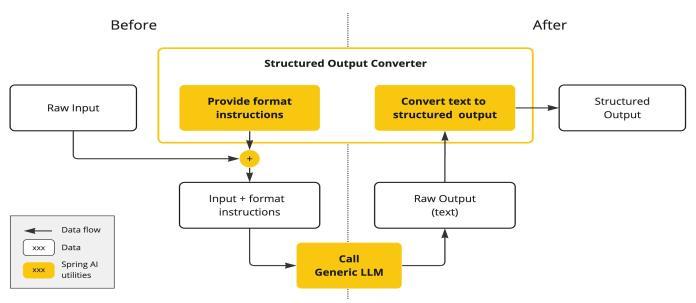
LLMs,suchasOpenAI'sGPT-4,aredeeplearningmodels trained on vast amounts of text data. They excel in understandingandgeneratinghuman-liketext,makingthem valuablefortaskssuchastextsummarization,translation, question-answering, and conversational agents. These modelsusetransformerarchitecturesandhave billions of parameters,enablingthemtocapturethenuancesofhuman language.
TheintegrationofLargeLanguageModels(LLMs)likeGPT-4 into Spring AI frameworks significantly enhances the capabilitiesofenterpriseapplications,particularlyinnatural language processing tasks. LLMs can understand and generate human-like text, making them invaluable for applicationssuchascustomersupport,contentgeneration, and automated communication. Using Spring Boot, developerscanseamlesslyintegrateLLMsintotheirbackend services, leveraging RESTful APIs to interact with these advanced models. This integration allows for real-time processing of user queries, providing intelligent and contextuallyrelevantresponses.Securityandscalabilityare keyconsiderations,asAPIinteractionswithLLMsmustbe protected against unauthorized access and capable of handlinghighvolumesofrequests.Thearchitecturetypically involvesamicroservicesapproach,wheretheLLMfunctions as a separate service that the main application communicates with. This modular design ensures that updates or changes to the LLM do not disrupt the overall system. Frontend applications, built with frameworks like React.js, can efficiently send queries to the backend, displaying responses to users in real-time. This setup not only enhances user experience but also improves operationalefficiencybyautomatingroutinetasks.Overall, integrating LLMs into Spring AI enables enterprises to leverage cutting-edge AI technology within a robust and scalableframework.
Integrating LLMs into Spring AI projects requires careful architecturalplanning.Thekeycomponentsinvolvedinclude:
LLM API Integration: LLMs can be accessed via APIs provided by platforms like OpenAI. These APIs allow the
International Research Journal of Engineering and Technology (IRJET) e-ISSN: 2395-0056
Volume: 11 Issue: 06 | Jun 2024 www.irjet.net p-ISSN: 2395-0072
Spring application tosend and receive data from the LLM, facilitatingseamlessinteraction.
Service Layer: The service layer in a Spring application handles the business logic. It is responsible for processing user inputs, invoking the LLM API, and managing the responses.
Controller Layer: This layer handles incoming HTTP requests, maps them to appropriate service methods, and returnstheresults.Itactsasabridgebetweentheclientand theservicelayer.
Security and Authentication: Integrating LLMs involves handling sensitive data, necessitating robust security measures. Spring Security can be used to implement authenticationandauthorizationmechanisms.
SetUpSpringBootProject:CreateanewSpringBootproject and include necessary dependencies such as Spring Web, Spring Security, and any additional libraries for handling HTTPrequestsandJSONprocessing.
Configure LLM API Access: Obtain API keys from the LLM providerandconfigurethemintheSpringapplication.This mayinvolvesettinguppropertiesfilesanddefiningbeans formanagingAPIinteractions.
DevelopServiceClasses:Implementserviceclassestohandle thelogicforinteractingwiththeLLMAPI.Theseclasseswill include methods for sending user inputs to the LLM and processingtheresponses.
Create Controller Classes: Develop controller classes to manage HTTP requests. These classes will map incoming requests to service methods and handle the responses returnedbytheLLM.
ImplementSecurityMeasures:UseSpringSecuritytosecure theapplication.Configureauthenticationmechanismsand defineaccesscontrolrulestoensureonlyauthorizedusers caninteractwiththeLLMfeatures.
3.1
TodemonstratethepracticalapplicationofintegratingLLMs with Spring AI, we present a case study of an Intelligent CustomerSupportSystem.ThissystemleveragesGPT-4to provideautomatedresponsestocustomerqueries,enhancing theefficiencyandeffectivenessofcustomerservice.
ThearchitectureoftheIntelligentCustomerSupportSystem includesthefollowingcomponents:
Frontend Application: A web-based interface where customerscansubmittheirqueries.
Spring Boot Backend: The core application that processes customer queries, interacts with GPT-4 via its API, and returnsresponses.
Database: A relational database to store customer interactionsandquerylogs.
Security Layer: Ensures secure communication and data handling.
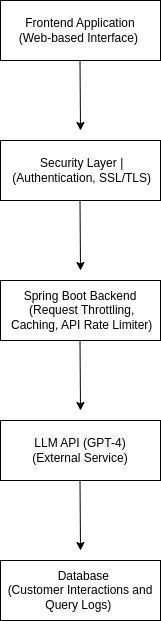
2: SystemArchitecture
International Research Journal of Engineering and Technology (IRJET) e-ISSN: 2395-0056
Volume: 11 Issue: 06 | Jun 2024 www.irjet.net p-ISSN: 2395-0072
Frontend Application: Built using React, it allows users to enterqueriesandviewresponses.ItsendsHTTPrequeststo theSpringBootbackend.
Spring Boot Backend: The backend application includes controllers for handling HTTP requests, services for processing business logic, and repositories for database interactions.TheservicelayerinteractswiththeGPT-4APIto generateresponses.
Database:PostgreSQLisusedtostorecustomerqueriesand responses.Thisdatacanbeanalyzedtoimprovethesystem's performanceandunderstandcustomerneedsbetter.
Security Layer: Spring Security is implemented to authenticate users and authorize access to the system's features.Encryptionisusedtoprotectsensitivedata.
The Intelligent Customer Support System exhibited remarkable advancements in managing customer queries followingtheintegrationofGPT-4.Thisintegrationenabled the system to comprehensively interpret and address a diverse array of queries with exceptional accuracy. By leveraging the advanced capabilities of GPT-4, the system achieved quicker response times and demonstrated proficiency in handling intricate questions that previously posedchallenges.
Customer satisfaction noticeably improved as a result of these enhancements. The ability of the system to provide timelyandaccurateresponsessignificantlycontributedtoa more positive user experience. Customers benefitted from receivingrelevantinformationpromptly,leadingtohigher satisfactionlevelsandincreasedtrustinthesupportsystem. Moreover,theadaptabilityofGPT-4tovaryingquerytypes andcomplexitiesfurtherelevatedthesystem'seffectiveness inmeetingcustomerneedscomprehensively.
The integration of GPT-4 not only optimized operational efficiencybyreducingthetimerequiredtoresolvequeries butalsoenhancedtheoverallqualityofinteractions.Thiswas evident in the system's ability to engage users more effectively, offering personalized responses tailored to individual queries. As a result, the Intelligent Customer SupportSystemnotonlymetbutexceededexpectationsin termsofresponsiveness,accuracy,andcustomersatisfaction, underscoring the transformative impact of integrating advancedlanguagemodelsincustomerserviceapplications.
Query Previous Response GPT-4Response
Howcan Ireset my passwor d?
Followthe instructions senttoyour email.
Clickon'Forgot Password'onthelogin page,enteryouremail, andfollowthe instructionssentto youremail.
Whatare your business hours? 8AMto5PM Ourbusinesshoursare from8AMto5PM, MondaytoFriday.
API Rate Limits: During integration, the system faced constraintswithAPIratelimitsimposedbytheLLMprovider. Tomanagethischallengeeffectively,weimplementedtwo keystrategies:requestthrottlingandcachingoffrequently asked questions (FAQs). Request throttling was achieved usingtoolssuchasSpring’sRateLimiterandBucket4j,which allowedustocontroltherateofrequestssenttotheLLMAPI. This ensured that our application remained within the permissible limits, preventing service disruptions due to exceededquotas.Additionally,cachingfrequentlyrequested responseslocallyusingRedisorEhcachereducedtheneed forrepetitiveAPIcalls,optimizingresponsetimesandoverall systemperformance.
ResponseQuality:Ensuringhigh-qualityresponsesfromthe LLMposedanothersignificantchallenge.Toaddressthis,we adoptedaproactiveapproachcenteredaroundcontinuous monitoringandfine-tuningoftheLLMparameters.Real-time monitoring tools like Prometheus and Grafana were instrumental in tracking response metrics and identifying areas for improvement. Leveraging user feedback, we regularlyadjustedtheLLM’sparametersandretraineditwith domain-specific data to enhance response accuracy and relevance. This iterative process not only improved the immediatequalityofresponsesbutalsoensuredthattheLLM remainedadaptivetoevolvinguserneedsandcontextsover time.
Scalability:Ensuringthescalabilityofthesystemtohandle varying loads and increased user demand was a critical objective.Toachievethis,weimplementedamicroservices architecturecoupledwithcontainerizationusingDockerand orchestrationwithKubernetes.Thisarchitecturalapproach allowed us to break down the application into smaller, independentlydeployableservices.Eachmicroservicecould then be scaled horizontally based on demand, ensuring efficientresourceutilizationandresiliencetofluctuationsin usertraffic.Elasticscalingmechanismswerealsoemployed toautomaticallyadjustthenumberofcontainerinstancesin
International Research Journal of Engineering and Technology (IRJET) e-ISSN: 2395-0056
Volume: 11 Issue: 06 | Jun 2024 www.irjet.net p-ISSN: 2395-0072
responsetoworkloadchanges,therebymaintainingoptimal performanceduringpeakperiodswithoutcompromisingon responsiveness.
Latency Management: Addressing latency issues in API responses was essential for delivering a responsive user experience,particularlyinreal-timeapplications.Tomitigate latency, we adopted several strategies. Firstly, edge computing solutions were deployed to process requests closertotheuser,minimizingtheround-triptimefordata transmission. Asynchronous processing techniques were implementedtohandlenon-criticaltasksseparately,ensuring that critical operations could proceed without delay. Load balancingmechanismswereemployedtodistributeincoming requests evenly across multiple server instances, further optimizing response times and enhancing overall system efficiency. These measures collectively contributed to reducinglatency and improving the responsiveness of our application,therebyenhancingusersatisfactionandusability.
The integration of Large Language Models into Spring AI projectspresentsnumerousopportunitiesforenhancingthe functionality and user experience of AI systems. By leveragingtheadvancedcapabilitiesofLLMs,developerscan build intelligent applications that can understand and generate human-like text, providing significant value in variousdomains.ThecasestudyoftheIntelligentCustomer Support System illustrates the practical benefits and challengesofthisintegration.Futureresearchcouldexplore furtheroptimizationtechniquesandtheapplicationofLLMs inotherSpringAIprojects.
[1] Dwivedi,YogeshK.,NeerajPandey,WendyCurrie,and AdrianMicu."LeveragingChatGPTandothergenerative artificial intelligence (AI)-based applications in the hospitalityandtourismindustry:practices,challenges and research agenda." International Journal of ContemporaryHospitalityManagement36,no.1(2024): 1-12.
[2] Moussaddak, Yasser. "The Impact of AI on PersonalizationandCustomerExperienceinMarketing." (2024).
[3] Venkateswaran, P. S., M. Lishmah Dominic, Shashank Agarwal,HimaniOberai,IlaAnand,andS.SumanRajest. "The role of artificial intelligence (AI) in enhancing marketing and customer loyalty." In Data-Driven IntelligentBusinessSustainability,pp.32-47.IGIGlobal, 2024.
[4] Hicham, N., H. Nassera, and S. Karim. "Strategic frameworkforleveragingartificialintelligenceinfuture
marketingdecision-making."JournalofIntelligentand ManagementDecision2,no.3(2023):139-150.