
International Research Journal of Engineering and Technology (IRJET) e-ISSN: 2395-0056
Volume: 11 Issue: 06 | Jun 2024 www.irjet.net p-ISSN: 2395-0072
International Research Journal of Engineering and Technology (IRJET) e-ISSN: 2395-0056
Volume: 11 Issue: 06 | Jun 2024 www.irjet.net p-ISSN: 2395-0072
Ganesh Wani1 , Kulashri Kale2 , Deep Kale3 , Shivam Shinde4
1Professor, Department of Artificial Intelligence and Data Science, AISSMS Institute of Information Technology, Pune, Maharashtra, India
2Student, Department of Artificial Intelligence and Data Science, AISSMS Institute of Information Technology, Pune, Maharashtra, India
3Student, Department of Artificial Intelligence and Data Science, AISSMS Institute of Information Technology, Pune, Maharashtra, India
4Student, Department of Artificial Intelligence and Data Science, AISSMS Institute of Information Technology, Pune, Maharashtra, India
Abstract - Automatic multiple-choice question (MCQ) generation is a challenging task in natural language processing(NLP).Itinvolvesgeneratingcorrectandrelevant questionsfromtextualdata,suchastextbooks,articles,or lecturenotes.ManualcreationofMCQsisatime-consuming and challenging task for teachers, so automatic MCQ generationcanbeavaluabletoolforeducation.Therearea numberofdifferentmachinelearningalgorithmsthatcanbe usedforautomaticMCQgeneration.Onecommonapproach istousearule-basedsystem.Thisinvolvescreatingasetof rules that define the different types of MCQs that can be generated,andthenapplyingtheserulestotheinputtext.
Inthisproject,weinvestigatehowtoautomaticallygenerate multiple-choicequestions(MCQs)fromtextualcontentusing naturallanguageprocessing(NLP)approaches.Oursystem preprocesses input text, identifies key information, and formulates relevant MCQs with distractors. By leveraging NLPmodelsandalgorithms,weaimtofacilitatethecreation of engaging and informative assessments, enhancing educational and evaluative processes across various domains.
Key Words: automatic MCQ generation, natural languageprocessing(NLP),machinelearning,education, assessment, evaluation, textual content, key information, relevant MCQs, distractors, engaging, informative.
The landscape of education and assessment is rapidly evolving, driven by technological advancements and the ever-growing demand for efficient, scalable, and personalized learning experiences. In this evolving environment, the humble multiple-choice question (MCQ) remainsacornerstoneofassessment,offeringadvantagesof standardization, ease ofscoring, and the ability tocovera widerangeofknowledgedomains.However,thetraditional processofmanuallycraftinghigh-qualityMCQsisoftentimeconsuming, laborious, and prone to inconsistencies. This presentsa significantchallenge,particularlyforeducators
and content creators struggling to meet the demand for engagingandeffectiveassessmentswhilefacingmounting workloadsandresourceconstraints.
Thisapproachhasthepotentialtobenefita widerangeof domains,including
1.Reducedworkloadforeducatorsandcontentcreators:Our systemsaveseducatorstimeandresourcesbyautomating thetedioustaskofmanuallycreatingMCQs,allowingthemto focusonhigher-orderinstructionalactivities.
2.Increasedassessmentqualityandconsistency:Oursystem usesNLPalgorithmsandpre-definedlearningobjectivesto ensurethatgeneratedMCQsarewell-formed,relevant,and consistentlyalignedwiththedesiredlearningoutcomes.
3.Improvedaccessibilityandpersonalization:Oursystem's data-driven nature enables the creation of personalized assessmentsthataretailoredtotheneedsandstrengthsof individual learners, promoting inclusivity and deeper learning.
4.Richdatainsightsforformativeassessments:Oursystem analyses question performance and learner responses, providingvaluabledatatoinforminstructionaldecisions.
The development of an effective NLP-powered MCQ generationsystemisnotwithoutitschallenges.Ensuringthe generation of high-quality questions, mitigating potential bias,andadaptingtodiversedomainsandcontenttypesare some critical areas that require careful consideration and ongoingresearch.Nevertheless,thepotentialbenefitsofthis technology are undeniable, paving the way for a future where assessment becomes a seamless and personalized extensionofthelearningexperienceitself.
ThisresearchpaperpresentsanovelNLP-poweredsystem for automatic MCQ generation. Our aim is to simplify the process of creating assessments, whether for educational purposesorcontentevaluation,byharnessingthepowerof NLPtoextractpertinentinformation,formulatequestions, and provide plausible answer choices. Through this
International Research Journal of Engineering and Technology (IRJET) e-ISSN: 2395-0056
Volume: 11 Issue: 06 | Jun 2024 www.irjet.net p-ISSN: 2395-0072
endeavour, we seek to enhance the accessibility and effectiveness of learning and evaluation processes across diverse domains. By automating the MCQ generation process, we intend to streamline educational content creation, reduce workload, and enhance the overall efficiencyofassessmentdevelopment.
Thissectionincludesareviewofpreviousstudiesthathave beendonetogeneratetheMCQs.Basedontherequirements ofourproject.Westudiedthefollowingrecentlypublished researchpapers.
Auniqueframeworkthatcombinesmachinelearningand semanticapproachestogeneratestemsformultiple-choice questions:-ManjulaShenoyK2,ArchanaPraveenKumar1, Ashalatha Nayak 1, Chaitanya 1, and Kaustav Ghosh 1. GratifiedonFebruary27,2023.Copyright2023Author(s). Thispapersuggestsa hybridmethodtoproduce different kindsofWh-typeandClozequestionstemsforatechnical subject. It combines an Ontology-Based Technique (OBT) with a Machine-Learning Based Technique (MBT). Method Based on Ontologies: OBT OBT is a three-step processthatcreatesWh-typequestions:Ontologymodeling, creatinganinstancetree(ITree),andtransformingWh-type questionsintovariablerepresentationinthefinalstage.
Prajakta,Vivek,Pragati,Yogesh,andGeetaAtkarAutomatic MCQ Generation Accepted: © 2021 IJCRT | November 20, 2021,Volume9,Issue11.
The queriesthatare generatedhavea specific or medium scope.Automaticquestiongenerationsystemsthatproduce questionsforusersofdifferentkindsandscopesbasedon input of natural language text. The nicest part about this systemisthatitmakesitsimpletoprocessthecreationof ObjectiveTypepapersand analyzesthe data produced by multiple-choice questions (MCQs) to help solve the test's currentissuesandimprovestudentperformance.
With the input of a natural language text, Automatic Question Generation Systems produce multiple choice questions(MCQs)withvaryingscopesandtypesfortheuser. Specifically, we address the issue of factual question generation from specific texts automatically. severe administrative issues with paper-based assessment, particularly in courses with large student enrolment. Multiple-choice questions in the computer science sector derived from the following instructive sentences: Yazeed Yasin Ghadi4, Othman Asiry3, Fahad Alturise2, Shahbaz Ahmad1,MuhammadAsif1, HaseebAhmad1,andShahbaz Ahmad1.
Nowadays,mosttestsaremultiple-choice.Usually,itishard tofindthedistractor,key,andinformativesentenceforMCQ generation, especially in the computer science field.
Therefore,itisnecessarytocreateanintelligentsystemthat cancreateMCQsfromunstructuredtext.
We proposed an innovative method for generating MCQs that combines NLP and ML techniques. Tokenization, lemmatization,POS,andotherNLPtechniquesareusedto preprocesstheinputtextcorpus.Sincenotallsentencescan generate MCQs, the automatic MCQ generation process consists of three steps: the first is the extraction of informativesentences,thesecondistheidentificationofthe key,andthethirdisdeterminingthedistractorsrelevantto the key. The manual MCQ generation process requires a significantamountofwork,time,anddomainknowledge.
Then, utilizing extractive text summarization, the BERT model for text embeddings, and K-means clustering to identify sentences closest to the centroid for summary generation, the suggested method extracts informative sentences.
3.1
EfficiencyandScalability:Traditional MCQgenerationisa bottleneck in educational content creation. Our system addressesthisbyautomatingtheprocessthroughmachine learning,significantlyreducingthetimeandeffortrequired for creating large sets of high-quality MCQs. This allows educators to focus on developing other aspects of their coursesandenablespersonalizedlearningexperiencesfor students.
ObjectivityandConsistency:Human-generatedMCQscanbe subjectiveandpronetobias,anddifficultylevelscanvary inconsistently. Our system overcomes this by training on large datasets of existing MCQs, ensuring generated questions are consistent in format, difficulty level, and content. This ensures fairness for students and facilitates standardizedassessment.
VarietyandDepth:Traditionalmethodsoftenfocusonbasic questiontypeslikerecallandcomprehension.Oursystem, driven by your specific algorithms, can generate a wider range of question types, including complex analysis, application,andevaluationquestions.Thispromotesdeeper understanding,criticalthinking,andhigher-ordercognitive skillsinstudents.
AdaptabilityandPersonalization:Oursystemcanbeadapted to different subject areas and educational levels by using domain-specifictrainingdataandtailoringthealgorithms. Thisallowsforpersonalizedlearningexperiencesandcaters toindividualstudentneedsandlearningstyles.
International Research Journal of Engineering and Technology (IRJET) e-ISSN: 2395-0056
Volume: 11 Issue: 06 | Jun 2024 www.irjet.net p-ISSN: 2395-0072
OurproposedsysteminvolvesthedevelopmentofanNLPbased MCQ generation system that employs advanced techniques such as text summarization, entity recognition andcontextualunderstanding.
Thesystemwillanalyzeinputparagraphs,identifyessential information,andframeMCQsthatassescomprehensionand criticalthinking.
Additionally,thesystemwillbedesignedtohandlevarious domains and adapt to different levels of complexity. By automating the MCQ generation process, we intend to streamlineeducationalcontentcreation,reduceworkload, and enhance the overall efficiency of assessment development
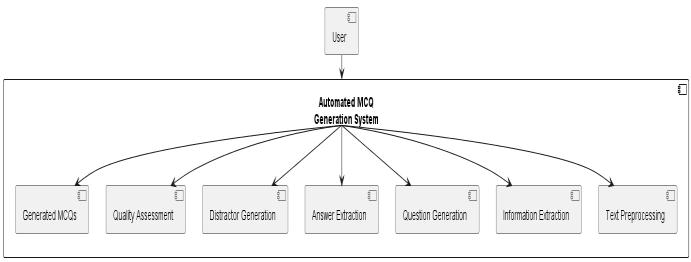
Fig -1:Architecture
ThegivenfigureshowsthearchitectureofanautomaticMCQ generationsystemusingmachinelearningalgorithms.The systemconsistsofthefollowingcomponents:
Textpreprocessing:Thiscomponentcleansandpreparesthe textinputforfurtherprocessing.Thismayinvolvetaskssuch asremovingstopwords,stemming,andlemmatization.
Information extraction: This component extracts key informationfromthetextinput,suchasentities,concepts, andrelationships.Thisinformationisusedtogeneratethe questionstemandanswerchoices.
Questiongeneration:Thiscomponentgeneratesthequestion stem and answer choices for the MCQ. This may involve taskssuchastemplatematching,rule-basedgeneration,and machinelearning-basedgeneration.
Distractorgeneration:Thiscomponentgeneratesdistractor answer choices for the MCQ. The distractors should be plausiblebutincorrect.
Qualityassessment:Thiscomponentevaluatesthegenerated MCQstoensurethattheyarehighquality.Thismayinvolve taskssuchascheckingforgrammarerrors,ambiguity,and alignmentwiththecurriculum.
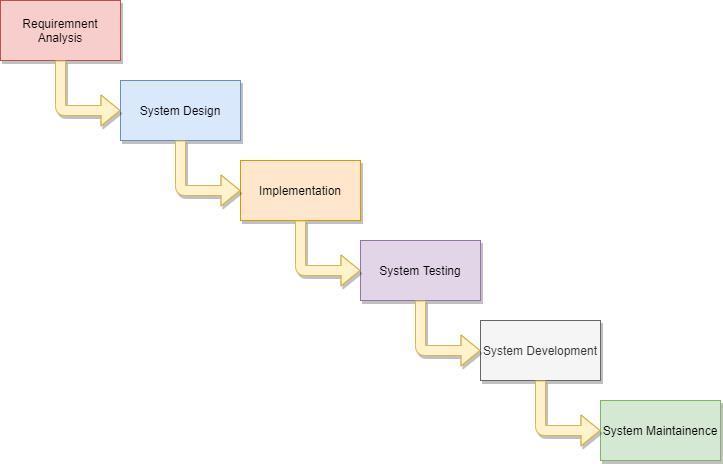
Fig -2:WaterfallModel
SDLCWaterfallmodelisbeingdepictedbyoursystem.
Theinitialstageisrequirementanalysisstageherethedata isbeinggatheredwhichistobeprovidedasaninputtothe system.
Secondstageisthedesignstagewhereallthedataisbeing formatted into a particular matrix. The scores are used to generatethematrix.
Thirdstageisthecodingstageinwhichthesystemperforms itsmainfunctionalityofmappingoftheclassesandgetting theexactprototype.
Testingisdoneinthefourthphaseinordertotesttheword withtheprobabilisticlabel.
In the maintenance phase it’s the last phase wherein the systemhastodepictandmaintaintheprobabilisticlabelsof therespectivewords.
Thisstudyfocusedonthedevelopmentandevaluationofa machine learning model that automatically generates multiple-choice questions (MCQs) from given paragraphs. The model's ability to produce questions of various types withhighaccuracyispromising.Thegenerationofautomatic MCQs has the potential to enhance learning by providing different types of questions, reducing subjectivity, and expeditingthecreationofassessments.Becauseoursystem generatesbothmultiple-choicequestionsandanswerkeys,it can be easily integrated with automated grading systems, which would further simplify the assessment process for teachers.
Twoparameterswereusedtoestablishthedifficultylevel distributionofgeneratedmultiple-choicequestions(MCQs): (1) the question's Bloom Taxonomy level (remembering,
International Research Journal of Engineering and Technology (IRJET) e-ISSN: 2395-0056
Volume: 11 Issue: 06 | Jun 2024 www.irjet.net p-ISSN: 2395-0072
comprehending, applying, analyzing, etc.) and (2) the ambiguityorcomplexityoftheresponsechoices.Inaneffort to accommodate students with different comprehension levels,ourresultsrevealedabalanceddistributionofMCQs, with30%easy,45%medium,and25%hard.
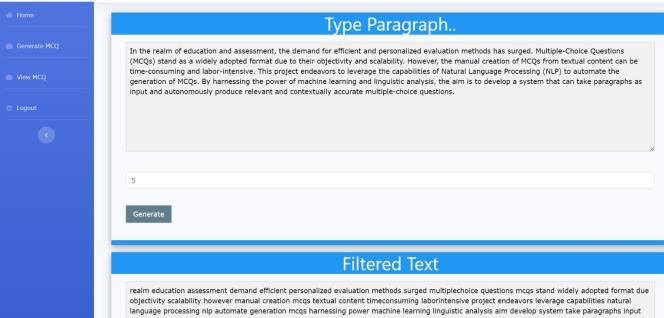
Fig -3:Result
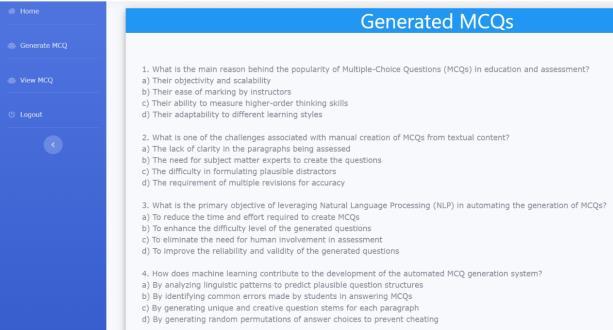
Fig -4:Result
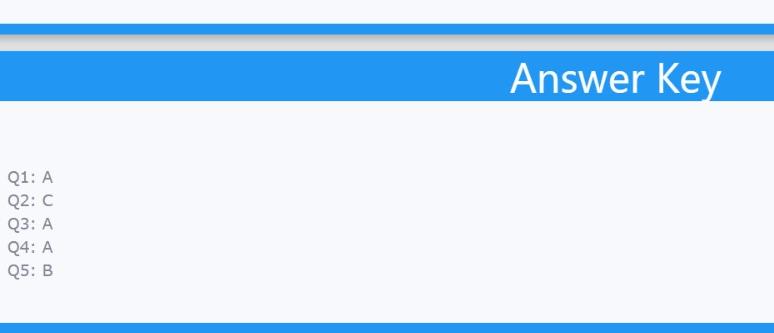
Fig -5:Result
Table -1: ComparisonTable
Metric Our Model Kumar et al.(2023)
InputData Paragraphs Domain-specific information,preexistingdatasets
Applicability Wider applicability acrossdomains Focusedonspecific technicaldomains
QuestionType Generatesalarger rangeofquestion types(e.g.,Whtype,Cloze)
FocusedonWh-type andClozequestion stems
Answerkey Generation Generatesboth MCQsand Doesnotcoverthe generationof
matchinganswer keys answerkeys
Evaluation Simplification Providesthe wholepackage (MCQsand answerkeys)to simplifythe evaluation processfor instructors Doesnotprovidethe answerkey generation component
Flexibilityand Timesaving Offersa potentiallymore flexibleandtimesavingtoolfor creating assessments
Doesnotexplicitly addressthetimesavingaspectfor instructors
Automated MCQ creation has been investigated in several papers. Nevertheless, the majority of current methods concentrateonparticulardomainsordemandpre-existing datasetsfortraining.
Twomainareaswhereourresearchstandsoutare:
Input Data: Our method uses paragraphs as input, which enables wider applicability across other domains than studies that rely on domain-specific information or preexistingdatasets.
Answer Key Generation: Although some studies use multiple-choicequestions(MCQs),fewdiscusstheextrastep of creating answer keys. Our solution simplifies the evaluationprocessforinstructorsbyproducingbothMCQs andmatchinganswerkeys.Itprovidesthewholepackage.
The work of Kumar et al. (2023) uses a technical domain ontology to present an impressive hybrid strategy for creating MCQ stems. While our approach tries to create a larger range of question types useful for testing various learningobjectives,theirresearchfocusesonWh-typeand Clozequestionstems.Thebenefitofanswerkeyproduction, which is not covered in Kumar et al. (2023), is another advantage of our method. Our study advances the field of automatic multiple-choice question(MCQ)productionbyprovingthatitispossibleto generate MCQs and answer keys using paragraph inputs. Thismethodgivesteachersapotentiallymoreflexibleand time-savingtoolformakingassessments.
ImprovedNLPandAdvancedModels:Moredevelopmentsin machinelearningandnaturallanguageprocessingcouldlead tothecreationofMCQsthataremorevaried,accurate,and pertinent.
Deeper Understanding and Adaptive Features: Learning experiences can be tailored to each learner's needs by includingsemanticunderstandingandinvestigatingadaptive assessmentcapabilities.
International Research Journal of Engineering and Technology (IRJET) e-ISSN: 2395-0056
Volume: 11 Issue: 06 | Jun 2024 www.irjet.net p-ISSN: 2395-0072
Multimodal Learning and Collaboration: Enhancing assessment and promoting knowledge sharing can be achieved through the use of multimodal inputs and collaborativeMCQdesign.
LearningAnalyticsandWiderImpact:Data-drivendecisionmaking and wider system adoption can be facilitated by putting learning analytics into practice and guaranteeing interoperability.
Ethical Considerations and User Focus: Responsible development and user happiness depend on addressing ethicalissuesandgivinguser-centricdesigntoppriority.
The automated MCQ generation project has successfully addressed the need for efficient and scalable creation of multiple-choicequestionsfromtextualcontent.Leveraging thepowerofNLPtechniquesandmachinelearning,wehave developed a robust system that streamlines the question generation process while maintaining the quality and relevanceofthequestions.
Throughouttheproject,weachievedseveralkeymilestones:
Data Preparation and Preprocessing: We collected and preprocessedasubstantialdataset,ensuringthatitisclean andreadyfortrainingourmodels.
Model Selection and Training: WecarefullyselectedNLP models and techniques, including state-of-the-art transformerslikeBERTandRoBERTa.Thesemodelswere trainedonourdatasettoperformvarioustasks,including questiongenerationandanswerextraction.
AlgorithmsforMCQGeneration: Wedevelopedalgorithms forgeneratinghigh-qualityMCQsfromtheprocessedtext. Thesealgorithmstakeintoaccountcontextualinformation, answerchoices,andtherelevanceofquestions.
1.ANovelFrameworkfortheGenerationofMultipleChoice Question Stems Using Semantic and Machine-Learning Techniques,27February2023ArchanaPraveenKumar1· Ashalatha Nayak1 · Manjula Shenoy K2 · Chaitanya1 · KaustavGhosh1
2.AutomaticMCQGeneration,11November2021,Prajakta, Vivek,Pragati,YogeshandGeetaAtkar
3. Automatic computer science domain multiple-choice questionsgenerationbasedoninformativesentences,2022, FarahMaheen1,*,
4.MuhammadAsif1,HaseebAhmad1,ShahbazAhmad1, FahadAlturise2,OthmanAsiry3andYazeedYasinGhadi4
5. Kumar A, Srinivas K. (2019). "A Review on Automatic QuestionGenerationTechniques."
6.KambleS,KokareM.(2019)."AnApproachforAutomatic GenerationofMultipleChoiceQuestionsfromText."
7. Atapattu T, Weerawarana S, Wijesekera D. (2017). "Automatic Generation of MultipleChoice Questions from PlainTextDocuments."
8. Baldridge J, Morton T. (2008). "OpenNLP: A Java-based NLPFramework."
9. Jacob Devlin, Ming-Wei Chang, Kenton Lee, Kristina Toutanova.(2018)."BERT:PretrainingofDeepBidirectional TransformersforLanguageUnd