
International Research Journal of Engineering and Technology (IRJET) e-ISSN:2395-0056
Volume: 11 Issue: 06 | Jun 2024 www.irjet.net p-ISSN:2395-0072
International Research Journal of Engineering and Technology (IRJET) e-ISSN:2395-0056
Volume: 11 Issue: 06 | Jun 2024 www.irjet.net p-ISSN:2395-0072
Anil Kumar1, Mr. Ushendra Kumar2
1Master of Technology, Civil Engineering, Lucknow Institute of Technology, Lucknow, India
2Head of Department, Department of Civil Engineering, Lucknow Institute of Technology, Lucknow, India
Abstract - Concrete is a versatile and commonly used construction material designed to withstand compressive stresses. The cost of sand production and utilization is higher, leading to various environmental issues. Sand is a natural product, but mining it along the Narmada River poses risks due to natural disasters. It is crucial to prepare for potential challenges in the future. The substance mistaken for dust is actually marble, a novel composite material that can enhance material efficiency in the concrete industry, yield economic advantages, and facilitate the construction of environmentally friendly, robust, and long-lasting structures. Lime can enhance the reactivity of marble dust, making it a viable option as a cement binder. Environmental issues are often a result of industrial waste, underscoring the importance of recycling. Annually, millions of metric tons of marble dust are produced globally during quarrying operations. The effective use of marble powder in concrete has significantly improved the material's ability to maintain its hardened state. To incorporate marble dust as a binding agent in concrete and mortar production, an analysis from both physical and chemical perspectives is necessary. Pure limestone transforms into marble through metamorphism, typically containing over 50% calcium oxide. By substituting sand with marble dust in concrete, we can reduce our environmental impact, save costs, and increase durability. Various mixtures of M20(1:1.5:3) grade concrete with marble dust replacing sand at different percentages were tested for compressive strength at 7 and 28 days using 150 mm x 150 mm x 150 mm cubes. Enhancing concrete with high-quality binding elements like marble dust can improve workability, durability, strength, fracture resistance, and permeability. Modifying the microstructure of cement composites in the future may enhance their compressive strength, flexural strength, split tensile strength, durability, and service life..
Key Words: Concrete, marble dust, fine aggregate replacement, sustainable construction, mechanical properties, compressivestrength,tensilestrength.
Concrete, a ubiquitous material in modern construction, embodies the essence of durability and versatility. Composed primarily of cement, water, and aggregates such as sand and gravel, it forms a robust matrix capable of withstanding immense compressive forces. Its history traces back to ancient civilizations like the Romans who
used a similar substance called "opus caementicium" in theirarchitecturalmarvels.Today,concrete'sapplications are boundless, from towering skyscrapers to intricate bridges, and even humble sidewalks. Its adaptability allows for the realization of intricate designs while ensuringstructuralintegrity.Beyonditsstrength,concrete offers thermal mass properties, aiding in temperature regulation within buildings. However, despite its durability, concrete production bears environmental consequences, notably due to cement manufacturing's high carbon footprint. Efforts are underway to innovate sustainable alternatives, such as using recycled materials or developing new cement formulations with reduced emissions. Concrete stands as a cornerstone of modern civilization, symbolizing both the ingenuity of human engineering and the ongoing pursuit of sustainable progressinconstructionpractices.
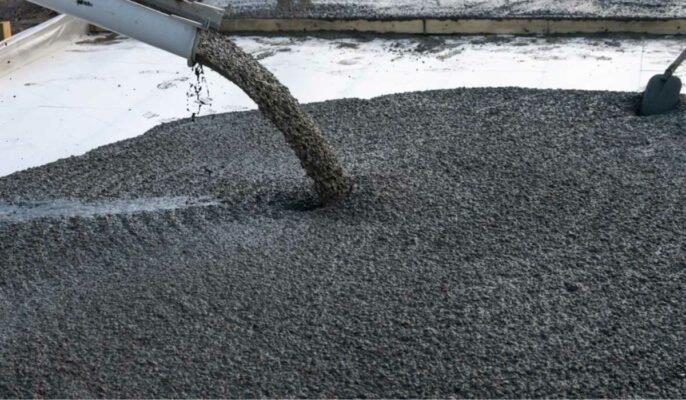
Concreteisprimarilycomposedoffourmaincomponents:
Cement, the binding material in concrete, serves as the foundational component that imparts strength and cohesion to the mixture. Derived from a finely ground blend of limestone, clay, and other minerals, cement undergoes a chemical transformation when mixed with water, resulting in hydration. This hydration process formsapastethatcoatsandbindstogethertheaggregates, filling the voids between particles. As the cement paste
International Research Journal of Engineering and Technology (IRJET) e-ISSN:2395-0056
Volume: 11 Issue: 06 | Jun 2024 www.irjet.net p-ISSN:2395-0072
hardensandsolidifies,itcreatesarobustmatrixthatbinds the entire concrete mixture into a cohesive unit. The quality of cement greatly influences the properties of the concrete, including its strength, durability, and resistance to environmental factors. Consequently, selecting the appropriate type and quality of cement is crucial in ensuring the structural integrity and performance of concreteinvariousconstructionapplications.
Coarse aggregate, a fundamental component of concrete, contributes to its structural integrity and overall performance. Comprising materials such as gravel, crushed stone, and recycled concrete, coarse aggregates provide bulk and stability to the concrete mixture. These aggregatestypicallyrangeinsizefrom3/8inchtoseveral inches in diameter, depending on the specific application and design requirements. Their primary function is to providestrengthandsupportbydistributingloadsevenly throughout the concrete mass. Additionally, coarse aggregatesinterlockwitheachotherandthecementpaste, enhancing the concrete's resistance to deformation and improving its durability under various stresses. The selectionof coarse aggregatetypeandsizeplays a critical role in determining the concrete's strength, workability, and appearance. Proper grading and quality control of coarse aggregates are essential to ensure the desired performanceandlongevityoftheconcretestructure.
The purpose of coarse aggregate in concrete is multifaceted, serving crucial roles in its overall performance and structural integrity. Firstly, coarse aggregates provide bulk and volume to the concrete mixture, reducing the amount of cement paste needed while maintaining the desired workability. By occupying the spaces between cement particles, coarse aggregates enhance the concrete's resistance to shrinkage and cracking during the drying and curing process. Moreover, theycontributesignificantlytotheconcrete'scompressive strength, distributing applied loads and stresses throughout the structure. Through interlocking and bonding with the cement paste, coarse aggregates reinforce the concrete matrix, improving its resistance to deformation and enhancing durability under various environmental conditions and loading scenarios. Additionally, coarse aggregates help control thermal expansion and contraction, as well as provide thermal mass properties, aiding in temperature regulation within concrete structures. Overall, the presence of coarse aggregates is indispensable for ensuring the stability, strength,andlongevityofconcreteindiverseconstruction applications.
Fine aggregate, a vital constituent of concrete, serves several critical functions essential for the material's
overall performance and characteristics. Comprising materials such as sand, crushed stone dust, or recycled concrete particles smaller than 5mm in size, fine aggregates play a pivotal role in enhancing the workability,cohesion,anddurabilityofconcretemixtures. By filling the voids between coarse aggregate particles, fine aggregates improve the packing density of the concrete mix, thereby reducing the amount of voids and optimizingtheparticledistributionwithinthematrix.This optimized particle distribution enhances the concrete's strength and density while minimizing the risk of segregation and bleeding during placement and compaction. Furthermore, fine aggregates contribute to the formation of a dense and impermeable cement paste, which enhances the concrete's resistance to moisture ingress, chemical attack, and abrasion over time. Additionally, fine aggregates help control the overall volumeandconsistency oftheconcrete mixture, ensuring proper bonding between particles and facilitating the attainmentofdesiredsurfacefinishesinfinishedconcrete structures. Overall, the presence of fine aggregates is essential for achieving the desired properties of concrete, including strength, durability, and workability, making them indispensable components in modern construction practices.
Replacing fine aggregate in concrete with alternative materialsisa topic of ongoing research and innovation in the construction industry. Some common reasons for exploring alternatives include scarcity of natural sand, environmental concerns related to sand mining, and the desire to create more sustainable construction practices. Here are some materials that have been considered or usedasreplacementsforfineaggregate:
Producedbycrushingrocks,M-sandisaviablealternative to natural river sand. It has similar properties to river sand and can be used in concrete production. Its use reducesthestrainonnaturalsandreserves.
Crushed rock fines obtained from quarriescan beused as a replacement for natural sand. These fines are produced during the crushing process of rock aggregates and have similarpropertiestonaturalsand.
Crushedconcretefromdemolishedstructurescanbeused asa substitute for natural sand.This not only reducesthe demand for virgin materials but also helps in managing constructionwaste.
International Research Journal of Engineering and Technology (IRJET) e-ISSN:2395-0056
Volume: 11 Issue: 06 | Jun 2024 www.irjet.net p-ISSN:2395-0072
2.4.Recycled Glass
Finely crushed recycled glass can be used as a partial replacement for fine aggregate. It offers benefits such as reduced landfill waste and can impart unique aesthetic qualitiestoconcrete.
2.5.Recycled Plastics
Some researchers have explored the use of finely shredded plastic waste as a replacement for fine aggregate.Whilestillinexperimentalstages,thisapproach aims to address both waste management issues and reducetheenvironmentalimpactofconcreteproduction.
2.6.Fly Ash
A byproduct of coal combustion in power plants, fly ash canbeusedasapartialreplacementforcementaswellas fine aggregate. It improves concrete's workability, durability,andreducesitsenvironmentalfootprint.
2.7.Silica Fume
Also known as microsilica, silica fume is a byproduct of silicon and ferrosilicon alloy production. It is highly reactive and can be used as a partial replacement for cement as well as fine aggregate. Its use improves concrete'sstrengthanddurability.
2.8.Expanded Clay or Shale
Lightweightaggregateslikeexpandedclayorshalecanbe used as a replacement for fine aggregate in lightweight concrete applications. They offer reduced density and improvedthermalinsulationproperties.
3.REPLACEMENT OF THE FINE AGGREGATE WITH DUST OF MARBLE
Replacingfineaggregatewithmarbledustisaninnovative approach in concrete production, offering both environmental and aesthetic benefits. Marble dust, a byproduct of marble processing, is finely powdered and can serve as a sustainable alternative to natural sand. Utilizing marble dust in concrete not only reduces the environmental impact of marble quarrying but also alleviates the strain on natural sand resources. Additionally, incorporating marble dust can enhance the visual appeal of concrete, imparting a distinctive finish that reflects the elegance of marble. However, careful considerationmustbegiventofactorssuchasparticlesize distribution, chemical composition, and the effect on concrete's mechanical properties when determining the optimal mix proportions. Thorough testing and experimentation are essential to ensure that concrete containing marble dust meets the required standards for strength, durability, and workability, thus realizing the
potential of this alternative material in sustainable constructionpractices.
4.IMPORTANT OF THE MARBLES DUST AS FINE AGGREGATE
The use of marble dust as a fine aggregate in concrete offersseveralimportantadvantages:
4.1.Environmental Sustainability
Marble dust is a byproduct of marble processing, which means its use in concrete reduces the environmental impact associated with marble quarrying and processing. By utilizing this waste material, it helps in conserving naturalresourcesandreducinglandfillwaste.
4.2.Resource Conservation
Incorporatingmarbledustasafineaggregatereducesthe demand for natural sand, which is often sourced from riverbeds and coastal areas. By substituting marble dust for natural sand, the strain on these natural resources is alleviated,contributingtotheirpreservation.
4.3.Improved Aesthetic Appeal
Concrete made with marble dust as a fine aggregate can have a visually appealing finish, reminiscent of the elegance of marble. This can be particularly desirable in architectural applicationswhereaestheticsareimportant, addingatouchofsophisticationtothefinishedstructure.
4.4.Enhanced Mechanical Properties
Properly engineered concrete mixes containing marble dust can exhibit favorable mechanical properties. While the exact effects may vary depending on factors such as particle size distribution and chemical composition, marble dust can contribute to improved strength, durability,andworkabilityofconcrete.
4.5.Potential Cost Savings
Utilizing waste materials like marble dust in concrete production can lead to cost savings for construction projects. Instead of disposing of marble dust as waste, its incorporation into concrete provides a value-added use, potentiallyreducingmaterialprocurementcosts.
4.6.Reduced Carbon Footprint
By substituting marble dust for traditional fine aggregate, the carbon footprint associated with concrete production may be reduced. This is especially significant if marble dust is sourced locally, minimizing transportation-related emissions.
International Research Journal of Engineering and Technology (IRJET) e-ISSN:2395-0056
Volume: 11 Issue: 06 | Jun 2024 www.irjet.net p-ISSN:2395-0072
4.7.Innovation and Research
Exploring alternative materials like marble dust encourages innovation and research in the construction industry. Researchers and engineers continually investigate the properties and potential applications of such materials, contributing to the development of more sustainableconstructionpractices.
5.RESULT AND DISCUSSION
The task's fulfillment encompasses two separate phases, withthefirststageyieldingavisualportrayaloftheresult. Through meticulous examination, cubes, cubes with bars, and cylinders have all been scrutinized to ascertain their individual capacities at 7 days and 28 days. This informationformsthebasisforassessingthedifferentmix ratiosintermsofstrength.Furthermore,acomparisonhas beenestablishedbetweenthestrengthsdemonstratedat7 daysand28daysforadditionalscrutinyandassessment.
5.1.Result of Compressive Strength
It is apparent that there is a substantial 21.74% enhancement in compressive strength when marble dust is utilized to substitute sand by 10%. Nevertheless, with anincrease in the percentage of marble dust replacement to 15%, the strength begins to diminish, ultimately reaching a minimum level. Conversely, the graph illustrating the 28-day strength (graph 2) displays a 16.85% escalation in strength when an additional 10% of marble dust is incorporated into the standard concrete mixture. Intriguingly, surpassing this threshold of marble dust addition leads to a decline in the concrete strength once again. These findings underscore the significance of carefully assessing the quantity of marble dust utilized in concrete mixtures to attain optimal strength characteristics.
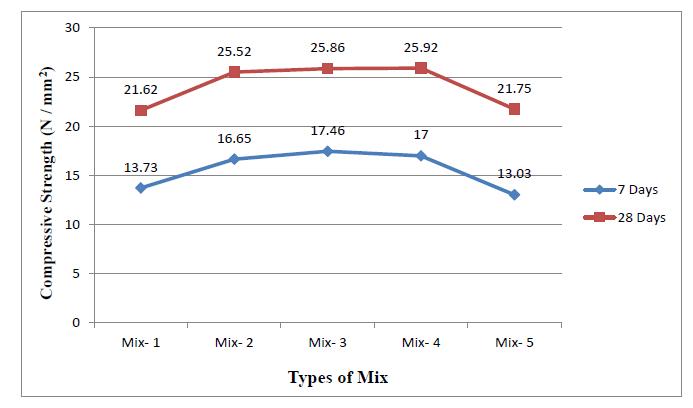
Figure-02: Result of Compressive Strength
5.2.Strength of Split Tensile
Itisapparentthatthesplittensilestrengthdemonstratesa remarkable increase of 15% when 15% of the sand is substituted with marble dust. However, with a further
20% increase in the proportion of marble dust, the concrete strength begins to exhibit a decrease after 28 days. Figure 5.4 visually depicts a substantial 35% enhancement in strength with the replacement of 15% marble dust in the standard concrete mix. Yet, with a subsequent20%increment intheamountofmarbledust, the concrete strength once again declines. This data highlights the influence of marble dust on the strength characteristics of concrete, showcasing both the positive andnegativeimpactsofitsinclusioninthemixture.
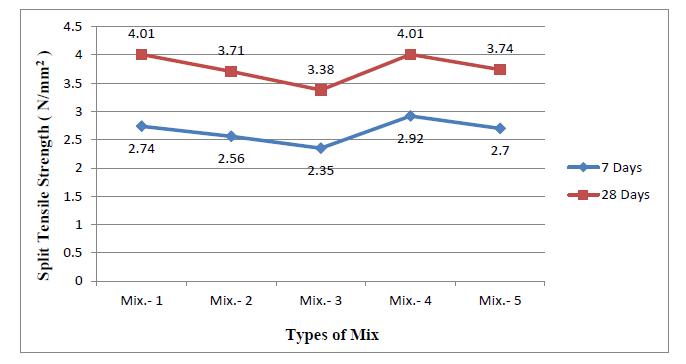
Figure-03: Result of Split Tensile Test
Strength Test
Thebondstrengthwasassessedthroughtestingtwocubes fromeachbatchmixaftersevendaysandthenagainafter twenty-eightdays.Atotaloffivedistinctbatchmixeswere examined, with each mix containing two cubes for evaluation. This method facilitated a thorough evaluation of bond strength evolution over time and across various mixtures, yielding valuable data for detailed analysis and comparison.
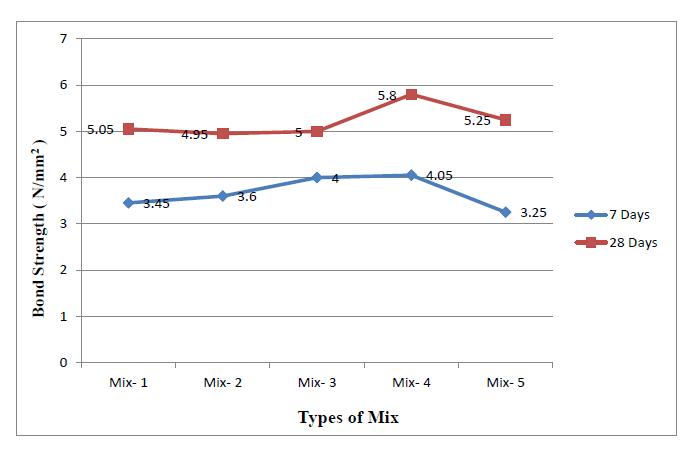
Figure-04: Bond Strength Test
6.CONCLUSION
Theresearchrevealedthatthesubstitutionoftenpercent ofsandwithmarbledust(mix-03)resultedinasubstantial improvementinthecompressivestrengthoftheconcrete.
International Research Journal of Engineering and Technology (IRJET) e-ISSN:2395-0056
Volume: 11 Issue: 06 | Jun 2024 www.irjet.net p-ISSN:2395-0072
Furthermore,replacing15%ofthesandwithmarble dust (mix-04)ledtoasignificantincreaseinthebondstrength ofthe concrete.Additionally,thestudy demonstratedthat when 15% of sand (mix-04) was replaced by weight with marble dust, the split tensile strength of the concrete reached its maximum value. These results underscore the positive influence of marble dust on various strength properties of concrete, underscoring its potential as a beneficial additive in concrete mixtures. At 7 and 28 days after curing, the compressive strength, split tensile strength, bond strength, and density of concrete mixtures are evaluated following the incorporation of a specific quantity of marble dust. In our research, the optimal proportion of Marble Dust is identified as five percent (in relation to the weight of Sand), and a variety of concrete characteristicsarescrutinized.MarbleDustisaddedtothe concrete in different ratios ranging from zero percent to twenty percent relative to the weight of Sand. The following conclusions can be drawn after completing all assessmentsandanalyzingtheirresults.
1. Pozzolanicpropertiesof marble industrial waste and its used in concrete. 7(3), 1083–1090. https://doi.org/10.33379/gtech.v7i3.2765.
2. Experimental Investigation of Concrete by Partial ReplacementofFineAggregatewithRedSoil.(2023). Experimental Investigation of Concrete by Partial Replacement of Fine Aggregate with Red Soil. 5(3). https://doi.org/10.36948/ijfmr.2023.v05i03.3973
3. Feasibility study of fine-metakaolin and coal bottom ash as cement and fine aggregate replacement in seawater-mixed concrete. (n.d.). Feasibility study of fine-metakaolin and coal bottom ash as cement and fine aggregate replacement in seawater-mixed concrete. 1205(1), 012041–012041. https://doi.org/10.1088/17551315/1205/1/012041
4. Experimental Study on Light Weight Concrete using Plastic Waste as a Partial Replacement of Fine Aggregate.(n.d.).ExperimentalStudyonLightWeight Concrete using Plastic Waste as a Partial Replacement of Fine Aggregate. https://doi.org/10.21203/rs.3.rs-2552757/v1
5. Recycling of Waste Glass as Partial Replacement to Fine Aggregate and Rice Husk Ash as Partial ReplacementofCementinConcreteProduction.2(1). https://doi.org/10.30880/jsmbe.2022.02.01.006+
6. Quality Assessment of Concrete produced with Marble dust as Partial Replacement of Cement using Ultrasonic Pulse Velocity Test. 1, 1305–1310. https://doi.org/10.38208/acp.v1.655
7. Effect of the Partial Replacement of Cement with WasteGranitePowderonthePropertiesofFreshand Hardened Mortars for Masonry Applications. 15(24), 9066–9066.https://doi.org/10.3390/ma15249066
8. Evaluation of Fresh and Hardened Concrete Properties Incorporating Glass Waste as Partial Replacement of Fine Aggregate. 14(23), 15895–15895.https://doi.org/10.3390/su142315895
9. Effects of Waste Powder, Fine and Coarse Marble AggregatesonConcreteCompressiveStrength.(n.d.). Effects of Waste Powder, Fine and Coarse Marble Aggregates on Concrete Compressive Strength. 14(21), 14388–14388. https://doi.org/10.3390/su142114388
10. Prediction of Strength Properties of Concrete Containing Waste Marble Aggregate and Stone Dust Modeling and Optimization Using RSM. 15(22), 8024–8024. https://doi.org/10.3390/ma15228024
11. Cement Kiln Dust (CKD) as a Partial Substitute for CementinPozzolanicConcreteBlocks.(n.d.).Cement Kiln Dust(CKD)asa Partial Substitute for Cement in PozzolanicConcreteBlocks.13(2),568–568.