
International Research Journal of Engineering and Technology (IRJET) e-ISSN: 2395-0056
Volume: 11 Issue: 06 | Jun 2024 www.irjet.net
p-ISSN: 2395-0072
International Research Journal of Engineering and Technology (IRJET) e-ISSN: 2395-0056
Volume: 11 Issue: 06 | Jun 2024 www.irjet.net
p-ISSN: 2395-0072
Shubham Bhimrao Bangar
ABSTRACT:
India is one of the significantly making countries in the world and it has the second-largest agricultural source of wage, which covers 61% of the entire wage of the country. The most valuable pay bunch, by giving the fitting planning in this advancement, will make their whole nation to finished up one of the most significantly making areas in the world. In afterwarda longtime, numerous makingmade,andyouthful countriesstandupto insufficienciesof,characteristic items andvegetablesduetotypicalcatastropheslikeseismictremors,downpour,andanyotherunforeseenevents.Presentlythe essentialissueofthispaperistoensurethefoodthingsfrompost-harvesttocustomerlevel,whichcover60%ofincidents due to the detachment of added substance methodologies. This paper fundamentally centred on the conventional techniquestoadvancedsun-orienteddryingpropelsforperseverating,characteristicitems,andvegetables.
InIndia,generally80percentofagriculturistsaredestitute,negligiblecreators.Amongthechallengestheygoupagainst arefluctuatingexhibitcosts.Atomatocanofferfor80Rsperkgonemonthandasitwere20 Rsperkgonemonthawhile later.Bethatasitmay,ranchersarenotabletosecuretheirnourishmentformorethan1to2weekssinceofcontrolcosts, down and out establishment and require of financing to contribute in capacity workplaces. When the promote costs are moo, farmers regularly have to hurl missing their make, coming around in essential misuse. The coming about commitmentwithoutadoubtleadsafewfamerstocommitsuicide.Tohandlethisissue,Ihavecomeupwithcosteffective sun-baseddryer.Themachinecostsveryless,asitismadecompletelyfrombamboo,thusbamboocanbecreatedinfarms and engages agriculturists to get dried out their country things and direct them for a slightest of six months, whereas ensuringsupplements,colourandtest.
Dryinghaslongbeenutilizedasamethodtoextendtheshelflifeoffoodproducts,datingbacktoancienttimes.Harnessing thesun'sheatandwind,thisage-oldtechniqueremainsacornerstoneoffoodpreservation.However,its energy-intensive nature,coupledwiththeincreasingscarcityandcostoffossilfuels,hasspurredashifttowardsrenewableenergysources. Amongthese,solarenergystandsoutforitsenvironmentalfriendlinessandminimalecologicalfootprint.Various typesof solar dryers have been developed and tested across different regions, primarily falling into two categories: natural convection and forced convection. Natural convection dryers rely on buoyancy-induced airflow, while forced convection dryersemployfans,typicallypoweredbyelectricity,solarmodules,orevenfossilfuels.
Solar thermal technology, rapidly gaining traction in agricultural applications, offers distinct advantages over other alternatives like wind or shale. Abundant, inexhaustible, and clean, solar energy presents a sustainable solution for food preservation needs. Addressing the pressing issue of agricultural produce preservation, particularly in developing countries, holds significant importance. Inadequate infrastructure, limited processing capacities, and market challenges contributetosubstantialpost-harvestlosses,exacerbatingfoodsecurityconcerns.Dryingemergesasaviablesolution,not onlycurbingspoilagebutalsobolsteringincomeopportunitiesandsupplystability.[1]
At the farm level, drying immediately post-harvest, especially during peak harvest periods, helps manage surpluses and extends storage capabilities. Thermal energy-based drying facilitates longer shelf lives and easier transportation by reducing moisture content. Moreover, when executed correctly, drying preserves nutritional quality and inhibits the proliferation of harmful pathogens. While energy-intensive, drying efficiency hinges on several factors such as produce type,size,arrangementondryingracks,andfrequencyofrotation.Optimaldryingnecessitatesavoidingovercrowdingand ensuringregularturningtoachieveuniformdrying.
Literature Review:
Cropdryingisavitalprocessinagriculture,aimedatreducingmoisturecontenttoensuresafe processingandprolonged storage of produce. It is estimated that a significant portion of global vegetable production about 20% is lost postharvest due to inadequate handling and suboptimal postharvest technology implementation. Typically, vegetables and
International Research Journal of Engineering and Technology (IRJET) e-ISSN: 2395-0056
Volume: 11 Issue: 06 | Jun 2024 www.irjet.net p-ISSN: 2395-0072
seeds are harvested with moisture levels ranging from 18% to 40%, requiring drying to levels between 7% and 11%, depending on specific applications and market demands. Storage of harvested vegetables is often necessary before marketing or utilization as feed.[2] The duration of safe storage depends on factors like initial harvest condition and storage facility type. Low temperature and moisture content storage conditions facilitate extended shelf lives for vegetables such as maize, rice, and beans. Solar drying methods can be categorized as direct, indirect, or mixed-mode dryers.Directsolardryersutilizesolarenergyabsorbedbythevegetableswithinanairheater,facilitatingdryingthrough radiation and subsequent conduction. Indirect dryers collect solar energy in a separate air heater, with heated air circulated through the vegetable bed. Mixed-mode dryers employ both direct and indirect solar energy absorption methods simultaneously. Energy plays a pivotal role in human development, with solar energy emerging as a promising renewable resource. However, challenges like lower energy density and geographic variability hinder its widespread adoption.Efficientsolarenergyconcentrationtechnologiesarethusessentialformaximizingitsutility.
Solar drying alludes to a procedure that utilizes occurrence sun-based radiation to change over it into warm vitality required for drying purposes. Most sun-oriented dryers utilize sun based discuss radiators and the warmed discuss is at that point passed through the drying chamber (containing fabric) to be dried. The discuss exchanges its vitality to the fabriccausingdissipationofdampnessofthematerial.
Design Methods Innumerouspartsoftheworldthereisadevelopingmindfulnessthatrenewablevitalityhaveancritical part to play in expanding innovation to the agriculturist in creating nations to increment their efficiency. Sun powered warminnovation isa innovationthatis quicklypicking upacknowledgmentasan vitality sparing degree inagribusiness application.Itisfavoredtootherelectivesourcesofvitalitysuchaswindandshale,sinceitisplenteous,limitless,andnonpolluting. Sun based discuss radiators are basic gadgets to warm discuss by utilizing sun-based vitality and utilized in numerous applications requiring moo to direct temperature underneath 80 C, such as trim drying and space warming. Drying forms play an imperative part in the conservation of agrarian items. They are characterized as a handle of dampness expulsion due to concurrent warm and mass exchange. [3] According to two sorts of water are display in nourishment things; the chemically bound water and the physically held water. In drying, it is as it were the physically heldwaterthatisexpelled.Themostcriticalreasonsfortheubiquityofdrieditemsarelongershelf-life,itemdifferences as well as significant volume decrease. This may be extended advance with advancements in item quality and handle applications.Theapplicationofdryersincreatingnationscandecreasepostgathermisfortunesandessentiallycontribute to the accessibility of nourishment in these nations. Estimations of these misfortunes are by and large cited to be of the arrangeof40%buttheycan,beneathexceptionallyunfavorableconditions,beaboutastallas80%.Anoteworthyrateof thesemisfortunesarerelatedtodishonorableand/orinopportunedryingoffoodstuffssuchascerealgrains,beats,tubers, meat,angle,etc
Design Execution Surroundingtemperaturewasrecordedamidthecourseoftests withtheofferassistanceofadvanced sensor. This extend presents the plan, development and execution of a mixed-mode sun powered dryer for nourishment conservation. The dryer displayed adequate capacity to dry nourishment things sensibly quickly to a secure dampness levelandatthesametimeitguaranteesaprevalentqualityofthedriedproduct History: How the extend fabricated Plan and arranging: Start by planning the sun powered vegetable dryer, considering variables such as estimate, shape, capacity, and usefulness. Decide the number and measure of drying racks or plate requiredtosuitthe wanted vegetablevolume.Arrangethesituatingofthesun-orientedboards, fanorblower,andother components.Bamboodeterminationandplanning:Selectbamboopoststhataresolid,straight,andofreasonablebreadth. Evacuateanybranchesorclearsoutfromtheposts.Cutthebamboototherequiredlengthsforthedifferentcomponents ofthedryer,suchastheprimaryoutline,supportingstructures,anddryingracks.Treatmentandconservation: Treatthe bambootoimproveitssolidnessandresistancetorot.Thiscanbedonethroughdifferentstrategiessuch asovendrying, warm treatment, or chemical medications. Take after the particular treatment rules based on the sort of bamboo and craved conservation comes about. Component creation: Cut, shape, and plan the bamboo shafts agreeing to the plan details. This may include strategies such as sawing, boring, or carving. Make the primary outline structure, supporting pillars, drying racks, and any extra components required for the dryer. Joinery and gathering: Collect the distinctive bamboo components utilizing fitting joinery strategies. This may incorporate lashing, weaving, or utilizing cements particularlyplannedforbamboo.Guaranteesolidandsecurejointstogivebasicastutenesstothesunpoweredvegetable dryer. Integration of sun-based components: Introduce the sun-oriented boards on the dryer structure, guaranteeing legitimate arrangement and situating to maximize sun-oriented vitality retention. Interface the boards to a charge controller or battery 46 framework. Introduce a fan or blower to encourage wind stream inside the drying chamber. Quality control and testing: Conduct careful assessments to guarantee the quality and usefulness of the sun-oriented vegetable dryer. Check for any auxiliary shortcomings, guarantee appropriate arrangement of components, and test the
International Research Journal of Engineering and Technology (IRJET) e-ISSN: 2395-0056
Volume: 11 Issue: 06 | Jun 2024 www.irjet.net p-ISSN: 2395-0072
sun-based board and fan operations. Make any fundamental alterations or repairs. Wrapping up touches: Apply a defensivecoatingorwrapuptothebamboosurfacestoupgradetheirlifespanandaesthetics.Thismayincludeutilizing characteristicoils,varnishes,oreco-friendlycoatings.Bundlingandshipping:Getreadythesun-orientedvegetabledryers for bundling, guaranteeing satisfactory assurance amid transportation. Consider eco-friendly bundling choices to adjust with the maintainable nature of the item. We are at long last made a ordinary sun based vegetable dryer which is completely made a of bamboo. this demonstrate is valuable for all small-scale agriculturists, house spouse & vegetable cellars.Thisdemonstrateisexceptionallylightweight,ecofriendly&convenient.RealWaightoftheventureisaround1520kg.Andthisshowiseffectivelymobile.
Theoretical Background
Design Specifications and Assumptions
Solardryingsystemscanbeclassifiedintodirectandindirectsolardryers.Indirectsolardryers,thevegetablesareplaced insidetheairheater,wheresolarenergypassesthroughatransparentcoverandisdirectlyabsorbedbythevegetables.[4] Theheatneededfordrying isprimarilyprovidedthroughradiationtotheupperlayersofthevegetablebed,followedby conductionthroughoutthebed.Incontrast,indirectsolardryersuseaseparatesolarcollector(airheater)togathersolar energy,whichthenheatstheairthatflowsthroughthevegetablebed.Amixed-modesolardryercombinesbothmethods: it uses heated air from a solar collector and also allows the drying cabinet to absorb solar energy directly through transparent walls or a roof. This study aims to design a mixed-mode solar dryer where vegetables are dried simultaneously by direct radiation through transparent sections of the cabinet and by heated air from a solar collector. Theconstructionmaterialsforthemixed-modesolardryerareinexpensiveandreadilyavailableinthelocalmarket.[5]
Solar Dryer Components
Thesolardryeriscomposedofthefollowingparts:
1. Collector (Air Heater): The inner box of the solar air heater, which serves as the heat absorber, is constructed fromwell-seasonedwoodandpaintedblack.Thesolarcollectorassemblyfeaturesanairflowchannelenclosedby atransparentcover(glazing).
2. Drying Cabinet: The drying cabinet, along with the structural frame of the dryer, is built from well-seasoned woodthatcanresisttermitesandweathering.Anoutletventlocatedneartheupperendatthebackofthecabinet helpscontroltheconvectionflowofairthroughthe
3. Drying Trays: Inside the drying chamber, the drying trays are made from a double layer of fine chicken wire meshwithanopenstructuretoallowdryingairtopassthroughthefooditems.
4. Solar Panel: A12-volt,5-wattsolarpanelisusedtochargethebattery.
5. Solar Charge Controller: Thisdevicechargesthebatteryandoperatesthefansimultaneously.
6. Battery: Thebatterystoresenergyforfutureuse.
7. Exhaust Fan: Thefanprovidesforcedaircirculationinsidethestructure.
International Research Journal of Engineering and Technology (IRJET) e-ISSN: 2395-0056
Volume: 11 Issue: 06 | Jun 2024 www.irjet.net
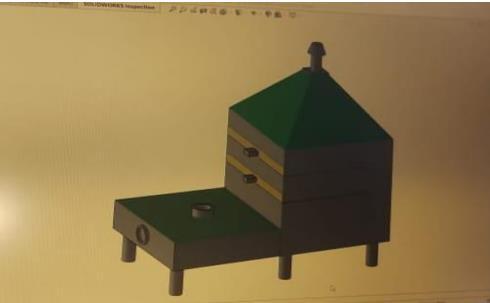
The Experimental Set-Up:
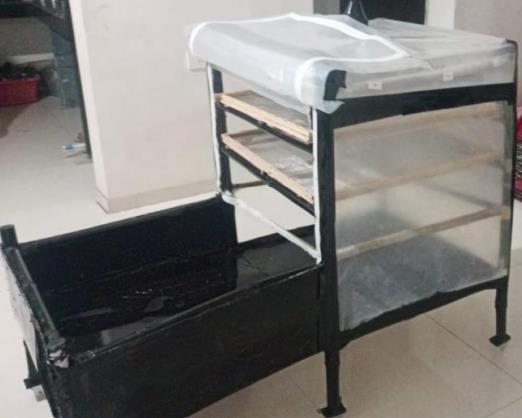
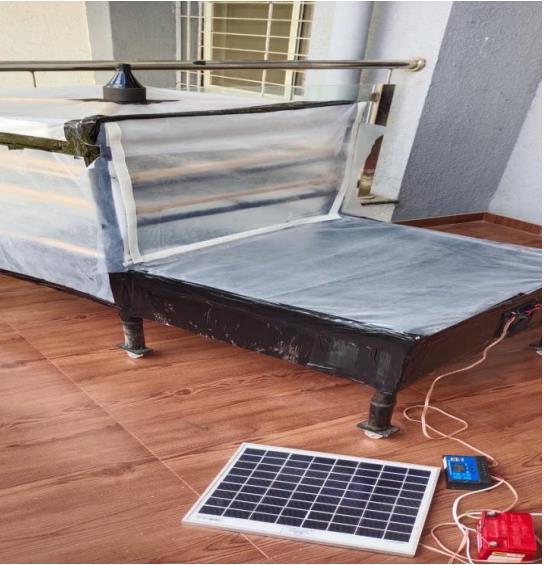
Numerical Models and Formulations
The dryer operates as a passive system, meaning it contains no moving parts and relies on solar energy. Sunlight enters through the collector's glazing, and the inside surfaces of the collector, painted black, enhance the absorption of solar rays.[7] This trapped energy heats the air within the collector. The greenhouse effect within the collector facilitates the movementofairthroughthedryingchamber.Whentheventsareopen,hotairrisesandexitsthroughtheupperventof thedryingchamber,whilecoolerambientairentersthroughthelowerventofthecollector.[8]
International Research Journal of Engineering and Technology (IRJET) e-ISSN: 2395-0056
Volume: 11 Issue: 06 | Jun 2024 www.irjet.net p-ISSN: 2395-0072
Drying Component Drying includes two fundamental forms: warm application to vanish dampness from the fabric and windstreamtotoexpelthedissipateddampness.
Thedryingprepareincorporatestwocrucialmechanisms:
1.Moisturemovementfromtheinsidesofthefabrictoitssurface.
2.Evaporationofdampnessfromthesurfacetotheencompassingair.
The drying prepare is a complex interaction of warm and mass exchange, impacted by outside factors such as discuss temperature, stickiness, and speed, as well as inner factors like surface characteristics (e.g., unpleasantness or smoothness), chemical composition (e.g., sugars and starches), physical structure (e.g., porosity and thickness), and the measureandshapeoftheproduct.[9]
Basic Hypothesis (Formulations)
Somecriticalformulaeutilizedaregivenasfollows:
Dryerproductivity(ηd):
Dryereffectivenessistheratioofcollectionproductivity(ηc)andtheFrameworkefficiency(ηs).
(ηc)=Qu/AcIs……….(1)
Where,
Qu=mCp∆t
Ac=collectorsurfacearea
Is=Separatorontiltedsurface
Efficiency(ηs)=WL/AcIs
Where,
W=MassofdampnessEvapourated
L=idealwarmofevaporationinthedryertemperature
Determinationofdampnesssubstance:
Mwb=(Mi–Md)/Mi×100
Where,
Mwb=Dampnessondampbasis
Mi=introductorymassofthesample
Md=lastmassofthesample
CALCULAION OF SUN-POWERED DRYER EFFICIENCY
1Dryereffectiveness
➢ OnedayDryereffectiveness(ηd)forgreenchilli=13.6%
➢ OnedayDryereffectiveness(ηd)forgrapes=14.19%
International Research Journal of Engineering and Technology (IRJET) e-ISSN: 2395-0056
Volume: 11 Issue: 06 | Jun 2024 www.irjet.net p-ISSN: 2395-0072
➢ OnedayDryereffectiveness(ηd)forapples=13.78%
Thedryerproductivityisfoundouttobe13%foroneday.[10]
2Moisturecontent
➢ Moisturecontentforgreenchilli=64%
➢ Moisturecontentforgrapes=58%
➢ Moisturecontentforapple=60%
Establishing a market for dried products presents a significant opportunity for farmers to increase their income and securereturnsoninvestment.Thisenablesfarmerstoaccessloansfromvariousorganizationsorfinancialinstitutionsto acquiredryingmachineswithinarelativelyshort timeframe,typically1to2years.Withtheflexibilitytoadapttomarket fluctuations, farmers can dry their produce during periods of low prices and wait for better market conditions, thereby maximizing their profits. Throughout the development of the drying machine, emphasis was placed on affordability and accessibilityofmaterials.Byharnessingsolarenergy,farmersincurnoadditionalelectricitycosts,andinstallationcanbe donewithouttheneedforspecializedtechnicians.The ultimate goalistocombatfoodwasteandupliftthelivelihoodsof farmers, particularly in regions like India where farmer suicides are prevalent. Over the next decade, the aim is to proliferate solar dryers globally, thereby reducing wasted produce and addressing socio-economic challenges in agriculturalcommunities.
Conclusion:
In conclusion, solar drying offers a low-cost solution for enhancing food processing by adding value to fruits and vegetables. By reducing spoilage and improving product quality and hygiene, these technologies can significantly boost agricultural returns for farmers. Solar tunnel drying emerges as a cost-effective method for preserving fruit quality and nutritionalretentionwhilepromotingrenewableenergyadoptionamidstincreasingnon-renewableenergyshortages.Key findingsindicatethatsolardryerseffectivelyincreaseambientairtemperature,acceleratingagriculturalcropdryingrates whileminimizingrisksassociatedwithnaturalsunexposure.Thesimplicity,lowcapitalcost,andeaseofmonitoringmake solar dryers a viable option for drying various crops. Experimental results demonstrate substantial moisture removal, validatingsolardryersasanefficientalternativeforfoodpreservation,particularlyinresource-constrainedregions.This researchunderscoresthepotentialforwidespreadadoptionofsolardryingtechnologies,offeringsustainablesolutionsfor foodsecurityandenergychallengesworldwide.
REFERENCES:
[1] Ajayi, C., Sunil, K.S., and Deepak, D. 2009. “Design of Solar Dryer with Turbo ventilator and Fireplace”.International SolarFoodProcessingConference2009.
[2] Brenidorfer B, Kennedy L, Bateman C O (1995). Solar dryer; their role in post-harvest processing, Commonwealth SecretariatMarlboroughhouse,London,Swly5hx.
[3] Gutti Babagana; Kiman Silas and Mustafa B. G. (2012): Design and Construction of Forced/Natural Convection Solar VegetableDryerwithHeatStorage,ARPNJournalofEngineeringandAppliedSciences,VOL.7,NO.10
[4]Xie,W.T.,DaiY.J.,Wang,R.Z.,Sumathy,K.,2011.ConcentratedsolarenergyapplicationsusingFresnellenses:Areview Renewable&SustainableEnergy,Vol.15(6)
[5] Sharma, A., Chen, C. R., Vu Lan, N., 2009. Solar- energy drying systems: A review. Renewable and Sustainable Energy Reviews,Vol.13,pp.1185-1210.
[6]Bassey,M.W.1989,Developmentanduseofsolardryingtechnologies,NigerianJournalofSolarEnergy89:133-64.
[7] J. Kaewkiew; S. Nabnean; S. Janjai (2012): Experimental investigation of the performance of a large-scale greenhouse typesolardryerfordryingchilliinThailand.ProcediaEngineering32,433–439.
International Research Journal of Engineering and Technology (IRJET) e-ISSN: 2395-0056
Volume: 11 Issue: 06 | Jun 2024 www.irjet.net p-ISSN: 2395-0072
[8]J.K.Afriyie;M.A.A.Nazha;H.Rajakaruna;F.K.Forson(2009):Experimentalinvestigationsofachimneydependentsolar cropdryer,RenewableEnergy34,217–222.
[9] Bolaji, B.O. 2005. Performance evaluation of a simple solar dryer for food preservation. Proc. 6 Ann. Engin. Conf. of SchoolofEngineeringandEngineeringTechnology,Minna,Nigeria,pp.8-13.
[10] Sendhil Kumar Natarajan, Elavarasan, Elangovan, Rajvikram Madurai Elavarasan, Anand Balaraman, Senthilarasu Sundaram. Review on solar dryers for drying fish, fruits, and vegetables. Environmental Science and Pollution Research(2022)