
International Research Journal of Engineering and Technology (IRJET) e-ISSN:2395-0056
Volume: 11 Issue: 06 | Jun 2024 www.irjet.net p-ISSN:2395-0072
International Research Journal of Engineering and Technology (IRJET) e-ISSN:2395-0056
Volume: 11 Issue: 06 | Jun 2024 www.irjet.net p-ISSN:2395-0072
Anindita Acharjee1, Rishikesh Duarah2
1Student, Dept. of Civil Engineering, The Assam Royal Global University, Assam, India
2Assistant Professor, Dept. of Civil Engineering, The Assam Royal Global University, Assam, India
Abstract - Water hyacinth is a freshwater weed that grows in most frost-free regions of the world. Although it is often used as a water ornamental due to its beautiful flowers, it is considered to be one of the most problematic aquatic plants due to its negative impacts. In Assam, it is seen in abundance in almost every river body of the state. Concrete is a widely used artificial material made up of aggregates that are bonded together with a fluid cement. Once the cement solidifies, it forms a solid mass that resembles rock. It is the second most commonly used building material worldwide, following water. This project has been done to test the compressive, flexural, and split tensile strength of concrete by partially replacing cement with water hyacinth. Concrete was casted in the form of a beam, cube, and cylinder with varying percentages of water hyacinth ash (WHA), i.e. 0%, 5%, 10%, and 15% for 7, 14, and 28 days. The prepared samples were tested in a Universal Testing Machine(UTM) in the laboratory. The final results of the test were compared to those of conventional concrete. It was found that the highest strength was achieved at a 5% WHA replacement for M30 grade. After comparing the concrete and WHA replacement concrete, it was concluded that using a 5% ratio of WHA to replace cement in concrete is the optimalsolution.
Key Words: Water Hyacinth Ash, Cement, Concrete, Compressive strength, Flexural strength, Split tensile strength, Universal Testing Machine.
1.INTRODUCTION
The aquatic weed water hyacinth produces roughly two tons of material per acre and grows very quickly. Waterway destruction, fish habitat degradation that resultsinfishdeath,decreasedoxygendissolvedinwater, increased water loss from evapotranspiration, preventing mosquitoes from having a place to breed, and deterioration of swimming and fishing water quality are just a few of its detrimental effects on the environment. However, it harms the ecosystem in a number of ways. It can destroy waterways, harm fish by deteriorating their habitat and reducing the oxygen dissolved in water. India has implemented several strategies to manage and mitigate the spread of water hyacinth. These measures includephysicallyremovingtheplantbyhand,introducing insectsthatfeedontheplantforbiologicalcontrol,andin some cases, using herbicides. Despite the progress made, water hyacinth remains a significant problem in many
regions. Water hyacinth is a fascinating aquatic plant. However,it'simportanttonotethatwaterhyacinthcanbe considered an invasive species in certain areas. Due to its fast growth rate, it can quickly cover water bodies, blocking sunlight and depleting oxygen levels, which can harm native plants and aquatic life. Despite its invasive nature, water hyacinth has some potential uses. It can be utilizedinthefieldofconstruction.
Concrete is a vital construction material known for its strength, durability and versatility. It is widely used in building foundations, floors, walls, highways, and bridges duetoitsreliabilityandcost-effectivenessinconstruction projects. As compared to the other materials in concrete, cement is the most costly material. Enormous amount of carbon dioxide are released during the cement manufacturing process which causes harm to the ecosystem in various ways. Studies and research projects havedemonstratedthatusinglocallyaccessiblematerials, likeflyashandegg shell etc.canreplacecementin whole or in part, and this approach has been effective in satisfying the demand for concrete in construction projects. This research work studies the impact of water hyacinth ash in concrete mixes, which determines the optimal proportions that enhance the performance of concretewhilereducingtheenvironmentalfootprint.
Todevelopmoreenvironmentalfriendlyconstruction methods by making better use of leftover resources andraisingthestandardsofconcretestructures.
To partially replace cement mixture with water hyacinthashwhichisproducedbyovendryingofthe material
Tounderstandhowwaterhyacinthashcaneffectthe durability,strengthandotherattributesofconcrete.
1.2
Environmentalcleanupbyremovingwaterhyacinth.
Utilizingitasaresourceinsteadofwaste.
Promotingsustainableconstructionpractices.
Enhancing concrete properties with water hyacinth ash.
International Research Journal of Engineering and Technology (IRJET) e-ISSN:2395-0056
Volume: 11 Issue: 06 | Jun 2024 www.irjet.net p-ISSN:2395-0072
Potentiallyreducingproductioncostsandofferingan eco-friendlyalternative.
Portland Pozzolana Cement 43 grade, confirming to IS 1489(Part1):1991wasused.Coarseaggregatesofsize 20 mm are adopted for the study. For fine aggregates, river sand was used which confirms to grading zone II of nominal size. Potable and colourless water has been used to mix the prepared concrete. Water Hyacinth Ash has beenpreparedandusedaccordingly.
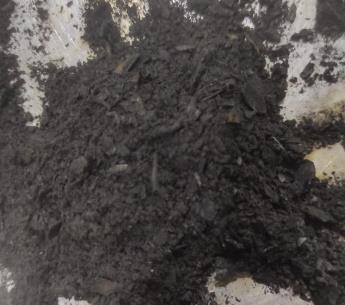
The water hyacinth plants have been accumulated from DeeporBeel,alakelocatedinGuwahati,Assam.Theplants were thoroughly cleaned with fresh tap water to remove all impurities, trash and contaminants. After that, they were cut into small pieces with the help of a knife. Subsequently,theyweredriedinsunlightforoveraweek, resulting in a significant reduction in weight compared to their original state. To completely dry the samples, they werekeptinanovenfor6hoursat800°C.Withthehelpof this procedure, the organic matter has changed into an inorganic matter. After that, a 150-micron sieve was used to filter the materials. The materials that made it beyond the 150-micron filter were utilized to partially substitute cement.
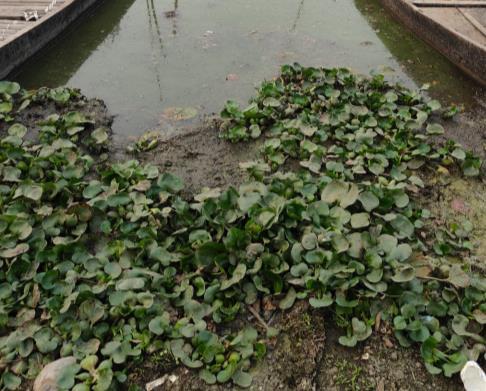
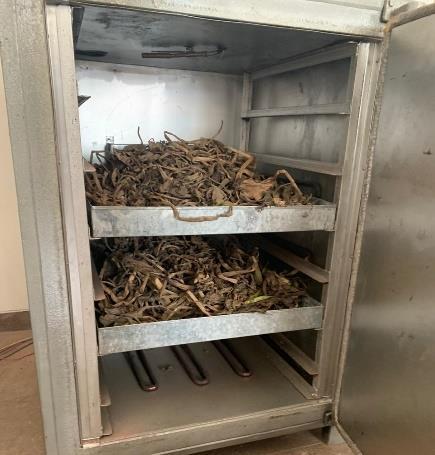
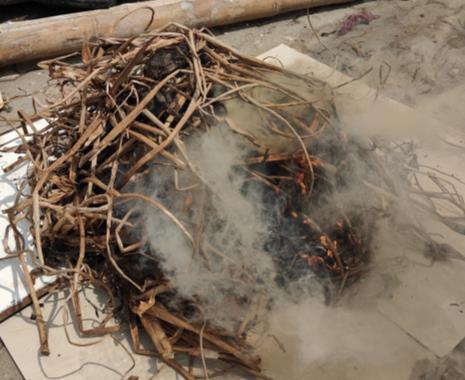
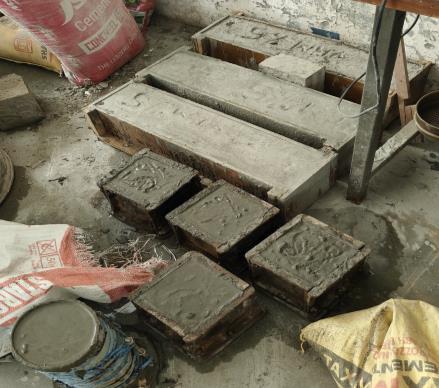
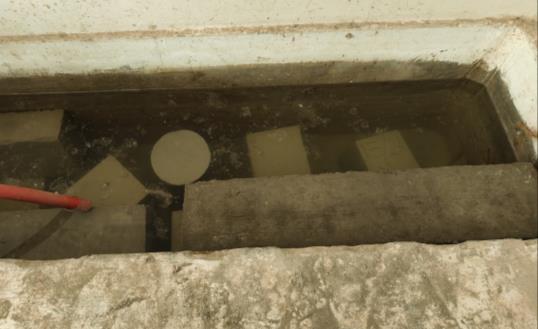
Tests such as the specific gravity, sieve analysis, slump test etc.were performedto examine the characteristics of thecoarseaggregate,fineaggregate,andcement.Concrete was manufactured by batching following the numerous tests conducted on the components. The water-cement ratio used was 0.432 kg/m³, and the chosen materials were accurately weighed and combined in accordance with the design mix proportion of 1:1.55:2.70 for M30 grade of concrete. Concrete mixture was cast into cubes, beams, and cylinders mould with water hyacinth ash replacing 0%, 5%, 10%, and 15% of the cement. The slump test was performed in the new concrete mix to determine the workability oftheconcrete. The specimens weredemouldedafter24hoursandwereallowedtocure. Universal testing machine (UTM) was used for testing of the compressive, flexural and split tensile strength in 7th, 14th, and 28th day. Split tensile strength=2PπLD, flexural strength=PL/(bd²),andcompressivestrength=Loadin(N) andareain(SQ.MM).
International Research Journal of Engineering and
Volume: 11 Issue: 06 | Jun 2024 www.irjet.net
3.1 Equipment
UniversaltestingMachine
MeasuringTube
MixingTray
SlumpCone
TamperingRod
WeighingMachine
3.2 Mix Design
4.1
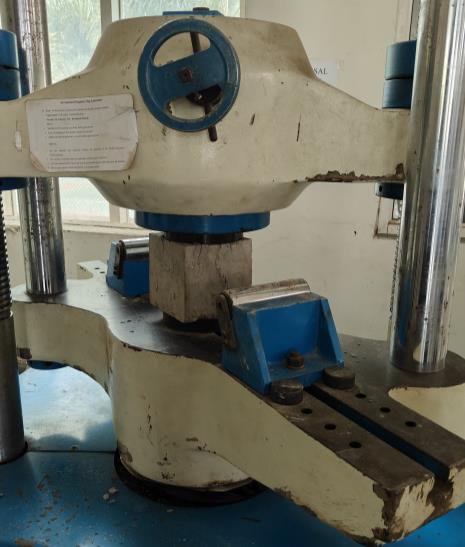
ThetestwasdoneasperIS156.After 7,14and28daysof curing, specimens measuring 150x150x150mm were madeandtestedusingauniversaltestingmachine.Figure 7showscompressiontestingofconcretecube.
4.2 Flexural Strength Test
Specimens of beam measuring 150x150x700mm dimensionsweremade.After28daysofcuring,testinghas been done by using a universal testing machine. Flexural testingonaconcretebeamisshowninFigure8.
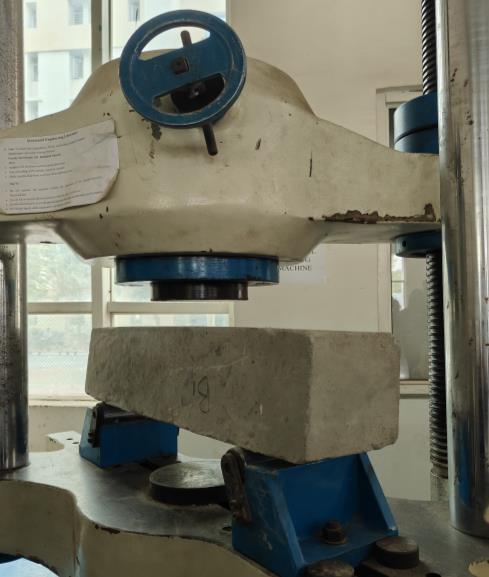
Fig-8: Flexuraltestingofbeams
International Research Journal of Engineering and Technology (IRJET) e-ISSN:2395-0056
Volume: 11 Issue: 06 | Jun 2024 www.irjet.net p-ISSN:2395-0072
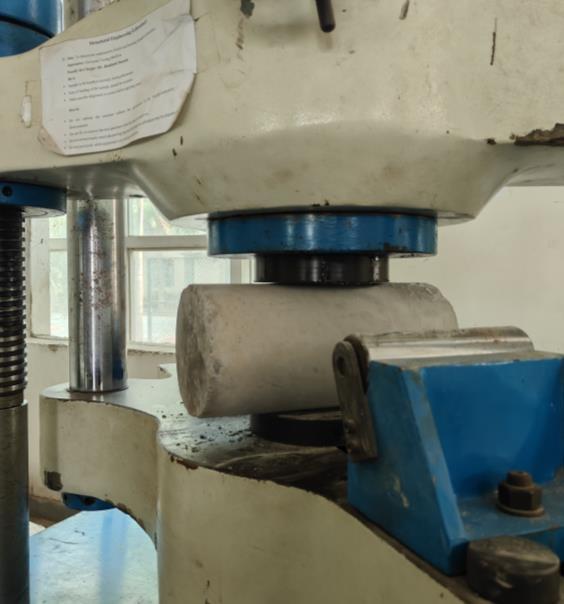
According to IS: 5816, the test was carried out. After 28 days of curing, the samples were tested. Figure 9, shows splittensilestrengthtest.
4.4 Slump Test
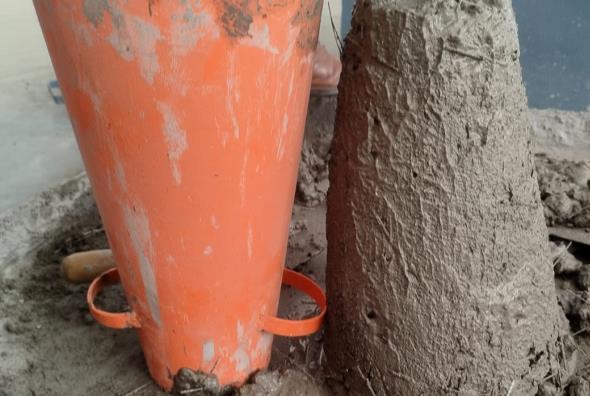
The slump test was done on freshly prepared concrete. Thetestwasperformedatvariousmixproportions.Figure 10showsslumptestonconcrete.
5. Results
The compressive strength test was performed. Chart 1 shows the results for various mixes tested after 7th, 14th and28thdayofcuringperiod.
Table-1: CompressiveStrengthTestResults
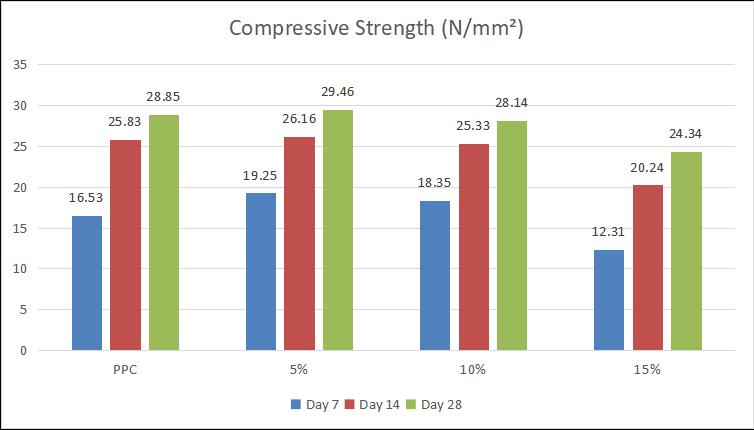
Chart-1: CompressiveStrengthTestofConcrete
Thestrengthoftheconcretecubeafter7th,14th,and28th days is displayed in the above chart for both regular concrete and concrete that has had varied ratios of water hyacinth ash added to the cement. It has been noted that as the curing time grows, so does the concrete's strength. Nonetheless, the WHA replacement increases strength by 5%comparedtoregularconcrete.
Theflexuraltestswereconductedandtheresultsobtained for different mixes tested after curing periods of 28 days areillustratedinchart2.
Table-2: FlexuralStrengthTestResults
International Research Journal of Engineering and Technology (IRJET) e-ISSN:2395-0056
Volume: 11 Issue: 06 | Jun 2024 www.irjet.net p-ISSN:2395-0072
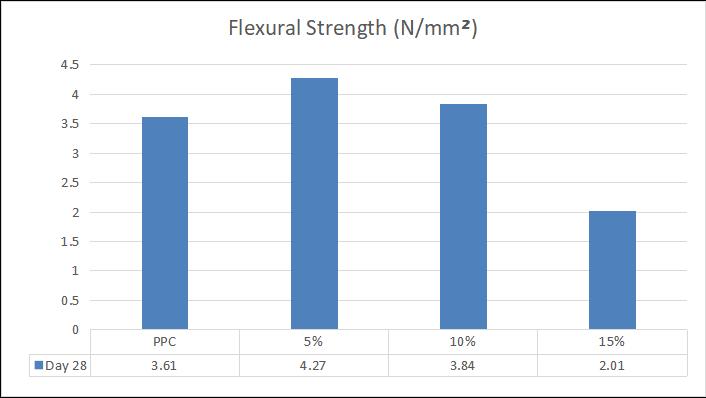
Chart-2: FlexuralStrengthTestofConcreteBeam
The strength of the beam in 28 days for both regular concreteandcementsubstitutedwithvaryingpercentages of water hyacinth ash is shown in the following chart. It has been noted that the flexural strength of 0% mix is within an acceptable range.In comparison to the control, theflexuralstrengthofthe5%WHAmixisthehighest.
Chart 3 shows the results of the split tensile test, which was performed on various mixes after a 28 day curing period.
Table-3: SplitTensileTestResults
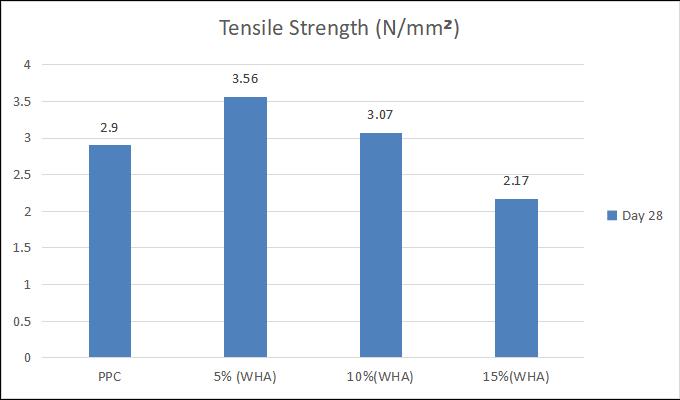
Chart-3: SplitTensileStrengthTestforConcreteCylinder
The split tensile strength of conventional concrete and water hyacinth-replaced concrete cylinders with different proportions are displayed in the following chart. The findings indicate that when water hyacinth ash is used in placeof5%cement,theultimatestrengthisachieved.
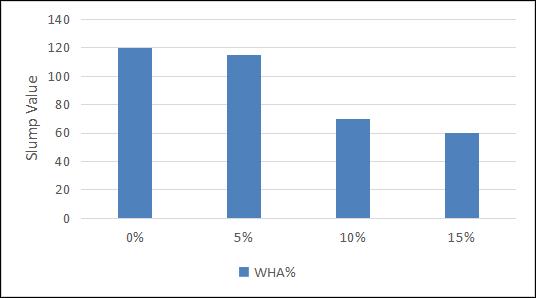
Chart-4: SlumpTest
Theconcreteworkabilityisdeterminedbytheslumptest. This is an observation of the slump test on concrete that hasbeenpartiallyreplacedwithwaterhyacinthashat5%, 10%,and15%.
Regression Analysis has been carried out for Flexural Strength with respect to compressive strength, split tensile strength and different percentages of water hyacinthash.Thegraphsofregressionanalysisareshown below.
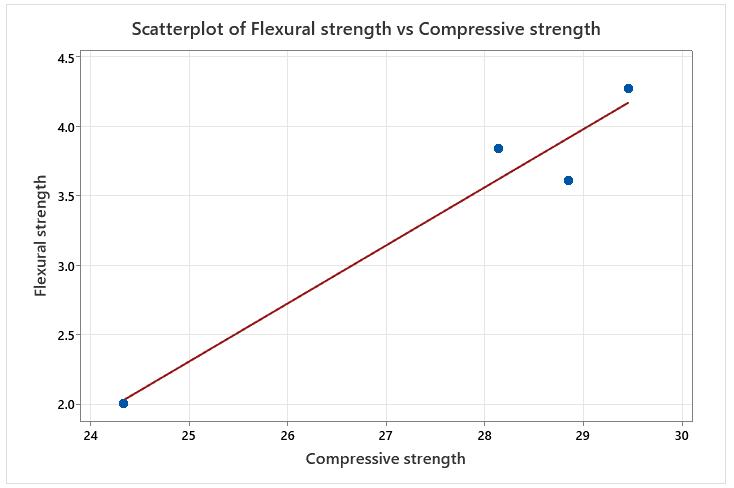
Chart-5: ScatterplotregressiongraphforFlexuralTestvs CompressiveTest
International Research Journal of Engineering and Technology (IRJET) e-ISSN:2395-0056
Volume: 11 Issue: 06 | Jun 2024 www.irjet.net p-ISSN:2395-0072
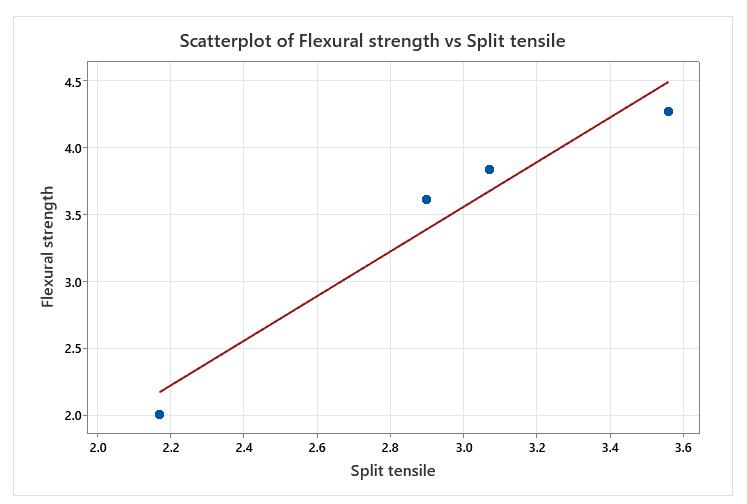
Chart-6: ScatterplotregressiongraphforFlexuralTestvs SplitTensileTest
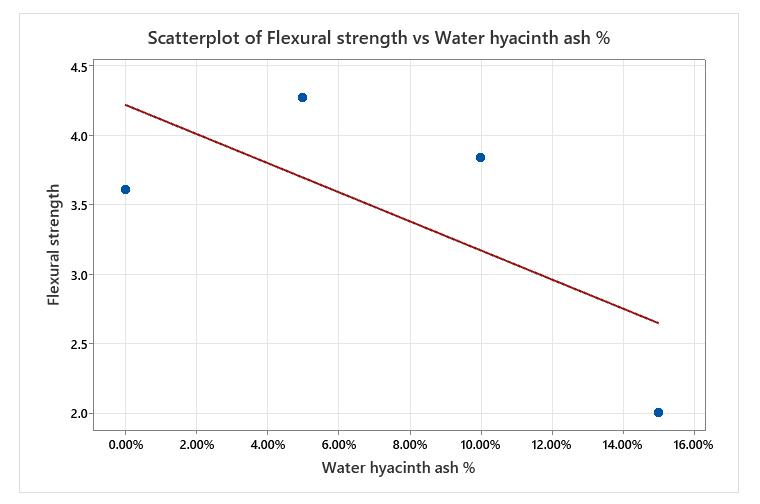
Chart-7: ScatterplotregressiongraphforFlexuralTestvs differentpercentagesofWHA
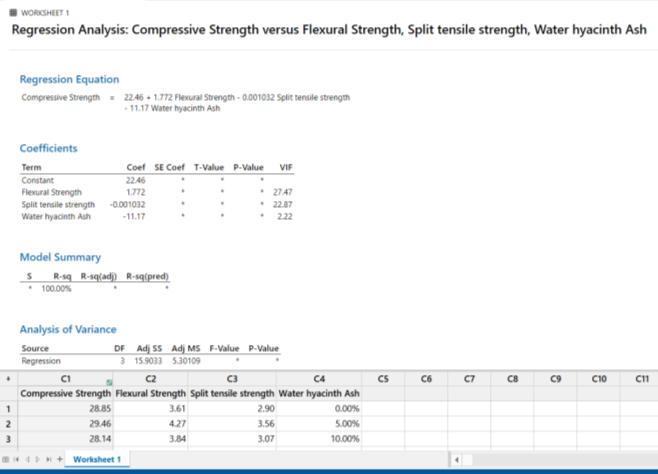
Fig-11: Relationshipofflexuralstrengthvscompressive strength,splittensilestrengthandwaterhyacinthash%
The relationship of flexural strength with respect to compressive strength, split tensile strength and different
percentages of water hyacinth ash is shown in figure 11. theequationobtainedisgivenbelow:
FlexuralStrength=-12.68+0.5644CompressiveStrength +0.000582SplitTensile+6.306WaterHyacinthAsh.
7. Conclusions
The research on incorporating water hyacinth ash (WHA) as a partial replacement for cement in concrete has providedimportantinsightsintoitsimpactonworkability, compressive strength, flexural strength and split tensile strength. This study is focused on replacement levels of 5%, 10%, and 15% by weight. Here are the key conclusionsdrawnfromtheresults:
The optimum value for the partial substitute of cementbyusingwaterhyacinthashisobtainedas5%.
Concrete loses strength in the compressive, flexural, and split tensile domains when the amount of water hyacinthashisincreasedabove5%.
Compressive,flexuralandsplittensilestrengthforthe above criteria sample is more than the normal concretemix.
The results shows that the strength of the concrete gets effected when 15% water hyacinth ash was replaced.
It was found that water hyacinth ash have high absorptivity, hence the setting time of cement gets increased.
Thus, it is feasible to introduce water hyacinth in the productionofconcrete.
8. References
[1] Ertie Abana, William Vega, Jaezel Gacias, Patrick John Rañon, John Denver Talattad, Herbert Orata, Jerone Perez, “Pulverized Water Hyacinth as an Admixture for Concrete” International Journal of Integrated Engineering,Vol.13NO.4(2021)298-303
[2] Aadarsha Lamichhane, Gokarna Bahadur Motra, Thaman Bahadur Khadka, “Evaluation of Water HyacinthExtractofNepaleseLakesasanAdmixturein Concrete Production”, Proceedings of 8th IOE GraduateConferencePeerReviewedISSN:2350-8914 (Online),vol.8,June,2020
[3] Prang Subpa-ASA, Laemthong Laokongthavorn, Sheigeyuki Date, “The Study on Effect of Lightweight Concrete Block by Water Hyacinth Adding”, 6th International Conference on Advanced Engineering andTechnology(ICAET2019)
International Research Journal of Engineering and Technology (IRJET) e-ISSN:2395-0056
Volume: 11 Issue: 06 | Jun 2024 www.irjet.net p-ISSN:2395-0072
[4] Geeja K George, Aswin Das A S, Breeze Joy K, Georgootty K Milson, Jeeva Varghese, “Effect of Using Water Hyacinth Extract and Glass Powder in Concrete”, International Research Journal of Engineering and Technology (IRJET), Volume 09 Issue:07,July2022.
[5] Neelu Das, Shashikant Singh, “Evaluation of Water Hyacinth Stem Ash as Pozzolanic material for use in BlendedCement”,JournalofCivilEngineering,Science andTechnologyVolume7,Issue1,April2016.
[6] C.K.Kiptum, L.Rosasi, O. Joseph and E.Odhiambo, “Some Mechanical Characteristics of Concrete Reinforced with Dried water Hyacinth and Quarry Dust as Fine Aggregate” Journal of Civil Engineering, Science and Technology Volume 10, Issue 2, September2019.
[7] M. Anwar, A. Makhlouf, “Durability of Water Hyacinth Ash Concrete”, Engng.Res.Jour.,Vol.87.PP.C 156, June 2003.
[8] Tidarut Jirawattanasomkul, Haruna Minakawa, Suched Likitlersuang, Tamon Ueda, Jian-Guo Dai, NattametWuttiwannasak,NattapongKongwang,“Use of water hyacinth waste to produce fibre reinforced polymer composites for concrete confinement: Mechanical performance and environmental assessment”, Journal of cleaner production 292(2):126041,2021
[9] Harshit Sharma and M.S. Chauhan, “Water Hyacinth: Control and Utilization. International Journal of Civil EngineeringandTechnologypp.765–772.
[10] IS:383-1970: Specifications for Coarse and Fine AggregatesforNaturalSourcesofConcrete,Bureauof IndianStandards,NewDelhi.
[11] IS:10262-20019: Concrete Mix Proportioning–GuidelinesBureauofIndianStandards,NewDelhi.
[12] IS:516-1959: Methods of Tests for Strength of Concrete,BureauofIndianStandards,NewDelhi.
[13] IS:1489(Part1): 1991 Portland-Pozzolana Cement –Specification,BureauofIndianStandards,NewDelhi.