
FRP moulding using biaxial toggle driven Roto- Casting machine
S. B. Sri Raam, S. Bhuvanesh
Abstract- Manufacturing hollow objects using biaxial toggle drive to produce cost efficient, highly durable, Stress free components with various surface finish. Any kind of component with no size and design. Restrictions can be fabricated using FRP (Fiber reinforced polymer) which is used in making the mould for the component. The casting technique known as rotational casting, or roto casting, is excellent for producing hollow objects. This technique does not use pressure like most other casting process does. Because the process’s moulds don’t need to withstand pressure, they are reasonably cheap and may be produced in relatively short batches at a very low cost. A wide variety of goods are produced using the roto casting process. Since almost any shape can be made, the method gives the product designer a great deal of creative freedom
Key words : biaxial, fiber reinforced polymer, mould, casting, pressure
INTRODUCTION
The sole purpose of the project is to understand the designandmechanismofthebiaxialtoggledriveandthe casting technique known as rotational casting, or roto casting, which is excellent for producing hollow objects. This technique does not use pressure like most other casting process does. The process’s moulds are affordably priced and can be made in comparatively small quantities for a very low cost because they don’t havetobearpressure.Therotocastingmethodisusedto make a wide range of products. The process allows for the creation of nearly any shape, which greatly expands the creative possibilities for the product designer. There are literally thousands of uses for mouldings, and there are virtually no size restrictions. This is an economical waytomakeclearresinorplastercomponents.Bygently rotating the mould it is filled with resin or plaster and rotatedbothverticallyandhorizontally.The resinonthe interior surfaces of the mould is distributed and fused by the simultaneous rotating and by the reaction with the catalyst it hardens. Large hollow, seamless, and double-walled pieces are produced using the casting technique known as “rotational casting,” also known as “roto casting.” A mould on a rotating frame, a heating chamber, and a cooling chamber are all components of the three-stageprocess. Rotocasting moulds may create goods with single or double walls to their particular design. polyethylene resins serves as the primary raw material for roto casting. The mould’s frame has the ability to rotate the mould around its axis rotation. The
resinisdistributedevenlyacrosstheinsidesurfaceofthe mould as it spins, giving the end product a uniform thickness throughout. The mould transitions to the cooling chamber after a certain amount of time, where the liquefied, melted resin is allowed to cool before the product is expelled from the mould. Products made by rotational casting are of the finest caliber and are renowned for their toughnessand longevity. The tooling for the moulds is less expensive since rotational casting doesnotentailpressurebecausethemouldsare notput under pressure. The proportions of the objects that are rotated into shape are essentially limitless because the machines and moulds can create very large, intricate plastic shapes. There are also few restrictions when it comes to part design, allowing the designer to include complex aspects. While rotational moulding also makes use of a rotating mould, roto casting is not the same. Rotational moulding involves heating and filling the mouldwithmaterial.Thematerialisthenslungonto the inner wall of the mould by the rotation of the mould aroundtwoormoreaxes.Producinghugeresinpiecesat a reasonable cost can be achieved using rotational casting. Producing products with superior stability, consistent wall thicknesses, and high-quality finishes is the main goal of rotational casting. The roto casted product canhave insertsandspin weldattachments put straight to it thanks to this production method. The end result is a product seamless sections that have uniform wallthicknessesandadditionalmaterialinthecornersto absorb shocks and stresses where they occur most frequently
WORKING PRINCIPLE
Therotationalcastingprocessisquitesimple,itisdriven byabiaxialtoggledrivemechanism,whichistransferred via the chain sprocket and bevel gears and rotates the major and minor axes of the machine, resulting in 360 degrees of rotation, which aids in the even filling of materialduringthecoolingcycles.Rotationalcastinghas aprettystraightforwardprinciple.
A resin or plaster substance, typically in powder slurry form, is poured into a hollow mould that is constructed outofFRP(Fiberreinforcedpolymer).Themouldisshut and slowly rotated on two axes. The polymer then graduallyreactswiththecatalyst,hardensand“laysup” ontheinterioroftherevolvingmould. Aftertheresinor theplasterslurryhardensandsolidifyastimepassesby. The process is stopped, and the result is removed from the mould, once the material has finally cooled and
International Research Journal of Engineering and Technology (IRJET) e-ISSN:2395-0056
Volume: 11 Issue: 06 | Jun 2024 www.irjet.net p-ISSN:2395-0072
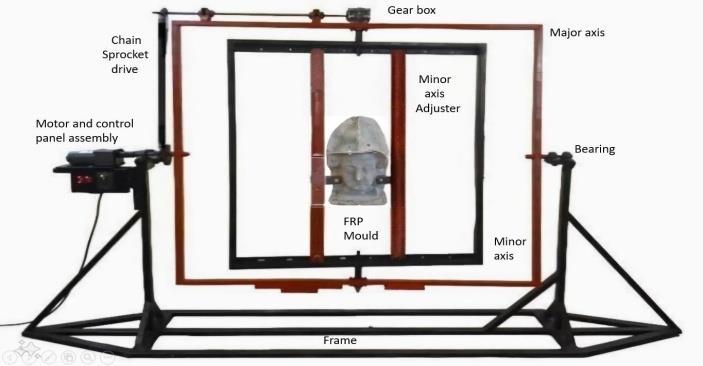
solidified sufficiently to pull away from the mould surface. The drive for the major axis is obtained by a chain drive which is connected with sprocket that is driven by a motor, similarly the minor axis is driven by gearboxthatisconnectedviashaft,whichisasub drive alsoknownastoggledrive,thismechanismgetsthedrive from the sprocket that drive the major axis. Its directly connectedtothemajoraxis’sdrivensprocketandrotates thegearbox,whichinturn rotatestheminoraxis.These gear box, is used for perpendicular drive, same in this case also drives in right angles. After the mould preparations are done the raw material that is either clearresinor plaster of parisalsoknown asPOP isthen diluted to a slurry form and then it is, poured into the mould, which then due to the process rotates 360 degrees and acquires the shape of the mould. After the cooling cycle is done, once after the raw material acquires the shape of the mould, after the regulated cooling time, the mould is opened and the final product isremovedfromthemould.
MACHINE WORKING PRINCIPLE :
The above explained mechanism is basicallyused to run the roto-casting machine with the help of a chain sprocket drive, shaft and a “helical gearbox”. The main drivefromthemotoristransmittedtothemajoraxisvia shaftthatislockedin positionwithBushand cotter pin. The drive from the motor to the shaft is connected via a “love joy coupling”. Then the sprocket of the ratio 1: 2.5 transmits the power for the Minor axis via sub drive Or the“toggledrive”.Thesprocketof2.5ratioismountedon the shaft That is welded to the bearing that is fixed to it but, The shaft that it’s mounted rotates freely irrespectivetothefixedsprocket.Thedriveirrelevantto theshaft istransmittedtothe1ratiosprocketvia chain. This then rotates the sprocket and the shaft that the sprocket is mounted on. Due to the pulling force that is created by the rotation of the major axis the chain pulls the 1 ratio sprocket and rotates it and the shaft. This shaftontheotherendisconnectedtoaspeedreduction gear box of 1:10 ratio, the shaft of long length is supported by bearings. This shaft transmits transverse power to longitudinal power that is “Perpendicular power transmission” is done to give drive to the minor axisviashafttheisconnectedtotheotheroutputendof the gearbox. This makes the perpendicular rotation of the minor axis with respect to the major axis by a total speed reduction of 4:1 that is the standard speed reductionthatisuniversalandaccordingtothereference ofsciencedirectory.
MANUFACTURING OF ROTO CASTING MACHINE:
➢ Afterthe finalizationofthedesignsanddrawings the rawmaterialandthesparepartsarepurchasedfromthe marketasperrequirementoftheneeded.
➢ Therawmaterialsthatarepurchasedcanbeclassified into two types that is products that is too be manufacturedandtheproductandthepartsthatistobe purchasedfortheassemblyofthemachinery.
➢ Thenthecomponentsthataretobemanufacturedfor the assembly are the frames, major axis, minor axis, minoraxisadjuster.
➢ The components are precisely cut according to the design and drawings and are arc welded for the necessary.
➢ And then after the completion of this process then a coatofprimerisappliedbeforepaintingandatrialrunis kepttotesttheabilityofthecomponents.
➢ Then bearing that are purchased is mounted on the frame of the shaft support to handle the major axis and thebearingsaremountedontheoutendoftheshaft.
➢ Due to the increased axial load another pair of bearings are installed on both the ends and support rib structureweldiskeptforsupport.
➢ The deflection of the machine is completely eliminatedafterthebearingsandthesupportweld.
➢ And the motor stand, motor base and the control panelassemblyaremountedonwiththehelpofnutsand boltsandthemotorisfixeduponitforthetrailrun,and itsuccessfullycompletedwithonlymajoraxis.
➢ And the minor axis is mounted in between the major axis and is given the biaxial toggle drive, asper the mechanismthatisexplainedintheworkingprinciple.
➢ And after successful trials with mechanism the machineiscompletelylobed,cleanedandpainted.
➢ After this work balancing is done so that the work offset or imbalance that creates uneven load for the machinethealsocausesthemotortooverload.
➢ And then the timer is set in a manner that it rotates clockwisefor3minutesandstopsof10secondsand the rotatesagainanticlockwisefor3minutesto ensureeven filling and settling of the material to ensure even wall thickness.
➢ For manufacturing a FRP mould a master pattern is required , so that its shape can be acquired and can be usedtotakethemould.
➢ Selection of the master pattern is important as the factor of negativity must be considered for the easy replicaofthepatternandeasyreleaseofthemould.
➢ Firstly the master pattern is coated with wax polish anddriedfor15minandwipedandanothercoatofwax polishisappliedanddried.
➢ After the dried wax coating a coat of PVA is applied ,it’sakindofreleaserthatisusedanditsimilarlyapplied aswaxand2coatsofPVA(polyvinylalcohol)isdried
➢ And then the combination of resin, catalyst, acceleratorandpigmentismixedinproportionateratios as mentioned earlier in the mould manufacturing process and applied on the pva coat and its dried, this turnstobetheinnerlayerofthemould.
➢ Andthe fine mattocapturethedetailsof the master pattern of 2 layers is applied with resin composition , Andafterdryingthecoarsematof6layerisusedforthe rigidityofthemould.
➢ And partion line are made so that the mould can be split while demoulding, The same process mould repeatedfortheotherpartsofthemould

ADVANTAGES:
Roto casting boasts a number of advantages over comparablemouldingmethods:
Low-cost tooling: low operating pressures allow roto cast tooling to be crafted from low-cost metals such as FRP(Fiberreinforcedpolymers).
Consistent wall thickness: the constant rotation of the mouldcoatsthewallsevenlyduringcoolingprocesses.
Double-wall construction:complexdouble-walledopen containers can be produced without secondary processing.
High durability: parts are moulded as one solid piece, eliminating the need for joining techniques such as weldingandjointfabricationwhichcreatesweakspots
High stability: the moulding material isn’t exposed to external pressure, increasing its stability and reducing theriskofdefectsinthefinishedpart
High strength: roto casting creates thicker corners, reducing the risk of failure in thesestress-concentration points
Appearance:thesoftmetalusedfortherotocasttooling easily accommodates surface finishes such as fine-detail textures,logos,symbols,andlettering.
Different Applications
A) Cases and Lockers: Cases and lockersare ideal products for theroto moulding process. Generally large cases, lockers, munitions cases, footlockers, industrial equipmentcarriersandsimilaritemscanberotationally mouldedtovaryingthicknesses,walldensitiesandexact dimensions in fairly small quantities. Designing in ribs canprovidestructuralsupportforlargerpieces
B) Lawn and Garden Products: Lawn and garden productslike organic composters, rain barrels, water conservation tanksandsimulatedstonespeakerscan all be rotationally moulded in plastic to reduce weight and provide leak tight large volume containers. The demand for water conservation solutions is growing and designers are turning to roto moulders to produce colourful,low cost productsthat can often simulate or blend in with their natural surrounds. Rotational mouldingintricatedesignslikethisrain watercollection “urn” are achieved as the roto moulds spin in 360 degrees to create seamless, hollow parts. The following are samples of custom roto moulded lawn and garden products:
Fig -1: Machine with FRP mould
Fig -2 : casted component
kgwith2layers
International Research Journal of Engineering and Technology (IRJET)
Volume: 11 Issue: 06 | Jun 2024 www.irjet.net
BarrelsCompost
MakersRain
CollectionUrns
C) Backboards and Spine Boards: Medicalspineboards and backboard are excellent applications for the rotationalmouldingprocess.Mostspineboardsarewide and long yet need to be very strong. Designing a mould for the rotational process allows for the moulding of a long, hollow part with handles and slots for accessories. Typically, rotationally moulded backboards will be injected with poly foam to create an extremely lightweight board with a high level of structural integrity... often rated in excess of 400 pounds. Roto moulded boards also offer customers a wide range of colour selections as wellmoulded in graphicopportunities that allowforbrandingandpropertyidentification.
CONCLUSION
The” The FRP mould using biaxial Toggle driven Rotocasting machine” is designed with satisfactory conditions. Wehave done ourability and skill maximum use of available abilities facilities. This has lot of advantages it is economically cheap, and the production canbedonemoreeasilywiththehelpof thismachine.It haslowmaintenance,thusitcanuseinindustryeasily.
REFERNCES
Rotational Molding Technology Hand Book Paperback–1January2008,ByEIRI(Author).
https://www.iqsdirectory.com/articles/rotation ally-molded- plastic/rotationalmolding.html#advantages-And disadvantagesof-rotational-molding
https://geminigroup.net/blog/rotationalmolding-advantages-disadvantages/
PRACTICAL GUIDE TO ROTOMOULDING, BYROY.J.CROWFORDANDMARK.P.KREANS.
https://www.sterlingrotationalmolding.com/rot ational-molding/rotationally-molded-parts-andapplications/