
International Research Journal of Engineering and Technology (IRJET) e-ISSN: 2395-0056
Volume: 11 Issue: 06 | Jun 2024 www.irjet.net p-ISSN: 2395-0072
International Research Journal of Engineering and Technology (IRJET) e-ISSN: 2395-0056
Volume: 11 Issue: 06 | Jun 2024 www.irjet.net p-ISSN: 2395-0072
Swapnil Rukadikar1, Pramod K Jadhav2, Saurabh Joshi3
1Research Scholar, Department of Civil and Environmental Engineering, KIT’s College of Engineering (Autonomous), Kolhapur, Maharashtra, India.
2Assitant Professor, Department of Civil and Environmental Engineering, KIT’s College of Engineering (Autonomous), Kolhapur, Maharashtra, India.
3Head and Associate Professor, Department of Civil and Environmental Engineering, KIT’s College of Engineering (Autonomous), Kolhapur, Maharashtra, India.
Abstract - The main objective of the study was to analyse the effect of ZnO, P25 Degussa, Anatase and mixture of ZnO + P25 Degussa on essential parameters of dairy wastewater. Dairy wastewater contains highly putrescible organic matter whichrequiresvariousbiological treatmentincludingaerobic andanaerobicprocessforeffectivesolutionsfordairyeffluent treatment.
Thetreatmentincludesonlypreliminarytreatmentforoiland grease removal followed by constructing a reactor with synthetic hydrogels or additives to fix reagents, reducing retention time. The study involves mixing varying concentration of reagents, whichranges from0.05gm, 0.1gm, 0.2gm, 0.3 gm, 0.4gm and 0.5gm per 500ml of dairy wastewater and thoroughly mixed in separate beakers to ensure uniform distribution. The optimum dose of reagent when exposed under UV light for 48 hours is determined.
Key Words: Dairywastewater,P25DegussaandUVlight
Thedairyindustry,beingoneofthelargestfoodprocessing sectors in many countries, faces significant challenges in managingitswaterusageandwastewatergeneration.With thegrowingdemandformilkinIndia,theindustryispoised forrapidexpansion,leadingtoincreasedwastegeneration and environmental concern. Inadequately treated wastewater, stemming from poor design or operation of treatmentsystems,posesmajorenvironmentalriskswhen dischargedintolandorwaterbodies. Thisindustry'sdiverse operationsgeneratevariouswastetypes,includingorganic materials,suspendedsolids,highlevelsofbiochemicaland chemicaloxygendemand,nitrogen,oil,andgrease,aswellas pHfluctuations,requiringspecializedtreatmenttoprevent environmental harm. Dairy wastewater treatment is complicated by fluctuating flow rates due to production cycles. Existing treatment methods, like conventional approaches and sequencing batch reactors, often require extensive land and incur high costs, posing challenges for future sustainability.. Various techniques, including established methods, recovery processes, and emerging technologies, can be employed to enhance wastewater treatmentefficiency.
Thestudymainlyfocusestoanalysetheparametersofdairy wastewater and obtain cost effective nanoparticle for treatment of wastewater. Also, its emphasis on to find optimumdosewithminimalcostforeffectivetreatment.
IntheRawMilkRevolutionDepartment(RMRD),incoming milk from dairies arrives either in cans or large truck containers.Cansareunloadedatthedockandsubjectedto smelltestingbeforeacceptance.Acceptedcansareemptied into collecting vessels, with each institute's milk given a separatesamplenumber.Samplesaretakenautomatically, homogenized,andtestedforfatandwaterpercentagebefore beingsenttothelab.Themilk'srateisdeterminedbasedon its quantity, fat, water percentage, and market rate. After testing,samplebottlesarewashedandreused.Emptiedcans are inverted and sterilized with hot water before being erected and dispatched. Lids are manually washed, assembled, and loaded onto trucks. Milk from truck containersundergoesmanualstirring,sampling,andtesting beforebeingtransferredtosilosformixing.Thetruckisthen sterilized, and wastewater is discharged to the Effluent TreatmentPlant(ETP).Refrigerationisusedtochillmilkand store milk products at 4°C to inhibit bacterial growth. Pasteurizationheatsmilkto75°C,reducingviablepathogens and extending milk's shelf life to about two days. This process,namedafterLouisPasteur,allowsmilktobestored longer,enhancingitsusability.
Temperature:Temperatureaffectschemicalandbiological reactionsinwater,varyingwithseasonandsamplingtime.
pH:pHservesasapollutionindex,influencedbyfactorslike photosynthesis, industrial water disposal, and sewage. It ranges from 0 to 14, with values below 7 being acidic, 7 neutral,andabove7basicoralkaline.
Turbidity: Turbidity indicates suspended solids concentration,increasingwithstrongerwaste.
International Research Journal of Engineering and Technology (IRJET) e-ISSN: 2395-0056
Volume: 11 Issue: 06 | Jun 2024 www.irjet.net p-ISSN: 2395-0072
Total Dissolved Solids (TDS): TDS comprise colloidal and dissolvedsolidsthatpassthroughafilterandevaporateata specifiedtemperature.
DissolvedOxygen(DO):DOlevelsarecrucialforbiological wastewater treatment. Decreased DO leads to septic conditionsduetohigherorganicmatterandchemicaloxygen demand.
Biochemical Oxygen Demand (BOD): BOD indicates wastewater'sorganicstrength,measuringoxygenrequired formicroorganismstostabilizeorganicmatterunderaerobic conditions.
ChemicalOxygenDemand(COD):CODmeasurespollutionin domestic and industrial waste, showing the oxidizable organicmatterandtheoxygenusedforoxidation.
Mixed Liquor Suspended Solids (MLSS): MLSS denotes suspendedsolidsconcentrationinanaerationtankduring wastewatertreatment,mainlycomprisingmicroorganisms andnon-biodegradablematter.
Mixed Liquor Volatile Suspended Solids (MLVSS): MLVSS determinestheconcentrationofvolatilesuspendedsolidsin the aeration phase, crucial for assessing the operational behaviourandbiologicalinventoryofthetreatmentprocess.
2. MATERIALS AND METHODS
2.1 Methodology
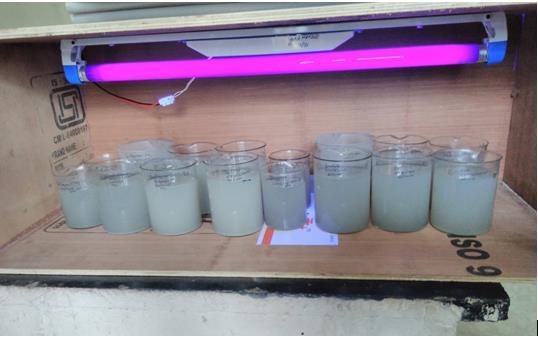
Reagents used for experimentation were made of varying concentrations,whichrangesfrom0.05gm,0.1gm,0.2gm,0.3 gm,0.4gmand0.5gmper500mlofdairywastewater.These solutionswerepreparedandthoroughlymixedinseparate beakerstoensureuniformdistribution.Thentheprepared solutions were exposedtoUV light for24and 48hoursto initiate,thesupernatantoftreatedwastewateriscollectedfor CODtesting.
TheChemicalOxygenDemand(COD)ofthesupernantwas foundoutaccordingtotheprocedureexplainedinIS3025. TheCODremovalefficiencywascalculatedaccordingtothe formulaenlistedbelow;
Efficiency= %

The initial parameters of the dairy wastewater before treatmentareillustratedintable1:
Table -1: Resultsforinitialparametersofdairy wastewaterbeforetreatment
After carrying out several lab trials by subjecting the wastewater involving various reagents at different concentrations under the UV box for 24 and 48-hour processesareasfollows:
3.1 Results for P25Degussa reagent after 24 hours of UV exposure
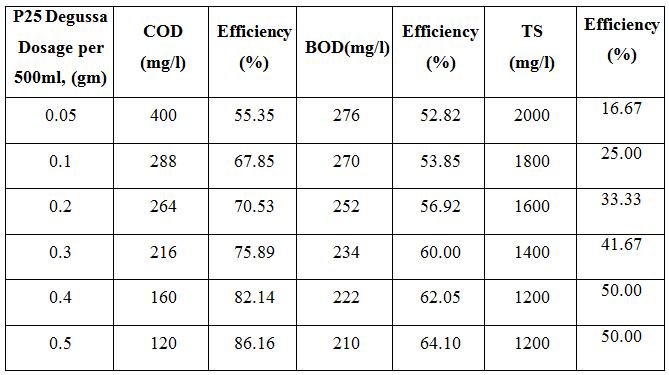
AftertreatingdairywastewaterwithP25Degussaatvarious dosageconcentrationrangingfrom0.05gm/500mlto0.5 gm/500 ml under UV exposure for 24 hours is outlined below:
International Research Journal of Engineering and Technology (IRJET) e-ISSN: 2395-0056
Volume: 11 Issue: 06 | Jun 2024 www.irjet.net p-ISSN: 2395-0072
Table 2 Results of P25Degussa exposed for 24 hours under UV light
Table 3 Results of P25degussa exposed for 48 hours under UV light
0.4
0.5
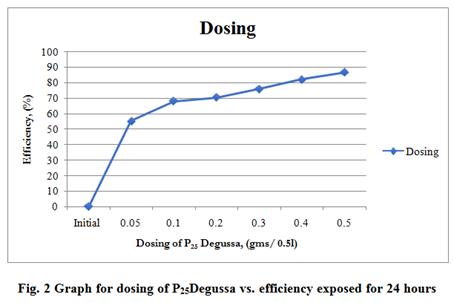
Figure 2 shows that as the P25 Degussa dosage concentration increase there is also an increase in COD removalefficiency.Allrelevantparametersaremonitoredas thedosageconcentrationrises.
3.2 Results for P25degussa reagent after 48 hours of UV exposure
When subjecting dairy wastewater to various dosages of P25Degussa ranging from 0.05gm, 0.1gm, 0.2gm, 0.3 gm, 0.4gmand0.5gmper500mlunderaUVBoxfor48hours,the resultingeffectivenessisasfollows:
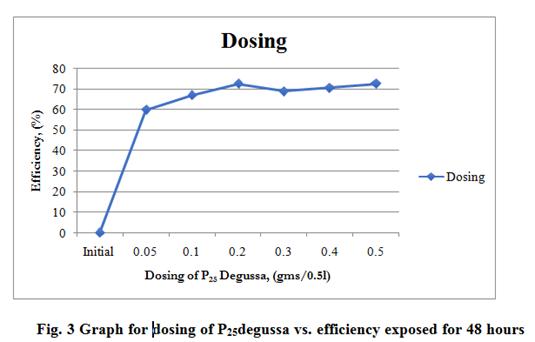
The results reveals that after 48 hours, an increment in efficiencyisobservedwithincreasingdosageofP25Degussa untilthedosingratereaches0.2gm/500ml,beyondwhicha reductioninefficiencyisobserved,indicatingitssaturation limit,withaCOD,withaCODreductionefficiencyof72.32%.
Fromtheresultofanalysis,itisseenthatthereisconsistent increment in efficiency with increasing dosage for P25 DegussaexposedinUVlightfor24hours
[1]B.Ohtani,O.O.Prieto-Mahaney,D.LiandR.Abe,2010 What is Degussa (Evonik) P25 Crytalline Composition Analysis, Reconstruction from Isolate Pure Particles and Photo catalytic Activity Test, J. of Photochemistry and PhotobiologyAChemistry2010Volume216,pp179-182
International Research Journal of Engineering and Technology (IRJET) e-ISSN: 2395-0056
Volume: 11 Issue: 06 | Jun 2024 www.irjet.net p-ISSN: 2395-0072
[2]ChitpisudSupha,YuphadaBoonto,ManeeJindakaraked, JirapatAnanpattarachai&PuangratKajitvichyanukul, 2015 Long-term exposure of bacterial and protozoan communitiestoTiO2nanoparticlesinanaerobicsequencing batch reactor, Int. J. Science and Technology of Advanced Materials16pp12
[3]DeannaC.Hurum,AlexanderG.AgriosandKimberlyA. Gray,2003ExplainingtheEnhancedPhotocatalyticActivity ofDegussaP25Mixed-PhaseTiO2UsingEPR,J.Phys.Chem.B 2003Volume107,pp4545-4549
[4]DhermendraK.Tiwari,J.BehariandPrasenjitSen,2008 Application of Nanoparticles in Wastewater Treatment, WorldAppliedSciencesJournal2008,pp417-433
[5] Haithem Bel Hadjltaief,AbdessalemOmri, Mourad Ben Zina,PatrickDaCostaandMariaElenaGalvez,2015Titanium DioxideSupportedonDifferentPorousMaterialsasPhotocatalystfortheDegradationofMethylGreeninWastewaters, Int.J.AdvancesinMaterialSci.andEng.Volume2015pp10
[6]HarikumarPS,LittyJosephandDhanyaA,2013Photocatalyticdegradationoftextiledyesbyhydrogelsupported titanium dioxide nano-particles, J. of Environmental Engg. AndEcologicalSci.Article
[7]I.J.ElSaliby,H.K.Shon,J.KandasamyandS.Vigneswaran, Nanotechnology for Wastewater Treatment: In Brief, NanotechnologyforWastewaterTreatment:InBrief
[8] Jatin G. Bhadiyadra1, Minakshi V. Vaghani, 2015 A ReviewonApplicabilityofPhoto-catalystTitaniumDioxide for Treatment of Grey Water, Int. J. Engineering Research andApplications2015,Volume–5,pp102-105
[9] Laura K. Adams, Delina Y. Lyon and Pedro J.J. Alvarez, 2006ComparativeEco-ToxicityofNanoscaleTiO2,SiO2, andZnOWaterSuspensions,WaterResearch2006,Volume–40,pp3527-3532
[10] Meng Nan Chong, Bo Jin, Christopher W.K. Chow and Chris Saint, 2010 Recent Developments in Photo-catalytic Water Treatment Technology: A Review, Water Research 2010,Volume–44,pp2997-3027
2024, IRJET | Impact Factor value: 8.226 |