
Implementation of SHA256 for NFT Management Using Blockchain
Prateek Baranwal1, Ritik Katiyar2, Prajusha Kundu 3, Meenakshi Yadav4
123UG Student, Department of Information Technology
4 Professor, Department of Information Technology, Galgotia’s College of Engineering & Technology, Gr. Noida, India
Abstract–Theriseoftechnologyhastransformedhow digital assets are managed, leading to the popularity of fungibletokens(NFTs),asakeyconcept.Thisendeavour aims to create a NFT management system that tackles issues related to ownership security, transparency and accessibility within the NFT realm. By harnessing blockchain,contractsand governance mechanisms users candotheirfundtransferandexchange digital assetsor Crypto Currency. The unveiling of the key is part of the process. With the assistance of the OpenAI API, machine learning models craft personalized NFT visuals that are then minted on the Ethereum blockchain using Solidity based contracts. The Interplanetary File System (IPFS) bolsters data integrity and immutability by furnishing NFT metadata. This project involves a blend of business operations and management systems. Through leveraging technology and embracing governance this initiative widens access to digital assets while nurturing innovation and safeguarding digital rights. Ultimately fostering social creativity and reinforcing business digitization efforts. This study expands on NFT management systems by integrating IPFS to enhance data integrity and immutability establishing a basis, for democratizingownershipandmanagementofassets.
Keywords - Ethereum, Solidity, NFT, Blockchain, Smart Contracts.
1. INTRODUCTION
The Decentralised applications, or DApps, are becoming increasingly popular in the quickly developing field of blockchaintechnology becauseoftheir intrinsicsecurity, transparency,andimmutability.Thisprojectmakesuseof Hardhat, an extensive development environment, and Solidity, the programming language for Ethereum smart contracts. The principal aim is to enable safe and transparent transactions on the Ethereum network, enhancedbypersonalisednotesandkeywords.
Through the use of Ethereum smart contracts, this dapp makes it possible for peer-to-peer transactions to occur directly without the need for middlemen. Ether can be transferred easily by users, who can also add keywords and customised messages to improve transaction functionalityandtraceability.Inaddition,theapplication offers a thorough history of transactions, which enables userstoquicklyfilterandgetpertinentinformationusing predefinedkeywords.
1.1 Background and Origin
With the development of blockchain technology, a new age of transparent, safe, and decentralized systems has begun. Ethereum stands out as a leading force in this domain, offering an open-source, global platform for decentralized applications (dapps). At the forefront of Ethereum's innovation are the contracts that executes itself and comes with terms written directly into the code. Solidity, a high-level, contract-oriented language, was developed to facilitate the creation of smart contracts on the Ethereum Virtual Machine (EVM). However, the process of creating Ethereum dapps has proven challenging, often necessitating developers to integrate multiple frameworks and tools. In response to this complexity, this project introduces Hardhat, an Ethereumdevelopmentenvironmentthatstreamlinesthe dapp development lifecycle. Hardhat offers comprehensive tooling to simplify smart contract development, testing, and deployment, addressing the need for practical solutions tailored to real-world use casesintheEthereumecosystem.
1.2 Need for Detection System
In the modern digital era, the imperative for secure, transparent, and efficient transaction systems spans various industries, challenging traditional centralized systems riddled with trust issues, fraud susceptibility, and intermediary reliance, thus inflating costs and vulnerability. Blockchain technology, with its decentralized and immutable nature, offers a compelling remedy, executing transactions in a trust less environment, cutting out intermediaries, and trimming associated costs. Its inherent transparency ensures all transactions are logged in a tamper-proof distributed ledger, accessible to all, fostering accountability and curbingfraudrisks.However,blockchain'sadoptionfaces hurdlesduetodappdevelopmentcomplexityand lackof user-friendly interfaces. This project endeavours to overcome these barriers by furnishing a seamless platform for Ethereum network-based blockchain transactions. By amalgamating Solidity and Hardhat, it empowerssecure,auditabletransactionsembeddedwith custommessagesandkeywords,facilitatingpeer-to-peer transactions while tailoring functionality to industry requisites. By streamlining decentralized application development and deployment, this initiative holds promisetoexpediteblockchain'smainstreamintegration,
International Research Journal of Engineering and Technology (IRJET) e-ISSN: 2395-0056
Volume: 11 Issue: 06 | Jun 2024 www.irjet.net p-ISSN: 2395-0072
ushering in heightened transparency, security, and efficiency across diverse sectors, from finance to supply chainmanagement,andbeyond.
1.3 Importance of NFT Management System
With the development of blockchain and token currencies the financing systems has been redefined enabling the representation of unique, indivisible, and non-interchangeable assets on the blockchain. NFT marketplaces serve as crucial platforms for buying, selling, and discovering these unique digital assets, leveraging blockchain technology to ensure secure, transparent, and immutable transactions. Crypto wallets play a vital role in the NFT ecosystem, serving as secure digitalstorageforthesevaluableassetsbystoringprivate keys that grant ownership and control over NFTs. Projects integrating NFT functionality into decentralized applications (dapps), such as those utilizing Solidity, Hardhat, and the Ethereum blockchain, enhance the utility and traceability of NFT ownership transfers by allowingusers to attachcustom messagesand keywords to transactions. This integration opens new avenues for personalization and storytelling within the NFT space, unlocking a new frontier in digital asset ownership and tradethat empowerscreators,collectors,andbusinesses to explore innovative business models, foster communities, and drive the evolution of the digital economy.
1.4 NFT-Creation
NFTcreationreferstotheprocessofcreatingorissuinga newdigitalasset,suchasanon-fungibletoken(NFT),on a network. When an NFT is created, a unique token is generated and associated with a specific digital asset, making it distinct from other tokens on the same blockchain. This process typically involves deploying a smartcontractontheblockchain.
2. LITERATURE REVIEW
Due to their potential to upend established financial systems and facilitate safe, decentralized transactions, cryptocurrencies and the blockchain technology that powers them have attracted a lot of attention recently. Numerous investigators have investigated the potential uses of blockchain technology and cryptocurrency in diverse fields, such as user authentication and banking. Using MetaMask, an online wallet extension, Choi and Kim (2019) present a blockchain-based user authenticationparadigm.Accordingtothem,thismethod addresses the issue of service providers gaining control of and stealing personal information by employing centralized servers for user management and authentication. Users can ensure decentralized control and security by storing their encrypted personal information in a Smart Contract by utilizing MetaMask and the Ethereum public blockchain [1]. With an
emphasis on Bitcoin, DeVries (2016) offers a thorough examination of cryptocurrencies. Writer draws attention to the benefits of Bitcoin, including its fixed supply limit and potential to act as a haven against inflation of currency values. Nevertheless, the study also addresses the paper's shortcomings, including the blockchain's public nature, which poses privacy issues, and the securityproblemswithbitcoinwalletsandexchanges[2]. Pamu et al. (2022) provide an overview of decentralized cryptocurrency wallet applications that leverage the Ethereum ledger in their study. They suggest a system design that stores cryptocurrency and transaction data on the Ethereum blockchain, facilitating safe and open financial transactions. The writers also go over the drawbacks of blockchain-based wallets, namely sluggish transaction times and security flaws [3]. Yadav et al. (2020) investigate the application of blockchain technology in conjunction with cryptocurrency wallets.Financial security solutions. The benefits of utilising blockchain-based wallets over conventional ewallets are emphasised, including the removal of thirdparty intervention and increased anonymity via the use of hexadecimal addresses. The authors stress the significance of safe authentication procedures and transaction tracking in their workflow for integrating blockchain-basedwalletsintothefinancialsystem[4].Di Angelo and Salzer (2020) concentrate on Ethereum platform wallet contracts. In order to increase trust and security through transparency and features like daily limitations, permissions, multi-signatures, and recovery methods, they suggest implementing wallet functionalities as smart contracts [5]. Martiny (2021) offers a tutorial on how to use the web3.js JavaScript library and the Ethereum blockchain with MetaMask to create one-click login flows. The author describes the procedures needed in A decentralized authentication system's realistic implementation is demonstrated with user authentication, nonce generation, private key signing, and signature verification [6]. The possible effects of blockchain technology on a number of industries, including financial services, are covered by TapscottandTapscott(2016).Theystressthebenefitsof blockchain, including decentralization, security, and transparency, and they contend that technology has the potential to completely transform how transactions are carried out and documented [7]. In the groundbreaking paperthatcreatedBitcoin,Nakamoto(2008)suggesteda decentralized blockchain-based peer-to-peer electronic payment system. The groundwork for the creation of cryptocurrencies and the investigation of blockchain technology'spotentialuseswasestablishedbythispaper [8]. The banking industry could benefit from the combination of blockchain technology and cryptocurrencies by improving security, transparency, and effectiveness in monetary exchanges. For wider implementation, nevertheless, issues including scalability,regulatoryconstraints,anduseradoptionstill need to be resolved. Sustained investigation and
International Research Journal of Engineering and Technology (IRJET) e-ISSN: 2395-0056
Volume: 11 Issue: 06 | Jun 2024 www.irjet.net p-ISSN: 2395-0072
advancement within this domain may yield inventive resolutions that fundamentally alter the conventional bankingterrain.
3. FEATURES CONSIDERED
Authors can tokenize their original works as NFTs through a decentralised NFT marketplace, which uses blockchain technology to facilitate safe transactions. By implementing automated execution and royalty payments, smart contracts offer an open and secure environmentforNFTtrading.
3.1 User-Friendly Interface
Developed using React.js and Tailwind CSS, the interface allows users to seamlessly browse, create, buy, and sell NFTs. Features like advanced search, filtering, and user authenticationenhancetheuserexperience.
3.2 Metadata Management
To maintain data integrity and tamper resistance, NFT metadata is saved on decentralized storage systems like IPFS. Accurate asset descriptions are achieved through theuseofmetadatastandards.
3.3 Security and Privacy
In order to ensure compliance with data protection laws like the CCPA and GDPR, security and privacy are given first priority through encryption systems that safeguard private keys and sensitive data, access restrictions, and permissionschemesforrestrictedaccess.
3.4 Scalability and Interoperability
The marketplace is designed for scalability, leveraging layer2protocolsorinteroperabilitysolutionstosupport cross-platform integration and seamless asset exchange, adhering to common protocols and standards for NFTs likeERC-721andERC-1155.
3.5 Environmental Sustainability
Environmental sustainability is considered, with explorationofsolutionslikerenewableenergysourcesor energy-efficient consensus mechanisms to mitigate the environmentalimpactofNFTmintingandtrading.
4.
METHODOLOGY
The NFT Management System was developed through a number of stages, which included creating the client for interactions on chain, putting smart contracts on the Ethereum chain, connecting with external handlers, testing, and assessment. We have gone through every stage, including the frameworks and subsystems employed,andtheintegrationisdoneandtheerrorsare fixed and documented. Furthermore, we outline the
processesthatwereemployedtosecurelyconnectusers' wallets,createuserprofilestooverseeNFTcollectingand its other functionality mint on the chain network, create uniquehashandmessagedigestfortheblockcreationfor NFTsusingproofofstakeandcreateNFTs.Thisproject`s purposeistoinshareainsightfulpaperofourprojectto provide guidance and insights for creating safe, userfriendly decentralized app for blockchain-based digital Fundandassetmanagement.
4.1 Building Client
Building a client for our NFT management project involves several crucial steps to ensure a seamless and secure user experience. Firstly, integrating wallet functionalities like MetaMask allows us to securely connect their wallets to our chain on sepolia network without any security concerns. Next, creating smart contracts with Solidity ensures the authenticity and scarcity of NFTs. Utilizing Truffle for development and Ganache for local testing enhances the development process.Web3.js facilitates blockchain interaction, while robust security measures protect user data. The user interface, built with React.js and Tailwind CSS, ensures accessibility and usability, making the platform userfriendly for all The Tokens is surety to be discrete and transferableacrossusersviatheuniqueidentifieronthe blockchain.
4.2 Wallet Integration
This NFT Management System has a function for Wallet Connectivity, which lets userssafely link their MetaMask wallets to the decentralized app without disclosing their private keys, is a vital feature. This is accomplished by using MetaMask [9], a well-known browser addon that serves as a medium between the webapp window and wallet.TheNFT webappgivesmessageuserstoconnect their wallet with the help of MetaMask when they first access it. After connecting, the user does not need to manually enter their private keys to use the dApp's functionalities, such minting and creating NFTs. This removesthepossibilityoftheftofanyofyourintellectual property. To build this amazing project we have incorporated two public libraries with the NFT MarketplaceAppthatareReact.js[10]andEther.js[11],a popular library for performing operations on Ethereumchain. This step makes gives us functionality to connect the dApp with its user’s cryptocurrency wallets through the MetaMask. The Ether.js library provides some methods for sending and receiving data from the chain, making it possible for us to connect the App with ethereum[12]network.
4.3 Generator Function
The main task of our project is to create a block for the new transaction based on some input parameters given by user. We have made an API, which gives us direct
International Research Journal of Engineering and Technology (IRJET) e-ISSN: 2395-0056
Volume: 11 Issue: 06 | Jun 2024 www.irjet.net p-ISSN: 2395-0072
access to a pretrained DALL·E model that can create images from text prompts, to implement this feature. An NFTiscreatedbytheuserenteringakeywordorphrase that represent the message from the user about your asset or transaction. These form data are sent with the helpofourbackendserver,whichusestheDALL·Emodel to create a unique image by interacting with the OpenAI API. This model allows to produce various and highquality images Additionally, the concept enables the construction of distinctive, personalised NFTs that are difficult to duplicate. Blockchain technology offers security, immutability and decentralised database are combinedintheNFTgenerationprocesstocreateunique and valuable digital assets. Through the utilisation of these methods, the NFT Marketplace decentralized App offers customers a distinctive and thrilling method to generate,possess,andexchangeNFTs.
4.4 NFT-Minting
On the blockchain, users can save and market exclusive intellectualpropertiesassetsthankstotheNFTgenerator function. We are used IPFS to store our data in decentralized wayofstoring,theEthereumdevelopment environment by Hardhat, and the Ai model in tandem to develop this feature. The user must first enter the necessarydatatogenerateimagebeforecreatinganNFT. The minting procedure begins when the user clicks the "Transfer"buttonthenafterthetransactionisdone.Next, the smart contract's mint function is triggered, which generates a new block on the Ethereum test chain and. The token's qualities, includes the sender address, receiver address and the amount of Ethereum, and the timestamp of transaction, are also specified in the smart contract.
NFTisnowavailableforviewingontheMarketplaceand is formally minted. Anyone can read the name, description,price,andimageoftheNFTbyaccessingthe metadata URI that is maintained on IPFS. The NFT's uniqueness and ability to be transferred between users areguaranteedbythetokenIDontheblockchain.

4.5 Network & Testnet
We thoroughly tested our NFT Marketplace dApp on Ethereum test networks like Testnet and Sepolia to guarantee its dependability and security. Testnet, which uses test ETH from faucets like Testeth Faucet, enables
developers to implement and test smart contracts without actual financial risk. For testing intricate dApps, Sepolia, a more recent test network, provides better performance and stability. Before going live on the mainnet,ourtestnetworksallowforthoroughdebugging and optimization, ensuring that our marketplace runs smoothly and that our smart contracts are reliable. By using test ETH from faucets, we can ensure that our testing procedures accurately reflect real-world scenarioswithouthavingtopayrealmoney.
4.6 Smart Contract
Deploying a smart contract using Hardhat involves several key steps. First, install Hardhat and initialize a newprojectusingnpxhardhat.Writethesmartcontract in Solidity, then compile it using npx hardhat compile. Next,createadeploymentscriptinthescript’sdirectory. This script uses the Hardhat Runtime Environment (HRE) to deploy the contract to the Ethereum network. Run the deployment script with sepolia network configuration. Ensure your network configuration is set up correctly in hardhat.config.js. Upon successful deployment,Hardhatlogsthecontractaddress.

5. RESULT ANALYSIS
In this section, we are showcase the results for our project and its performance and subsystem’s analysis. The Sepolia testnet's smart contract transactions were used to mint NFTs, and the time system took to produce responsetoourgeneratingrequestwasmeasuredaspart of the performance test [3]. Ten users from throughout the testing batch were polled for the performance study in order to assess the marketplace's smoothness in operations, connectivity, and robustness as well as the hashing message procedure and general use case scenario. To better highlight the results, we provide the researchresultsasbargraphs.Additionally,feedbackwas gathered on the ease of navigation and the intuitiveness of the user interface. The performance data is presented alongsidethesefindingstoofferacomprehensiveviewof thesystem'sefficiencyandusersatisfaction.Thisanalysis aims to identify areas for improvement and validate the overalleffectivenessofourNFTmarketplaceplatform.
5.1 Performance Analysis
In order to generate NFT images for the performance test, AI models were used, and contract transactions on theSepoliatestnetworkwereusedtomintNFTs.
International Research Journal of Engineering and Technology (IRJET) e-ISSN: 2395-0056
Volume: 11 Issue: 06 | Jun 2024 www.irjet.net p-ISSN: 2395-0072
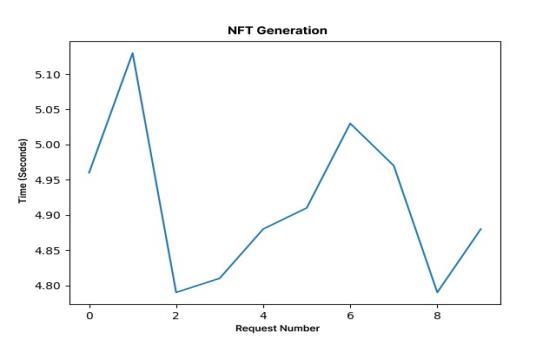
TimeGraphforperformance
To see the performance test results, we displayed two graphs.Thegraphs'x-axisdisplaysthenumberofdistinct requests send through us, and the y-axis displays the waitingtimeforthecompletionofeveryrequest.
5.2
Demonstrating MetaMask Functionality
Here, we provide examples of MetaMask transactions using sender and recipient screenshots. Make sure MetaMaskisfirstconfiguredandlinkedtoanetwork.Put cryptocurrency into each wallet. By confirming the amountandpetrolfee,aswellastherecipient'saddress, the sender starts the transaction. The recipient then checks their MetaMask wallet to confirm the receipt. Both parties have the option to examine the transaction usingablockchainexplorersuchasEtherscan.
5.3 Algorithm - SHA256
SHA256comesfromthefamilyofSHA2algorithmswhich arealgorithmsthatperformshashingonthedatafordata integrity and security. It was made by the NSA and released NIST in the year 2001. With the ability to produce a 256-bit hash value from any amount of input data,itguaranteesa highdegreeofsecurityfora variety ofuses,suchaspasswordhashing,digitalsignatures,and certifications.

5.4 Why SHA256?
A message digest in blockchain is a fixed-size numerical representation(hash)ofadatapointproducedbyahash function. It functions as a digital fingerprint, enabling users to confirm that the data has not been changed, so guaranteeing data integrity. The hash functions SHA-256
and SHA-3 are often utilized. SHA-256 is considered "almostunique"becauseitwilllikelyproducea different hashforeachdifferentinputmessage.

5.4 Architectural Designs
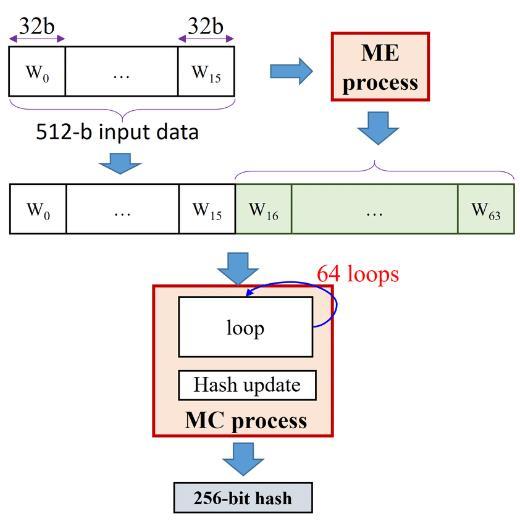
Architecture of SHA256
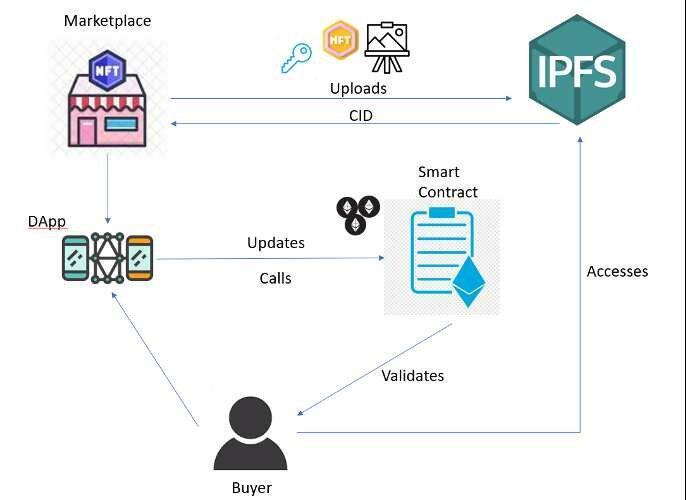
TransactionDataflow
6. FUTURE WORK
While the NFT dApp offers a new approach to secure digital way of fund transfer and management using hardhat development technology on Ethereum and AI
Volume: 11 Issue: 06 | Jun 2024 www.irjet.net p-ISSN: 2395-0072
models, there are many limitations that are there in the idea as scalability as blockchains are difficult to expand and the second most concerning issue is the energy consumptionasittakeslotofenergytocreateablockon chainasapartofitsconsensusmechanismbeaddressed in future iterations of the app. First, the NFT creation processiscurrentlylimitedtotheAPI.Futureworkcould include developing custom learning models that are bettersuitedforcustomgenerationtaskandcanhandlea wider range of input types. Second, the application is currently deployed on the sepolia Testnet, which allows secure and controlled testing, but limits scalability and real-world applicability. Future work may include bringingthedApptothewebtoenablerealNFTtrading. Itdoesnotsupport Tokens resale,whichisanimportant function of crypto markets. Future work could include developingasecureandopenmechanismforNFTresale. Finally, the user interface can have many more features like a storage vault and a system to embed social media platforms be further refined to improve user experience andaccessibilitybyaddingimproveddesignandusability principles and additional features such as social sharing can help in community building and innovating our currentmarketwithtrustissues.
7. CONCLUSION
In conclusion, we can say the NFT Management System Webapp development shows the potential of crypto currenciesandblockchaintechnologiesandAImodelsto createrobust,secure,transparent,andfriendlyplatforms to manage and sell or buy our assets. Our dApp reports several issues in NFT management system, including secure wallet for crypto, block generation on the blockchain, and NFT trading application. The integration of the image generating API with the Ethereum network made it possible tocreateuniqueNFTs thatare not easy to copy, thus creating valuable and unique assets. The studies show that our dApp is easy to use. In the upcoming years the directions for research and development in this area will include improving the scalability and the adaptation in our current banking system.exploringnewareaswherewecanusetokensto pay for services. Overall, our NFT Marketplace application is an important step forward in the development of decentralized applications for token and fundmanagementandtransactionmanagement.
REFERENCES
[1] Choi, N., & Kim, H. (2019). A Blockchain-based User Authentication Model Using MetaMask. Korea Science, 5(9),6016-8896.
[2] DeVries, P. D. (2016). An analysis of cryptocurrency, bitcoin, and the future. International Journal of Business ManagementandCommerce,1(2),1-9.
[3] Pamu, D., Harshad, Birari, T., Kadam, T., & Kedare, N. (2022). Survey Paper on Decentralized Crypto Wallet ApplicationusingEthereumLedger.InternationalJournal of Advance Research, Ideas and Innovations in Technology,8(6),496-499.
[4] Yadav, N. S., Goar, V. K., & Kuri, M. (2020). Crypto Wallet: A Perfect Combination with Blockchain and Security Solution for Banking. International Journal of PsychosocialRehabilitation,24(2),6056-6066.
[5]DiAngelo,M.,&Salzer,G.(2020).WalletContractson Ethereum. In Tokenized Securities and Crypto Enforcer (pp.95-115).Apress,Berkeley,CA.
[6] Martiny, A. (2021). MetaMask Tutorial: One-click Login With Blockchain Made Easy. https://www.toptal.com/ethereum/one-click-loginflows-a-metamask-tutorial
[7] Tapscott, D., & Tapscott, A. (2016). Blockchain revolution: how the technology behind bitcoin is changingmoney,business,andtheworld.Penguin.
[8] Nakamoto, S. (2008). Bitcoin: A peer-to-peer electronic cash system. Retrieved from https://bitcoin.org/bitcoin.pdf
[9]"ThecryptowalletforDefi,Web3DappsandNFTs MetaMask." Metamask.io, 2023. Retrieved from https://metamask.io/ (accessed Apr. 09, 2023). [10] "Getting Started – React." Reactjs.org, 2021. Retrieved from https://legacy.reactjs.org/docs/gettingstarted.html(accessedApr.09,2023).
[11] "Documentation." Ethers.org, 2023. Retrieved from https://docs.ethers.org/v5/(accessedApr.09,2023).
[12] "Ethereum Developer Resources ethereum.org." Ethereum.
[13] "OpenAI API." Openai.com, 2023. Retrieved from https://platform.openai.com/docs/ (accessed Apr. 09, 2023).
[14] "Express - Node.js web application framework." Expressjs.com,2017.
[15] Contract ABI Specification. Retrieved from https://docs.soliditylang.org/en/latest/abi-spec.html#
[16] Contract ABI Specification. Retrieved from https://docs.soliditylang.org/en/latest/abi-spec.html#
[15] Contract ABI Specification. Retrieved from https://docs.soliditylang.org/en/latest/abi-spec.html#
[16] Sepolia Network. (n.d.). Retrieved from https://sepolia.etherscan.io/
International Research Journal of Engineering and Technology (IRJET) e-ISSN: 2395-0056
[17] Deploy smart contract. (n.d.). Retrieved from https://docs.alchemy.com/docs/hello-world-smartcontract
[18] Shafique, M., Khurram, M., Amjad, F., & Khalid, H. (2020). Lightweight Security Algorithms for Resourceconstrained IoT-based Sensor Nodes. In IEEE International Conference on Communications (ICC)(pp. 16). Dublin, Ireland. doi:10.1109/ICC40277.2020.9149359
[19] IEIE Transactions on Smart Processing and Computing. (2022). IEIESPC, 11(5), 385-391. https://doi.org/10.5573/IEIESPC.2022.11.5.385
Volume: 11 Issue: 06 | Jun 2024 www.irjet.net p-ISSN: 2395-0072 © 2024, IRJET | Impact Factor value: 8.226 |