
International Research Journal of Engineering and Technology (IRJET) e-ISSN: 2395-0056
International Research Journal of Engineering and Technology (IRJET) e-ISSN: 2395-0056
Kartik Porwal1 , Dr. Nitesh Parmar2 , Dr. Rajesh Kaushal3
1MTech Student, RGPV University, IPS Academy, Indore
2Assistant Professor, Department of Chemical Engineering, IPS Academy, Indore, M.P.
3 Head of Department, Dept. of Chemical Engineering, IPS Academy, Indore, M.P.
Abstract – Advanced oxidation processes (AOP) has offered the best solution in treatment of pharmaceutical wastewater. It has investigated on the efficacy of AOPs in degrading the water with the use of Titaniumdioxide (TiO2) nanoparticles. It has synthesized through sol-gel method and evaluating the study with the parameters catalyst dosage, irradiation time, temperature, pH and degradation efficient with effective results. It has underscored on the organic pollutants with optimal conditions and achieving higher degradation rates in sustainable treatment of wastewater and environmental remediation
Key Words: Advanced Oxidation Processes, Wastewater Treatment, Pharmaceutical Wastewater, Titanium Dioxide Nanoparticles, Sol-Gel Method, Photocatalytic Degradation, Catalyst Dosage, Irradiation Time, Temperature, pH, Organic Pollutants
The need of water is raised due to efficient factors like expanding agriculture, industrialization and raising population.Ithastraditionallymanagethewatercollection methods using reservoirs, wells and alternatives like recyclinganddesalination.Ithasbeenpredictedthatwater scarcitywouldbecausedduetocontaminationofthewater in regions leading to water pollution. It will excessively depleteoxygenandharmingtheaquaticenvironmentwhich areleadingtodetrimentaleffectsontheaquaticecosystem.
TiO2hasemergedtobepromisingtechniquewhichcanhelp in extensive use of the environmental application. It has finally aim on sol-gel method to offer a control on the particlesizeandcrystallinity.Ithasdegradedontheorganic pollutantsinthepharmaceuticalwastewater.
The Nano-particles have synthesized using various methods including sol-gel, chemical vapor deposition, physical vapor deposition, bottom-up techniques like nucleationandgrowthofparticles.However,sol-gelmethod turnsouttobemoreeffectiveasitisutilizingthehydrolysis and condensation of precursor molecules with colloidal suspension.Ithasviolatedonthemoleculesandthendried toformnano-particles.
Volume: 11 Issue: 06 | Jun 2024 www.irjet.net p-ISSN: 2395-0072 © 2024, IRJET | Impact Factor value: 8.226 | ISO 9001:2008
Various articles, journals and thesis are conducted on the topicbutextensiveuseofTiO2nanoparticleinprecisecanbe analyzedwiththebaseforthereviewsthatareundertakenin thestudy
Table -1: LiteratureReview
Author Year Focus
Vassilios Binas et al 2019
Muhetal 2018
Xiaodongetal 2018
YuNiuetal 2018
Investigated on thedegradationof sulfamethoxazole using iron-doped titania under simulated solar radiation
Explored on the preparation of natural biopesticides as a antimicrobial material through lignin photodegradation using mineral ilmenite
Examined the enhancement of Raman scattering using substrates of titanium oxide nanorods coated with gold nanoparticles
Analyzing the efficiency of photocatalytic hydrogen production using TiO2photocatalyst in aqueous solution of methanol
International Research Journal of Engineering and Technology (IRJET) e-ISSN: 2395-0056
Volume: 11 Issue: 06 | Jun 2024 www.irjet.net p-ISSN: 2395-0072
Similarly,otherauthorshavealsofocusedonthesynthesisof titanium dioxide for encapsulating it into the potential application of it. The use of Trigonella foenum-graecum extract, fabricated Alcea and thyme stabilized TiO2 nano particles have highlighted on the potential application of environmentalremediation.
The experimental setup forthin-filmbased photocatalytic reactorisdesignedusingkineticstudiesbyminimizingthe scatteringoftheenergyintensitywithsuitablepseudo-BeerLambertlawapplication
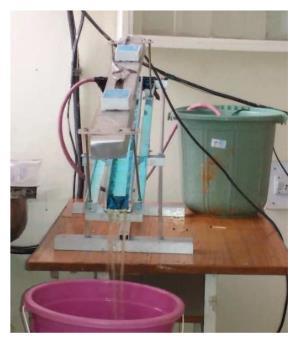
Chart -1:FrontViewofSetupinOperatingCondition
Ithascontinuouslyoperatedfor2hoursattheflowrateof4 liters/hrunder100W/cm2 UVsource,theperformanceof thereactorwasevaluatedthroughfollowingparameters.
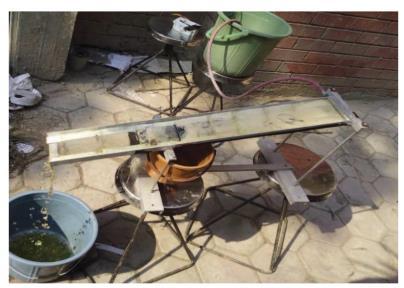
Chart -2:ReactorUnderSunlight
ThepHandchemicaloxygendemand(COD)havebeenused inthestandardmethod.Ithasinvolvedtheoxidizingorganic matter,pHwhichwaselectrometricallymanaged.Ithasalso done the catalyst dosage with the effluent concentration, irradiation time, temperature and pH. It can remark that optimal conditions are 10:1 effluent-to-water ratio, a 0.8g catalystdosage,1hourirradiationat350Ctemperatureand ensuring OH* in radical form to facilitate effective degradationofphotocatalyticpollutantsinthewastewater.
ThecharacterizationofTiO2nanoparticleshavesynthesized thesol-gelrouteshowsforthecrystallinestructureswith2θ distinctpeaksindicatedintheanatasephases
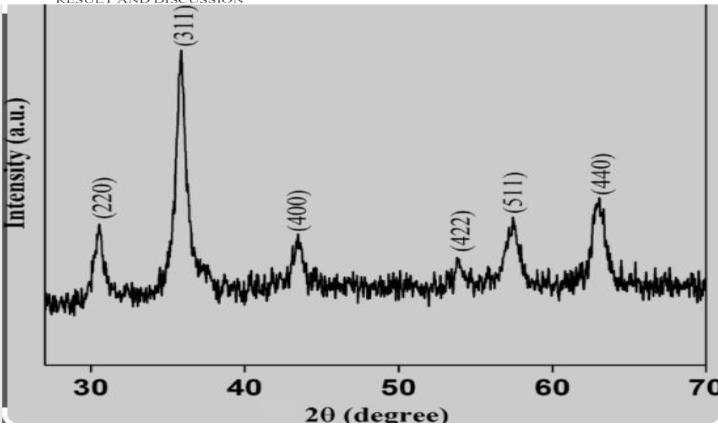
Fig -1:XRDpatternofTiO2nanoparticlessynthesizedvia sol-gelroute
TheuseofDebye-Scherrer’sformulaat7nmhasrepresented the SEM images which reveal on the optimal usage of the pharmaceuticalwastewatertreatment
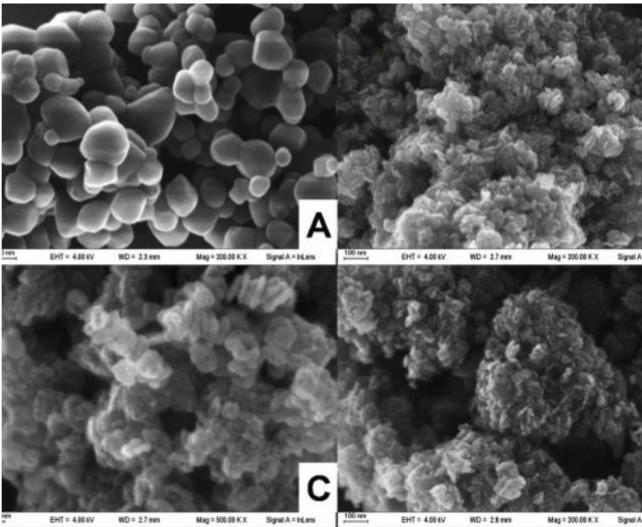
Fig -2:SEMmicrographsofTiO2nanoparticles synthesizedviasol-gelroute
International Research Journal of Engineering and Technology (IRJET) e-ISSN: 2395-0056
Volume: 11 Issue: 06 | Jun 2024 www.irjet.net p-ISSN: 2395-0072
TheoptimaluseofUV-visabsorptionspectrahasaddedon crystalline size and achieving the different photocatalytic performanceofwastewater.
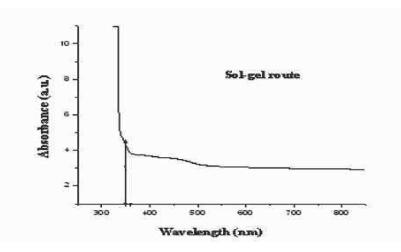
Fig -3: UV-visabsorptionspectraofTiO2nanoparticles viaSol-gelroute
Thetreatmentofthewastewaterhasaddedontheradiation of catalyst dosage to be 80mg, achieving90% degradation efficiency
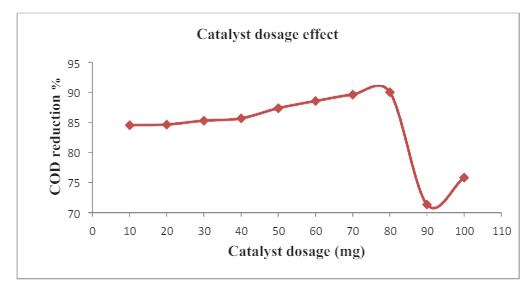
-4: Effectofdosageonphotocatalyticdegradation efficiencyoforganicpollutants
This has raised the increase in the dosage beyond the reducedefficiencyduetoUVlightintensityinterference.
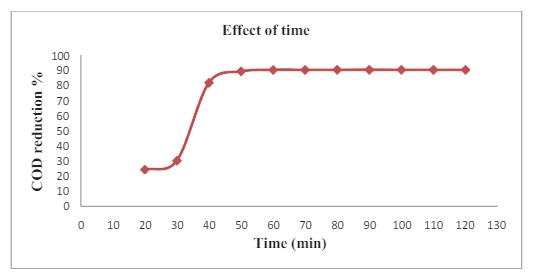
Fig -5: Effectofirradiationtimeonthephotocatalytic degradationefficiencyoforganicPollutants
The irradiation time has significantly influenced the degradation with 91.08% efficiency at 60 minutes time. It canpresentthesharpincreaseinthetimeandattributeto the organic pollutants with raised waste molecules in the activatedsurfaceofTiO2
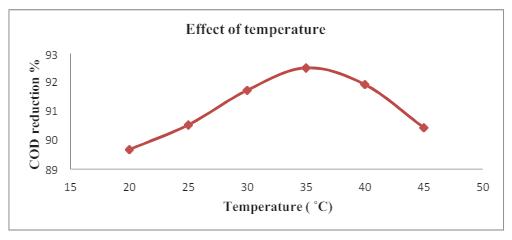
Fig -6: Effectoftemperatureonthephotocatalytic degradationefficiencyoforganicPollutants
Thereactiontemperatureislikelytoraisethephotocatalytic activitywhichcanpresenttheoptimumconcentrationwithin 100 ml effluent solutionandoptimal dosage of0.8g.ithas variedtemperatureandremoving92.07%CODdegradation removalat350C.
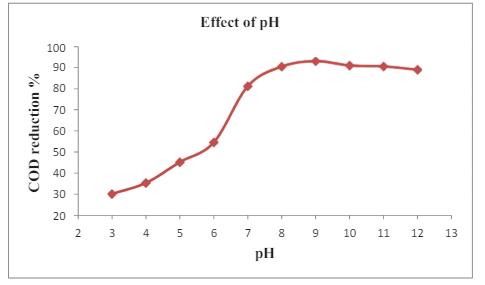
Fig -7: EffectofpHonthephotocatalyticdegradation efficiencyoforganicPollutants
At high pH, the effective time will attract the cation to the surfaceandinfluencingtheestimateeffectofpHontheCOD removalinthewastewater Ithasminimalimpactandadding optimaldegradationatpH9andachieving93.06%efficiency. It has underscore the importance of optimizing catalyst dosageusingTiO2 nanoparticles.
Photocatalysis has remark on the treatment of the water with the decomposition of organic compounds. Photocatalyticdegradationisapromisingtechnologywhich instigateonthetransformationofambientconditionswith theextensivepresenceofpesticides,herbicides,andmicro pollutants. It has also scale up with the results and use of
2024, IRJET | Impact Factor value: 8.226 | ISO 9001:2008 Certified Journal | Page49
International Research Journal of Engineering and Technology (IRJET) e-ISSN: 2395-0056
Volume: 11 Issue: 06 | Jun 2024 www.irjet.net p-ISSN: 2395-0072
TiO2 with the wastewater treatment. The result has optimized the process parameters with optimum catalyst dose of 80 mg/ 100 ml for irradiation time of 1hr under continuousstirringwithmaximumintensityandpHof9and temperatureat350C.Infuture,itcancommerciallyscalethe possibilityofviabilityofAOPintheindustry.
[1] Athanasios Tsiampalis, Zacharias Frontistis, VassiliosBinas, George Kiriakidis and Dionissios Mantzavinos.,(2019)“DegradationofSulfamethoxazole Using Iron-Doped Titania and Simulated Solar Radiation”, Catalysts 2019, 9, 612; doi:10.3390/ catal 9070612.
[2] Muh. Natsir, MaulidiyahMaulidiyah, AnharullahAnsharullah, ZulArham, Dwiprayogo Wibowo, Muhammad Nurdin.,( 2018)”Natural biopesticidepreprationasantimicrobialmaterialbased on lignin photodegeneration using mineral ilmenite”, Internationaljournalofpharmacy,Int.Res.J.Pharm.pp. 9,(6).
[3] Xiaodong Wang, Xiulan Cheng , Xufeng Yu, and XuelingQuan.,(2018)“StudyonsurfaceenhancedRaman scatteringsubstratebasedontitaniumoxidenanorods coated with gold nanoparticles,” Journal of Nanotechnology,vol.2018,ArticleID9602480,pp.9.
[4] Yu Niu, Fuying Li, Kai Yang, Qiyou Wu, Peijing Xu and RenzhangWang.,(2018)“HighlyEfficientPhotocatalytic Hydrogen on CoS/TiO2 Photocatalysts from Aqueous Methanol Solution,” International Journal of Photoenergy,Vol2018,ArticleID8143940,pp.6.
[5] S. Subhapriya and P.Gomathipriya.,(2018) “Green synthesis of titanium dioxide (TiO2) nanoparticles by Trigonellafoenumgraecumextractanditsantimicrobial properties,”MicrobialPathogenesis,vol.116,pp.215–220.
[6] Negar Arabi, Abbas Kianvash, Abdollah Hajalilou, EbrahimAbouzariLotf,VahidAbbasiChianeh.,(2018)“A facileandgreensyntheticapproachtowardfabrication of Alcea- and (yme-stabilized TiO2 nanoparticles for photocatalytic applications,” Arabian Journal of Chemistry.
[7] Surya PratapGoutam, Gaurav Saxena, Varunika Singh, Anil Kumar Yadav, Ram Naresh Bharagava, Khem B. Thapa.,(2018) “Green synthesis of TiO2 nanoparticles usingleafextractofJatrophacurcasL.forphotocatalytic degradation of tannery wastewater,” Chemical EngineeringJournal,vol.336,pp.386–396.
[8] Kavitha T.,(2012)” Synthesis, characterization of TiO2 nano powder and water based nanofluids” Volume
2012, Article ID 430638, ), Hindawi Publishing CorporationInternationalJournalofPhotoenergy.
[9] R. Vijayalakshmi and V. Rajendran.,(2012)” Synthesis and characterization of nanoTiO2 via different methods,”ArchivesofAppliedScienceResearch,4(2): pp.1183-1190.
[10] JinwenLiu,RongHan,YanZhaoHongtaoWang,Wenjing Lu, Tongfeng Yu and Yaxin Zhang.,(2011) “Enhanced PhotoactivityofV-NCodopedTiO2DerivedfromaTwoStep Hydrothermal Procedure for the Degradation of PCP-NaunderVisibleLightIrradiation”,J.Phys.Chem.C 2011, pp. 115, 4507–4515dx.doi.org/10.1021/jp110814b
[11] R.M.Abhang,DeepakKumarandS.V.Taralkar.,(2011) “Design of Photocatalytic Reactor for Degradation of PhenolinWastewater”,Volume2,Number-5,pp.337341.
[12] Batakrushna Santara, Bappaditya Pal and P. K. Giri.,(2011) “Signature of strong ferromagnetism and optical properties of Co doped TiO2 nanoparticles”, JournalofAppliedPhysics,110pp.114322-114327.
[13] Nicholas T. Nolan, Michael K. Seery and Suresh C. Pillai.,(2011) “Crystallization and phase-transition characteristics of sol−gel-synthesized zinc titanates”, ChemistryofMaterials,23,pp.1496-1504.
[14] SanjaiJ.Parikh,JamesD.Kubicki,CarolineM.Jonsson, Christopher L. Jonsson, Robert M. Hazen, Dimitri A. Sverjensky, and Donald L. Sparks.,(2011) “Evaluating glutamateandaspartatebindingmechanismstorutile (a-TiO2) via ATRFTIR spectroscopy and quantum chemicalcalculations”,Langmuir,27,pp.1778-1787.
[15] VaclavStengl,SnejanaBakardjieva,JanaBludska.,(2011) “Se and Te-modified titania for photocatalytic applications”,JournalofMaterialScience,46pp.35233536
[16] MohammadSalehGhodrati,MohammadHaghighi,Jafar SadeghSoltanMohamdzadeh,BehzadPourabas,Ehsan Pipelzadeh.,(2011) “Phenol decomposition under sunlightusingasonochemicallysynthesizedCdSe/TiO2 nanocatalyst”, Reaction Kinetics, Mechanisum and Catalysis,104,pp.49-60.
2024, IRJET | Impact Factor value: 8.226 | ISO 9001:2008