
International Research Journal of Engineering and Technology (IRJET) e-ISSN: 2395-0056
Volume: 11 Issue: 06 | Jun 2024 www.irjet.net p-ISSN: 2395-0072
International Research Journal of Engineering and Technology (IRJET) e-ISSN: 2395-0056
Volume: 11 Issue: 06 | Jun 2024 www.irjet.net p-ISSN: 2395-0072
Niny Sam1 , Radhika P2
1 PG Student, Mar Baselios College of Engineering, Trivandrum
2Assistant Professor, Mar Baselios College of Engineering, Trivandrum
Abstract - Multi-storiedbuildingsaregenerallyconstructed with shear walls to withstand high lateral loads such as earthquake and wind loads. Shear wall systems provide greater strength and high stiffness to withstand heavy horizontal loads and sustain gravityloads.Toconstructacosteffective and corrosion-free lateral resistant system, steel reinforcements in the shearwallsarereplacedwithGlassFibre Reinforced Polymer (GFRP) bars. There is moreconcernabout the placing of shear walls in reinforced concrete buildings because it affects the seismic behaviour of the structure against the external lateral forces acting on it. The major reason for the appropriate orientationandplacementofshear walls in the RC structure is to avoid the torsion generated in the building due to the eccentricity caused by the improper arrangement of shear walls. This study employs Incremental Dynamic Analysis (IDA) to assess the vulnerability of a G+7 storied building with different shearwalllocationsofidealised structure using seismostruct software. Fragility curves are generated using the guidelines from FEMA 58-1, which provides the probability of exceedance in different structural models. In this study modelling and analysis are done in buildings with different location of shear wall to find out the most preferable arrangement of shearwalltoresistthelateral loadings and probability of collapse ratio is analysed. Ten different far field ground motion data is collected and IDA has been performed for each structural arrangement.
Key Words: Shearwall,Lateralloads,GlassFiberReinforced PolymerBars,RCStructure,Incrementaldynamicanalysis, Fragility
Consideringthecurrentscenario,multi-storiedRCbuildings are constructed to withstand the lateral loads including earthquake and wind loads. RC Buildings which are constructed in seismic areas collapses due to severe earthquakes. To resist these loads vertical structural members such as shear walls can be implemented and stabilityofthebuildingcanbeincreased.Theseshearwalls arerigidverticaldiaphragmcapabletosustainthecombined axial,moment,andshearloadsbroughtonbytheearthquake and wind loads [16]. Now-a-days high rise buildings are mostcommonintheconstructionfieldduetotheshortageof landandmanyfactorssuchasthegrowingpopulationrate, increase in the cost of land, urbanisation and many more.
Construction of high-rise buildings can solve all these problems,butmoreconcernshouldbetakeninthelateral load combinations while increasing the height of the building. Hence framed structures are constructed with shear walls which acts as vertically oriented wide beams, startsfromthefoundationlevelandextendsthroughoutthe building'sheightthatcancarrylateralloadstogetherwith thegravityloads[15].Todissipatetheearthquakeloadsand energies,recentadvancesinseismicstudieshasbeenarrived touseGFRPbarsastheprimaryreinforcementintheseismic resistant buildings due to its inelastic deformation. These GFRP bars are used as the reinforcement material rather than traditional steel rebars because of its corrosion free property and better durability than steel bars. It can be utilized in the construction of buildings in coastal areas, bridgedecks,superstructureinwaterbodiesetc.,duetoits economic benefits, better material properties and its availability.TheseGFRPbarshasdielectricproperties,high tensilestrengthandpossesslightweightcharacteristics[19].
Inmulti-storiedbuildings,shearwallsaremostimportantin designingprocess.Thus,shearwalldesignandconstruction aredonewithhighsupervisionsothatpositioningofshear wallshouldbedonewithmoreaccuratelyandefficiently.It is necessary to check the position of mass centre and hardnesscentreofthestructureindecidingthedistanceof shearwalllocationfromthemasscentreofthestructurefor thepropershearcontributioninshearwall.[15].Toobtain theseismicbehaviourofRCStructure,amethodknownas Incremental Dynamic Analysis (IDA) has been adopted in recentresearchesinwhichoneormoregroundmotionsare chosenandmodifiedsothattheyfitthedifferentIntensity Measure(IM)usingascalingfactor.ThenNon-LinearTime HistoryAnalysishasbeendoneforeachIntensityMeasure levelsuntilthestructureattainsitsstructuralinstabilityand measuresitslevel ofdamage[6].Sincehighrise buildings shows more dynamic properties, seismic probabilistic analysisisdevelopedusingfragilitycurveandthusseismic vulnerabilitycanbemeasured[2].
2.1
TheresearchhasbeendoneusinganidealisedG+7storied structurewithgeometricpropertieslistedintable1.Inthis study shear wall has been placed in different locations to
Volume: 11 Issue: 06 | Jun 2024 www.irjet.net
resistthelateral loadingsandfurtherfragilityassessment hasbeendoneforknowingtheprobabilityofdamageofthe structure. Thus, the best positioning of shear wall in the structurecanbeobtained.
Table-1: Detailsofbuilding
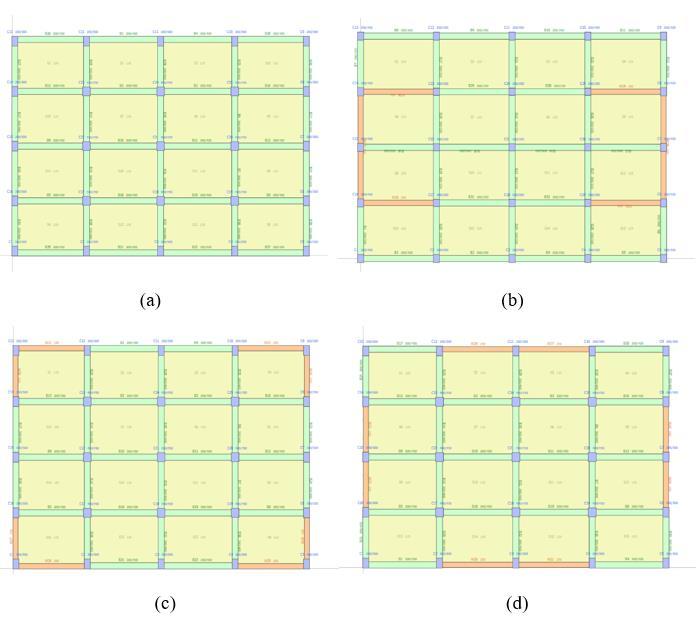
Different structural models have been adopted for the evaluation with different shear wall locations and it have beensubjectedtonon-lineartimehistoryanalysisforfurther studies. One of the models is analysed without shear wall and three of them with GFRP reinforced shear wall in differentorientationsinthestructurewhichisdepictedin Figure1
Atechniqueforseismicanalysiscalledincrementaldynamic analysis allows for the determination of a structure's capacityaswellasitsdemand.Byutilizingtherelationship between the incremental dynamic analysis and the static pushover,VamvatsikosandCornell[12]developedarapid andaccurateapproachfordeterminingtheseismicdemand
aswellascapabilityoffirstmodedominatedmulti-degreeof-freedomsystems.IDAisaparametricanalytictechnique in seismic engineering which provide the estimates of demand measure for intensity measure statistics. The objective of IDA is the relation of response and potential level of ground motion records [3]. When conducting a comprehensive analysis that involves a wide range of earthquakedatarecordsandnonlineartimehistoryanalyses
International Research Journal of Engineering and Technology (IRJET) e-ISSN: 2395-0056
Volume: 11 Issue: 06 | Jun 2024 www.irjet.net p-ISSN: 2395-0072
at increasing levels of intensity and this IDA involves performing numerous nonlinear time history analyses, systematically scaling ground motions to progressively higherearthquakeintensities,andrecordingthestructural response until collapse initiates in the structure. This analysisgeneratesadispersedsetofdatapointsatdifferent seismicintensities,whichcanbeusedtodeterminecollapse fragilityusingalognormaldistribution.
Ten records of far field ground motion data have been obtained from PEER next generation attenuation (NGA) database. Table 2 presents the information of the ground motionconsideredforthestudy.Thisincludesspecificssuch as the date and magnitude of the earthquake event, the recordingstation,thepeakgroundacceleration(PGA).
Table-2: Propertiesofselectedgroundmotions
EQ1
EQ2
EQ3
EQ4
EQ5
EQ6
Thepeakgroundacceleration(PGA)isselectedinsuchaway that it should increase uniformly and would result in the initiation in collapse of the structure. For the Incremental Dynamic Analysis, scale factors are calculated using the
requiredPGAandwiththePGAofselectedearthquakesas shown in Table 3. For the seismic analysis 0.1g has been selected as the increment to arrive the PGA which ranges from0.1gto1.0g.
Thelikelihoodofattainingaspecificconditionaldegradation stateofastructureistermedasfragility.Someofthefactors, like spectral acceleration (Sa), peak ground velocity, peak groundaccelerationandspectraldisplacementareusedto expressthefragilityofastructure.Fragilitytheorydictates thatfragilitycurvesforallthemodelshavebeenanalysedin thisstudyandthevulnerabilityandprobabilityofdamageis assessed. When evaluating the probabilistic damage to a structure'sseismicsafety,asdemonstratedbyEquation(1), itisimportanttotakeintoaccountthefailureprobabilityof eachindividualstructure[11].
International Research Journal of Engineering and Technology (IRJET) e-ISSN: 2395-0056
Volume: 11 Issue: 06 | Jun 2024 www.irjet.net p-ISSN: 2395-0072

Where, ∅ is the standard normal cumulative distribution function, θ is the median value of this probability distributionand��iisthedispersionofthedata.
3.1 Eigen Value Analysis
The Eigen value analysis is done to obtain the first modal time period as well as the natural frequencies of first five modes of the proposed structures for the further analysis and studies. Table 4 given below shows the natural frequencies obtained for first five modes for the specified structure.
Table-4: NaturalFrequenciesofbuildingmodels
3.2 IDA Curve
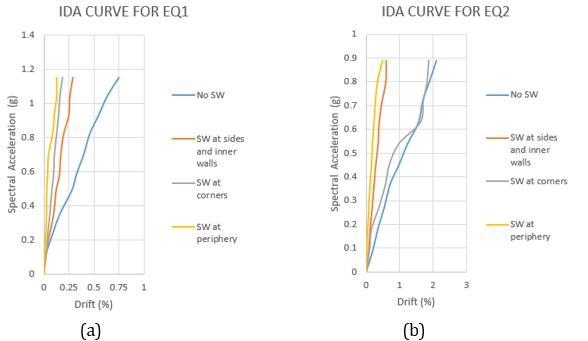
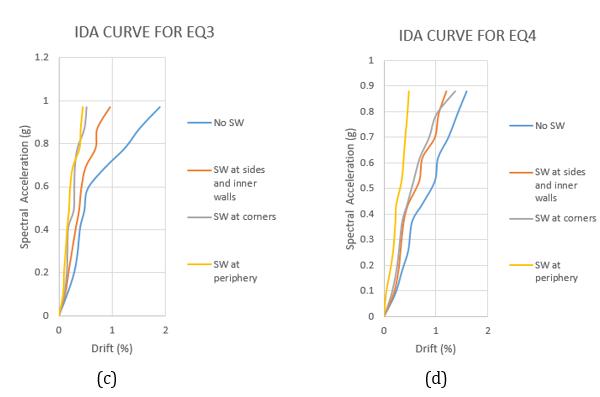
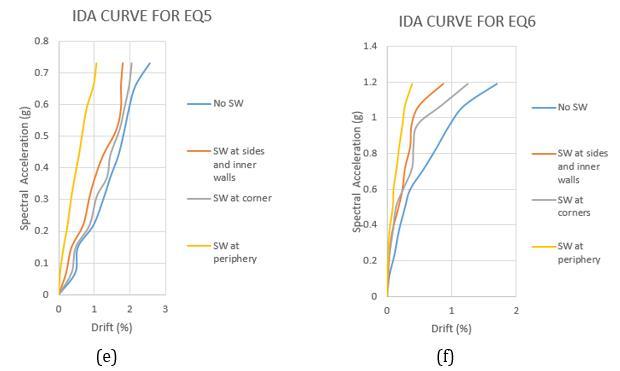
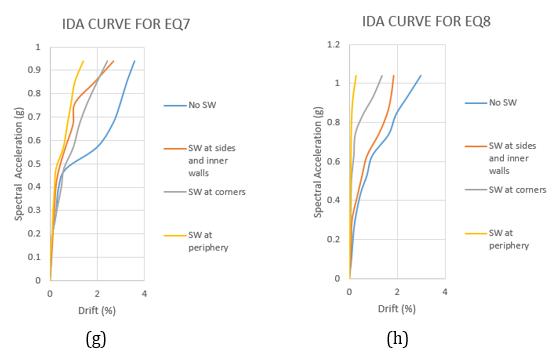
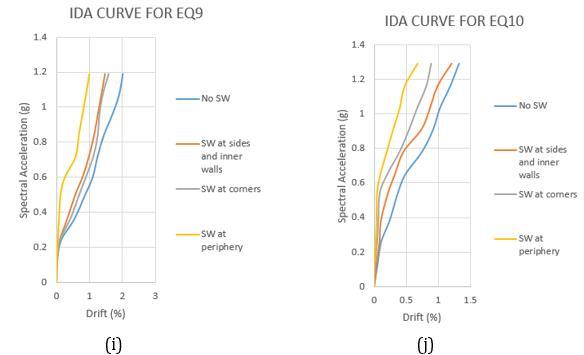
Thegroundmotionsselectedfortheanalysisarescaledsuch thatthePGAofeachearthquakerangesfrom0.1gto1.0g.The structuresaresubjectedtoeachofthescaledgroundmotion inonedimensionalongtheshearwall'sdirection.Asaresult, each structure has undergone 100 dynamic time history analyses,andresponseforeachofthegroundmotionwith particularpeakgroundaccelerationhasbeenobtained.The spectralacceleration(Sa)ofthestructureat5%dampingis
selectedastheintensitymetricfortheevaluation.Drift(%) isconsideredasthedamagemeasurewhichisobtainedfrom the analysis for each intensity measure. IDA curve is generatedbyplottingIntensitymeasurevsDamagemeasure. Figure2showstheIDAcurveobtainedaftertheanalysisfor eachofthestructures.
International Research Journal of Engineering and Technology (IRJET) e-ISSN: 2395-0056
Volume: 11 Issue: 06 | Jun 2024 www.irjet.net p-ISSN: 2395-0072
International Research Journal of Engineering and Technology (IRJET) e-ISSN: 2395-0056
Volume: 11 Issue: 06 | Jun 2024 www.irjet.net p-ISSN: 2395-0072
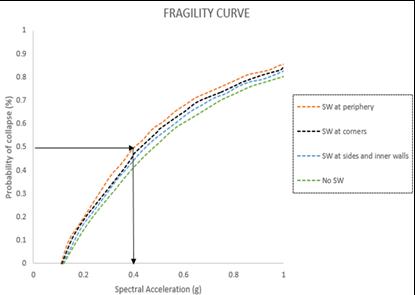
The likelihood of exceeding a limit state under a specific groundmotionintensityisprovidedbythefragilitycurve.In this study probability of collapse is calculated from the lognormal distribution function along with the spectral acceleration(Sa)toobtainthefragilitycurvesforalltypesof structure shown in Figure 3. As a function of the selected ground motion intensity, the expected degree of damage, specificallyCollapsePrevention(CP),isrepresentedbythe fragility curve that is produced from the IDA curve. The collapse fragility curve shows that the Sa (spectral acceleration)ofthegroundmotiononthex-axisisrelatedto theprobabilityofcollapse(showninthey-axis)[28].
Thestudy'sprimaryaimwastodevelopafragilitycurvefor astructurewithvariouslocationsofGFRP-reinforcedshear walls by performing incremental dynamic analysis (IDA) usingtenfar-fieldgroundmotions.Thestudyassessedthe probabilityofcollapseforthesestructuresandidentifiedthe optimalshearwalllocationformulti-storiedbuildings.The analysis concluded that factors such as drift percentage, spectral acceleration at a specific period, maximum base shear, and maximum peak interstorey drift angles significantlyinfluencetheoptimallocationoftheshearwall. Fragilityanalysisrevealedthatstructureswithshearwalls positioned on the perimeter demonstrated superior performanceagainstlateralloads,reducingthelikelihoodof collapseandstructural deformations.Thesefindingsalign withthecurrentinvestigation'sobservations,indicatingthat drift percentages determined through IDA analysis can effectively identify the best location for GFRP-reinforced shearwalls.
[1] Pathan Hyderkhan and Dr. P. B. Murnal (2018), “Comparison of incremental dynamic analysis curve withpushovercurve”.InternationalResearchJournalof Engineering and Technology (IRJET) Vol. 5, Issue 10, Pages1588-1593
[2] Sumit.A.Patel,Prof.A.R.Darji,ProfDr.K.B.Parikh,Prof. Bhavik.R.Patel (2016), “Fragility analysis of high rise building structure”. Journal ofEmerging Technologies andInnovativeResearch(JETIR)Vol.3,Issue7,Pages 127-133.
International Research Journal of Engineering and Technology (IRJET) e-ISSN: 2395-0056
Volume: 11 Issue: 06 | Jun 2024 www.irjet.net p-ISSN: 2395-0072
[3] MahmoudMiari,RobertJankowski(2022),“Incremental dynamicanalysisandfragilityassessmentofbuildings foundedondifferentsoiltypesexperiencingstructural poundingduringearthquakes”.EngineeringStructures 252(2022)113118.
[4] Ganesh Awchat, Abhishek Patil, Ashish More, Gopal Dhanjode (2023), “Incremental dynamic analysis and seismicfragilityanalysisofreinforcedconcreteframe”. Civil and Environmental Engineering Vol. 19, Issue 1, Pages444-451.
[5] Atulkumar A. Manchalwar, S.V. Bakre (2019), “Incremental dynamic analysis of building with weak storey at top as TMD”, ISET Journal of Earthquake Technology,Vol.56,No.4,Pages123-134.
[6] P. Leger1, G. Kervegant, R. Tremblay (2010), “Incrementaldynamicanalysisofnonlinearstructures: Selectionofinputgroundmotions”.Proceedingsofthe 9th U.S. National and 10th Canadian Conference on EarthquakeEngineering,PaperNo442.
[7] DimitriosVamvatsikos(2011),“Performingincremental dynamicanalysisinparallel”.Computersandstructures 89,Pages170-180.
[8] E.Brunesi,R.Nascimbene,F.Parisi,N.Augenti(2015), “Progressive collapse fragility of reinforced concrete framed structures through incremental dynamic analysis”.EngineeringStructures104(2015)65–79.
[9] Pradeep Pandya, Dr. Rajendra K. Srivastava (2023), “Scale Factor in Non-Linear Time History Analysis for RCC Multistorey Building”. Journal of Emerging TechnologiesandInnovativeResearch(JETIR),Vol.10, Issue11.
[10] NileshChandrakantGaikwad,AbhijeetA.Galatage,Dr. SumantK.Kulkarni(2017),“ScalingofGroundMotions for Performing Incremental Dynamic Analysis of RC Framed Structures”. International Journal of Advance Research,IdeasandInnovationsinTechnology,Vol.3, Issue5,Pages56-68.
[11] Xuchen Liu, Xiaojun Li, Xiaohui Wang, Ning Wang, Zaixian Li (2022), “Seismic fragility analysis of the transferandpurgingchamberinanuclearpowerplant based on incremental dynamic analysis”. Journal of RadiationResearchandAppliedSciences15,Pages133141.
[12] Dimitrios Vamvatsikos and C.Allin Cornel (2002), “IncrementalDynamicAnalysis”.Pages60-75
[13] TulayAksuOzkul,AhmetKurtbeyoglu,MuzafferBorekci, BasakZengin,AliKocak(2019),“Effectofshearwallon
seismic performance of RC frame buildings”. EngineeringFailureAnalysis100(2019),Pages60-75.
[14] Seyed Mohammad Hosseini, Mohammad Yekrangnia, Milad Shakiba, Milad Bazli, Asghar Vatani Oskouei, “Experimental study on seismic performance of squat RCshearwalls reinforced withhybridsteel andGFRP rebars”.Structures64(2024)106487.
[15] TarunMagendra,AbhyudayTitiksh,A.A.Qureshi(2016), “Optimum Positioning of Shear Walls in MultistoreyBuildings”.International Journal ofTrendinResearch andDevelopment,Volume3(3),ISSN:2394-9333,Pages 666-671.
[16] Ashikur Rahman Simona, Ferdows Kabir Hridoya, M. Fahim Siddiquea, Sanjid Ahmed Safat (2023), “OrientationandlocationofshearwallsinRCbuildings to control deflection and drifts”. Procedia Structural Integrity46,Pages162–168.
[17] Francesco Morellia, Agnese Natalia, Gabriele Poggi (2023), “Seismic behavior and nonlinear analysis of Hybrid Coupled Shear Walls”. Procedia Structural Integrity44,Pages574–581.
[18] Chunhua Lu, Yuting Yang, Liyuan He (2021), “Mechanical and durability properties of GFRP bars exposedtoaggressivesolutionenvironments”.Science andEngineeringofCompositeMaterials,Pages11-23.
[19] SimoneSpagnuolo,ZilaRinaldi,JacopoDonnini,Antonio Nanni (2021), “Physical, mechanical and durability properties of GFRP bars with modified acrylic resin (modar) matrix”. Composite Structures 262 (2021) 113557.
[20] FEMAP-795(2021),QuantificationofBuildingSeismic Performance Factors: Component Equivalency Methodology
[21] FEMAP-58-1:2018,SeismicPerformanceAssessmentof Buildings Vol.1- Methodology, Federal Emergency ManagementAgency,WashingtonDC,2018.
[22] FEMAP-58-2:2018,SeismicPerformanceAssessmentof BuildingsVol.2-ImplementationGuide,WashingtonDC, 2018.
[23] Ahmed Hassanein, Nayera Mohamed, Ahmed Sabry Farghaly, Brahim Benmokrane (2020), “Effect of boundary element confinement configuration on the performanceofGFRP-Reinforcedconcreteshearwalls”. EngineeringStructures225(2020)111262.
[24] IS456:2000,PlainandReinforcedConcrete - Codeof Practice,BureauofIndianStandards,NewDelhi,India, 2000.
2024, IRJET | Impact Factor value: 8.226 | ISO 9001:2008
International Research Journal of Engineering and Technology (IRJET) e-ISSN: 2395-0056
Volume: 11 Issue: 06 | Jun 2024 www.irjet.net p-ISSN: 2395-0072
[25] IS1893(Part4):2015,CriteriaforEarthquakeResistant Design of Structures (Part 4 Industrial structures including stack-like structures), Bureau of Indian Standards,NewDelhi,India,2015
[26] IS1893(Part1):2016,CriteriaforEarthquakeResistant Design of Structures (Part 1 General Provisions and Buildings),BureauofIndianStandards,NewDelhi,India, 2016.
[27] Earthquake data, https://peer.berkeley.edu/peerstrong-ground-motiondatabases.
[28] FEMA P-695 (2009), Evaluation of Methodology for QuantificationofBuildingSeismicPerformanceFactors, Federal Emergency Management Agency, Washington DC,2009.