
International Research Journal of Engineering and Technology (IRJET) e-ISSN: 2395-0056
Volume: 11 Issue: 06 | Jun 2024 www.irjet.net p-ISSN: 2395-0072
PESTICIDE DETECTION & CONTROL MEASURES IN FRUITS AND VEGETABLES USING INTERNET OF THINGS
Dr. M. Purna Kishore 1 , Kandula Y T Siva Sai Ganesh 2 , Koduru Venkata Siva Naga Sai Tarun 3 , Malapati Venu Babu4 , Moparthi Naveen Kumar5
1Assosciate Professor, Department of ECE, KKR & KSR Institute of Technology and Sciences, Vinjanampadu, Guntur Dt., Andhra Pradesh 2-5UG-Students, Department of ECE, KKR & KSR Institute of Technology and Sciences, Vinjanampadu, Guntur Dt.,Andhra Pradesh
Abstract - Thegrowingconcernsaboutpesticideresidues in fruits and vegetables have led to the development of advanced monitoring and detection techniques. Among these, the Internet of Things (IoT) has emerged as a transformative technology for ensuring food safety and enhancing agricultural practices. This paper explores the application of IoT-based systems in the real-time detection and control of pesticide levels in agricultural produce. By integrating sensors, connectivity, and data analytics, IoT devices provide a comprehensive platform for continuously monitoring pesticide residues. We discuss various sensor technologies that are capable of detecting specific pesticide chemicalsatlowconcentrationsandproposeamodelfor an IoT-enabled network that communicates these data to stakeholders. The system facilitates immediate decisionmaking regarding the safety of produce and the implementation of corrective actions in farming practices. Control measures, including the adjustment of pesticide applicationsandalertsforpotentialhazards,areautomated, enhancing the effectiveness and responsiveness of agricultural management. This paper also reviews the challenges in deploying IoT technology in diverse agricultural environments and suggests potential solutions forwidespreadadoption.
Key Words: Internet of Things, IoT, pesticide detection, food safety, agricultural technology, sensor networks, real-time monitoring, sustainable farming.
1.INTRODUCTION
The pervasive presence of pesticides in fruits and vegetables has raised significant public health concerns globally, necessitating the development of efficient detection and control mechanisms. Traditionally, the assessment of pesticide residues has relied on laboratorybased tests that are often time-consuming and costly. However,theadventoftheInternetofThings(IoT)offersa promising alternative by enabling real-time monitoring andmanagementofpesticidelevelsdirectlyinthefield.IoT technology leverages a network of sensors and connected
|
devices to collect, transmit, and process data concerning environmental conditions and pesticide concentrations. Thisapproachnotonlyenhancestheaccuracyandspeedof detection but also facilitates proactive interventions to mitigate risks associated with pesticide exposure. The integration of IoT in agricultural practices aligns with the broadergoalsofprecisionagriculture,aiming tomaximize yield while minimizing environmental impacts and ensuring the safety and quality of agricultural produce. This paper provides an overview of how IoT technologies can be strategically employed to monitor and control pesticide residues in fruits and vegetables, thereby supporting sustainable farming practices and protecting consumerhealth.
Advantages
•Real-timeMonitoringofPesticidelevels
•Enhancedfoodsafetyandconsumerprotection.
•Increasedefficiencyinfarmingpractices.
•Reducedenvironmentalimpact.
•Improvedcompliancewithregulatorystandards
Applications
•Continuousmonitoringofpesticideresidueincommercial agriculture.
•Automatedalertsystemsforhighpesticidedetection.
•Data-drivendecision-makingforpesticideapplication.
•Supplychainmonitoringfromfarmtoconsumer.
•Integration with smart farming solutions for precision agriculture.
1.1 Components
1.1.1ESP01
The ESP01 module, powered by the ESP8266 microcontroller, is a popular choice in the IoT (Internet of Things)landscapeduetoitscompactsize,lowcost,andWiFi capability. This module facilitates the wireless connection of various devices to the internet, enabling the
International Research Journal of Engineering and Technology (IRJET)
Volume: 11 Issue: 06 | Jun 2024 www.irjet.net
creation of a network of smart devices that can communicate with each other and with cloudbased platforms. TheESP01 providestwo GPIO (General Purpose Input Output) pins, which can be used for basic input and output operations, such as reading sensors or controlling relays. In IoT applications, the ESP01 is often used for remote data monitoring, control systems, and as a subordinate connectivity module integrated within larger systems. For example, it can be used to transmit environmental data collected by sensors such as temperature, humidity, or air quality to a central server for analysis and action. It's also commonly employed in home automation systems, allowing users to control lighting, HVAC (heating, ventilation, and air conditioning), and other home appliances remotely through smartphone apps. Despite its limited number of GPIO pins, the ESP01's capability to run on a simple Lua-based firmware or through the Arduino IDE platform makes it accessible for beginners and versatile enough for complex projects, ensuring its widespread use in the IoT development community.
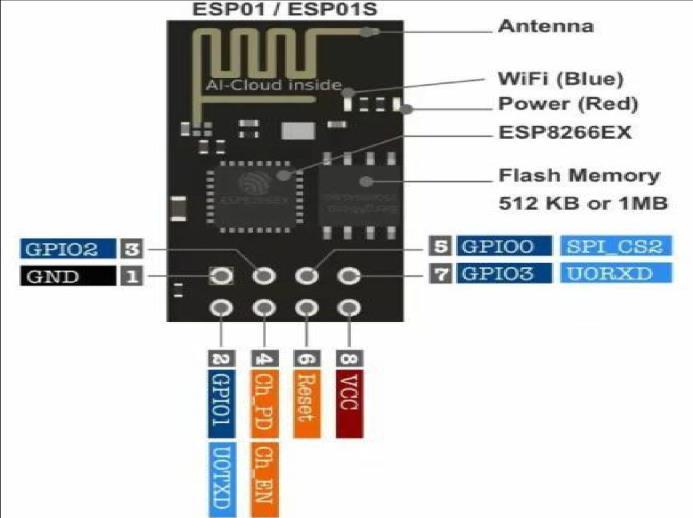
Fig:1.1.1.1ESP01
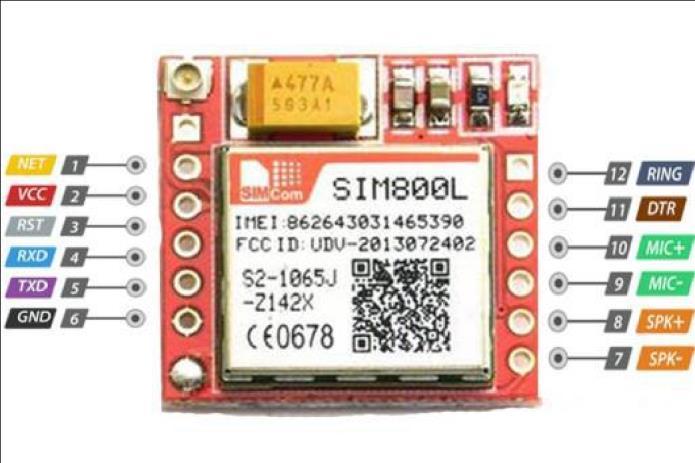
1.1.2 GSM Module (SIM800L)
-ISSN: 2395-0056
-ISSN: 2395-0072
The SIM800L is a compact and versatile quad-band GSM/GPRS module from SIMCom that enables devices to communicateviavoice,SMS,anddata.Itssmallformfactor andlowcostmakeitparticularlyattractiveforIoTprojects thatrequirecellularcommunicationbutareconstrainedby size and budget. Designed to work on frequencies 850/900/1800/1900 MHz, it is capable of functioning globally on all existing GSM networks. The Internet of Things (IoT) is revolutionizing how we interact with technology, making our environments smarter and more responsive. At the heart of many IoT devices is a need for connectivity, whether it's to send data to a remote server, receive commands, or notify users about system statuses. The SIM800L GSM/GPRS module emerges as a critical player in this domain, providing wireless network connectivityacrossawiderangeofapplications.
One of the main advantages of the SIM800L is its integration ease with microcontrollers, thanks to its support for serial communication (UART), which allows it to interface seamlessly with popular development platforms like Arduino and Raspberry Pi. This feature simplifies the design of IoT solutions that need to operate overcellularnetworkstosendorretrievedata.
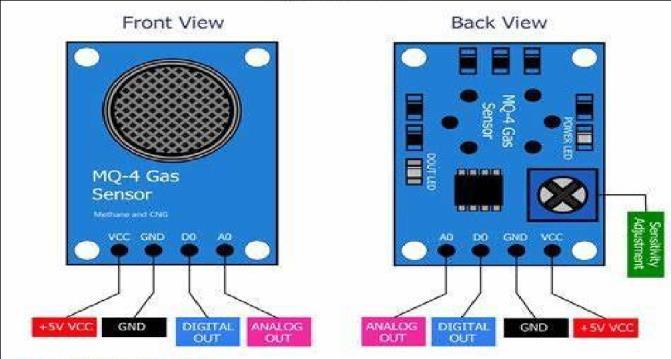
1.1.3 MQ4 Gas Sensor
The MQ-4 gas sensor is a widely used electronic device designedspecificallyfordetectingmethane(CH4)gaslevels in the air. This sensor has significant applications across varioussectors,includingenvironmentalmonitoring,home safety,andindustrial processes.WiththeadventofIoT, the MQ-4 sensor has found new applications, enabling remote monitoringandsmartautomationcapabilitiesthatenhance safety and efficiency. The MQ-4 gas sensor operates on the principle of gas adsorption onto a sensitive material and subsequentchangesinitselectricalresistance.Itconsistsof ametaloxidesemiconductorlayerthatreactswithmethane present in the air. When methane gas molecules are
International Research
Volume: 11 Issue: 06 | Jun 2024 www.irjet.net p-ISSN: 2395-0072
absorbed by the sensor, the conductivity of the semiconductor changes, which is then translated into an electrical signal proportional to the concentration of the gas.
Integrating MQ-4 sensors into IoT systems involves connecting the sensor with microcontrollers or microprocessorsthatcantransmitdata toacloudplatform viaWi-Fi,GSM,orotherIoTcommunicationprotocols.This connectivity enables real-time data analytics and monitoringfromremotelocations.
1.1.4
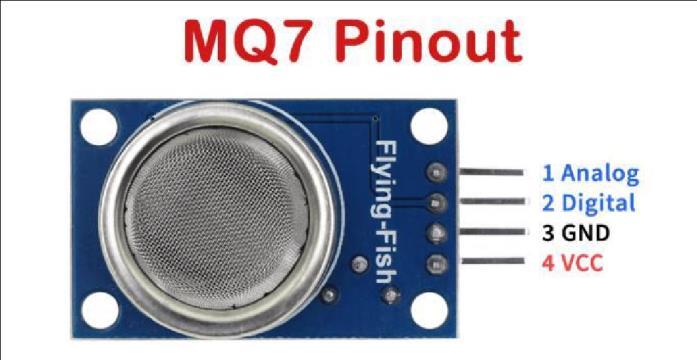
MQ7 Gas Sensor
The MQ-7 gas sensor, a crucial component in the detection of carbon monoxide (CO) levels, plays a significant role in the Internet of Things (IoT) ecosystem, especially in safety and environmental monitoring applications. This sensor is designedtodetectCOconcentrationsintheair,makingitan essential tool in bothresidential and industrial settings. As IoTtechnologiesadvance,theintegrationofsensorslikethe MQ-7hasbecomepivotalindevelopingsmartsystemsthat enhancehumanhealthandsafetywhileofferingnewlevels ofenvironmentalintelligence.TheMQ-7sensoroperateson theprincipleofgassensitizationusingaSnO2(tindioxide) semiconductor, whichhas a lower conductivity inclean air. WhentheaircontainsCOgas,theconductivityincreasesas thegasreactswiththeoxygenontheheatedsurfaceof the sensor, altering the resistance across the sensor element. This change in resistance can be measured and translated intoCO gasconcentration.ForIoTapplications,thisdata is crucialforreal-timemonitoringandresponsesystems
1.1.5
IOT Thingspeak app
ThingSpeak isanIoTanalyticsplatform service thatallows users to aggregate, visualize, and analyze live data streams inthecloud.Userscansend data fromIoTdevices,such as sensors and microcontrollers, to ThingSpeak, which then provides tools for plotting graphs, creating visualizations, and triggering alerts based on the incoming data. It supports MATLAB® analytics and visualization, enabling users to perform online analysis directly on the data without needing additional software. Ideal for IoT applications like remote monitoring, ThingSpeak facilitates easy data collection and operation, helping developers and researchers turn data into actionable insights efficiently andeffectively.
2. Methodology
This project represents a significant step forward in food safety and public health. Utilizing IoT technology, the system employs Arduino UNO board coordination with MQ4 and MQ7 gas sensors to detect unsafe levels of methane and carbon monoxide, which indicate the presence of harmful pesticide residues in produce. Data fromthesesensorsisdisplayedinreal-timeviaanLCDand transmitted to the ThingSpeak cloud platform for ongoing analysis, facilitating remote monitoring. This system enhances consumer safety by using visual (LEDs) and audible(buzzer)alertstonotifyuserswhenpesticidelevels exceedsafethresholds.Theincorporationofa GSMmodule allows the system to send immediate alerts to users, enabling swift decisionmaking about the safety of consuming affected produce. This proactive approach not only helps prevent health issues related to pesticide exposurebutalsocontributesvaluabledataforresearching saferpestcontrolmethods.Byintegratingadvancedsensor technologyandreal-timedataanalysis,thisprojectnotonly ensures the safety of fruits and vegetables but also empowers communities with knowledge, promoting healthier lifestyles and enhanced food safety standards worldwide.
International Research Journal of Engineering and Technology (IRJET)
Volume: 11 Issue: 06 | Jun 2024 www.irjet.net
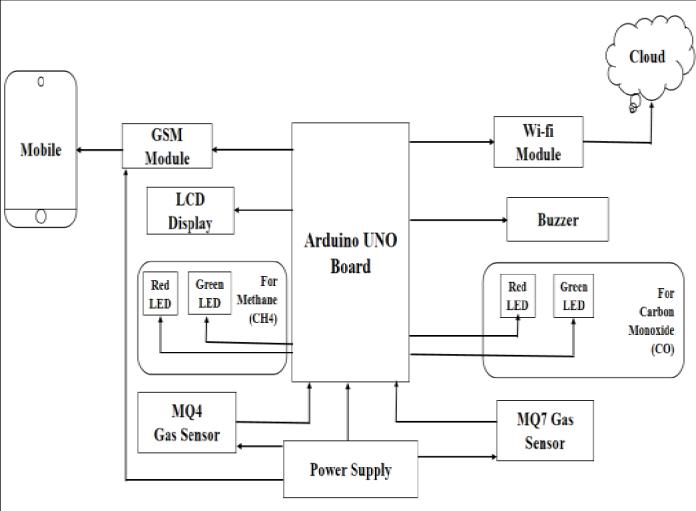
Fig:2.1blockdiagramofproposedsystem
3.Flow chart
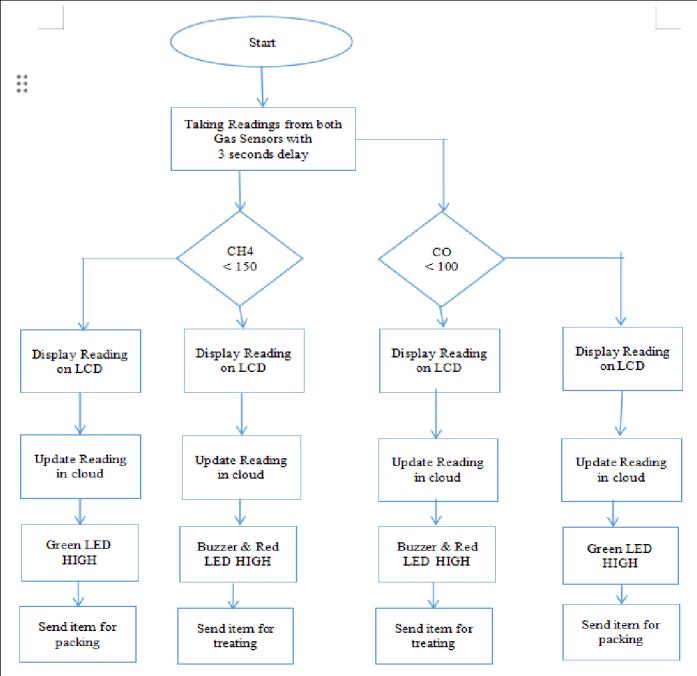
Fig:3.1flowchartofproposedsystem
4.Results
In this, the user can see the content of pesticides in a fruit or vegetable. After crossing the minimum level, the device will warn to give the safety measures based on its toxic category
Sample paragraph Define abbreviations and acronyms the first time they are used in the text, even after they have beendefinedintheabstract.AbbreviationssuchasIEEE,SI, MKS,CGS,sc,dc,andrmsdonothavetobedefined.Donot use abbreviations in the title or heads unless they are unavoidable.
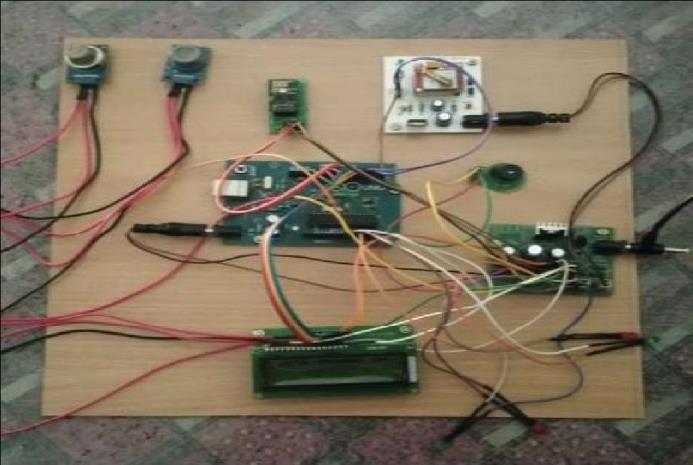
Circuit Connection
Once the fruit has no excess content then the both green LED’swillbehighandtheitemissentforpacking.
Here, for every reading both the LCD and Cloud is updated timetotime.
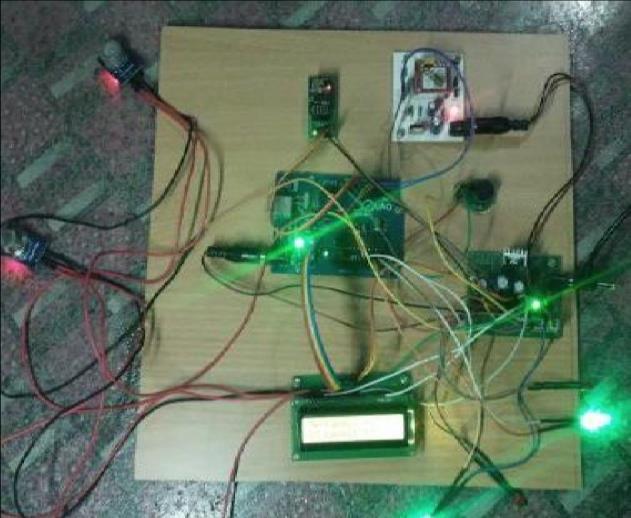
Both Gases are within ranges
Once the fruit has excess content of CH4, then the red LED referring CH4 and Buzzer will be high and the item is sent forthreatening.
Here, for every reading both the LCD and Cloud is updated timetotime
Volume: 11 Issue: 06 | Jun 2024 www.irjet.net
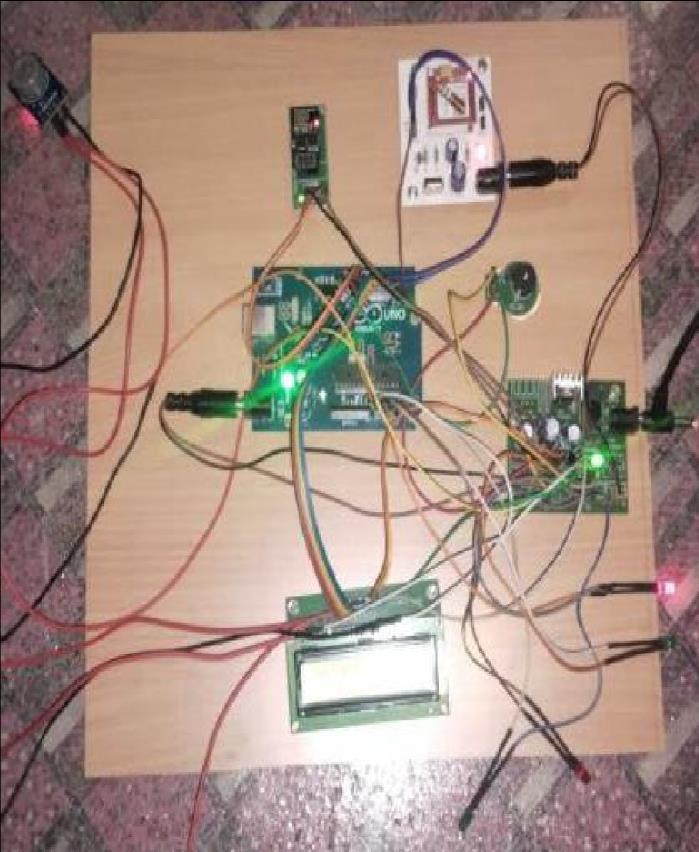
Fig:4.1.3. CH4 Exceeds the range
Once the fruit has excess content of CO, then the red LED referringCOandBuzzerwillbehighandtheitemissentfor threatening
Here, for every reading both the LCD and Cloud is updated timetotime.
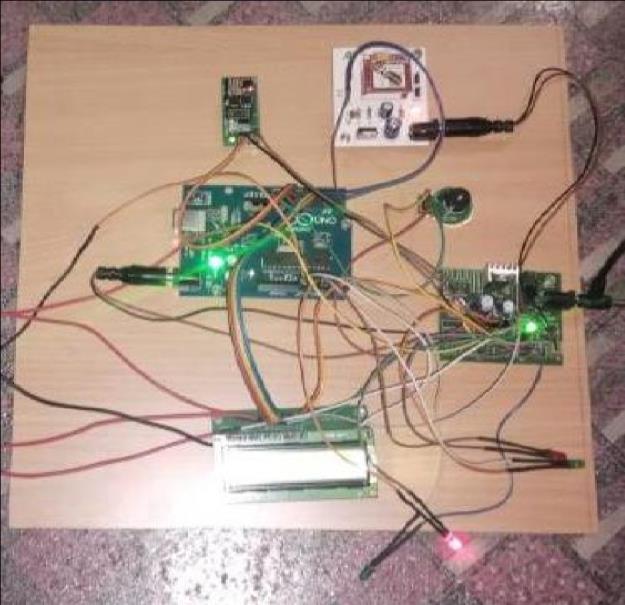
Fig:4.1.4. CO Exceeds the range
Once the fruit has both gases excess in content then the both red LED’s and the Buzzer will be high and the item is sentforthreatening.
Here, for every reading both the LCD and Cloud is updated timetotime
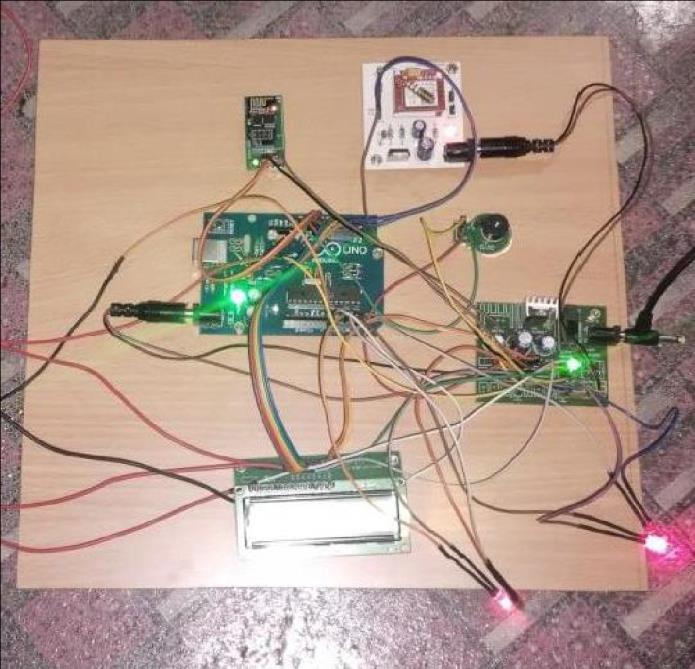
Fig:4.1.5 Both Gases Exceeds the range
5. Conclusion
The integration of the Internet of Things (IoT) in agricultural practices has opened new vistas in the monitoring and management of food safety, specifically in the detection of pesticide residuesin fruitsand vegetables. Our project, "Pesticide Detection and Control Measures in FruitsandVegetablesUsingIoT,"demonstratesasuccessful application of IoT technology to address critical issues of public health and safety. Through the deployment of advancedsensortechnology,namelyMQ4andMQ7sensors, the project effectively monitors the levels of methane and carbon monoxide, which are indicative of pesticide presence. The use of Arduino UNO as a central processing unit facilitates the seamless collection, processing, and analysisofdatainrealtime
The integration of these components within an IoT framework allows for immediate detection and alerts, which are crucial for preventing the consumption of contaminated produce.Moreover,thesystem'scapability toalertusersviaSMSthroughtheGSMmoduleensuresthat critical information reaches the relevant stakeholders promptly. This immediacy of communication is pivotal in preventingthedistributionandsaleofcontaminatedgoods, thereby protecting consumers and helping vendors maintaintheirreputationsforsafetyandquality
6.Future Scope
The project also underscores the potential for scalability and adaptability in different environmental conditions and agricultural settings. The flexibility of IoT architectures allows for tailored configurations that can meet diverse
International Research Journal of Engineering and Technology (IRJET)
Volume: 11 Issue: 06 | Jun 2024 www.irjet.net p-ISSN: 2395-0072
operational requirements, making this technology universallyapplicableacrossvarious domains beyond agriculture, such as environmental monitoring and industrialprocesscontrol.
Furthermore, the educational and awareness-raising componentsoftheprojectaresignificant.Bydemonstrating the effectiveness of IoT in real-world applications for food safety,theprojectnotonlypromotestechnologicaladoption amongfarmersandproducersbutalsoeducatesthegeneral publicaboutthe importance of pesticide monitoring. This knowledge dissemination is crucial for fostering a culture of safety and responsibility across the food supply chain
7.References
1. Biswas, P. K., & Karmakar, N. C. (2019). Internet of Things(IoT)andSensorNetworksforPrecisionAgriculture andSmartFarming.
2. Jayasundera,M.,Adikari, A. B.,&Adikari, J.(2021). IoTBasedSmartAgriculture:AReview.
3. Lee, M., & Khan, R. (2018). Integrating Internet of Things (IoT) into Agriculture and Smart Farming Towards EnhancingAgriculturalProductivity.
4. Sharma, A., Tyagi, S., & Gupta, P. (2020). IoT-based Monitoring System Using MQTT for Agricultural Environment
5. Thakur,D.,&Kumar,Y.(2019).AStudy ontheRole ofInternetofThings(IoT)inSmartAgriculture.
6. Feng, X., & Zhang, S. (2018). Application of the Internet of Things Technology in Precision Agriculture: A Review.
7. Li,X.,Li,D.,Wan,J.,Vasilakos,A.V.,Lai,C.,&Wang, S. (2017). A Review of Industrial Wireless Networks in the ContextofIoTandIndustry4.0.
8. Singh,R.,Sharma,P.,Sharma,V.,&Kalia,A.(2020). Detection of Pesticide Residues in Food Using IoT Technology.
9. Smith, L., & Sulaiman, T. (2022). Emerging Sensor Technologies for Agriculture: Current Progress and Future Implications.