
International Research Journal of Engineering and Technology (IRJET) e-ISSN: 2395-0056
Volume: 11 Issue: 06 | Jun 2024 www.irjet.net p-ISSN: 2395-0072
International Research Journal of Engineering and Technology (IRJET) e-ISSN: 2395-0056
Volume: 11 Issue: 06 | Jun 2024 www.irjet.net p-ISSN: 2395-0072
Mr. Chandra Shekhar Sahu1 , Mr. Vishwanath Prasad Kurmi2 , Miss. Preeti Sahu3
1Department of Electrical Engineering, Dr. CVRU Kota Bilaspur Chhattisgarh, India
2Asst. Professor, Dept. of Electrical Engineering, Dr. CVRU Kota, Bilaspur, Chhattisgarh, India
3 Asst. Professor, Dept. of Electrical Engineering, Dr. CVRU Kota, Bilaspur, Chhattisgarh, India
Abstract - The need for contemporary transportation infrastructure is growing along with concerns about dangerous climatic changes and global warming. To resolve this issue, countries are promoting the use of Electric Vehicles (EVs). However, dependency on fossil fuel-based infrastructure for charging EVs is not efficient. An EV charging station powered by renewable energy (RE) has significant potential for EV charging. A solar-powered charging station and a BESS (Battery Energy Storage System) are essential in the present situation. It is also recommended to provide additional grid support to ensure uninterrupted power supply to the charging station without overloading the grid. The ANFIS-based MPPT monitors the solar PV array's maximum power. Generate the power and charge the EV battery and Stationary battery storage system from the PV source and also transfer power to the grid. When the PV array does not generate power and no power in the stationary batterystoragesystemthen theGrid charges the stationary battery storage system and the EV battery. The findings of the present research can also help to increase power efficiency and the power factor should be maintained.
Key Words: PV source, BES Grid, EV Station, Bidirectionalconverter,ANFIS,PID,
1. Introduction:-
In current times transportation systems based on nonrenewable sources are the key factor in the increase in global warming. This will be overcome by the use of renewable energy-based transportation systems. Solar powerhasbeenusedforatleast20-25years. Solarenergy isnowtheREsourcewiththequickestrateofgrowth,and astheglobemovestowardmore clean,sustainableenergy sources, its popularity is expected to only increase. The utilization of solar energy is expected to increase and become more crucial in supplying the world's energy needs. Furthermore, solar energy can be used to power remote or underdeveloped areas, providing access to electricity and enhancing the quality of life for people in thoseareas.Insomecases,solarenergycanalsoprovidea more reliable source of electricity than traditional grid systems, which may be prone to blackouts and outages. The efficiency and financial viability of solar energy are
projected to rise more as technology develops. A solar PV system that is grid-connected and has the ability to feed power into and take power from the grid in both directions. This type of system is becoming increasingly popular people are looking for ways to move towards renewable energy and reduce their dependence on fossil fuels.
One of the challenges with a bi-directional grid-connected solarPVsystemisensuringthatitoperatesefficientlyand effectively. To address this challenge, researchers have been exploring the use of artificial intelligence (AI) approaches, such as ANFIS and neural networks, to optimize system performance. ANFIS, or Adaptive NeuroFuzzy Inference System, is a type of Al that combines the strengths of fuzzy logic and neural networks to create a morepowerfulandaccuratesystem.
PVpanel DC/DC EV STATION
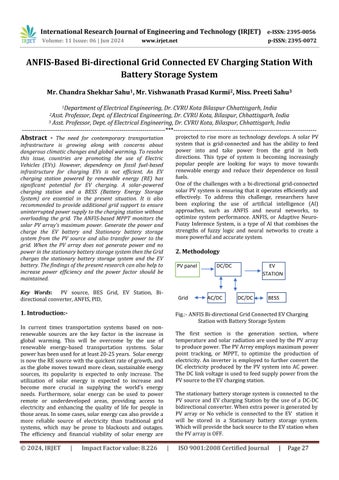
Fig.:-ANFISBi-directionalGridConnectedEVCharging StationwithBatteryStorageSystem
The first section is the generation section, where temperature and solar radiation are used by the PV array toproducepower.ThePVArreyemploysmaximumpower point tracking, or MPPT, to optimize the production of electricity. An inverter is employed to further convert the DC electricity produced by the PV system into AC power. TheDClinkvoltageisusedtofeedsupplypowerfromthe PVsourcetotheEVchargingstation.
The stationary battery storage system is connected to the PV source and EV charging Station by the use of a DC-DC bidirectionalconverter.Whenextrapowerisgeneratedby PV array or No vehicle is connected to the EV station it will be stored in a Stationary battery storage system. WhichwillprovidethebacksourcetotheEVstationwhen thePVarrayisOFF.
International Research Journal of Engineering and Technology (IRJET) e-ISSN: 2395-0056
Volume: 11 Issue: 06 | Jun 2024 www.irjet.net p-ISSN: 2395-0072
The PV source is directly connected to the EV charging stationaswellasthestationarybattery.Grid-connectedto theEVChargingStationwiththeDClink.
The stationary battery storage system, EV charging system, and PV source are all connected to the grid. To feedgridelectricitytoEVsandPVpowertothegrid.
The adaptive neuro-fuzzy interface system works the same as the Fuzzy interface system. Utilizing ANFIS, a perfect duplicate of the real solar PV system is created in this MPPT structure. A pair of inputs (temperature and irradiance)andoneoutput(voltage)areemployedtotrain ANFIS under various temperature and irradiance conditions.
A PWM (Pulse Width Modulation) generator for solar panelsisadevicethathelpscontrolthequantityofenergy thesolarpanelsareproducing.ThePWMgeneratorworks by controlling the amount of energy that is being transferred from the solar panels to the battery or grid, ensuringefficiencyandsafety.[4]
Buck-boost converter is a type of DC-DC converter that operates by converting DC voltage from a source at one leveltoadifferentlevel.Itisaswitch-modepowersupply that can step up or down voltage levels depending on the inputandoutputconfigurations.
Grid-connected photovoltaic (PV) power systems frequently employ PLL (Phase-Locked Loop) to synchronize the PV system's output with the grid's frequency and phase. In a grid-connected PV system, an inverter is employed to convert the DC power generated bythePVpanelsintoACelectricity.Tobefedintothegrid, the AC power must be in phase and frequency alignment withthegrid.ThePLL systemmodifiesthefrequencyand phaseoftheinvertertomatchthegridaftermeasuringthe grid voltage's phase and frequency. The PLL system regulates the frequency and phase of the inverter via a feedbackloop.
A PI controller is a type of feedback controller commonly used in engineering applications to regulate a system's behavior. A Pl controller can be used in a solar PV EV charging station to modify the rate at which an electric vehicle'sbatterychargesaccordingtothequantityofsolar energythatisavailable.
An LCL filter is a type of filter circuit that is often used in power electronics applications to reduce harmonic distortion in the output of an inverter. The filter consists of an inductor (L), capacitor (C), and inductor (L) connectedinseriesbetweentheoutputoftheinverterand the load. The purpose of the LCL filter is to minimize the high-frequency elements present in the inverter's output voltagewaveform.
2.1 An adaptive neuro-fuzzy inference system (ANFIS) ANFIS is a network that emulates the behavior of both neural networks and fuzzy inference systems (FIS). The adaptive neural network lacks synaptic weights but contains bothadaptiveaswellasnon-adaptivenodes.The adaptablenetworkreceivesitsnamesinceitisessentially transformedintoastandardfeed-forwardneural network structure.[6]
The emulator of the adaptive Takagi-Sugeno fuzzy controller shares a structure with the ANFIS adaptive network. This adaptable network functions in a manner that is comparable to a FI (Flexible Interface). The ANFIS network utilizes gradient descent as well as least squares toadjusttheinputandoutputparametersforthespecified input/output data set during the back-propagation tprocess. The input as well as output parameters of the ANFIS network are the terms employed to describe its linear and nonlinear properties, respectively. The predecessor and successor segments make up the ANFIS network's 2 primary parts. Both a FIS and a rule-based systemlinkthesecomponents.
Layer 1:
Thislayer'sNodeIisreferredto asanadaptivenode,and its parameters are the ANFIS network's nonlinear parameters. Equation (2) states that each node's function is, …………………………….(1) ……...……………………(2)
where e and ∆e denote the inputs of layer 1 node i. Each node's membership functions are Ai and Bi. The input variables are typically distributed using a Gaussian membership function, which assigns each node its membership function. As a consequence of Equation (3), the function of Gaussian membership is represented as follows.
……………………….(3)
wherethebreadthandcenteroftheGaussianmembership function are, respectively, σ and c. The center and width parameters are nonlinear characteristics that change as thelearningprocedureprogresses.
Layer 2:
An output node that is fixed and represented by the symbol " П "; its signals are the product of Layer 1 node signals.Thenodefunctionisrepresented,in Eq.(4) ……………(4) "The output of each layer 2 node determines the rule base'sfiringstrength"
International Research Journal of Engineering and Technology (IRJET) e-ISSN: 2395-0056
Volume: 11 Issue: 06 | Jun 2024 www.irjet.net p-ISSN: 2395-0072
Layer 3:
The letter "N" stands for this layer node, which is also known as a fixed nodeThe output is generated by calculatingtheratioofeachnode'svaluetothetotalvalue of all the nodes. The node function is represented by the equation(5).
Layer 4:
This node is adaptable. The functioning of this node is expressedas,inEq.(6)
Where is the normalized layer 3 firing strength and are the ANFIS network's linear parameters, also known as network consequent parameters. During the learning phase, these parameters are adjusted using the leastsquaresmethod.
Layer 5:
Theoutputlayerisa fixednodefoundinthislayer,which is denoted by the symbol "∑". The weighted average approach is used to determine the output from this layer, whichisgivenby equation(7).
Ahybridapproachhasbeenemployedtoupdatethelinear and nonlinear parameters of Layers 2 and 4. ANFIS Parameters hybrid algorithm is a framework that combinesleast-squaresandsteepestdescenttechniques. The hybrid approach uses two different types of propagation: backward and forward. The hybrid algorithm's forwarding propagation carries the nodes' outputuptoLayer4,wheretheleast-squaresapproach is employed to modify the linear parameters. The false signals traveled backward during the hybrid approach's backward propagation, and gradient descent changed the nonlinear parameters. The hybrid approach converges morerapidlythanusual back-propagation algorithms due to the significant reduction in search dimensions during training.
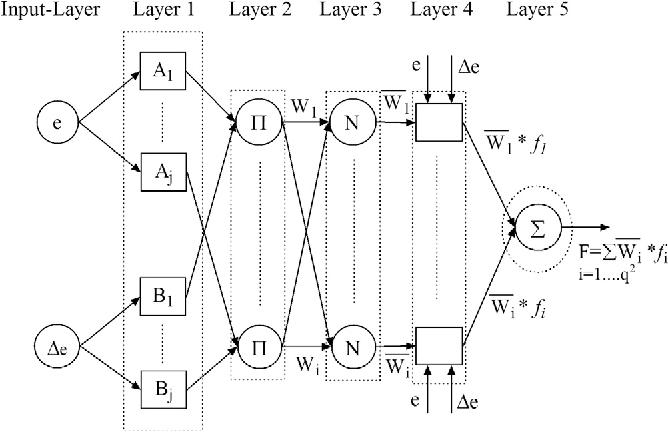
In this MPPT structure, an exact replica of the original solar PV system is modeled utilizing ANFIS. ANFIS is trained using two inputs (temperature and irradiance) and one output (voltage) under a range of temperature and irradiance situations. The error voltage is generated by collecting the voltage reference from the output of the ANFIS system and comparing it with the real PV voltage. ThedutycycleforthePWMgeneratorisgeneratedbythe proportional-integral controller, which also processes the errorvoltage.[8]

Figure2.2ANFIISVoltageControlledMPPT
2.3 PLL (Phase Locked Loop)
In grid-connected PV power systems, phase-locked loops, or PLLs, are frequently employed to synchronize the PV system's output with the grid's phase and frequency. In a grid-connected PVsystem, theDC power produced bythe PV panels is transformed into AC electricity through the utilization of an inverter. To be fed into the grid, the AC powermustbeinphaseandfrequencyalignmentwiththe grid. The PLL mechanism modifies the frequency and phase of the inverter to match the grid after figuring out the grid voltage's phase and frequency. The PLL system regulates the frequency and phase of the inverter via a feedbackloop.
2.4
A PWM (Pulse Width Modulation) generator for solar panelsisadevicethathelpsregulatehowmuchenergythe solarpanelsare producing. ThePWMgenerator worksby controllingtheamountofenergythatisbeingtransferred from the solar panels to the battery or grid, ensuring efficiencyandsafety.[4]
2.5
Abatterystoragesystemis a technology thatallowssolar powergeneratedbyphotovoltaic(PV)panelstobestored forlateruse.Whenenergydemandexceedsthequantityof energy supplied by the PV panels or when the sun isn't
International Research Journal of Engineering and Technology (IRJET) e-ISSN: 2395-0056
Volume: 11 Issue: 06 | Jun 2024 www.irjet.net p-ISSN: 2395-0072
shining, battery storage systems employ the DC power from the PV panels to create AC power, which is then storedinbatteriesforlateruse[20]
Results:-
1st Mode:
EV battery charging with PV array alone. Currently, the temperature remains consistent, the intensity of the PV panel is modified, and the ANFIS voltage-controlled method is utilized for collecting electricity from the PV array.
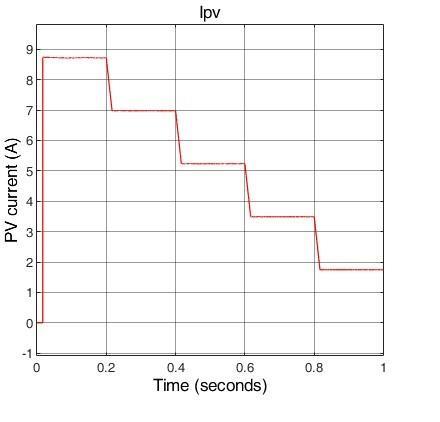
2nd Mode:
Only when the BESS is connected to a DC bus can solar energy be employed to charge EV batteries and the BESS itself.PVpaneloperatingusingANFISatMPPT.
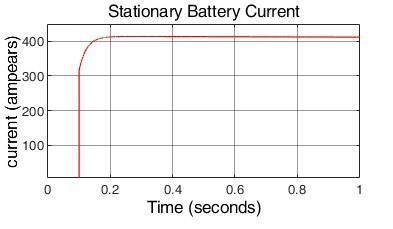
3rd Mode:
EV batteries are charged with a combination of BESS and solar electricity under varying irradiance conditions. ANFIS guarantees the maximum power that can be obtainedfromthePVarray.
4th Mode:
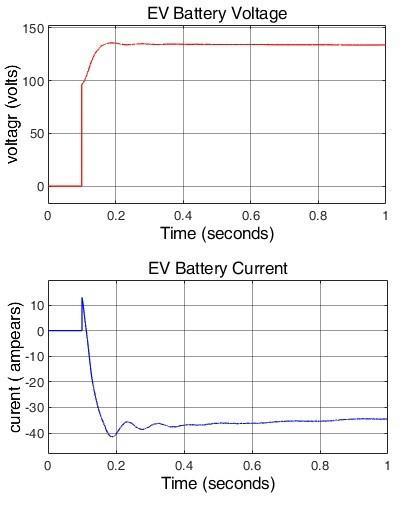
When the PV array is not producing solar radiation at night, the BESS and AC grid are utilized to charge the EV battery. The AC grid's power flow is managed by a functionalfittingneuralnetwork.
5th Mode:
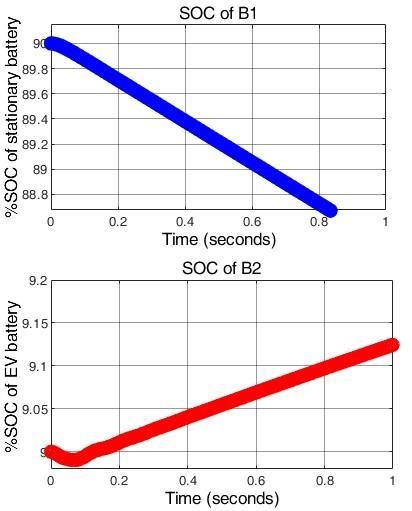
The temperature and irradiance of the PV array are regulated. Extra power is fed into the grid and used to charge EV batteries when a solar PV array, BESS, and AC gridarelinked.
An ANFIS Bi-directional Grid Connected EV Charging stationwithaBatteryStorageSystemisanelegantwayof
© 2024, IRJET | Impact Factor value: 8.226 | ISO 9001:2008
| Page30
International Research Journal of Engineering and Technology (IRJET) e-ISSN: 2395-0056
Volume: 11 Issue: 06 | Jun 2024 www.irjet.net p-ISSN: 2395-0072
combining Solar PV, GRID, as well as Battery energy systems for charging EVs in EV stations. This will reduce carbon emission also maximize the use of renewable energy. Which will lead to reduced global warming. Also, minimizesthedependencyonconventionalresourcesand thegridtochargetheelectricvehicle.
[1] Jlidi, M., Hamidi, F., Barambones, O., Abbassi, R., Jerbi, H., Aoun, M., & Karami-Mollaee, A. (2023). An Artificial Neural Network for Solar Energy Prediction and Control Using Jaya-SMC.Electronics,12(3), 592. 10.3390/electronics12030592
[2] Alrubaie, A. J., Salem, M., Yahya, K., Mohamed, M., & Kamarol, M. (2023). A comprehensive review of electric vehicle charging stations with solar photovoltaic systems considering market, technical requirements, network implications, and future challenges.Sustainability,15(10), 8122.10.3390/su15108122
[3]Wang,H.,Pourmousavi,S.A.,Soong,W.L.,Zhang,X.,& Ertugrul, N. (2023). Battery and energy management systemforvanadiumredox flowbattery:Acritical review and recommendations.Journal of Energy Storage,58, 106384.10.1016/j.est.2022.106384
[4] Colasante, A., D'Adamo, I., & Morone, P. (2022). “The effect of policies, incentives, and behavior in a crosscountry comparison.Energy Research & Social Science”,85, 102405., ISSN 2214-6296. 10.1016/j.erss.2021.102405.
[5] Islam, N., Nat, A., & Khan, R. A. (2022). Recent TechnologicalAdvancesinSolarPhotovoltaicSystemsand Its Applications in Building Integrated Photovoltaic Systems Sustainable Technology and Advanced Computing in Electrical Engineering: Proceedings of ICSTACE2021,625-636.10.1007/978-981-19-4364-5_45
[6]Malik,P.,Gehlot,A.,Singh,R.,Gupta,L.R.,&Thakur,A. K. (2022). A review of ANN-based model for solar radiation and wind speed prediction with real-time data.Archives of Computational Methods in Engineering, 1-19.10.1007/s11831-021-09687-3
[7] Waqas Khan, Shalika Walker, Wim Zeiler, (2022) "Improved solar photovoltaic energy generation forecast using deep learning-based ensemble stacking approach." Energy, Volume 240, 2022, 122812, ISSN 0360-5442, 10.1016/j.energy.2021.122812
[8]RohitTrivedi,ShafiKhdem.(2022)"Implementationof artificial intelligence techniques in microgrid control environment:Currentprogressandfuturescopes."Energy and Al, Volume 8, 2022, 100147, ISSN 2666-5468. 10.1016/j.egyai.2022.100147.
2024, IRJET | Impact Factor value: 8.226 |
[9] Kang Miao Tan, Thanikanti Sudhakar Babu, Vigna K. Ramachandaramurthy, Padmanathan Kasinathan, Sunil G. Solanki, Shangari K. Raveendran, (2021) "Empowering smart grid: A comprehensive review of energy storage technology and application with renewable energy integration." Journal of Energy Storage, Volume 39, 2021, 102591,ISSN2352152X,10.1016/j.est.2021.102591.
[10] Kumar, Astitva & Rizwan, M. & Nangia, Uma. (2021) "Development of ANFIS-based algorithm for MPPT controller for standalone photovoltaic system." International Journal of Advanced Intelligence Paradigms. 18.247.10.1504/IJAIP.2021.112906.
[11] Bendary, A.F. Abdelaziz, A.Y. Ismail, M.M. Mahmoud, K. Lehtonen, M. Darwish, M.M.F. (2021) Proposed ANFIS Based Approach for Fault Tracking, Detection, Clearing and Rearrangement for Photovoltaic System. Sensors 2021,21,2269,10.3390/s21072269.
[12] Singh, A. Shaha, S.S., G, N.P. Sekhar, Y.R. Saboor, S., Ghosh,A.,(2021)"DesignandAnalysisofaSolar-Powered Electric Vehicle Charging Station for Indian Cities". World Electr.Veh.J.2021,12,132.10.3390/wevj12030132.
[13] Ahmad, Furkan & Khalid, Mohd & Panigrahi, Bijaya. (2021) "An enhanced approach to optimally place the solar-powered electric vehicle charging station in a distribution network." The Journal of Energy Storage. 42. 103090.10.1016/j.est.2021.103090.
[14] G. Liu, Y. Xue, M. S. Chinthavali and K. Tomsovic, (2020)"Optimal Sizing of PV and Energy Storage in an ElectricVehicleExtremeFastChargingStation,"2020IEEE Power & Energy Society Innovative Smart Grid Technologies Conference (ISGT), Washington, DC, USA, 2020,pp.1-5,10.1109/ISGT45199.2020.9087792.
[15]Li,Baojie&Delpha,Claude&Diallo,Demba&MiganDubois, A, (2020). "Application of Artificial Neural Networkstophotovoltaicfaultdetectionanddiagnosis." A review. Renewable and Sustainable Energy Reviews. 138. 110512.10.1016/j.rser.2020.110512.
[16] Nwaigwe, Kevin & Mutabilwa, Philemon & Dintwa, Edward. (2019) "An overview of Solar Power (PV Systems) Integration into Electricity Grids." Materials Science for Energy Technologies. 2.10.1016/j.mset.2019.07.002.
[17] Unal Yilmaz, Omer Turksoy, Ahmet Teke, (2019) "Improved MPPT method to increase accuracy and speed in photovoltaic systems under variable atmospheric conditions" International Journal of Electrical Power & Energy Systems, Volume 113,2019, Pages 634- 651, ISSN 0142-0615,10.1016/j.ijepes.2019.05.074.
International Research Journal of Engineering and Technology (IRJET) e-ISSN: 2395-0056
Volume: 11 Issue: 06 | Jun 2024 www.irjet.net p-ISSN: 2395-0072
[18] Khan, and I. U., (2019) "Comparative analysis of MPPTtechniquesusingANFISforgrid-connectedsolarPV system". Journal of Electrical Engineering & Technology, 14(5),2500-2513.
[19] Dai, Q. Liu, J. Wei, Q.(2019). "Optimal Photovoltaic/Battery Energy Storage/Electric Vehicle Charging Station Design Based on Multi-Agent Particle Swarm Optimization Algorithm". Sustainability 2019, 11, 1973.10.3390/su11071973.
[20] Krewer, Ulrike, Röder, Fridolin, Harinath, Eranda, Braatz, Richard, Bedürftig, Benjamin, Findeisen, Rolf., (2018) "Review-Dynamic Models of Li-Ion Batteries for Diagnosis and Operation: A Review and Perspective. Journal of The Electrochemical Society." 165. A3656A3673.10.1149/2.1061814jes.
[21]Raugei,Marco&Sgouridis(2017)"EnergyReturn on EnergyInvested(EROEI)forphotovoltaicsolarsystemsin regions of moderate insulation." A comprehensive response. Energy Policy. Volume 102. 377-384. 10.1016/j.enpol.2016.12.042.
[22] Bruno Scrosati, Jürgen Garche, (2010). "Lithium batteries: Status, prospects and future." Journal of Power Sources, Volume 195, Issue 9, 2010, Pages 2419-2430, ISSN0378-7753.10.1016/j.jpowsour.2009.11.048