
Volume: 11 Issue: 06 | Jun 2024 www.irjet.net
Volume: 11 Issue: 06 | Jun 2024 www.irjet.net
Sheetal N
1
, Chandan M D2 , Mounesh U3 , Vaishnavi V Bidave4 , Anjan Kumar V5
1Assistant Professor, EIE, Dr. Ambedkar Institute of Technology, Bangalore, Karnataka, India
2,3,4,5B. E, EIE, Dr. Ambedkar Institute of Technology, Bangalore, Karnataka, India
Abstract –
A project centred on library management leveraging robotic systems encompasses the integration of automation into various facets of library operations. Initiated by identifying the inefficiencies inherent in manual processes like book sorting, shelving, and inventory management, the project aims to optimize these tasks through the utilization of robotics technology. The primary objectives revolve around reducinglabourrequirements,minimizingerrors,enhancing accessibility, and ultimately improving the overall user experience within the library environment. Designing the roboticsystementailscarefullyorchestratingbothhardware and software components, including robots equipped with sensors and actuators alongside sophisticated control algorithms. These robots are programmed to execute functions such as sorting books based on diverse criteria, accurately shelving items, and managing inventory. Moreover,theymayprovideuserassistancethroughintuitive interfaces, aiding patrons in locating books or accessing information. Throughout development, rigorous testing ensures reliability and safety, with user feedback informing iterative improvements. Upon deployment, the robotic system integrates seamlessly with existing library management software, and staff receive comprehensive training to operate and maintain it effectively. The project concludes with an evaluation of its impact on library operations, laying the groundwork for future enhancements andservingasablueprintforsimilarinitiatives.
Key Words: Microprocessor, Database management system (DBMS)
Robots represent a transformative field of technology characterized by their ability to perform tasks autonomously or semi-autonomously, often in environments unsuitable for humans. These machines comeinvariousforms,from industrial robotsoperating in factories to humanoid robots mimicking human actions and interactions. The key components of a robot typically include sensors for perceiving the environment, actuators for physical manipulation, and a control system governing their behaviour. Robots can be programmed to execute a wide range of tasks, from simple repetitive actions to complex decision-making processes. They have diverse applications across industries, including manufacturing, healthcare, agriculture, exploration, and service sectors.
Recent advancements in robotics have led to the developmentofmoreagileandadaptablerobotscapableof learningfrom theirinteractionswiththe environmentand collaborating with humans in collaborative settings. However, challenges such as ensuring safety, ethical considerations surrounding their use, and addressing societalimpactsremainareasofactiveresearchanddebate in the field of robotics. Overall, robots continue to revolutionize industries and daily life, offering the potential to augment human capabilities, improve efficiency,andtacklecomplexchallenges.
The problem statement for library management using a robotic system addresses the inefficiencies and challenges inherent in traditional manual library operations, highlighting the need for technological intervention to improveefficiency,accuracy,anduserexperience.Inmany libraries, tasks such as book sorting, shelving, and inventory management are predominantly manual processes,requiringsignificanttimeandlaborfromlibrary staff. This manual approach often leads to errors, delays, andinefficiencies,hinderingthelibrary'sabilitytoprovide timely and seamless services to patrons. Additionally, the increasing volume of digital and physical resources in modern libraries exacerbates these challenges, necessitating a more scalable and automated approach to library management. By implementing a robotic system, libraries aim to streamline these labor-intensive tasks, reduceoperationalcosts,andenhancetheaccessibilityand usability of library resources for patrons. The problem statement thus emphasizes the pressing need for innovative solutions to modernize library operations and meettheevolvingneedsoflibraryusersinanincreasingly digitalworld.
The objective of implementing a robotic system in library management is to revolutionize traditional library operations, enhancing efficiency, accessibility, and user experience through automation and technological innovation.Byintroducingroboticstechnologyintolibrary environments, the primary goal is to automate labourintensive tasks such as book sorting, shelving, and inventory management, thereby reducing the burden on librarystaffandfreeinguptheirtimeformorevalue-added activities. Additionally, the objective includes improving the accuracy and reliability of library operations,
International Research Journal of Engineering and Technology (IRJET) e-ISSN: 2395-0056
Volume: 11 Issue: 06 | Jun 2024 www.irjet.net p-ISSN: 2395-0072
minimizing errors and inconsistencies in tasks such as cataloguing and inventory tracking. Furthermore, the implementation of robotic systems aims to enhance the accessibility of library resources by enabling round-theclockservicesandprovidinginnovativesolutionsfortasks such as book retrieval and patron assistance. Overall, the objective is to leverage robotics technology to modernize library operations, optimize resource utilization, and provide an enhanced and futuristic library experience for patrons,aligningwiththeevolvingneedsandexpectations ofusersinanincreasinglydigitalworld.
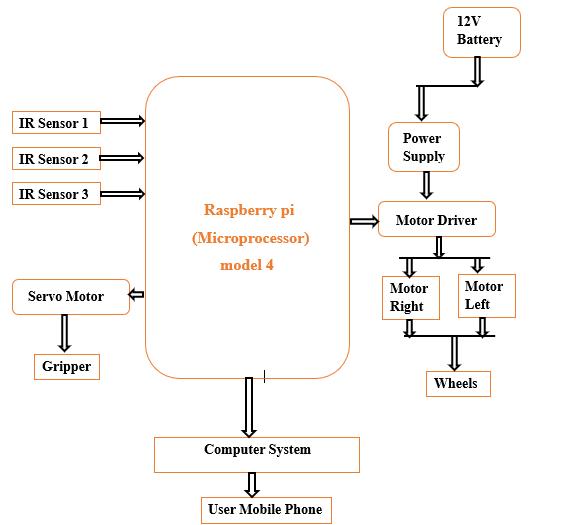
Fig3.1Blockdiagram
4. METHODOLOGY
The basic mechanism of the LIBRARY MANAGEMENT ROBOTIC SYSTEM is to issue and return the books by taking the inputs from the user. The system verifies the identity of the user by scanning their library card through the Graphical User Interface (GUI) using DBMS. The Graphical User Interface has been created using MongoDB frompython.Firsttheuserentersthedetailsofthebookin the system which then access the reference number and thelocationdetailsofthebook.
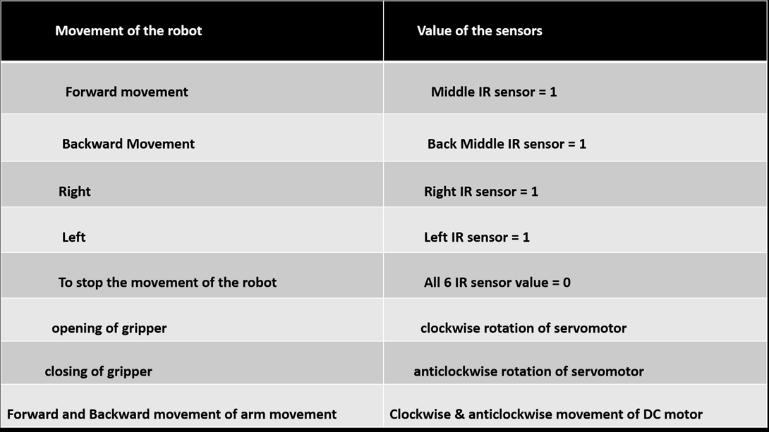
The robot has the Raspberry pi 4 as the main processing unit and it is programmed using python programming languagewiththehelpthornyIDE.Nextitwillmovetothe specific location using the line follower algorithm and reach the rack where the book has been placed. The mechanicalarmpresentontherobothasaclampattached toit.
Roboticarmandthenbeplacedina basketpresentonthe robot itself after which the robot will return back to the
initial position i.e., the point of delivery of the book. The databaseisupdatedandthebookisissuedtotheuser.
Speed of the Robot:
To determine the speed at which the line-following robot will move with 60 RPM motors, we need to consider the followingfactors:
1. Wheel Diameter: Thesizeofthewheelsattached tothemotors.
2. Gear Ratio: Any gear reduction or amplification betweenthemotorandthewheels.
The linear speed of the robot depends on the rotational speed of the wheels (in RPM) and the diameter of the wheels.
1. Convert RPM to Revolutions per Second (RPS): RPS=RPM/60
For60RPM:
RPS=60/60=1RPS
2. Determine the Wheel Circumference: The circumference C of the wheel is calculated using thewheeldiameterD:
C=π×D (whereπ≈3.141).
The diameter of the wheel which we haveusedis8.5cm
8.5cm=0.085m
C=π×D
C=3.14x0.085=0.266m
3. Calculate Linear Speed: ThelinearspeedVofthe robot is the product of the wheel circumference andthenumberofrevolutionspersecond:
V=C×RPS
Substitutingthevalues:
V=0.266x1=0.266m/sec.
Gripper length & width:
Servo Angle to Rotation: The maximum angle range of servomotoris120degrees.
Lever Arm Movement: When the servo rotates, it moves theleverarm.
The linear movement L at the end of the lever arm can be approximatedusingthearclengthformula:
L=rxθ
where ris thelength of theleverarmand θis theangle inradians.
Convert Degrees to Radians:
θmax=120degrees
radians=degrees×(π/180)
radians=120x(π/180)=2xπ/3
Calculate the Maximum Linear Movement:
L(max)=rxπ
L(max)=0.108x2xπ/3
(r=108mm)
L(max)=0.22mm
Gripper Opening Width:
Thetotalopeningwidthofthegripperistwicethe linearmovement(sincetheleverarmaffectsboth sidesofthegripperifsymmetricallydesigned)
W(max)=2xL(max)
W(max)=2x0.22mm=0.44mm
5. RESULTS
The implemented library management system excelled acrosscriticalparameters.TheRaspberry Pi-basedrobotic system demonstrated accuracy and efficiency in following the path and holding the book respectively. Additionally, the database management is also accurate in finding out thebooklocationandstudentsdata.
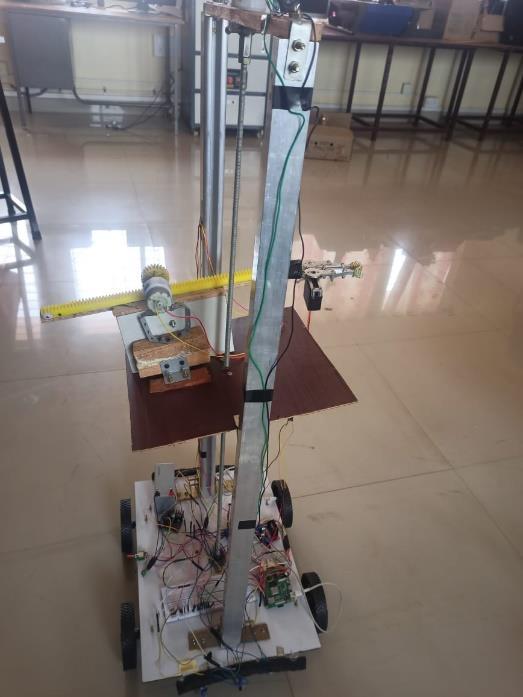
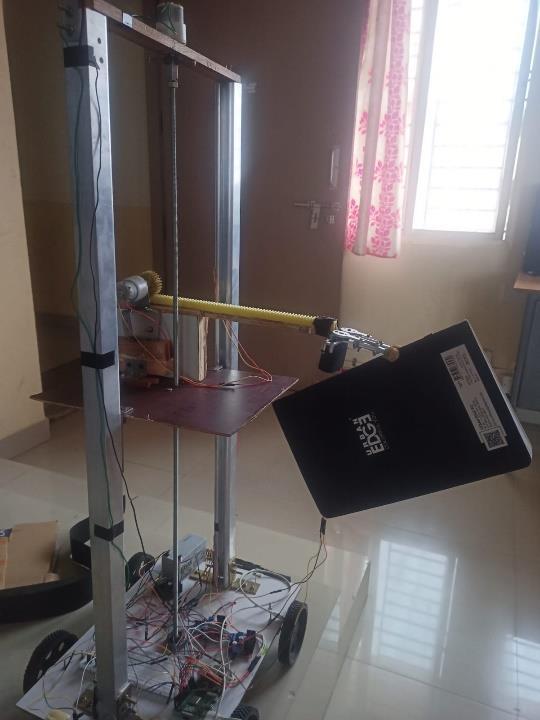
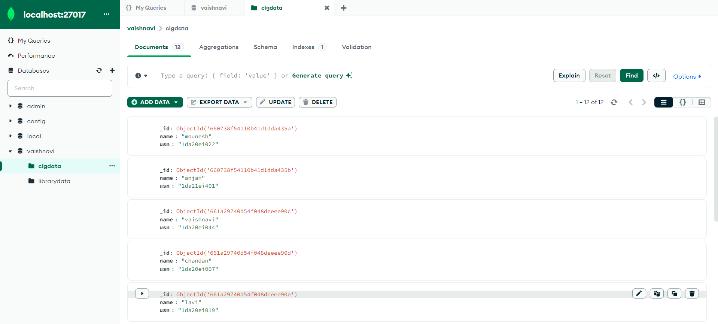
Fig5.3Studentdataset
International Research Journal of Engineering and Technology (IRJET) e-ISSN: 2395-0056 Volume: 11 Issue: 06 | Jun 2024 www.irjet.net p-ISSN: 2395-0072
Inconclusion,theintegrationofaroboticsysteminlibrary management presents a transformative solution that enhances efficiency, accessibility, and user experience. By employing robotics, tasks such as shelving, inventory management, and book retrieval can be automated, minimizing human intervention and reducing operational costs.
Moreover, the implementation of robotic systems can significantly improve accessibility for users with disabilities, ensuring that all patrons can navigate the libraryeffectivelyandindependently.
Additionally, the utilization of robotics opens up opportunities for real-time data analytics and insights, enabling libraries to make informed decisions regarding resource allocation, collection development, and user preferences.
Overall, the incorporation of a robotic system into library management not only streamlines operations but also fosters a more inclusive and technologically advanced library environment, ultimately enhancing the overall experienceforbothpatronsandstaffalike.
[1] Mayank Pathak, Manish Pandit, Surbhi Kanthed, and Rohit Sanvaliya, “Library management robot design and fabrication,”International Journal of EngineeringResearch &Technology(IJERT),vol.5,no.10,2020.
[2] Ekram Hussain, Ambrish Shekhawat, Shubham Saini, BirajTamang,SharathGSdevelopedamodelofCylindrical Robot for Library Application. International Journal of Engineering Research & Technology (IJERT), vol. 5, no. 10, 2021.
[3]Fati,andSulimanMohamed,"Automatedlibrarysystem using sms based pick and place robot," International Journal of Computing and Digital Systems, vol. 8, no. 6, 2019.
[4] Ester Martinez-Martin, Gabriel Recatala, and Angel P. del Pobil, “Transforming library operation with robotics,” Information Technology Satellite Meeting “Robots in libraries: challenge or opportunity?” Technical University ofAppliedSciences,Berlin,Germany,pp.21-22,2020.
[5] Deepthi Unnikrishnan, Aswani C R, Arjun K Jayaprakash, and Ganesh S, “Library assistat robots in library management system,” International Journal of Engineering Research & Technology (IJERT), vol. 6, no. 01, 2019.
[6] B.R. Sathishkumar, M. Krishnaprabha, S. Priya, and M.Ragavi, “Automated library system using android based robot”, International Journal of Recent Technology and Engineering(IJRTE),vol.8,no.2,2020.
[7] Vaishal S. Pande, Suraj Yenurkar, Pranjali Landge, and Kajal Yadav, “Design of smart library assistant robotic system,” International Journal of Scientific Development andResearch(IJSDR),vol.4,no.2,2019.
[8]Sharath H.K., Shivashankar B.S. presented Book Handling Robot for Libraries. International Journal of Recent Technology and Engineering (IJRTE), vol. 8, no. 2, 2020.
[9] Ramanan N.V. and Mr. K. Manoj Senthil, “Library managementsystemtoissueandretrievebooksfromuser usingautonomousrobot,”AsianJournalofAppliedScience andTechnology(AJAST),vol.2,no.2,pp.707-715,2019.