
Volume: 11 Issue: 06 | Jun 2024 www.irjet.net
International Research Journal of Engineering and Technology (IRJET) e-ISSN: 2395-0056 p-ISSN: 2395-0072
Volume: 11 Issue: 06 | Jun 2024 www.irjet.net
International Research Journal of Engineering and Technology (IRJET) e-ISSN: 2395-0056 p-ISSN: 2395-0072
Mrs.Monikashree T S1 , Kshama Sannagoudar2 , Lavi Singh A3,Sindhu Patil4,Vaishnavi M Iyengar5
1Assistant Professor, EIE, Dr. Ambedkar Institute of Technology, Bangalore, Karnataka, India 2345B.E, EIE, Dr. Ambedkar Institute of Technology, Bangalore, Karnataka, India
Abstract -The current emphasis on cleanliness in India, spurred by both individual and governmental efforts, acknowledges the inadequacy of traditional waste management practices in tackling the challenges posed by urbanization and industrialization. The escalating volume of non-biodegradable waste contributes to environmental pollution andhealth issues, necessitatinginnovativesolutions. One such proposal involves generating electricity from solid waste, aiming to mitigate pollution and address the power crisis by utilizing abundant waste resources. This Waste to Energy concept holds promise for sustainable energy production and environmental preservation in India.
Key Words: Waste monitoring system, Raspberry Pi, Electricity Generation
Addressing the critical challenge of waste management in thecontextofrapidurbanizationandindustrialization,our project proposes an innovative solution: using waste materials to generate electricity. This approach not only contributestowastereductionbutalsoalignswiththegoals of sustainable energy generation and circular economy practices.Ourholisticapproachinvolvesthreekeystages: Monitoring,Sorting,andGeneration.ThroughRaspberryPi technology, we monitor dry waste in real time, enabling data-driven decision-making. We automate sorting with Arduino technology, enhancing efficiency and material quality. Finally, we harness the energy potential of sorted wastematerialstogenerateelectricitysustainably,thereby revolutionizing waste management and promoting ecofriendlyenergyproduction.
The management of municipal solid waste is a significant challenge in urban areas, leading to pollution, resource depletion, andhealth risks. Traditionalfossilfuelreliance on electricityworsensclimatechange.Innovativesolutionsare needed to improve waste management and utilize waste for renewableenergy.Existingsystemslackefficientmonitoring and sorting, hindering resource recovery. This project proposes a solution using Raspberry Pi and Arduino to monitor, sort, and generate electricity from dry waste, aimingtooptimizewaste-to-energyconversionandpromote sustainableelectricitygeneration.
The project comprises three main components: a waste monitoring system utilizing Raspberry Pi technology for real-timedatacollection,anautomatedsortingmechanism driven by Arduino technology to efficiently segregate dry wastematerials,andawaste-to-energyconversionprocess for electricity generation. Through controlled combustion of materials like paper and dry leaves, heat energy will be harnessed and converted into electricity. The system's performanceandfeasibilitywillberigorouslyevaluatedto ensure scalability and suitability for urban waste management, promoting sustainable practices at abroaderscale.
A.
•Waste collection: Waste materials are collected and monitored from various sources, such as households, businesses, and industries, and transported toa waste-toenergyplant.
•Waste handling and Monitoring: The system detects parameters like distance with the help of two ultrasonic sensors. Some predefined values of these sensors are storedinRaspberryPi.
• Management offilledcontainer:When thecontact value is reached the LED begins to glow, if the garbage bin is completely filled then both theLED glows otherwise, only oneLEDglows.Thisresultsintheringingofthebuzzer.
Thistypicallyincludesaconveyorbelttomovewaste.
• SetupandCalibration:Setupthemetaldetectormodule andthesoundsensorinthewasteprocessingline.
• Metal detection: when metal is passed over a metal detector module, the sound is produced by the module, whichistakenasaninputforthesoundsensor.
• Metalsorting:thesounddetectedwillactivatethe servo motor to divert waste when metal is detected orwhen a certainsoundthresholdisexceeded,indicatingthepresence ofmetal.
Volume: 11 Issue: 06 | Jun 2024 www.irjet.net
C.ELECTRICITYGENERATION
• Incineration: The sorted dry waste is sent to the burning process through a conveyor belt and burned ina combustion chamber at high temperatures, producing heatandgases.
• Generation:Thesolarpanelswilldetectthelightand the thermoelectric generator will detect heat which resultsinthegenerationofelectricity.
•Conversion: the 12v DC power is to converted 230V AC byusingInverter.
•Energy recovery: the heat generated from burning dry wasteisusedtoproducesustainableElectricity.
3.1 BLOCK DIAGRAM
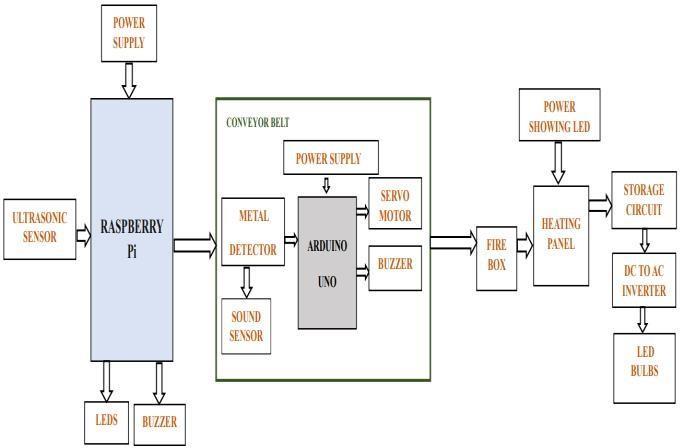
Fig -3.1:Blockdiagramforelectricitygeneration
3.2 CIRCUIT DIAGRAM
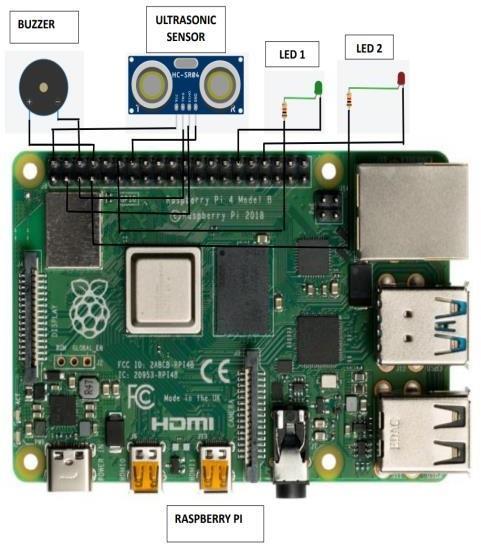
Fig-3.2 :(a)WasteMonitoringSystem
p-ISSN: 2395-0072
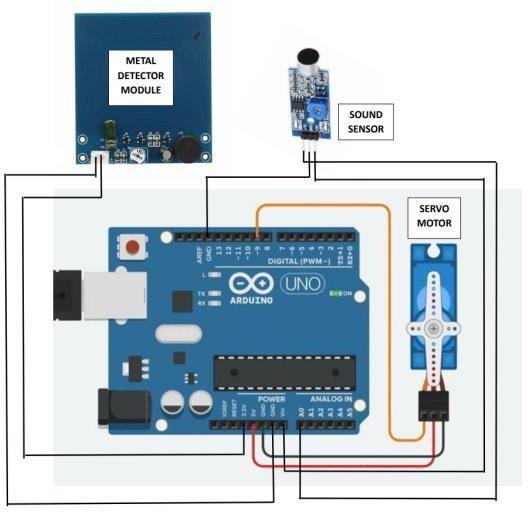
3.3:(b)MetalSortingSystem
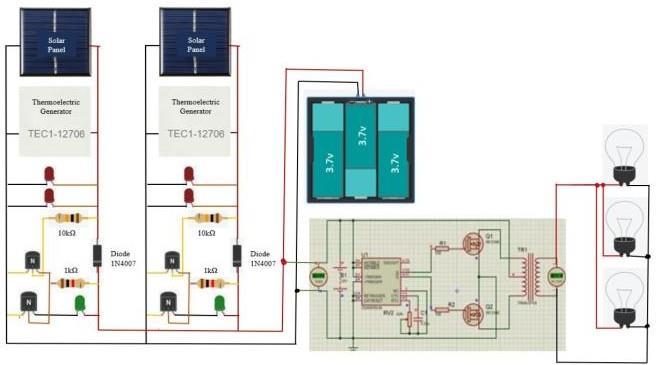
3.4:(c)ElectricityGeneration
The implemented waste management system has been assessed across various critical aspects. The RaspberryPibasedmonitoringsystemhasdemonstratedcommendable accuracyasshownintable 4.1.Intrackingkeyparameters of dry waste, aligning closely with ground truth measurementsobtainedthroughmanualinspection.
Table 4.1 Waste monitoring result
Volume: 11 Issue: 06 | Jun 2024 www.irjet.net
The Arduino-based sorting mechanism has exhibited high efficiency in segregating dry waste materials, boasting impressive sorting accuracy, throughput, and reliability based on real-world testing observations. The waste sorting results in Table 4.2 show that out of the listed objects, only ferrous metal was detected as metal, indicated by a status of '1'. Other objects, including dry leaves,paper,stainlesssteel,non-ferrousmetal, and wood, werenotdetectedasmetal,allmarkedwithastatusof'0'.
Table 4.2 WasteSortingResult WASTE OBJECTS
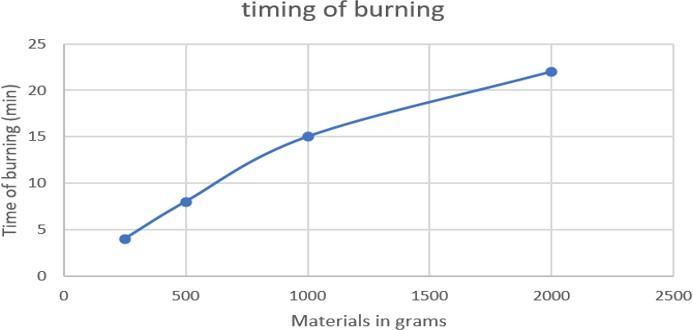
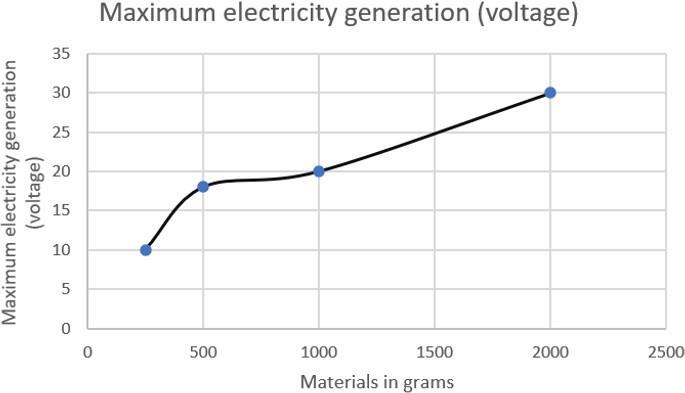
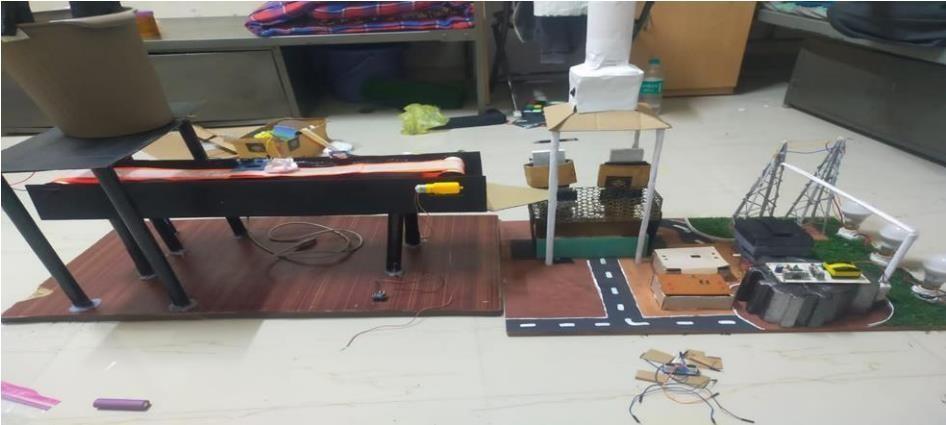
Moreover, the waste-to-energy conversion process has proven successful, with quantifiable energy output generated from the combustion of sorted dry waste materials, showcasing the system's ability to convert waste into renewable energy effectively. Performance metrics, including waste processing throughput and energy generation capacity, have met or exceeded predefined benchmarks, emphasizing the system's efficiency and effectiveness. Table 4.3 illustrates the output load characteristics for different material weights. As the material weight increases, both the maximum electricity generation and the duration of electricity generationrise,with250gramsproducing10Vfor1-2days and2000grams producing30Vfor10days. The timing of burning also increases with the material weight and the sametrendsareillustratedin
. Table 4.3 Output Load
MATERIALS TIMINGOF BURNING MAXIMUM ELECTRICITY GENERATION (V) ELECTRICI TY GENERATI NG TIME (DAYS)
250gram 4-5min 10V 1-2days
500gram 5-8min 18V 3days thefig4.1,fig4.2andfig4.3
1000gram 15-17min 20V 7days 2000gram 20-22min 30V 10days
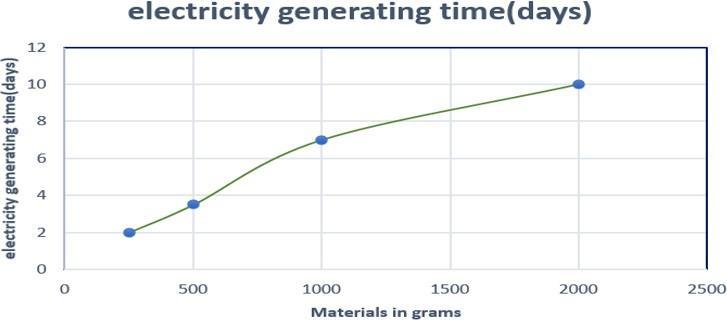
Table 4.4 Power Generation
Table 4.4 shows power generation details, where increasingamphoursandvoltageresultinhigherkilo-watt hours. Specifically, 5 amp hours at 3.7V produce 0.0185 kWh, 10 amp hours at 7.4V generate 0.0370 kWh, and20 amphoursat14.8Vyield0.0740kWhandthesametrends areillustratedingraph4.2.
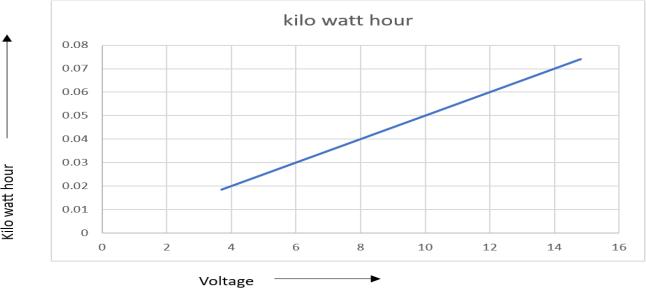
Fig 4.4 Power generation
TOCALCULATETHEELECTRICALENERGYGENERATED FROMBURNINGPAPERWASTEANDTHECONVERSION EFFICIENCY:
1.Measurethemassofpaperwasteanddetermineits calorificvalue.
2.Calculatethethermalenergyinputalsocalledtotal energy.
3.Directlymeasuretheelectricalenergyoutput.
4.ConvertthemeasuredelectricalenergytoMJifneeded.
5.Calculate the conversion efficiency using the measured electricalenergyoutputandthecalculatedthermalenergy input.
a)DeterminetheMassofPaperWaste(m):
For example, let's say we have 6 paper sheets used for burningwhichweighupto36grams. Massofthepaper(m):0.036kg
b)FindtheCalorificValueofPaper(CV):
The typical calorific value of paper is around 10 MJ/kg.
c)CalculatetheTotalThermalEnergyInput(totalenergy):
ThermalEnergyInput=m×CV
For0.036kgofpaper,
ThermalEnergyInput=0.036kg×10MJ/kg =0.36MJ
e-ISSN: 2395-0056 p-ISSN: 2395-0072
d)MeasuretheElectricalEnergyOutput:
Theelectricalenergyoutputistypicallymeasuredusing instrumentssuchaspowermetersormulti-meters.To calculatethepower,theformulais P=V×I
where:Pisthepowerinwatts(W), Visthevoltageinvolts(V), Iisthecurrentinamps(A).
Given:Voltage(V)=14.8v,Current(I)=5amps
Substitutingthevaluesintotheformula:P=14.8v×5amps P=74 watt
Therefore,thepoweris74watts=0.074kWh. IftheelectricalenergyismeasuredinkWh,itisconverted toMJusingtheconversionfactor1kWh=3.6MJ Hence,0.074kWh=0.266MJ.
e) Calculate the Conversion Efficiency (%): ConversionEfficiency=(ElectricalEnergyOutput(MJ)/ ThermalEnergyInput(MJ))x100 =(0.266MJ/0.36MJ)×100 =73.89%
Lastly, the feasibility and scalability of the implemented solution for urban waste management systems have been evaluated, considering factors such as cost-effectiveness, ease of deployment, and adaptability to different environmental conditions. Based on real-world implementation and feedback, the system demonstrates promise for broader adoption and replication in diverse contexts, contributing to sustainable waste management practices.
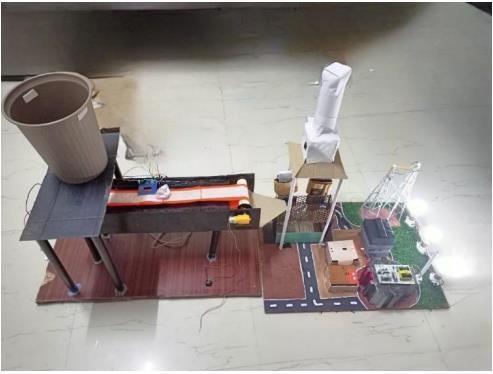
-4.5:sustainableelectricitygeneration
The combination of Raspberry Pi technology for waste monitoring and Arduino-based automation for sorting signifies a remarkable leap in waste management practices. Real-time monitoring and analysis of dry waste parameters empower informed decision-making, boosting resourceallocationefficiencyandoperationaleffectiveness. Automated sorting mechanisms not only enhance the quality of sorted waste materials but also streamline downstream processing, maximizing resource recovery. Moreover, the establishment of a waste-to-energy conversionprocessunderscoresthesystem'scommitment to sustainable energy generation, minimizing environmental impact while promoting renewable energy production.
This holistic approach to waste management reflects the principles of circular economy and sustainable development, emphasizing resource efficiency and environmental stewardship. Rigorous performance evaluation and feasibility assessments confirm the system's efficacy and scalability for urban waste management systems, paving the way for broader adoption and replication across diverse contexts. Overall, theimplementedwastemonitoring,sorting,andelectricity generation system represents a significant stride toward addressingpressingwastemanagement challenges and fostering acleaner,greenerfuture.
[1]. Prakash, Prabhu, “IoT based management system for smartcities”, International Journal of Innovative Research in Science, Engineering and Technology, vol 4, Issue 2, February2021.
2395-0072
[2].ShoaibBanday,AdilBashir,andAbRoufKhan,”DESIGN AND IMPLEMENTATION OF AUTOMATIC WASTE MANAGEMENT”,IEEE,September2020.
[3]. Kanchan Mahajan, Prof J. S. Chitode, “Waste Bin Monitoring System Using Integrated Technologies”, International Journal of Innovative Research in Science, Engineering andTechnology (An ISO 3297:2007 Certified Organization)Vol3,Issue7,July2014.
[4].Electricitygenerationbywastematerials”,International Journal of Advanced in Science, Communication and Technology (IJARSCT) Volume2, Issue 3,May 2022 by Mr. Ashish R. Chandane, Mr. Sagar D. Hedau, MR. Lucky S. Sarode.
[5]. “Generation of electricity using solid waste” Project reference No: 45S-BE-1864 By Dr. Nalini E Rebello, Mr. Anvith V B adikana, Mr. MuhammadShunaif,Ms.SahanaJ.