
International Research Journal of Engineering and Technology (IRJET) e-ISSN: 2395-0056
Volume: 11 Issue: 05 | May 2024 www.irjet.net p-ISSN: 2395-0072
International Research Journal of Engineering and Technology (IRJET) e-ISSN: 2395-0056
Volume: 11 Issue: 05 | May 2024 www.irjet.net p-ISSN: 2395-0072
Dr. Dhara Shah1
1Sr. Assistant Professor, F aculty of Technology, CEPT University, Ahmedabad-09
Abstract - The latest draft of the building code IS 1893 (WC) Part1 & Part 2, issued by the Bureau of Indian Standards (BIS) in April 2023, introduces significant alterations and provisions necessitating careful scrutiny before enforcement. Key changes include the transition from Deterministic Seismic Hazard Assessment (DSHA) to Probabilistic Earthquake Hazard Assessment (PEHA) methodology for seismic zone factor determination, leading to substantial increase in peak ground accelerations and distinct seismic zone factors for strength design and serviceability checks within the same structure. This exodus hints a substantial shift towards performance-based seismic design practices. Moreover, adjustments to the horizontal response spectrum curve, expansion of soil site classification based on shear wave velocity, and modifications in load combinations, minimum design horizontal base shear force, lateral storey drift limits, and allowable structural systems in reinforced concrete (RC) buildings have been implemented. Furthermore, the draft code introduces novel criteria for assessing building irregularities, with a specific focus on torsion, and mandates consideration of soil flexibility in structural analysis. It also incorporates provisions for analyzing Architectural Elements and Utilities (AEU), addresses small residential structure design, and delineates torsional analysis criteria for rectangular regular buildings. While these revisions aim to enhance seismic design methodologies, challenges such as comprehending return periods and adapting to new methodologies may arise. Therefore, the provision of clear explanations within the code and educational resources is imperative to facilitate understanding and implementation. This research paper conducts a comprehensive analysis of the revisions introduced in the draft code, particularly focusing on their implications for RC buildings.
Key Words: Draft building code IS 1893 (WC) part 1 & part 2, peak ground accelerations, Probabilistic Earthquake Hazard Assessment, shear wave velocity
ThelatestdraftofthebuildingcodeIS1893(WC)Part1&Part2releasedbyBISinApril2023[1][2]havebroughtsubstantial changesandprovisionsthatwarrantthoroughreview.Whilethefinalversionoftherevisionisanticipatedtocloselyresemble thisdraft,it'sessentialtoacknowledgethepossibilityofmodificationsinvaluesorspecificationsbeforeitsimplementation.It's worthnotingthattheimminentreleaseofIS1893Parts3to11,whichencompasstopicsrangingfromtankstotunnelsand more,isanticipatedinthenearfuture.
Part1:Generalprovisions
Part2:Buildings
Part3:Liquidretainingtanks
Part4:Bridgesandretainingwalls
Part5:Industrialstructures
Part6:Baseisolatedbuildings
Part7:Pipelines
Part8:Damsandembankments(tobeformulated)
Part9:Coastalstructures(tobeformulated)
Part10:Steeltowers(tobeformulated)
Part11:Tunnels(tobeformulated)
SomenoteworthychangesoutlinedinthedraftofthebuildingcodeIS1893(WC)Part1&Part2arepresentedhere.
TheexistingIS1893-2016Part1encompassesgeneralprovisionsandguidelinesforseismicdesignofbuildings,whileIS 1893(WC)Part1andPart2serveascomplementarysectionstobeinterpretedtogether.Part1typicallyaddressesgeneral provisions, while Part 2 specifically focuses on seismic design considerations for buildings. It could potentially introduce confusion or make the code less user-friendly if essential provisions for seismic design are spread across multiple parts. ConsolidatingallpertinentinformationintoPart1ofthecodewouldlikelystreamlinethedesignprocessandfacilitateeasier
International Research Journal of Engineering and Technology (IRJET) e-ISSN: 2395-0056
Volume: 11 Issue: 05 | May 2024 www.irjet.net p-ISSN: 2395-0072
referenceforpractitioners.Thisapproachensuresthatcriticalseismicdesignconsiderationsarereadilyaccessiblewithina singledocument,enhancingclarityandusability.
ThemajorityofsymbolsandnotationsinIS1893(WC)Part1andPart2,arenewlyintroducedandcausingconfusion comparedtothepreviousversionofthecode,highlightingasignificantusabilityissue.
Thecornerstoneofthealterationsinthecodeisthemethodologyusedtodeterminezonefactors.Thenewseismicmapof IndiaisbasedonProbabilisticEarthquakeHazardAssessment(PEHA)[3]methodwithanadditionalzone–ZoneVI.Previous versions relied on the Deterministic Seismic Hazard Assessment (DSHA) approach. The design earthquake zone factor Z, indicativeofthemeanhorizontalpeakgroundacceleration,nowvariesbasedondifferentreturnperiods -TRP (years)for variousstructurecategorieswithineachzone.Peakgroundaccelerationshavesubstantiallyincreasedcomparedtoexisting values. Additionally, separate zone factors are now applicable for strength design and serviceability checks to the same building.Thisshiftrepresentsamomentousexodusfromearlierpractice,hintingasteptowardsperformancebasedseismic designofstructures. ThemethodforspecifyingthezonefactorsZinthedraftcodeinvolvesreferencingtwotables:Table1for obtainingthereturnperiod(TRP)applicabletoeachbuildingcategory(differentiatingbetweenDesignandServiceability),and Table2fordeterminingthecorrespondingzonefactorZbasedontheTRP andtheseismiczoneofthelocation.AppendixGof thedraftcodepart1givesabriefoftheprocess.
Inthecurrentcode,seismicintensityisdefinedusingtwodistinctcategories:MaximumConsideredEarthquake(MCE)and DesignBasisEarthquake(DBE)[4].ZonefactorZrepresentsMCEandtheDesignBasisEarthquakeistakenas50%ofMCEi.e. Z/2.Noteveryonemaybefamiliarwiththeconceptofreturnperiodsinseismicdesign.Returnperiodsrepresenttheaverage intervaloftimebetweenoccurrencesofaspecificseismiceventwithacertainmagnitudeatagivenlocation.Toaddressthis knowledgegap,it'simportantforseismicdesigncodestoprovideclearexplanationsandcontextregardingreturnperiods.This couldincludedefinitionswithinthecodeitself,aswellaseducationalmaterialsorreferencestoresourceswhereuserscan learnmoreaboutseismicterminologyandconcepts.Additionally,codecommitteecouldconsiderprovidingpracticalexamples orguidanceonhowreturnperiodsareusedinseismicdesigncalculations.Thiscanhelpusersunderstandthesignificanceof returnperiodsandhowtheyinfluencedesigndecisionswithoutrequiringspecializedexpertiseinseismology.
Nuclearpowerplant structures
TobespecifiedbyAtomicEnergy RegulatoryBoard(AERB),GoI
To be specified by Atomic Energy RegulatoryBoard(AERB),GoI
International Research Journal of Engineering and Technology (IRJET) e-ISSN: 2395-0056
Volume: 11 Issue: 05 | May 2024 www.irjet.net p-ISSN: 2395-0072
Table -3: Earthquake Zone Factor Z (MCE) [4]
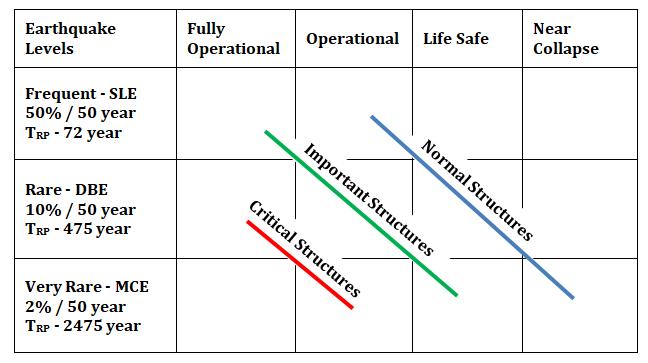
Earthquakelevelsarecategorizedbasedontheirprobabilityofoccurrenceasfrequent,occasional,rare,veryrareandso on.Afrequentearthquakehas50%chanceofoccurrencein50yearswitha returnperiod-TRP of72years.Itisknownas serviceabilityearthquakeasperexistingcode. Alltypesofstructuresaredesignedtoremainfullyoperationalandfunctional undertheexpectedlevelsofshakingassociatedwiththeseearthquakes.Arareearthquakehas10%chanceofoccurrencein50 yearswithareturnperiod-TRP of475years.Itisknownasdesignearthquakeasperexistingcode.Criticalinfrastructureand importantstructuresaredesignedtoremainoperationalandfunctionalundertheexpectedlevelsofshakingassociatedwith theseearthquakes.Averyrareearthquakehas2%chanceofoccurrencein50yearswithareturnperiod-TRPof2475years.Itis knownasmaximumconsideredearthquakeasperexistingcode.Thislevelofseismiceventservesasabenchmarkforensuring thesafetyandresilienceofcriticalandlifelinefacilities.Thistypologyhintstheshifttowardsperformancebasedseismicdesign asperFig-1.
ThecomparisonofzonefactorsfordesignstrengthaspercategoryofstructuregivenindraftcodeisshowninTable4and comparedwiththezonefactorofthecurrentcode.
Table -4: Zone Factor comparison for design strength (current code and draft code)
be specified by AERB, Government of
International Research Journal of Engineering and Technology (IRJET) e-ISSN: 2395-0056
Volume: 11 Issue: 05 | May 2024 www.irjet.net p-ISSN: 2395-0072
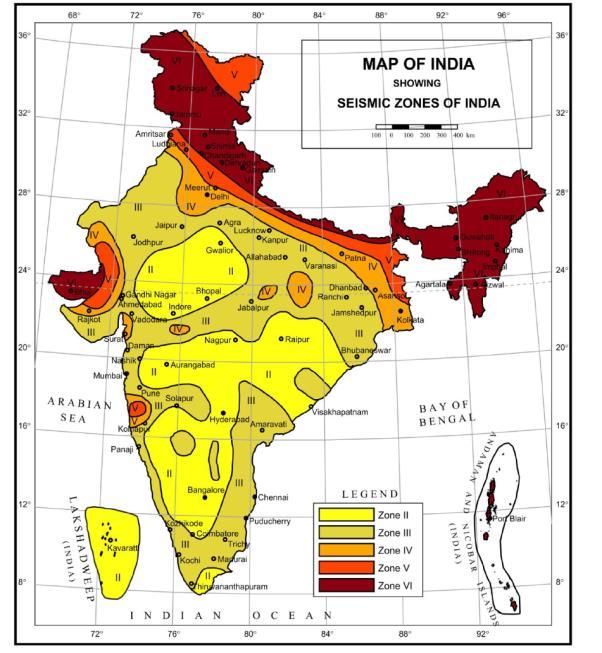
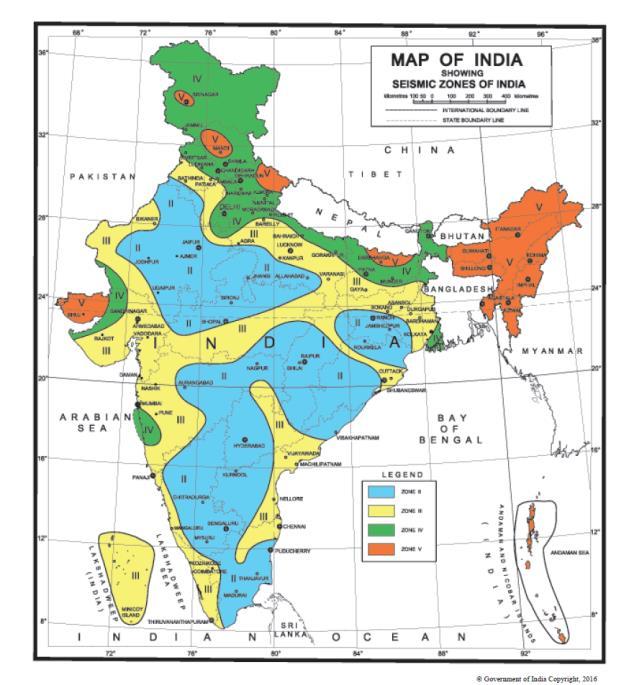
TheseismiczonemapofIndiahasbeenmodifiedinthedraftcodewithadditionalzone–zoneVIasshowninFig.2.Dueto changeinboundaries,manycitieshaveshiftedfrompreviouszonetohigherzone.Shimla,Chandigarh,RoorkeeandDehradun shiftedfromzoneIVtoVI.MaduraiandTrichyshiftedfromzoneIItoIII.Theentirenortheastbelt,northernpartandHimalayan regionalongwithwestGujaratisshiftedtonewzoneVI[2].
Seismic zone map India - draft code
Seismic zone map India - current code
Fig-2: SeismiczonemapIndia-draftcode¤tcode
2.1 Importance factor I
Inthedraftcode,theimportancefactorIvarydependingonthecategoryofstructuresandtheassociateddesignreturn period.Thecurrentcodeprovidesthreebasicvaluesforimportancefactor.Tablebelowshowsthecomparisonofimportance factorIaspercurrentcodeanddraftcode.
Table -5: Importance factor I
bespecifiedbyAtomic
RegulatoryBoard (AERB),GovernmentofIndia
International Research Journal of Engineering and Technology (IRJET) e-ISSN: 2395-0056
Volume: 11 Issue: 05 | May 2024 www.irjet.net p-ISSN: 2395-0072
Inthedraftcode,theresponsereductionfactoristermedaselasticforcereductionfactorR.Forbuildingsystems,itismore orlesssameascurrentcodeexceptatfewplaces.Table6belowhighlightsthedifferenceinvalueofRaspercurrentcodeand draftcode.FromthetableitisobservedthatthedraftcodehasprovideddifferentvalueofRforductilestructuralwallswithout boundaryelementsandwithboundaryelements.Additionally,fordualstructuralsystemtheincreaseinRvaluefrom5.0to5.5 and6.0couldpotentiallyleadtocostsavingsbyallowingformoreefficientdesignandconstructionofhigh-risebuildings.
Table -6: Response reduction factor R Structural system
BuildingwithOrdinaryBracedFrames(OBF)havingconcentricbraces
BuildingwithSpecialBracedFrames(SBF)havingeccentricbraces
Unreinforcedmasonry(designedanddetailedasperIS1905)andprovidedwith horizontalRCseismicbands
BuildingswithductileRCStructuralWallswithoutboundaryelements
withductileRCStructuralWallswithboundaryelements
Dual system - Buildings with ductile RC Structural Walls without boundary elementsandRCSMRF
Dualsystem-BuildingswithductileRCStructuralWallswithboundaryelements &RCSMRF
Inthedraftcode,thehorizontalresponsespectrumcurvehasbeenextendedto10secondsunlikethecurrentcodeupto4 secondssoastoincorporatestructureswithhighertimeperiodsuchastallbuildings.Thenormalizedhorizontalpseudo spectralacceleration(PSA)ANH(T)correspondingtodampingof5percentofcritical,foreachsiteasperdraftcodeforusein Lineardynamicmethod–responsespectrummethodandforuseinlinearequivalentstaticmethodisshowninFig.3andFig. 4.Thecurrentcodecurveshavebeenextendedto10secondshereforbettercomparison.Forvaluesofdampingξ,otherthan5 percent(0%<ξ<30%),thenormalizedhorizontalPSAANH(T)shallbeobtainedaspertheequationsgiveninthedraftcode.
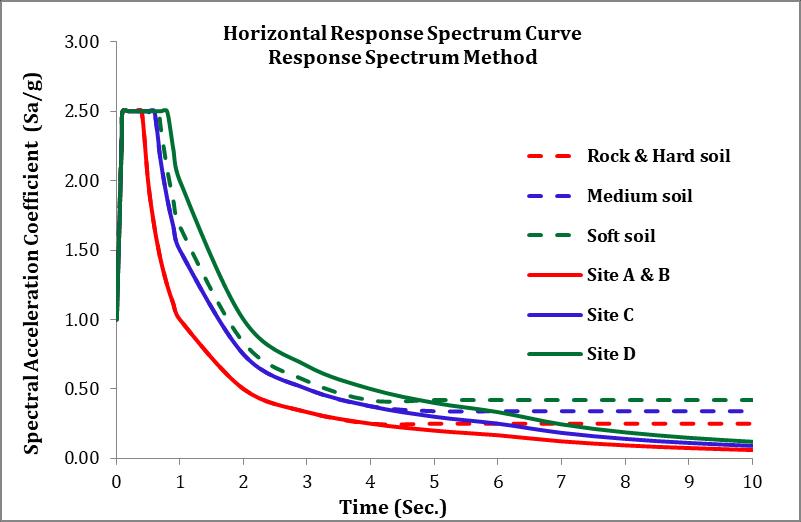
Fig-3: Horizontalspectrumcurvecomparisonforresponsespectrummethod (Solidlinesrepresentdraftcode,dottedlinesrepresentcurrentcode)
International Research Journal of Engineering and Technology (IRJET) e-ISSN: 2395-0056
Volume: 11 Issue: 05 | May 2024 www.irjet.net p-ISSN: 2395-0072
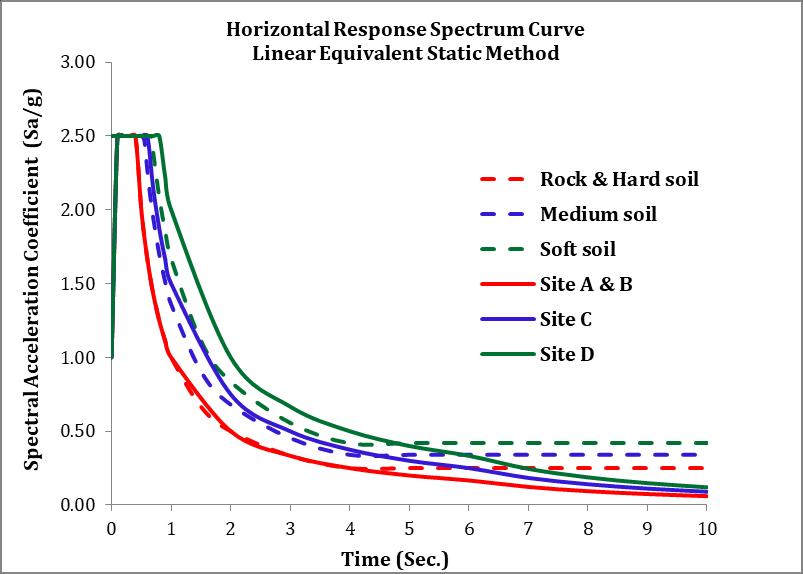
Fig-4: Horizontalspectrumcurvecomparisonforequivalentstaticmethod (Solidlinesrepresentdraftcode,dottedlinesrepresentcurrentcode)
Thesoilsiteclassificationtoselectappropriateresponsespectrumcurvehasbeenmodifiedinthedraftcode.Thecurrent codeappearstousetheSPT(StandardPenetrationTest)“N”valueforsoilclassification[4]asshowninTable7whereasthe draftcodeproposestouseshearwavevelocityVS ofthesoilforclassificationasshowninTable8.Itisbasedontheweighted averageVS oftheunderlyingsoilstratainthetop30m.Thereisnodirectreferenceindraftcodewhichrelatesshearwave velocityandNvalueofasoil.InternationalBuildingCode[6]clearlyrelatessoilsiteclasswithaverageshearwavevelocityVS, NvalueandAverageundrainedshearstrengthofagivensoilasshowninTable9.Comparingthese,wecanconcludethatthe soiltypeA,BandCasperdraftcodecorrespondstotypeIsoilofthecurrentcode.TypeDsoilaspartlytypeIandpartlytypeII andtypeEsoilaspartlytypeIIandpartlytypeIII.NoresponsecurveisprovidedfortypeEsoilindraftcodewhichispartly undertypeIIIsoilaspercurrentcode.
Table -7: Soil type Classification (current code)
Soil Class
SPT value N
Type A – RockorHardsoils(TypeI) >30
Type B –Mediumorstiffsoils(TypeII) 10-30
Type C –Softsoils(TypeIII) <10
Type D –Unstable,collapsible,liquefiablesoils Requiressitespecificstudy
Table -8: Site Classes for estimating Normalized PSA (draft code) [2]
Site Class
Weighted Average Shear Wave Velocity VS - (m/s)
Lower Limit Upper Limit
International Research Journal of Engineering and Technology (IRJET) e-ISSN: 2395-0056
Volume: 11 Issue: 05 | May 2024 www.irjet.net p-ISSN: 2395-0072
Site Class
A:HardRock
Average shear wave velocity (Vs)
Average standard penetration resistance (N1 or Nch)
Average undrained shear strength in the case of cohesive soils (su)
>1500m/s Notapplicable Notapplicable
B:Rock 760to1500m/s Notapplicable Notapplicable
C:Verydensesoilorsoftrock 370to760m/s >50 >100kPa
D:Stiffsoil
180to370m/s 15to50 50to100kPa
E:Softsoil <180m/s <15 <50kPa
Anyprofilewithmorethan3mofsoilhavingPlasticityIndexPI>20, Moisturecontentω≥40%,Averageundrainedshearstrengthsu<24kPa
F:Soilsrequiringsite-specific evaluation
Soilsvulnerabletopotentialfailureorcollapse(liquefiable,quick-orhighly sensitiveclays,collapsibleweaklycementedsoils)
Morethan3mofpeatand/orhighlyorganicclays
Morethan7.5mofveryhighplasticityclays(PI>75)
Morethan37mofsofttomediumclays
Theverticalresponsespectrumhasbeenmodifiedinthedraftcode.Thenewformulavarieswiththeperiod(T)ofthe structure'sresponse,asopposedtothecurrentcode,whichemploysaflatlinewithSa/gas2.5asshowninFig.5.Inthecurrent code,theflatlineeffectuallyrepresentsSa/gvalueof0.83,achievedthroughacalculationinvolvingthemultiplicationof2.5x (2/3)x(1/2),where(1/2)accountsfortheconversionfromMCEtoDBE.
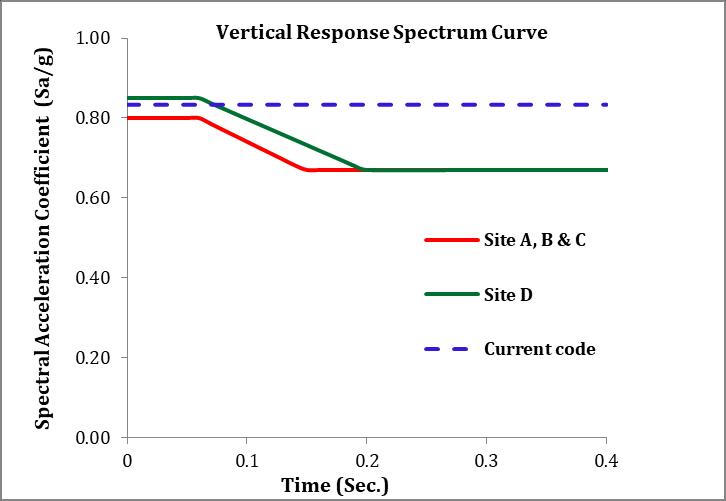
Fig-5: Verticalspectrumcurvecomparison (Solidlinesrepresentdraftcode,dottedlinesrepresentcurrentcode)
TheseismichorizontalcoefficientAh fordesignasperthecurrentcodeistakenas
Ah = Z/2 * I/R * Sa/g (1) where,
Z=zonefactorforMCEasperTable3
I=Importancefactor
R=Responsereductionfactor
Sa/g=Designaccelerationcoefficientfordifferentsoiltypes
International Research Journal of Engineering and Technology (IRJET) e-ISSN: 2395-0056
Volume: 11 Issue: 05 | May 2024 www.irjet.net p-ISSN: 2395-0072
TheelasticmaximumhorizontalPSAAHD(T)fordesignasperthedraftcodeistakenas
AHD(T) = Z * I/R * ANH(T) (2) where,
Z=zonefactorasperTable1andTable2
I=Importancefactor
R=Elasticforcereductionfactor
ANH(T) =Normalizedhorizontalpseudospectralacceleration(PSA)fordifferentsoiltype
Inthedraftcode[2],forlimitstateofstrength,thefollowingcombinationsareconsideredwhenearthquakeeffectsare combinedwithdeadandimposedloads.
1.5DL+1.5LL
1.2DL+1.2LL±EED
1.5DL±EED
0.9DL±EED
Whenperformingtheserviceabilitycheckofstructures,thefollowingcombinationsareconsideredwhenearthquakeeffects arecombinedwithDeadandImposedLoads.
DL+LL
DL+0.8LL±EES
DL±EES
0.9DL±EES
HereEEDisearthquakeloadfordesignandEESisearthquakeloadforserviceability.
The draft code proposes a partial load factor of 1.0 for earthquake loads in both design and serviceability combinations, contrastingwiththecurrentcode'suseofaloadfactorof1.5.ThismodificationiscreditedtothevigilantselectionofTRPaimed at accounting for qualms epitomized by partial safety factors. This can be proved by taking example of normal structure category and comparing Z values and partial load factors as shown in Table 10. Simultaneously, it's a concern for cities currentlydesignatedasZoneIV,facingaproposedshifttoZoneVIinthedraft,accompaniedbysubstantialincreasesinvalues for1.2(DL+LL+EQ)by247%andfor1.5(DL+EQ)by177%.
Table -10: Zone factor and partial load factor comparison (current code and draft code IS1893) Seismic Zone
Shimla, Chandigarh, Roorkee, Dehradun
International Research Journal of Engineering and Technology (IRJET) e-ISSN: 2395-0056
Volume: 11 Issue: 05 | May 2024 www.irjet.net p-ISSN: 2395-0072
Asperthedraftcode,theminimumdesignhorizontalearthquakebaseshearforceVBD,H forstrengthdesignshouldbe VBD,H, min = 0.625 * Z * I/R * W > 0.015W i.e. 1.5% where,
Z=zonefactorasperTable1andTable2
I=Importancefactor
R=Elasticforcereductionfactor
W=Seismicweightofthebuilding
TheequationclearlystatesthattheminimumvalueofANH(T)shouldbe0.625.Italsohighlightsthatinanycasethezonefactor Zshouldnotbelessthan0.12consideringnormalductilestructure.Theminimumdesignhorizontalearthquakebaseshear forceforstrengthaspercurrentcodeisshowninTable11.
Table -11: Minimum Design Earthquake Horizontal Lateral Force, current code [4]
Thedraftcodehasundergonechangesinthepermissibledriftlimitsaswell.ThelimitsaretobetakenfromZforserviceability andreducedforhigherzonesasshowninTable12,resultinginstrictercriteriaforhigherzones.Thecurrentcodeimposesa uniformrestrictiononstoreydrifts,limitingthemto0.004forbuildingsregardlessoftheseismiczones.
Table -12: Lateral Storey Drifts in Buildings as per draft code
Seismic Zone Lateral Storey Drifts
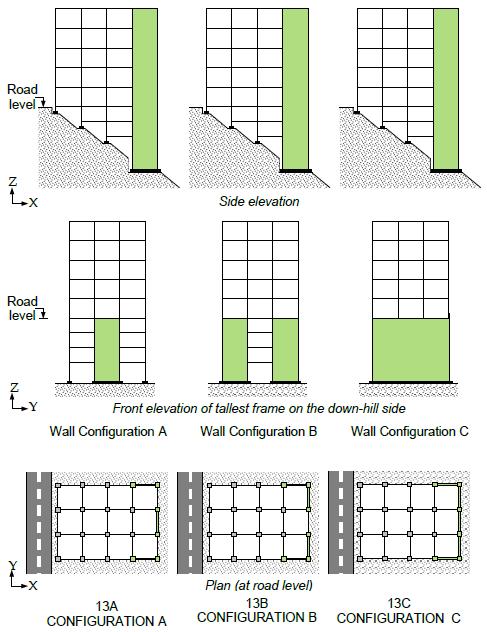
ThestructuralsystemspermittedasperdraftcodeforRCbuildingsareoutlinedinTable13,emphasizingthatrelying solely on moment frames may not yield optimal performance in higher seismic zones. Table 13 should be interpreted in conjunctionwiththeminimumStructuralPlanDensity(SPD)ofStructuralWallsinRCBuildingsasoutlinedinTable14,with zone-specificlimits.Notably,therearespecificprovisions,suchastherequirementforshearwallsinbuildingsonslopes(Fig.6 andTable15tobereferredtogether),aimedatmitigatingtorsionaleffectsinsuchstructures.Thenotationsgivenare:
OMRS=OrdinaryMomentResistingFrames
SMRF=SpecialMomentResistingFrames
SMRF+SSW=SpecialMomentResistingFrameswithSpecialStructuralWalls
International Research Journal of Engineering and Technology (IRJET) e-ISSN: 2395-0056
Volume: 11 Issue: 05 | May 2024 www.irjet.net p-ISSN: 2395-0072
Table -13: Admissible structural systems in RC Buildings as per draft code
Seismic Zone
Building Category
Normal Important
II OMRF
SMRF
SMRF+SSW
DualSystem
III SMRF
SMRF+SSW
DualSystem
IV SMRF+SSW
DualSystem
SMRF
SMRF+SSW
DualSystem
SMRF
SMRF+SSW
DualSystem
Critical and Lifeline
SMRF+SSW DualSystem
SMRF+SSW DualSystem
SMRF+SSW DualSystem DualSystem
V DualSystem DualSystem DualSystem
VI DualSystem DualSystem DualSystem
Table -14: Minimum Structural Plan Density of Structural Walls alone in RC Buildings
Seismic Zone
Minimum Structural Plan Density of Structural Walls - SPD
Table -15: RC Wall Configurations in Step-Back Buildings on Hill Slopes
International Research Journal of Engineering and Technology (IRJET) e-ISSN: 2395-0056
Volume: 11 Issue: 05 | May 2024 www.irjet.net p-ISSN: 2395-0072
Thedraftcodeadoptsalenientapproachtowardsthedesignofsmallresidentialframedstructuresuptotwostoreys (includingbasement),wheretheEquivalentStaticMethodofanalysissuffices.However,inzonesIIandIII,itmandatesatleast SpecialMomentResistingFrames(SMRF)withinfillwallscoveringaminimumof90%ofthebays.In zonesIVandV,the requirementisforatleastSMRF(withinfills)alongwithSpecialShearWalls(SSW),ensuringaminimumof1.5%Structural PlanDensity(SPD)ineachprincipalplandirection.
Thedraftcodenowmandatestheconsiderationofsoilflexibilityforallcases,demandingthatbuildinganalysismodels havetheirsupportsassignedwithcalculatedspringsratherthanbeingfixedorpinned. ForLinearEquivalentStaticAnalysis withoutexplicitlyconsideringinertialeffects,it'sessentialtoaccountforflexiblesoiltranslationaland/orrotationalsprings intotheanalysis.It’sessentialtoincorporateallaspectsofsoil-structureinteractionwhenperformingDynamicAnalysisforthe structureunderdesignorevaluation.However,thisrequirementexcludesbuildingsinsiteclassesAandB,aswellasthoseup tofivestoreysinheightrestingonindividualfootings.Inthedraftcode,theflexibilityofsoiliscapturedthroughitsmodulusof subgradereactionfordifferentfoundations.
Oneofthenumerousenhancementstothecodeistheintroductionofsoildampingforthepurposeofdesign.Thedamping ratioofsoilistobetakenas2.5percent.But,forassessmentofstructuresunderearthquakeloading,itisrequiredtousestraindependenthystereticdampinginsteadofviscousdamping,whenmodelingsoil.
Thedraftcodehasintroducedasignificantcriterionregardingbuildingirregularities,particularlycrucialfortallstructures, focusingontorsion.Theexistingcriterioninthecurrentcodeidentifiesabuildingastorsionallyirregularwhentheratioof maximumflooredgedisplacement∆maxtoitsminimum∆minexceeds1.5timesasshowninFig.7.Inadditiontoit,thedraftcode
International Research Journal of Engineering and Technology (IRJET) e-ISSN: 2395-0056
Volume: 11 Issue: 05 | May 2024 www.irjet.net p-ISSN: 2395-0072
specifiesTorsionalFlexibilityFactor,ψofthebuilding,derivedbyevaluatingtheinfluencesofthreeaspectscontributingtothe building's torsional tendencies. If ψ < 0.4, the building is said to be torsionally stiff else is termed as torsionally flexible. TorsionalFlexibilityFactoriscalculatedas
where,
B=OuterDimensionofthebuildingalongthedirectiontotheconsidereddirectionofshaking
eK =StiffnesseccentricityofthebuildingwithrespecttoCR
eK
= Normalized stiffness eccentricity of the building
r = Translational radius of gyration of the mass of the building at the floor level
rKθ = Torsional Radius of gyration of the mass of the building at the floor level
τ =RatioofNaturalPeriodsofFundamentalTorsionalandFundamentalTranslational Modesofoscillationofthebuilding,i.e.T
or Tθ / TY for considered direction of shaking of X and Y
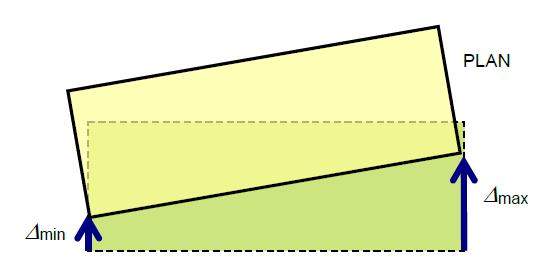
Fig- 7: TorsionalIrregularityinBuildings
Inthecaseofrectangularregularplanbuildings,thedecisiontoconducteitheratorsionalanalysisorrevisethestructural configurationisdeterminedbyconsideringthetorsionaleccentricityandtheratiooftheτ'sasspecifiedinTable16.However, forbuildingswithnon-rectangularirregularplangeometry,itmustbeensuredthattheTorsionalFlexibilityFactor-ψisless than0.4.Otherwise,thestructuralconfigurationneedstoberevised.
Table -16: Design Limit foreK and τ for Rectangular Regular Buildings

AsignificantenhancementtothecodeistheinclusionofanalysisforArchitecturalElementsandUtilities(AEU),previously mainlyfoundinNDMAguidelinesbutnowintegratedintothedraftcode.AEUencompassesvariousappendages,rangingfrom partitionwallsandstoragecabinetstoelectricalandmechanicalequipment.Theyarecategorizedasacceleration-sensitive AEUsanddisplacement-sensitiveAEUs,withthelatterfurthersubdividedbasedonwhethertheyarefixedatdifferentbuilding levels or at the same level. The code elaborates on methods of analysis for each category, providing dedicated tables for Importance,AccelerationAmplification,andResponseReductionfactorsforreference.ThedesignlateralforceFpforthedesign ofanchoragesconnectingAcceleration-SensitiveAEUstotheStructuralElements(SEs)ofthebuildingshallbetakenas:
© 2024, IRJET | Impact Factor value: 8.226 | ISO 9001:2008
International Research Journal of Engineering and Technology (IRJET) e-ISSN: 2395-0056
Volume: 11 Issue: 05 | May 2024 www.irjet.net p-ISSN: 2395-0072
Where,
Z =Earthquakezonefactor asperTable2ofdraftcodeforthe earthquakezoneofthesiteofthestructureonwhichtheAEU ismounted,givenbytheEarthquakeZoneMapofIndia(Fig.1)
��=HeightofthepointofattachmentofAEUabovetopofthefoundationofthestructure
H=Overallheightofthestructureabovetopofthefoundation
��AEU = ImportancefactoroftheAEU(Table17)
��AEU =AccelerationAmplificationFactoroftheAEU(Tables11and12ofdraftcode)
��AEU =ElasticForceReductionFactoroftheAEU(Tables11and12ofdraftcode)
��AEU =Weightofthe AEU
Theprovisionofthisclauseisequallyapplicableforthedesignofinfillwallsandpartitionwallsthatareplacedwitha gap betweenthestructuralelements,sothatthesewallsdonotfoulwiththelateraldisplacementofthestructuralelements,the provisionsoftheseclausesshallbeapplicable.
Table-17: Importance Factor ����EU of AEUs
racksinstructuresopentothepublic
ThemomentouschangesintheDraftcodesofIS1893,incomparisontothecurrent2016edition,arehighlighted. Notably,inthedraftcode,zonefactorsaredeterminedbasedonProbabilisticSeismicHazardAssessment(PSHA), divergingfromtheDeterministicSeismicHazardAssessment(DSHA)approachutilizedthecurrentcode.Wang[7]sees PSHAasapurelynumericalconceptwithoutphysicalormathematicalbasiswhichcouldleadtoengineeringdesigns thatareeitherunsafeoroverlycautious,withseriousconsequencesforsociety.AlsoKrinitzsky[8]arguesthatPSHAis aflawedprocedure.
Thecodecomplicatesthewell-understoodconceptsof MaximumConsideredEarthquake(MCE)andDesignBasis Earthquake(DBE)byexcludingthefactor'2'fromtheexpressionforAh,whichisrecognizedbystructuralengineers. Consequently,structuralengineersmaylackclarityonwhethertheyaredesigningfortheactualearthquakeforcesor forreducedvalues.
Thecodeundervaluestheimportancefactor'I'bytypicallysettingitsvalueto1.0,renderingitinsignificant.
Theearthquakeloadfactor,previouslyspeciouslysetat1.5inearlierversions,isnowcorrectlyacknowledgedas1.0.
WhiletheexistingcodeusestheSPTvalueofsoilforclassification,thedraftcodeemploystheshearvelocityofsoil,Vs, forthispurpose.
Theallowabledriftlimitsaresternerforthehigherzones.
ThedraftcoderecommendsspecificstructuralsystemsforRCbuildingsacrossdifferentzones,alongsideminimum requirements for Structural Plan Density (SPD) of structural walls.Implementing these guidelines, particularly in severezones,mayposechallengesandcouldpotentiallyconstrainthecreativityofarchitectsandengineers.
Animportantaspectinvolvesincorporatingshearwallsinbuildingslocatedonslopestomitigatetorsionaltendencies. Toaddressthis,anewprovisionhasbeenintroducedforcalculatingtheTorsionalFlexibilityFactor,aimingtoreduce torsionalirregularitiesinthebuildingdesign.
FEMAP-2012[9]conductedcollapseanalysesondifferenttypesofbuildings,bothwithandwithoutirregularities. Their findings exhibited that the Equivalent Lateral Force (ELF) method tends to yield more conservative results comparedtoResponseSpectrumAnalysis(RSA),aligningmorecloselywiththeforceoutcomesderivedfromNonlinear Time-History Analysis. Consequently, the ELF method is recommended in the latest ASCE 7-22 [10] with fewer limitations.However,it'snotedthattheproposedcodalprovisionsoverallleantowardsbeingoverlycautious.
International Research Journal of Engineering and Technology (IRJET) e-ISSN: 2395-0056
Volume: 11 Issue: 05 | May 2024 www.irjet.net p-ISSN: 2395-0072
[1] CED 39(22343) WC, "Draft Indian Standard Criteria for Earthquake Resistant Design of Structures Part 1 General Provisions[SeventhRevisionofIS1893(Part1)](ICSNo.91.120.25),"BureauofIndianStandards,NewDelhi,2023.
[2] CED 39 (22345) WC, "Draft Indian Standard Criteria for Earthquake Resistant Design of Structures Part 2 Buildings [SeventhrevisionofIS1893(Part1)](ICSNo.91.120.25),"BureauofIndianStandards,NewDelhi,2023.
[3] NDMA,"ProbabilisticSeismicHazardMapofIndia-Finalreport,"NationalDisasterManagementAuthority,India,New Delhi,2022.
[4] IS1893part-1,"CriteriaforEarthquakeResistantDesignofStructures:Part1-GeneralprovisionsandBuildings,"Bureauof Indianstandards,NewDelhi,2016.
[5] SEAOC, "Vision2000, Performance Based Seismic Engineering of Buildings, Vols. I and II: Conceptual Framework," StructuralEngineersAssociationofCalifornia,USA,2000.
[6] IBC,"InternationalBuildingCode,"WashingtonStateBuildingCodeCouncil,USA,2009.
[7] WangZ.,"SeismicHazardAssessment:IssuesandAlternatives,"PureandAppliedGeophysics,p.11–25,2010.
[8] KrinitzskyE.L.,"Deterministicversusprobabilisticseismichazardanalysisforcriticalstructures,"EngineeringGeology, vol.Volume40,no.1–2,pp.1-7,1995.
[9] FEMA P -2012, "Assessing Seismic Performance of Buildings with Configuration Irregularities-Calibrating Current StandardsandPractices,"AppliedTechnologyCouncilfortheFederalEmergencyManagementAgency,Washington,D.C, US,2018.
[10] ASCE/SEI-7,"MinimumDesignLoadsandAssociatedCriteriaforBuildingsandOtherStructures,"AmericanSocietyof CivilEngineers,Reston,Virginia,USA,2022.
[11] SubramanianN.,LeslieR.,“ImpactofDraftIS1893-2023CodeProvisionsonBuildingDesign”,CE&CR,2023.

Dr.DharaShahisSr.AssistantProfessor,atFacultyofTechnology,CEPTUniversitysince2006.Hermajor areaofresearchincludesperformancebasedseismicdesignofstructures,fragilityanalysisofstructures, Vibrationimpactassessmentofheritagestructure,Marinestructures,Steel&RCCstructures.