
International Research Journal of Engineering and Technology (IRJET) e-ISSN: 2395-0056
Volume: 11 Issue: 05 | May 2024 www.irjet.net
p-ISSN: 2395-0072
International Research Journal of Engineering and Technology (IRJET) e-ISSN: 2395-0056
Volume: 11 Issue: 05 | May 2024 www.irjet.net
p-ISSN: 2395-0072
Clifa Mascarenhas1 , Dr. Nilesh B. Fal Dessai2
1Student, Department of Information Technology and Engineering, Goa College of Engineering, Farmagudi, Goa, India
2Head of Department, Department of Information Technology and Engineering, Goa College of Engineering, Farmagudi, Goa, India ***
Abstract - Satellite-Based Communication (SATCOM) systems are increasingly pivotal for connecting remote areas, driven by advancements in manufacturing and radio technologies. However, this surge in adoption comes with heightened cybersecurity challenges. Neglected security services, coupled with evolving cyber threats, create an expandedattacksurfaceforSATCOM.
The study systematically compares the performance of diverse anomaly detection models on a synthetic dataset, assessing their ability to identify and counteract deviations fromnormalsystembehavior.
The outcomes of this research will contribute valuable insights to the selection of effective anomaly detection models for SATCOM security. Stakeholders involved in the SATCOMdomainwillbenefit fromthisresearch,providinga foundation for informed decision-making when implementing security measures to safeguard critical communicationchannels.
Key Words: SATCOM, cybersecurity, anti-jamming, integrity, confidentiality, anomaly detection
Inaneramarkedbytheimperativeofglobalconnectivity, Satellite-Based Communication (SATCOM) systems have emergedaspivotalfacilitators,connectingremoteregions andfosteringseamlesscommunication.Asthedemandfor robustconnectivitycontinuestorise,thisprojectembarks on a comprehensive study, focusing on the intricate landscape of security threats, solutions, and challenges inherent in the deployment and operation of SATCOM systems,withaspecificemphasisonanomalydetection.
Anomaly Detection Models: The primary objective of this project is to explore and evaluate various anomaly detection models tailored for SATCOM systems. Anomalies, deviations from the expected behavior, can signify potential security breaches or operational irregularities. This study delves into the effectiveness of state-of-the-art models, assessing their precision, recall, and overall performance in identifying anomalies within SATCOMdata.
Security Threat Landscape: While the project narrows its focus to anomaly detection, it remains cognizant of the broader security threat landscape. Cyber threats, deliberate interference, and signal jamming are acknowledged as potential sources of anomalies, promptingtheneedforadvanceddetectionmechanisms.
In essence, this project serves as a focused exploration into the application of anomaly detection models to the security dimensions of SATCOM systems. By bridging theoretical analyses with practical considerations, this endeavor aims to contribute valuable insights to the ongoing discourse on securing and sustaining SATCOM systemsinanever-evolvingdigitallandscape.
Thepaper[1]employsarobustgroundtruthmethodology, labeling a specific number of segments in each telemetry variable to establish the accuracy of anomaly detection methods. Out of 21,644 samples, 287 are labeled as fake anomalies. Notably, the Deviation Divide Mean over Neighbors (DDMN) consistently achieves 100% precision and maintains a high F1-score above 90%. DDMN's F1score reaches 0.969 when H = 2, surpassing DDM(next), DDM(prior), Z-SCORE, GMM, and K-means by significant margins of 93%, 92%, 30%,61%, and 126%, respectively. Importantly,DDMNexhibitsrobustnesstovariationsinthe threshold (H). In contrast, other methods such as DDM(next), DDM(prior), and Z-SCORE exhibit low precision when H is small, as they tend to detect rapidly changing values as fake anomalies. GMM and K-means perform poorly in recall, erroneously assigning fake anomaliestothenormalcluster.
This paper proposes a data-driven anomaly detection frameworkforsatellitetelemetrywithfakeanomalies.The authorsproposetheDeviationDivideMeanoverNeighbors (DDMN)methodtosolvethefakeanomalyproblemcaused by data errors in satellite telemetry data. They then use LongShort-TermMemory(LSTM),adeeplearningmethod, to model multivariable time-series data and a Gaussian modeltodetectanomalies.
International Research Journal of Engineering and Technology (IRJET) e-ISSN: 2395-0056
Volume: 11 Issue: 05 | May 2024 www.irjet.net p-ISSN: 2395-0072
The authors applied their approach to telemetry data collected from sensors on an in-orbit satellite for more thantwoyearsanddemonstrateditssuperiority.Theyalso explored what conditions could lead to false alarms. The approach has been deployed to the ground station to monitorthehealthstatusofthein-orbitsatellites.
Anomaliesareeventsthatdifferfromtheusualbehaviorof system data, and analyzing satellite telemetry data is crucialinthedevelopmentofaeronauticsandastronautics. Satellites are complex systems composed of interrelated and mutually restricted components, and hardware monitoring is difficult. A single failure in a component or subsystemcanbefataltothesystem.
The Out-Of-Limit (OOL) method is widely used in current satellites, but it is not robust enough to detect various types of anomalies and requires significant domain knowledgeandexpertisefromoperators.Toaddressthese shortcomings, data-driven methods have been proposed. These methods use the stored telemetry to create a mathematical model of the nominal behavior of the satellite, as anomalous events are rare. Data-driven methodsgeneratemodelsfromdataanddiagnosisdirectly fromvastnewlyacquiredtelemetry,ratherthanbuildingit basedonhumanexpertise.
In conclusion, this paper presents a data-driven anomaly detection framework for satellite telemetry with fake anomalies,addressingthelimitationsofcurrentsystems.
[2] This survey article is a comprehensive exploration of space anomaly detection, vital for ensuring space system safety amid increasing threats. It addresses specific challenges such as scalability, real-time detection, limited labeleddata,conceptdrift,andadversarialattacksinspace security. The article reviews current approaches and introduces an innovative integration of stream-based and graph-based methods for dynamic space anomaly detection, enhancing accuracy by capturing complex dependencies. It provides valuable insights and guidance forresearchersandpractitioners,emphasizingtheneedfor innovative approaches to counter evolving space threats. The article concludes with future directions, offering a roadmap to advance anomaly detection capabilities and securespacenetworks.
Itfocusesontheimportanceofspaceanomalydetectionin ensuring the safety and reliability of space systems, especially in the face of increasing threats. The article providesathoroughanalysisandsynthesisofstate-of-theart anomaly detection systems, identifying key challenges suchasscalability,real-timedetection,limitedlabeleddata, concept drift, and adversarial attacks. By extensively reviewing existing approaches and methods, the article evaluates their strengths, limitations, and potential applications in space networks. It goes beyond a mere
summary by introducing an innovative integration of stream-basedandgraph-basedmethodsfordynamicspace anomalydetection.Thisintegrationnotonlyopensupnew avenuesforresearchbutalsoenhancesdetectionaccuracy by capturing the complex temporal and structural dependencieswithinspacenetworks.
Thespaceindustryisexperiencingrapidgrowthandholds significant promise for the future, with a projected value exceeding $1 trillion by 2040. This expansion is driven by various factors, including decreasing launch costs and advancements in computing technology, particularly miniaturization. The emergence of small satellites and the availabilityofcommercialoff-the-shelf(COTS)components have made space more accessible to new entrants, resulting in increased satellite usage in communication, government operations, meteorology, remote sensing, and navigation.
The growth of the space industry has profound implications across different sectors, including job creation, technological advancements, increased accessibility, and potential economic growth. The expansion is expected to create numerous job opportunities in engineering, science, manufacturing, and support services. Advancements in technology for space missions can drive scientific research, improve communicationsystems,andenhancenationalsecurity.
SpaceInformationNetworks(SINs)havegainedsignificant attention within the space industry, encompassing a network of systems such as satellites, unmanned aerial vehicles, airships, and other objects capable of receiving, processing, and transmitting real-time spatial and temporal information. Satellite constellations offer tremendous potential in disaster response, scientific research, environmental management, and military missions.
3.1
The dataset utilizedin thisstudyisa bespokecompilation generated to explore the intricacies of satellite telemetry data under varying environmental conditions. Simulated throughaMATLABscriptspecificallydesignedforsatellite communication scenarios, the dataset incorporates key variables such as temperature, humidity, signal strength, and time stamps. Comprising 50000 samples, the dataset adopts a time series format with irregular intervals, mirroring the unpredictability of real-world telemetry data. Each variable is recorded numerically, with temperature measured in degrees Celsius, humidity as a percentage, signal strength in decibels (dBm), and time stamps provided in UNIX format. The dataset is enriched by dynamic variations in environmental conditions,
International Research Journal of Engineering and Technology (IRJET) e-ISSN: 2395-0056
Volume: 11 Issue: 05 | May 2024 www.irjet.net p-ISSN: 2395-0072
enabling a nuanced analysis of satellite communication scenarios. Prior to analysis, the data underwent preprocessing steps, including the normalization of temperature and humidity, along with the removal of outliers in signal strength. It is important to note that the dataset is intended for internal research purposes and serves as a valuable resource for investigating the impact of environmental factors on satellite communication reliability.
The three models used in the anomaly detection and evaluationprojectare:
1.IsolationForest:
Isolation Forest, introduced by Liu et al. in 2008[3], is an unsupervised machine learning algorithm designed specifically for anomaly detection. It operates on the principle of isolating anomalies by employing decision trees. Unlike traditional methods that rely on proximitybased metrics, Isolation Forest utilizes a fundamentally different approach by randomly selecting feature subsets andisolatinganomaliesefficientlyinfewersplits.
The core mechanism of Isolation Forest lies in the construction of isolation trees. These trees are built recursively by randomly selecting a feature and then selecting a random split value within the range of the selectedfeature.Thisprocesscontinuesuntiltheinstances are completely isolated, forming terminal nodes. Anomalies are expected to be isolated more quickly comparedtonormalinstancesduetotheirdistinctiveness, resultinginshorterpathsinthetree.
The average path length in the tree, denoted as E(h), is computedasfollows: E(h)=c(h)
Where:
c(h) is the average depth of a terminal node in a binary treewith �� ninstances.
The anomaly score for a data point x is calculated using theaveragepath lengthand the number of isolation trees (T):
(��,��)=2-E(h(x))/c(n)
Where:
E(h(x))istheaveragepathlengthforxacrossalltrees, c(n)istheaveragepathlengthforninstances.
OneofthedistinguishingfeaturesofIsolationForestisits ability to handle high-dimensional data effectively. Traditional methods often struggle with the curse of
dimensionality,wheretheperformancedeterioratesasthe number of features increases. However, Isolation Forest's random selection of feature subsets mitigates this issue, making it well-suited for datasets with a large number of dimensions.
Furthermore, Isolation Forest does not require prior knowledge or training on normal data, making it particularly useful in scenarios where labeled data is scarce or impractical to obtain. Its unsupervised nature allows for the detection of novel anomalies that may not conformtoknownpatternsordistributions.
2.One-ClassSVM(SupportVectorMachine):
One-Class SVM is an unsupervised machine learning algorithm designed specifically for anomaly detection. Unliketraditional SVM,whichisprimarilyusedforbinary classification tasks, One-Class SVM is trained only on instances considered normal during training. It aims to determinethehyperplanethatbestseparatesnormaldata from outliers, effectively creating a boundary around the normalinstancesinthefeaturespace.
The core principle behind One-Class SVM is to find the optimalhyperplanethatmaximizesthemarginaroundthe normal data points while minimizing the penetration of outliers into this margin. Mathematically, this can be formulatedasanoptimizationproblem:
Subjectto:
Where: wistheweightvector, ��I are slack variables representing the deviation of each trainingsamplefromthedecisionboundary, ρistheoffsetofthehyperplanefromtheorigin, ν is a parameter that controls the trade-off between maximizing the margin and controlling the fraction of outliers, nisthenumberofnormalinstancesinthetrainingset, ��(��i)denotesthefeaturemappingfunction.
The decision function of the One-Class SVM can be expressedas: ��(��)=⟨��,��(��)⟩ ��
Where: xisanewdatapoint.
One of the key features of One-Class SVM is its ability to modelthedistributionofnormalinstanceswithoutrelying on labeled data for anomalies. This makes it particularly effectiveinscenarioswherelabeledanomalydataisscarce orexpensivetoobtain.
International Research Journal of Engineering and Technology (IRJET) e-ISSN: 2395-0056
Volume: 11 Issue: 05 | May 2024 www.irjet.net p-ISSN: 2395-0072
Furthermore, One-Class SVM is well-suited for datasets with limited anomalies, where the majority of instances are considered normal. By focusing solely on the characteristics of normal data during training, One-Class SVM can learn a representation of normality that generalizeswelltounseendata
3.LSTM(LongShort-TermMemory):
LSTM is a variant of RNN designed to address the vanishing gradient problem, which impedes traditional RNNs from effectively learning long-range dependencies. Itachievesthisthrougha sophisticatedgatingmechanism that selectively retains or discards information over time, allowing for the preservation of relevant information across distant time steps. This mechanism consists of threegates:theinputgate,theforgetgate,andtheoutput gate, each responsible for controlling the flow of informationthroughthecellstate.
The core mechanism of LSTM revolves around the manipulation of its internal state, known as the cell state, which serves as a conveyor belt for information flow acrosstimesteps.Ateachtimestep, theLSTMunitmakes decisionsonwhethertoupdatethecellstate,erasecertain information, or output specific information based on the input data and its current state. This process enables LSTM to capture and retain relevant temporal dependenciescrucialforanomalydetection.
Mathematically,theoperationswithinanLSTMcellcanbe summarizedasfollows:
��t=��(��f⋅[ℎt-1,��t]+��f)
��t=��(��i [ℎt-1,��t]+��I)
̃ t=tanh(��C [ℎt-1,��t]+��C )
��t=��t∗��t-1+��t∗ t
��t=��(��o [ℎt-1,��t]+��o)
ℎt=��t∗tanh(��t)
Where:
��t istheforgetgateoutput,
��t istheinputgateoutput, t isthecandidatecellstate,
��t isthecellstate,
��t istheoutputgateoutput,
ℎt isthehiddenstateoutput,
��f,i,��C,��o areweightmatricesforeachgate,
��f,��i,��C,��o arebiastermsforeachgate,
��t istheinputattimestep
ℎt-1 isthehiddenstateattheprevioustimestep.
LSTM's ability to capture long-term dependencies and intricate temporal patterns makes it particularly effective for anomaly detection in multivariate time-series data. Traditional methods often struggle to model complex relationships across time, especially in the presence of noisy or irregular data. LSTM's hierarchical structure and
sequentiallearningcapabilityempowerittodiscernsubtle deviations from normal behavior, thereby facilitating the detectionofanomalies.
Furthermore, LSTM's adaptability to varying sequence lengths and its robustness to noisy inputs enhance its applicability across diverse domains. Whether it's monitoring industrial processes, detecting anomalies in network traffic, or predicting financial market trends, LSTM's versatility and efficacy make it a go-to choice for time-seriesanalysistasks.
These models were selected to provide a diverse set of approaches for anomaly detection, ranging from traditional machine learning algorithms like Isolation Forest and One-Class SVM to a deep learning approach with LSTM. Each model has its strengths and limitations, and the evaluation metrics were employed to compare theirperformanceonthespecificdataset.
1)DatasetPreparation:
Create and label a dataset representative of SATCOM communication scenarios. Include variations in signalto-noise ratios, frequencies, and transmission power levels.
2)ModelSelectionandTraining:
Explore diverse anomaly detection models such as Isolation Forest, One-Class SVM, and LSTM. Train and evaluate each model on the prepared dataset to assess theirperformanceindetectinganomalies.
3)EvaluationMetrics:
Employ standard evaluation metrics like precision, recall, and F1-score to quantify the effectiveness of anomaly detection models. Compare and analyze the performance of different models to identify the most suitableforSATCOMsecurity.
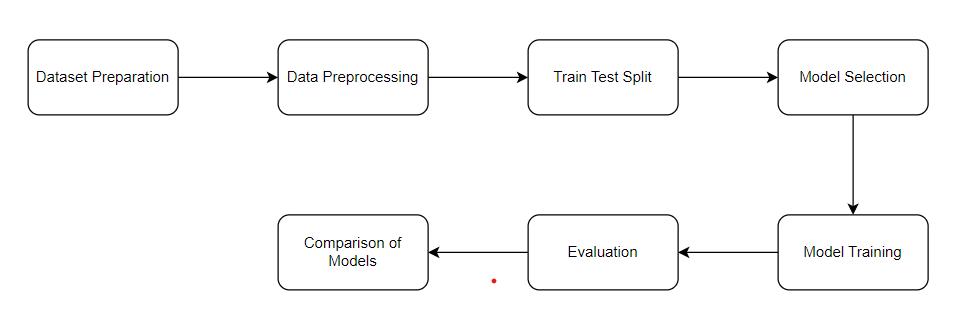
Fig1.Flowdiagram
3.4 Equations used
1.Precision(PositivePredictiveValue):
Precisionistheratiooftruepositivepredictionstothe total predicted positives. It measures the accuracy of positivepredictionsmadebythemodel.
International Research Journal of Engineering and Technology (IRJET) e-ISSN: 2395-0056
Volume: 11 Issue: 05 | May 2024 www.irjet.net p-ISSN: 2395-0072
Precision=True Positives
TruePositives+FalsePositives
2.Recall(SensitivityorTruePositiveRate):
Recall is the ratio of true positive predictions to the total actual positives. It measures the ability of the model tocapturealltherelevantinstances.
Recall=TruePositives
TruePositives+FalseNegatives
3.F1Score:
The F1 score is the harmonic mean of precision and recall. It provides a balance between precision and recall and is particularly useful when there is an imbalance betweenclasses.
F1Score=2×Precision×Recall
Precision+Recall
Thesemetricsarecommonlyusedinclassificationtasksto evaluate the performance of machine learning models, particularly in scenarios where imbalances between positiveandnegativeclassesexist.
The dataset is created in matlab and has 50000 samples 40000normalsamplesand10000anomaloussamples.The datasetconsists of10 features. All the models were tested using the dataset and the results are shown in the table below:
30201
0745
0534
Table -1: ComparisonofIsolationForest,One-ClassSVM, andLSTMModels
Precision:
Isolation Forest: The precision for Isolation Forest is relatively low (0.11), indicating a high number of false positives. The model's predictions of anomalies have a highchanceofincludingnormalinstances.
One-ClassSVM:SimilartoIsolationForest,One-ClassSVM also has a low precision (0.17), suggesting a notable numberoffalsepositives.
LSTM: The LSTM model shows a precision of 1.0, which meansthatallinstancespredictedasanomaliesareindeed anomalies.Therearenofalsepositives.
Recall:
Isolation Forest: The recall for Isolation Forest is moderate (0.51), indicating that the model captures aroundhalfoftheactualanomalies.
One-Class SVM: One-Class SVM has a higher recall (0.77) comparedtoIsolationForest,suggestingabetterabilityto identifyanomalies.
LSTM: The LSTM model shows a recall of 1.0, indicating that it captures all actual anomalies. There are no false negatives.
F1-Score:
Isolation Forest: The F1-score for Isolation Forest is low (0.19), reflecting a balance between precision and recall, butbotharerelativelylow.
One-Class SVM: The F1-score for One-Class SVM is also low (0.28), suggesting a trade-off between precision and recall.
LSTM:TheLSTMmodelachievesaperfectF1-scoreof1.0, indicating a harmonious balance between precision and recall.Thisisbecauseprecisionandrecallareboth1.0.
In summary, the LSTM model appears to outperform Isolation Forest and One-Class SVM in terms of precision, recall, and F1-score. It achieves perfect scores, indicating that it correctly identifies anomalies without any false positivesorfalsenegatives.
Anomaly detection, a pivotal aspect of SATCOM security, wasapproachedthroughthelensofthreedistinctmodels: Isolation Forest, One-Class SVM, and Long Short-Term Memory(LSTM)neuralnetworks.
- Isolation Forest and One-Class SVM: Both models demonstrated varying degrees of success in identifying anomalies. Isolation Forest and One-Class SVM exhibited limitations in achieving a balance between precision and recall. Isolation Forest, while showing moderate recall, suffered from a high number of false positives, impacting precision. One-Class SVM demonstrated improved recall butstillfacedchallengesinprecision.
- LSTM: The LSTM model showcased exceptional performance, achieving perfect precision, recall, and F1score.TheLSTMmodel,withitsdeeplearningcapabilities,
International Research Journal of Engineering and Technology (IRJET) e-ISSN: 2395-0056
Volume: 11 Issue: 05 | May 2024 www.irjet.net p-ISSN: 2395-0072
demonstrated a profound ability to discern anomalies withoutanyfalsepositivesorfalsenegatives.
Theanomalydetectionmodelcomparisonunderscoresthe superiority of the LSTM model, indicating its potential for robust anomaly identification in SATCOM systems. However, the choice of the most suitable model depends onspecificusecases,datacharacteristics,anddeployment scenarios.
The dataset used was generated in MATLAB and the results might vary for actual datasets. Given that the dataset was artificially generated in MATLAB, it's understandable that the LSTM model achieved perfect results.
In addition to the current findings, there exists a rich landscapeofpotentialfuturedirectionstofurtherenhance the efficacy and applicability of anomaly detection in satellitecommunication.
Oneavenue forfuture exploration involvesthe evaluation of the developed models on real-world datasets sourced from satellite communication systems, providing crucial insights into their performance under authentic operationalconditions.
Furthermore, the incorporation of advanced feature engineering techniques tailored to satellite communication data could yield improvements in model robustnessanddetectioncapabilities.
Additionally, the optimization of model parameters and architectures, guided by domain-specific knowledge, presents an opportunity to refine and tailor the anomaly detection process to the intricacies of satellite communicationsystems.
Moreover, the exploration of dynamic adaptation and continuallearningmechanismscouldenablethemodelsto evolveandadapttochangingcommunicationpatternsand emerginganomaliesovertime.
Cross-domainapplicationofthedevelopedmodelsbeyond satellite communication, such as in network security or financial fraud detection, offers avenues for broader impactandvalidationoftheirgeneralizationcapabilities.
Finally, considerations of scalability and efficiency are paramount for the deployment of anomaly detection models in large-scale satellite communication infrastructures, necessitating optimizations for real-time processingandresource-constrainedenvironments.
By addressing these future research directions, we aim to propel the field of anomaly detection in satellite communication towards greater efficacy and practical utility.
[1] Yakun Wang, Jianglei Gong, Jie Zhang, Xiaodong Han, "A Deep Learning Anomaly Detection Framework for Satellite Telemetry with Fake Anomalies", International Journal of Aerospace Engineering, vol. 2022, Article ID 1676933, 9 pages, 2022. https://doi.org/10.1155/2022/1676933
[2] Abebe Diro, Shahriar Kaisar, Athanasios V. Vasilakos, AdnanAnwar,ArazNasirian,GaddisaOlani,“Anomaly detectionforspaceinformationnetworks:Asurveyof challenges, techniques, and future directions”, Computers & Security, Volume 139, 2024, 103705, ISSN 0167-4048, https://doi.org/10.1016/j.cose.2024.103705.
[3] F.T.Liu,K.M.TingandZ.-H.Zhou,"IsolationForest," 2008 Eighth IEEE International Conference on Data Mining, Pisa, Italy, 2008, pp. 413-422, doi: 10.1109/ICDM.2008.17.
[4] N. Abdelsalam, S. Al-Kuwari and A. Erbad, “Physical layersecurityinsatellitecommunication:State-of-theart and open problems”, 2023, [online] Available: https://arxiv.org/abs/2301.03672.
[5] Zixiang Jia, “Anti-jamming Technology in Small Satellite Communication” 2018J. Phys.: Conf. Ser.960012013
[6] Dan Shen, Gang Wang, Genshe Chen, Khanh D. Pham, Erik Blasch, “Network survivability oriented Markov games (NSOMG) in wideband satellite communications” 2014, 2014 IEEE/AIAA 33rd Digital AvionicsSystemsConference(DASC)
[7] Xi, Y.; Liu, J.; Zhao, W. “SATCOM Earth Station Arrays Anti-Jamming Based on MVDR Algorithm”.Appl. Sci.2023,13,8337.
[8] Li, Jiong. (2021). Satellite communication antijamming based on ABC blind source separation. 10.21203/rs.3.rs-279435/v1.
[9] I. Ahmad, J. Suomalainen, P. Porambage, A. Gurtov, J. Huusko and M. Höyhtyä, "Security of SatelliteTerrestrial Communications:ChallengesandPotential Solutions," in IEEE Access, vol. 10, pp. 96038-96052, 2022,doi:10.1109/ACCESS.2022