
International Research Journal of Engineering and Technology (IRJET) e-ISSN: 2395-0056
Volume: 11 Issue: 05 | May 2024 www.irjet.net p-ISSN: 2395-0072
International Research Journal of Engineering and Technology (IRJET) e-ISSN: 2395-0056
Volume: 11 Issue: 05 | May 2024 www.irjet.net p-ISSN: 2395-0072
Clifa Mascarenhas1 , Nadine Dias2
1Student, Department of Information Technology and Engineering, Goa College of Engineering, Farmagudi, Goa, India
2Assistant Professor, Department of Information Technology and Engineering, Goa College of Engineering, Farmagudi, Goa, India ***
Abstract - Image forgery is a growing concern in today's digital age, where images can be easily manipulated and altered using various software tools. The proposed project aims to tackle the pressing issue of image forgery in the digital era by utilizing advanced deep learning techniques for detection. By curating a dataset containing both authentic and manipulated images, the project seeks to expose the model to various forgery scenarios. Through the use of lightweight deep learning architectures, strategic data preprocessing, transfer learning from pre-trained models, and rigorous training, the project endeavours to develop a reliable system for automated forgery detection. This comprehensive approach is designed to enhance image forensics and safeguard the credibility and integrity of visual content in the face of increasing threats posed by image manipulation.
Key Words: image forgery, lightweight deep learning architectures, transfer learning, image forensics, image manipulation
1.INTRODUCTION
Image forgery, the manipulation of digital images, is a growingconcernintoday'sdigitalage.Withtheincreasing use of digital images in various fields such as forensic investigation, criminal investigation, intelligence systems, medical imaging, insurance claims, and journalism, the credibilityandintegrityofvisualcontentareatstake.The easeofimagemanipulationusingadvancedsoftwaretools hasmadeitchallengingtodistinguishbetweenauthenticand manipulatedimages.
Toaddressthischallenge,researchershaveturnedtodeep learning techniques to develop automated image forgery detection systems. Deep learning models, such as convolutional neural networks (CNNs), have shown promising results in detecting image forgery with high accuracy. These models can learn complex features from largedatasetsofauthenticandmanipulatedimages,enabling them to distinguish between genuine and manipulated images.
This paper presents a novel approach to image forgery detection using deep learning techniques. The proposed approach involves a curated dataset of authentic and
manipulatedimages,strategicdatapreprocessing,transfer learningfrompre-trainedmodels,andrigoroustraining.The paper emphasizes the importance of maintaining image authenticityand proposesfuture directionsforimproving detectionandlocalizationofdigitalforgeries.
The rest of the paper is organized as follows: Section 2 describestheRelatedworkdoneinthisdomain.Themethod proposedwhichincludestheuseoftransferlearningfrom pre-trained models and Procedure is given in Section 3. ConclusionsarediscussedinSection4.
In the pursuit of tackling image forgery, researchers have explored various methodologies, each contributing to the evolving landscape of digital forensics. Traditional approachesoftenreliedon handcraftedfeaturesandrulebasedalgorithms,butrecentadvancementshavewitnessed a paradigm shift towards data-driven techniques, particularlydeeplearning.Here,wedelveintoabriefreview of related work, highlighting key developments in image forgerydetection:
Traditionalimageforgerydetectionmethodsoftenfocused onextractinghandcraftedfeaturessuchastexture,color,and shape. Techniques like error level analysis (ELA), wavelet transforms, and statistical measures were commonly employed. While these methods showcased effectiveness, they struggled to adapt to the complexities of modern forgerytechniques.
Traditional image forgery detection methods have historicallyreliedonextractinghandcraftedfeaturesfrom images, including texture, color, and shape, to identify potentialanomaliesindicativeoftampering.Thesemethods aimedtoleverageintrinsiccharacteristicsofdigitalimages todistinguishbetweenauthenticandmanipulatedcontent. Techniques such as error level analysis (ELA), wavelet transforms, and statistical measures were commonly employedinthisregard.
International Research Journal of Engineering and Technology (IRJET) e-ISSN: 2395-0056
Volume: 11 Issue: 05 | May 2024 www.irjet.net p-ISSN: 2395-0072
ELA is a widely used technique in traditional image forensics, based on the observation that different compressionlevelsareappliedtoregionsofanimageduring multiple save operations. By resaving an image with a known compression level and then comparing it to the original,regionswithinconsistentcompressionartifactscan be identified, potentially indicating areas that have been digitallyaltered.ELAexploitsthesediscrepanciestodetect forgeries,althoughitseffectivenesscanbelimitedincasesof sophisticated manipulation or when the image undergoes additionalprocessing.
Wavelettransformshavebeenextensivelyutilizedinimage processingandforensicsduetotheirabilitytodecompose imagesintodifferentfrequencybands.Inforgerydetection, wavelet transforms are employed to analyze variations in frequency content across different regions of an image. Alterationssuchascopy-move,splicing,orretouchingoften introduceirregularitiesinthefrequencydomain,whichcan bedetectedthroughcarefulanalysisofwaveletcoefficients. However, the efficacy of wavelet-based methods may diminishinthepresenceofnoiseorwhendealingwithhighresolutionimageswithsubtlemanipulations.
StatisticalMeasures:
Traditional forgery detection methods also relied on statistical measures to identify anomalies within images. These measures encompassed a range of statistical properties, including pixel intensity distributions, spatial correlations, and higher-order statistics. By quantifying deviations from expected statistical distributions, these methods aimed to flag regions of an image that exhibited irregularbehaviorindicativeoftampering.However,their performancecouldbeinfluencedbyfactorssuchaslighting conditions,imagecontent,andthespecificcharacteristicsof theforgery.
ChallengesandLimitations:
While traditional image forgery detection methods demonstratedeffectivenessincertainscenarios,theyfaced significant challenges in adapting to the complexities of modern forgery techniques. With the proliferation of advanced image editing tools and sophisticated manipulation algorithms, traditional methods often struggled to reliably detect subtle alterations or forgeries designed to evade detection. Moreover, the increasing prevalenceofhigh-resolutionimagesandtherapidevolution of digital media presented new challenges for traditional techniques, which may have been designed with older, lower-resolutionimageryinmind.
ErrorLevelAnalysis(ELA)hasemergedasapopularpostprocessing technique in digital image forensics, offering valuableinsightsintothecompressionhistoryofanimage. By analyzing the discrepancies in compression artifacts acrossdifferentregionsofanimage,ELAcanhelpidentify areas that have undergone multiple save operations or digitalalterations.Thistechniquehasbeenwidelyadopted by forensic analysts and researchers alike for detecting variousformsofimagemanipulation,includingcopy-move, splicing,andretouching.
ELA operates on the principle that different compression levelsareappliedtoregionsofanimageduringsuccessive save operations. By resaving an image with a known compression level and comparing it to the original, ELA highlights areas with inconsistencies in compression artifacts,indicatingpotentialtampering.Thisprocessallows forensicexaminerstopinpointsuspiciousregionsforfurther analysis, guiding subsequent investigations into the authenticityoftheimage.
InadditiontoELA,forensictoolssuchasAdobePhotoshop's Content-Aware Fill have played a significant role in tampering detection. Content-Aware Fill is a powerful featurethatenablesuserstoseamlesslyremoveorreplace objects within an image by intelligently filling in the surrounding areas based on the image content. While Content-AwareFillcanbeavaluabletoolfordigitalediting and retouching, it has also been leveraged by forensic analyststodetecttamperedregions.
However, despite the utility of ELAand forensic tools like Content-Aware Fill, they often lack the automation and scalabilityofferedbydeeplearningtechniques.ELArequires manual inspection and interpretation of compression artifacts, making it labor-intensive and time-consuming, especially when dealing with large datasets or highresolutionimages. Similarly, whileContent-Aware Fill can identify potential tampering, it may not always provide definitiveevidenceordetectsubtlemanipulationsthatevade visualinspection.
Theadventofdeeplearninghasrevolutionizedthefieldof digitalimageforensicsbyenablingautomatedandscalable approachestotamperingdetection.Deeplearningmodels, particularly convolutional neural networks (CNNs), have demonstratedremarkableperformanceinidentifyingforged or manipulated images, leveraging large datasets and powerfulcomputationalresourcestolearncomplexpatterns andfeaturesindicativeoftampering.Bytrainingondiverse sets of authentic and manipulated images, deep learning modelscangeneralizewelltodetectawiderangeofforgery techniqueswithhighaccuracyandefficiency.
International Research Journal of Engineering and Technology (IRJET) e-ISSN: 2395-0056
Volume: 11 Issue: 05 | May 2024 www.irjet.net p-ISSN: 2395-0072
Theintegrationofdeeplearning,particularlyconvolutional neuralnetworks(CNNs),hascatalyzedasignificantleapin the field of image forgery detection. Unlike traditional methods that rely on handcrafted features and heuristic approaches, deep learning models have demonstrated unparalleledcapabilitiesinlearningintricatepatternsand featuresdirectlyfromrawimagedata.
Various deep learning architectures, such as MobileNet, VGG16, and ResNet, have been successfully applied to the task of image forgery detection. These architectures are characterized by their deep, hierarchical structures composed of multiple layers of convolutional and pooling operations,whichenablethemtolearnincreasinglyabstract representationsofimagecontent.
MobileNet, for instance, is renowned for its efficiency and lightweight design, making it suitable for resourceconstrainedenvironmentsorreal-timeapplications.Despite itscompactsize,MobileNetretainsimpressiveperformance in detecting forged or manipulated images, thanks to its depthwiseseparableconvolutionsandparameter-efficient design.
On the other hand, VGG16, with its deeper architecture comprisingmultipleconvolutionallayersfollowedbyfully connectedlayers,excelsincapturingfine-graineddetailsand subtle features indicative of tampering. VGG16's ability to learn rich representations of image content has made it a popularchoiceforimageclassification,objectdetection,and forgerydetectiontasks.
Oneofthekeyadvancementsfacilitatedbydeeplearningis transfer learning, a technique that leverages pre-trained modelsonlargedatasetstoexpeditetrainingandenhance modelgeneralization.Byinitializingadeeplearningmodel with weights learned from a large-scale dataset, such as ImageNet,and fine-tuningit ona smaller, domain-specific datasetofmanipulatedimages,transferlearningenablesthe modeltoquicklyadapttothenuancesofforgerydetection.
Transferlearningnotonlyacceleratesthetrainingprocess butalsoimprovestherobustnessandperformanceofdeep learning models by leveraging the rich representations learned from diverse visual concepts in the pre-trained network. This approach has been instrumental in democratizingdeeplearningforforgerydetection,enabling researchers and practitioners with limited resources to achievestate-of-the-artresultswithminimaleffort.
[1] Francesco Marra, Diego Gragnaniello, Luisa Verdoliva, Giovanni Poggi proposed a CNN-based image forgery detectionframeworkdesignedtomakedecisionsusingfullresolutioninformationgatheredfromtheentireimage.To overcome limited memory resources and rely on weak
(image-level) supervision, the framework incorporates gradientcheckpointing,enablingend-to-endtraining.
The architecture consists of three independent blocks: patch-level feature extraction, feature aggregation, and decision.Eachblockistrainedseparately.Xception,adeep learningmodelknownforitsperformanceinimage-related tasks,isutilizedintheframework.
The research reports an average AUC (Area Under the Curve) of 0.824, suggesting promising performance in the detectionofforgedimages.
[2] A-Rom Gu; Ju-Hyeon Nam; Sang-Chul Lee proposed a forgery localization approach using a Discrete Cosine Transformation (DCT)-based multi-task learning network calledFBI-Net.
Thenetworkisdesignedforforgerydetectionandincludes anencoder-decodermodelcapableofend-to-endlearning. DCTfilteringisemployedtoextractfrequencyinformation fromtheinputimages,andatechniquecalledDFSAM(DCT FilteringandSpatialAttentionModule)isusedtocombine thesefeatures,emphasizingthetracesoftheforgedregion. Additionally,apre-trainedsegmentationmodelisintegrated to guide the location of specific forged objects during the decodingprocess.
The proposed FBI-Net achieves a promising F1-score of 76.98%, indicating effective forgery localization and detectionperformance.
[3] Ali, S.S.; Ganapathi, I.I.; Vu, N.-S.; Ali, S.D.; Saxena, N.; Werghi,N.proposeda robustdeeplearning-basedsystem tailored for identifying image forgeries in the context of doubleimagecompression.Theproposedsystemfeaturesa lightweight CNN model with minimal parameters, comprising three convolutional layers and a dense fully connectedlayer.
Despite its simplicity, the model achieves a commendable accuracy of 92.23%, highlighting its effectiveness in accurately detecting forged images subject to double compression. The emphasis on robustness and efficiency makesthissystemapotentiallyvaluabletoolinthefieldof digital forensics, particularly for scenarios involving manipulatedimageswithmultiplecompressionstages.
[4]A.H.Khalil,A.Z.Ghalwash,H.A.-G.Elsayed,G.I.Salama and H. A. Ghalwash proposed technique which focuses on identifyingforgedareasindigitalimagesbyleveragingthe differencesincompressedqualitybetweenthemanipulated regionandtherestoftheimage.
Adeeplearning-basedmodelisemployedtodetectforgery bycalculatingthedissimilaritybetweentheoriginalimage and its compressed counterpart. The process involves generatingafeaturedimage,whichservesasinputtoapre-
International Research Journal of Engineering and Technology (IRJET) e-ISSN: 2395-0056
Volume: 11 Issue: 05 | May 2024 www.irjet.net p-ISSN: 2395-0072
trained model for training. Subsequently, the model's classifierisremoved,andanewclassifierisfine-tuned.
The technique is tested against various frameworks, with threeofthebestperformersbeingVGG19,MobileNet,and ResNet50, achieving detection accuracy rates of 94.77%, 94.69%,and94.6%,respectively.MobileNetishighlighted foritsoptimalbalancebetweenhighdetectionaccuracyand minimal computational costs and training time. This approach demonstrates promise in effectively detecting imageforgeries,particularlyinscenarioswherecompressed qualitydiscrepanciesrevealmanipulatedregions.
[5] Sudiatmika, Ida & Rahman, Fathur & Trisno, Trisno & Suyoto,SuyotoemployedDeepLearningtechniquesVGG16 todiscernmanipulationsinimages.Thedatasetconsistsof both manipulated images and authentic ones, and Error LevelAnalysis(ELA)isappliedtoeachimage,accompanied by supporting parameters for error rate analysis. The experimental outcomes reveal compelling results, showcasinganoteworthyaccuracyof92.2%duringtraining and88.46%invalidationafter100epochs.Thissignifiesthe effectiveness of their approach in accurately identifying manipulated images, demonstrating the potential of combining Deep Learning and ELA for image forgery detection.
The availability of diverse datasets, such as CASIA and ImageNet,hasplayedapivotalroleintrainingdeeplearning models.Thesedatasetsencompassawiderangeofforgery scenarios,aidingmodelsinlearningfeaturesthatgeneralize welltodifferenttypesofimagemanipulation.
Despitetheadvancements,challengespersist,includingthe detection of adversarial attacks and unseen manipulation techniques.Futuredirectionsinvolveexploringmorerobust architectures,incorporatingdomain-specificknowledge,and addressingethicalconsiderationsinimageforensics.
Theevolutionofimageforgerydetectionreflectsatransition from rule-based methods to data-drivenapproaches,with deep learning at the forefront. The exploration of diverse datasets and the continuous refinement of model architecturesunderscorethedynamicnatureofresearchin thisdomain.
Intherealmofdigitalcontent,imageforgeryhasbecome a pressing issue due to the widespread availability of sophisticated editing tools. Originally intended for image enhancement, these tools are now frequently misused to manipulateimages,raisingconcernsaboutmisinformation, deception,andmaliciousintent.Imageforgerymanifestsin
variousforms,includingcommontechniqueslikecopy-move forgeryandsplicing,wherepartsofanimageareduplicated orcombinedtocreatedeceptivevisuals.
To address these challenges, the integration of deep learning techniques, particularly convolutional neural networks (CNNs), has shown great promise in the field of image forensics. Deep learning models excel in pattern recognitionandfeatureextraction,enablingthemtodetect subtlealterationswithinimageseffectively.Thefundamental concept is to equip machines with the capability to autonomously distinguish between authentic and manipulatedimages.
By utilizing a diverse dataset representing real-world scenarios,deeplearningmodelslikeVGG,Resnet,MobileNet can learn complex patterns indicative of forgery. During training, the model is exposed to both genuine and manipulated images, enabling it to identify features that traditionalmethodsmightoverlook.
Deeplearningarchitecturesplayapivotalroleinimage forgerydetection,offeringdiversetrade-offsbetweenmodel complexity, computational requirements, and detection performance. Among the prominent architectures, VGG, ResNet, and MobileNet stand out for their distinct characteristicsandapplicabilityinforensicapplications.
VGGisrenownedforitsdepthandsimplicity,comprising multiple layers of convolutional and pooling operations stacked sequentially. While VGG achieves impressive performanceincapturingfine-graineddetailsandcomplex patterns in images,itsarchitectural complexitycomesata cost in terms of computational requirements and memory footprint.ThesheernumberofparametersinVGGmodels, particularly VGG16 and VGG19, necessitates substantial computational resources for training and inference. Additionally, the computational overhead associated with processing high-resolution images or large datasets can furtherexacerbatethecomputationalburdenofVGGmodels, limitingtheirscalabilityandreal-timeapplicability.
ResNet introduced a groundbreaking architectural innovationwiththeconceptofresidualconnections,which alleviate the vanishing gradient problem and facilitate the trainingofextremelydeepnetworks.Despiteitsremarkable performanceinachievingstate-of-the-artresultsonvarious computervisiontasks,ResNet'sdepthandparametercount render it computationally intensive, especially for training fromscratchonlargedatasets.Thedeepstackingofresidual blocks in ResNet architectures, such as ResNet50 and ResNet101, requires significant memory resources and computational power, making them less practical for
International Research Journal of Engineering and Technology (IRJET) e-ISSN: 2395-0056
Volume: 11 Issue: 05 | May 2024 www.irjet.net p-ISSN: 2395-0072
resource-constrained environments or applications with stringentlatencyrequirements.
MobileNet:
In contrast to VGG and ResNet, MobileNet offers a lightweightandefficientalternativetailoredfordeployment on resource-constrained devices or scenarios where computationalefficiencyisparamount.MobileNetachieves its efficiency through depthwise separable convolutions, which factorize standard convolutions into depthwise and pointwiseconvolutions,significantlyreducingthenumberof parameters and computational cost while preserving representational capacity. This design choice not only minimizes the memory footprint and computational overheadofMobileNetmodelsbutalsoacceleratesinference speed, making them well-suited for real-time applications, edgecomputing,andmobileplatforms.
TheefficiencyandscalabilityofMobileNetmodelsmakethem particularly attractive for image forgery detection tasks, where rapid processing of large volumes of image data is essential.ComparedtoVGGandResNet,MobileNetmodels offeracompellingbalancebetweendetectionperformance andcomputational efficiency,enablingforensic analyststo deploy sophisticated forgery detection systems on diverse hardwareplatformswithminimalcomputationaloverhead. Moreover, the lightweight nature of MobileNet models facilitates their integration into embedded systems, IoT devices,andcloud-basedservices,democratizingaccessto state-of-the-artforgerydetectioncapabilitiesacrossvarious domains.
In conclusion, the choice of deep learning architecture for imageforgerydetectiondependsonacarefulconsideration of factors such as computational requirements, detection performance, and deployment constraints. While VGG and ResNet offer exceptional accuracy and representational capacity, their computational demands may limit their applicabilityinresource-constrainedenvironments.Onthe other hand, MobileNet's lightweight design and computationalefficiencymakeitanattractiveoptionforrealtimeforgerydetection,enablingscalableandcost-effective solutions that can be deployed across a wide range of platformsandscenarios.
MobileNetV3, the latest iteration of the MobileNet architecture,isoptimizedforefficientdeploymentonmobile andedgedeviceswithcomputationalconstraints.Introduced toenhanceperformanceoverMobileNetV1andMobileNetV2, MobileNetV3 incorporates novel architectural elements to strike a balance between model accuracy and efficiency. Introduced in the paper "Searching for MobileNetV3" by Andrew Howard et al. [6], MobileNetV3 employs neural architecture search to produce variants like "Large" and "Small"models.Itfeaturesefficientinvertedresidualblocks, innovativeactivationfunctionslikeSwish,andSqueeze-andExcitation blocks for improved feature extraction.
MobileNetV3achievesenhancedaccuracywhilemaintaining computational efficiency, making it ideal for real-time applications such as object detection and image segmentation.Itsversatilityisevidentintherangeofvariants tailoredtodifferentdeploymentscenarios.
The application of deep learning in image forgery detection reflects the evolving landscape of artificial intelligence and its potential to bolster digital security. As these techniques progress, they offer robust solutions to combattheincreasingsophisticationofimagemanipulation tools,promisingamoresecuredigitalenvironment.
Intheproposedmethodforimageforgerydetection,we harnessthepoweroftransferlearningfromdeeplearning models alongside the integration of forensic tools such as ErrorLevelAnalysis(ELA).Transferlearningoffersapotent strategyforleveragingtheknowledgegainedfromlarge-scale datasetsbypre-traineddeeplearningmodels.Thesemodels, suchasMobileNet,VGG16,orResNet,havebeenextensively trained on diverse image datasets like ImageNet, enabling themtoextractintricatefeaturesfromimages.Byemploying transfer learning, we can capitalize on the learned representationsencodedinthesemodelsandadaptthemto theforgerydetectiontask.Thisinvolvesfine-tuningthetop layersofthepre-trainednetworkwhilepreservingthelower layers, which serve as feature extractors. Through this process, the model learns to discern subtle patterns indicative of image forgeries, enhancing its detection capabilities.
Alongside transferlearning,weintegrate forensic tools like Error Level Analysis (ELA) into the forgery detection pipeline. ELA serves as a valuable forensic technique for highlightingpotentialregionsoftamperingormanipulation within digital images. By analyzing the discrepancies in compressionlevelsacrossdifferentregionsofanimage,ELA can reveal artifacts introduced during image manipulation processes.Theseartifacts,oftenimperceptibletothehuman eye, provide valuable cues for identifying forged regions within an image. By incorporating ELA-enhanced features alongside deep learning-based representations, we aim to enrichthefeaturesetusedforforgerydetection.Thisfusion ofdeeplearningandforensicanalysistechniquesenablesa holisticapproachtoimageforgerydetection,leveragingthe strengths of both methodologies to enhance the model's accuracy and robustness. Through this synergistic integration,ourproposedmethodaimstoadvancethestateof-the-art in digital forensics, enabling more effective detectionand mitigation of image forgeriesacross various applicationsanddomains.
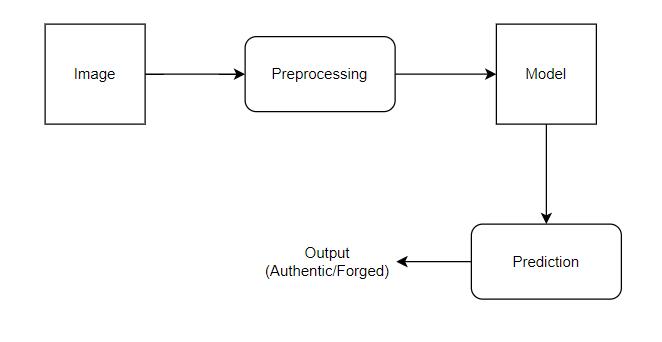
Input:Curateddataset withauthentic and manipulated images.
International Research Journal of Engineering and Technology (IRJET) e-ISSN: 2395-0056
Volume: 11 Issue: 05 | May 2024 www.irjet.net p-ISSN: 2395-0072
Initialization:Chooseasuitabledeeplearningarchitecture (e.g.,MobileNetv3).Prepareabalanceddatasetfortraining andevaluation.
DataPreprocessing:Standardizeimagedimensions(e.g., resizeto224x224pixels).Augmentdatasetusingzooming, shifting, and shearing for diversity. Applying ELA on the images.
TransferLearning:UtilizeapretrainedMobileNetv3ona large-scaledataset.Fine-tunethemodelforforgerydetection usingthecurateddataset.
Training:Splitdatasetintotrainingandtestsets.Trainthe modelwithoptimizationtechniques(e.g.,gradientclipping, batch normalization). Use binarycross-entropyas the loss function.
Evaluation:Assessmodelusingaccuracy,precision,recall, and F1-score metrics. Ensure robustness across various forgeryscenarios.
Result Analysis: Analyse accuracy on the test dataset. Identifyareasforpotentialimprovement.
Further Optimization: Explore techniques to enhance accuracy, addressing false positives and false negatives. Iterateonthealgorithmbasedonanalysisandfeedback.
Output: Reliable forgery detection and localization algorithm
In conclusion, this survey paper highlights the synergistic potentialofintegratingtransferlearningfromdeeplearning modelsandforensictoolslikeErrorLevelAnalysis(ELA)for image forgery detection. Through an extensive review of existing research and methodologies in the field, we have observedthatbothtransfer learningandforensicanalysis techniques offer unique advantages and capabilities in identifyingimageforgeries.
Transfer learning enables the adaptation of knowledge learnedfrompre-traineddeeplearningmodelstonewtasks, significantly enhancing the efficiency and effectiveness of forgerydetectionalgorithms.Byleveragingtherichfeature representations learned by these models on large-scale datasets, transfer learning empowers forgery detection systemstocapturesubtlepatternsandanomaliesindicative ofimagemanipulations.
Ontheotherhand,forensictoolslikeELAprovidevaluable insights into the compression history of digital images, revealing potential regions of tampering or manipulation. ELA operates on the principle of analyzing differences in compression levels within an image, allowing forensic analyststoidentifysuspiciousareasthatmayrequirefurther investigation.
Bycombiningthestrengthsoftransferlearningandforensic toolslikeELA,webelievethatforgerydetectionsystemscan achieveunprecedentedlevelsofaccuracy,robustness,and adaptability.Theintegrationofdeeplearning-basedfeature extractionwithforensicanalysistechniquesoffersaholistic approachtoimageforensics,enablingthedetectionofawide rangeofforgerytypesandmanipulationmethods.
Insummary,oursurveypaperunderscoresthesignificance of collaborative efforts between transfer learning and forensic tools in advancing the field of image forgery detection. We advocate for further research and developmentinthisinterdisciplinarydomain,withtheaim ofcreatingmoresophisticatedandreliableforgerydetection systemscapableofaddressingtheevolvingchallengesposed bydigitalmanipulationtechniques.
The proposed algorithm addresses the challenge of image forgery detection by leveraging the capabilities of deep learning, specifically employing the MobileNetv3 architecture. Through a meticulous data preprocessing phase, including resizing and augmentation, a curated dataset is prepared, ensuring the model's exposure to diverse forgery scenarios. Transfer learning is applied, utilizing a pretrained MobileNetv3 model to expedite training and capture intricate features relevant to forgery detection.
[1] F.Marra,D.Gragnaniello,L.VerdolivaandG.Poggi,"A Full-ImageFull-ResolutionEnd-to-End-TrainableCNN Framework for Image Forgery Detection," in IEEE Access,vol.8,pp.133488-133502,2020.
[2] A.-R.Gu,J.-H.NamandS.-C.Lee,"FBI-Net:FrequencyBased Image Forgery Localization via Multitask Learning With Self-Attention," in IEEE Access, vol. 10, pp.62751-62762,2022.
[3] Ali, S.S.; Ganapathi, I.I.; Vu, N.-S.; Ali, S.D.; Saxena, N.; Werghi, N. Image Forgery Detection Using Deep
International Research Journal of Engineering and Technology (IRJET) e-ISSN: 2395-0056
LearningbyRecompressing Images.Electronics2022, 11,403.
[4] A.H.Khalil,A.Z.Ghalwash,H.A.-G.Elsayed,G.I.Salama andH.A.Ghalwash,"EnhancingDigitalImageForgery DetectionUsingTransferLearning,"inIEEEAccess,vol. 11,pp.91583-91594,2023.
[5] Sudiatmika, Ida & Rahman, Fathur & Trisno, Trisno & Suyoto,Suyoto.(2018).“Imageforgerydetectionusing errorlevelanalysisanddeeplearning”.TELKOMNIKA (Telecommunication Computing Electronics and Control).
[6] A. Howard et al., "Searching for MobileNetV3," 2019 IEEE/CVFInternationalConferenceonComputerVision (ICCV),Seoul,Korea(South),2019,pp.1314-1324,doi: 10.1109/ICCV.2019.00140.
[7] Dertat, A. Review: MobileNetV2 Light Weight Model (Image Classification).. Available online: https://towardsdatascience.com/review-mobilenetv2light-weight-model-image-classification-8febb490e61c (accessedon19May2019).
[8] ElsayedAbdElaziz,Mohamed&Al-qaness,Mohammed A. A. & Dahou, Abdelghani & Alsamhi, Saeed & Abualigah, Laith & Ibrahim, Rehab & Ewees, Ahmed. (2023).“Evolutiontowardintelligentcommunications: Impactofdeeplearningapplicationsonthefutureof6G technology.” Wiley Interdisciplinary Reviews: Data Mining and Knowledge Discovery. 14. 10.1002/widm.1521.
[9] Cheuque,César&Querales,Marvin&León,Roberto& Salas,Rodrigo&Torres,Romina.(2022).“AnEfficient Multi-LevelConvolutionalNeuralNetworkApproachfor WhiteBloodCellsClassification.”Diagnostics.12.248. 10.3390/diagnostics12020248.
[10] Ayoub Kirouane 2022, LinkedIn, accessed 2 February 2024,<https://www.linkedin.com/pulse/squeeze-andexcitation-networks-senet-ayoub-kirouane/>
[11] Kaur, Amanpreet and Richa Sharma. “Optimization of Copy-Move Forgery Detection Technique.” Computer EngineeringandApplications2(2013):n.pag.
[12] Islam,M.M.;Karmakar,G.;Kamruzzaman,J.;Murshed,M. ARobustForgeryDetectionMethodforCopy–Moveand Splicing Attacks in Images. Electronics 2020, 9, 1500. https://doi.org/10.3390/electronics9091500
Volume: 11 Issue: 05 | May 2024 www.irjet.net p-ISSN: 2395-0072 © 2024, IRJET | Impact Factor value: 8.226 | ISO 9001:2008
|