
International Research Journal of Engineering and Technology (IRJET) e-ISSN: 2395-0056
Volume: 11 Issue: 05 | May 2024 www.irjet.net p-ISSN: 2395-0072
International Research Journal of Engineering and Technology (IRJET) e-ISSN: 2395-0056
Volume: 11 Issue: 05 | May 2024 www.irjet.net p-ISSN: 2395-0072
Tejaswi
R1, Rajesh M Mysoremath2, Pradhan D Prabhu3, Honey Jain4, Prof. Mahitha G5
1,2,3,4Student Department of Computer Science and Engineering PES University Bangalore, India 5Professor, Department of Computer Science and Engineering PES University Bangalore, India ***
Abstract - Arecanut is one of the major crops in India. Because of its higher market value, it is grown more in India andother subtropical regions. This plant is susceptible to a number ofdiseases that cause great losses to farmers. These diseases occur due to sudden changes in temperature and other climatic conditions; Early detection of the disease is very important. This work involves a focus on early and accurate disease detection to reduce losses for farmers. The proposed work uses RGB images as input and a Res-Net model. It then assigns learnable weights and biases to different objects in the image, then based on the results, it learns to distinguish between them. Global average pooling is used for image detection.
Key Words: Arecanut, Res-Net (Residual Network), Global average pooling, RGB images.
1.INTRODUCTION
Arecanut is a crop that is widely cultivated in India. Karnataka, Kerala, and Assam are the major states that produceArecanutinIndia.Karnatakaproducesthelargest quantity of Arecanut in India, with a total cultivation area of218,010hectaresandaproductionof457.560tones.
Arecanut is mainly grown in the southern and coastal districtsofIndiaunderassuredirrigation.Thecropthrives well in areas with a temperature range of 20-34°C and an annual rainfall of 2000-5000 mm. The crop is grown as a garden crop and is usually intercropped with coconut, cocoa,pepper,andothercrops.
The crop is used in various forms, such as raw, boiled, orroasted,andisconsumedasamouthfreshener.Itisalso usedinAyurvedicmedicineforitsmedicinalproperties.
Since it has several importance in India and it is also a major commercial crop there are some challenges to cultivatethiscrop.In thatchallenge occurrenceofDisease is a major challenge due to changes in temperature and climaticconditions.
1. Koleroga/Mahali/Fruit Rot: This is a major diseaseofarecanutthatcausesseriouslosses.The Characteristic symptoms are rot and significant lossofimmaturefruits,scatterednearthebaseof the tree. Infected seeds lose their luster and
natural green quality and therefore have a low market value. Disease is spread by strong winds and torrentialrain. The severity, persistence and spread of fruit rot disease are related to rainfall patterns. The disease usually appears 15 to 20 daysaftertheonsetofregularmonsoonrainsand may last until the end of the rainy season. The pathogen is a fungus called Phytophthora palmivora.
2. Anabe Roga/Foot Rot: This disease is characterized bythe rotting of the roots and the lower part of the stem. Affected trees exhibit stunted growth, yellowing of leaves, and premature fruit drop. Disease caused by the fungusFusariumsolani
3. Bud Rot: This disease is characterized by the rotting of the apical bud and the surrounding leaves. Affected trees exhibit stunted growth, yellowingofleaves,andprematurefruitdrop.The disease is caused by the fungus Phytophthora palmivora
4. YellowLeafDisease:Thisdiseaseischaracterized byLeaftips of2 or3outermostwhorlleavesturn yellow.Brownnecrotic streaks run parallel to the spreading leaf veins. The yellow color extends to themiddle of the leaf blade. The tipsoftheleaves turn yellow and dry. At the advanced stage, all leaves turn yellow. The yellow color of the leaves is visible from October to December. Finally, the foliage falls, leavingthe tree trunk bare. The ends oftherootsturnblackandgraduallyrot
Dhanuja K C et.al [1] Proposed detection and identification of cau nodes at exceptional, fair and poor levels. The defective regions are segmented using DL algorithmandBPNNclassifierbasedonimagetechnique.A random sample of 48 excellent, 46 poor, and 49 poor images wasused to testthedevice. The classification rates for Excellent, Good, and Poor ratings were 91.7%, 89.1%, and 91.8%, respectively. And an average accuracy level of 90.9wasachieved. With theCD camera, the algorithm can accuratelyandsuccessfully locatelocationsanddetermine theconsistencyofarecanuts,buthecouldnotexaminethe coveredslides.
International Research Journal of Engineering and Technology (IRJET) e-ISSN: 2395-0056
Volume: 11 Issue: 05 | May 2024 www.irjet.net p-ISSN: 2395-0072
Akshay S et.al [2] Suggested identification of healthy and unhealthy areca nuts (with shell or without shell). Using the GLCM trait model, we classify areca nuts into healthy and unhealthy types. In the proposed system, 60 images are collected, including 30 healthy images and 30 unhealthy images, captured for training and testing purposes. Classification of these images into healthy and unhealthy classes is performed with 95° accuracy in the training phase and 90° accuracy in the testing phase. This means that only good quality areca nuts are selected; Arecanutpriceswillthereforeincreaseandfarmers'income will also increase. Themain objective of this model is to classifyrawmaterials(shelled)intohealthyandunhealthy, which is achieved by applying a decision tree algorithm. Thisachieves90%accuracy.
Meghana D R et.al [3] This article proposes a system to detect diseases on Arecanut trees using Convolutional NeuralNetwork(CNN)andsuggestsremediesforthesame. CNNisadeeplearningalgorithmthattakesimagesasinput andlearnstodistinguishdifferentobjectsintheimage.The authors createda separatedataset of 620 images of areca nuts, healthyand diseased, and divided it into a training set andatestingset.Theyusedcategoricalcross-entropyasthe loss function, Adam as the optimization function, and accuracyasthemetric tocompiletheirmodel.Theytrained the model for 50 epochsto achieve high validation and testingaccuracywithminimalloss.Theproposedmethodis found to be 88.46° curative in identifying Arecanut diseases, especially Mahali (Koleroga) disease, stem bleedingandyellowspotdisease.
Anilkumar M G et.al [4] proposed early detection of diseases on areca trees, leaves and stems using convolutional neural networks. The experiment was performed using ahealthy and diseased areca nut image dataset of 620 images. First, the images are preprocessed, followed by feature extraction, training, and classification. This project helpsdetect diseases on areca trees such as Mahali, stem bleeding, yellow leaf spots and provide solutions to overcome this problem. The accuracy of the working model is 88.66%. Enable them to make better yield decisions by allowing themto take all the necessary preventativeandcorrectivemeasuresontheirarecatrees.
Mamatha Balipa et.al [5] gives the classification and accuracydifferencesbetweenSVMandCNNmodel.Herethe authors have used a self-created dataset for the project with 200 original images and they are taken in Shivamogga. Thenthey augmented the images for training and testing the model.They considered the diseases like Koleroga, bud rot, yellow leaf disease, stem bleeding etc. theyconvertedthe imageto GLCMandGLDM matricesfor inputdatatoCNNandSVMmodels.TheSVMmodelgavethe accuracy of 0.75 eq(1) andCNN gave 0.9 eq(1) when the training and testing data was sent. Here this paper states that CNN has better Accuracy thanSVM model in image processingmodels.
Mallikarjuna et.al [6] Inthepaper,multigradientimages areusedheretodetectthediseaseinArecanutfruit.Multi gradient images are augmented and taken, they are then converted to array and sent to the ResNet model for training and testing. This model gave the accuracy of 80.02% for normal images and 82% for MGD images. ResNet is the mostefficient and popular model for image processing whichcontains up to 152 layers. ResNet can alsohandlevanishinggradientproblems.
Mohammed Khalid Kaleem, et.al [7] Inthepaperfocuses on developing a prediction model for the occurrence of Mahali/Koleroga/Fruit Rot disease in areca crops using machine learning algorithms such as Support Vector MachineRegression (SVMR) and Random Forest Classifier (RFC). The study was conducted in the areca fields of the Vittal region in Dakshina Kannada, Karnataka, India, from January2018 to April 2019, along with historic weather data. The environmental conditions that are suitable for the disease occurrence were identified as frequent splashes of rain, humidity higher than 90%, low temperatures in the range of 20 °C to 23 °C, and intermittent sunshine and rain hours, usually 15-20 days after the onset of monsoon. Environmentaldata such as temperature, rainfall, humidity, soil, and wind speed were collected using sensors such as DHT-11 and soilhumidity sensor. The collected data was processed and converted into a tabular format to develop the input dataset forthe model. The proposed algorithm involved calculating the difference between two consecutive data values, identifying patterns in the data, and predicting the occurrenceofthedisease.Theresultsofthestudycouldbe used to provide suitable countermeasures to prevent or controlthediseaseandimprovecropproductivity.
L. Vinod Kanan et.al [8] proposed a disease prediction system to address the challenges faced by the agricultural industry,suchasthegrowthofdiseasesinessentialcrops, whichhasresultedinascarcityoffoodsupplies.Theproposed system takes into consideration various environmental factors, such as temperature, humidity, rainfall, wind flow, andsoilmoisture,topredicttheoccurrenceofdisease.The system analyzes different relationships among these factorsandprovidesinformationpriortotheoccurrenceof disease. The study also presents a system to predict the susceptibility of Arecanut plants to disease infection by comparing data valuesobtained from IoT sensors, such as DHT11andsoilhumidity,withdatavaluesthathavecaused diseasesinplants,basedonhistoricalresearch.Aregression algorithm is used to identifysimilarities in the pattern of conditions, and a range is determined for scoring the results. The output obtained is manually confirmed with experience, helping to evaluate themodel effectively. The farmersarewarnedaboutthepossibilityofdiseasesothat theycantakenecessaryprecautions.
International Research Journal of Engineering and Technology (IRJET) e-ISSN: 2395-0056
Volume: 11 Issue: 05 | May 2024 www.irjet.net p-ISSN: 2395-0072
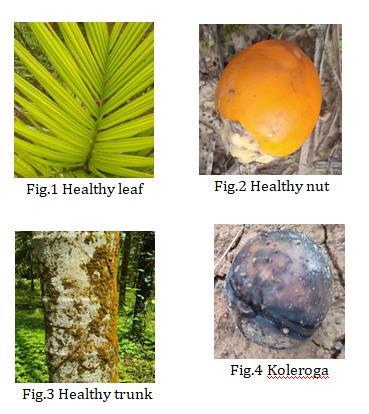
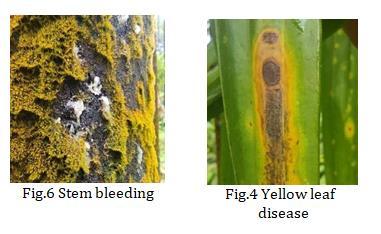
We searched for dataset in internet and all opensource sites but we got just a reference dataset with few image data which was not enough for our project so with the help of UAS Shivamogga we visited the cultivated farm and got the information about the Arecanut plant and its diseases. We took photos with the help of mobile at standard resolution. We took about 1200 images and augmented it to 11063 images. The figure 1-6 showthe sample images.
A. Dataset preparation
Thecollectedimagesweredividedintotheirrespective diseasecategory.Wehadtheimagesofstemcracking,Stem bleeding, Healthy Leaf, yellow leaf disease, healthy foot, HealthyTrunk,MahaliKoleroga,budborer,HealthyNut.
B. Data preprocessing
The images were augmented to reduce overfitting and underfitting of data. We used rotate, flip and rotate-flip techniquetoaugmentthedata.Theimagesizewasreduced to150*150pixeltoreducemorememoryusage.Theimages
arethen converted to float32 array which ranges form 0255. This conversion is because computers cannot read imagesdirectlylikehumanssotheimagesareconvertedto digits, the float32 gives higher precision and memory efficient than any other format so which helps to get minute information present in image and better accuracy duringdetection.
Deep convolutional neural networks have achieved great heightsinimageclassificationbut when deepernetworks are considered, there is a degradation problem where accuracy initially rises with increased depth but then reaches saturation and decreases with further depth increases. The error rate of training and testing set increases,thisindicatesthatitisnotcausedbyoverfitting. The Res-Net enhances the feature extraction ability by using cross layer feature fusion this helps in gradual increase in performance when depth is increased. The deeper Res-Net models were tested in acceptable time frame and it was compared with other deep learning models. Res-Net proved it has better classification performance than other models and accuracy can be improvedbyincreasingdepth.
Res-Net (Residual Neural Network) was proposed by theKaimingHeteamatMicrosoftResearchInstitute,andis also called Residual Network in Chinese. The basic motivationfortheRes-Netdesignwastosolvetheproblem of neural network degradation, where the error rate increases as the network depth increases. To address this issue, the teamproposed a residual structure in which the
2395-0056
Volume: 11 Issue: 05 | May 2024 www.irjet.net p-ISSN: 2395-0072
functionality of each network layer is reprogrammed as a residual function ofthe input to that layer. The concept of residualinmathematicalstatisticsisthedifferencebetween the actual observed value and the estimated (adjusted) value.
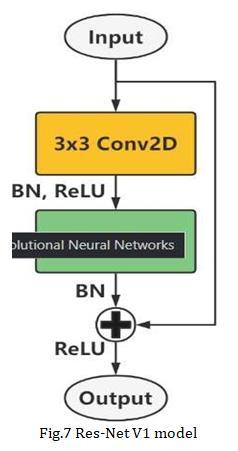
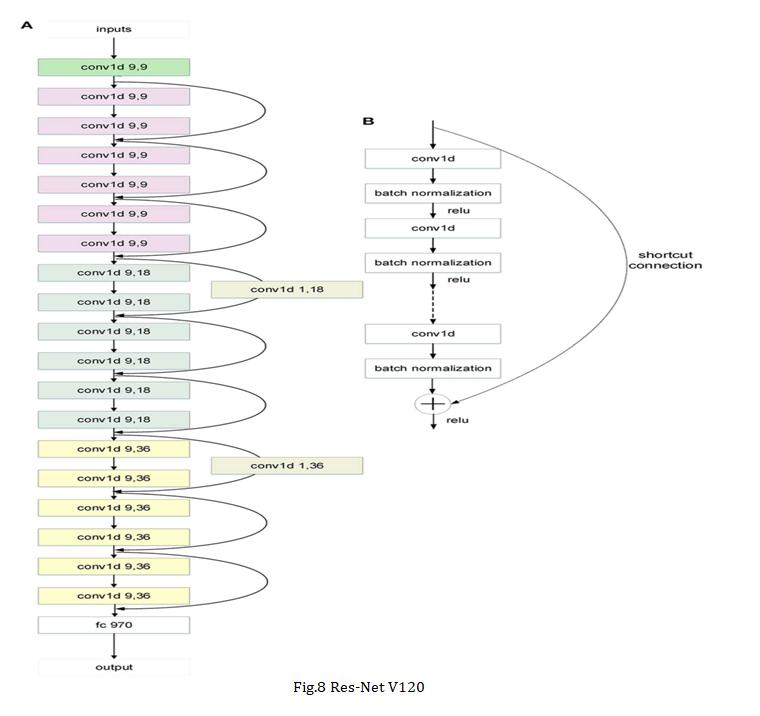
TherearemanytypesofRes-Netresidualsthatyoucan define depending on your project requirements. Figure 7 showstheremainingconfigurationofhisResnet-20usedin this paper, which successfully solves the mining problem. The remaining components include his two layers: convolution and identity mapping. The convolution kernel size is 3x3. Therefore, the input and output sizes of the residualcomponentsareequalandcanbeaddeddirectly.If the step size is 1, the fill layer becomes the original input layer after batch normalization, ReLU activation, and ResNetinputconvolution.Whenthestepsizeis2,theinputof Res-Net performs the same operation again before being averaged to obtain the fill layer. Finally, the input to the outputlayeristheoutputofthefilledlayerplus theoutput oftheresidualcomponent.
Inthisworka20-layerRes-Netversion1modelisused which has a stack of Conv2D-BN-ReLU 2 x (3 x 3) blocks where the feature map size is halved at the beginning of eachstage, and the number of filters is doubled. The stack of residual blocks for each stage creates the specified number ofresidual blocks containing Res-Net layers. The firstlayerof eachstagecontains2stridestodownsample the feature mapsize and uses residual connections to add theinputtensorwithoutputoftheresidualblock.
Thev1modelwillfirstundergo1dconvolutionandthenit is sent to Batch-normalization and then it is passed throughactivationfunctionwhichisReLU.ReLUactivation function helps to learn non-linear dependencies which returnsthevaluegreaterthan0,ifvalueislessthan0then 0isreturnedsotheequationgoeslikethisf(x)=max(0,x).
TheRes-NetlayersfunctioncreatestheRes-Netlayerthen itisusedtocreateapoolofRes-Netlayers.Eachlayerhas3 kernels 16 filters and1 stride. The filters get doubled at beginningofeachstageanddownsamplingwithstride2is applied when transitioning between2stages.Forthefinal classprediction,themodelusesglobalaveragepoolingwith SoftMaxactivationfunction
International Research Journal of Engineering and Technology (IRJET) e-ISSN: 2395-0056
Volume: 11 Issue: 05 | May 2024 www.irjet.net p-ISSN: 2395-0072
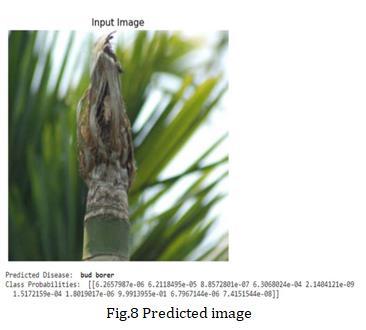
A thorough test is conducted on our own dataset to evaluate the system's capability. The 1200 photos that were gathered for the suggested method included several Arecanutplantdiseases.FollowingRESNETmodeltraining, the observed accuracy was 97.5 percent. Images and location areinputs used to identify diseases and choose suitable measures.The model identifies the disease and highlights the need for action with regard to Areca nut plants.TheoutputofthemodelinKaggleisshownbelowFig 8 RESNET model-Kaggle. The model will determine the disease's name and the likelihood ofeach possibility after receivinganimage.
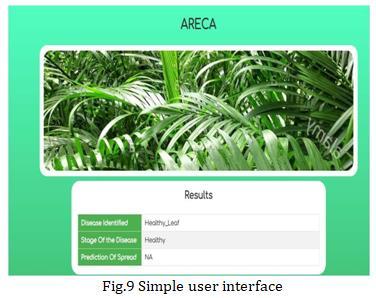
The websiteshown in Fig.9 allows us to uploadan image andreceive results regarding the disease that the model hasdiagnosed.
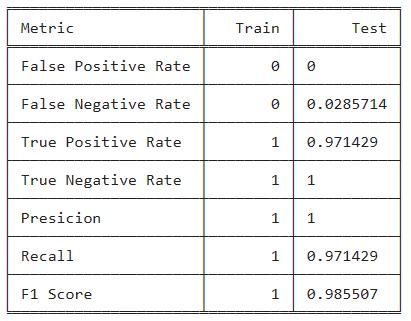
The testing of accuracy of the model is done using confusion matrix. Using confusion matrix, the standard matriceslikePrecision(P),Recall(R)andF-measure(F)is used to measure the accuracy and performance of the model.
As per literature survey previous research had shown thatuse of various deep learning models for detection of diseasesbut they were focusing on a particular disease. Thisworkfocusesondetectingmanydiseaseswithgreater accuracyusingRes-Netmodel.ThereasonforusingRe-Net is that it has skipping connections so that the vanishing gradientproblemisremovedwhichincreasestheaccuracy of the detection. This helps the Arecanut farmers in early detectionof diseases so that they can be pre-prepared and this helpsthem to reduce their yieldloss. This model has achieved the accuracy of 97.5 percent which can achievegoodresult.Thiswork canbe extended further for other various diseases of Arecanut and other crops also. Thismodelcanbemadeassoftwaresothatfarmerscanget accesstoit.
M.K.H.P.DhanujaKC,“ArecaNutDiseaseDetectionusing ImageProcessingTechnology,”ISSN,2022.
[1] AkshayS,AshwinHegde,“Detectionandclassification of areca nut diseases”, ISBN: 978-1-6654-2867-5, 2021.
[2] M. D. R. a. P. S, “Image Processing based Areca nut DiseasesDetectionUsingCNNModel,”ISSN,2022.
[3] K. T. P. H. S. U. D. A. D. Anilkumar M G, “Detectionof Diseases in Areca nut Using Convolutional Neural Networks,”ISSN,2021.
International Research Journal of Engineering and Technology (IRJET) e-ISSN: 2395-0056
Volume: 11 Issue: 05 | May 2024 www.irjet.net p-ISSN: 2395-0072
[4] P. S. A. K. B. R. P. a. A. M. Balipa, “Arecanut Disease Detection Using CNN and SVM Algorithms,” InternationalConference on Artificial Intelligence and Data Engineering (AIDE), no. 10.1109/AIDE57180.2022.10060130, pp. 01- 04, 2022.
[5] P. S. V. K. M. B. U. P. B. P. B. Mallikarjuna, “Multi‐gradient‐direction based deep learning model for arecanutdiseaseidentification,”IET,2022.
[6] N.P.K.A.S.A.MohammedKhalidKaleema,“AModern Approach for Detection of Leaf Diseases UsingImage ProcessingandMLBasedSVMClassifier,”TURCOMAT, 2021.s
[7] M. S. K. L. Vinod Kanan, “Arecanut Yield Disease Forecast using IoT and Machine Learning,” IJSREAT, 2021.
2024, IRJET | Impact Factor value: 8.226 | ISO 9001:2008