
International Research Journal of Engineering and Technology (IRJET) e-ISSN: 2395-0056
Volume: 11 Issue: 05 | May 2024 www.irjet.net p-ISSN: 2395-0072
International Research Journal of Engineering and Technology (IRJET) e-ISSN: 2395-0056
Volume: 11 Issue: 05 | May 2024 www.irjet.net p-ISSN: 2395-0072
Gayatri kanwade1 , Vansh Koli2 , Prof.Vijaykumar Shep3, Saish Purankar4, Vaishnav Shende5
*1,2,3,4,5Department Of Mechanical Engineering MIT School Of Engineering, MIT-ADT University Pune, Maharashtra, India.
Abstract - This paper presents a project focused on developing a deep learning model for classifying the diverse hand gestures used in sign language fingerspelling. The classification algorithm is trained using MNIST image data, with testing conducted on a varied dataset comprising realtime static photos. Deep learningtechniquesfromTensorFlow, Keras, and machine learning libraries such as sklearn are employed, with the model based on Convolutional Neural Networks (CNN). The CNN model is pretrained using the MNIST dataset,anddataaugmentationtechniquesareapplied to enhance accuracy, resulting in 99.71% training accuracy and 100% testing accuracy.
Key Words: Sign Language Translation, Sign Language Recognition, Convolutional Neural Networks, Image Processing,DeepLearning
Communication with individuals who have hearing loss presentssignificantchallenges.Handgesturesarecommonly used by speech and hearing-impaired individuals for communication,creatingalanguagebarrierbetweenthem and non-impaired individuals. It is essential to develop systems capable of identifying various gestures and conveying information to the general population. Understanding sign language gestures can be difficult for manyindividuals,andfindinginterpreterswhenneededcan bechallenging.Toaddressthisissue,aprospectivesolution isproposedtotranslatehandpositionsandgesturesfrom signlanguageinreal-time.Thissolutioninvolvesanopensourcewebapplicationaccessibleonanydeviceequipped withacameratocapturehandpositionsandmotions.
We explored various machine learning and deep learning techniques, including Support Vector Machines (SVM), Logistic Regression, K-nearest neighbors (KNN), and Convolutional Neural Networks (CNN), for sign language detection.OurinvestigationrevealedthatCNNisthemost effective technique for constructing a sign language recognitionmodel.Thismodelistrainedonstandardhand gesturesusedintheSignLanguagesystem,whichfacilitates communication for individuals with speech impairments. However, due to the complexity and diversity of these gestures,manypeoplefindthemchallengingtounderstand, leadingtocommunicationbarriersbetweenindividualswith andwithoutspeechimpairments.
Whilethereisconsiderableongoingresearchincomputer vision,particularlyfueledbyadvancementsindeeplearning, therehasbeenlimitedexplorationintogesturerecognition inSignLanguage.Ourpaperaimstoestablishabaselinefor SignLanguagegestureidentificationanddevelopamodelto enhance communication for individuals with speech impairments.
In the paper titled "The Application of Deep Learning in ComputerVision"byQ.Wu,Y.Liu,Q.Li,S.Jin,andF.Li[1], theauthorsprovideanoverviewofdeeplearningconcepts anddiscussvariouscommonlyusedalgorithmsincomputer vision.Theyalsoexaminethecurrentresearchlandscapein computervision,withafocusontheprevalentapplicationsof deeplearninginthefield.
In the paper titled "Generalizing the Hough Transform to Detect Arbitrary Shapes" by D. Ballard [2], the Hough transformisintroducedasamethodfordetectingcurvesby exploiting the duality between points on a curve and the parametersdefiningthatcurve.Initiallyrestrictedtobinary edgeimages,subsequentworkgeneralizedtheapproachto detect some analytic curves in grey-level images, such as lines, circles, and parabolas. This involved establishing a mappingbetweenpicturespaceandHoughtransformspace, enablingthedetectionofinstancesofspecificshapeswithin animage.
Thepaper"DistinctiveImageFeaturesfromScale-Invariant Key points" by D. G. Lowe [3] presents an approach for extracting invariant features from images, facilitating accuratematchingacrossdifferentviewpointsofobjectsor scenes.Themethodalsodiscussesutilizingthesefeaturesfor object recognition, starting with individual feature comparisonsagainstadatabaseofrecognizedobjectsusinga rapidnearest-neighbormethod.
Inthepapertitled"HandGestureRecognitionUsingOtsu's Method"byV.Bhavana,G.M.SuryaMouli,andG.V.Lakshmi Lokesh[4],theauthorsproposeamethodforaccuratehand motion recognition using computers and Arduino devices. The system involves preprocessing, segmentation, feature extraction, pixel shifting, and classification of RGB images capturedbyalaptopcamera.Otsu'ssegmentationtechnique isappliedtosegmentthecollectedRGBimagesintograyscale imagesandsegmentthemintodistinctregions.
International Research Journal of Engineering and Technology (IRJET) e-ISSN: 2395-0056
Volume: 11 Issue: 05 | May 2024 www.irjet.net p-ISSN: 2395-0072
In"AnImageLocalizationSystemBasedonGradientHough Transform" by Y. Liu, J. Zhang, and J. Tian [5], the authors develop a system for automatic target localization in computer vision applications, particularly focusing on industrialcontrolscenarios.ThesystemutilizestheGradient Hough Transform for circular device detection and localization to address mechanical deviation issues. The process involves picture preprocessing, edge extraction, circledetection,centerlocalization,deviationcalculation,and feedback.
Finally, in "A Review of Hand Gesture and Sign Language RecognitionTechniques"byM.J.Cheok,Z.Omar,andM.H. Jawar[6],theauthorsdiscussthesignificanceofhandgesture recognitioninvariousapplications,particularlyinenhancing human-machineinteractionandfacilitatingcommunication. The paper provides a comprehensive analysis of current advances in hand gesture and sign language recognition systems, covering data collection, pre-processing, segmentation,featureextraction,andclassificationstages.It alsoaddressesthechallengesandlimitationsfacedbygesture recognition research, with a focus on sign language recognition.
In the paper titled "Multi-sensor Data Fusion for Sign LanguageRecognitionBasedonDynamicBayesianNetwork andConvolutionalNeuralNetwork"byQ.Xiao,Y.Zhao,and W. Huan [7], a novel architecture for sign language recognition (SLR) is proposed, leveraging Convolutional Neural Networks (CNN) and Dynamic Bayesian Networks (DBN). This architecture incorporates multi-sensor fusion, utilizingaMicrosoftKinectasacost-effectiveRGB-Dsensor for human-computer interaction. Initially, color and depth videos are captured with the Kinect, and then CNN is employed to extract features from the image sequences. Subsequently,theDBNreceivesobservationdataintheform of color and depth feature sequences, achieving optimal recognitionratesfordynamicisolatedsignlanguagethrough graphmodelfusion.
Inthepapertitled"3DSignLanguageRecognitionwithJoint DistanceandAngularCodedColorTopographicalDescriptor ona2-StreamCNN"byE.K.Kumar,P.V.V.Kishore,M.T.K. Kumar, and D. A. Kumar [8], the authors address the challenging task of 3D sign language recognition, a prominentprobleminhumanactionrecognition(HAR).They proposeamethodthatutilizes3Djointlocationinformation overtimetocharacterizesignsin3Dvideos.Specifically,a topographicaldescriptoriscreatedusingcolor-codedjoints basedoncalculatedjointdistancesandangles.
Inthepapertitled"WearableComputersforSignLanguage Recognition" by J. Wu and R. Jafari [9], a real-time sign languagerecognition(SLR)systemisintroducedtoconvert gesturesofdeafindividualsintotextandvoice.Thissystem employs surface electromyography (sEMG) and inertial measurementunits(IMU)assensorsfordetectinghandand
armmotions,effectivelycapturingsigns.Awearablesystem isproposed,integratingdatafromsEMGsensorsandinertial sensorsforreal-timerecognitionofAmericanSignLanguage (ASL).Featureselectionisperformedusinganinformation gain-based strategy, and the effectiveness of various classificationalgorithmsisevaluatedonfrequentlyusedASL signs.
Inthepapertitled"IndianSignLanguageGestureRecognition usingImageProcessingandDeepLearning"byNeelKamal Bhagat, Y. Vishnusai, and G. N. Rathna [10], the authors address the communication challenges faced by speechimpaired individuals in India by focusing on Indian Sign Language (ISL) gesture recognition. They highlight the complexityofISL gesturesandthelimitedresearch inthis area.TheirworkaimstoestablishabaselineforISLgesture identification and develop a model to improve communicationforspeech-impairedindividuals,leveraging advancesincomputervisionanddeeplearning.
In the paper titled "Deep Learning for Sign Language Recognition: Current Techniques Benchmark and Open Issues" by M. Al-Qurishi, T.Khalid, and R. Souissi [11], the necessity for the development of local-level sign language recognition (SLR) techniques is emphasized due to the widespread presence of deaf individuals. Through a comprehensiveanalysisofmachine/deeplearningmethods and approaches published between 2014 and 2021 for automatedsignlanguagerecognition,itwasconcludedthat existing systems require conceptual classification to effectivelyprocesstheavailabledata.Consequently,thefocus was directed towards identifying components common to most sign language detection techniques. This paper comparestheirrespectiveadvantagesandlimitationswhile providing a comprehensive framework for researchers. Furthermore,thestudyunderscoresthesignificanceofinput modalitiesinthisdomain,suggestingthatrecognitionbased onacombinationofdatasources,includingvision-basedand sensor-basedchannels,outperformsunimodalapproaches.
In the paper titled "Real-Time American Sign Language Recognition Using Desk and Wearable Computer-Based Video"byThadStarner,JoshuaWeaver,andAlexPentland [12],signlanguagesexhibithighlystructuredsetsofgestures, witheachgesturepossessingadistinctmeaning.Contextand grammarrulesfurtheraidinmanageableidentification.The preferredmodeofcommunicationformostdeafindividuals intheUnitedStatesisAmericanSignLanguage(ASL),which encompassesapproximately6,000gesturesforsimplewords andfingerspellingformorecomplexwordsorpropernouns. Despitethediversityofgestures,completewordsconstitute the bulk of ASL communication, facilitating signed conversations to progressata pace comparable to spoken dialogues.
International Research Journal of Engineering and Technology (IRJET) e-ISSN: 2395-0056
Volume: 11 Issue: 05 | May 2024 www.irjet.net p-ISSN: 2395-0072
A. ImageProcessing
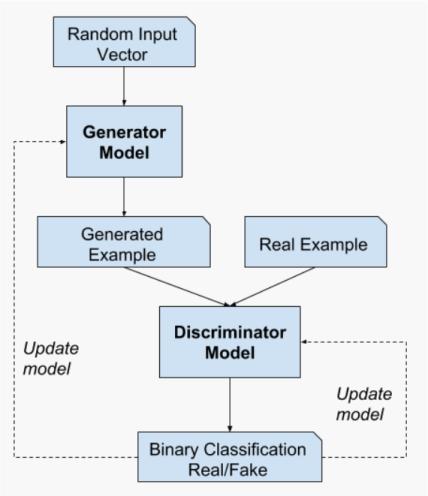
Imageprocessingisamethodusedtoperformspecific operationsonanimagewiththeaimofenhancingitor extractingpertinentinformationfromit.Itfallsunder the domain of signal processing, where an image is treated as input, and the output may consist of an improved image or features and characteristics associatedwiththeoriginalimage.
B. VideoProcessing
The process of capturing video frames from a camera involves several stages: preprocessing the frames, identifying indicators within them, and applying machine learning models to interpret the signals into text or voice. The procedure commences with positioning the camera and capturing images. To enhanceprecision,theframesundergopreprocessing, involving resizing, cropping, and conversion to grayscale. Subsequently, sign detection is conducted usingcomputervisiontechniquessuchashandtracking anddetection.Machinelearningmodelstrainedonsign language datasets are then employed to translate the recognized signs. The output is presented to the user through eithera graphical orcommand-lineinterface. Withthegoalofenhancingcommunicationbetweensign language users and non-users, this project aims to
deliverareliableandaccuratesystemforsignlanguage recognitionandtranslation.
DeepLearning
DeepLearning,a branchof MachineLearning,utilizes artificialneuralnetworks(ANNs)withnumerouslayers, commonlyreferredtoasdeepneuralnetworks(DNNs). These networks are modeled after the structure and functionalityofthehumanbrainandareengineeredto glean insights from extensive datasets through unsupervisedorsemi-supervisedlearningtechniques.
International Research Journal of Engineering and Technology (IRJET) e-ISSN: 2395-0056
Volume: 11 Issue: 05 | May 2024 www.irjet.net p-ISSN: 2395-0072
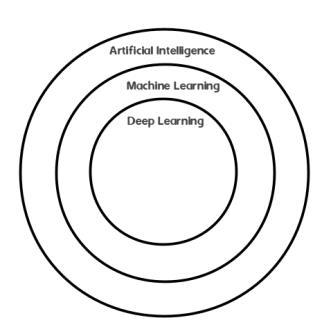
-2:SetsofArtificialintelligence.
D. ConvolutionalNeuralNetworkCNNs
Convolutional Neural Networks (CNNs) represent a specialized form of FNNs tailored for image and video recognition endeavors. These networks possess the capability to autonomously extract features from images, rendering them highly adept at tasks like image classification,objectdetection,andimagesegmentation.The layerscomprisingafundamentalCNNmodelaredelineated inthefigurebelow:
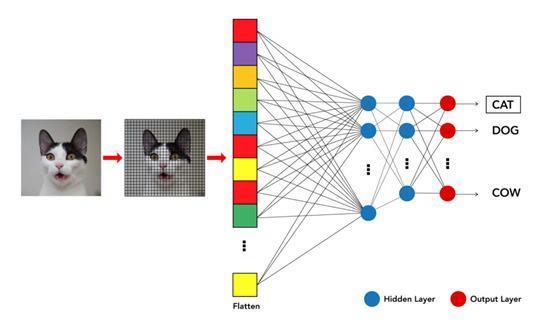
-3:CNNmodelexample
4. METHODLOGY
Sign language is a visual form of communication characterizedbythreeprimarycomponents:
a) Fingerspelling: This involves spelling out words letterbyletter,aswellasemployinghandgestures toconveythemeaningofwords.
b) Word-level signvocabulary:Recognitionofentire words or alphabets through video classification, involvingdynamicinput.
c) non-manual features: These encompass facial expressions,tonguemovements,mouthshapes,and body positions, which contribute to the overall expressionandunderstandinginsignlanguage.
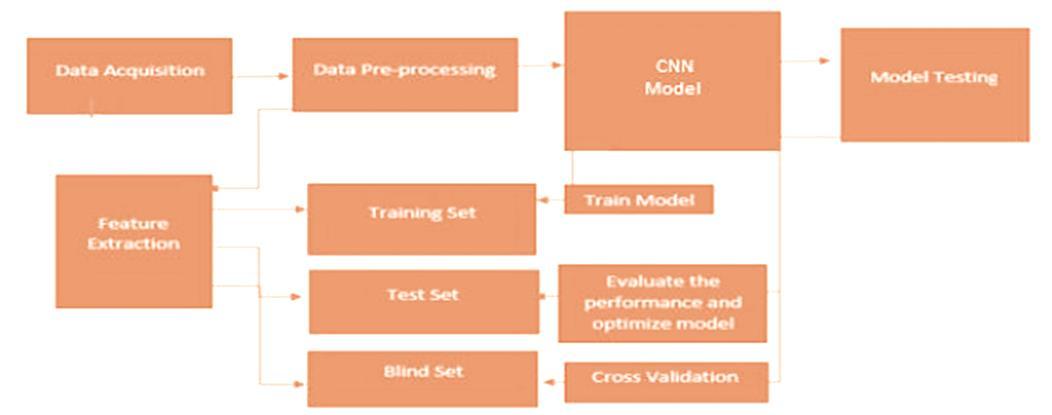
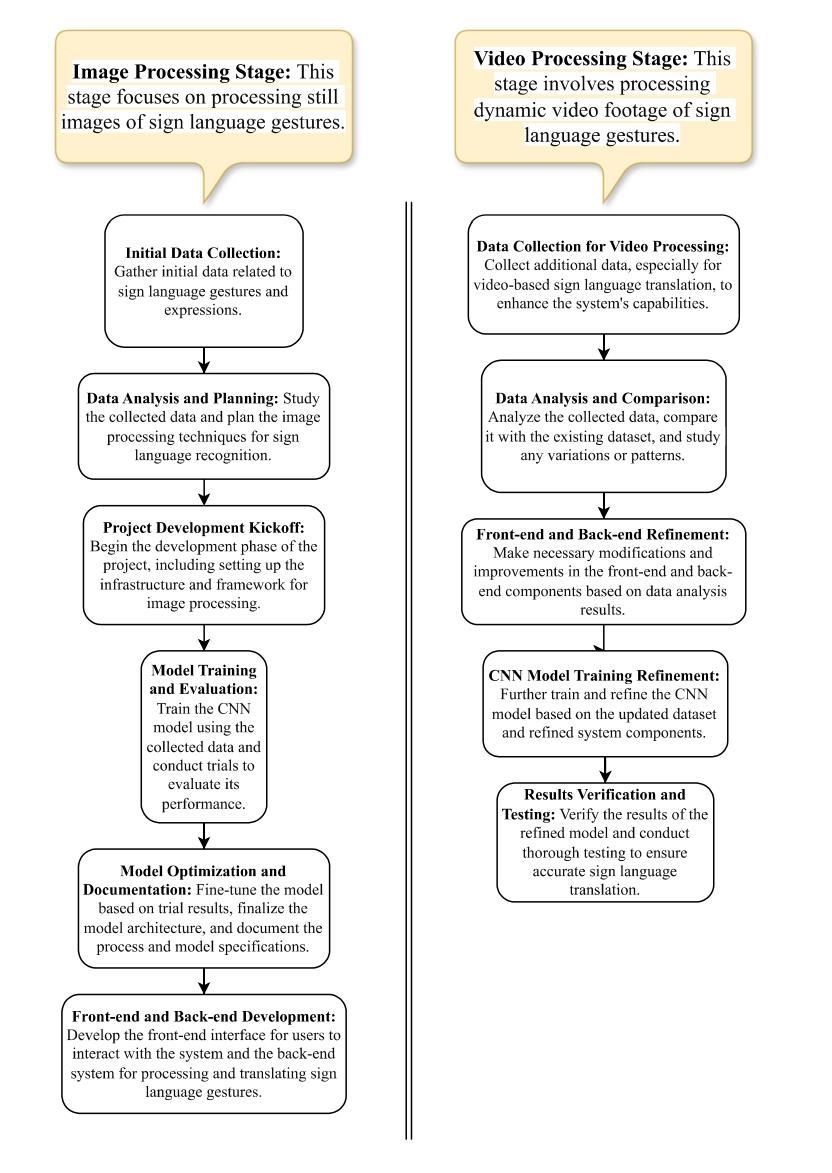
Flow- Chart -1:Processflow.
Data Collection & Pre-Processing
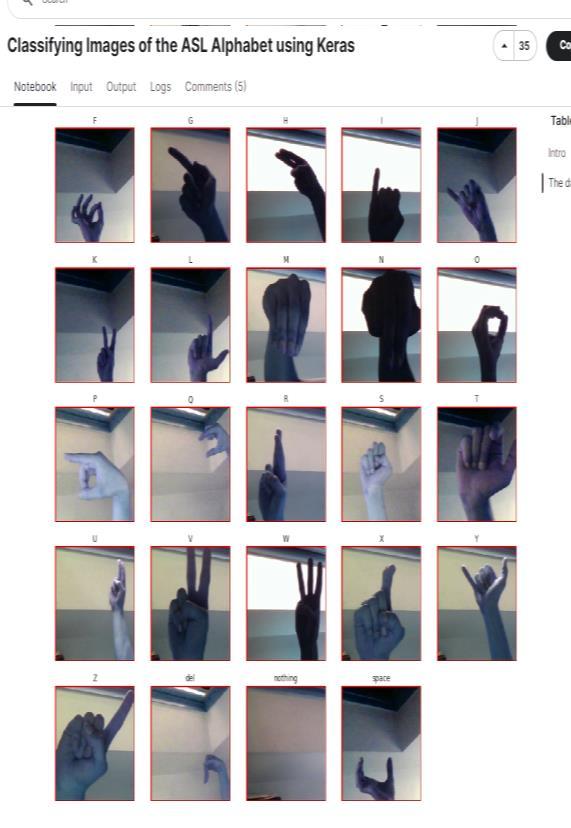
ASL Alphabet Dataset: -
The ASL Alphabet data set provides 87,000 images of the ASL alphabet. This notebook aims to take a first step at building a model around that data that is sufficiently versatiletohandleimagesoftheASLalphabetwithdifferent handsanddifferentbackgrounds.Thisprojectispartofan assignmentfortheW207AppliedMachineLearningclassin the UC Berkeley MIDS (Master of Information and Data Science)program.
Additionally, the test dataset comprises only 29 images, intendedtopromotetheutilizationofreal-worldtestimages. DatasetDownloadLink: https://www.kaggle.com/code/danrasband/classifyingimages-of-the-asl-alphabet-using-keras/notebook
Thereare2datasetsutilizedinthisnotebook:
ASLAlphabet(TestData)-Thisdatasetisthebasis forthemodel.
ASLAlphabetTest(Realtimedata)-Thisdataset was made specifically for validating the model
International Research Journal of Engineering and Technology (IRJET) e-ISSN: 2395-0056
Volume: 11 Issue: 05 | May 2024 www.irjet.net p-ISSN: 2395-0072
createdusingtheabovedatasetandisintendedto be used to improve the feature engineering and modelingprocesstomakeitmoreversatilein"the wild"withlesscontrivedimages.
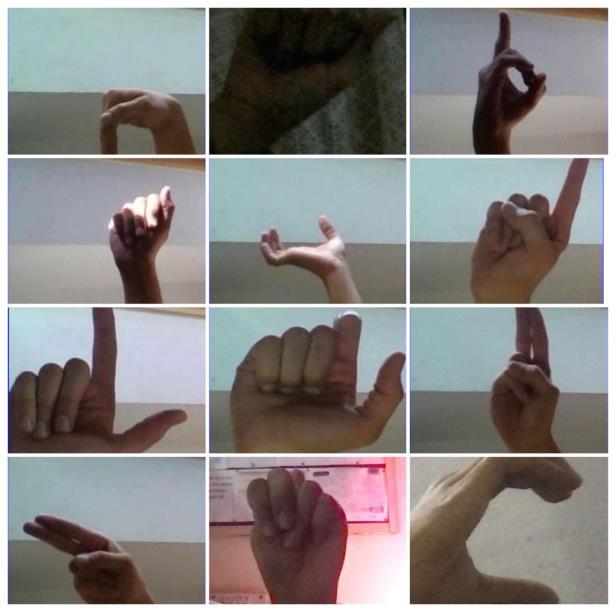
-5:ActualDataSetforRealtimeCalculations
Model Training and Evaluation
a) CNNModel:-
WetraintheCNNmodelusingtheaugmentedtrainingdata. Themodellearnstoidentifypatternsamongthepixelsfrom thediversetrainingsamplesandassociatesthemwitheach
2024, IRJET | Impact Factor value: 8.226 |
labeledletter.Subsequently,weevaluatetheperformanceof themodelusingthetestingset.
b) ModelEvaluation:To evaluate the model, we use confusion matrixes, classificationreports,andmetricssuchasaccuracyandf1 score,etc.
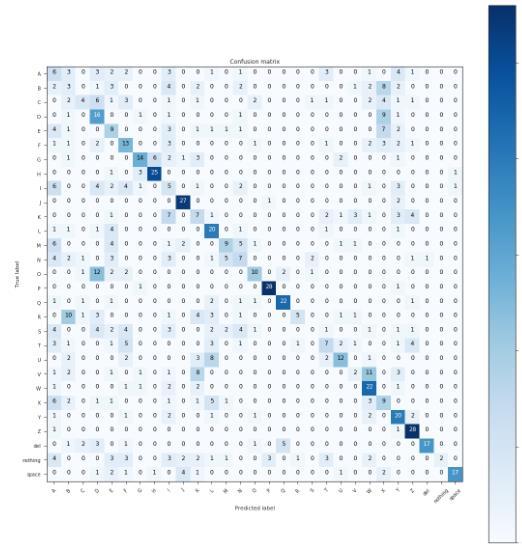
Thegeneratedheatmapisbasedontheconfusionmatrixof themodel,illustratingtheaccuracyofpredictionsforeach sample.
International Research Journal of Engineering and Technology (IRJET) e-ISSN: 2395-0056
Volume: 11 Issue: 05 | May 2024 www.irjet.net p-ISSN: 2395-0072
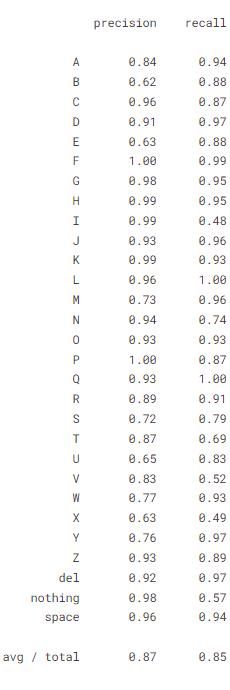

Theclassificationreportprovidesdetailedmetricssuchas precision, recall, f1-score, and support for each of the 25 classes in which the model was trained. These metrics evaluatetheaccuracyofpredictionsmadebythemodelon the test set data. Additionally, the report includes overall accuracy,aswellasmacroandweightedaverages,toprovide acomprehensiveassessmentofthemodel'sperformance.
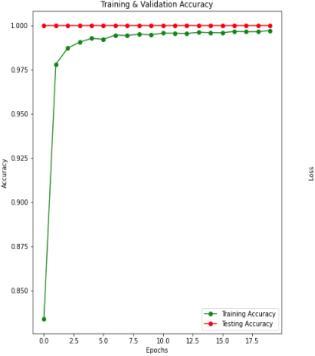
-1:Trainingaccuracychart
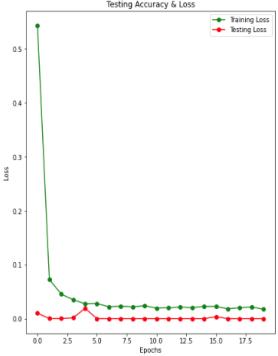
-2:Testingaccuracychart
Thechartsaboveillustratethetrainingandtestingaccuracy resultsacrossepochs.

International Research Journal of Engineering and Technology (IRJET) e-ISSN: 2395-0056
Volume: 11 Issue: 05 | May 2024 www.irjet.net p-ISSN: 2395-0072
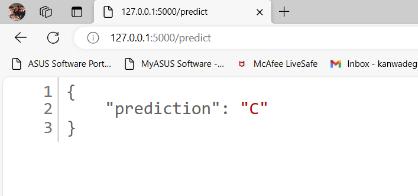
A CNN model proves to be an effective approach for identifyingandinterpretinghandgesturesinsignlanguage. Trained on a vast dataset of sign language images, the machine demonstrates successful recognition of various motions.Evaluationofthemodel'sperformanceusingatest datasetyield.promisingresults,showcasinghighaccuracy and minimal error rates. This concept holds potential for enhancing communication for individuals with hearing impairmentsandimprovingaccessibilityforsignlanguage users.However,it'sessentialtoacknowledgethatthemodel may not be flawless and might encounter challenges in recognizing or interpreting all movements accurately in every scenario. Continuous development and research effortsarenecessarytoenhancethemodel'sperformance and accuracy further. Overall, the model achieves 100% TrainingAccuracyand99.99%TestingAccuracy.
The potential for sign language translation using Convolutional Neural Networks (CNNs) is extensive and promising. Researchers can explore various avenues to enhancethistechnology,suchasdevelopingmoreextensive sign language datasets, refining real-time translation capabilities,integratingmulti-modaldata,accommodating regional sign language variations, and expanding to encompassdifferentsignlanguages.Theseendeavorsaimto improve the accuracyandefficacyofCNN modelsfor sign language translation, with significant implications for education,communication,andcross-culturalinteractions. Asadvancementsinmachinelearningandcomputervision continue,CNN-basedsignlanguagetranslationtechnology has the capacity to bridge the communication barrier betweendeafandhearingcommunities,fosteringinclusivity andaccessibilityforall.
WeextendoursinceregratitudetoProf.VijaykumarShepfor serving as our project mentor and providing invaluable guidanceateverystageoftheproject.
WealsowishtoconveyourappreciationtoProf.Dr.Sachin Pawar, Head of the Department, for his steadfast encouragement and support throughout the project's progression.
Lastly,weexpressourthankstoallprojectstakeholderswho contributedtotheplanningandexecutionoftheproject.The successofthe"SignLanguageTranslationsystembasedon CNNmodel"projectwouldnothavebeenpossiblewithout theextensivesupportofallindividualsdirectlyorindirectly involvedinitsimplementation.
[1]Q. Wu,Y.Liu,Q.Li,S.Jin,andF.Li,”Theapplication of deeplearningincomputervision,”2017ChineseAutomation Congress(CAC),Jinan,2017,pp.6522-6527.
[2]D.Ballard,GeneralizingtheHoughtransformtodetect arbitrary shapes, Pattern Recognition, vol. 13, no. 2, pp. 111122,1981.
[3] D. G. Lowe, Distinctive Image Features from ScaleInvariant Key points, International Journal of Computer Vision,vol.13,no.2,pp.111122,1981.
[4]V.Bhavana,G.M.SuryaMouliandG.V.LakshmiLokesh,” HandGestureRecognitionUsingOtsu’sMethod,”2017IEEE InternationalConferenceonComputationalIntelligenceand ComputingResearch(ICCIC),Coimbatore,2017,pp.1-4.
[5]Y.Liu,J.Zhang,andJ.Tian,Animagelocalizationsystem basedongradientHoughtransform,MIPPR2015:Remote SensingImageProcessing,GeographicInformationSystems, andOtherApplications,2015.
[6]M.J.Cheok,Z.Omar,andM.H.Jaward,‘‘Areviewofhand gesture and sign language recognition techniques,’’ Int. J. Mach.Learn.Cybern.,vol.10,no.1,pp.131–153,Jan.2019.
[7]Q.Xiao,Y.Zhao,andW.Huan,‘‘Multi-sensordatafusion for sign language recognition based on dynamic Bayesian network and convolutional neural network,’’ Multimedia ToolsAppl.,vol.78,no.11,pp.15335–15352,Jun.2019.
[8]E. K. Kumar,P. V. V. Kishore, M. T. K. Kumar, and D. A. Kumar,‘‘3Dsignslanguagerecognitionwithjointdistance and angular coded color topographical descriptor on a 2–stream CNN,’’ Neurocomputing, vol. 372, pp. 40–54, Jan. 2020.
[9] J. Wu and R. Jafari, ‘‘Wearable computers for sign language recognition,’’ in Handbook of Large-Scale Distributed Computing in Smart Healthcare. Cham, Switzerland:Springer,2017,pp.379–401
[10] Neel Kamal Bhagat, Y. Vishnusai and G. N. Rathna, "Indian Sign Language Gesture Recognition using Image
International Research Journal of Engineering and Technology (IRJET) e-ISSN: 2395-0056
Processing and Deep Learning", 2019 Digital Image Computing:TechniquesandApplications(DICTA).
[11]M.Al-Qurishi,T.KhalidandR.Souissi,"Deeplearning for sign language recognition: Current techniques benchmarks and open issues", IEEE Access, vol. 9, pp. 126917-126951,2021.
[12]ThadStarner,JoshuaWeaver,andAlexPentland,"Realtime American sign language recognition using desk and wearable computer-based video", IEEE Transactions on patternanalysisandmachineintelligence,vol.20,no.12,pp. 1371-1375,1998
Volume: 11 Issue: 05 | May 2024 www.irjet.net p-ISSN: 2395-0072 © 2024, IRJET | Impact Factor value: 8.226 | ISO 9001:2008
|